
Lesson 3 Corporate Bank Transactions in Securities Markets
Lesson 3 Corporate Bank Transactions in Securities Markets
A. Bank Investment in Government Securities Markets • Approximately 23% of U. S. bank assets are invested in securities • Most banks will carry off-balance sheet instruments, sometimes listed in footnotes. • Most bank securities investment is in money market securities, low-risk, high-denomination (typically), highly liquid debt instruments with terms to maturity less than a single year
B. Bank Issues and Sales of Securities • Federal Funds markets allow depository institutions to borrow excess reserves from one others to meet Federal Reserve requirements. The rate at which these loans are extended is the Federal Funds Rate. • Negotiable Certificates of Deposit (a type of Jumbo C. D. ) are tradable CDs with denominations exceeding $100, 000. • A Banker's Acceptance is originated when a bank assumes a client’s financial responsibility. • Repurchase Agreements (Repos) are issued by financial institutions acknowledging the sale of assets and a subsequent agreement to re-purchase at a higher price. • The counterparty transaction is a reverse repo.
U. S. Treasury Securities and Markets • The United States Treasury is the largest issuer of debt securities in the world. • In 2016, the U. S. Treasury (technically, the Fed) auctioned $8. 1 trillion in Treasury instruments. • Treasury issues are practically default risk-free because they are fully backed by the full faith and credit of the U. S. government, which has substantial resources due to its ability: – To tax citizens – To create money – To borrow more money. • More than half the marketable Treasury debt outstanding as of 2000 was in the form of notes, while bills and bonds each represented about 20 percent.
Types of Treasury Issues • Treasury Bills typically mature in less than one year (13, 26 or 52 weeks). These issues are sold as pure discount debt securities, meaning that their purchasers receive no explicit interest payments. • Strips are issued through the U. S. Treasury’s Separate Trading of Registered Interest and Principle Securities (STRIPS) program. Strips are portfolios of single payment instruments sold by the Treasury in blocks with varying maturities. • Treasury Notes (T-Notes) have maturities ranging from one to ten years and make semi-annual interest payments. • Treasury Bonds (T-Bonds) typically range in maturity from ten to thirty years and make semi-annual interest payments. These TBonds are frequently callable, meaning that the Treasury maintains an option to repurchase them from investors at a stated price. • Treasury inflation-protected Securities (TIPS) • Floating Rate Notes (FRNs)
Agency and Government Sponsored Enterprise Issues • The U. S. Federal Government sponsors agencies and enterprises that enable it to make funds available for policy-related functions.
FNMA • The Federal National Mortgage Association (FNMA or Fannie Mae) • Created in 1938 to expand the flow of money to housing markets during the Great Depression, spur investment into real estate, improve employment to help enable people to purchase homes. • Functions of Fannie Mae are to purchase, hold, and sell FHA-insured (and, after World War II, VA Administration-insured loans) mortgage loans originated by private lenders. • Privatized in 1968, FNMA had shares traded on the New York Stock Exchange and other security holders as well.
FNMA and Mortgage-Backed Securities • FNMA facilitates capital acquisition in the mortgage industry through the creation of mortgage-backed securities. • These portfolios of mortgage-backed securities are also called pass- through securities. • FNMA can obtain money directly from the U. S. Treasury should it need to do so.
GNMA • The Government National Mortgage Association (GNMA or Ginnie Mae) • Established 1968 as a “spin off” of FNMA, is a corporation owned by the U. S. Federal Government. • GNMA guarantees mortgage-backed securities for the FHA, VA and other agency mortgage issues. • Many mortgages issued by these agencies are targeted towards particular groups such as families in lower-income brackets or veterans, and experience relatively high default rates. • The mortgages issued by these agencies are full faith and credit instruments.
B. Bank Issues and Sales of Securities • • • Federal Funds markets Repurchase Agreements (Repos) Negotiable Certificates of Deposit Letters of Credit and Banker's Acceptances Commercial Paper
Federal Funds Markets • Federal Funds markets allow depository institutions to borrow from one another to meet Federal Reserve requirements. – Excess reserves of one bank are loaned to other banks for satisfaction of reserve requirements. – The rate at which these loans are extended is generally referred to as the Federal Funds Rate.
Repurchase Agreements • Repurchase Agreements (Repos) are issued by financial institutions acknowledging the sale of assets and a subsequent agreement to repurchase at a higher price in the near term. • This agreement is essentially the same as a collateralized short-term loan.
Negotiable Certificates of Deposit • Negotiable Certificates of Deposit (a type of Jumbo C. D. ) is a tradable depository institution C. D. with a denomination or balance exceeding $100, 000. • The amounts by which jumbo C. D. s exceed $250, 000 are not FDIC insured.
Letters of Credit and Banker's Acceptances • Letters of Credit and Banker's Acceptances are originated when a bank accepts responsibility for assuming some financial responsibility on behalf of a client. • Because the bank is likely to be a good credit risk, acceptances are usually marketable. • In some respects, a letter of credit (though less so than a banker’s acceptance) is similar to a post-dated cashier’s check written by a bank. • A Banker's Acceptance is an instrument originated when a bank accepts the unconditional responsibility for making payment on a client's loan or assuming some other financial responsibility on behalf of the client.
C. Structured Finance and Derivative Instruments • Structured finance activities involve the pooling of debts and subsequent issuance of a prioritized and collateralized structures of claims known as tranches against these pools. • Repackaging and pooling of these original instruments allows redistribution of risks. • During the late 1990 s and early part of this century, use of structured lending increased dramatically, bolstered by favorable ratings by credit agencies, leading to overvaluation and a subsequent bubble and crash.
Loan Sales • A loan sale occurs when the originator of the loan, sells the loan to another financial institution. • Loan sales are said to occur either with or without recourse.

Securitized Instruments • Securitized instruments or asset backed securities (ABS) are created from pools of debt instruments, restructured to be marketed as securities. • A mortgage-backed security is a securitized instrument whose payoffs draw from instruments that are backed by a pool of mortgages. • Asset-backed securities (ABS) trade on: – – – student loans auto loans credit card receivables trade receivables aircraft and equipment leases home equity loans.
Pass-through Instruments • A pass-through instrument is said to “pass through” mortgage payments to secondary market investors. • Mortgage pools are packaged by the sponsor into bankruptcy-remote entities called special purpose vehicles (SPVs) • The sponsor arranges for servicing of the passthrough securities • the mortgage servicer collects payments from the pool and passes them through to the owners of the pass-through securities.
Collateralized Debt Obligations • Collateralized debt obligation (CDO): a security by which specified events determine the payouts associated with multiple classes of holders of debt-backed assets. – a series of mortgage-backed securities is placed into an SPV – repackaged the series into tranches – each offering a series of payments that depend on conditions – For example: • Tranche 1: the senior tranche • Tranche 2: the mezzanine tranche • Tranche 3: the subordinate tranche
Interest Rate Derivatives • Interest rate derivatives are used by banks and other institutions to manage their interest rate exposure and to generate fee revenues. • A total return swap is a tradable contract that provides for one party to make a payment based on the total economic performance of a specified asset in exchange for some other fixed or variable cash flow. – Suppose, for example, that a bank enters into a one-year total return swap in which the client pays the SOFR on the notional amount of $1, 000 in exchange for a fixed rate of 5%. – Suppose that after one year the SOFR is 4%. The bank pays the client $10, 000 = ($1, 000 (5% - 4%)).
Caps • A cap is a call option or a series of call options on interest rates that grants its owner the right to receive a payment or payments at the end of each period in which the interest rate exceeds the striking price (cap rate). – If the relevant market interest rate were to rise above the cap rate, the writer of the cap compensates the option owner by the notional amount times the difference between the market rate and the cap rate. – The cap can provide for a maximum interest rate that a variable rate borrower would have to pay on a loan.
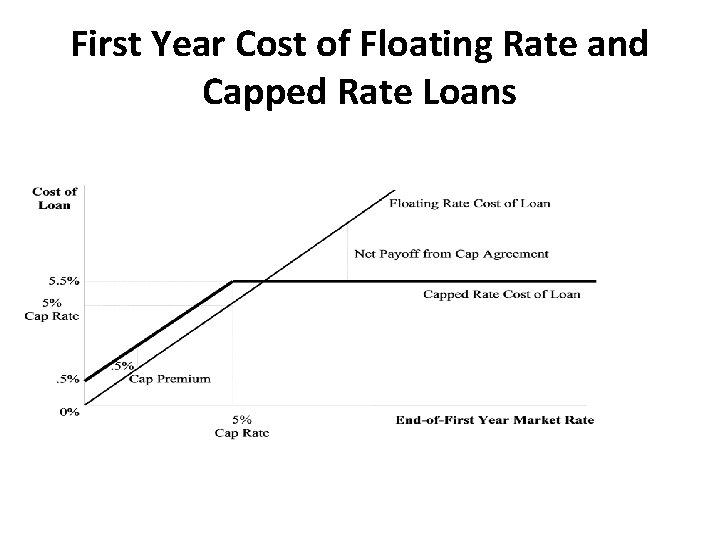
First Year Cost of Floating Rate and Capped Rate Loans
Floors • A floor is a put option or a series of put options on interest rates that grants its owner the right to receive a payment or payments at the end of each period in which the relevant market interest rate is exceeded by the striking price (floor rate). – If the relevant market interest rate were to drop below the floor rate, the writer of the floor compensates the option owner. – The floor can provide for a minimum interest rate that a variable rate lender would receive on a loan.
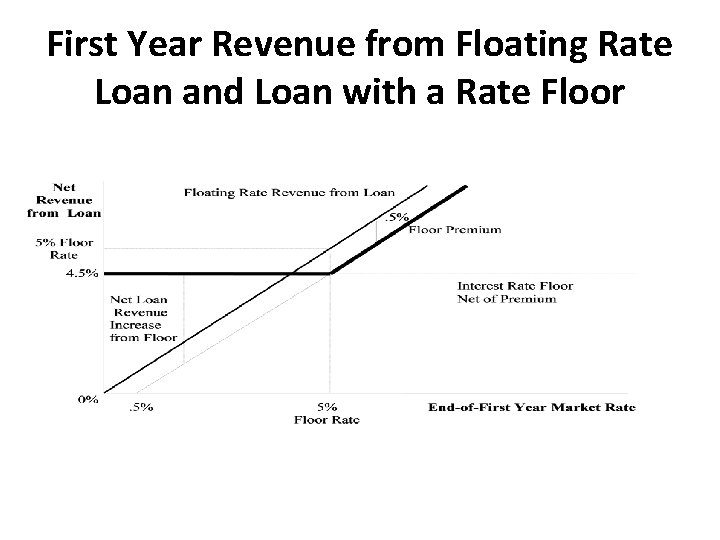
First Year Revenue from Floating Rate Loan and Loan with a Rate Floor
Collars • A collar is essentially the combination of a long position in a cap (a call on the market rate) along with a short position in a floor (a put on the market rate). • In effect, the institution implementing the interest rate collar writes a floor on a given interest rate, which requires her to make a payment if interest rates drop below the floor rate. • Should the market interest rate increase above the rate of the cap, the cap owner will have the option to purchase the underlying instrument (take a payment) at the exercise price.

First Year Cost of Floating Rate and Collared Loans
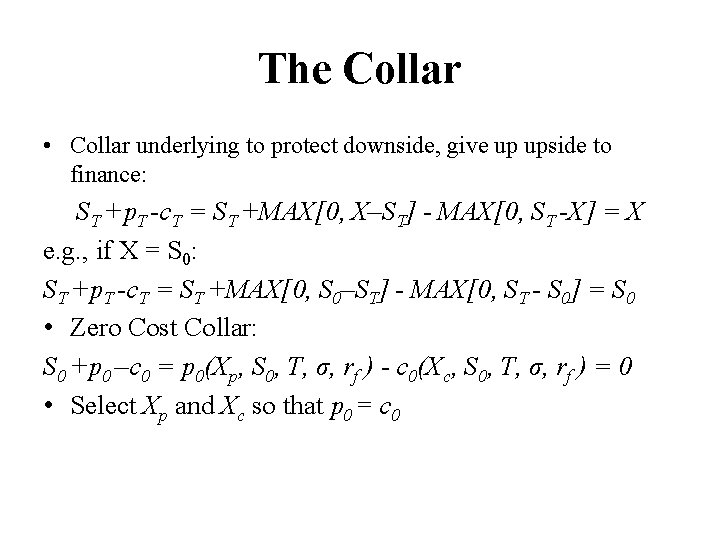
The Collar • Collar underlying to protect downside, give up upside to finance: ST +p. T -c. T = ST +MAX[0, X–ST] - MAX[0, ST -X] = X e. g. , if X = S 0: ST +p. T -c. T = ST +MAX[0, S 0–ST] - MAX[0, ST - S 0] = S 0 • Zero Cost Collar: S 0 +p 0 –c 0 = p 0(Xp, S 0, T, σ, rf ) - c 0(Xc, S 0, T, σ, rf ) = 0 • Select Xp and Xc so that p 0 = c 0

D. Eurocurrency Issues • Eurodollars are freely convertible dollar-denominated time deposits outside the United States. • Eurocredits (e. g. , Eurodollar Credits) are bank loans denominated in currencies other than that of the country where the loan is extended. Their rates are generally tied to LIBOR (the London Interbank Offered Rate) and U. S. rates. • Eurobonds are generally underwritten, bearer bonds denominated in currencies other than that of the country where the loan is extended. • Euro-Commercial paper is the term given to short-term (usually less than six months) notes issued by large, particularly "credit-worthy" institutions. Most commercial paper is not underwritten. The notes are generally very liquid (much more so than syndicated loans) and most are denominated in dollars. They are usually pure discount instruments. • Euro-Medium Term Notes (EMTN's) are interest-bearing instruments usually issued in installments. Most are not underwritten. Eurobonds are generally underwritten, bearer bonds denominated in currencies other than that of the country where the loan is extended.
- Slides: 28