
Lesson 3 Audio Coding and Standards Models Techniques
![LPC and Parametric Coding x(n) n=1~m Diff [x(n), s(n)] Minimum Encoder Decoder a 1,](https://slidetodoc.com/presentation_image_h2/0ef9368d4ed7e8b84dc71fabab78d422/image-11.jpg "LPC and Parametric Coding x(n) n=1~m Diff [x(n), s(n)] Minimum Encoder Decoder a 1,")
- Slides: 31
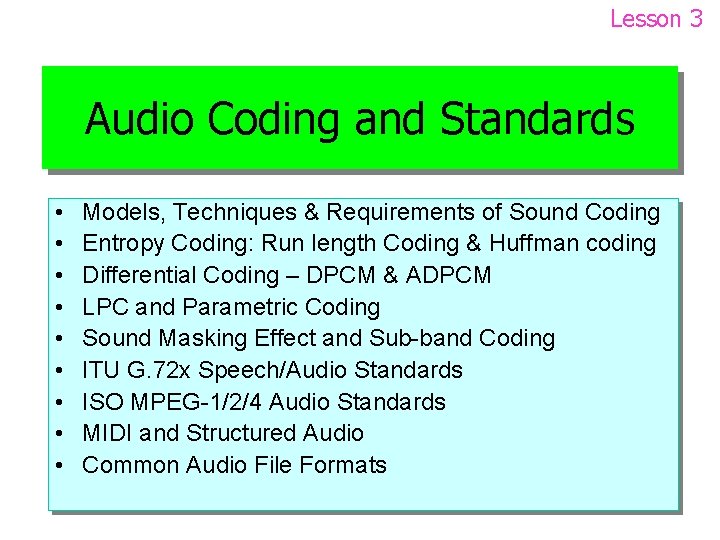
Lesson 3 Audio Coding and Standards • • • Models, Techniques & Requirements of Sound Coding Entropy Coding: Run length Coding & Huffman coding Differential Coding – DPCM & ADPCM LPC and Parametric Coding Sound Masking Effect and Sub-band Coding ITU G. 72 x Speech/Audio Standards ISO MPEG-1/2/4 Audio Standards MIDI and Structured Audio Common Audio File Formats
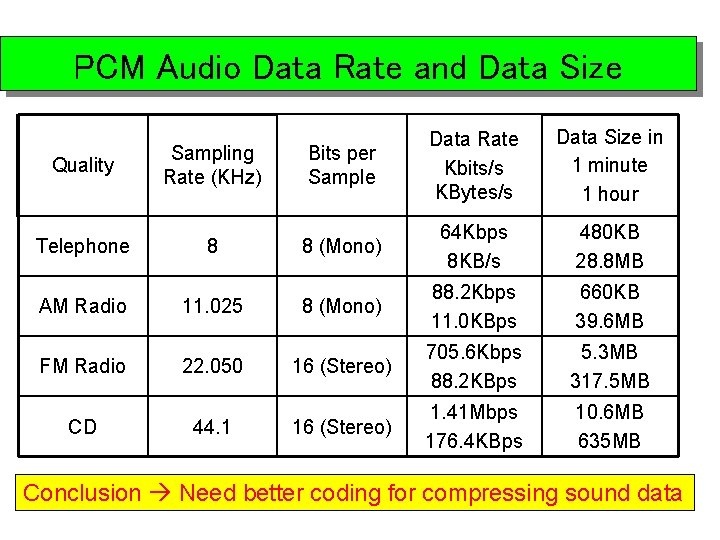
PCM Audio Data Rate and Data Size Quality Telephone AM Radio FM Radio CD Sampling Rate (KHz) 8 11. 025 22. 050 44. 1 Bits per Sample Data Rate Kbits/s KBytes/s Data Size in 1 minute 1 hour 8 (Mono) 64 Kbps 8 KB/s 480 KB 28. 8 MB 8 (Mono) 88. 2 Kbps 11. 0 KBps 660 KB 39. 6 MB 16 (Stereo) 705. 6 Kbps 88. 2 KBps 5. 3 MB 317. 5 MB 16 (Stereo) 1. 41 Mbps 176. 4 KBps 10. 6 MB 635 MB Conclusion Need better coding for compressing sound data
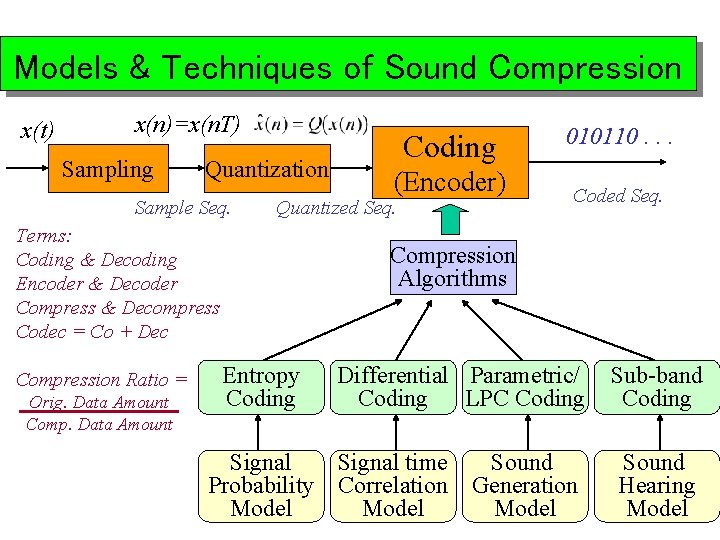
Models & Techniques of Sound Compression x(t) x(n)=x(n. T) Sampling Quantization Sample Seq. Orig. Data Amount Comp. Data Amount (Encoder) Quantized Seq. Terms: Coding & Decoding Encoder & Decoder Compress & Decompress Codec = Co + Dec Compression Ratio = Coding 010110. . . Coded Seq. Compression Algorithms Entropy Coding Differential Parametric/ Coding LPC Coding Signal time Sound Probability Correlation Generation Model Sub-band Coding Sound Hearing Model
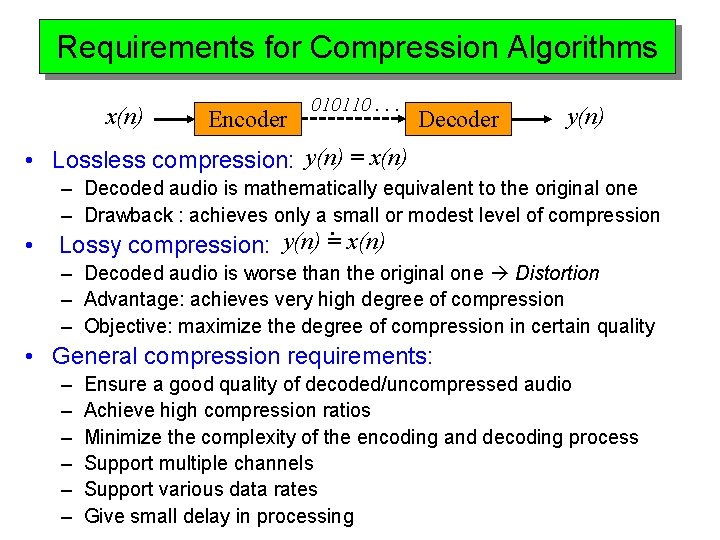
Requirements for Compression Algorithms x(n) Encoder 010110. . . Decoder y(n) • Lossless compression: y(n) = x(n) – Decoded audio is mathematically equivalent to the original one – Drawback : achieves only a small or modest level of compression • . Lossy compression: y(n) = x(n) – Decoded audio is worse than the original one Distortion – Advantage: achieves very high degree of compression – Objective: maximize the degree of compression in certain quality • General compression requirements: – – – Ensure a good quality of decoded/uncompressed audio Achieve high compression ratios Minimize the complexity of the encoding and decoding process Support multiple channels Support various data rates Give small delay in processing
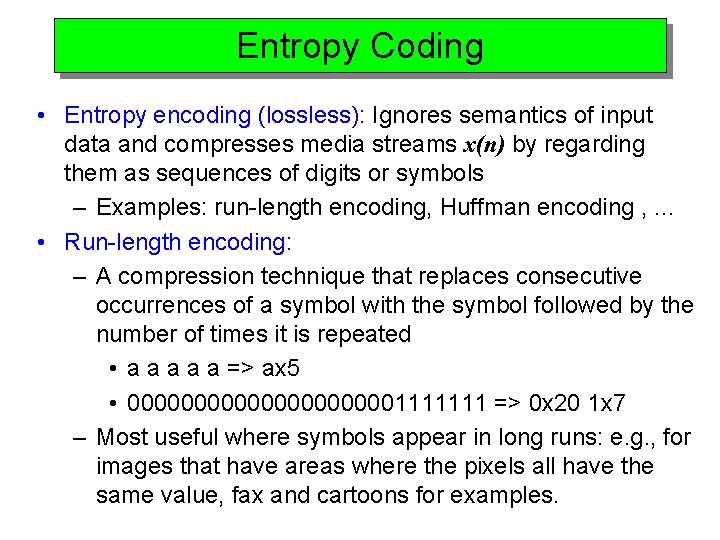
Entropy Coding • Entropy encoding (lossless): Ignores semantics of input data and compresses media streams x(n) by regarding them as sequences of digits or symbols – Examples: run-length encoding, Huffman encoding , . . . • Run-length encoding: – A compression technique that replaces consecutive occurrences of a symbol with the symbol followed by the number of times it is repeated • a a a => ax 5 • 00000000001111111 => 0 x 20 1 x 7 – Most useful where symbols appear in long runs: e. g. , for images that have areas where the pixels all have the same value, fax and cartoons for examples.
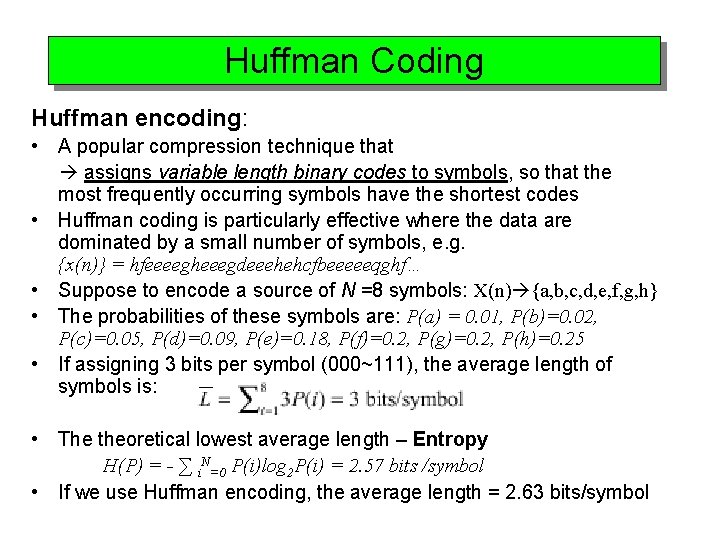
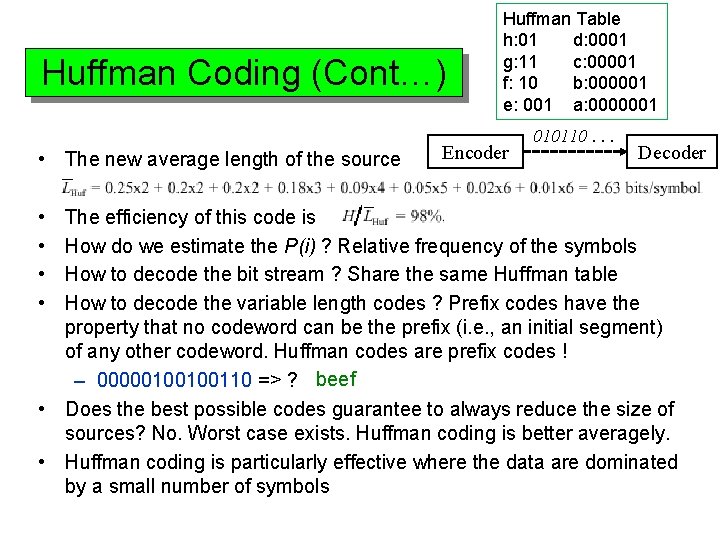
Huffman Coding Huffman encoding: • A popular compression technique that assigns variable length binary codes to symbols, so that the most frequently occurring symbols have the shortest codes • Huffman coding is particularly effective where the data are dominated by a small number of symbols, e. g. {x(n)} = hfeeeegheeegdeeehehcfbeeeeeqghf… • Suppose to encode a source of N =8 symbols: X(n) {a, b, c, d, e, f, g, h} • The probabilities of these symbols are: P(a) = 0. 01, P(b)=0. 02, P(c)=0. 05, P(d)=0. 09, P(e)=0. 18, P(f)=0. 2, P(g)=0. 2, P(h)=0. 25 • If assigning 3 bits per symbol (000~111), the average length of symbols is: • The theoretical lowest average length – Entropy H(P) = - ∑ i. N=0 P(i)log 2 P(i) = 2. 57 bits /symbol • If we use Huffman encoding, the average length = 2. 63 bits/symbol
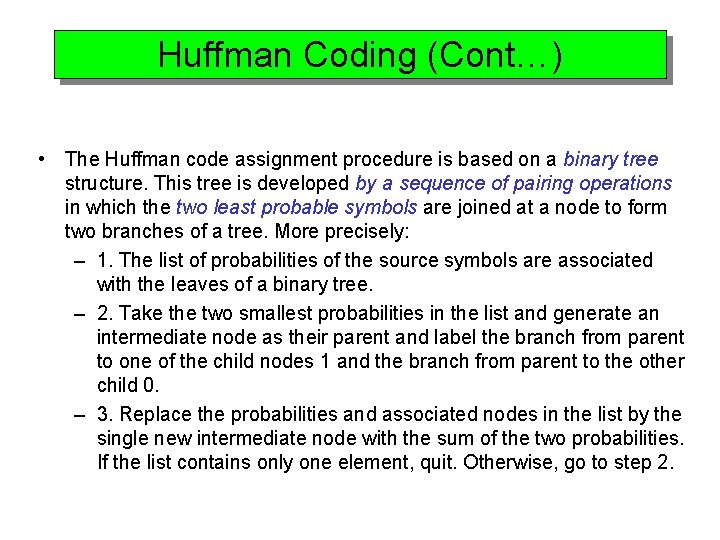
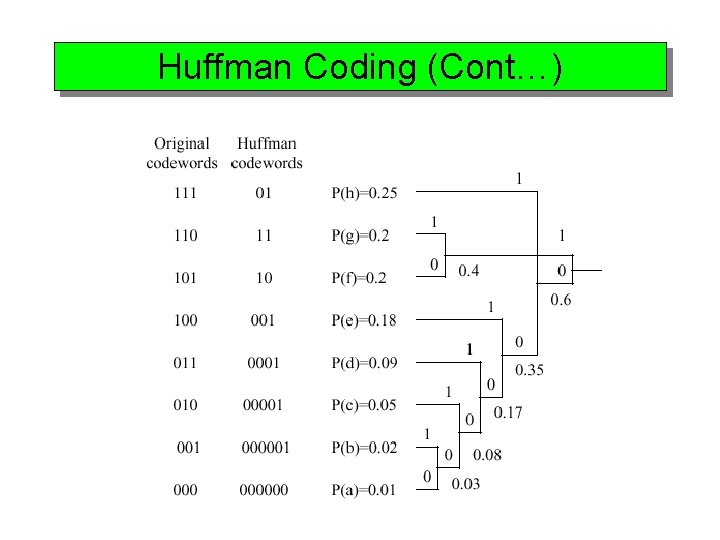
Huffman Coding (Cont…) • The Huffman code assignment procedure is based on a binary tree structure. This tree is developed by a sequence of pairing operations in which the two least probable symbols are joined at a node to form two branches of a tree. More precisely: – 1. The list of probabilities of the source symbols are associated with the leaves of a binary tree. – 2. Take the two smallest probabilities in the list and generate an intermediate node as their parent and label the branch from parent to one of the child nodes 1 and the branch from parent to the other child 0. – 3. Replace the probabilities and associated nodes in the list by the single new intermediate node with the sum of the two probabilities. If the list contains only one element, quit. Otherwise, go to step 2.
Huffman Coding (Cont…)
Huffman Coding (Cont…) • The new average length of the source • • Huffman Table h: 01 d: 0001 g: 11 c: 00001 f: 10 b: 000001 e: 001 a: 0000001 Encoder 010110. . . Decoder The efficiency of this code is How do we estimate the P(i) ? Relative frequency of the symbols How to decode the bit stream ? Share the same Huffman table How to decode the variable length codes ? Prefix codes have the property that no codeword can be the prefix (i. e. , an initial segment) of any other codeword. Huffman codes are prefix codes ! – 00000100100110 => ? beef • Does the best possible codes guarantee to always reduce the size of sources? No. Worst case exists. Huffman coding is better averagely. • Huffman coding is particularly effective where the data are dominated by a small number of symbols
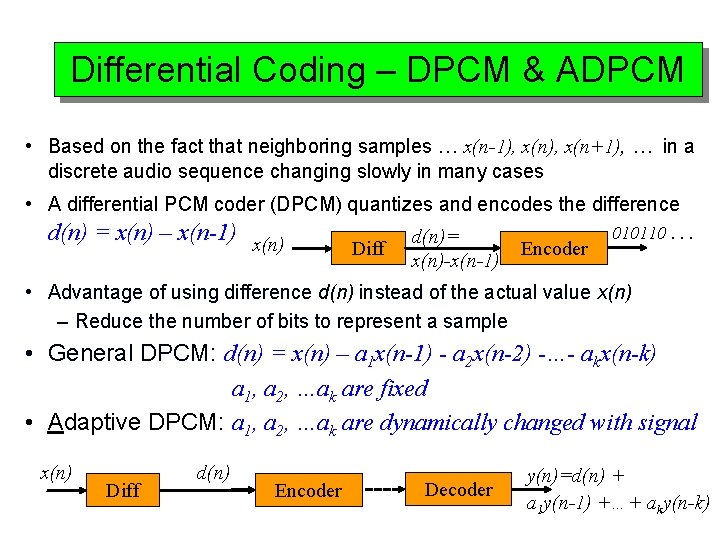
Differential Coding – DPCM & ADPCM • Based on the fact that neighboring samples … x(n-1), x(n+1), … in a discrete audio sequence changing slowly in many cases • A differential PCM coder (DPCM) quantizes and encodes the difference d(n) = x(n) – x(n-1) x(n) Diff d(n)= x(n)-x(n-1) Encoder 010110. . . • Advantage of using difference d(n) instead of the actual value x(n) – Reduce the number of bits to represent a sample • General DPCM: d(n) = x(n) – a 1 x(n-1) - a 2 x(n-2) -…- akx(n-k) a 1, a 2, …ak are fixed • Adaptive DPCM: a 1, a 2, …ak are dynamically changed with signal x(n) Diff d(n) Encoder Decoder y(n)=d(n) + a 1 y(n-1) +…+ aky(n-k)
LPC and Parametric Coding x(n) n=1~m Diff [x(n), s(n)] Minimum Encoder Decoder a 1, a 2, …ak, e(n) s(n) LPC (Linear Predictive Coding) • Based on the human utterance organ model s(n) = a 1 s(n-1) + a 2 s(n-2) +…+ aks(n-k) + e(n) • Estimate a 1, a 2, …ak and e(n) for each piece (frame) of speech • Encode and transmit/store a 1, a 2, …ak and type of e(n) • Decoder reproduce speech using a 1, a 2, …ak and e(n) - very low bit rate but relatively low speech quality Parametric coding: • Only coding parameters of sound generation model • LPC is an example where parameters are a 1, a 2, …ak , e(n) • Music instrument parameters: pitch, loudness, timbre, …
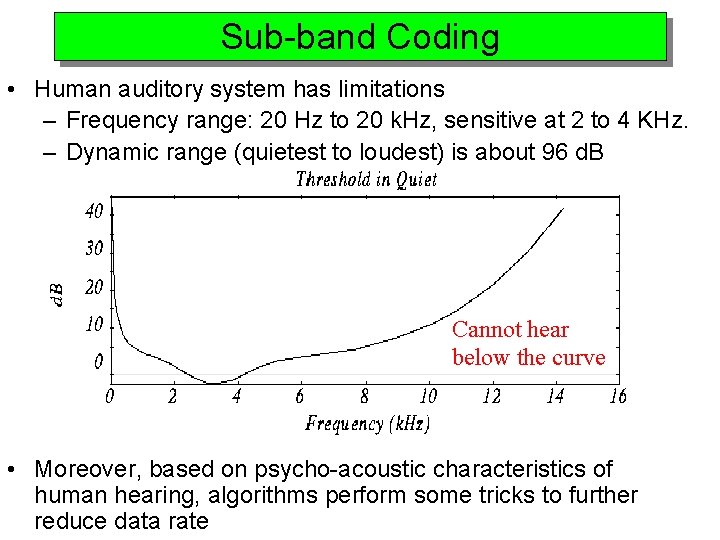
Sub-band Coding • Human auditory system has limitations – Frequency range: 20 Hz to 20 k. Hz, sensitive at 2 to 4 KHz. – Dynamic range (quietest to loudest) is about 96 d. B Cannot hear below the curve • Moreover, based on psycho-acoustic characteristics of human hearing, algorithms perform some tricks to further reduce data rate
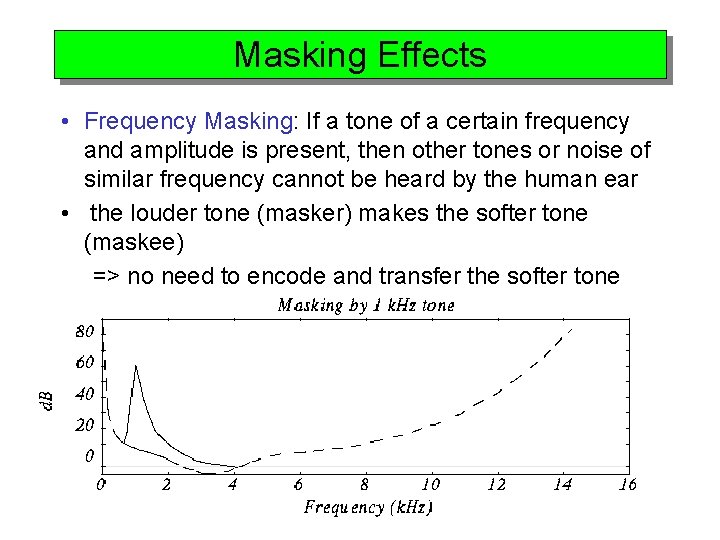
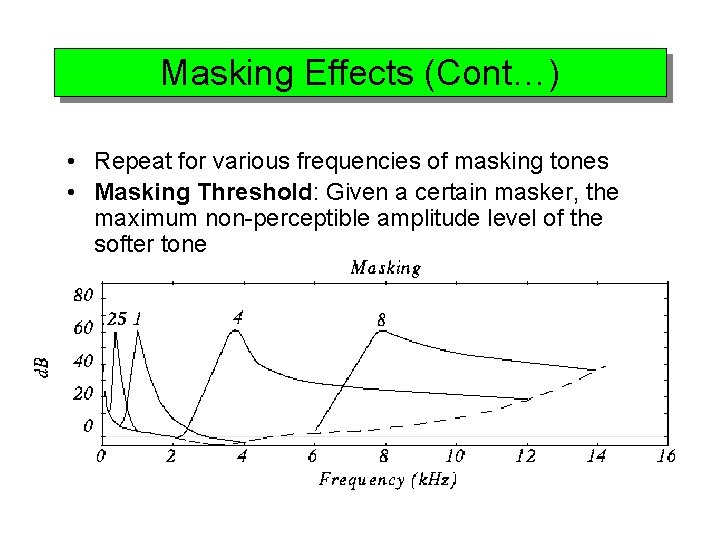
Masking Effects • Frequency Masking: If a tone of a certain frequency and amplitude is present, then other tones or noise of similar frequency cannot be heard by the human ear • the louder tone (masker) makes the softer tone (maskee) => no need to encode and transfer the softer tone
Masking Effects (Cont…) • Repeat for various frequencies of masking tones • Masking Threshold: Given a certain masker, the maximum non-perceptible amplitude level of the softer tone
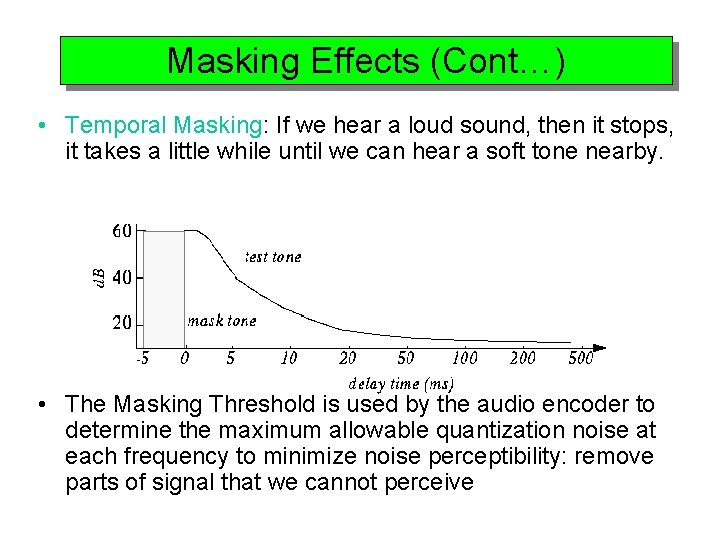
Masking Effects (Cont…) • Temporal Masking: If we hear a loud sound, then it stops, it takes a little while until we can hear a soft tone nearby. • The Masking Threshold is used by the audio encoder to determine the maximum allowable quantization noise at each frequency to minimize noise perceptibility: remove parts of signal that we cannot perceive
Speech Compression • Handling speech with other media information such as text, images, video, and data is the essential part of multimedia applications • The ideal speech coder has a low bit-rate, high perceived quality, low signal delay, and low complexity. • Delay – Less than 150 ms one-way end-to-end delay for a conversation – Processing (coding) delay, network delay – Over Internet, ISDN, PSTN, ATM, … • Complexity – Computational complexity of speech coders depends on algorithms – Contributes to achievable bit-rate and processing delay
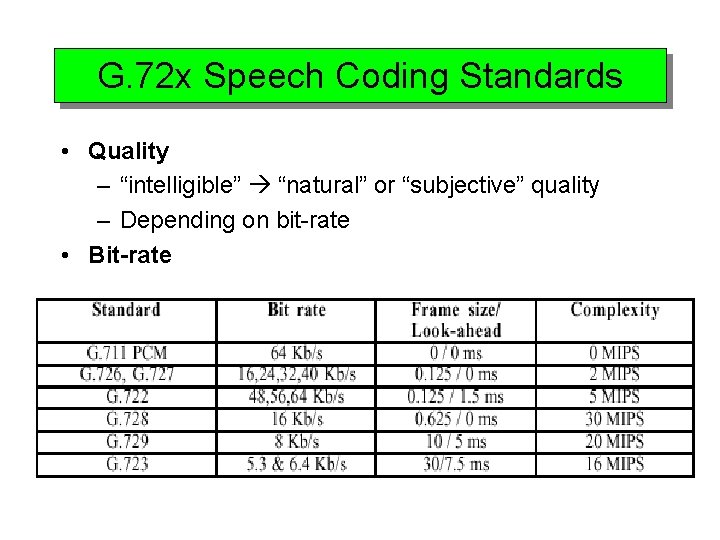
G. 72 x Speech Coding Standards • Quality – “intelligible” “natural” or “subjective” quality – Depending on bit-rate • Bit-rate
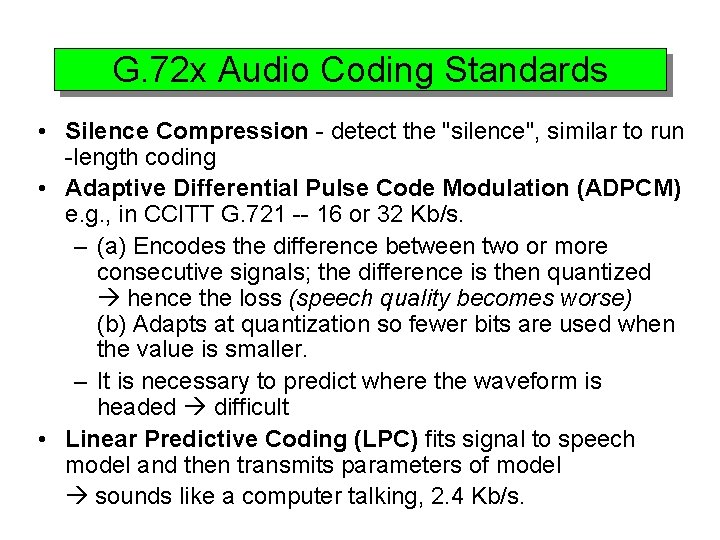
G. 72 x Audio Coding Standards • Silence Compression - detect the "silence", similar to run -length coding • Adaptive Differential Pulse Code Modulation (ADPCM) e. g. , in CCITT G. 721 -- 16 or 32 Kb/s. – (a) Encodes the difference between two or more consecutive signals; the difference is then quantized hence the loss (speech quality becomes worse) (b) Adapts at quantization so fewer bits are used when the value is smaller. – It is necessary to predict where the waveform is headed difficult • Linear Predictive Coding (LPC) fits signal to speech model and then transmits parameters of model sounds like a computer talking, 2. 4 Kb/s.
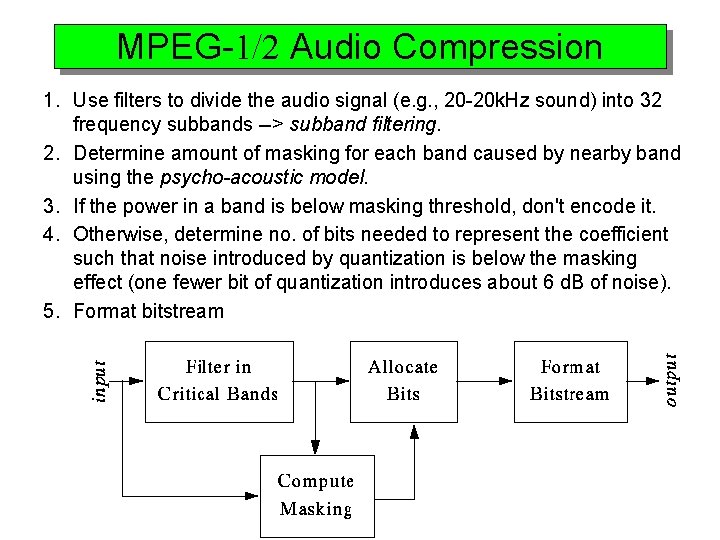
MPEG-1/2 Audio Compression 1. Use filters to divide the audio signal (e. g. , 20 -20 k. Hz sound) into 32 frequency subbands --> subband filtering. 2. Determine amount of masking for each band caused by nearby band using the psycho-acoustic model. 3. If the power in a band is below masking threshold, don't encode it. 4. Otherwise, determine no. of bits needed to represent the coefficient such that noise introduced by quantization is below the masking effect (one fewer bit of quantization introduces about 6 d. B of noise). 5. Format bitstream
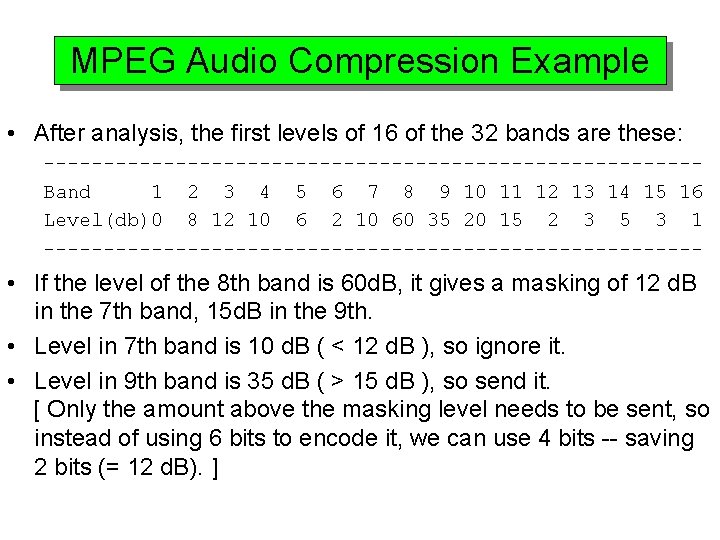
MPEG Audio Compression Example • After analysis, the first levels of 16 of the 32 bands are these: ---------------------------Band 1 2 3 4 5 6 7 8 9 10 11 12 13 14 15 16 Level(db)0 8 12 10 60 35 20 15 2 3 5 3 1 ---------------------------- • If the level of the 8 th band is 60 d. B, it gives a masking of 12 d. B in the 7 th band, 15 d. B in the 9 th. • Level in 7 th band is 10 d. B ( < 12 d. B ), so ignore it. • Level in 9 th band is 35 d. B ( > 15 d. B ), so send it. [ Only the amount above the masking level needs to be sent, so instead of using 6 bits to encode it, we can use 4 bits -- saving 2 bits (= 12 d. B). ]
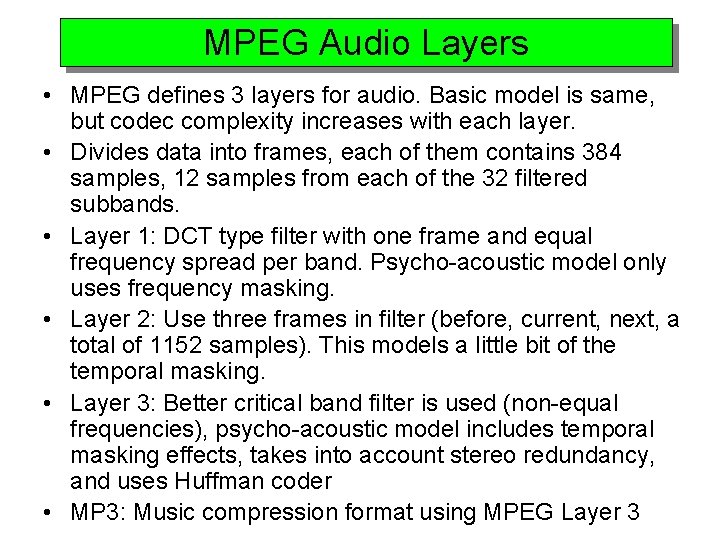
MPEG Audio Layers • MPEG defines 3 layers for audio. Basic model is same, but codec complexity increases with each layer. • Divides data into frames, each of them contains 384 samples, 12 samples from each of the 32 filtered subbands. • Layer 1: DCT type filter with one frame and equal frequency spread per band. Psycho-acoustic model only uses frequency masking. • Layer 2: Use three frames in filter (before, current, next, a total of 1152 samples). This models a little bit of the temporal masking. • Layer 3: Better critical band filter is used (non-equal frequencies), psycho-acoustic model includes temporal masking effects, takes into account stereo redundancy, and uses Huffman coder • MP 3: Music compression format using MPEG Layer 3
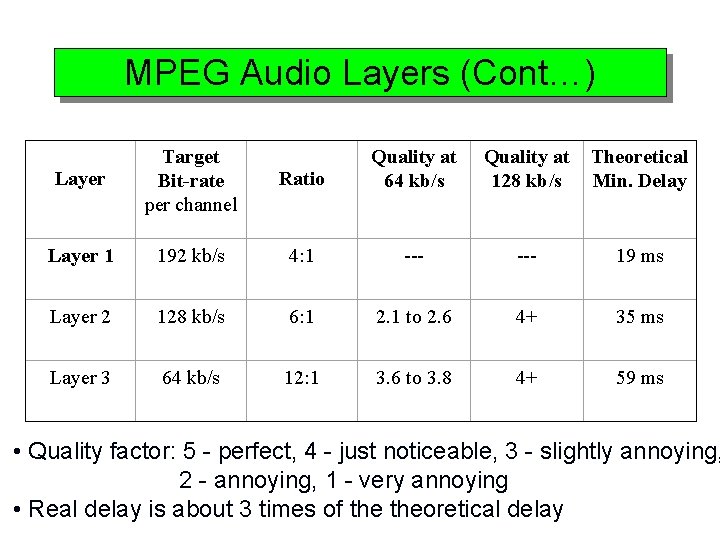
MPEG Audio Layers (Cont…) Layer Target Bit-rate per channel Ratio Quality at 64 kb/s Quality at 128 kb/s Theoretical Min. Delay Layer 1 192 kb/s 4: 1 --- 19 ms Layer 2 128 kb/s 6: 1 2. 1 to 2. 6 4+ 35 ms Layer 3 64 kb/s 12: 1 3. 6 to 3. 8 4+ 59 ms • Quality factor: 5 - perfect, 4 - just noticeable, 3 - slightly annoying, 2 - annoying, 1 - very annoying • Real delay is about 3 times of theoretical delay
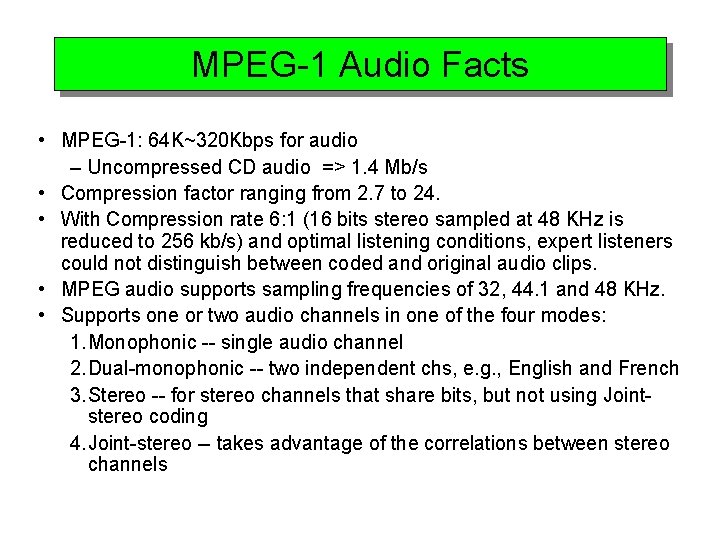
MPEG-1 Audio Facts • MPEG-1: 64 K~320 Kbps for audio – Uncompressed CD audio => 1. 4 Mb/s • Compression factor ranging from 2. 7 to 24. • With Compression rate 6: 1 (16 bits stereo sampled at 48 KHz is reduced to 256 kb/s) and optimal listening conditions, expert listeners could not distinguish between coded and original audio clips. • MPEG audio supports sampling frequencies of 32, 44. 1 and 48 KHz. • Supports one or two audio channels in one of the four modes: 1. Monophonic -- single audio channel 2. Dual-monophonic -- two independent chs, e. g. , English and French 3. Stereo -- for stereo channels that share bits, but not using Jointstereo coding 4. Joint-stereo -- takes advantage of the correlations between stereo channels
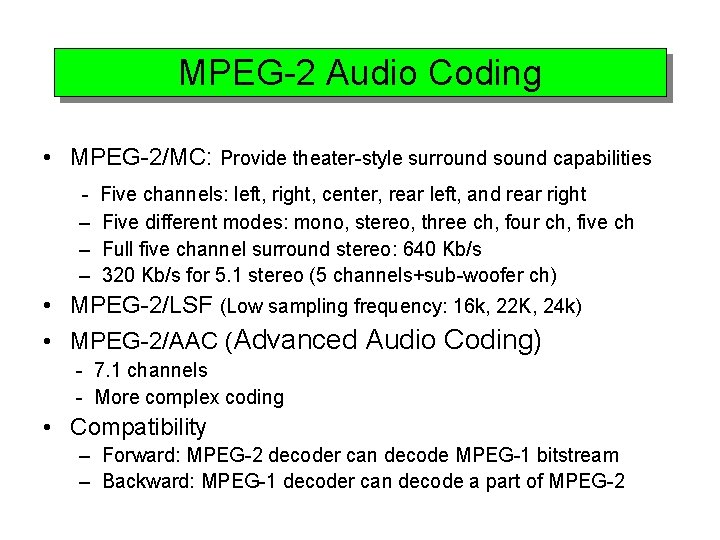
MPEG-2 Audio Coding • MPEG-2/MC: Provide theater-style surround sound capabilities – – – Five channels: left, right, center, rear left, and rear right Five different modes: mono, stereo, three ch, four ch, five ch Full five channel surround stereo: 640 Kb/s 320 Kb/s for 5. 1 stereo (5 channels+sub-woofer ch) • MPEG-2/LSF (Low sampling frequency: 16 k, 22 K, 24 k) • MPEG-2/AAC (Advanced Audio Coding) - 7. 1 channels - More complex coding • Compatibility – Forward: MPEG-2 decoder can decode MPEG-1 bitstream – Backward: MPEG-1 decoder can decode a part of MPEG-2
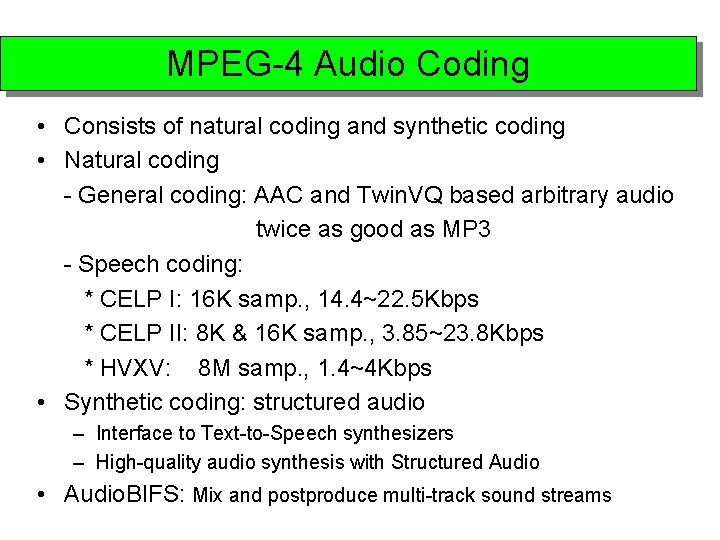
MPEG-4 Audio Coding • Consists of natural coding and synthetic coding • Natural coding - General coding: AAC and Twin. VQ based arbitrary audio twice as good as MP 3 - Speech coding: * CELP I: 16 K samp. , 14. 4~22. 5 Kbps * CELP II: 8 K & 16 K samp. , 3. 85~23. 8 Kbps * HVXV: 8 M samp. , 1. 4~4 Kbps • Synthetic coding: structured audio – Interface to Text-to-Speech synthesizers – High-quality audio synthesis with Structured Audio • Audio. BIFS: Mix and postproduce multi-track sound streams
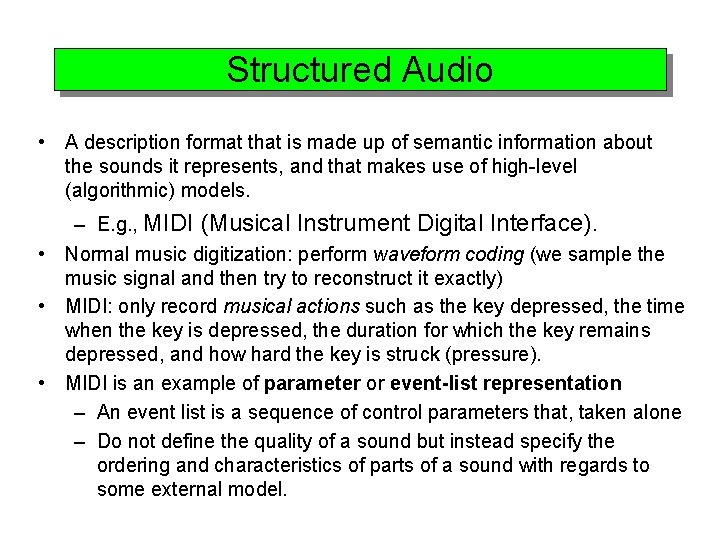
Structured Audio • A description format that is made up of semantic information about the sounds it represents, and that makes use of high-level (algorithmic) models. – E. g. , MIDI (Musical Instrument Digital Interface). • Normal music digitization: perform waveform coding (we sample the music signal and then try to reconstruct it exactly) • MIDI: only record musical actions such as the key depressed, the time when the key is depressed, the duration for which the key remains depressed, and how hard the key is struck (pressure). • MIDI is an example of parameter or event-list representation – An event list is a sequence of control parameters that, taken alone – Do not define the quality of a sound but instead specify the ordering and characteristics of parts of a sound with regards to some external model.
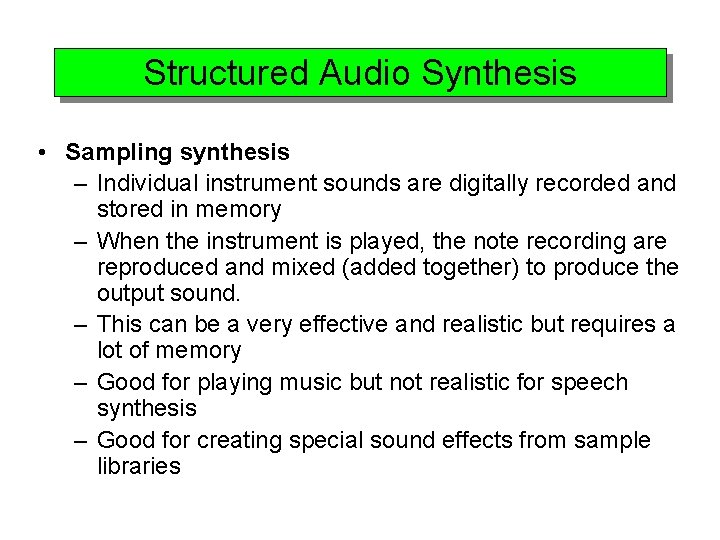
Structured Audio Synthesis • Sampling synthesis – Individual instrument sounds are digitally recorded and stored in memory – When the instrument is played, the note recording are reproduced and mixed (added together) to produce the output sound. – This can be a very effective and realistic but requires a lot of memory – Good for playing music but not realistic for speech synthesis – Good for creating special sound effects from sample libraries
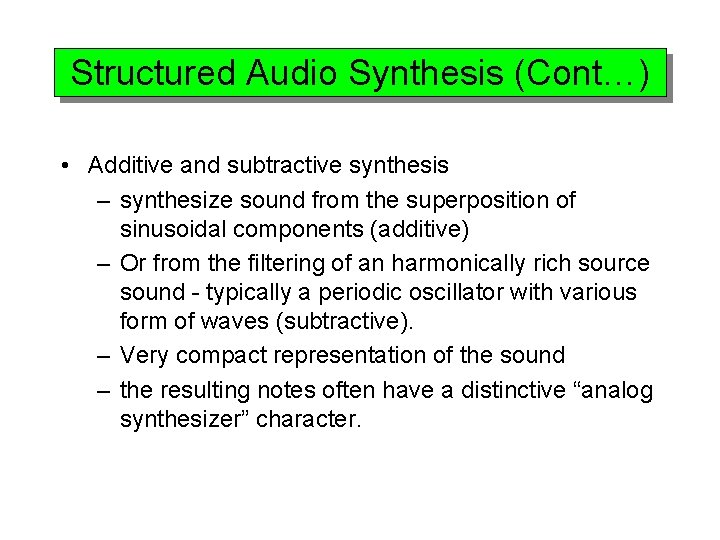
Structured Audio Synthesis (Cont…) • Additive and subtractive synthesis – synthesize sound from the superposition of sinusoidal components (additive) – Or from the filtering of an harmonically rich source sound - typically a periodic oscillator with various form of waves (subtractive). – Very compact representation of the sound – the resulting notes often have a distinctive “analog synthesizer” character.
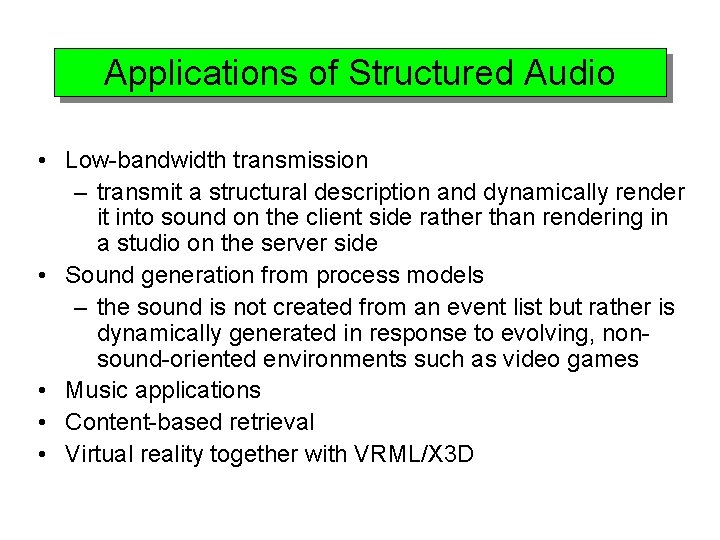
Applications of Structured Audio • Low-bandwidth transmission – transmit a structural description and dynamically render it into sound on the client side rather than rendering in a studio on the server side • Sound generation from process models – the sound is not created from an event list but rather is dynamically generated in response to evolving, nonsound-oriented environments such as video games • Music applications • Content-based retrieval • Virtual reality together with VRML/X 3 D
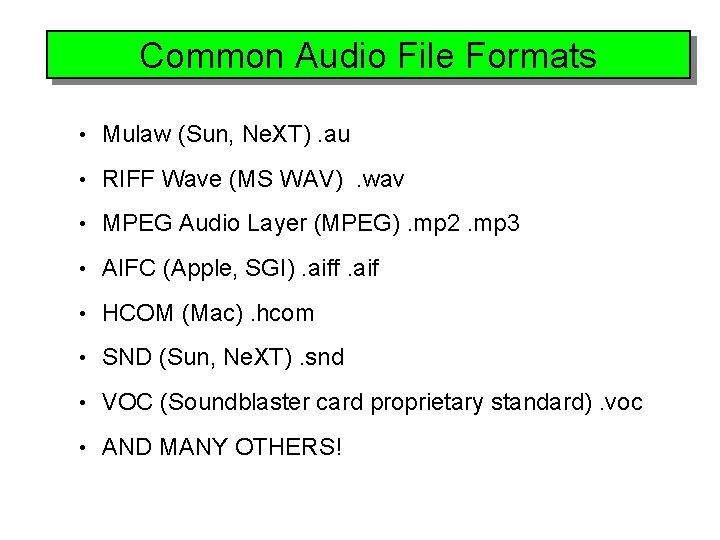
Common Audio File Formats • Mulaw (Sun, Ne. XT). au • RIFF Wave (MS WAV). wav • MPEG Audio Layer (MPEG). mp 2. mp 3 • AIFC (Apple, SGI). aiff. aif • HCOM (Mac). hcom • SND (Sun, Ne. XT). snd • VOC (Soundblaster card proprietary standard). voc • AND MANY OTHERS!
Demos of Audio Coding and Formats