
Lesson 3 1 Measure of Central Tendency Objectives
Lesson 3 - 1 Measure of Central Tendency
Objectives • Determine the arithmetic mean of a variable from raw data • Determine the median of a variable from raw data • Determine the mode of a variable from raw data • Use the mean and the median to help identify the shape of a distribution
Vocabulary • Parameter – a descriptive measure of a population • Statistic – a descriptive measure of a sample • Arithmetic Mean – sum of all values of a variable in a data set divided by the number of observations • Population Arithmetic Mean – (μ) summation ( ∑ ) of all values of a variable from the population divided by the total number in the population (N) • Sample Arithmetic Mean – (x‾) summation of all values of a variable from a sample divided by the total number of observation from the sample (n) • Median – (M) the value of the variable that lies in the middle of the data when arranged in ascending order (if there is a even number of observations, then the median is the average of observations either side of the middle (½) value • Mode – the most frequently observed value of the variable • Resistant – extreme values do not effect the statistic
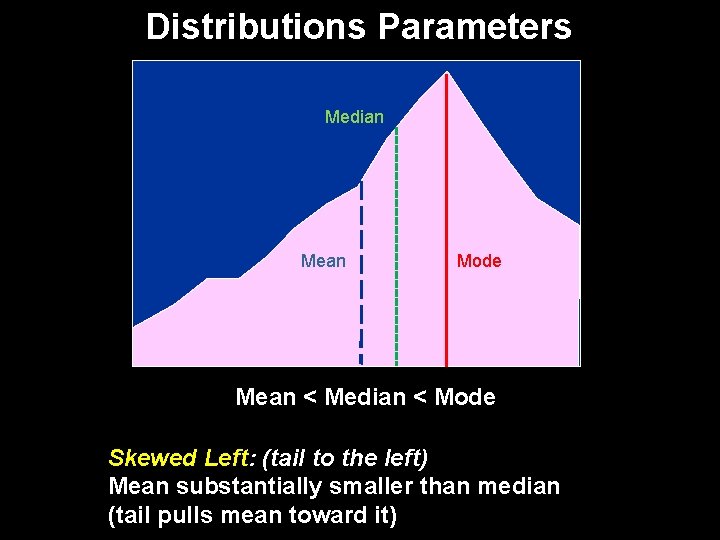
Distributions Parameters Median Mean Mode Mean < Median < Mode Skewed Left: (tail to the left) Mean substantially smaller than median (tail pulls mean toward it)
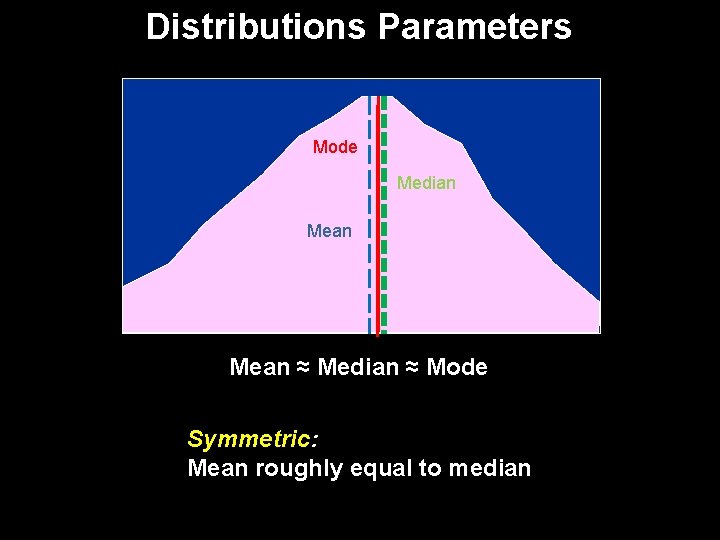
Distributions Parameters Mode Median Mean ≈ Median ≈ Mode Symmetric: Mean roughly equal to median
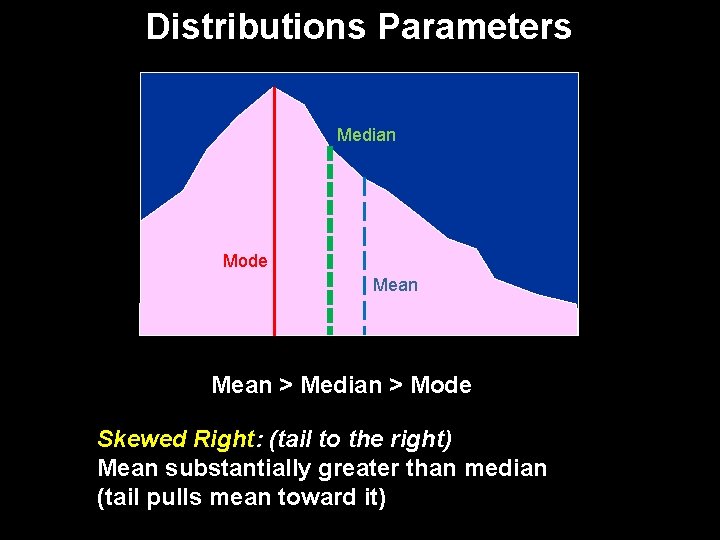
Distributions Parameters Median Mode Mean > Median > Mode Skewed Right: (tail to the right) Mean substantially greater than median (tail pulls mean toward it)
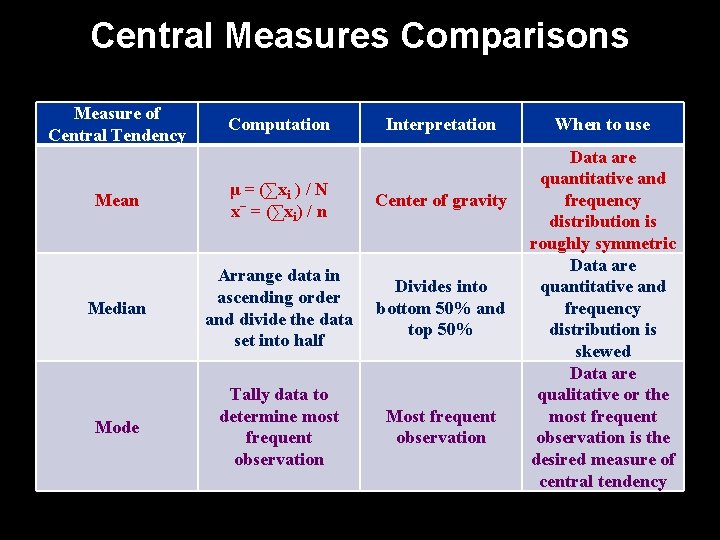
Central Measures Comparisons Measure of Central Tendency Computation Interpretation Mean μ = (∑xi ) / N x‾ = (∑xi) / n Center of gravity Median Arrange data in ascending order and divide the data set into half Divides into bottom 50% and top 50% Mode Tally data to determine most frequent observation Most frequent observation When to use Data are quantitative and frequency distribution is roughly symmetric Data are quantitative and frequency distribution is skewed Data are qualitative or the most frequent observation is the desired measure of central tendency
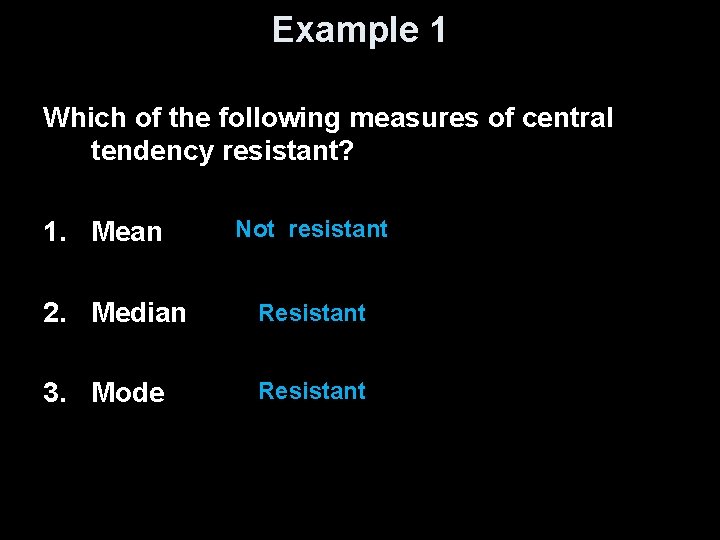
Example 1 Which of the following measures of central tendency resistant? 1. Mean Not resistant 2. Median Resistant 3. Mode Resistant
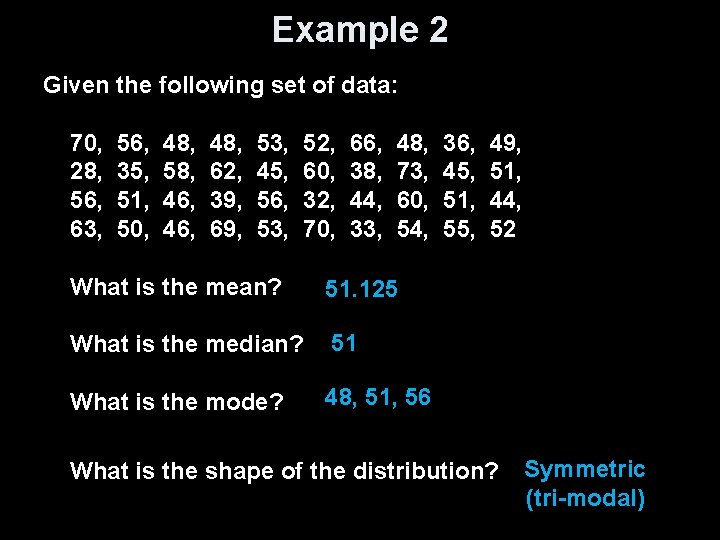
Example 2 Given the following set of data: 70, 56, 48, 53, 52, 66, 48, 36, 49, 28, 35, 58, 62, 45, 60, 38, 73, 45, 51, 56, 51, 46, 39, 56, 32, 44, 60, 51, 44, 63, 50, 46, 69, 53, 70, 33, 54, 55, 52 What is the mean? 51. 125 What is the median? 51 What is the mode? 48, 51, 56 What is the shape of the distribution? Symmetric (tri-modal)
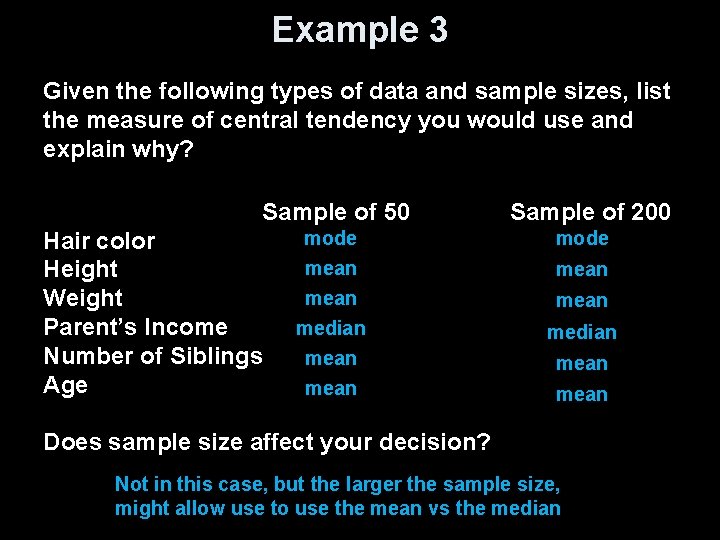
Example 3 Given the following types of data and sample sizes, list the measure of central tendency you would use and explain why? Sample of 50 Sample of 200 mode Hair color mean Height mean Weight mean median Parent’s Income median Number of Siblings mean Age mean Does sample size affect your decision? Not in this case, but the larger the sample size, might allow use to use the mean vs the median
Summary and Homework • Summary – Three characteristics must be used to describe distributions (from histograms or similar charts) • Shape (uniform, symmetric, bi-modal, etc) • Center (mean, median, mode measures) • Spread (variance – next lesson) • Homework: – pg 130 -7; 9, 21, 23, 27, 33, 34, 44
- Slides: 11