
Lesson 25 The objectoriented thought process Python MiniCourse
Lesson 25 The object-oriented thought process Python Mini-Course University of Oklahoma Department of Psychology 1 Python Mini-Course: Lesson 25 6/16/09
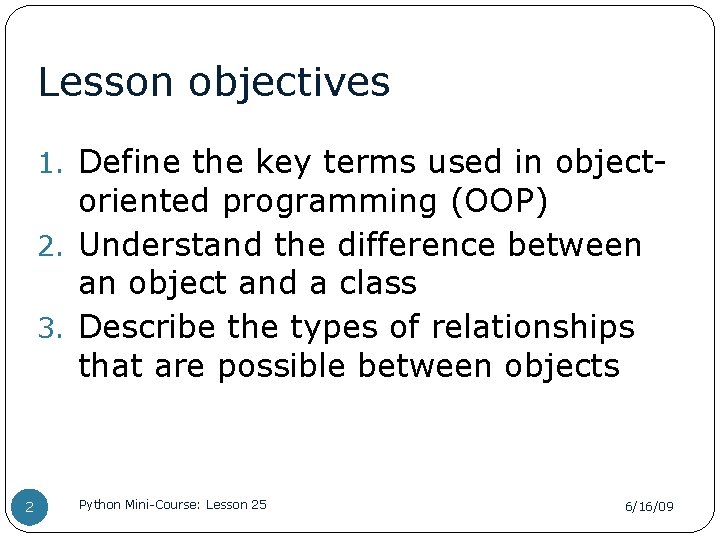
Lesson objectives 1. Define the key terms used in object- oriented programming (OOP) 2. Understand the difference between an object and a class 3. Describe the types of relationships that are possible between objects 2 Python Mini-Course: Lesson 25 6/16/09
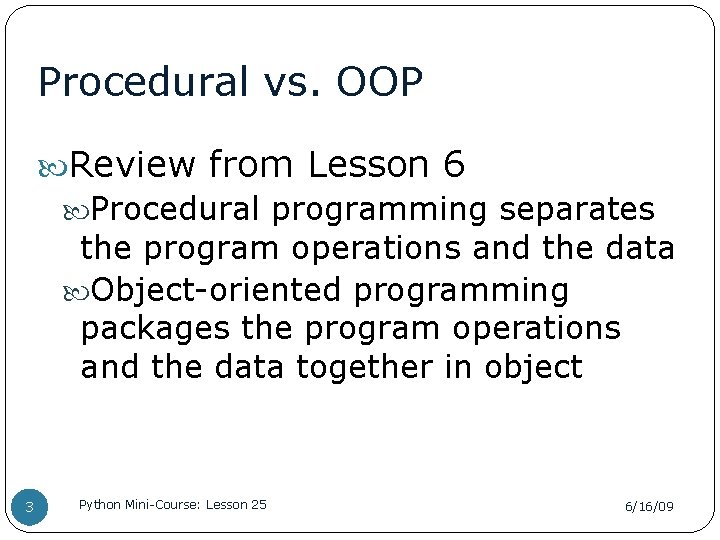
Procedural vs. OOP Review from Lesson 6 Procedural programming separates the program operations and the data Object-oriented programming packages the program operations and the data together in object 3 Python Mini-Course: Lesson 25 6/16/09
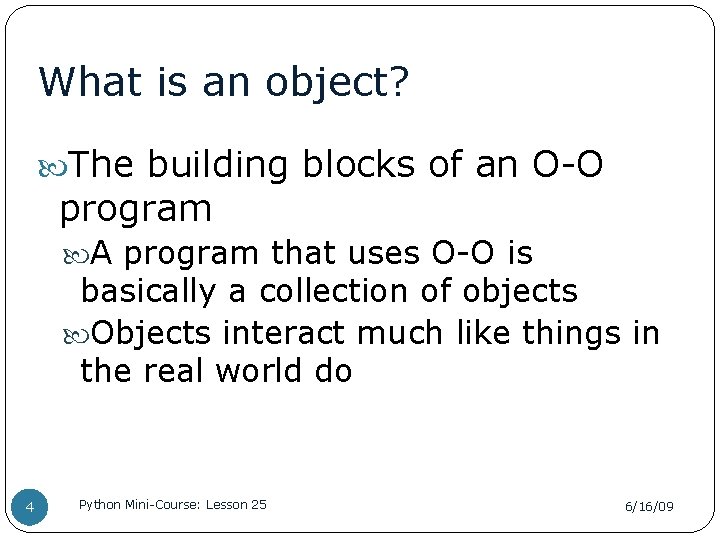
What is an object? The building blocks of an O-O program A program that uses O-O is basically a collection of objects Objects interact much like things in the real world do 4 Python Mini-Course: Lesson 25 6/16/09
What is an object? Objects have two components: Data (i. e. , attributes) Behaviors (i. e. , methods) 5 Python Mini-Course: Lesson 25 6/16/09
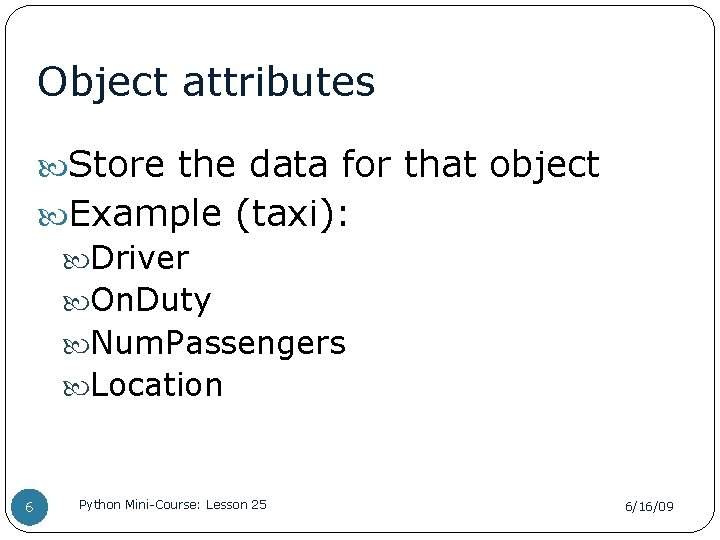
Object attributes Store the data for that object Example (taxi): Driver On. Duty Num. Passengers Location 6 Python Mini-Course: Lesson 25 6/16/09
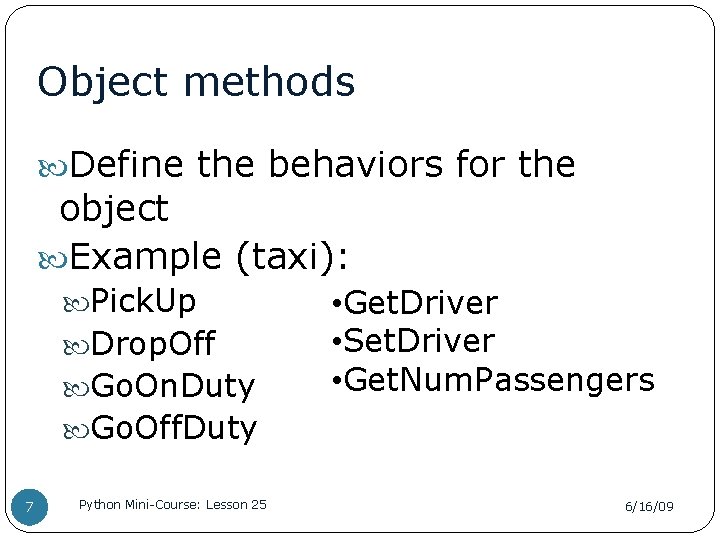
Object methods Define the behaviors for the object Example (taxi): Pick. Up Drop. Off Go. On. Duty • Get. Driver • Set. Driver • Get. Num. Passengers Go. Off. Duty 7 Python Mini-Course: Lesson 25 6/16/09
Object interface To use a method, the user (programmer) must know: Name of the method Parameters to pass to the method What (if anything) the method returns 8 Python Mini-Course: Lesson 25 6/16/09
Object implementation The user does NOT need to know how the method works internally 9 Python Mini-Course: Lesson 25 6/16/09
What is a Class? A blueprint for an object Classes can be thought of as templates or cookie cutters Given a class description, we can instantiate objects of that class Classes are high-level data types 10 Python Mini-Course: Lesson 25 6/16/09
OOP concepts Encapsulation Data and behaviors are packaged together, but the object only reveals the interfaces needed to interact with it Internal data and behaviors can remain hidden 11 Python Mini-Course: Lesson 25 6/16/09
OOP concepts Interfaces Fundamental means of communication between objects Should completely describe to user (programmer) how to interact with the object Should control access to attributes 12 Python Mini-Course: Lesson 25 6/16/09
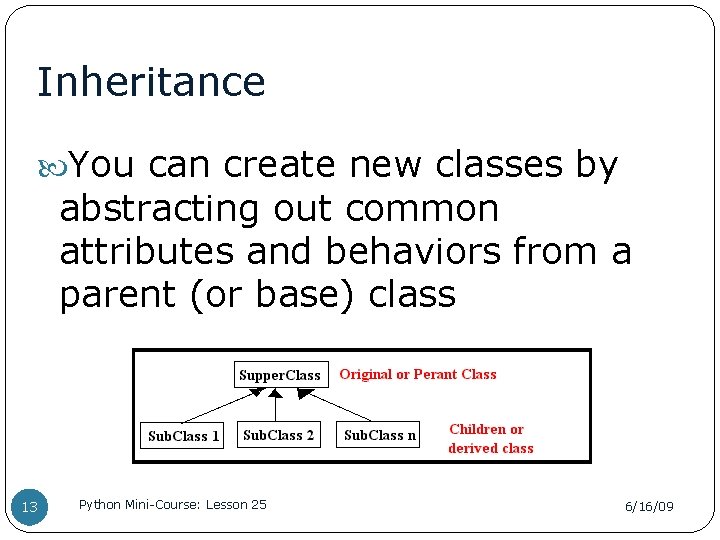
Inheritance You can create new classes by abstracting out common attributes and behaviors from a parent (or base) class 13 Python Mini-Course: Lesson 25 6/16/09
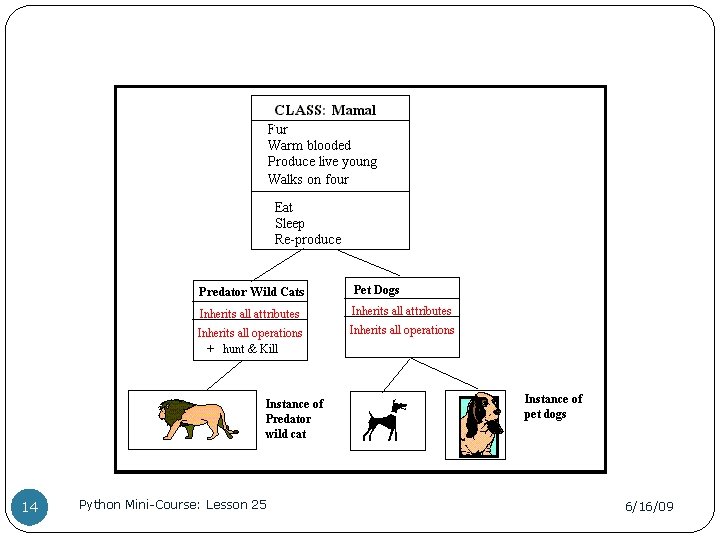
14 Python Mini-Course: Lesson 25 6/16/09
Is-a relationship Because sub-classes inherit from their base class, they have an isa relationship: Lion is a cat Cat is a mammal 15 Python Mini-Course: Lesson 25 6/16/09
Polymorphism Allows similar objects to to respond to the same message (method call) in different manners Sub-classes can override base class methods 16 Python Mini-Course: Lesson 25 6/16/09
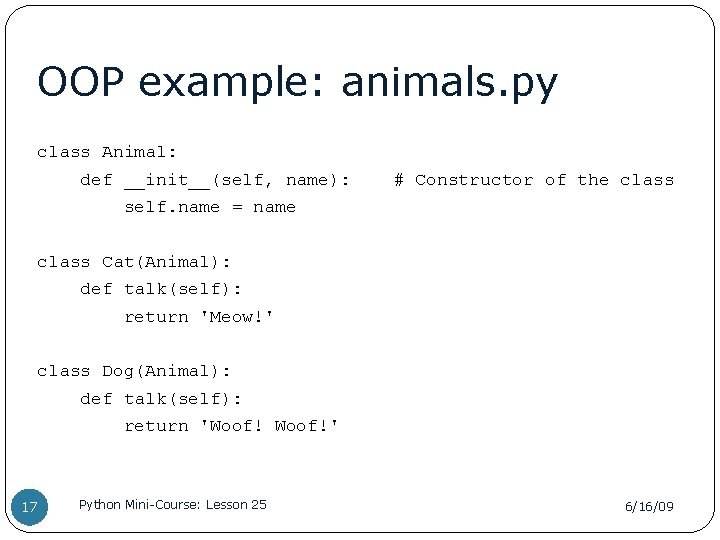
OOP example: animals. py class Animal: def __init__(self, name): # Constructor of the class self. name = name class Cat(Animal): def talk(self): return 'Meow!' class Dog(Animal): def talk(self): return 'Woof!' 17 Python Mini-Course: Lesson 25 6/16/09
Composition Objects can contain other objects This is called a has-a relationship Example: Taxi has-a driver 18 Python Mini-Course: Lesson 25 6/16/09
- Slides: 18