
LESSON 23 MATERIAL REQUIREMENTS PLANNING LOT SIZING WITH
- Slides: 27
LESSON 23: MATERIAL REQUIREMENTS PLANNING: LOT SIZING WITH CAPACITY CONSTRAINTS Outline • Lot Sizing with Capacity Constraints – Order Partial Requirements – Checking Feasibility – Lot Shifting Technique – An Improvement Procedure 1
Lot Sizing with Capacity Constraints • In Lessons 21 and 22 we have assumed that there is no capacity constraint on production. However, often, the production capacity is limited. • In this lesson we assume that it is required to develop a production plan (i. e. , production quantities of various periods) that minimizes total inventory holding and ordering costs. • Capacity constraints make the problem more realistic. • At the same time, capacity constraints make the problem difficult. 2
Lot Sizing with Capacity Constraints • We shall discuss – the lot shifting technique, a heuristic procedure that constructs a production plan, and – another procedure that improves a given production plan. • At times, capacity may be so low that it may not be possible to meet the demand of all periods. We shall discuss a procedure to check feasibility. • First, a property that is new for the problems with capacity constraints. 3
Order Partial Requirements • Recall from Lesson 22, that if a lot-sizing solution includes an order size that covers a period only partially, then we can reduce the holding cost without increasing the ordering cost. So, Silver-Meal heuristic, least unit cost and part-period balancing consider order sizes that equals demand of K periods in future, for some K>0. • As it is shown by the next example, the above does not hold if there are some capacity constraints. It may be essential to order partial requirement of a period. 4
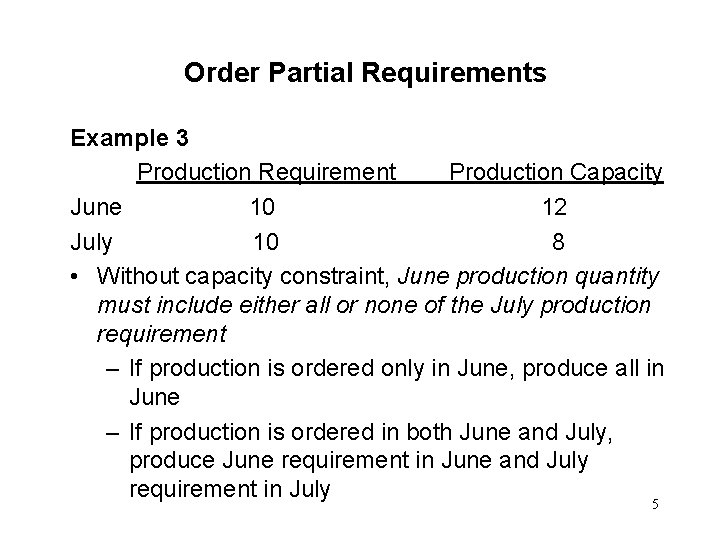
Order Partial Requirements Example 3 Production Requirement Production Capacity June 10 12 July 10 8 • Without capacity constraint, June production quantity must include either all or none of the July production requirement – If production is ordered only in June, produce all in June – If production is ordered in both June and July, produce June requirement in June and July requirement in July 5
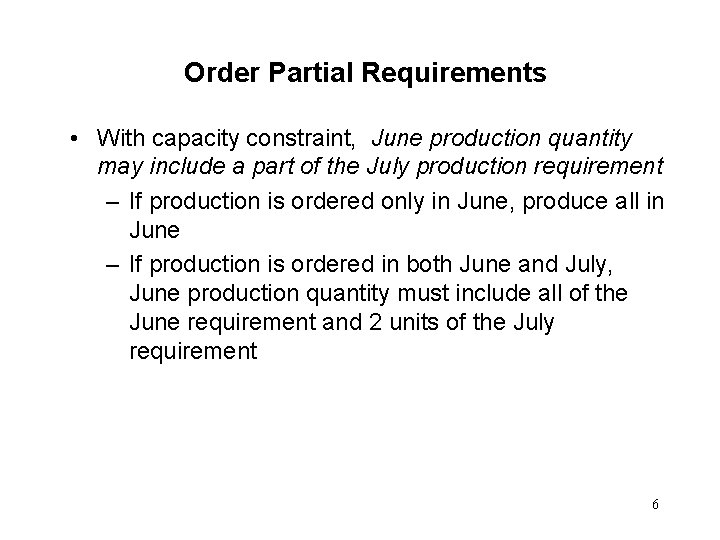
Order Partial Requirements • With capacity constraint, June production quantity may include a part of the July production requirement – If production is ordered only in June, produce all in June – If production is ordered in both June and July, June production quantity must include all of the June requirement and 2 units of the July requirement 6
Checking Feasibility • As it was discussed before, sometimes capacity may be so low that it may not be possible to meet the demand of all periods. • So, given demand over the planning horizon and the corresponding capacity constraints, we ask if there exists a feasible solution that meets all the demand. This is the feasibility problem. • The procedure is stated in the next slide and then the procedure is illustrated with an example. 7
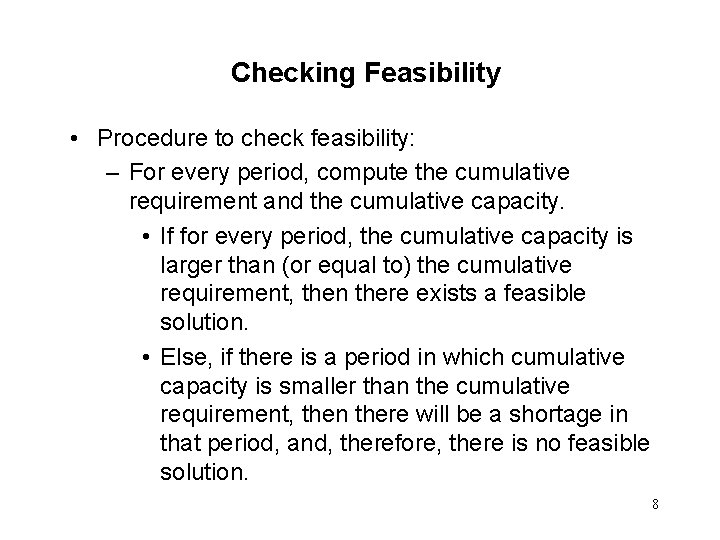
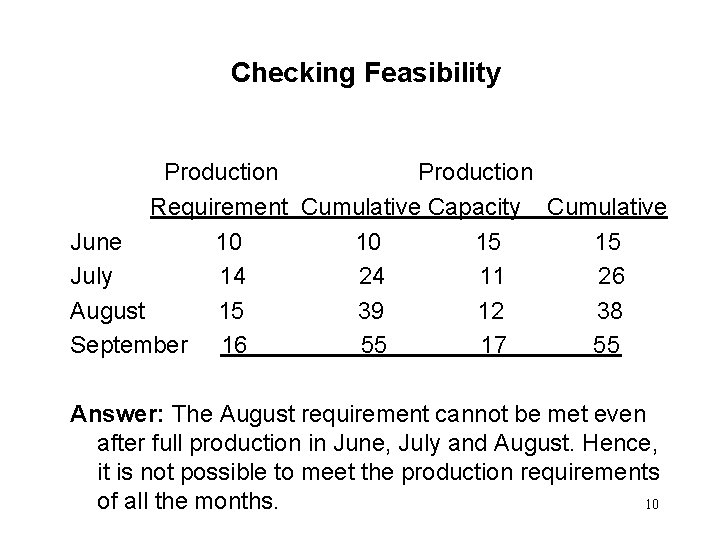
Checking Feasibility • Procedure to check feasibility: – For every period, compute the cumulative requirement and the cumulative capacity. • If for every period, the cumulative capacity is larger than (or equal to) the cumulative requirement, then there exists a feasible solution. • Else, if there is a period in which cumulative capacity is smaller than the cumulative requirement, then there will be a shortage in that period, and, therefore, there is no feasible solution. 8
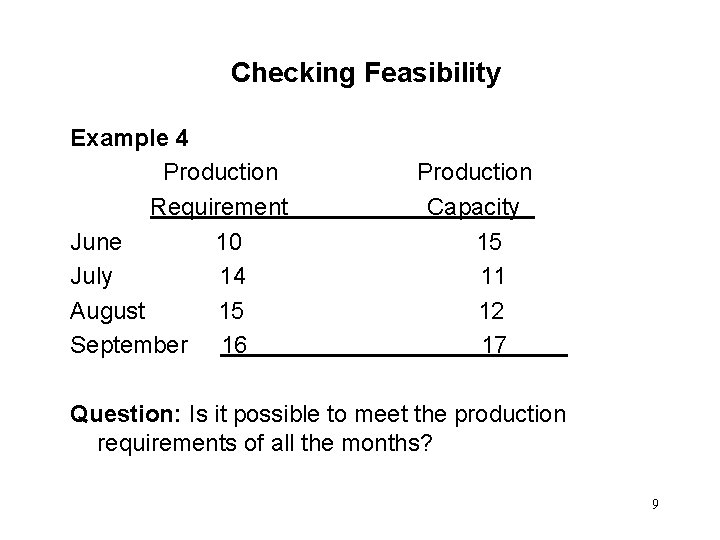
Checking Feasibility Example 4 Production Requirement June 10 July 14 August 15 September 16 Production Capacity 15 11 12 17 Question: Is it possible to meet the production requirements of all the months? 9
Checking Feasibility Production Requirement Cumulative Capacity Cumulative June 10 10 15 15 July 14 24 11 26 August 15 39 12 38 September 16 55 17 55 Answer: The August requirement cannot be met even after full production in June, July and August. Hence, it is not possible to meet the production requirements of all the months. 10
Lot Shifting Technique • Lot shifting technique constructs a feasible production plan, if there exists one or provides a proof that there is no feasible solution. • Lot shifting method is a heuristic. The production plan obtained from the lot shifting technique is not necessarily optimal. It is possible to improve the production plan. • An improvement procedure will be discussed after the discussion on the lot shifting technique. 11
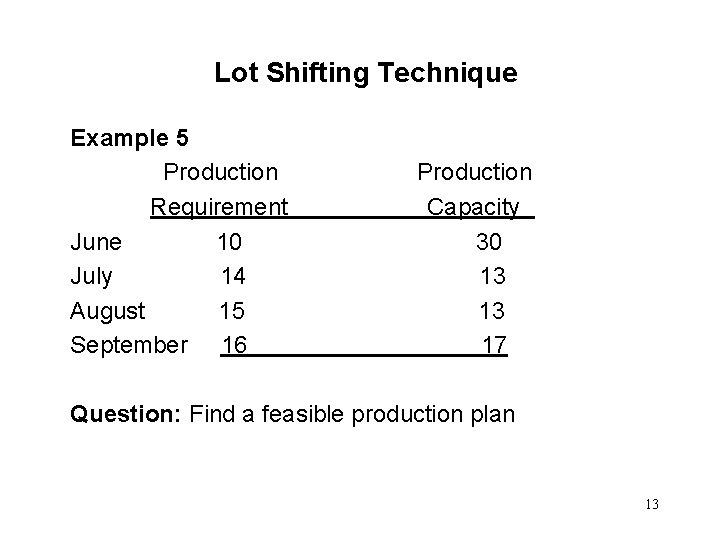
Lot Shifting Technique • The lot shifting method repeatedly does the following: – Find the first period with less capacity. • If possible, back-shift the excess capacity to some prior periods. Continue. • If it is not possible to back-shift the excess capacity to some prior periods, stop. There is no feasible solution. 12
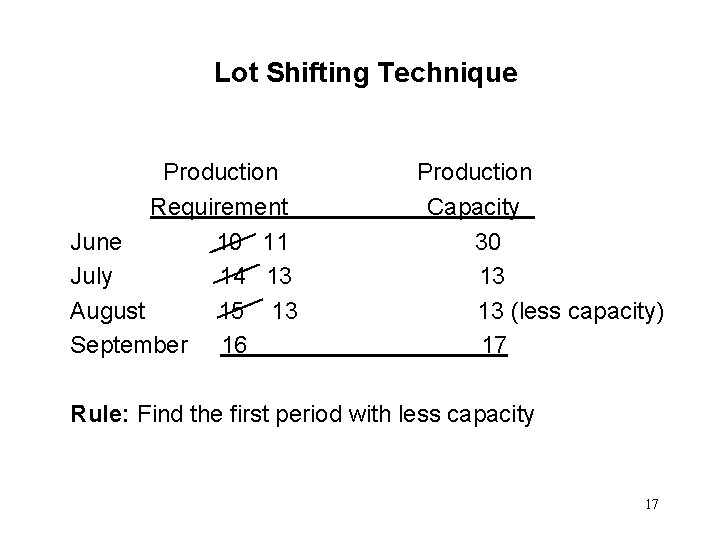
Lot Shifting Technique Example 5 Production Requirement June 10 July 14 August 15 September 16 Production Capacity 30 13 13 17 Question: Find a feasible production plan 13
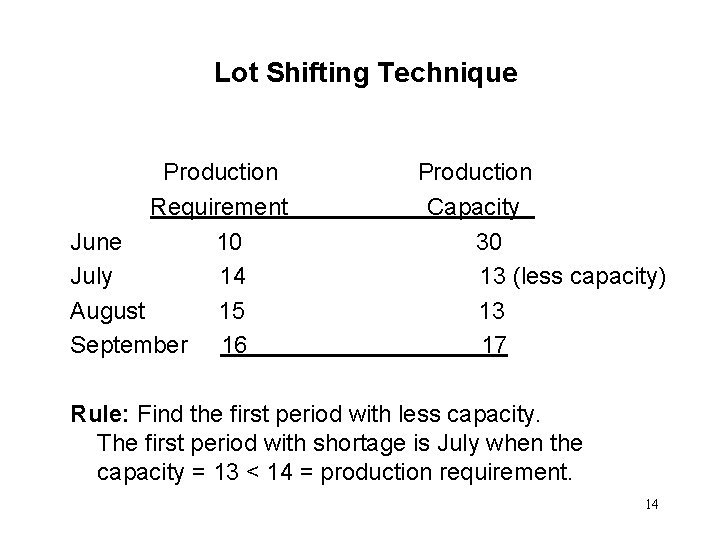
Lot Shifting Technique Production Requirement June 10 July 14 August 15 September 16 Production Capacity 30 13 (less capacity) 13 17 Rule: Find the first period with less capacity. The first period with shortage is July when the capacity = 13 < 14 = production requirement. 14
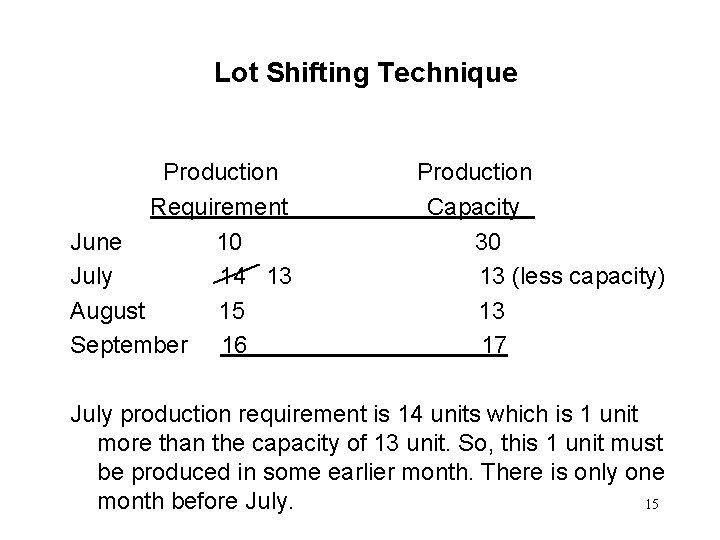
Lot Shifting Technique Production Requirement June 10 July 14 13 August 15 September 16 Production Capacity 30 13 (less capacity) 13 17 July production requirement is 14 units which is 1 unit more than the capacity of 13 unit. So, this 1 unit must be produced in some earlier month. There is only one month before July. 15
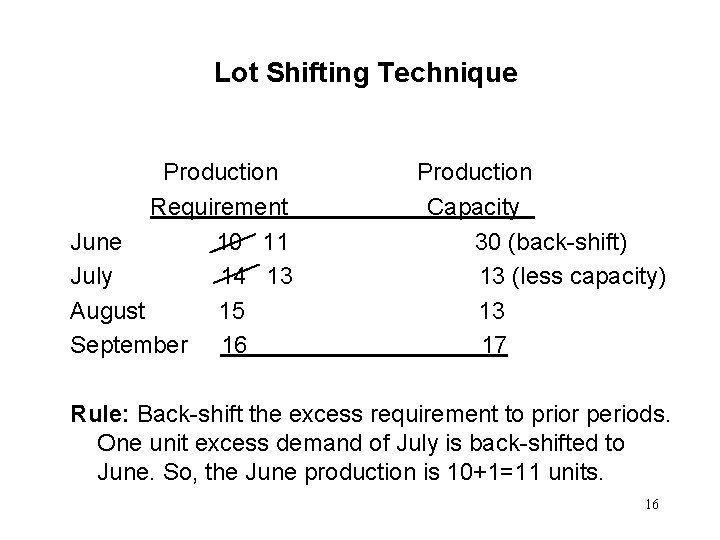
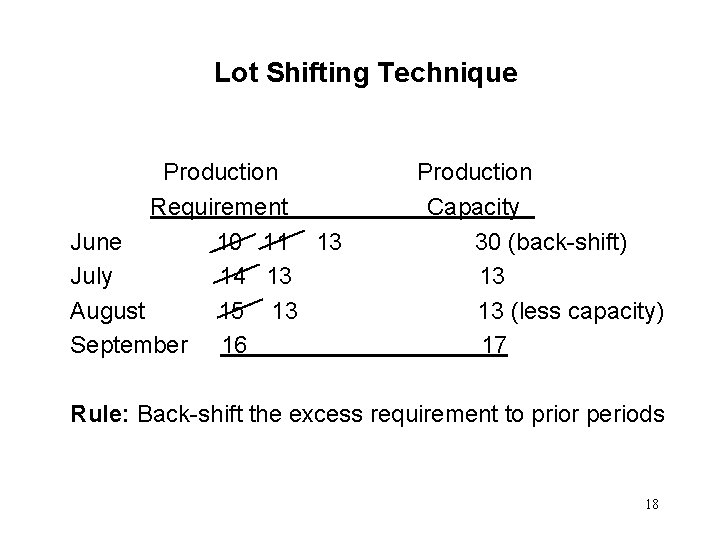
Lot Shifting Technique Production Requirement June 10 11 July 14 13 August 15 September 16 Production Capacity 30 (back-shift) 13 (less capacity) 13 17 Rule: Back-shift the excess requirement to prior periods. One unit excess demand of July is back-shifted to June. So, the June production is 10+1=11 units. 16
Lot Shifting Technique Production Requirement June 10 11 July 14 13 August 15 13 September 16 Production Capacity 30 13 13 (less capacity) 17 Rule: Find the first period with less capacity 17
Lot Shifting Technique Production Requirement June 10 11 13 July 14 13 August 15 13 September 16 Production Capacity 30 (back-shift) 13 13 (less capacity) 17 Rule: Back-shift the excess requirement to prior periods 18
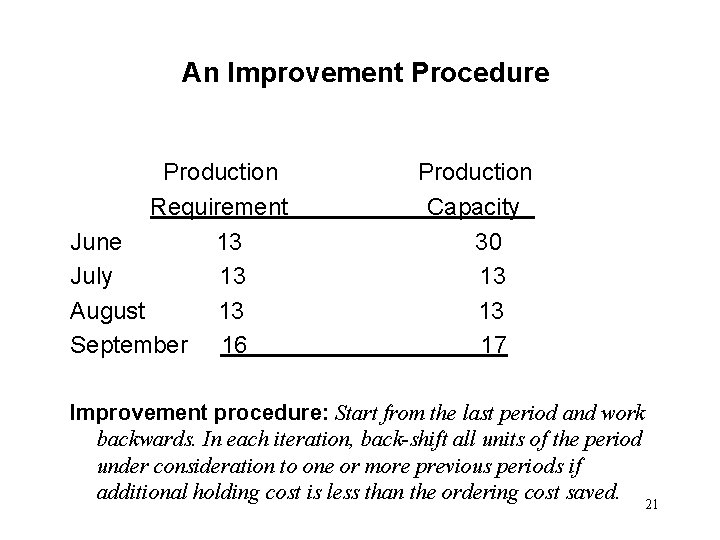
An Improvement Procedure • Now, a procedure will be discussed that can sometimes find an alternative production plan that may reduce the total holding and ordering cost over the planning horizon. • Keep in mind that it is guaranteed that whenever, there is an improved plan, the procedure will be able to identify that plan. Sometimes, the procedure may fail to identify an improved plan, although there may actually exist one. 19
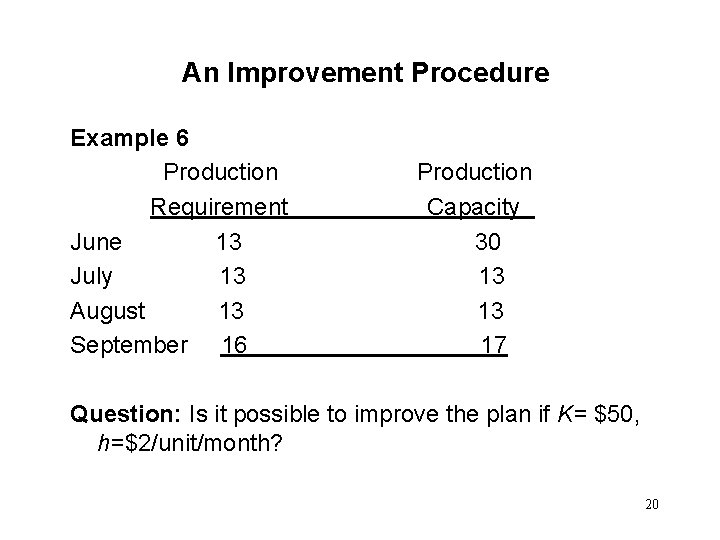
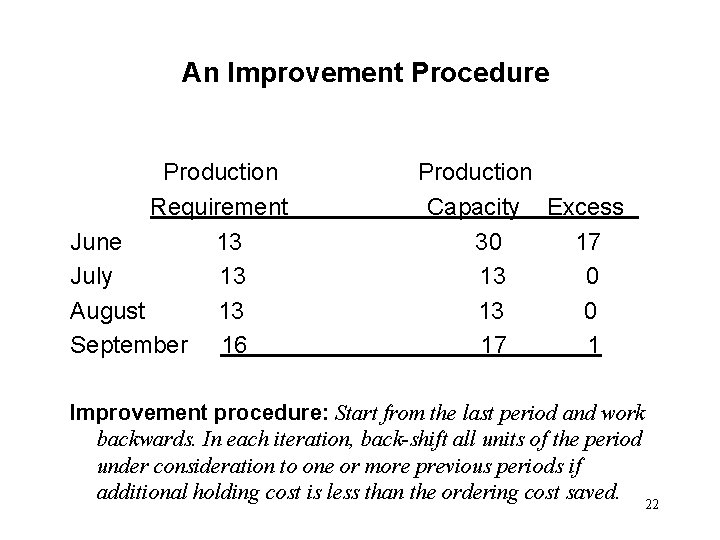
An Improvement Procedure Example 6 Production Requirement June 13 July 13 August 13 September 16 Production Capacity 30 13 13 17 Question: Is it possible to improve the plan if K= $50, h=$2/unit/month? 20
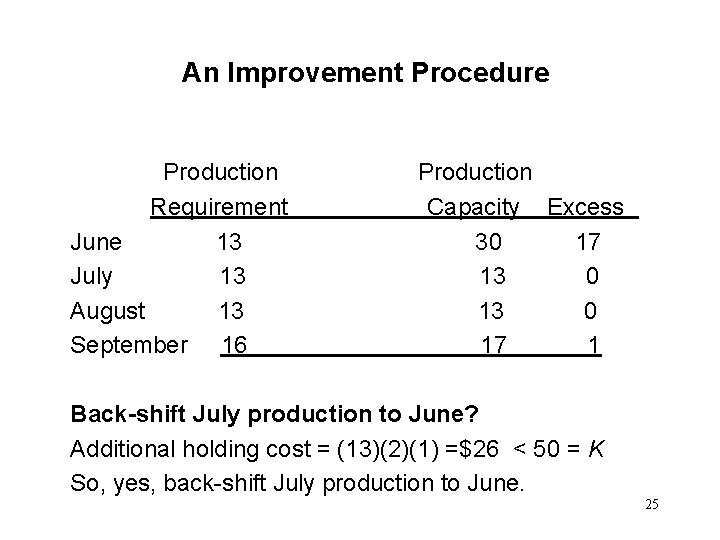
An Improvement Procedure Production Requirement June 13 July 13 August 13 September 16 Production Capacity 30 13 13 17 Improvement procedure: Start from the last period and work backwards. In each iteration, back-shift all units of the period under consideration to one or more previous periods if additional holding cost is less than the ordering cost saved. 21
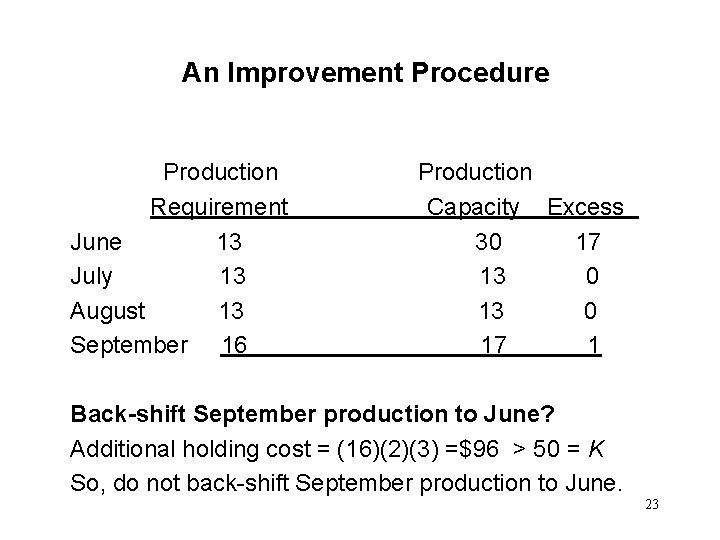
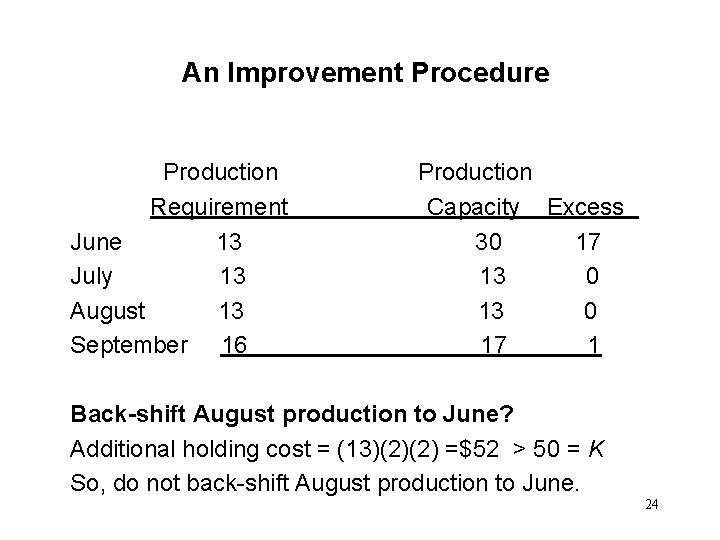
An Improvement Procedure Production Requirement June 13 July 13 August 13 September 16 Production Capacity Excess 30 17 13 0 17 1 Improvement procedure: Start from the last period and work backwards. In each iteration, back-shift all units of the period under consideration to one or more previous periods if additional holding cost is less than the ordering cost saved. 22
An Improvement Procedure Production Requirement June 13 July 13 August 13 September 16 Production Capacity Excess 30 17 13 0 17 1 Back-shift September production to June? Additional holding cost = (16)(2)(3) =$96 > 50 = K So, do not back-shift September production to June. 23
An Improvement Procedure Production Requirement June 13 July 13 August 13 September 16 Production Capacity Excess 30 17 13 0 17 1 Back-shift August production to June? Additional holding cost = (13)(2)(2) =$52 > 50 = K So, do not back-shift August production to June. 24
An Improvement Procedure Production Requirement June 13 July 13 August 13 September 16 Production Capacity Excess 30 17 13 0 17 1 Back-shift July production to June? Additional holding cost = (13)(2)(1) =$26 < 50 = K So, yes, back-shift July production to June. 25
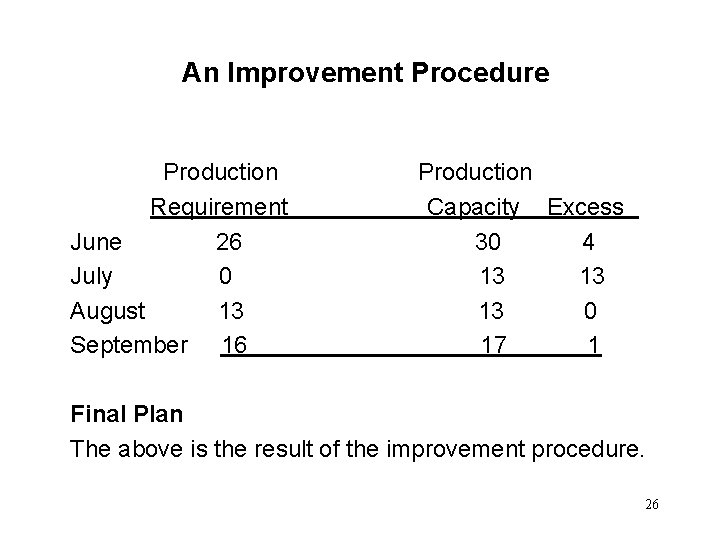
An Improvement Procedure Production Requirement June 26 July 0 August 13 September 16 Production Capacity Excess 30 4 13 13 13 0 17 1 Final Plan The above is the result of the improvement procedure. 26
READING AND EXERCISES Lesson 23 Reading: Section 7. 4 pp. 375 -379 (4 th Ed. ), pp. 366 -369 (5 th Ed. ) Exercise: 28 p. 380 (4 th Ed. ), p. 369 (5 th Ed. ) Lesson 24 Reading: Section 7. 6 pp. 387 -395 (4 th Ed. ) pp. 377 -384 (5 th Ed. ) Exercise: 37 p. 395 (4 th Ed. ), p. 384 (5 th Ed. ) 27