
Lesson 23 Cold War Containment Confrontation The Cold
![Review LBJ’s Dilemma “In later years [Johnson] lamented: 'I knew from the start that](https://slidetodoc.com/presentation_image_h2/18a817259a4dafb564ba6263f6911ba9/image-40.jpg "Review LBJ’s Dilemma “In later years [Johnson] lamented: 'I knew from the start that")
- Slides: 70
Lesson 23 Cold War: Containment & Confrontation
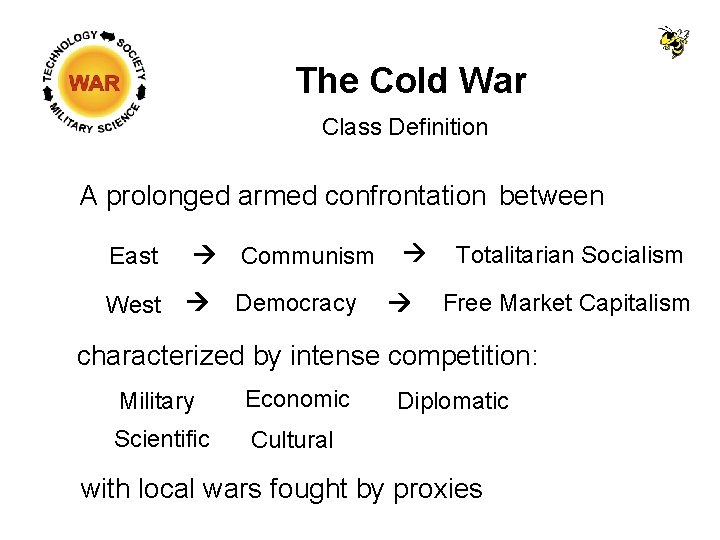
The Cold War Class Definition A prolonged armed confrontation between East Communism West Democracy Totalitarian Socialism Free Market Capitalism characterized by intense competition: Military Economic Scientific Cultural Diplomatic with local wars fought by proxies
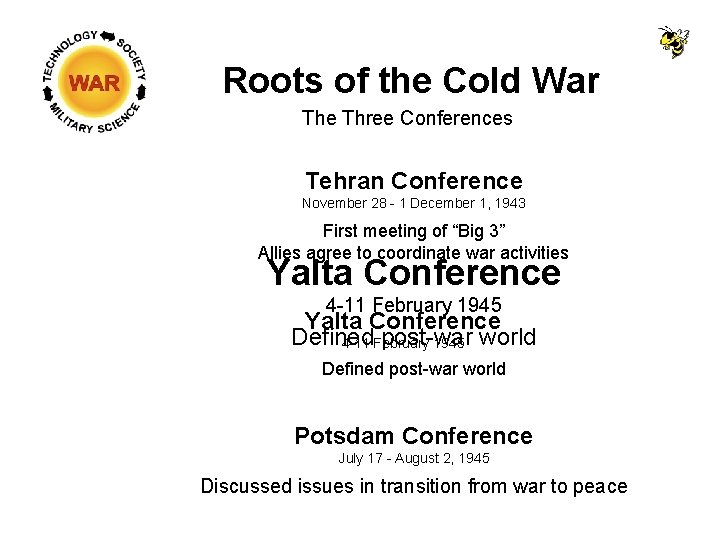
Roots of the Cold War The Three Conferences Tehran Conference November 28 - 1 December 1, 1943 First meeting of “Big 3” Allies agree to coordinate war activities Yalta Conference 4 -11 February 1945 Yalta Conference Defined post-war 4 -11 February 1945 world Defined post-war world Potsdam Conference July 17 - August 2, 1945 Discussed issues in transition from war to peace
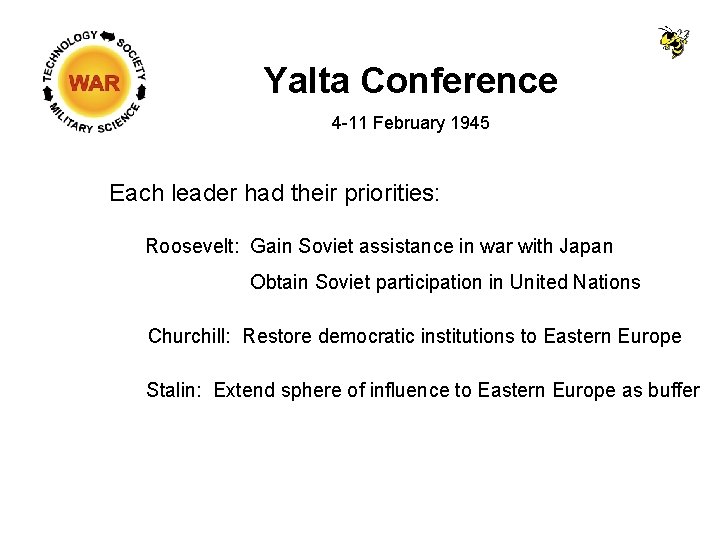
Yalta Conference 4 -11 February 1945 Each leader had their priorities: Roosevelt: Gain Soviet assistance in war with Japan Obtain Soviet participation in United Nations Churchill: Restore democratic institutions to Eastern Europe Stalin: Extend sphere of influence to Eastern Europe as buffer
Yalta Conference 4 -11 February 1945 Concerns: • Soviets would take Berlin • Four Power Partition of Germany, Berlin • Soviets would get parts of Poland • Soviets would receive Japanese territory • Korea divided at 38 th parallel Considered by many the beginning of the Cold War Defined the issues of the confrontation
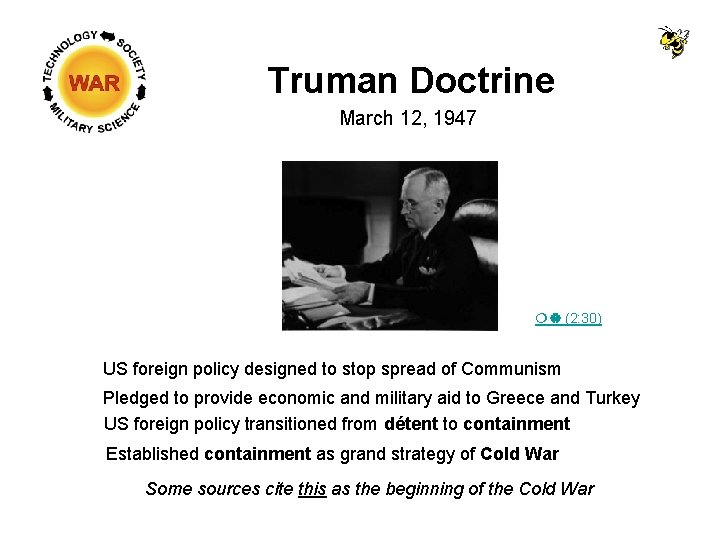
Truman Doctrine March 12, 1947 (2: 30) US foreign policy designed to stop spread of Communism Pledged to provide economic and military aid to Greece and Turkey US foreign policy transitioned from détent to containment Established containment as grand strategy of Cold War Some sources cite this as the beginning of the Cold War
Marshall Plan April 3, 1948 Foreign Assistance Act of 1948 (Also referred to as the Economic Cooperation Act and the European Recovery Act) • Grew from realization that slow recovery from war devastation in Western Europe would leave the region weak and subject to Communist incursion • US leadership did not want a repeat of post- World War One conditions that contributed to the Great Depression and rise of Fascism. • Marshall publicly presented idea in Harvard commencement address (June 5, 1947) • Provided $12 B in recovery aid (Value in 2005 $: $555 B per GDP share) • Major factor in Western European resistance to Communism
North Atlantic Treaty April 4, 1949 Formed North Atlantic Treaty Organization (NATO) • Military alliance to protect Western Europe • Original members: Belgium, Canada, Denmark, France, Iceland, Italy, Luxembourg, the Netherlands, Norway, Portugal, United Kingdom, United States • Greece, Turkey joined in 1952 • West Germany joined following ratification of Paris Peace Treaties (May 1955) USSR responded with Warsaw Pact (May 14, 1955) • Albania, Bulgaria, Czechoslovakia, East Germany, Hungary, Poland, Rumania, Soviet Union
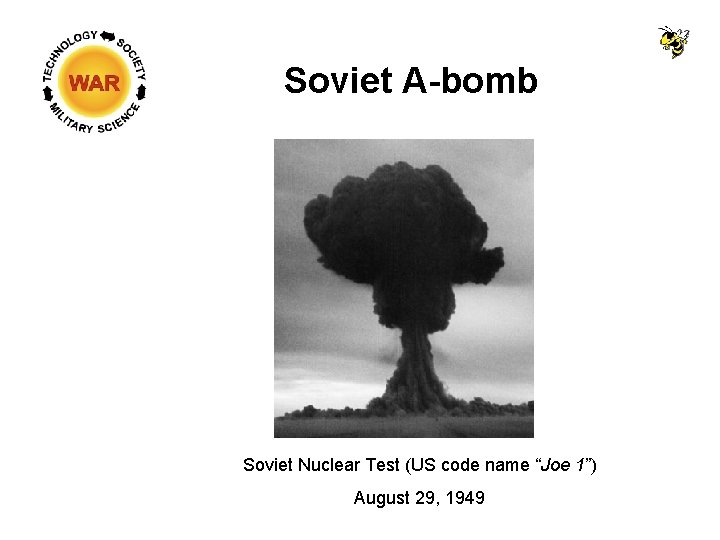
Soviet A-bomb Soviet Nuclear Test (US code name “Joe 1”) August 29, 1949
NSC-68 April 14, 1950 Classified National Security Council document Full analysis of US-USSR relationship Defined initial US Cold War strategy: Containment Implemented the Truman Doctrine
Impact of NSC-68 Immediate increase in defense spending FY 1950: Defense budget $14. 1 billion 33% of national budget, 5% 0 f GNP FY 1951: Defense budget $33. 6 billion 73% of national budget, 10% 0 f GNP Demonstrated American commitment to win the Cold War Source
Cold War: Thinking the Unthinkable
US Cold War Policy Stem the tide of worldwide Soviet expansionism Insure security of Europe through a strong NATO Prevent global nuclear war through deterrence • Emphasis on defense Colonel John Osgood, USA, Retired United States Nuclear Strategy 1945 -1995
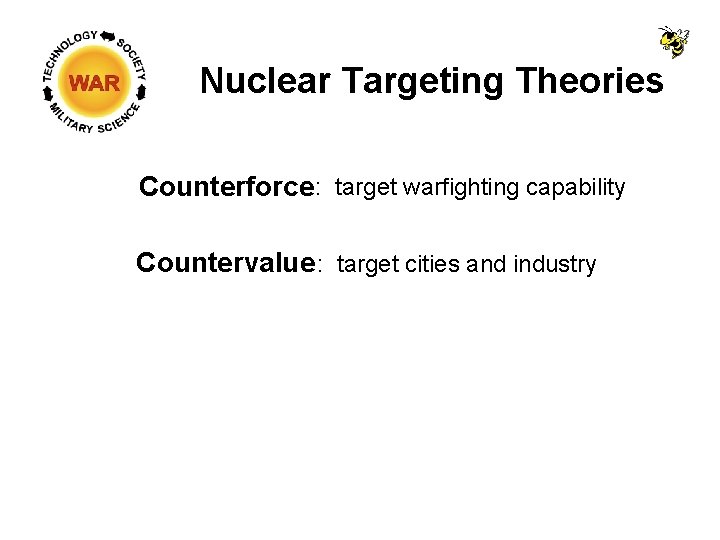
Nuclear Targeting Theories Counterforce : target warfighting capability Countervalue : target cities and industry
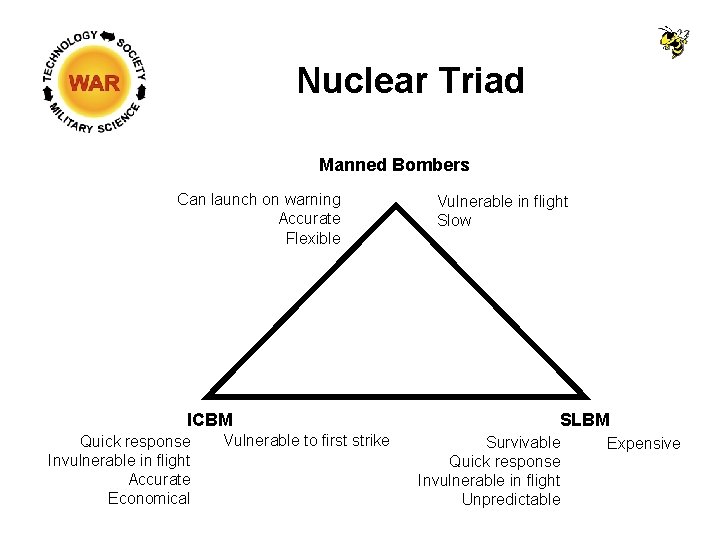
Nuclear Triad Manned Bombers Can launch on warning Accurate Flexible ICBM Quick response Invulnerable in flight Accurate Economical Vulnerable to first strike Vulnerable in flight Slow SLBM Survivable Quick response Invulnerable in flight Unpredictable Expensive
Cold War: Cuban Missile Crisis
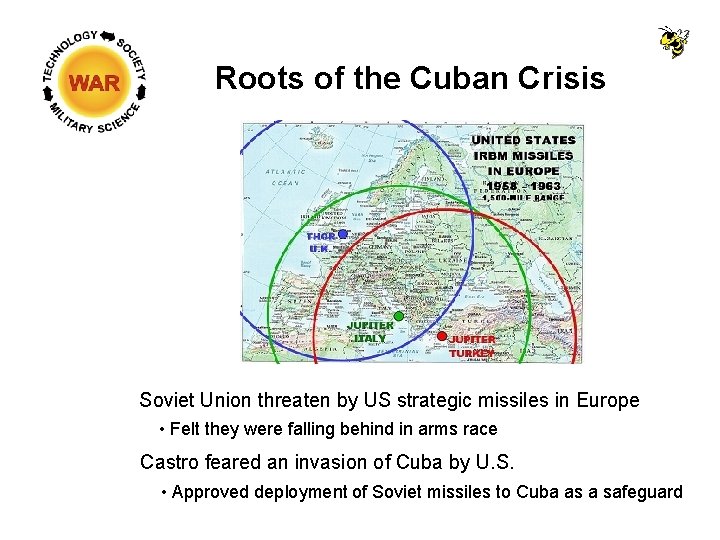
Roots of the Cuban Crisis Soviet Union threaten by US strategic missiles in Europe • Felt they were falling behind in arms race Castro feared an invasion of Cuba by U. S. • Approved deployment of Soviet missiles to Cuba as a safeguard
Cuban Crisis Options Available to U. S. Airstrikes against missiles Invasion of Cuba Quarantine
Resolution October 28, 1962 After exchange of messages, Kennedy & Khrushchev reach a confidential agreement: • US to remove IRBMs from Turkey, Italy • USSR to remove missiles from Cuba • US pledged not to invade Cuba • USSR agreed not to publicly reveal removal of IRBMs
Significance of Cuban Crisis Kennedy gained prestige for having defused the crisis but widen trans-Atlantic gulf for not consulting with NATO allies USSR lost some stature in Third World to China Superpowers learned valuable crisis management lessons Nuclear disarmament received increased emphasis Kennedy’s Flexible Response doctrine validated
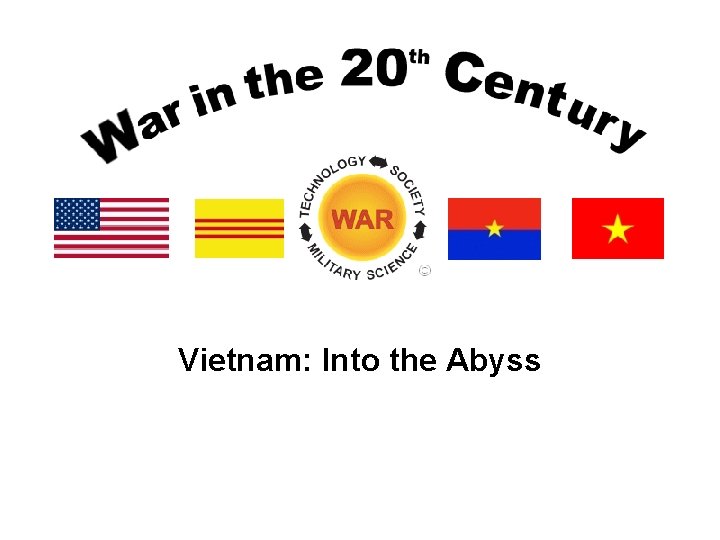
Vietnam: Into the Abyss
The Vietnam War Technically, The Second Indochina War or The Southeast Asia War
Terms Viet Minh: Communist independence movement in Vietnam, founded 1941 VC: Viet Cong, political/military insurgent group in South Vietnam (1959 -1975) NLF: National Liberation Front, formal name for Viet Cong COSVN: Central Office for South Vietnam, US term for NLF HQ DRV: Democratic Republic of Vietnam (North Vietnam) PAVN: Peoples Army of Vietnam (North Vietnamese Army, also NVA) RVN: Republic of Vietnam (South Vietnam) ARVN: Army of the Republic of Vietnam
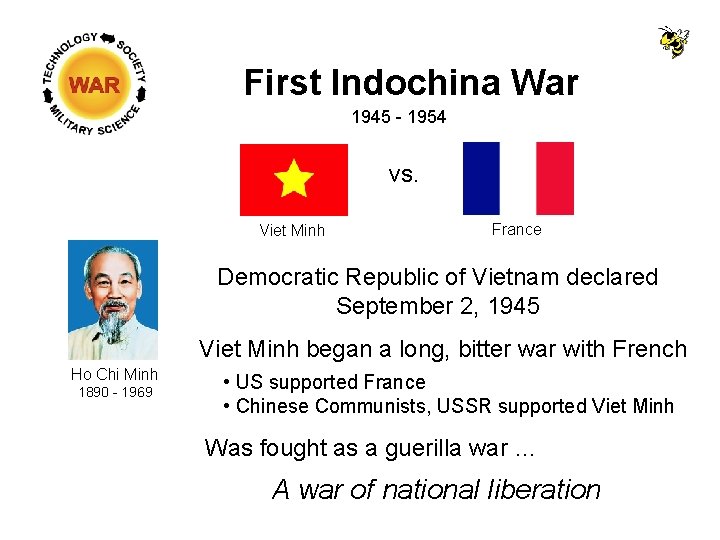
First Indochina War 1945 - 1954 vs. Viet Minh France Democratic Republic of Vietnam declared September 2, 1945 Viet Minh began a long, bitter war with French Ho Chi Minh 1890 - 1969 • US supported France • Chinese Communists, USSR supported Viet Minh Was fought as a guerilla war … A war of national liberation
Viet Minh Strategy of Revolutionary War Objective: The seizure of power in a nation-state … … by any means possible Characteristics: • Integrated military conflict and political conflict • War on multiple fronts • Geographical • Programmatic
Strategy of Revolutionary War Phase I: Targeted state stronger militarily • Revolutionaries avoid combat • Guerrilla war: raids, ambushes, sabotage, terrorism • Political conflict predominant Phase II: Rough military parity • Combined guerrilla and conventional war • Military and political conflict equally important Phase III: Revolution stronger than targeted state • Revolutionary forces go to totally conventional war • “General Offensive” linked to political “Great Uprising”
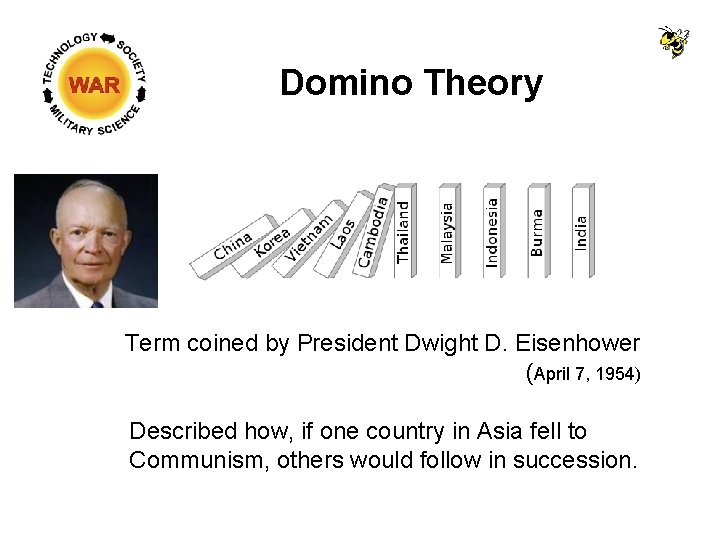
Domino Theory Term coined by President Dwight D. Eisenhower (April 7, 1954) Described how, if one country in Asia fell to Communism, others would follow in succession.
• Munich • Truman Doctrine (Containment) • Chinese Intervention in Korea • Domino Theory • Cuban Missile Crisis
Why Vietnam? What were the U. S. objectives in Vietnam? Stated: Preserve a non-Communist government in South Vietnam Understood: Containment
U. S. Attitude Toward Vietnam Eisenhower (1954 -1961): US Military Assistance • Trained ARVN to resist cross-border invasion Kennedy (1961 -1963): Counterinsurgency • Resisted by US military leaders Johnson (1963 -1969): Limited War • Attempted to force North Vietnam to negotiate Nixon (1969 -1973): Vietnamization • Increased pressure on North Vietnam to negotiate
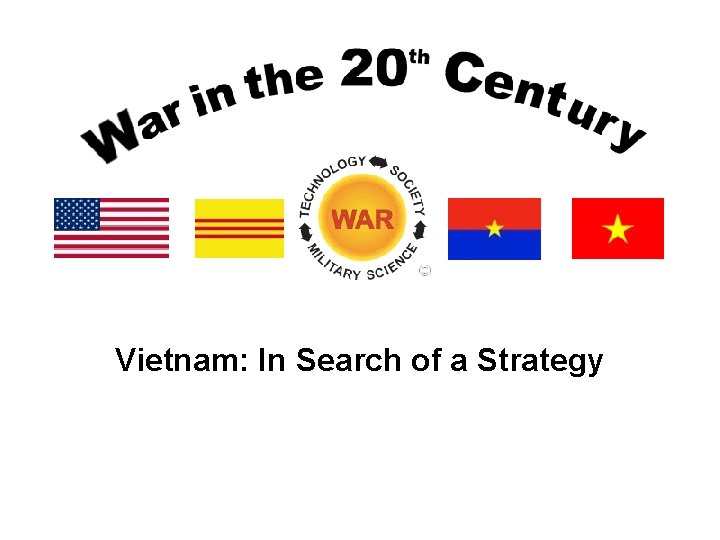
Vietnam: In Search of a Strategy
Review Strategy of Revolutionary War Phase I: Targeted state stronger militarily • Revolutionaries avoid combat • Guerrilla war: raids, ambushes, sabotage, terrorism • Political conflict predominant Phase II: Rough military parity • Combined guerrilla and conventional war • Military and political conflict equally important Phase III: Revolution stronger than targeted state • Revolutionary forces go to totally conventional war • “General Offensive” linked to political “Great Uprising”
Review Viet Minh Strategy As Used In First Indochina War Strategy of Revolutionary War Objective: The seizure of power in a nation-state … … by any means possible Characteristics: • Integrated military conflict and political conflict • War on multiple fronts • Geographical • Programmatic
Review Viet Minh Strategy North Vietnamese Strategy As used In First Indochina War Strategy of Revolutionary War Objective: The seizure of power in a nation-state … … by any means possible Characteristics: • Integrated military conflict and political conflict • War on multiple fronts • Geographical • Programmatic … just as they used against the French in the First Indochina War!
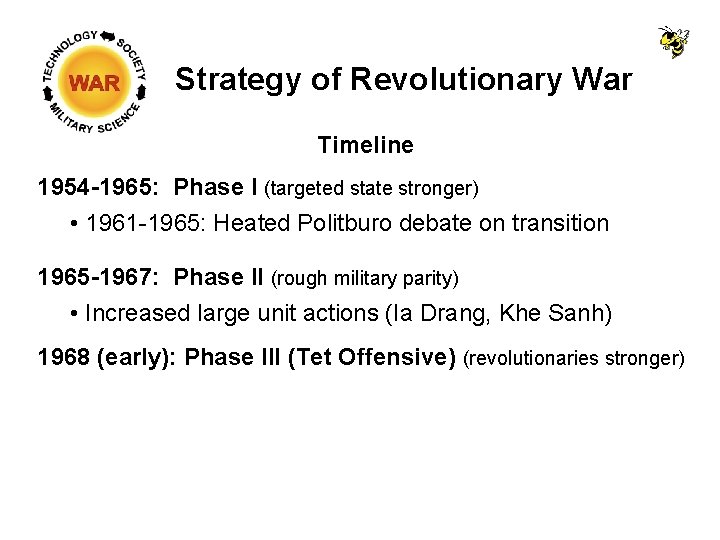
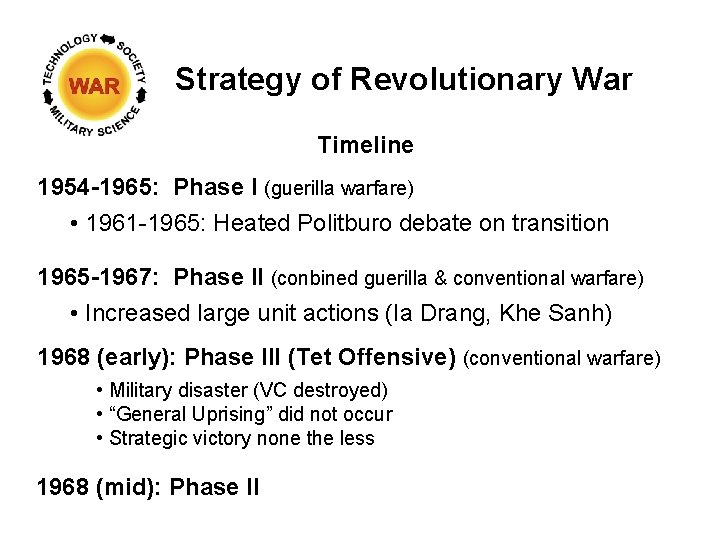
Strategy of Revolutionary War Timeline 1954 -1965: Phase I (targeted state stronger) • 1961 -1965: Heated Politburo debate on transition 1965 -1967: Phase II (rough military parity) • Increased large unit actions (Ia Drang, Khe Sanh) 1968 (early): Phase III (Tet Offensive) (revolutionaries stronger)
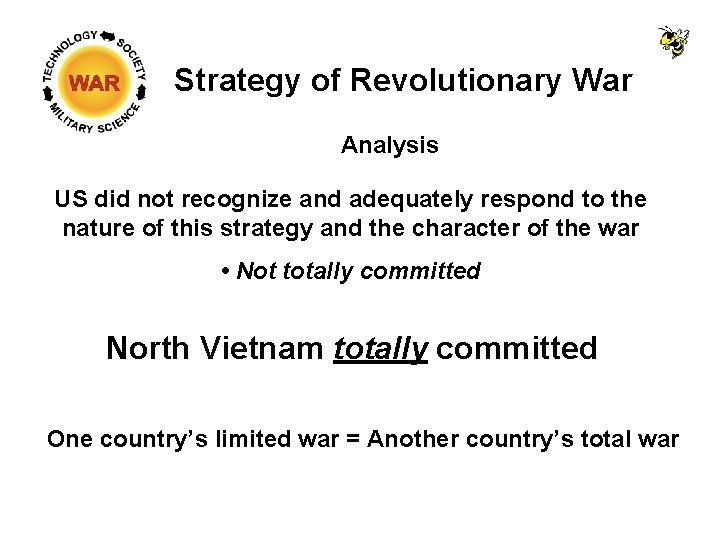
Strategy of Revolutionary War Analysis US did not recognize and adequately respond to the nature of this strategy and the character of the war • Not totally committed North Vietnam totally committed One country’s limited war = Another country’s total war
Strategy of Revolutionary War Timeline 1954 -1965: Phase I (targeted state stronger) • 1961 -1965: Heated Politburo debate on transition 1965 -1967: Phase II (rough military parity) • Increased large unit actions (Ia Drang, Khe Sanh) 1968 (early): Phase III (Tet Offensive) (revolutionaries stronger)
Vietnam: Great Society to Great Quagmire
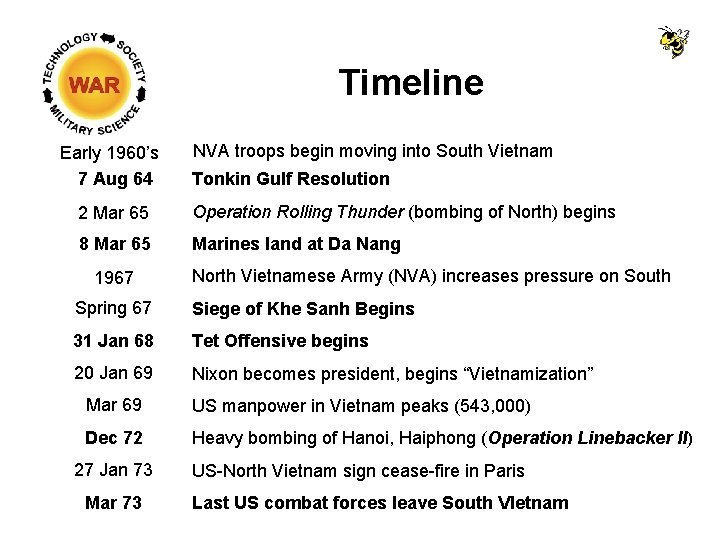
Timeline Early 1960’s NVA troops begin moving into South Vietnam 7 Aug 64 Tonkin Gulf Resolution 2 Mar 65 Operation Rolling Thunder (bombing of North) begins 8 Mar 65 Marines land at Da Nang 1967 North Vietnamese Army (NVA) increases pressure on South Spring 67 Siege of Khe Sanh Begins 31 Jan 68 Tet Offensive begins
Review LBJ’s Dilemma “In later years [Johnson] lamented: 'I knew from the start that I was bound to be crucified either way I moved. If I left the woman I really loved, the Great Society, in order to get involved in that bitch of a war on the other side of the world, I would lose everything at home. All my programs. . But if I left that war and let the communists take over South Vietnam, then I would be seen as a coward and my nation would be seen as an appeaser, and we would both find it impossible to accomplish anything for anybody anywhere on the entire globe. ’” Joshua Zeitz "1964 - The Year the Sixties Began" American Heritage, October 2006 Source
Review Strategy of Revolutionary War Phase I: Targeted state stronger militarily • Revolutionaries avoid combat • Guerrilla war: raids, ambushes, sabotage, terrorism • Political conflict predominant Phase II: Rough military parity • Combined guerrilla and conventional war • Military and political conflict equally important Phase III: Revolution stronger than targeted state • Revolutionary forces go to totally conventional war • “General Offensive” linked to political “Great Uprising”
Significance of Ia Drang First employment of Airmobile concept First major combat between US and NVA units Communist shift from Phase I to Phase II in Strategy of Revolutionary War
Strategy of Revolutionary War Timeline 1954 -1965: Phase I (guerilla warfare) • 1961 -1965: Heated Politburo debate on transition 1965 -1967: Phase II (combined guerilla & conventional warfare) • Increased large unit actions (Ia Drang, Khe Sanh)
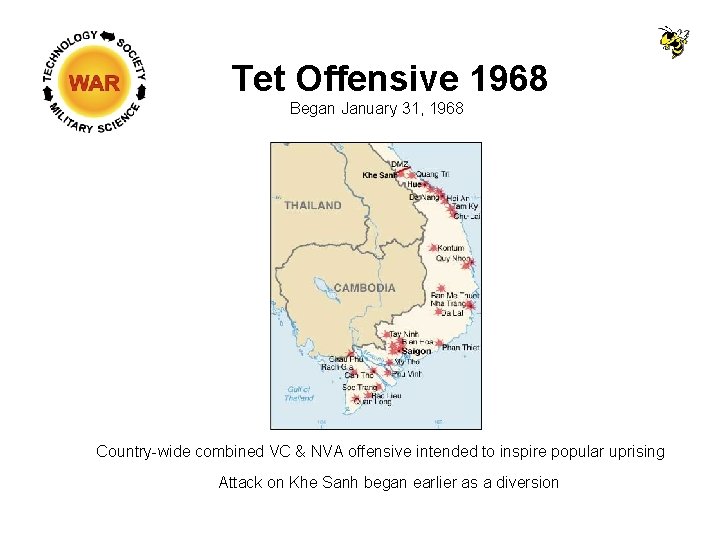
Tet Offensive 1968 Began January 31, 1968 Country-wide combined VC & NVA offensive intended to inspire popular uprising Attack on Khe Sanh began earlier as a diversion
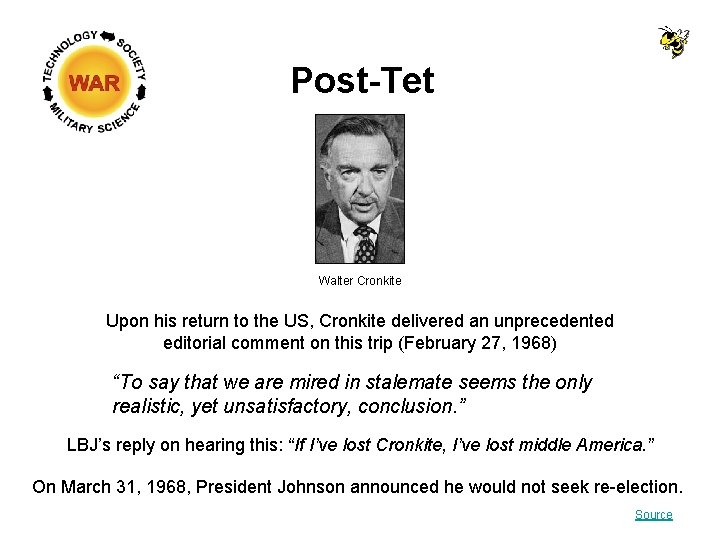
Post-Tet Walter Cronkite Upon his return to the US, Cronkite delivered an unprecedented editorial comment on this trip (February 27, 1968) “To say that we are mired in stalemate seems the only realistic, yet unsatisfactory, conclusion. ” LBJ’s reply on hearing this: “If I’ve lost Cronkite, I’ve lost middle America. ” On March 31, 1968, President Johnson announced he would not seek re-election. Source
Strategy of Revolutionary War Timeline 1954 -1965: Phase I (guerilla warfare) • 1961 -1965: Heated Politburo debate on transition 1965 -1967: Phase II (conbined guerilla & conventional warfare) • Increased large unit actions (Ia Drang, Khe Sanh) 1968 (early): Phase III (Tet Offensive) (conventional warfare) • Military disaster (VC destroyed) • “General Uprising” did not occur • Strategic victory none the less 1968 (mid): Phase II
Timeline Early 1960’s 7 Aug 64 NVA troops begin moving into South Vietnam Tonkin Gulf Resolution 2 Mar 65 Operation Rolling Thunder (bombing of North) begins 8 Mar 65 Marines land at Da Nang 1967 North Vietnamese Army (NVA) increases pressure on South Spring 67 Siege of Khe Sanh Begins 31 Jan 68 Tet Offensive begins 20 Jan 69 Nixon becomes president, begins “Vietnamization” Mar 69 US manpower in Vietnam peaks (543, 000) Dec 72 Heavy bombing of Hanoi, Haiphong (Operation Linebacker II) 27 Jan 73 Mar 73 US-North Vietnam sign cease-fire in Paris Last US combat forces leave South VIetnam
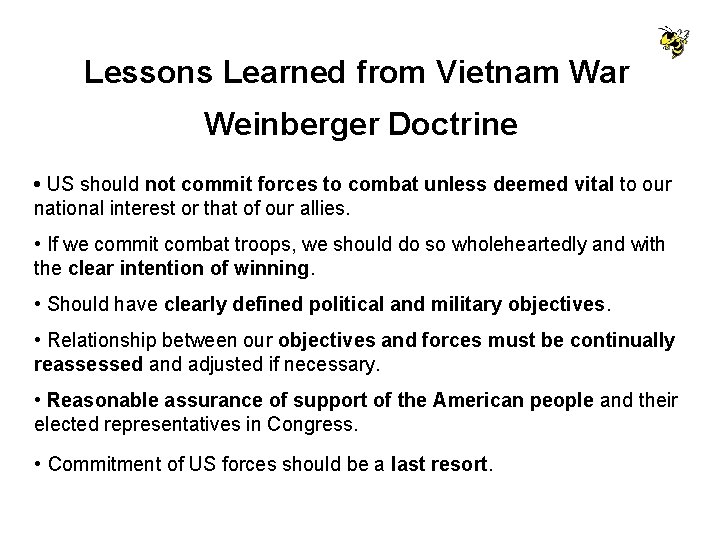
Lessons Learned from Vietnam War Weinberger Doctrine • US should not commit forces to combat unless deemed vital to our national interest or that of our allies. • If we commit combat troops, we should do so wholeheartedly and with the clear intention of winning. • Should have clearly defined political and military objectives. • Relationship between our objectives and forces must be continually reassessed and adjusted if necessary. • Reasonable assurance of support of the American people and their elected representatives in Congress. • Commitment of US forces should be a last resort.
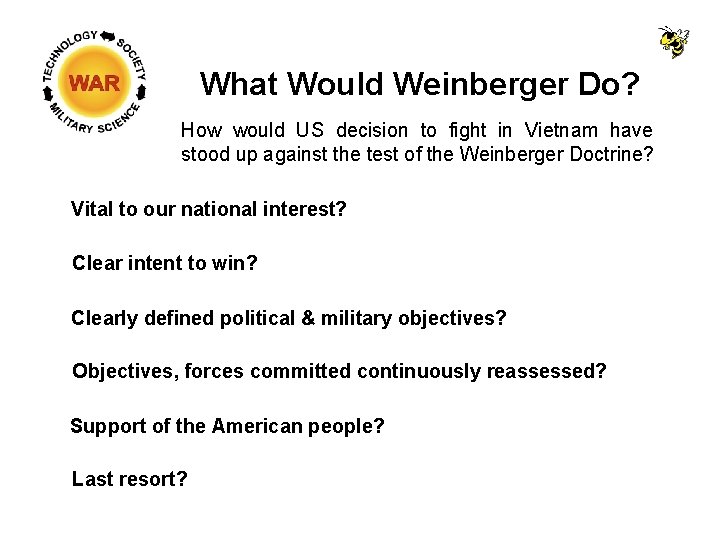
What Would Weinberger Do? How would US decision to fight in Vietnam have stood up against the test of the Weinberger Doctrine? Vital to our national interest? Clear intent to win? Clearly defined political & military objectives? Objectives, forces committed continuously reassessed? Support of the American people? Last resort?
Vietnam: Peace With Honor
Major Issues What was Vietnamization? What was the impact of the Cambodian Incursion on the US domestic situation? • Specifically, how did Congress react to the Cambodian incursion? What was Lam Son 719? • How did Lam Son 719 reflect on the Vietnamization effort? What were the results of the Easter (Spring) Offensive of 1972? What action did the US take as a result of the Easter (Spring) Offensive of 1972? What was Linebacker II and what was its objective?
Review US Strategy in Vietnam JCS Proposal 1965 • Build a Korean-war style defensive line across DMZ • Conduct operations into Laos to permanently cut supply lines (Ho Chi Minh Trail) • Proposed by Westmoreland in 1967, again in 1968 • Never approved or rejected by LBJ, Sec. Def Summers In 1971, President Nixon approved the plan
Lam Son 719 8 February - 25 March 1971 Results: Casualties: US: 215 KIA ARVN: 1, 500 -3, 500 KIA * NVA: 2, 000 KIA (estimated) Some NVA weapons, ammo, food captured ARVN did not perform well in face of stiff NVA resistance • Poor planning and execution by ARVN leadership Generally regarded as indicating a failure of Vietnamization * ARVN reports vary
Easter (Spring) Offensive March 30 - October 22, 1972 Major conventional invasion on three fronts: • Across DMZ • Central Highlands • West of Saigon ARVN performed reasonably well with US air support DRV gained valuable space inside RVN for future offensives • Also gained bargaining chip in negotiations Nixon initiated Operation Linebacker (May 9 - October 23, 1972) • Bombing of North Vietnamese logistics targets Nixon began planning for Linebacker II • Sustained bombing of North Vietnamese strategic targets
Paris Peace Accords January 23, 1973 Major Provisions: US troops would leave Vietnam by 1973 North Vietnamese troops would remain in South Vietnamese government would remain
Congress and the War Use of Budget to Restrict Operations in SEA Case-Church Amendment (1973) • After Paris Peace Accords (Jan 1973), Nixon hinted at US intervention if North Vietnam attacked South • Introduced by Senators Clifford Case (R‐NJ) & Frank Church (D‐ID) • Prohibited U. S. military activity in Vietnam, Laos and Cambodia after August 15, 1973 without Congressional approval. • Passed by Senate 64 -26, House 278 -124 (June 1973) Significance: Essentially ended US military activity in Southeast Asia
Vietnam War in Retrospect
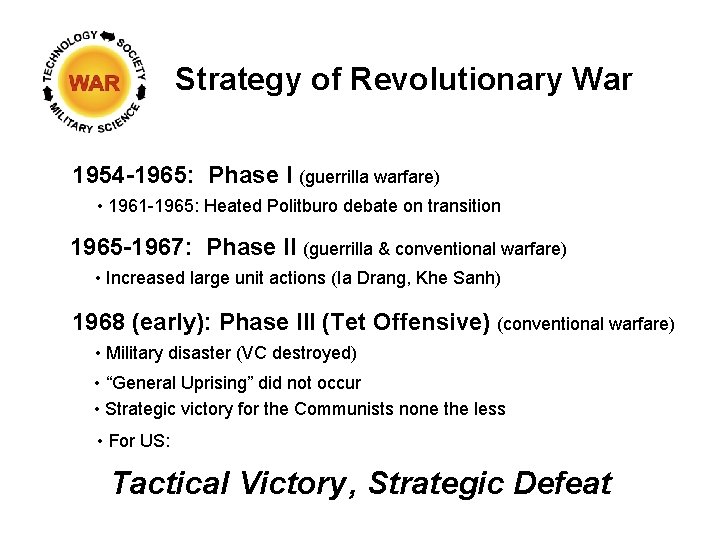
Strategy of Revolutionary War 1954 -1965: Phase I (guerrilla warfare) • 1961 -1965: Heated Politburo debate on transition 1965 -1967: Phase II (guerrilla & conventional warfare) • Increased large unit actions (Ia Drang, Khe Sanh) 1968 (early): Phase III (Tet Offensive) (conventional warfare) • Military disaster (VC destroyed) • “General Uprising” did not occur • Strategic victory for the Communists none the less • For US: Tactical Victory , Strategic Defeat
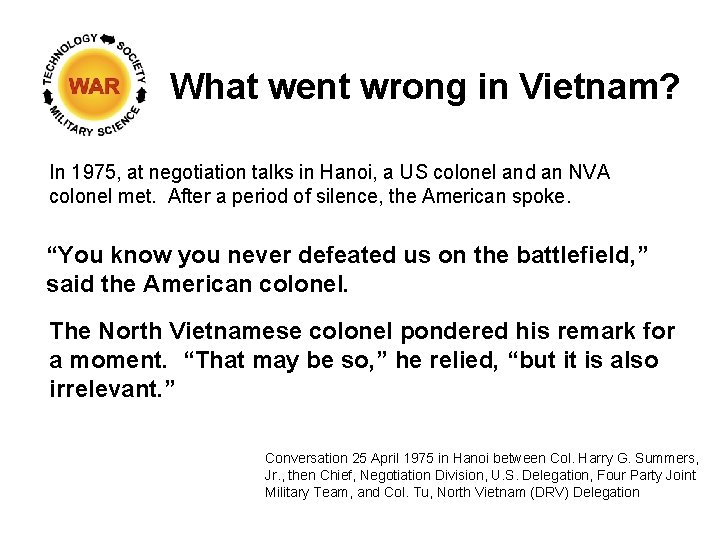
What went wrong in Vietnam? In 1975, at negotiation talks in Hanoi, a US colonel and an NVA colonel met. After a period of silence, the American spoke. “You know you never defeated us on the battlefield, ” said the American colonel. The North Vietnamese colonel pondered his remark for a moment. “That may be so, ” he relied, “but it is also irrelevant. ” Conversation 25 April 1975 in Hanoi between Col. Harry G. Summers, Jr. , then Chief, Negotiation Division, U. S. Delegation, Four Party Joint Military Team, and Col. Tu, North Vietnam (DRV) Delegation
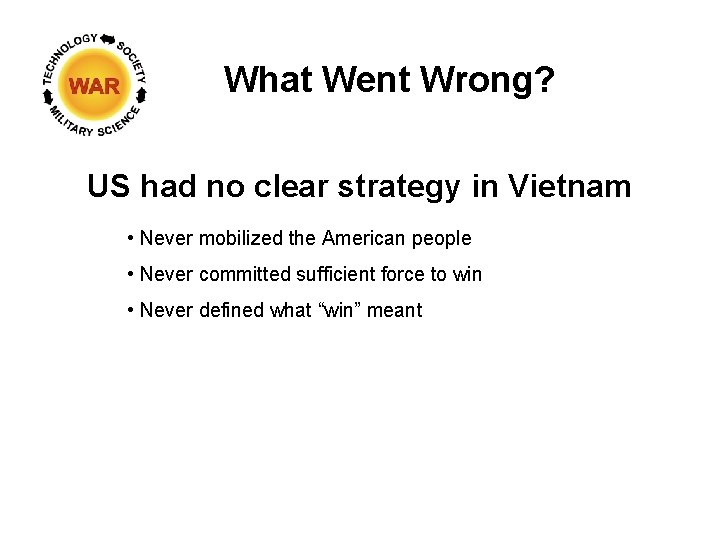
What Went Wrong? US had no clear strategy in Vietnam • Never mobilized the American people • Never committed sufficient force to win • Never defined what “win” meant
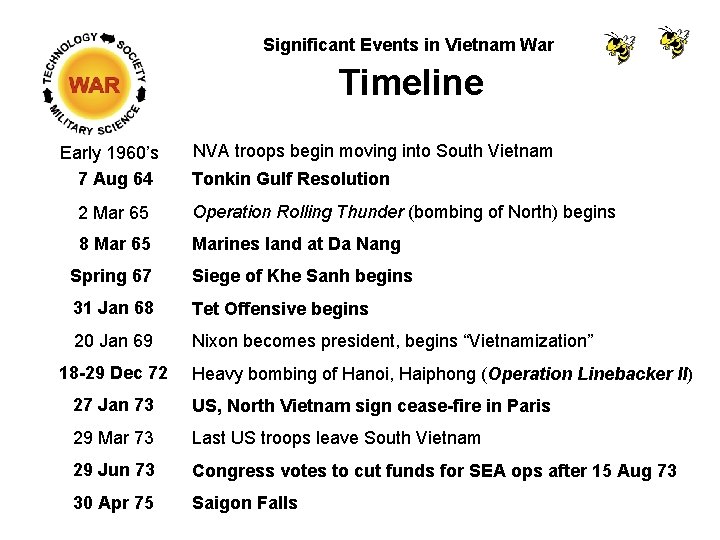
Significant Events in Vietnam War Timeline Early 1960’s 7 Aug 64 NVA troops begin moving into South Vietnam Tonkin Gulf Resolution 2 Mar 65 Operation Rolling Thunder (bombing of North) begins 8 Mar 65 Marines land at Da Nang Spring 67 Siege of Khe Sanh begins 31 Jan 68 Tet Offensive begins 20 Jan 69 Nixon becomes president, begins “Vietnamization” 18 -29 Dec 72 Heavy bombing of Hanoi, Haiphong (Operation Linebacker II) 27 Jan 73 US, North Vietnam sign cease-fire in Paris 29 Mar 73 Last US troops leave South Vietnam 29 Jun 73 Congress votes to cut funds for SEA ops after 15 Aug 73 30 Apr 75 Saigon Falls
Weinberger Doctrine • The United States should not commit forces to combat overseas unless the particular engagement or occasion is deemed vital to our national interest or that of our allies. . • If we decide it is necessary to put combat troops into a given situation, we should do so wholeheartedly and with the clear intention of winning. . • If we do decide to commit forces to combat overseas, we should have clearly defined political and military objectives. . • The relationship between our objectives and the forces we have committed -- their size, composition, and disposition -- must be continually reassessed and adjusted if necessary. . • Before the United States commits combat forces abroad, there must be some reasonable assurance we will have the support of the American people and their elected representatives in Congress. . • The commitment of US forces to combat should be a last resort.
What Would Weinberger Do? How would US decision to fight in Vietnam have stood up against the test of the Weinberger Doctrine? Vital to our national interest? Clear intent to win? Clearly defined political & military objectives? Objectives, forces committed continuously reassessed? Support of the American people? Last resort?
Lesson 30 Finishing Touches
Course Objectives The successful student will gain the historical foundation and framework to support informed discussion and analysis of modern warfare, its causes, conduct, and consequences.
Course Objectives Specifically, the successful student will be able to: • Understand trace the historical roots of the strategies, operational concepts, and weapons employed in modern wars. • Trace key technological threads in the history of warfare and appreciate their continuing significance in modern war. • Understand the concept of revolutions in military affairs and their impact on warfare in the 20 th century and beyond. • Understand the impacts of modern war on society and society on modern war. • Develop an historical appreciation for the moral and ethical issues of modern war. • Understand historical trends in the Law of Armed Conflict and other initiatives to limit the impact of war on society.
Threads & Themes • The Circle of Modern War: Society < = > Technology < = > Military Science < = > Society • Match/Mismatch between national objectives and national strategy • Core technologies: metallurgy, chemistry, physics, mechanics, electronics • Core Weapons: Infantry weapons, artillery, naval armament, aircraft • Logistics as the lynchpin of modern war • Offense vs. defense • Revolutions in Military Affairs (RMA)
Points of Emphasis Levels of War Instruments of National Power Weinberger’s Six Tests for Going to War Total War Causes, Conduct & Consequences of Wars
Course Review Focus your review on the highlight slides for each of the three blocks of instruction • These are grouped at the end of the Lectures page (click) The material for Lessons 22 -30 (starting with the A-bomb lecture) will be on the exam in questions much like these in Exams 1 & 2 (short answers, identification, chronology, etc. ) The material from Lessons 1 -10 and 12 -21 will be used in broader concept questions addressing the major themes of the course. • There will be a few repeat detail questions from Exams 1 & 2 • Be sure the review the ones you missed!
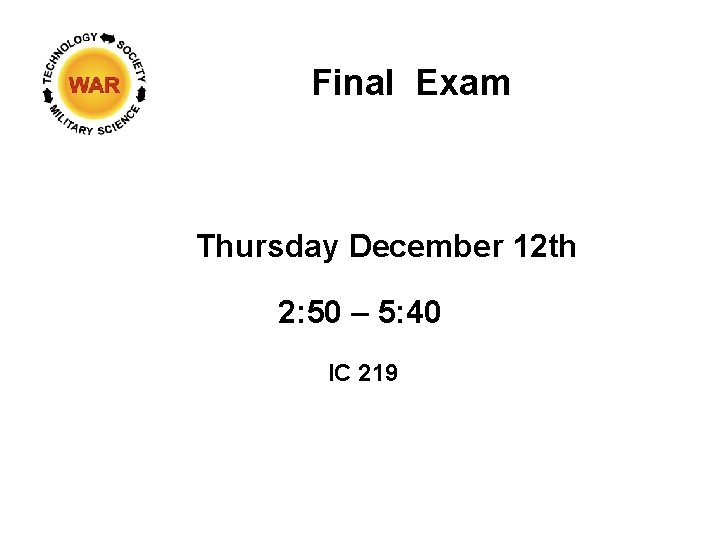
Final Exam Thursday December 12 th 2: 50 – 5: 40 IC 219