
LESSON 23 452 478 History of Political Parties
- Slides: 22
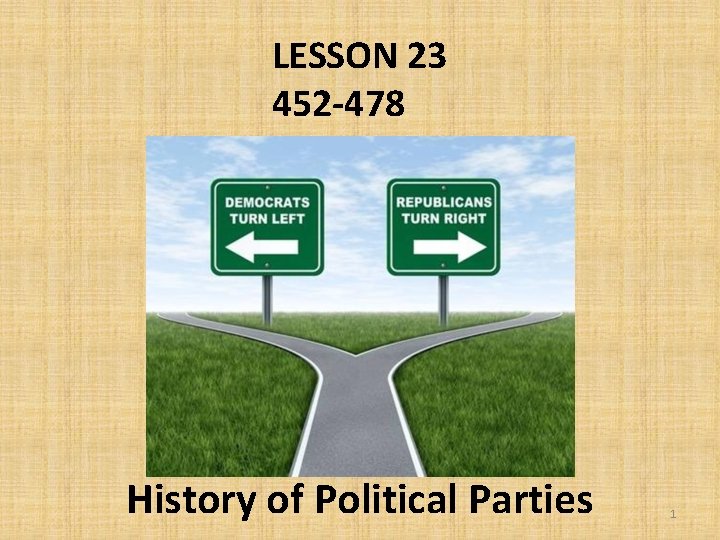
LESSON 23 452 -478 History of Political Parties 1
WHAT IS A POLITICAL PARTY? • A group of people seeking to control government by gaining office in elections and determining public policy 2
WHAT IS A POLITICAL PARTY? THREE COMPONENTS OF PARTIES • Party-in-Government. Party leaders occupy positions in: – Presidency – Congress – State governors – State legislatures – Local governments (though sometimes these are nonpartisan positions) 3
WHAT IS A POLITICAL PARTY? THREE COMPONENTS OF PARTIES • Party-in-Electorate – Registered Democrats – Democratic identifiers/leaners – Registered Republicans – Republican identifiers/leaners 4
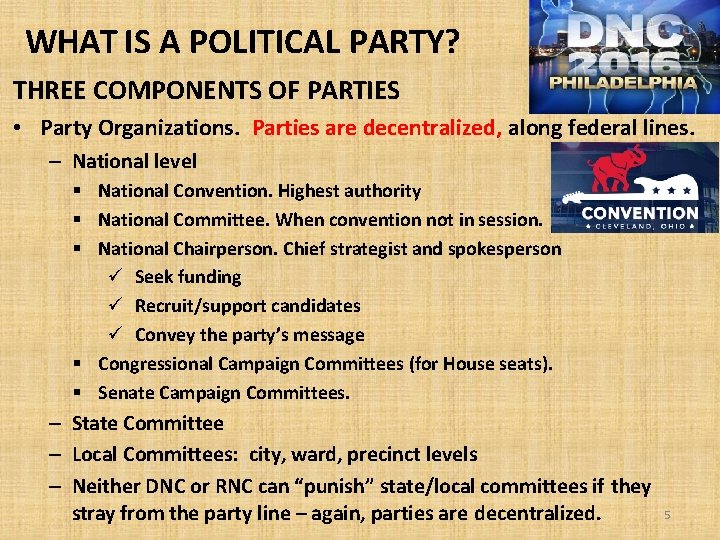
WHAT IS A POLITICAL PARTY? THREE COMPONENTS OF PARTIES • Party Organizations. Parties are decentralized, along federal lines. – National level National Convention. Highest authority National Committee. When convention not in session. National Chairperson. Chief strategist and spokesperson ü Seek funding ü Recruit/support candidates ü Convey the party’s message Congressional Campaign Committees (for House seats). Senate Campaign Committees. – State Committee – Local Committees: city, ward, precinct levels – Neither DNC or RNC can “punish” state/local committees if they stray from the party line – again, parties are decentralized. 5
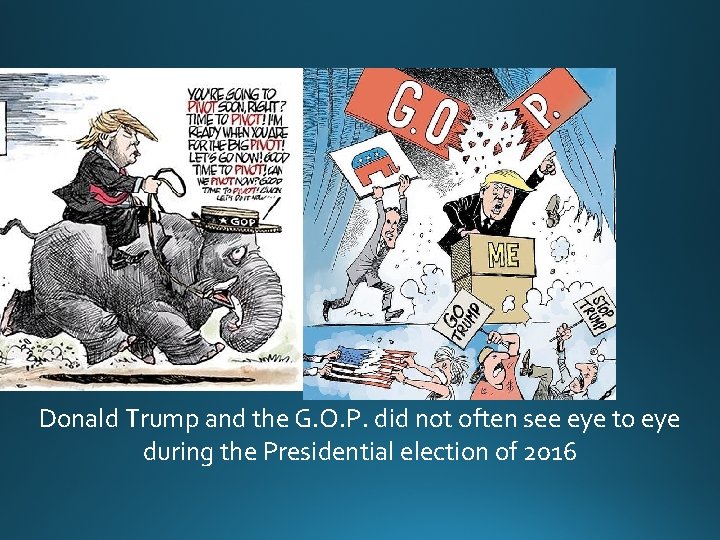
Donald Trump and the G. O. P. did not often see eye to eye during the Presidential election of 2016
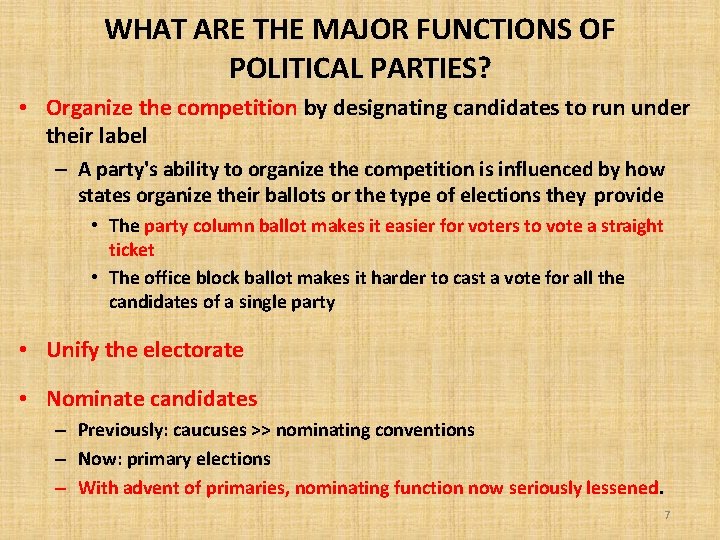
WHAT ARE THE MAJOR FUNCTIONS OF POLITICAL PARTIES? • Organize the competition by designating candidates to run under their label – A party's ability to organize the competition is influenced by how states organize their ballots or the type of elections they provide • The party column ballot makes it easier for voters to vote a straight ticket • The office block ballot makes it harder to cast a vote for all the candidates of a single party • Unify the electorate • Nominate candidates – Previously: caucuses >> nominating conventions – Now: primary elections – With advent of primaries, nominating function now seriously lessened. 7
WHAT ARE THE MAJOR FUNCTIONS OF POLITICAL PARTIES? • Control over many of these functions has been declining • Provide “loyal opposition” • Agents of political socialization • Linking mechanism between people and government • Provide Patronage • Register voters, mobilize voters, and get them to the polls 8
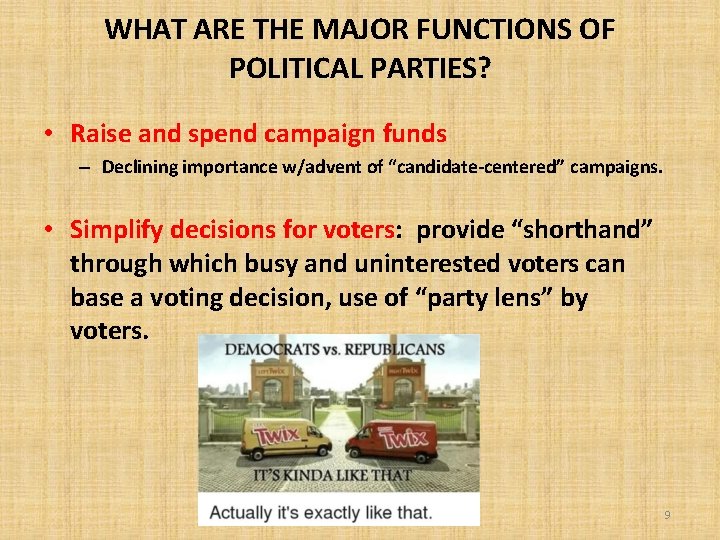
WHAT ARE THE MAJOR FUNCTIONS OF POLITICAL PARTIES? • Raise and spend campaign funds – Declining importance w/advent of “candidate-centered” campaigns. • Simplify decisions for voters: provide “shorthand” through which busy and uninterested voters can base a voting decision, use of “party lens” by voters. 9
WHAT ARE THE MAJOR FUNCTIONS OF POLITICAL PARTIES? • Act as Moderating Influence on Government – To win elections, parties must usually nominate moderate candidates who appeal to the vast center of the American electorate. Fringe elements squeezed out. – Criticism: To appeal to such a wide variety of party members, parties must avoid taking strong stands • Inform public about political issues through party platforms – However, few people check platforms, which in any case are often broadly-worded, i. e. , like train platforms: “something to get on rather than something to stand on. ” 10
RISE OF POLITICAL PARTIES OUR FIRST PARTIES • Dangers of factions mentioned by Madison in Federalist #10 and Washington’s warning about the “baneful effects of the spirit of party. ” • Parties became necessary to get things done, e. g. , Hamilton’s financial plan and support for Jefferson’s Louisiana Purchase. • Necessity of an institution that unifies government in order to overcome the systems of separation of powers and checks and balances that divide government. 11
RISE OF POLITICAL PARTIES Historical development: the Six Party Systems in American history. Realignment occurs roughly every 36 years or so. • 1796 -1820: 1 st party system – Federalists v. Jeffersonian Democratic-Republicans • 1824 -1856: 2 nd party system – Jacksonian Democrats v. Whigs • 1860 -1892: 3 rd party system (Post Civil War) – Republican dominance as the party against slavery and the party that put the Union back together. • 1896 -1928: 4 th party system (Post Reconstruction) – Second period of Republican dominance with its coalition of big business and the working classes against the Democratic rural interests. • 1932 -1964: 5 th party system (Post Depression) – Democratic dominance begun under FDR and the New Deal. FDR’s grand coalition included urban dwellers, labor unions, Catholics, Jews, the poor, Southerners, Blacks, farmers. 12
RISE OF POLITICAL PARTIES Historical development: the Six Party Systems in American history. Realignment occurs roughly every 36 years or so. • 1968 -present: 6 th party system – Era of Divided Government and Dealignment • Much split ticket voting • Presidents of one party (typically Republican) with Congresses of the opposite party (typically Democratic). • An era of party dealignment, as voters are moving away from both parties and are increasingly independent. • Nixon (“Southern strategy”) and Reagan built a coalition of disenchanted white suburban middle class, Southern white Protestants, big business • Clinton won twice in part because of his resurrection of FDR’s grand coalition, especially Southern middle class moderates (“Reagan Democrats”). Women’s votes were also decisive. • Election of 2000 gave us a Republican president who won only a minority of popular votes, a 50 -50 Senate (which became a 50 -49 -1 Democratic Senate after Jeffords defection), and a House w/a narrow Republican majority 13
DIVIDED GOVERNMENT • Since 1953, we have had divided government twice as often as we have had one party in control of both legislative and executive branches • Republican President and a Democratic Congress (control of even one house) or Democratic President & Republican Congress (control of even one house) • Relative party strengths – National Government 2013 -2015 • President: Democrat • House: 246 Republicans, 188 Democrats, 1 vacancy (114 th Congress) • Senate: 54 Republicans, 44 Democrats, 2 Independents (114 th Congress) 14
REALIGNMENT AND CRITICAL ELECTIONS • Realignment – Sharp changes in issues, party leaders, the regional and demographic bases of power of the two parties, and structure or rules of the political system resulting in a new political power structure. 15
REALIGNMENT AND CRITICAL ELECTIONS • A "critical" election usually serves as the basis for realignment. • Characteristics – – Intense electoral involvement by the voters Disruptions of traditional voting patterns Changes in the relations of power within the community The formation of new and durable electoral groups • Four critical (or realigning) elections (each realignment lasts roughly 36 years) – – – 1824: Andrew Jackson and the Democrats 1860: The Civil War and the rise of the Republicans 1896: A Party in transition 1932: Franklin Roosevelt and the New Deal alignment 1968: Nixon? 16
DEALIGNMENT • Dealignment – Process whereby a large portion of the electorate abandons its previous partisan affiliation without developing a new one to replace it – It is contrasted with realignment • We are experiencing dealignment – People have abandoned both parties to become Independents – However, most Independents are really partisans in their voting behavior and attitudes • Dealignment has led to ticket splitting in recent times 17
DEALIGNMENT • Other factors that have weakened the parties and contributed to dealignment – Candidate-centered campaigns (especially after FECA) – Public disenchantment with parties and politics during the 60's – Growth of interest groups – have taken on some party functions – Development of mass media – candidates rely on media rather than party organization to get message across – Growth of political independents – Trend to “vote the man, not the party” and rise of ticket splitting (voting for candidates from both political parties) 18
MINOR (THIRD) PARTIES TYPES • Ideological – Communist Party, Libertarian Party • Single issue – Free Soil opposed the spread of slavery – Right to Life opposes abortion – Know Nothings opposed Irish-Catholic immigration • Parties centered around a strong personality – Teddy Roosevelt’s Bull Moose Party – George Wallace’s American Independent Party – Ross Perot's Reform Party 19
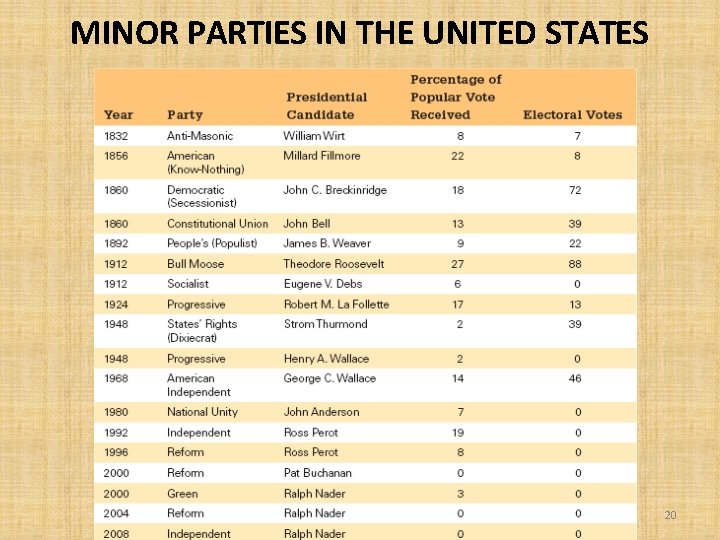
MINOR PARTIES IN THE UNITED STATES 20
MINOR (THIRD) PARTIES CONTRIBUTIONS OF THIRD PARTIES • Raise issues that other parties must address, and often incorporate into their own party platforms. “Champions not of lost causes, but of causes yet to be won” (e. g. , Populist Party: direct election of senators, income tax, etc. ) • Voice for the fringe elements in society • Safety valve for discontent in society EFFECTS OF THIRD PARTIES • Rarely win elections • Influence the outcome of presidential elections (e. g. , 1968, 1992, 2000): “spoiler role” 21
MINOR (THIRD) PARTIES OBSTACLES – Why they do not win! • Two-party tradition (because of single-member legislative districts) • Single-member, winner-take-all, plurality district system for congressional seats, as opposed to the multi-member, proportional system that is common in other countries • Electoral College’s Winner-Take-All system: Perot won 19% of the vote in 1992, but had zero electoral votes. • Getting candidates on the ballot – Democrat and Republican candidates are automatically placed on state ballots – Minor party candidates must persuade registered voters to sign petitions in order to have their names placed on the ballot. • Money • Media coverage • Exclusion from TV debates 22