
Lesson 22 Trigonometric Identities IB Math HL 12252021
Lesson 22 - Trigonometric Identities IB Math HL 12/25/2021 HL Math - Santowski 1
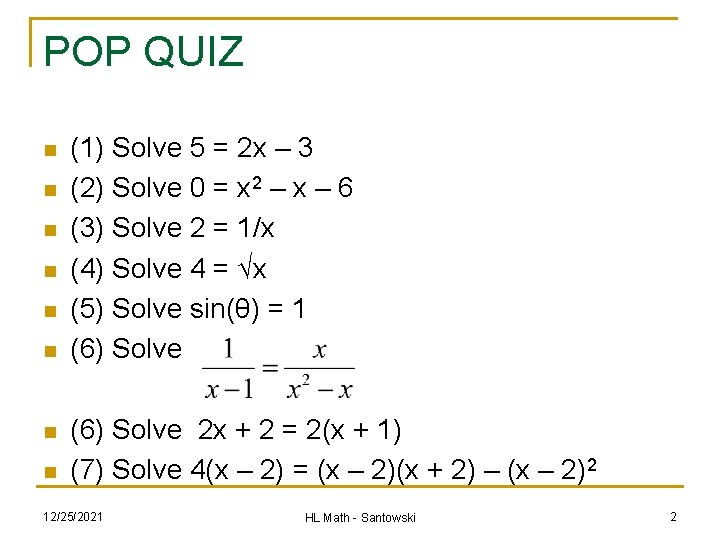
POP QUIZ n n n n (1) Solve 5 = 2 x – 3 (2) Solve 0 = x 2 – x – 6 (3) Solve 2 = 1/x (4) Solve 4 = √x (5) Solve sin(θ) = 1 (6) Solve 2 x + 2 = 2(x + 1) (7) Solve 4(x – 2) = (x – 2)(x + 2) – (x – 2)2 12/25/2021 HL Math - Santowski 2
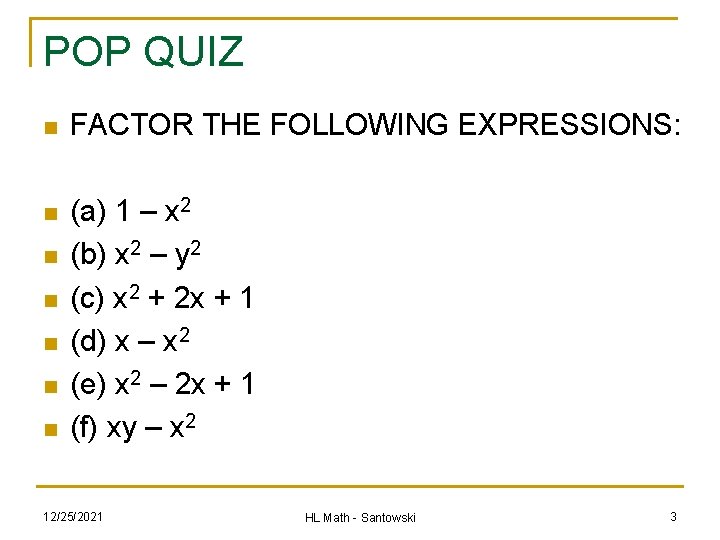
POP QUIZ n FACTOR THE FOLLOWING EXPRESSIONS: n (a) 1 – x 2 (b) x 2 – y 2 (c) x 2 + 2 x + 1 (d) x – x 2 (e) x 2 – 2 x + 1 (f) xy – x 2 n n n 12/25/2021 HL Math - Santowski 3
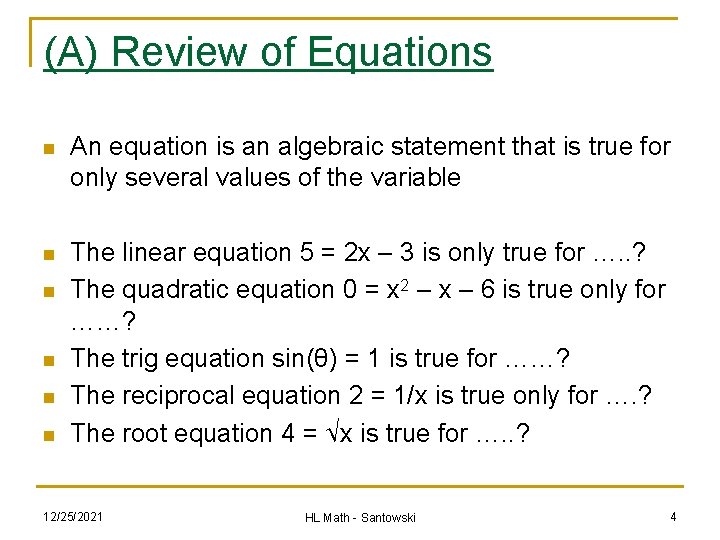
(A) Review of Equations n An equation is an algebraic statement that is true for only several values of the variable n The linear equation 5 = 2 x – 3 is only true for …. . ? The quadratic equation 0 = x 2 – x – 6 is true only for ……? The trig equation sin(θ) = 1 is true for ……? The reciprocal equation 2 = 1/x is true only for …. ? The root equation 4 = √x is true for …. . ? n n 12/25/2021 HL Math - Santowski 4
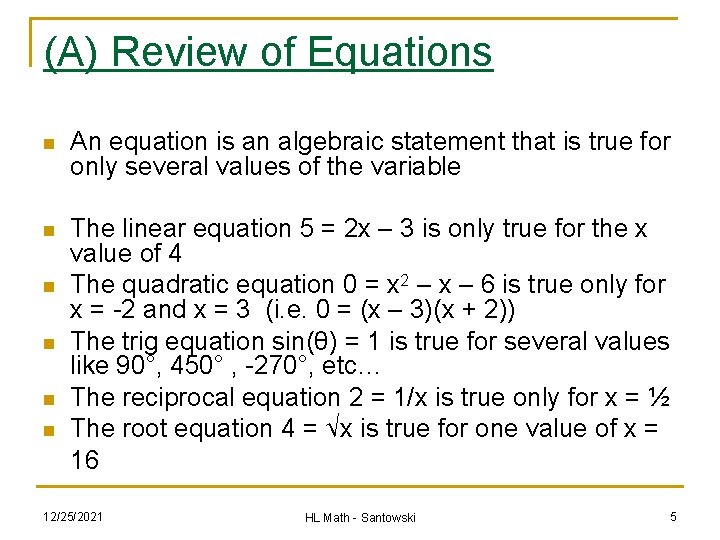
(A) Review of Equations n An equation is an algebraic statement that is true for only several values of the variable n The linear equation 5 = 2 x – 3 is only true for the x value of 4 The quadratic equation 0 = x 2 – x – 6 is true only for x = -2 and x = 3 (i. e. 0 = (x – 3)(x + 2)) The trig equation sin(θ) = 1 is true for several values like 90°, 450° , -270°, etc… The reciprocal equation 2 = 1/x is true only for x = ½ The root equation 4 = √x is true for one value of x = 16 n n 12/25/2021 HL Math - Santowski 5
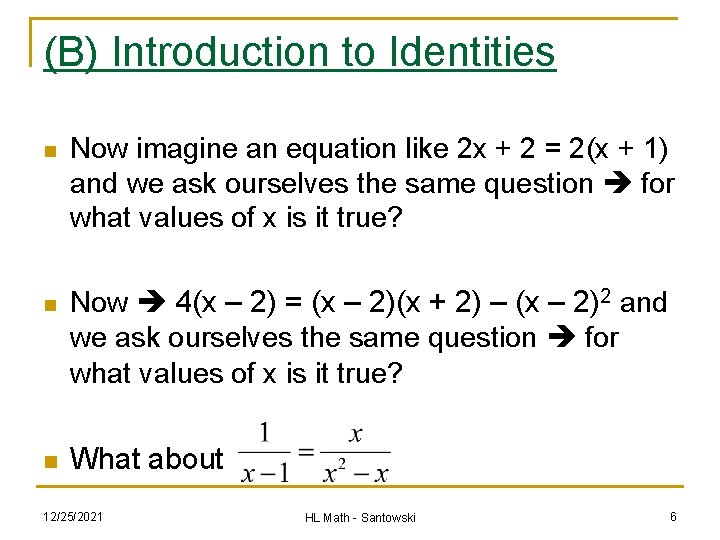
(B) Introduction to Identities n n n Now imagine an equation like 2 x + 2 = 2(x + 1) and we ask ourselves the same question for what values of x is it true? Now 4(x – 2) = (x – 2)(x + 2) – (x – 2)2 and we ask ourselves the same question for what values of x is it true? What about 12/25/2021 HL Math - Santowski 6

(B) Introduction to Identities n n n Now imagine an equation like 2 x + 2 = 2(x + 1) and we ask ourselves the same question for what values of x is it true? We can actually see very quickly that the right side of the equation expands to 2 x + 2, so in reality we have an equation like 2 x + 2 = 2 x + 2 But the question remains for what values of x is the equation true? ? Since both sides are identical, it turns out that the equation is true for ANY value of x we care to substitute! So we simply assign a slightly different name to these special equations we call them IDENTITIES because they are true for ALL values of the variable! 12/25/2021 HL Math - Santowski 7
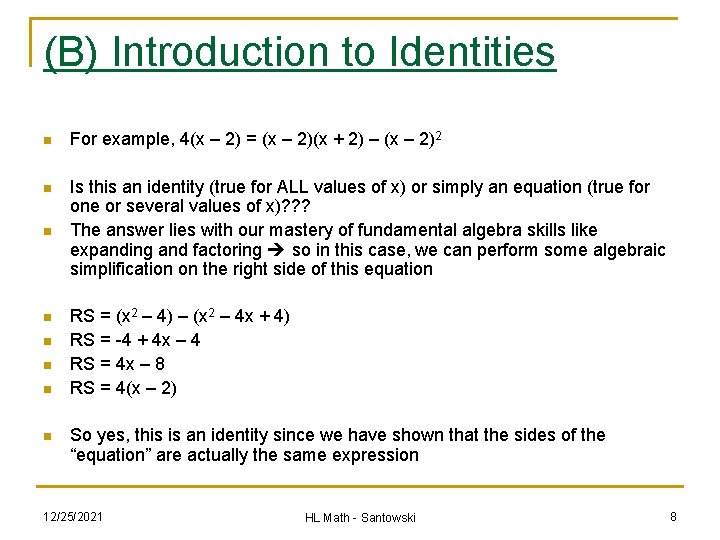
(B) Introduction to Identities n For example, 4(x – 2) = (x – 2)(x + 2) – (x – 2)2 n Is this an identity (true for ALL values of x) or simply an equation (true for one or several values of x)? ? ? The answer lies with our mastery of fundamental algebra skills like expanding and factoring so in this case, we can perform some algebraic simplification on the right side of this equation n n n RS = (x 2 – 4) – (x 2 – 4 x + 4) RS = -4 + 4 x – 4 RS = 4 x – 8 RS = 4(x – 2) So yes, this is an identity since we have shown that the sides of the “equation” are actually the same expression 12/25/2021 HL Math - Santowski 8
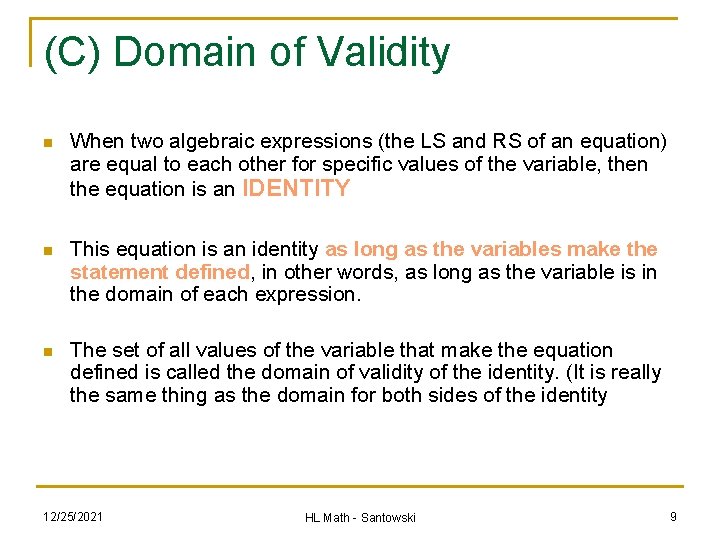
(C) Domain of Validity n When two algebraic expressions (the LS and RS of an equation) are equal to each other for specific values of the variable, then the equation is an IDENTITY n This equation is an identity as long as the variables make the statement defined, in other words, as long as the variable is in the domain of each expression. n The set of all values of the variable that make the equation defined is called the domain of validity of the identity. (It is really the same thing as the domain for both sides of the identity 12/25/2021 HL Math - Santowski 9
(C) Basic Trigonometric Identities n Quotient Identity 12/25/2021 HL Math - Santowski 10
(C) Basic Trigonometric Identities n n Recall our definitions for sin(θ) = o/h, cos(θ) = a/h and tan(θ) = o/a So now one trig identity can be introduced if we take sin(θ) and divide by cos(θ), what do we get? sin(θ) = o/h = o = tan(θ) cos(θ) a/h a n So the tan ratio is actually a quotient of the sine ratio divided by the cosine ratio n What would the cotangent ratio then equal? 12/25/2021 HL Math - Santowski 11
(C) Basic Trigonometric Identities n So the tan ratio is actually a quotient of the sine ratio divided by the cosine ratio n We can demonstrate this in several ways we can substitute any value for θ into this equation and we should notice that both sides always equal the same number Or we can graph f(θ) = sin(θ)/cos(θ) as well as f(θ) = tan(θ) and we would notice that the graphs were identical n n This identity is called the QUOTIENT identity 12/25/2021 HL Math - Santowski 12
(C) Basic Trigonometric Identities n Pythagorean Identity 12/25/2021 HL Math - Santowski 13
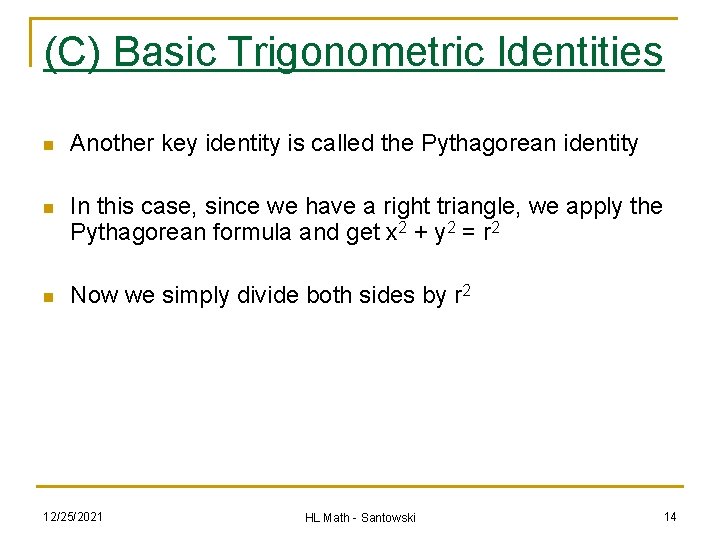
(C) Basic Trigonometric Identities n Another key identity is called the Pythagorean identity n In this case, since we have a right triangle, we apply the Pythagorean formula and get x 2 + y 2 = r 2 n Now we simply divide both sides by r 2 12/25/2021 HL Math - Santowski 14
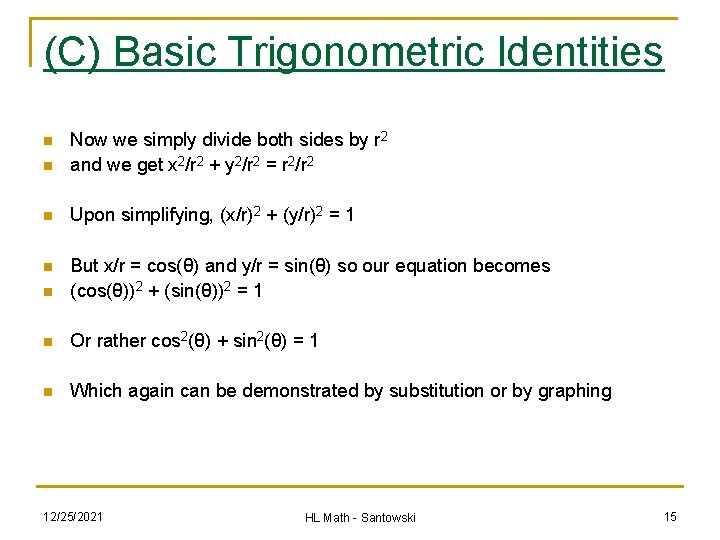
(C) Basic Trigonometric Identities n Now we simply divide both sides by r 2 and we get x 2/r 2 + y 2/r 2 = r 2/r 2 n Upon simplifying, (x/r)2 + (y/r)2 = 1 n n But x/r = cos(θ) and y/r = sin(θ) so our equation becomes (cos(θ))2 + (sin(θ))2 = 1 n Or rather cos 2(θ) + sin 2(θ) = 1 n Which again can be demonstrated by substitution or by graphing n 12/25/2021 HL Math - Santowski 15
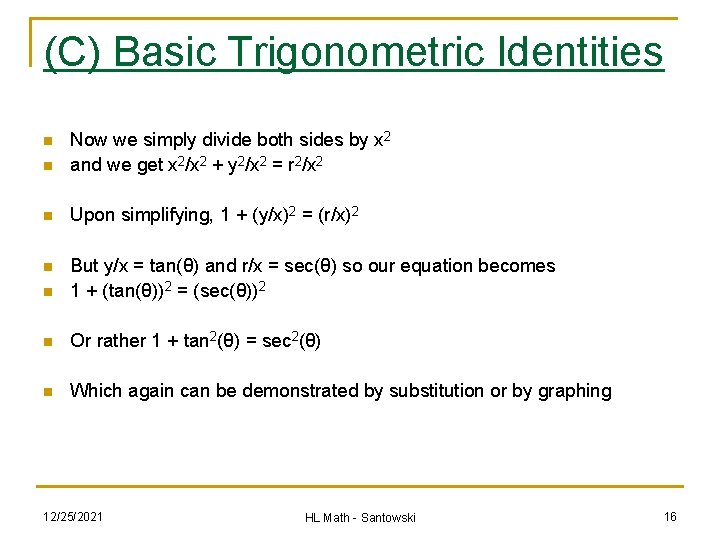
(C) Basic Trigonometric Identities n Now we simply divide both sides by x 2 and we get x 2/x 2 + y 2/x 2 = r 2/x 2 n Upon simplifying, 1 + (y/x)2 = (r/x)2 n n But y/x = tan(θ) and r/x = sec(θ) so our equation becomes 1 + (tan(θ))2 = (sec(θ))2 n Or rather 1 + tan 2(θ) = sec 2(θ) n Which again can be demonstrated by substitution or by graphing n 12/25/2021 HL Math - Santowski 16
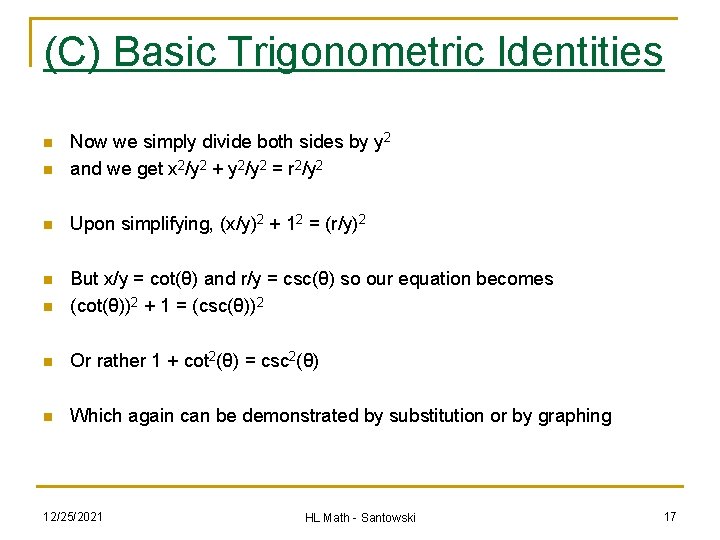
(C) Basic Trigonometric Identities n Now we simply divide both sides by y 2 and we get x 2/y 2 + y 2/y 2 = r 2/y 2 n Upon simplifying, (x/y)2 + 12 = (r/y)2 n n But x/y = cot(θ) and r/y = csc(θ) so our equation becomes (cot(θ))2 + 1 = (csc(θ))2 n Or rather 1 + cot 2(θ) = csc 2(θ) n Which again can be demonstrated by substitution or by graphing n 12/25/2021 HL Math - Santowski 17
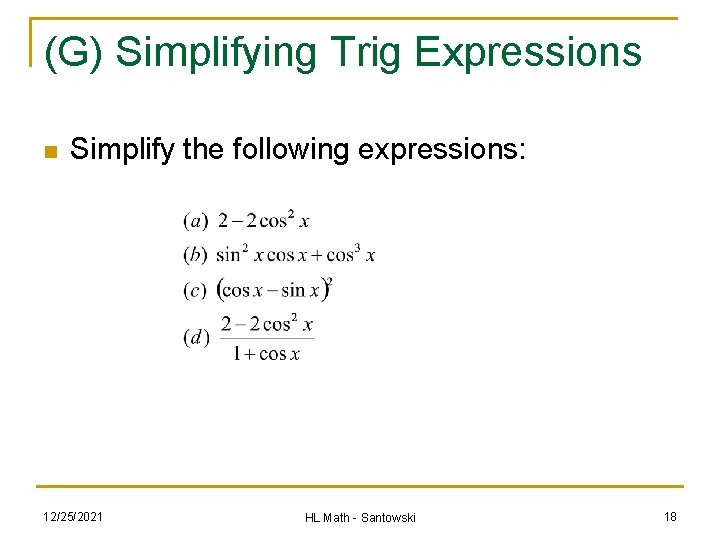
(G) Simplifying Trig Expressions n Simplify the following expressions: 12/25/2021 HL Math - Santowski 18
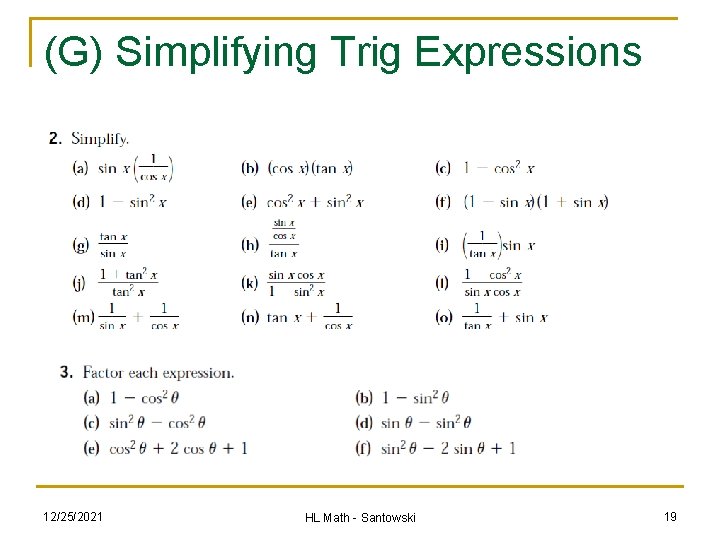
(G) Simplifying Trig Expressions 12/25/2021 HL Math - Santowski 19
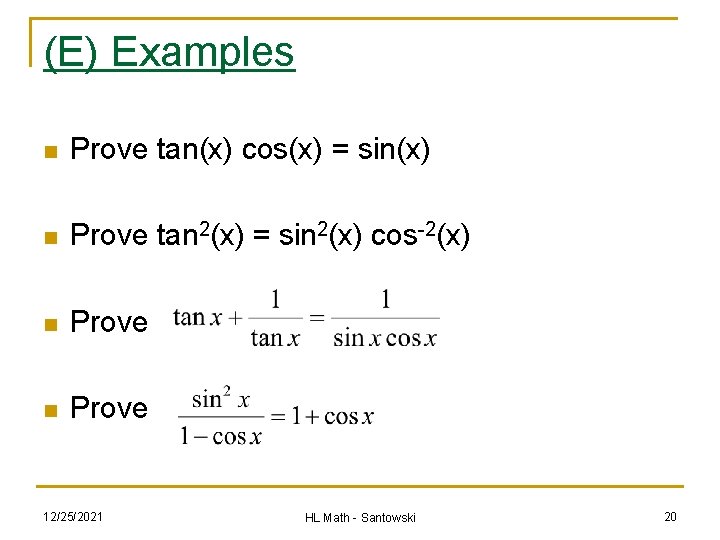
(E) Examples n Prove tan(x) cos(x) = sin(x) n Prove tan 2(x) = sin 2(x) cos-2(x) n Prove 12/25/2021 HL Math - Santowski 20
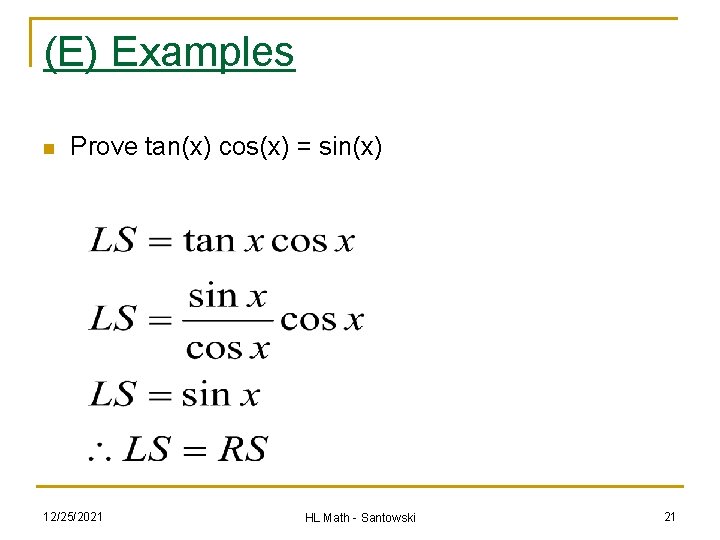
(E) Examples n Prove tan(x) cos(x) = sin(x) 12/25/2021 HL Math - Santowski 21
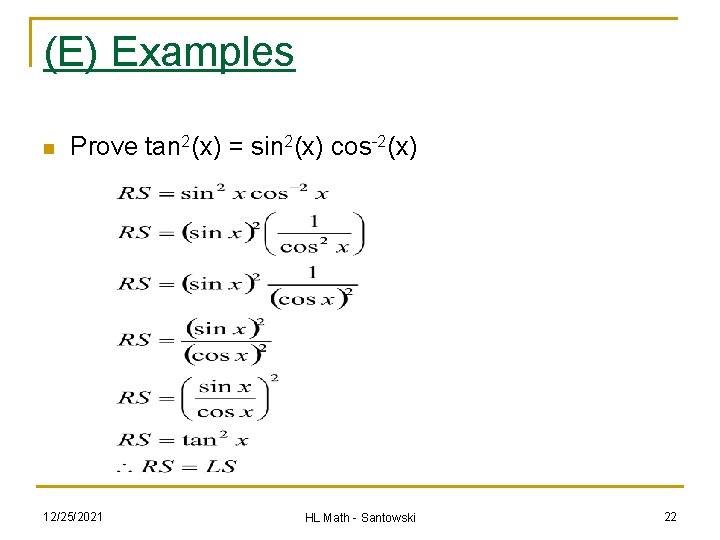
(E) Examples n Prove tan 2(x) = sin 2(x) cos-2(x) 12/25/2021 HL Math - Santowski 22
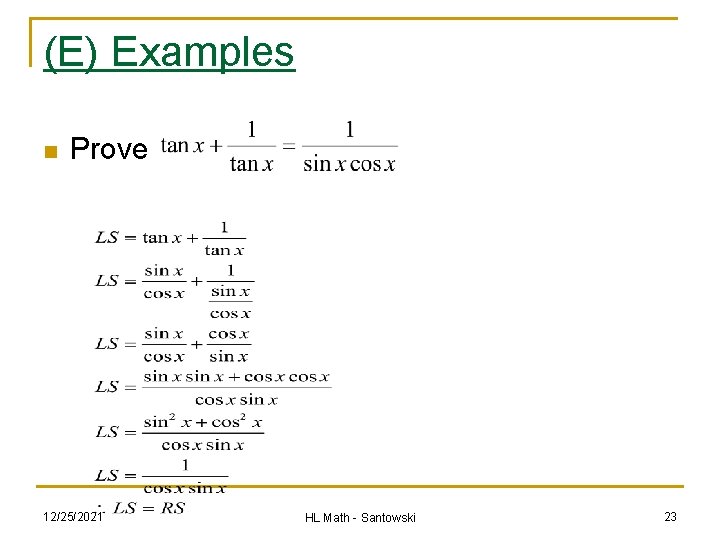
(E) Examples n Prove 12/25/2021 HL Math - Santowski 23
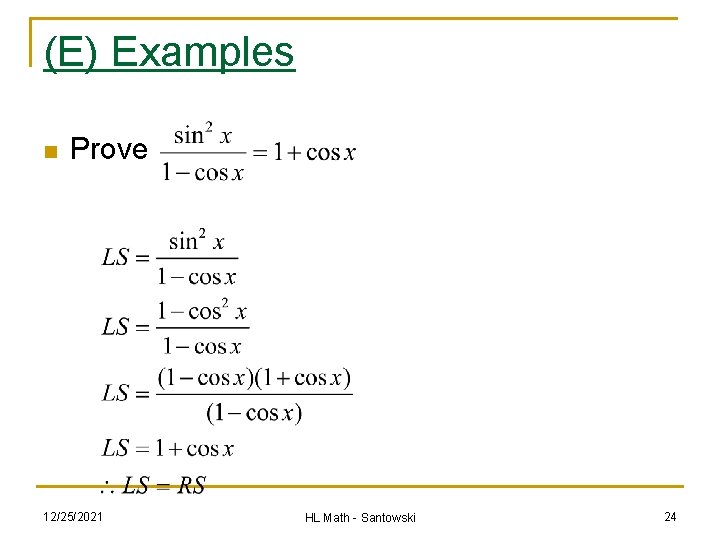
(E) Examples n Prove 12/25/2021 HL Math - Santowski 24
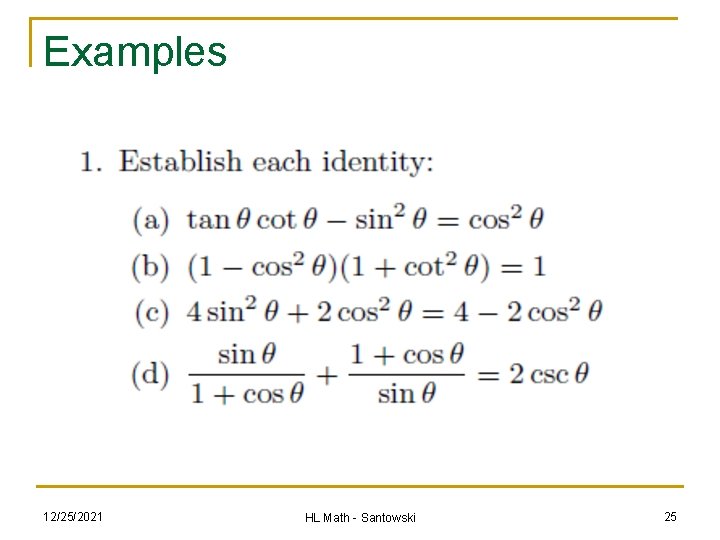
Examples 12/25/2021 HL Math - Santowski 25
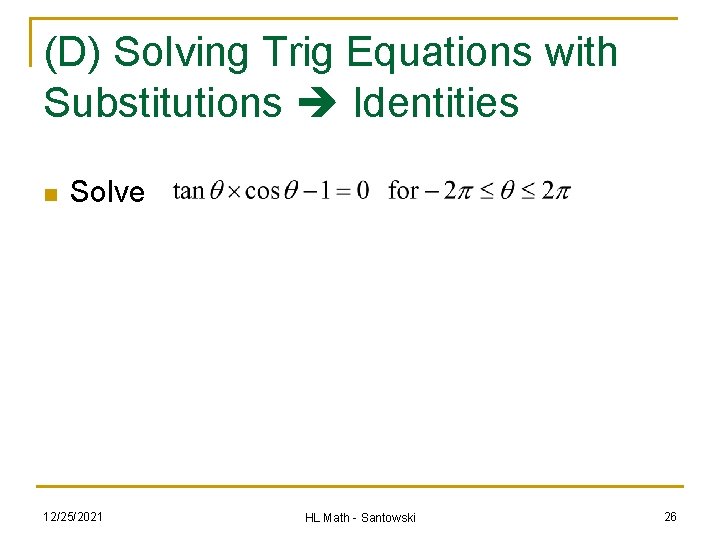
(D) Solving Trig Equations with Substitutions Identities n Solve 12/25/2021 HL Math - Santowski 26
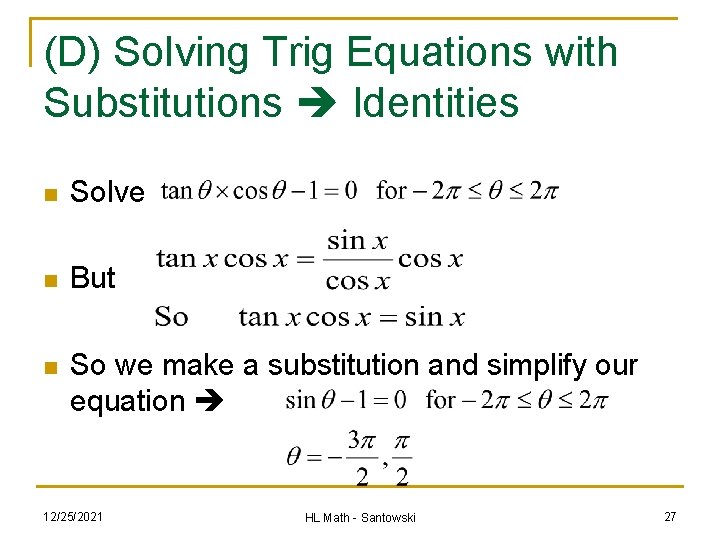
(D) Solving Trig Equations with Substitutions Identities n Solve n But n So we make a substitution and simplify our equation 12/25/2021 HL Math - Santowski 27
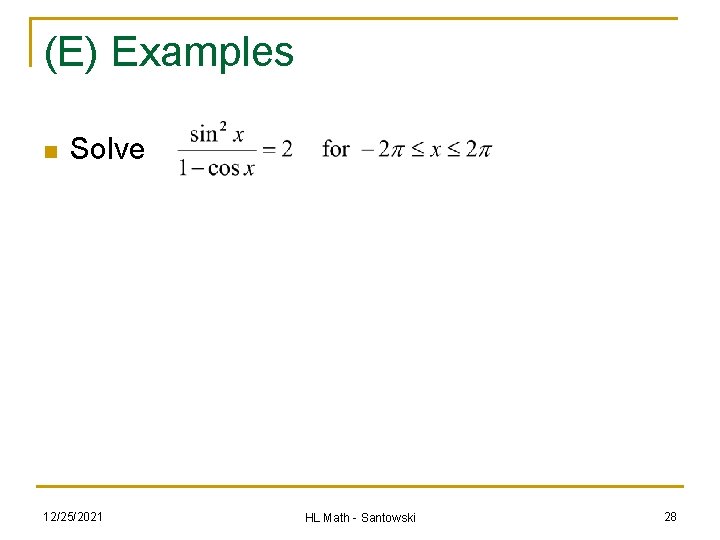
(E) Examples n Solve 12/25/2021 HL Math - Santowski 28
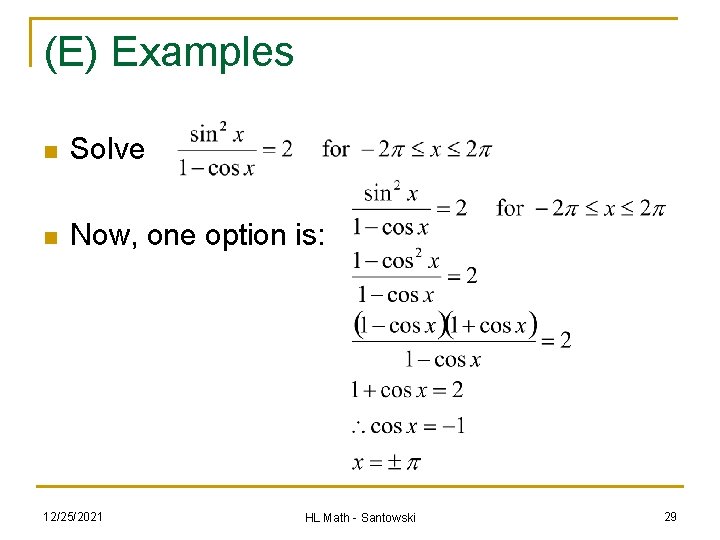
(E) Examples n Solve n Now, one option is: 12/25/2021 HL Math - Santowski 29
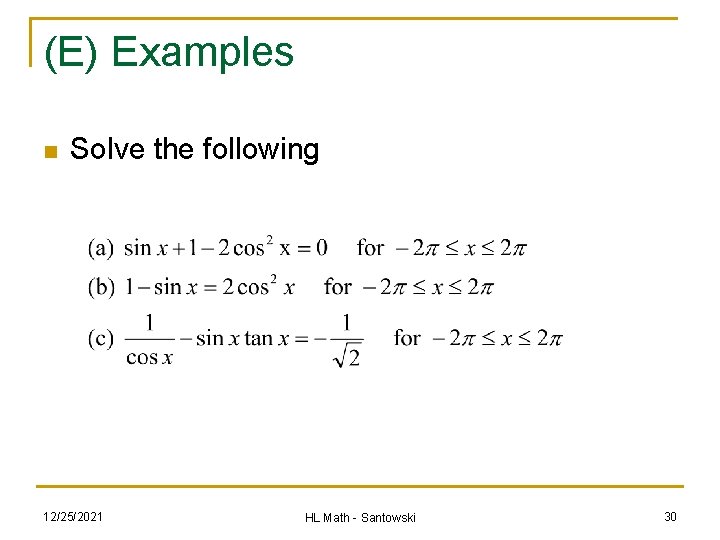
(E) Examples n Solve the following 12/25/2021 HL Math - Santowski 30

(F) Example n Since 1 - cos 2 x = sin 2 x is an identity, what about 12/25/2021 ? HL Math - Santowski 31
- Slides: 31