
Lesson 22 Impact of Climate Change on Wastewater
- Slides: 46
Lesson 22: Impact of Climate Change on Wastewater Treatment S. B. Weerakoon Professor, University of Peradeniya, Sri Lanka sbweera@pdn. ac. lk
I. Climate
Climate is a measure of the average pattern of variation in meteorological variables in a given region over long periods of time. Meteorological variables : temperature, humidity, atmospheric pressure, wind, precipitation, atmospheric particle count and other Climate is different from weather. Weather describes the short-term conditions of meteorological variables in a given region. Lesson 22 : Impact of climate change on WWT 3
Climate The climate of a location is affected by its latitude, terrain, and altitude, as well as nearby water bodies and their currents. Climates can be classified according to the average and the typical ranges of different variables, most commonly temperature and precipitation. Lesson 22 : Impact of climate change on WWT 4
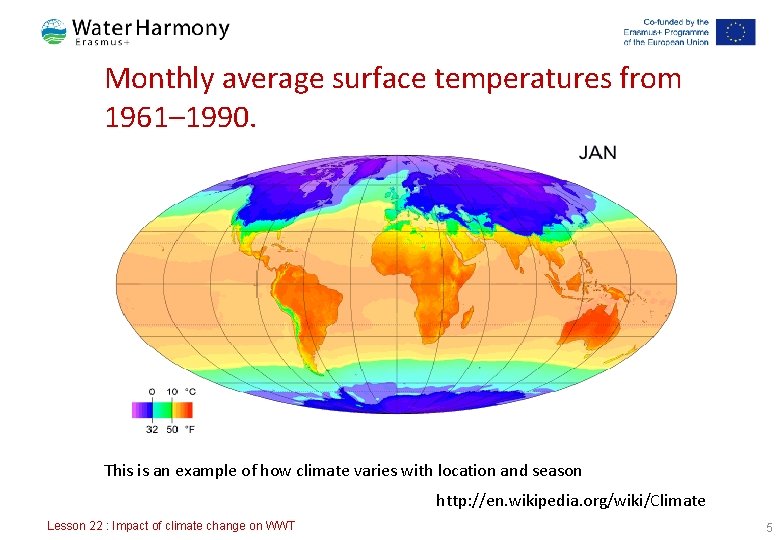
Monthly average surface temperatures from 1961– 1990. This is an example of how climate varies with location and season http: //en. wikipedia. org/wiki/Climate Lesson 22 : Impact of climate change on WWT 5
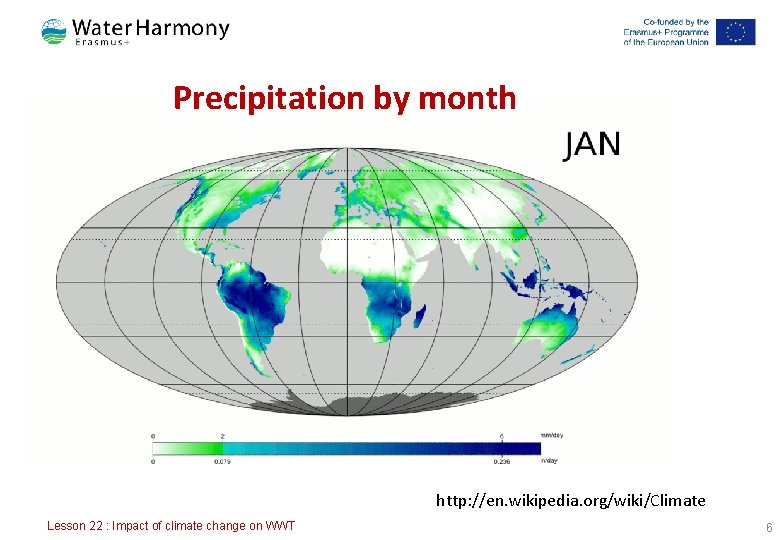
Precipitation by month http: //en. wikipedia. org/wiki/Climate Lesson 22 : Impact of climate change on WWT 6
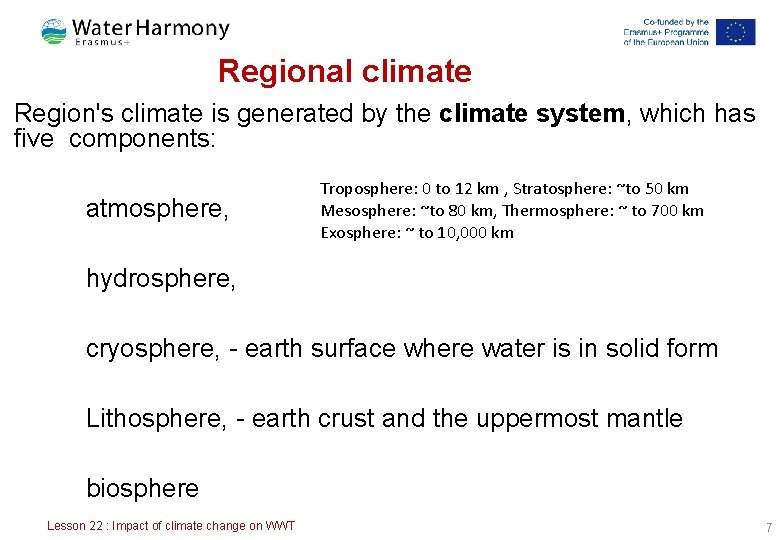
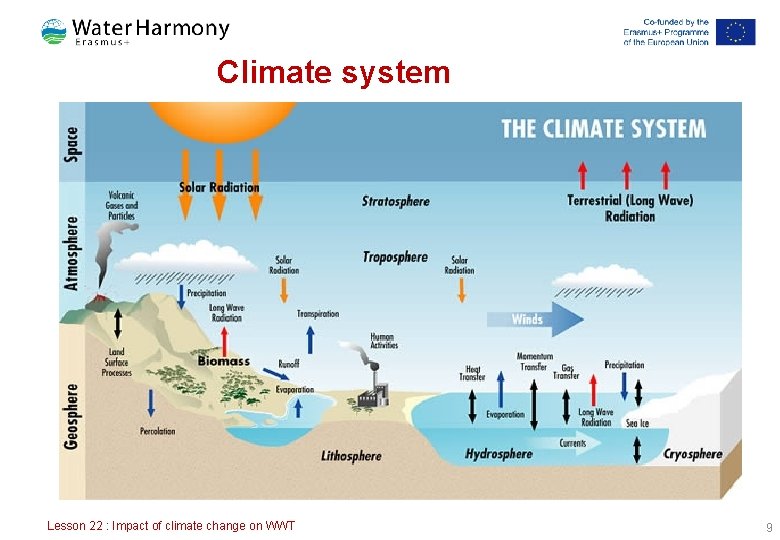
Regional climate Region's climate is generated by the climate system, which has five components: atmosphere, Troposphere: 0 to 12 km , Stratosphere: ~to 50 km Mesosphere: ~to 80 km, Thermosphere: ~ to 700 km Exosphere: ~ to 10, 000 km hydrosphere, cryosphere, - earth surface where water is in solid form Lithosphere, - earth crust and the uppermost mantle biosphere Lesson 22 : Impact of climate change on WWT 7
II. Climate system
Climate system Lesson 22 : Impact of climate change on WWT 9
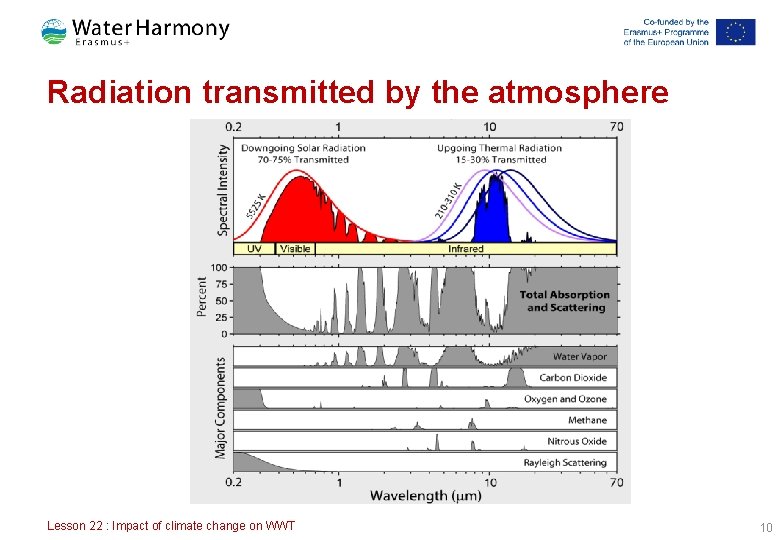
Radiation transmitted by the atmosphere Lesson 22 : Impact of climate change on WWT 10
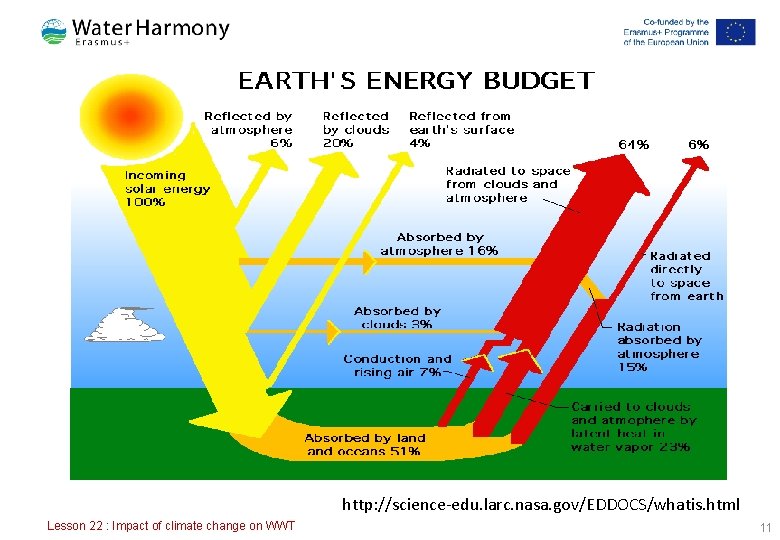
http: //science-edu. larc. nasa. gov/EDDOCS/whatis. html Lesson 22 : Impact of climate change on WWT 11
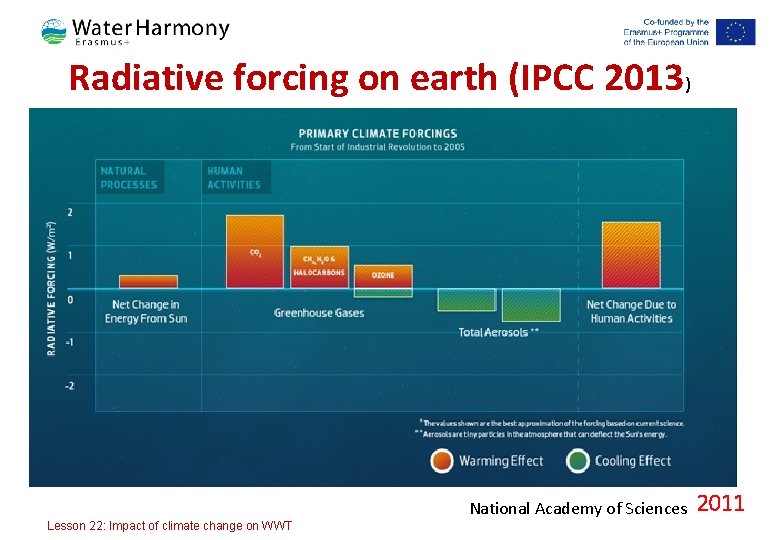
Radiative forcing on earth (IPCC 2013) National Academy of Sciences Lesson 22: Impact of climate change on WWT 2011
III. Climate change
United Nations framework convention on climate change “A change of climate which is attributed directly or indirectly to human activity that alters the composition of the global atmosphere and which is in addition to natural climate variability observed over comparable time periods” Lesson 22 : Impact of climate change on WWT 14
Climate Change Intergovernmental Panel on Climate Change (IPCC) defines climate change as: § Climate change in IPCC usage refers to a change in the state of the climate that can be identified (e. g. using statistical tests) by changes in the mean and/or the variability of its properties, and that persists for an extended period, typically decades or longer. It refers to any change in climate over time, whether due to natural variability or as a result of human activity. Lesson 22 : Impact of climate change on WWT 15
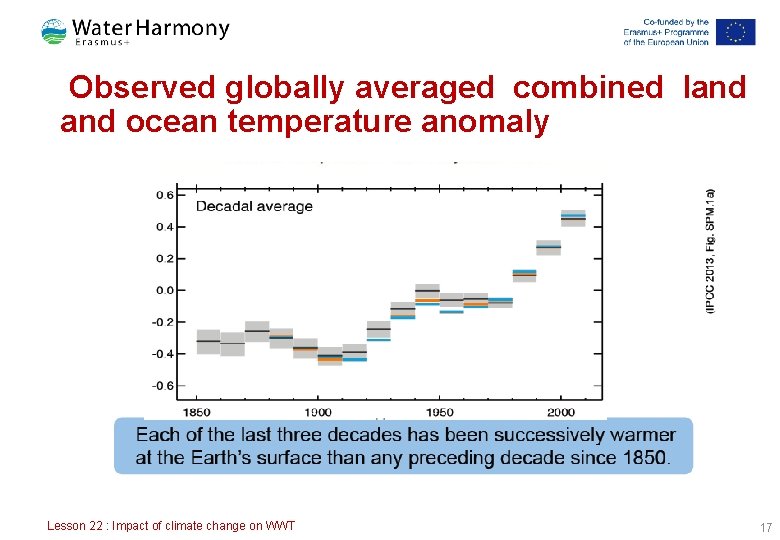
Evidence of global temperature increases since 1900 § Recorded temperature changes § The observed rise in sea level of 4 -8 inches § The shrinkage of mountain glaciers § Reduction of northern hemisphere snow cover § Increasing sub-surface ground temperatures Lesson 22 : Impact of climate change on WWT 16
Observed globally averaged combined land ocean temperature anomaly Lesson 22 : Impact of climate change on WWT 17
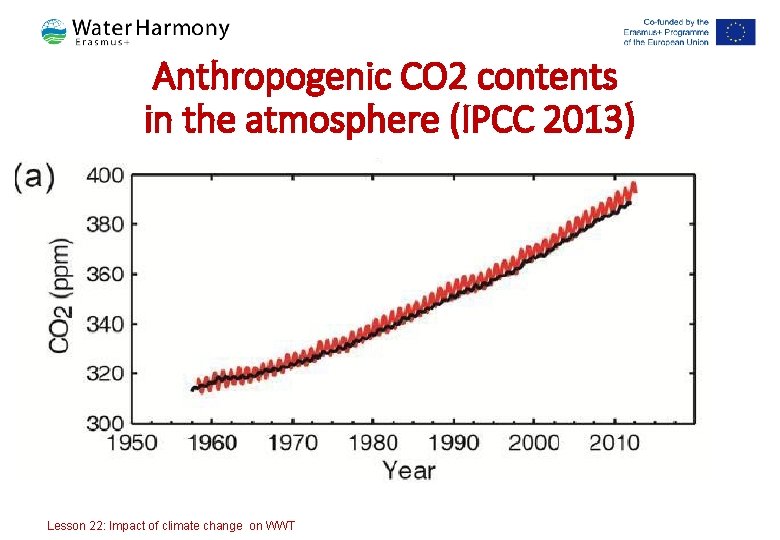
Anthropogenic CO 2 contents in the atmosphere (IPCC 2013) Lesson 22: Impact of climate change on WWT
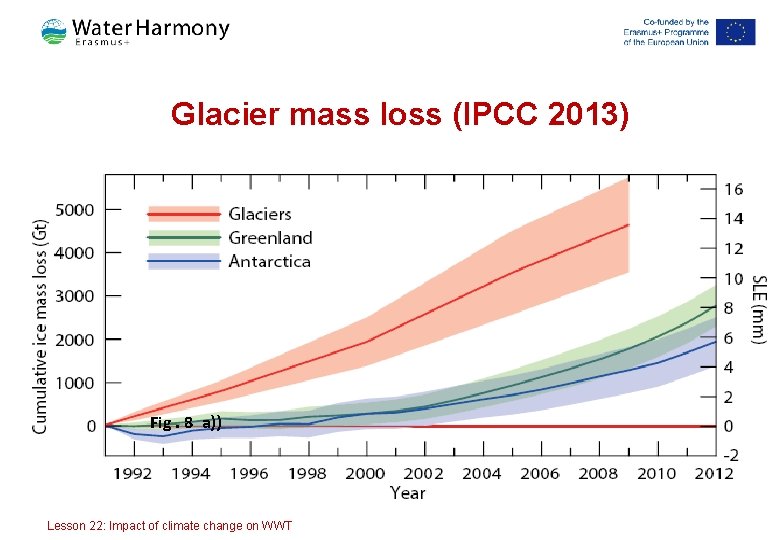
Glacier mass loss (IPCC 2013) Fig. 8 a)) Lesson 22: Impact of climate change on WWT
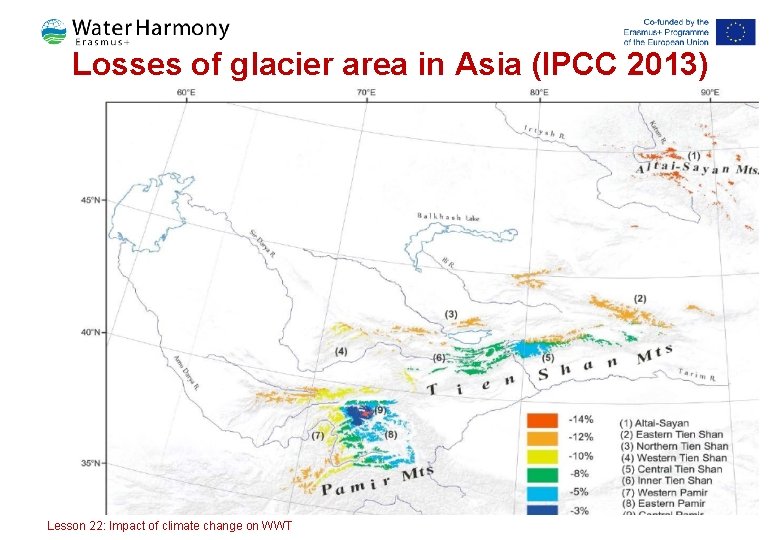
Losses of glacier area in Asia (IPCC 2013) Lesson 22: Impact of climate change on WWT
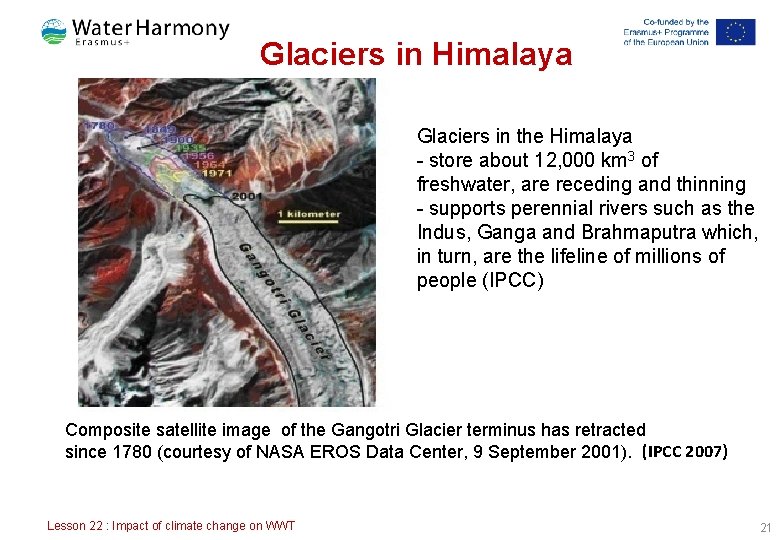
Glaciers in Himalaya Glaciers in the Himalaya - store about 12, 000 km 3 of freshwater, are receding and thinning - supports perennial rivers such as the Indus, Ganga and Brahmaputra which, in turn, are the lifeline of millions of people (IPCC)ll Composite satellite image of the Gangotri Glacier terminus has retracted since 1780 (courtesy of NASA EROS Data Center, 9 September 2001). (IPCC 2007) Lesson 22 : Impact of climate change on WWT 21
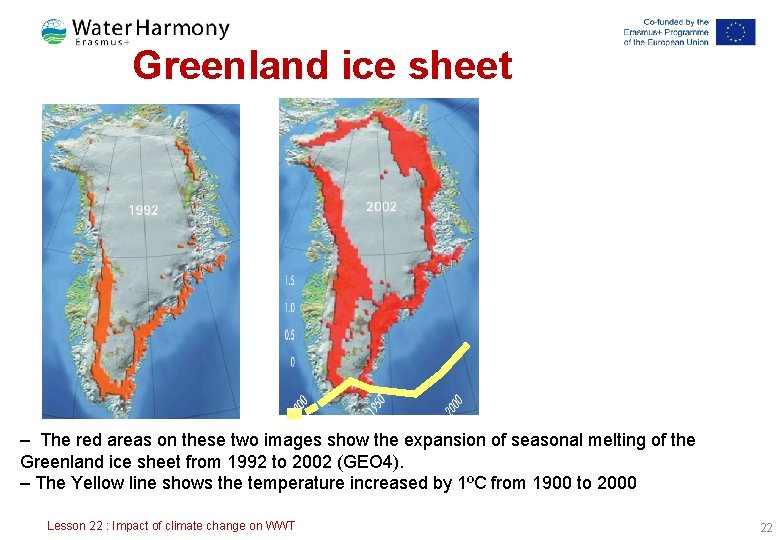
Greenland ice sheet – The red areas on these two images show the expansion of seasonal melting of the Greenland ice sheet from 1992 to 2002 (GEO 4). – The Yellow line shows the temperature increased by 1ºC from 1900 to 2000 Lesson 22 : Impact of climate change on WWT 22
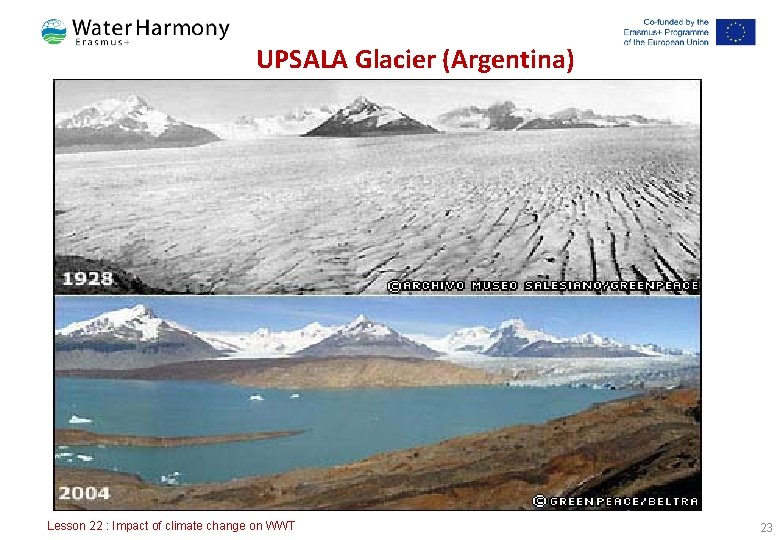
UPSALA Glacier (Argentina) Lesson 22 : Impact of climate change on WWT 23
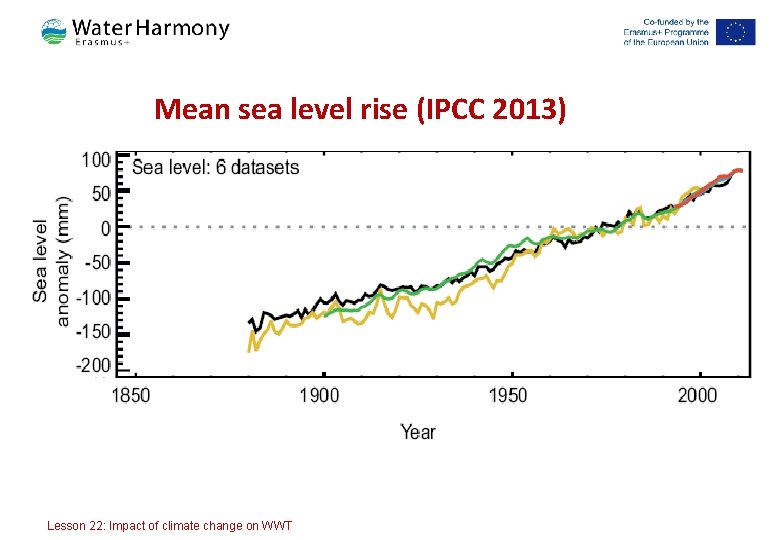
Mean sea level rise (IPCC 2013) Lesson 22: Impact of climate change on WWT
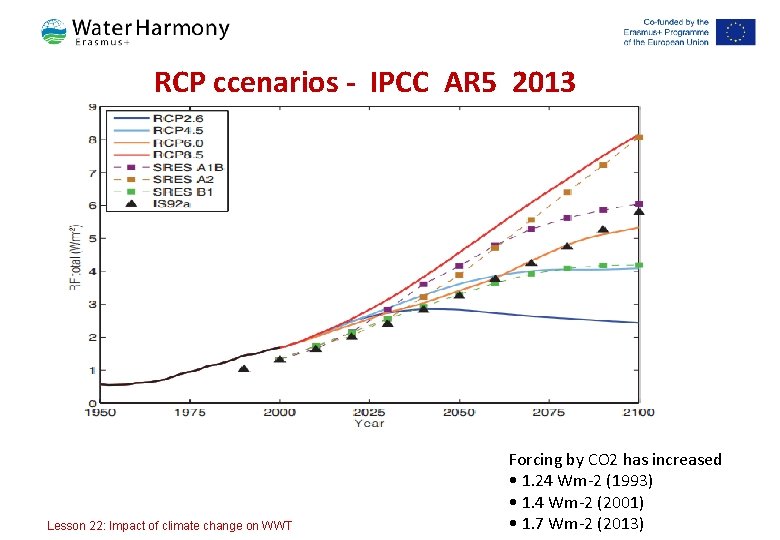
RCP ccenarios - IPCC AR 5 2013 Lesson 22: Impact of climate change on WWT Forcing by CO 2 has increased • 1. 24 Wm-2 (1993) • 1. 4 Wm-2 (2001) • 1. 7 Wm-2 (2013)
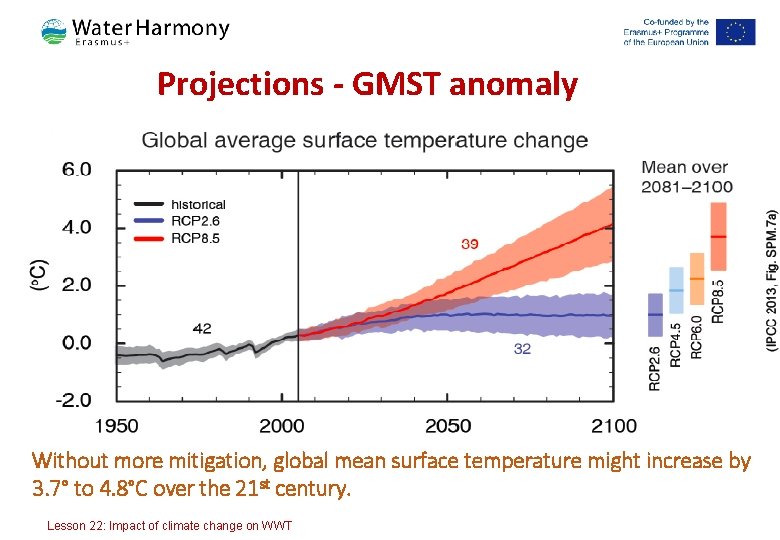
Projections - GMST anomaly Without more mitigation, global mean surface temperature might increase by 3. 7° to 4. 8°C over the 21 st century. Lesson 22: Impact of climate change on WWT
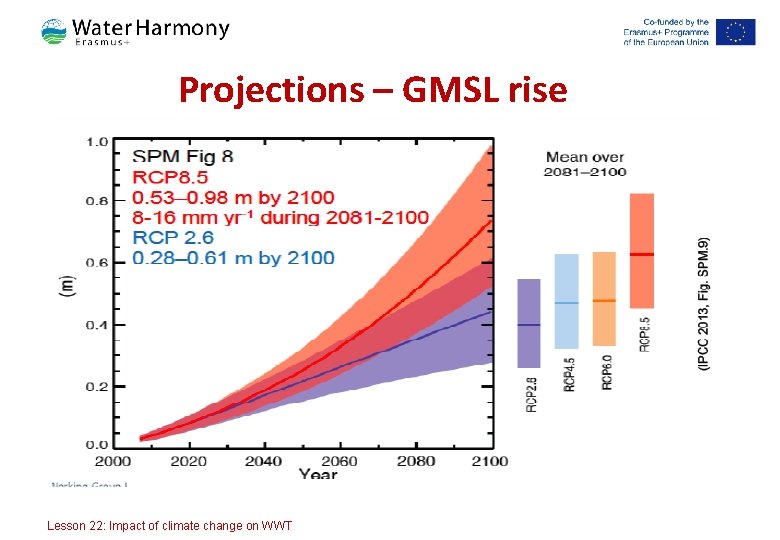
Projections – GMSL rise Lesson 22: Impact of climate change on WWT
IV. Climate change impacts
Climate change impacts The impacts and risks associated with these changes are real and are already happening in many systems and sectors essential for human livelihood, including water resources, food security, energy security, coastal zones and health An estimated 200 million people could be displaced as a result of climate impacts climate-related disasters by 2050 (IPCC 2007) Lesson 22 : Impact of climate change on WWT 29
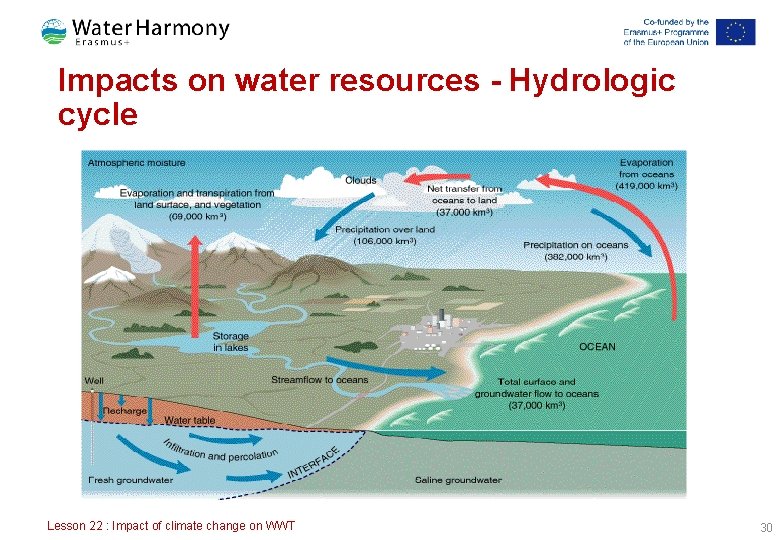
Impacts on water resources - Hydrologic cycle Lesson 22 : Impact of climate change on WWT 30
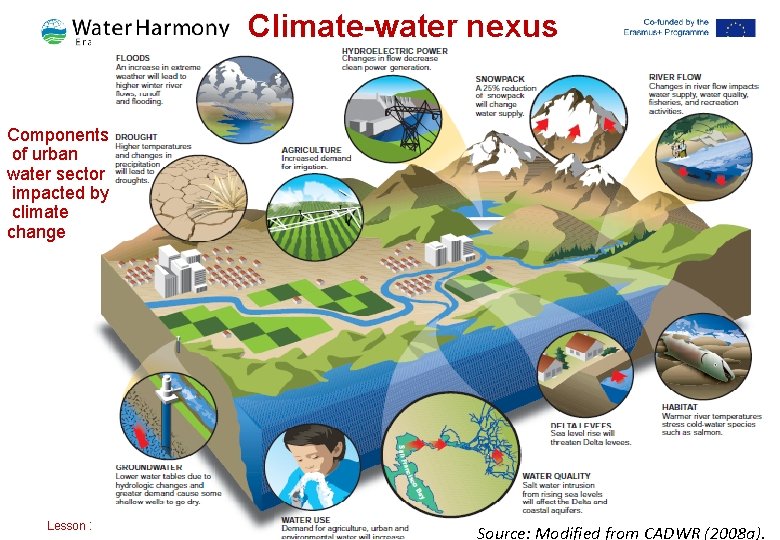
Climate-water nexus Components of urban water sector impacted by climate change Lesson 22 : Impact of climate change on WWT Source: Modified from CADWR (2008 a). 31
Impacts on water sector § Extreme events, floods and droughts, coastal storms will be more frequent The devastating effects of extreme events, temperature increases and sea level rise have consequences for all, particularly the poor, and will only worsen in the future. § Sea level rise associated with temperature increase Inundation of low lying areas, coastal marshes and wetlands, exacerbate flooding and increase the salinity in rivers, bays and aquifers. Lesson 22 : Impact of climate change on WWT 32
Impacts on wastewater quantity • Reduced water usage during frequent droughts decreases water that flows into the wastewater transmission and treatment systems while waste load is same resulting high pollutant concentrations • Increased scarcity of water resources will demand more reuse of wastewater, • Fluctuation of wastewater quantities Lesson 22 : Impact of climate change on WWT 33
Impacts on wastewater quality • Varying pollutant concentrations and types in a wide range than before Ø Droughts will cause high pollutant concentrations Ø Floods will cause different pollutants, sediments in waste water • Increased pollution and temperatures can result in blooms of harmful algae and bacteria in wastewater Lesson 22 : Impact of climate change on WWT 34
Impacts on wastewater quality • Seal level rise affect coastal areas Ø Water level rise in water bodies reduce the discharge of storm water/ treated wastewater under gravity flow to water bodies Ø Wastewater logging create poor water quality in coastal inland water bodies Ø Salinity may increase in CSOs Lesson 22 : Impact of climate change on WWT 35
Impacts on wastewater treatment • Water courses could have a lower dissolved oxygen content leading to tighter discharge consent standards to maintain water quality standards • Potential for odour generation in warmer conditions and risk of causing nuisance to customers • Impact on sludge as prolonged wet periods may restrict sludge to land recycling route • Stringent standards for reduction of greenhouse gas emissions • Increase of investment needs (energy use, processes, ) of treatment Lesson 22 : Impact of climate change on WWT 36
Impacts on wastewater treatment • Warmer weather may have a positive effect on biological treatment processes, which operate more effectively at higher temperatures • Stringent standards due to reduced final effluent discharge dilution (reduced assimilative capacity of receiving water bodies) • Flooding on wastewater treatment facilities, interruption to service • Sea water level will make it difficult to discharge treated water under gravity • Sludge drying handling and disposal become more Lesson 22 : Impact of climate change on WWT expensive 37
V. Adaptation to climate change impacts on wastewater
Climate change mitigation and adaptation There are two main responses to climate change, viz: § climate change mitigation is cutting the emissions that cause climate change; § climate change adaptation is preparing for the impacts of climate change. IPCC has defined climate adaptation as the "adjustment in natural or human systems in response to actual or expected climatic stimuli or their effects, which moderates harm or exploits beneficial opportunities”. Lesson 22 : Impact of climate change on WWT 39
Adaptation UNFCCC Nairobi Work Program • Climate modelling, scenarios and downscaling – Promoting the development of, access to, and use of information and data on projected climate change. • Climate related risks and extreme events – Promoting understanding of impacts and vulnerability, emphasizing current and future climate variability and extreme events, and the implications for sustainable development. Lesson 22 : Impact of climate change on WWT 40
Adaptation – water sector Adaptation is a local issue – Depends on geographical, climatic, bio-physical as well as socio-economic characteristics Adaptation options are many, including: Structural options ensure water quantity and quality: § Dikes (embankments, levee), sewer networks, drainage § Retention pond for artificial recharge, dams § Desalination technology § Coastal wall, flood proofing § Green Buildings Lesson 22 : Impact of climate change on WWT 41
Adaptation - water sector Non-Structural options to ensure quantity and quality : § National and sectoral policies § Demand management, water pricing § Efficient water use, reuse § Watershed management § Insurance § Awareness campaign Lesson 22 : Impact of climate change on WWT 42
Adaptation of wastewater systems for climate resilience § Make structures to be safe against extreme events (floods, coastal storms, ) § Risk of failure of operation plan for emergency options Lesson 22 : Impact of climate change on WWT 43
Adaptation of wastewater systems for climate resilience § Upgrade existing water infrastructure and management practices due to uncertainty of projected hydrological changes Statistical parameters of hydro-meteorological data series are not stationary. Historical hydro-meteorological data become not useful to make projection. Modern tools considering climate change projection would be necessary Design criteria on stormwater inflows different return periods to be redefined Lesson 22 : Impact of climate change on WWT 44
Adaptation of wastewater systems for climate resilience § Adopt modern technologies for wastewater treatment facilities to reduce greenhouse gas emissions § Promotion of ecosystem management practices, such as biodiversity conservation, e. g. by conserving and restoring mangroves to protect people from storms § Behavioral change at the individual level, Reduce wastewater generation Onsite treatments Lesson 22 : Impact of climate change on WWT 45
Thank you