
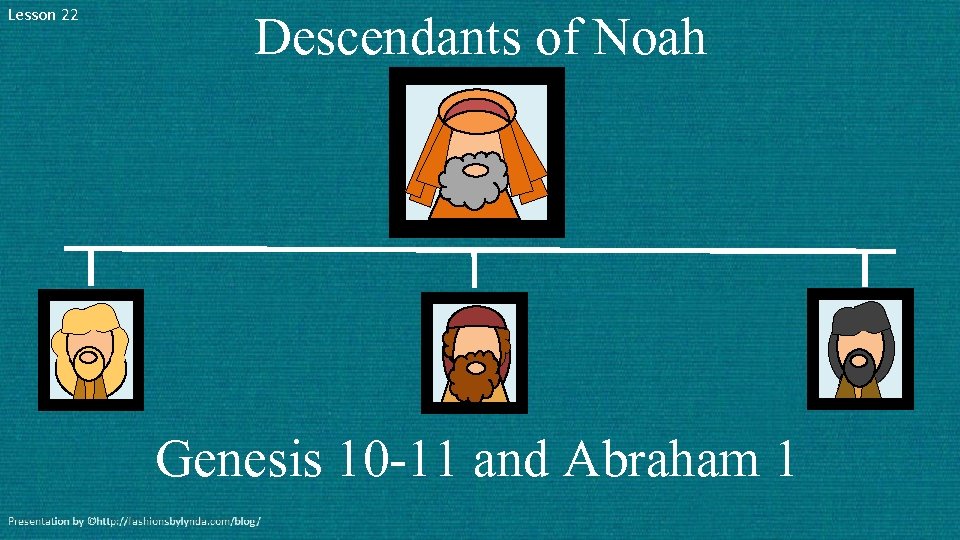
Lesson 22 Descendants of Noah Genesis 10 11
- Slides: 30
Lesson 22 Descendants of Noah Genesis 10 -11 and Abraham 1
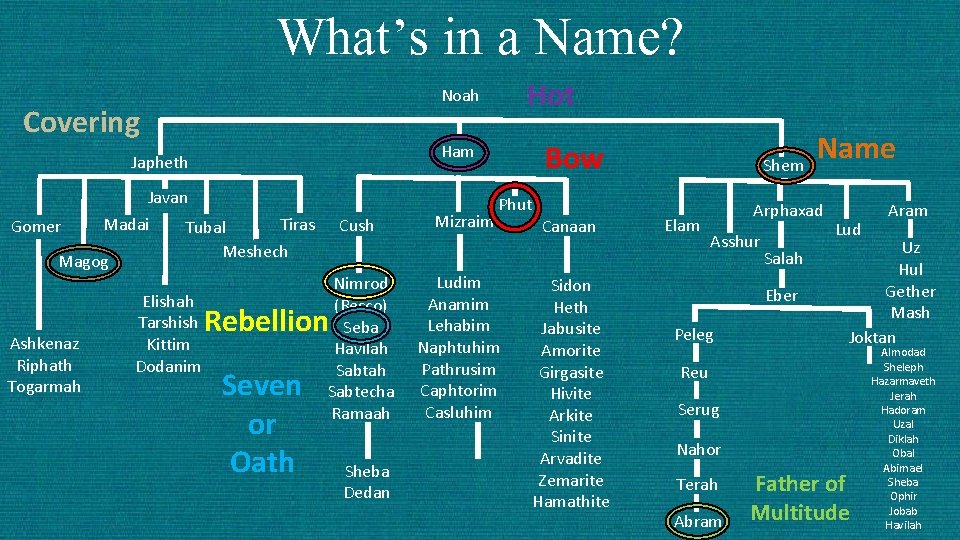
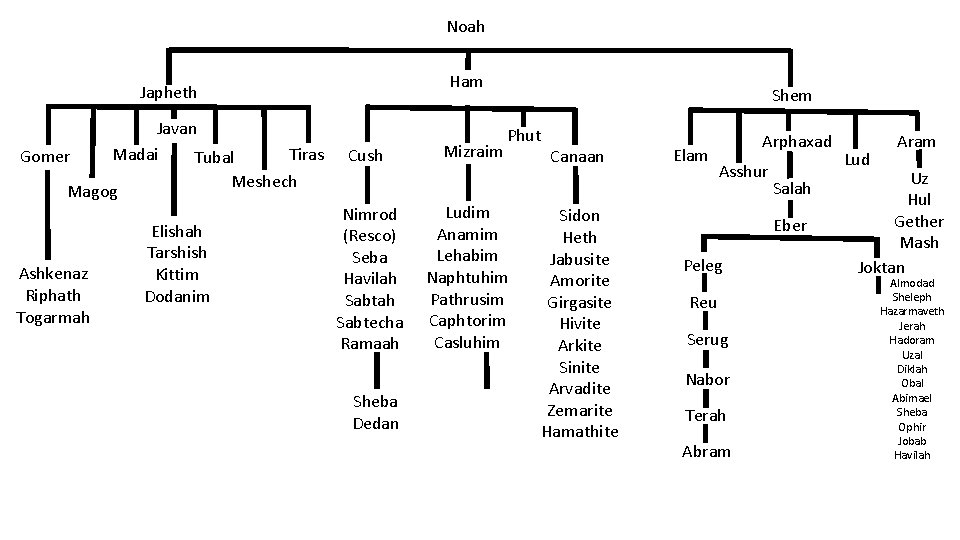
What’s in a Name? Covering Javan Madai Tiras Gomer Tubal Meshech Magog Ashkenaz Riphath Togarmah Bow Ham Japheth Elishah Tarshish Kittim Dodanim Hot Noah Cush Nimrod (Resco) Seba Havilah Sabtecha Ramaah Rebellion Seven or Oath Sheba Dedan Mizraim Phut Ludim Anamim Lehabim Naphtuhim Pathrusim Caphtorim Casluhim Canaan Sidon Heth Jabusite Amorite Girgasite Hivite Arkite Sinite Arvadite Zemarite Hamathite Shem Elam Name Arphaxad Asshur Salah Eber Peleg Lud Uz Hul Gether Mash Joktan Reu Serug Nahor Terah Abram Aram Father of Multitude Almodad Sheleph Hazarmaveth Jerah Hadoram Uzal Diklah Obal Abimael Sheba Ophir Jobab Havilah
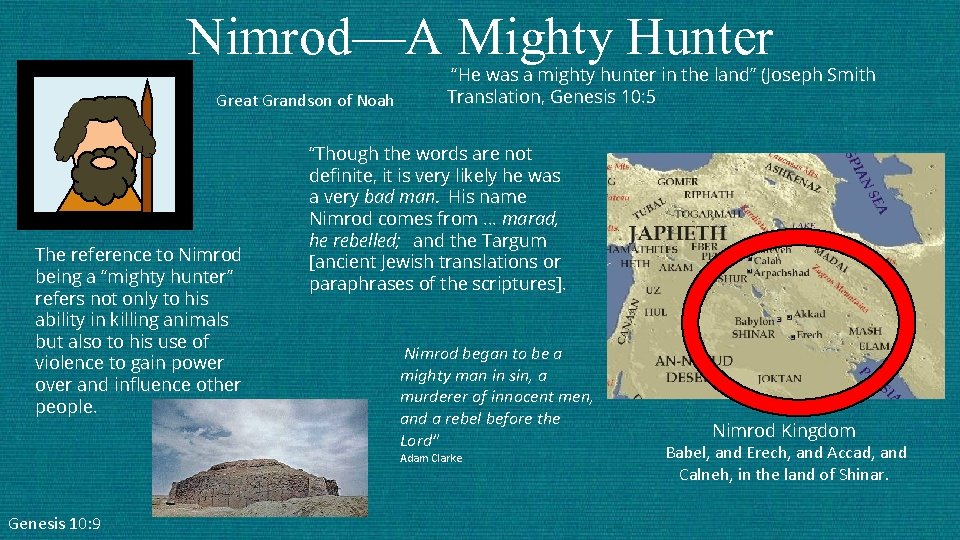
Nimrod—A Mighty Hunter Great Grandson of Noah The reference to Nimrod being a “mighty hunter” refers not only to his ability in killing animals but also to his use of violence to gain power over and influence other people. “He was a mighty hunter in the land” (Joseph Smith Translation, Genesis 10: 5 “Though the words are not definite, it is very likely he was a very bad man. His name Nimrod comes from … marad, he rebelled; and the Targum [ancient Jewish translations or paraphrases of the scriptures]. Nimrod began to be a mighty man in sin, a murderer of innocent men, and a rebel before the Lord” Adam Clarke Genesis 10: 9 Nimrod Kingdom Babel, and Erech, and Accad, and Calneh, in the land of Shinar.
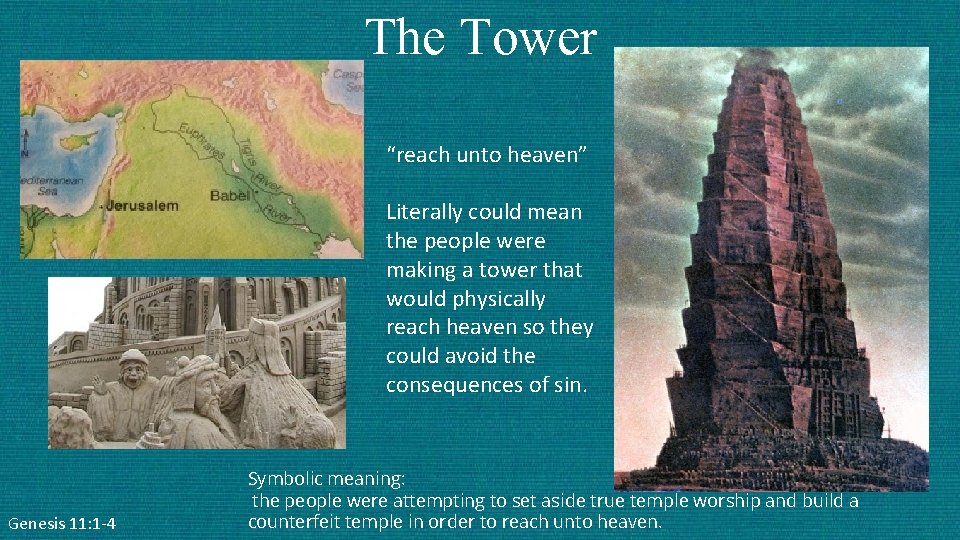
The Tower “reach unto heaven” Literally could mean the people were making a tower that would physically reach heaven so they could avoid the consequences of sin. Genesis 11: 1 -4 Symbolic meaning: the people were attempting to set aside true temple worship and build a counterfeit temple in order to reach unto heaven.
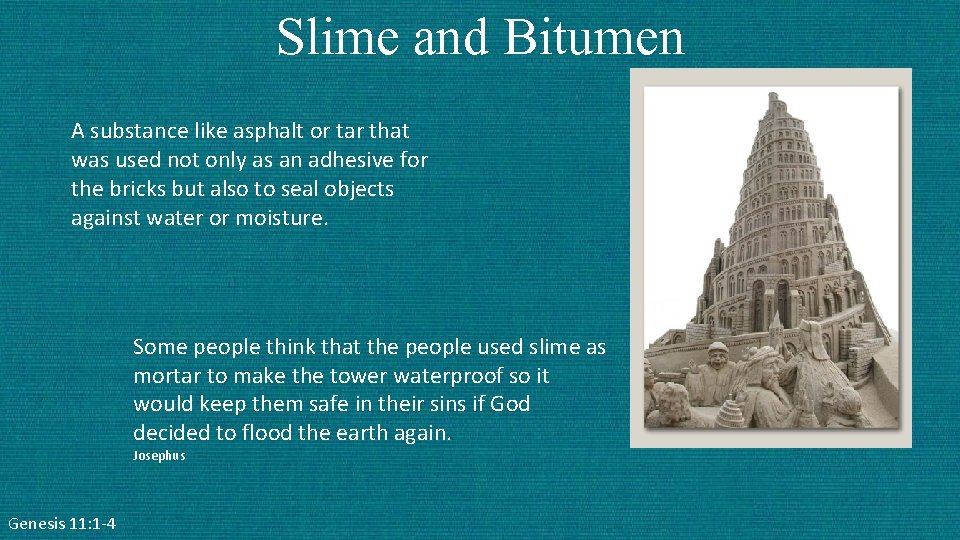
Slime and Bitumen A substance like asphalt or tar that was used not only as an adhesive for the bricks but also to seal objects against water or moisture. Some people think that the people used slime as mortar to make the tower waterproof so it would keep them safe in their sins if God decided to flood the earth again. Josephus Genesis 11: 1 -4
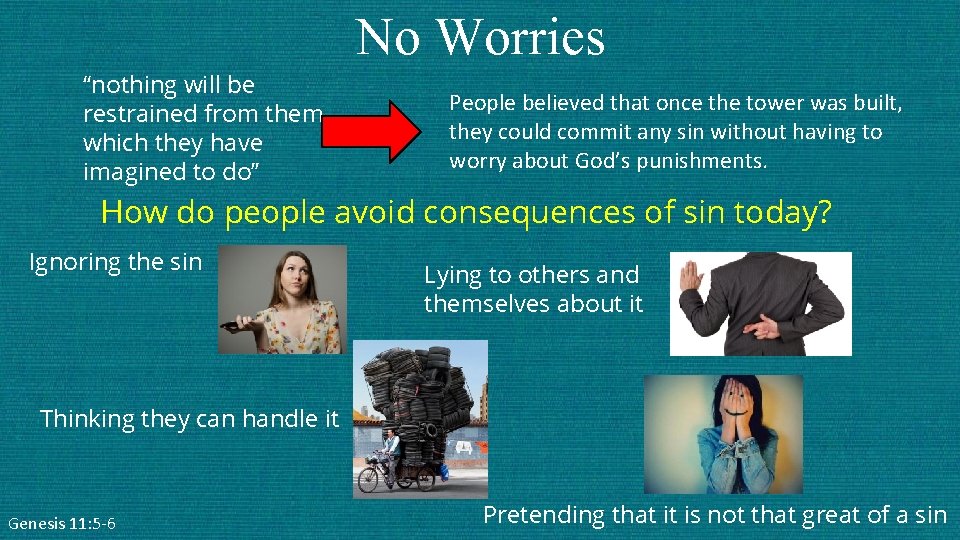
“nothing will be restrained from them, which they have imagined to do” No Worries People believed that once the tower was built, they could commit any sin without having to worry about God’s punishments. How do people avoid consequences of sin today? Ignoring the sin Lying to others and themselves about it Thinking they can handle it Genesis 11: 5 -6 Pretending that it is not that great of a sin
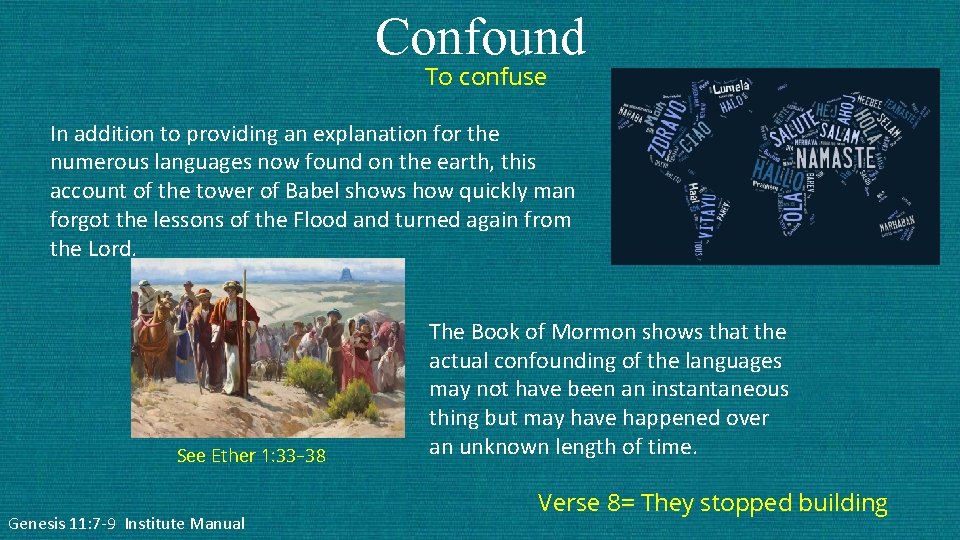
Confound To confuse In addition to providing an explanation for the numerous languages now found on the earth, this account of the tower of Babel shows how quickly man forgot the lessons of the Flood and turned again from the Lord. See Ether 1: 33– 38 Genesis 11: 7 -9 Institute Manual The Book of Mormon shows that the actual confounding of the languages may not have been an instantaneous thing but may have happened over an unknown length of time. Verse 8= They stopped building
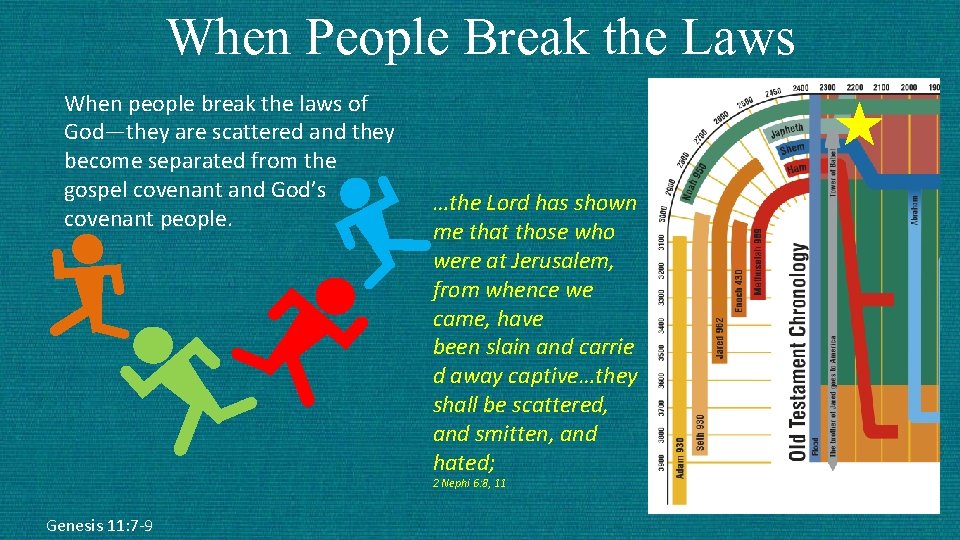
When People Break the Laws When people break the laws of God—they are scattered and they become separated from the gospel covenant and God’s covenant people. …the Lord has shown me that those who were at Jerusalem, from whence we came, have been slain and carrie d away captive…they shall be scattered, and smitten, and hated; 2 Nephi 6: 8, 11 Genesis 11: 7 -9
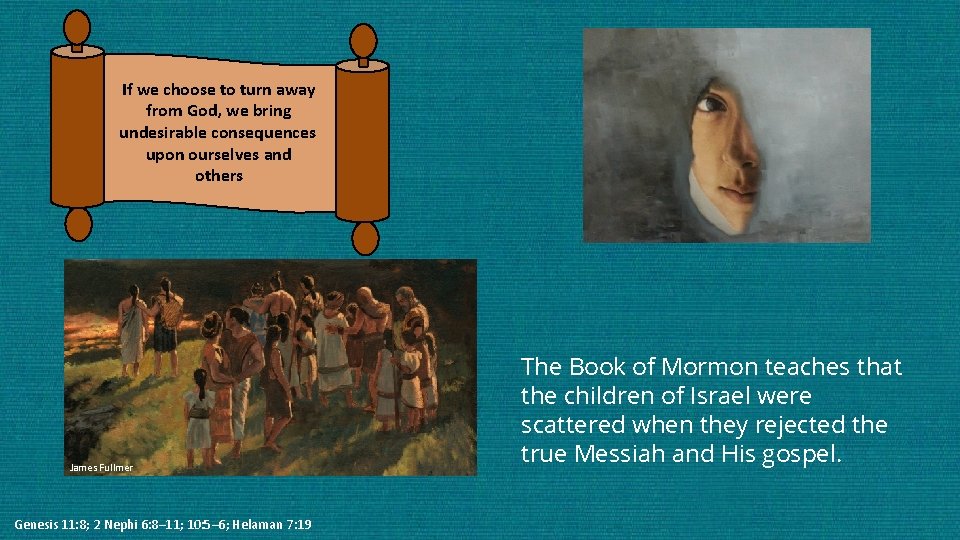
If we choose to turn away from God, we bring undesirable consequences upon ourselves and others James Fullmer Genesis 11: 8; 2 Nephi 6: 8– 11; 10: 5– 6; Helaman 7: 19 The Book of Mormon teaches that the children of Israel were scattered when they rejected the true Messiah and His gospel.
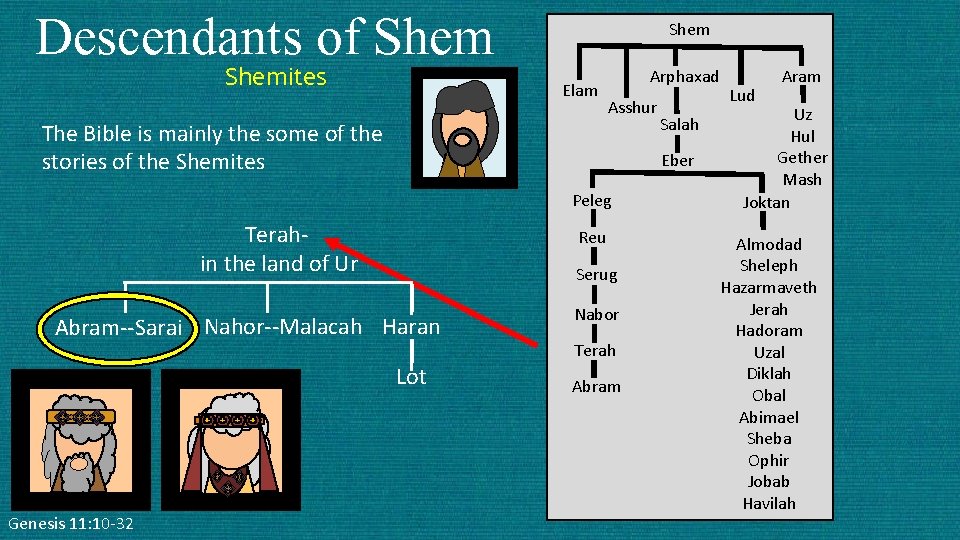
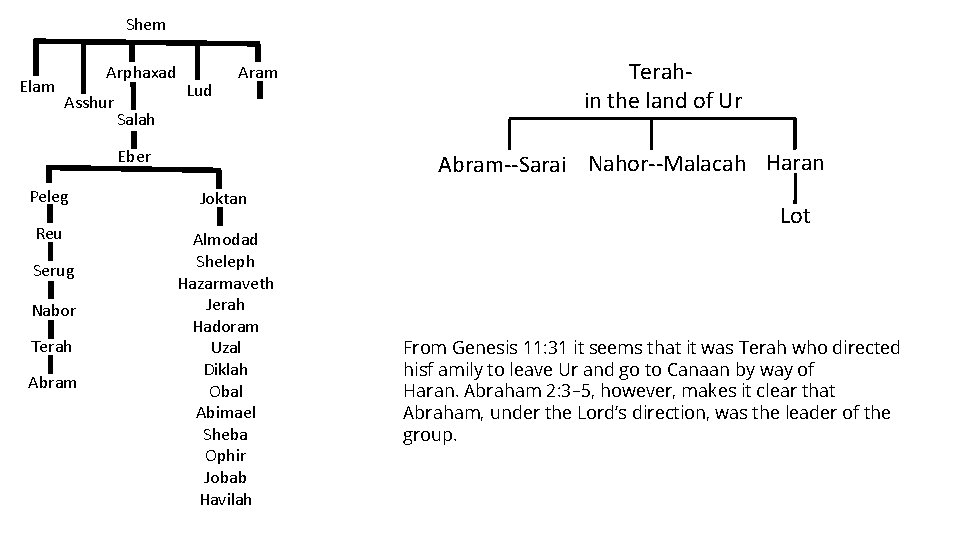
Descendants of Shemites Shem Elam Arphaxad Asshur The Bible is mainly the some of the stories of the Shemites Eber Peleg Terahin the land of Ur Reu Serug Abram--Sarai Nahor--Malacah Haran Lot Genesis 11: 10 -32 Salah Nabor Terah Abram Lud Aram Uz Hul Gether Mash Joktan Almodad Sheleph Hazarmaveth Jerah Hadoram Uzal Diklah Obal Abimael Sheba Ophir Jobab Havilah
Exalted Father Abraham 1 Look unto Abraham your father, and unto Sarah that bare you: for I called him alone, and blessed him, and increased him. Isaiah 51: 2
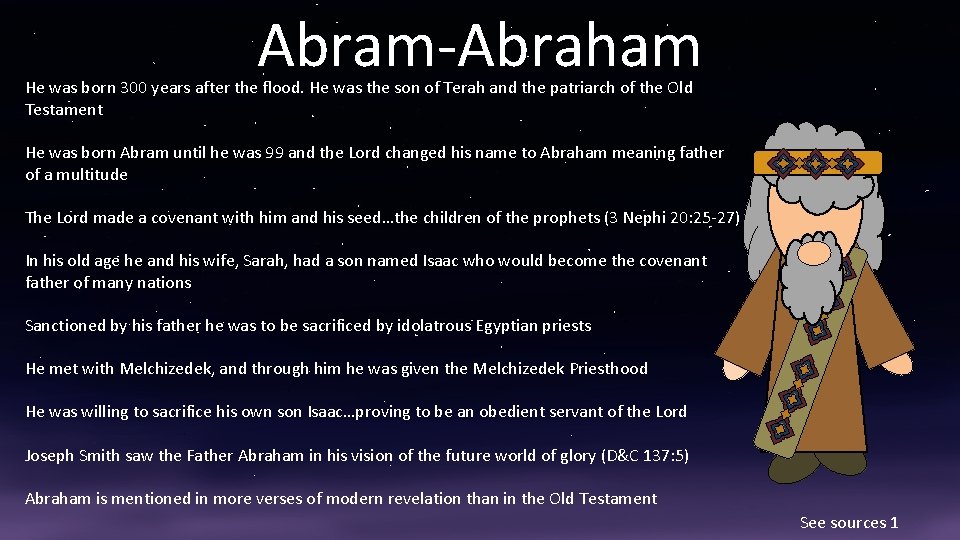
Abram-Abraham He was born 300 years after the flood. He was the son of Terah and the patriarch of the Old Testament He was born Abram until he was 99 and the Lord changed his name to Abraham meaning father of a multitude The Lord made a covenant with him and his seed…the children of the prophets (3 Nephi 20: 25 -27) In his old age he and his wife, Sarah, had a son named Isaac who would become the covenant father of many nations Sanctioned by his father he was to be sacrificed by idolatrous Egyptian priests He met with Melchizedek, and through him he was given the Melchizedek Priesthood He was willing to sacrifice his own son Isaac…proving to be an obedient servant of the Lord Joseph Smith saw the Father Abraham in his vision of the future world of glory (D&C 137: 5) Abraham is mentioned in more verses of modern revelation than in the Old Testament See sources 1
Sarai-Sarah She was the wife of Abraham and originally known as Sarai meaning princes She was childless for many years beyond her childbearing years She and her husband traveled to Egypt because of the famine in Canaan She was “a fair woman to look upon” and was to present herself to Egyptians as Abraham’s sister After their return to Canaan, Sarai gave unto Abram her Egyptian handmaid, Hagar, as a wife (D&C 132: 3334, 65) Sarai received a new name Sarah and was blessed that she would bear a son to “be a mother of nation; kings of people shall be of her. ” Genesis 17: 16) Three holy men visited her and Abraham confirming that she would be a mother in which she laughed to herself. Her son, Isaac name means “he laughed” She had Hagar and her son Ishmael sent away She died at age 127 and was buried “in the cave of field of Machpelah before Mamre (Hebron, land of Canaan Paul and Peter mention Sara/Sarah as an obedient woman (Hebrew 11: 11; 1 Peter 3: 6) See sources 1
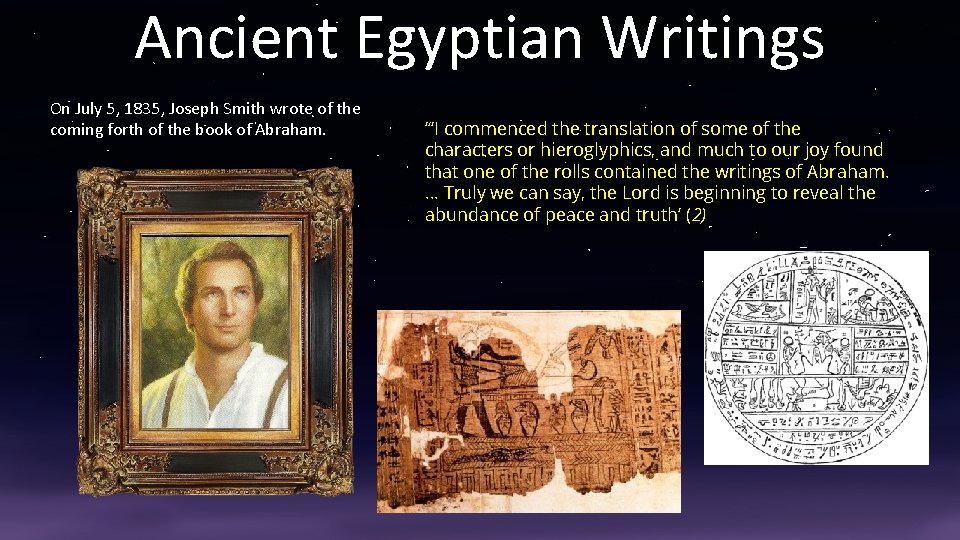
Ancient Egyptian Writings On July 5, 1835, Joseph Smith wrote of the coming forth of the book of Abraham. “‘I commenced the translation of some of the characters or hieroglyphics, and much to our joy found that one of the rolls contained the writings of Abraham. … Truly we can say, the Lord is beginning to reveal the abundance of peace and truth’ (2)
Written by the Hand of Abraham “The Prophet Joseph Smith never communicated his method of translating these records. As with all other scriptures, a testimony of the truthfulness of these writings is primarily a matter of faith. The greatest evidence of the truthfulness of the book of Abraham is not found in an analysis of physical evidence nor historical background, but in prayerful consideration of its content and power” (2) Although we do not know the exact method Joseph Smith used to translate the writings of Abraham, we do know that he translated them by the gift and power of God.
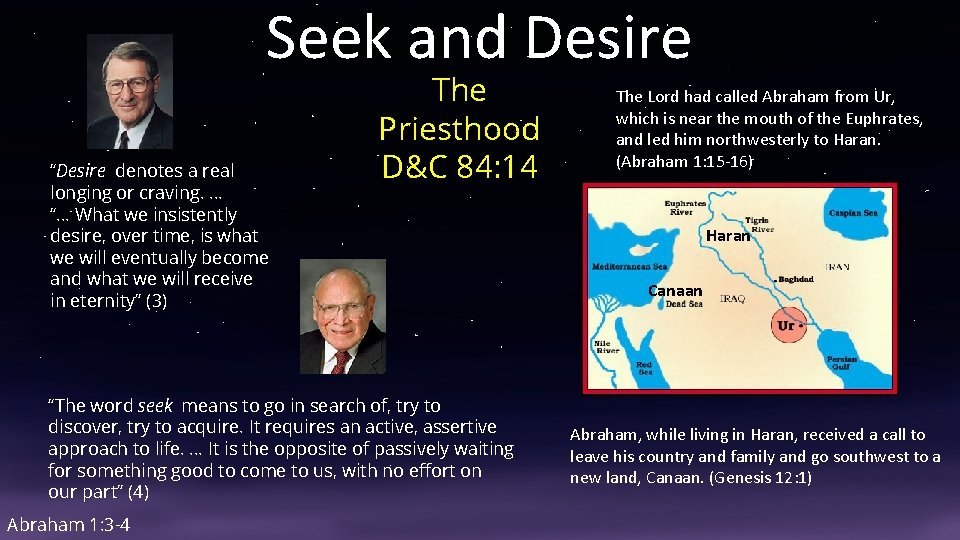
Seek and Desire “Desire denotes a real longing or craving. … “… What we insistently desire, over time, is what we will eventually become and what we will receive in eternity” (3) The Priesthood D&C 84: 14 “The word seek means to go in search of, try to discover, try to acquire. It requires an active, assertive approach to life. … It is the opposite of passively waiting for something good to come to us, with no effort on our part” (4) Abraham 1: 3 -4 The Lord had called Abraham from Ur, which is near the mouth of the Euphrates, and led him northwesterly to Haran. (Abraham 1: 15 -16) Haran Canaan Abraham, while living in Haran, received a call to leave his country and family and go southwest to a new land, Canaan. (Genesis 12: 1)
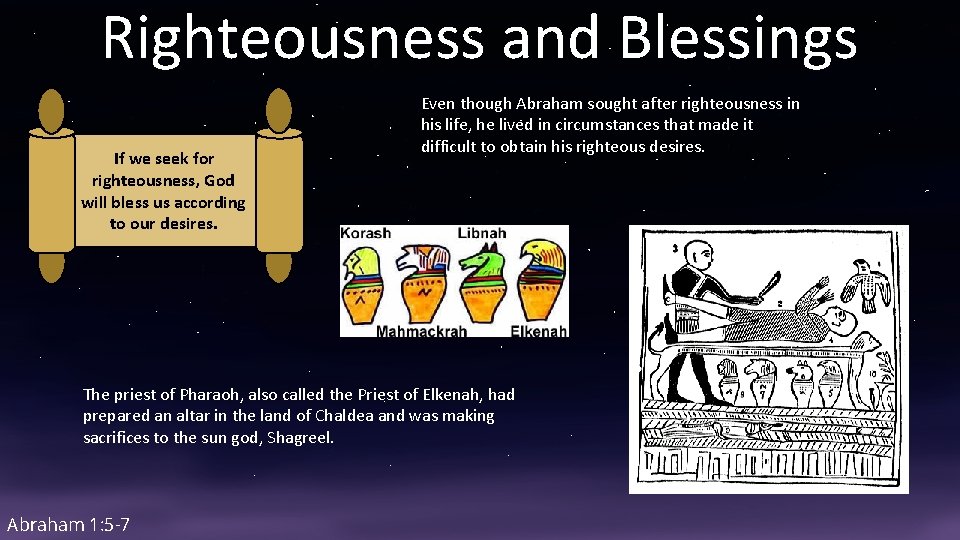
Righteousness and Blessings If we seek for righteousness, God will bless us according to our desires. Even though Abraham sought after righteousness in his life, he lived in circumstances that made it difficult to obtain his righteous desires. The priest of Pharaoh, also called the Priest of Elkenah, had prepared an altar in the land of Chaldea and was making sacrifices to the sun god, Shagreel. Abraham 1: 5 -7
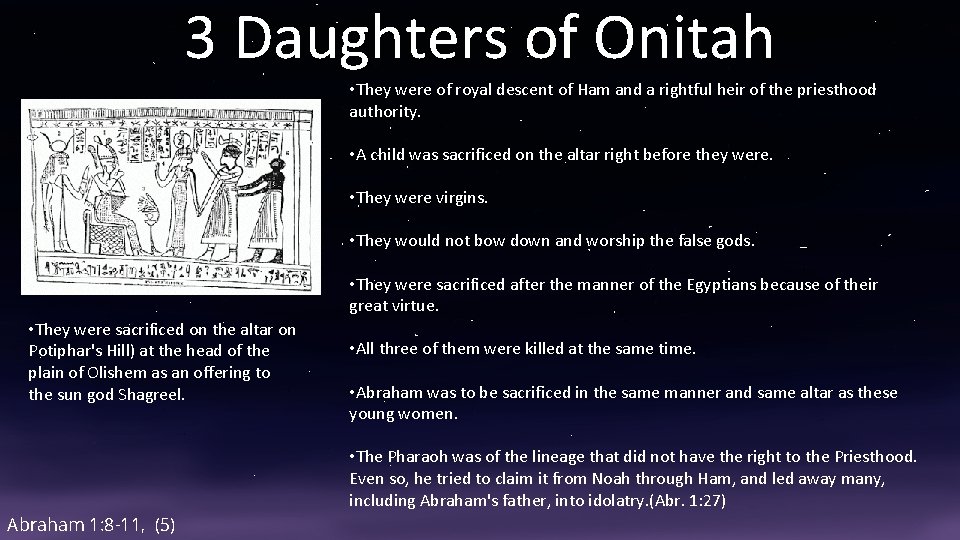
3 Daughters of Onitah • They were of royal descent of Ham and a rightful heir of the priesthood authority. • A child was sacrificed on the altar right before they were. • They were virgins. • They would not bow down and worship the false gods. • They were sacrificed after the manner of the Egyptians because of their great virtue. • They were sacrificed on the altar on Potiphar's Hill) at the head of the plain of Olishem as an offering to the sun god Shagreel. • All three of them were killed at the same time. • Abraham was to be sacrificed in the same manner and same altar as these young women. • The Pharaoh was of the lineage that did not have the right to the Priesthood. Even so, he tried to claim it from Noah through Ham, and led away many, including Abraham's father, into idolatry. (Abr. 1: 27) Abraham 1: 8 -11, (5)
Choosing Righteousness We can choose righteousness regardless of the circumstances in which we live. Abraham 1: 8 -11 “We all know something of the courage it takes for one to stand in opposition to united custom, and general belief. None of us likes to be ridiculed. Few are able to withstand popular opinion even when they know it is wrong, and it is difficult to comprehend the magnificent courage displayed by Abraham in his profound obedience to Jehovah, in the midst of his surroundings. His moral courage, his implicit faith in God, his boldness in raising his voice in opposition to the prevailing wickedness, is almost beyond comparison. ” (6)
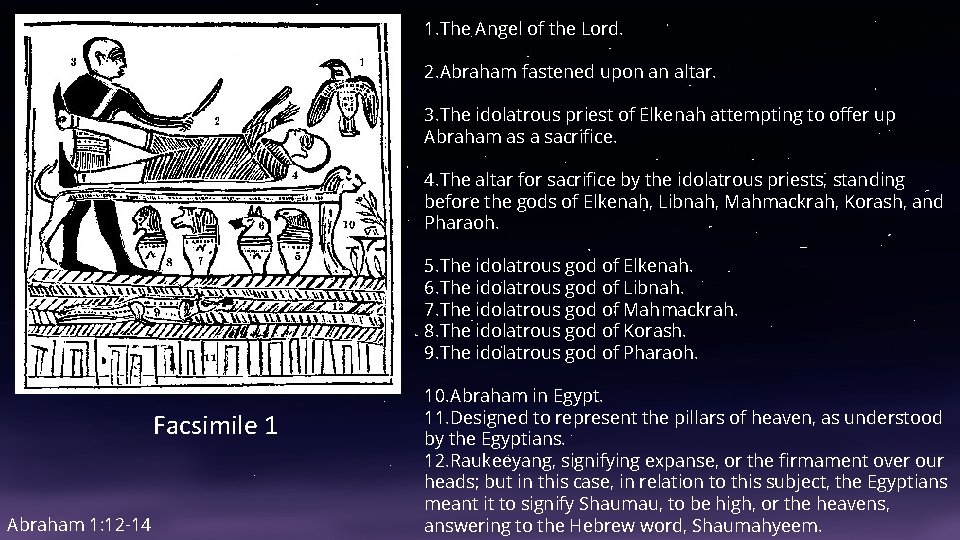
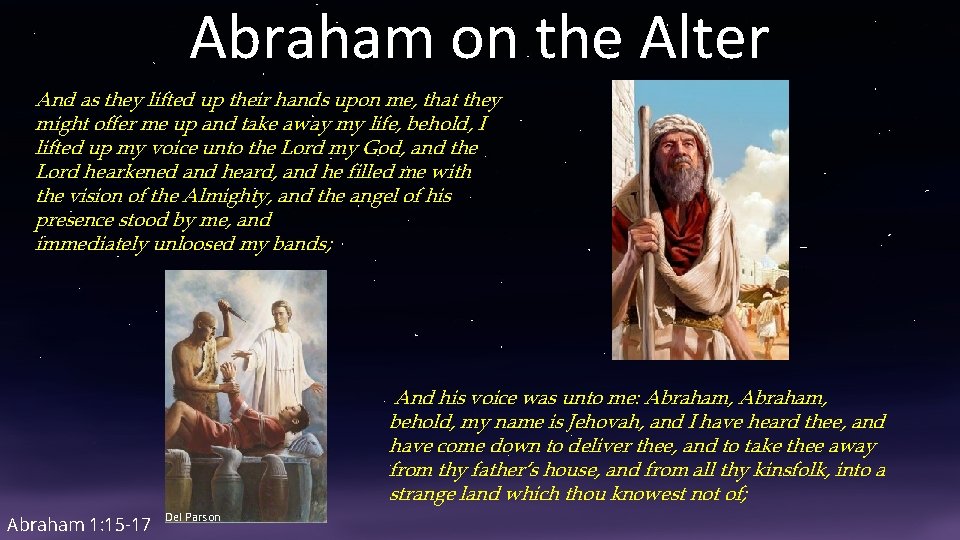
1. The Angel of the Lord. 2. Abraham fastened upon an altar. 3. The idolatrous priest of Elkenah attempting to offer up Abraham as a sacrifice. 4. The altar for sacrifice by the idolatrous priests, standing before the gods of Elkenah, Libnah, Mahmackrah, Korash, and Pharaoh. 5. The idolatrous god of Elkenah. 6. The idolatrous god of Libnah. 7. The idolatrous god of Mahmackrah. 8. The idolatrous god of Korash. 9. The idolatrous god of Pharaoh. Facsimile 1 Abraham 1: 12 -14 10. Abraham in Egypt. 11. Designed to represent the pillars of heaven, as understood by the Egyptians. 12. Raukeeyang, signifying expanse, or the firmament over our heads; but in this case, in relation to this subject, the Egyptians meant it to signify Shaumau, to be high, or the heavens, answering to the Hebrew word, Shaumahyeem.
Abraham on the Alter And as they lifted up their hands upon me, that they might offer me up and take away my life, behold, I lifted up my voice unto the Lord my God, and the Lord hearkened and heard, and he filled me with the vision of the Almighty, and the angel of his presence stood by me, and immediately unloosed my bands; And his voice was unto me: Abraham, behold, my name is Jehovah, and I have heard thee, and have come down to deliver thee, and to take thee away from thy father’s house, and from all thy kinsfolk, into a strange land which thou knowest not of; Abraham 1: 15 -17 Del Parson
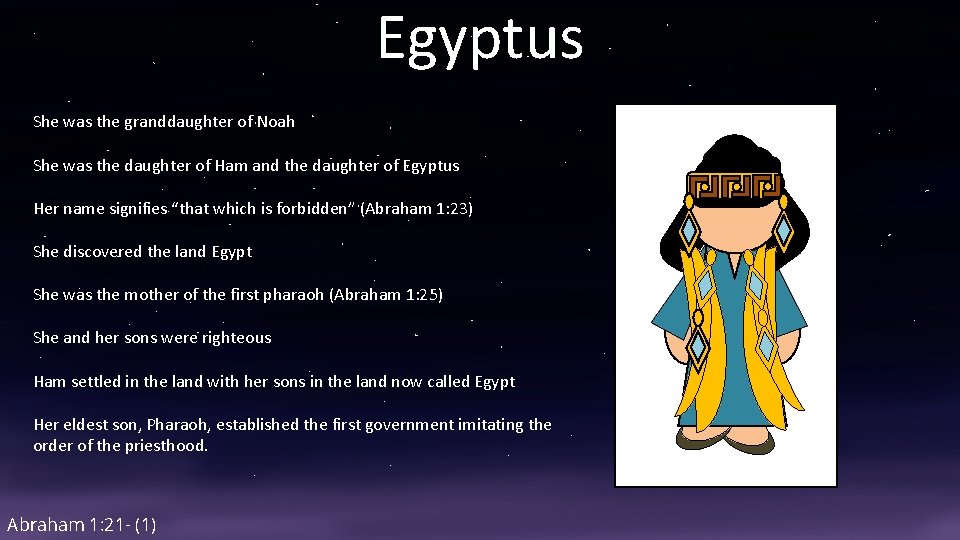
Egyptus She was the granddaughter of Noah She was the daughter of Ham and the daughter of Egyptus Her name signifies “that which is forbidden” (Abraham 1: 23) She discovered the land Egypt She was the mother of the first pharaoh (Abraham 1: 25) She and her sons were righteous Ham settled in the land with her sons in the land now called Egypt Her eldest son, Pharaoh, established the first government imitating the order of the priesthood. Abraham 1: 21 - (1)
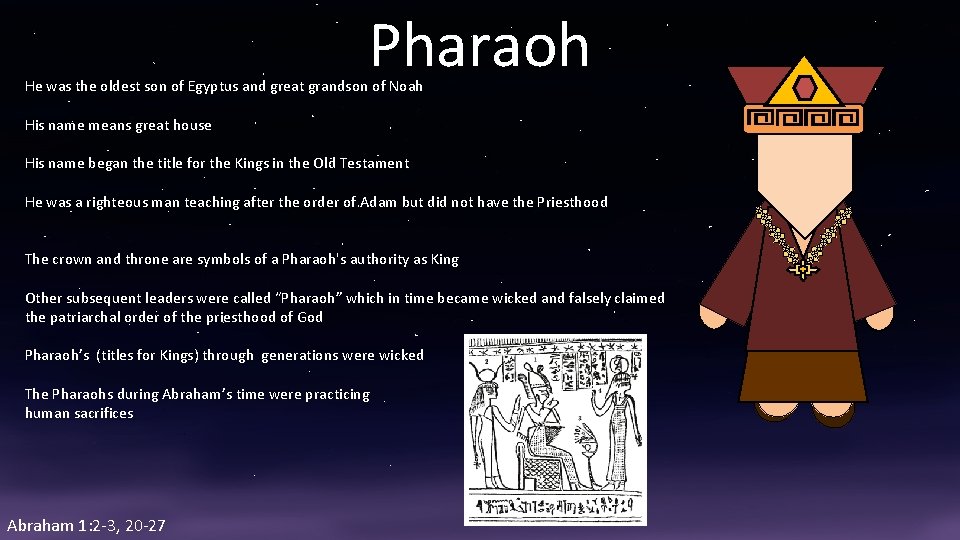
Pharaoh He was the oldest son of Egyptus and great grandson of Noah His name means great house His name began the title for the Kings in the Old Testament He was a righteous man teaching after the order of Adam but did not have the Priesthood The crown and throne are symbols of a Pharaoh's authority as King Other subsequent leaders were called “Pharaoh” which in time became wicked and falsely claimed the patriarchal order of the priesthood of God Pharaoh’s (titles for Kings) through generations were wicked The Pharaohs during Abraham’s time were practicing human sacrifices Abraham 1: 2 -3, 20 -27
Records of the Fathers …the records have come into my hands, which I hold unto this present time. Abraham 1: 28
Sources: Suggested Hymn: #8 Awake And Arise Video: “Deliverance of Abraham” (Adam Clarke, The Holy Bible … with a Commentary and Critical Notes, 6 vols. , 1: 86; see also Old Testament Student Manual: Genesis– 2 Samuel, 3 rd ed. [Church Educational System manual, 2003], 57– 58). Josephus, Antiquities of the Jews, book 1, chapter 4, paragraphs 2– 3). Institute Manual Old Testament Genesis 4 -11 Old Testament Who’s Who by Ed J. Pinegar and Richard J. Allen pp. 5 -7 43, 165 -166 Voices of Old Testament Prophets Russell M. Nelson p. 9, 203 (The 26 th Annual Sidney B. Sperry Symposium) (History of the Church, 2: 236)” (The Pearl of Great Price Student Manual [Church Educational System manual, 2000], 28). Elder Neal A. Maxwell (“According to the Desire of [Our] Hearts, ” Ensign, Nov. 1996, 21). Elder Joseph B. Wirthlin (“Seeking the Good, ” Ensign, May 1992, 86). Heather Farrell Women in the Scriptures Blog President Joseph Fielding Smith (The Way to Perfection [1953], 86)” (Pearl of Great Price Student Manual, 30). Presentation by ©http: //fashionsbylynda. com/blog/
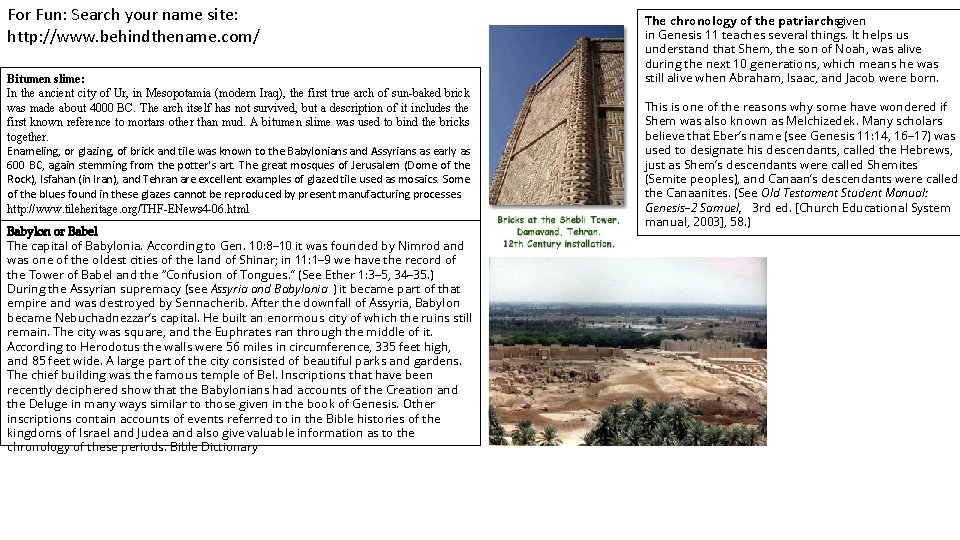
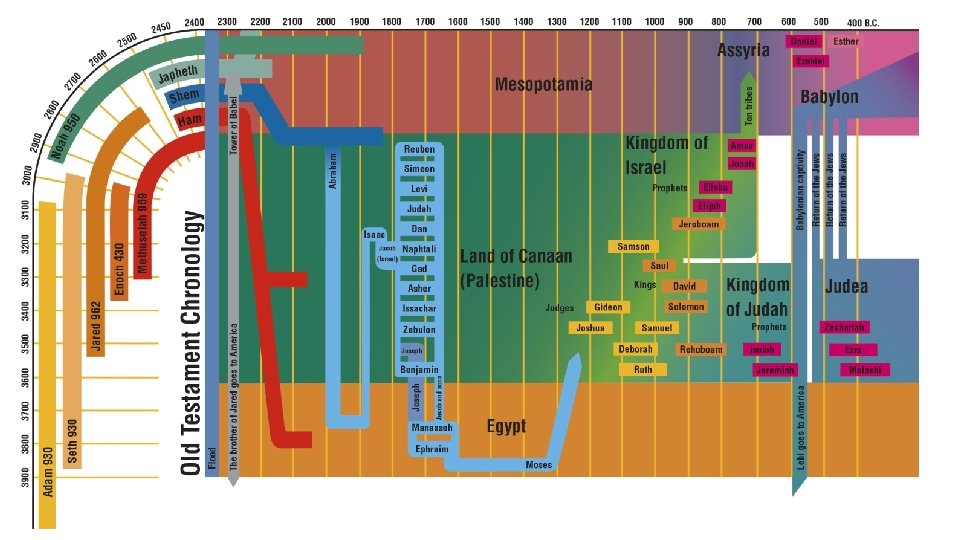
For Fun: Search your name site: http: //www. behindthename. com/ Bitumen slime: In the ancient city of Ur, in Mesopotamia (modern Iraq), the first true arch of sun-baked brick was made about 4000 BC. The arch itself has not survived, but a description of it includes the first known reference to mortars other than mud. A bitumen slime was used to bind the bricks together. Enameling, or glazing, of brick and tile was known to the Babylonians and Assyrians as early as 600 BC, again stemming from the potter's art. The great mosques of Jerusalem (Dome of the Rock), Isfahan (in Iran), and Tehran are excellent examples of glazed tile used as mosaics. Some of the blues found in these glazes cannot be reproduced by present manufacturing processes. http: //www. tileheritage. org/THF-ENews 4 -06. html Babylon or Babel The capital of Babylonia. According to Gen. 10: 8– 10 it was founded by Nimrod and was one of the oldest cities of the land of Shinar; in 11: 1– 9 we have the record of the Tower of Babel and the “Confusion of Tongues. ” (See Ether 1: 3– 5, 34– 35. ) During the Assyrian supremacy (see Assyria and Babylonia ) it became part of that empire and was destroyed by Sennacherib. After the downfall of Assyria, Babylon became Nebuchadnezzar’s capital. He built an enormous city of which the ruins still remain. The city was square, and the Euphrates ran through the middle of it. According to Herodotus the walls were 56 miles in circumference, 335 feet high, and 85 feet wide. A large part of the city consisted of beautiful parks and gardens. The chief building was the famous temple of Bel. Inscriptions that have been recently deciphered show that the Babylonians had accounts of the Creation and the Deluge in many ways similar to those given in the book of Genesis. Other inscriptions contain accounts of events referred to in the Bible histories of the kingdoms of Israel and Judea and also give valuable information as to the chronology of these periods. Bible Dictionary The chronology of the patriarchsgiven in Genesis 11 teaches several things. It helps us understand that Shem, the son of Noah, was alive during the next 10 generations, which means he was still alive when Abraham, Isaac, and Jacob were born. This is one of the reasons why some have wondered if Shem was also known as Melchizedek. Many scholars believe that Eber’s name (see Genesis 11: 14, 16– 17) was used to designate his descendants, called the Hebrews, just as Shem’s descendants were called Shemites (Semite peoples), and Canaan’s descendants were called the Canaanites. (See Old Testament Student Manual: Genesis– 2 Samuel, 3 rd ed. [Church Educational System manual, 2003], 58. )
Noah Ham Japheth Javan Madai Tiras Gomer Tubal Meshech Magog Ashkenaz Riphath Togarmah Elishah Tarshish Kittim Dodanim Cush Nimrod (Resco) Seba Havilah Sabtecha Ramaah Sheba Dedan Mizraim Shem Phut Ludim Anamim Lehabim Naphtuhim Pathrusim Caphtorim Casluhim Canaan Sidon Heth Jabusite Amorite Girgasite Hivite Arkite Sinite Arvadite Zemarite Hamathite Elam Arphaxad Asshur Salah Eber Peleg Reu Serug Nabor Terah Abram Lud Aram Uz Hul Gether Mash Joktan Almodad Sheleph Hazarmaveth Jerah Hadoram Uzal Diklah Obal Abimael Sheba Ophir Jobab Havilah
Shem Elam Arphaxad Asshur Lud Aram Salah Eber Abram--Sarai Nahor--Malacah Haran Peleg Joktan Reu Almodad Sheleph Hazarmaveth Jerah Hadoram Uzal Diklah Obal Abimael Sheba Ophir Jobab Havilah Serug Nabor Terah Abram Terahin the land of Ur Lot From Genesis 11: 31 it seems that it was Terah who directed hisf amily to leave Ur and go to Canaan by way of Haran. Abraham 2: 3– 5, however, makes it clear that Abraham, under the Lord’s direction, was the leader of the group.
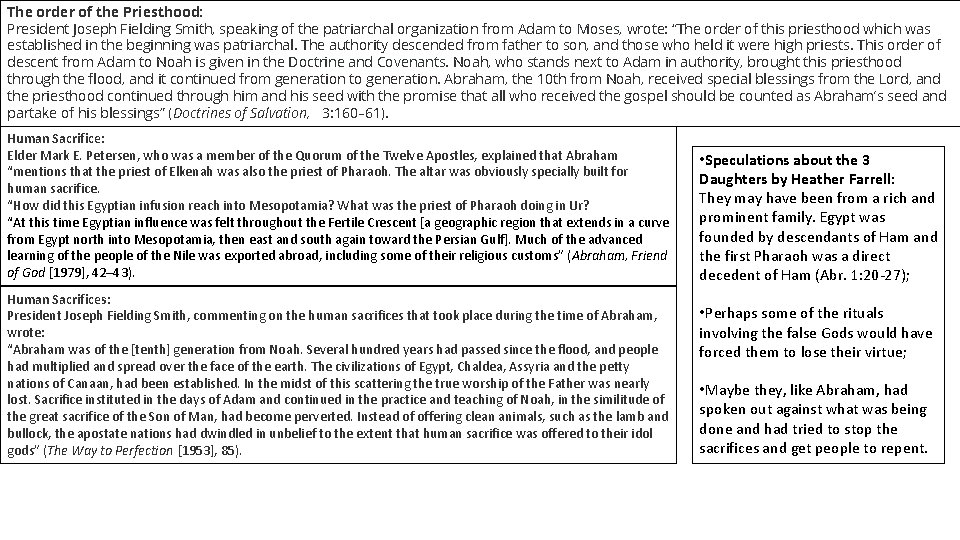
The order of the Priesthood: President Joseph Fielding Smith, speaking of the patriarchal organization from Adam to Moses, wrote: “The order of this priesthood which was established in the beginning was patriarchal. The authority descended from father to son, and those who held it were high priests. This order of descent from Adam to Noah is given in the Doctrine and Covenants. Noah, who stands next to Adam in authority, brought this priesthood through the flood, and it continued from generation to generation. Abraham, the 10 th from Noah, received special blessings from the Lord, and the priesthood continued through him and his seed with the promise that all who received the gospel should be counted as Abraham’s seed and partake of his blessings” (Doctrines of Salvation, 3: 160– 61). Human Sacrifice: Elder Mark E. Petersen, who was a member of the Quorum of the Twelve Apostles, explained that Abraham “mentions that the priest of Elkenah was also the priest of Pharaoh. The altar was obviously specially built for human sacrifice. “How did this Egyptian infusion reach into Mesopotamia? What was the priest of Pharaoh doing in Ur? “At this time Egyptian influence was felt throughout the Fertile Crescent [a geographic region that extends in a curve from Egypt north into Mesopotamia, then east and south again toward the Persian Gulf]. Much of the advanced learning of the people of the Nile was exported abroad, including some of their religious customs” (Abraham, Friend of God [1979], 42– 43). Human Sacrifices: President Joseph Fielding Smith, commenting on the human sacrifices that took place during the time of Abraham, wrote: “Abraham was of the [tenth] generation from Noah. Several hundred years had passed since the flood, and people had multiplied and spread over the face of the earth. The civilizations of Egypt, Chaldea, Assyria and the petty nations of Canaan, had been established. In the midst of this scattering the true worship of the Father was nearly lost. Sacrifice instituted in the days of Adam and continued in the practice and teaching of Noah, in the similitude of the great sacrifice of the Son of Man, had become perverted. Instead of offering clean animals, such as the lamb and bullock, the apostate nations had dwindled in unbelief to the extent that human sacrifice was offered to their idol gods” (The Way to Perfection [1953], 85). • Speculations about the 3 Daughters by Heather Farrell: They may have been from a rich and prominent family. Egypt was founded by descendants of Ham and the first Pharaoh was a direct decedent of Ham (Abr. 1: 20 -27); • Perhaps some of the rituals involving the false Gods would have forced them to lose their virtue; • Maybe they, like Abraham, had spoken out against what was being done and had tried to stop the sacrifices and get people to repent.