
Lesson 20 Laws of Logarithms IB Math HL
Lesson 20 - Laws of Logarithms IB Math HL 1 - Santowski 1/19/2022 IB Math HL 1 - Santowski 1
Lesson Objectives n Understand the rationale behind the “laws of logs” n Apply the various laws of logarithms in solving equations and simplifying expressions 1/19/2022 IB Math HL 1 - Santowski 2
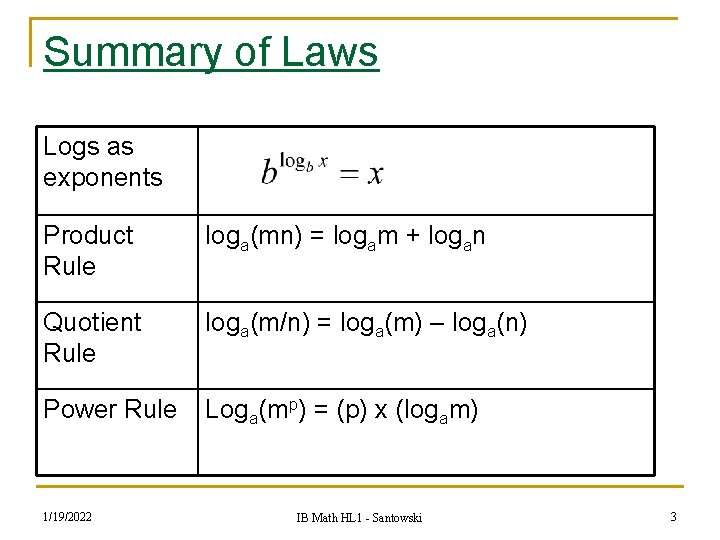
Summary of Laws Logs as exponents Product Rule loga(mn) = logam + logan Quotient Rule loga(m/n) = loga(m) – loga(n) Power Rule Loga(mp) = (p) x (logam) 1/19/2022 IB Math HL 1 - Santowski 3

(A) Properties of Logarithms – Product Law n n n Recall the laws for exponents product of powers (bx)(by) = b(x+y) so we ADD the exponents when we multiply powers For example (23)(25) = 2(3+5) So we have our POWERS 8 x 32 = 256 1/19/2022 IB Math HL 1 - Santowski 4
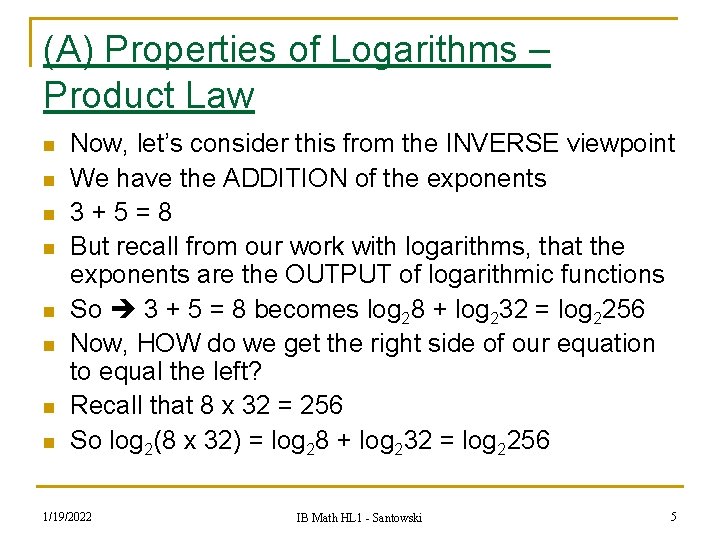
(A) Properties of Logarithms – Product Law n n n n Now, let’s consider this from the INVERSE viewpoint We have the ADDITION of the exponents 3+5=8 But recall from our work with logarithms, that the exponents are the OUTPUT of logarithmic functions So 3 + 5 = 8 becomes log 28 + log 232 = log 2256 Now, HOW do we get the right side of our equation to equal the left? Recall that 8 x 32 = 256 So log 2(8 x 32) = log 28 + log 232 = log 2256 1/19/2022 IB Math HL 1 - Santowski 5
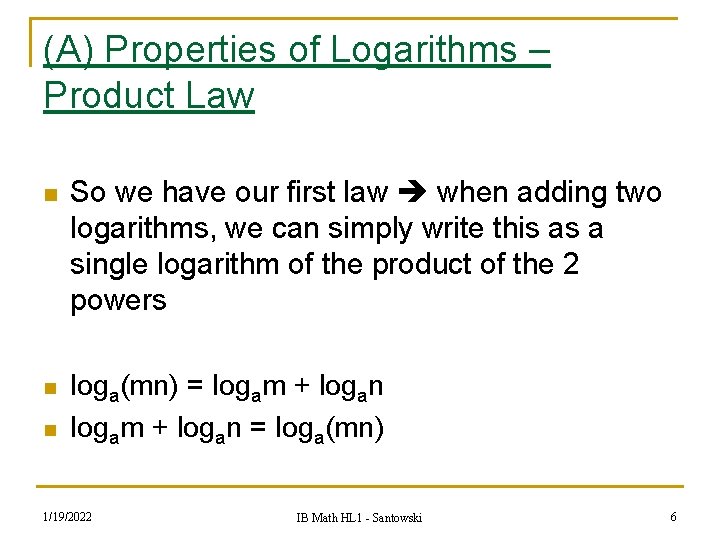
(A) Properties of Logarithms – Product Law n So we have our first law when adding two logarithms, we can simply write this as a single logarithm of the product of the 2 powers n loga(mn) = logam + logan = loga(mn) n 1/19/2022 IB Math HL 1 - Santowski 6
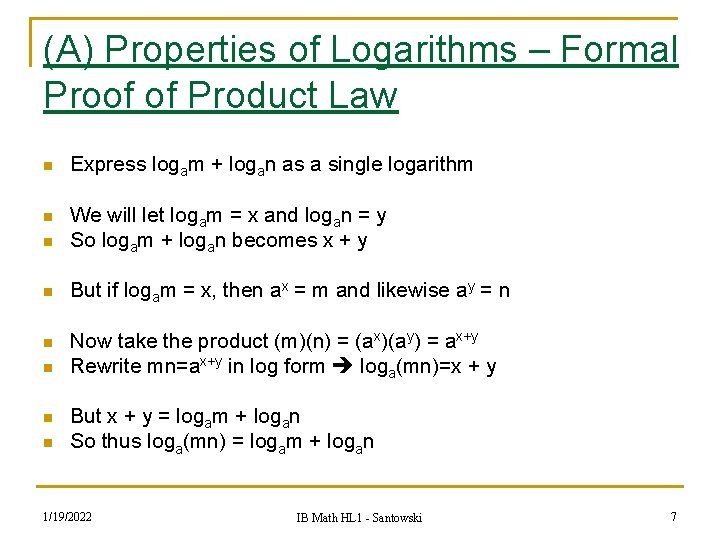
(A) Properties of Logarithms – Formal Proof of Product Law n Express logam + logan as a single logarithm n n We will let logam = x and logan = y So logam + logan becomes x + y n But if logam = x, then ax = m and likewise ay = n n Now take the product (m)(n) = (ax)(ay) = ax+y Rewrite mn=ax+y in log form loga(mn)=x + y n n n But x + y = logam + logan So thus loga(mn) = logam + logan 1/19/2022 IB Math HL 1 - Santowski 7
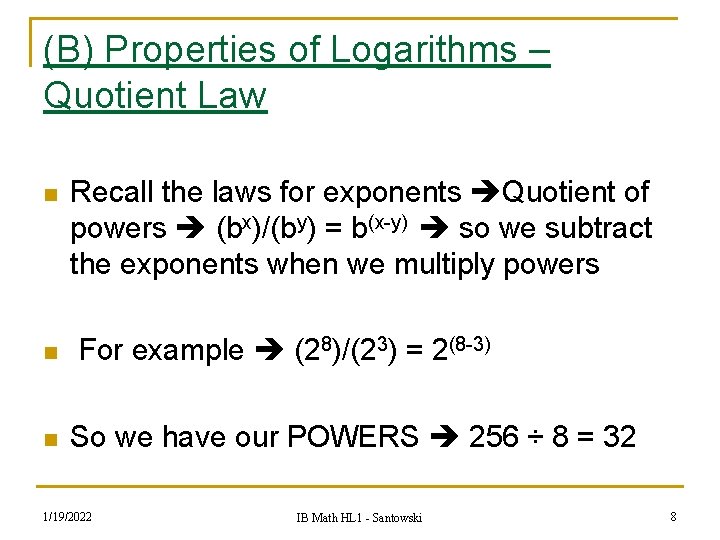
(B) Properties of Logarithms – Quotient Law n n n Recall the laws for exponents Quotient of powers (bx)/(by) = b(x-y) so we subtract the exponents when we multiply powers For example (28)/(23) = 2(8 -3) So we have our POWERS 256 ÷ 8 = 32 1/19/2022 IB Math HL 1 - Santowski 8
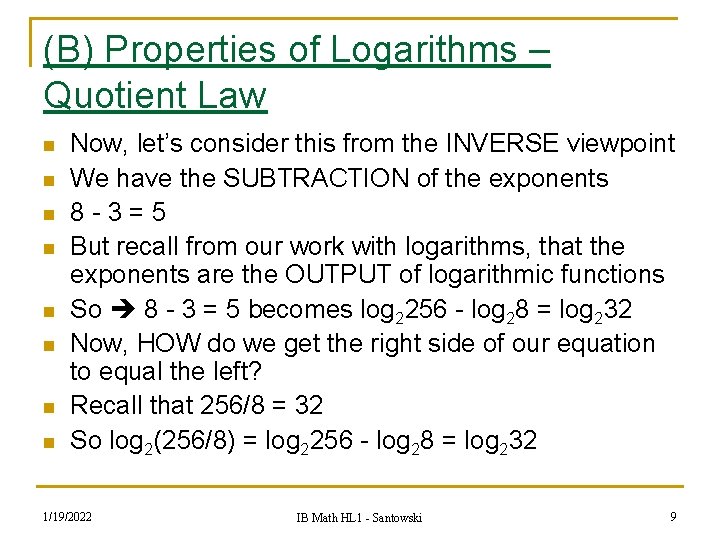
(B) Properties of Logarithms – Quotient Law n n n n Now, let’s consider this from the INVERSE viewpoint We have the SUBTRACTION of the exponents 8 -3=5 But recall from our work with logarithms, that the exponents are the OUTPUT of logarithmic functions So 8 - 3 = 5 becomes log 2256 - log 28 = log 232 Now, HOW do we get the right side of our equation to equal the left? Recall that 256/8 = 32 So log 2(256/8) = log 2256 - log 28 = log 232 1/19/2022 IB Math HL 1 - Santowski 9
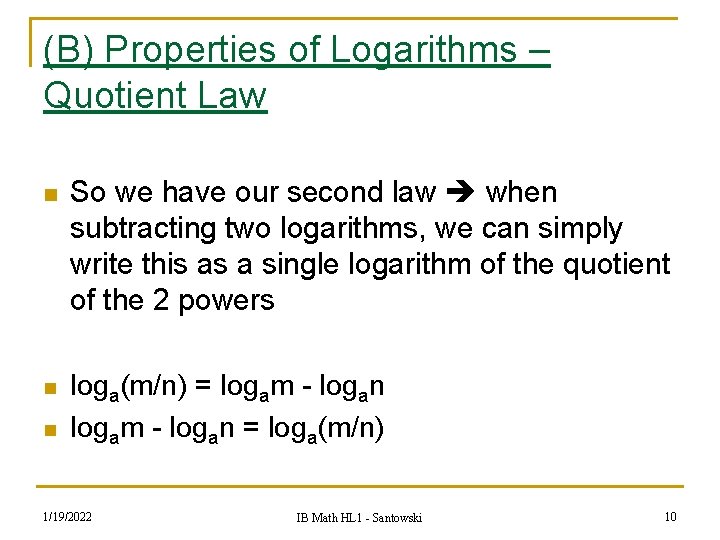
(B) Properties of Logarithms – Quotient Law n So we have our second law when subtracting two logarithms, we can simply write this as a single logarithm of the quotient of the 2 powers n loga(m/n) = logam - logan = loga(m/n) n 1/19/2022 IB Math HL 1 - Santowski 10
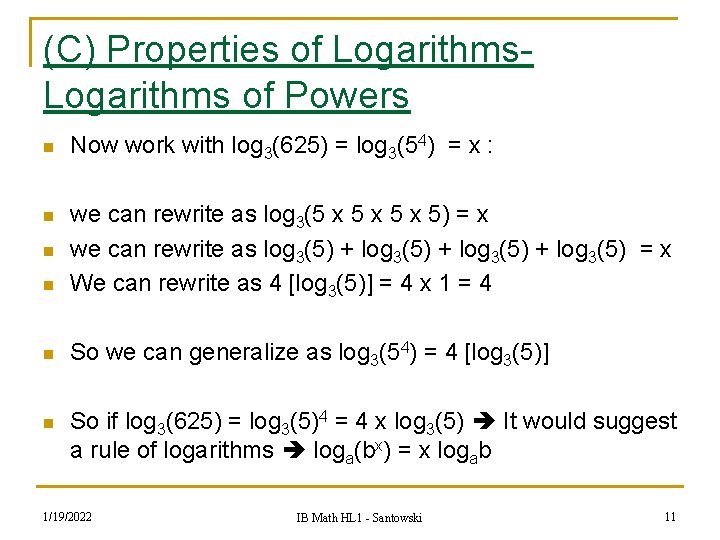
(C) Properties of Logarithms of Powers n Now work with log 3(625) = log 3(54) = x : n n we can rewrite as log 3(5 x 5 x 5) = x we can rewrite as log 3(5) + log 3(5) = x We can rewrite as 4 [log 3(5)] = 4 x 1 = 4 n So we can generalize as log 3(54) = 4 [log 3(5)] n So if log 3(625) = log 3(5)4 = 4 x log 3(5) It would suggest a rule of logarithms loga(bx) = x logab n 1/19/2022 IB Math HL 1 - Santowski 11
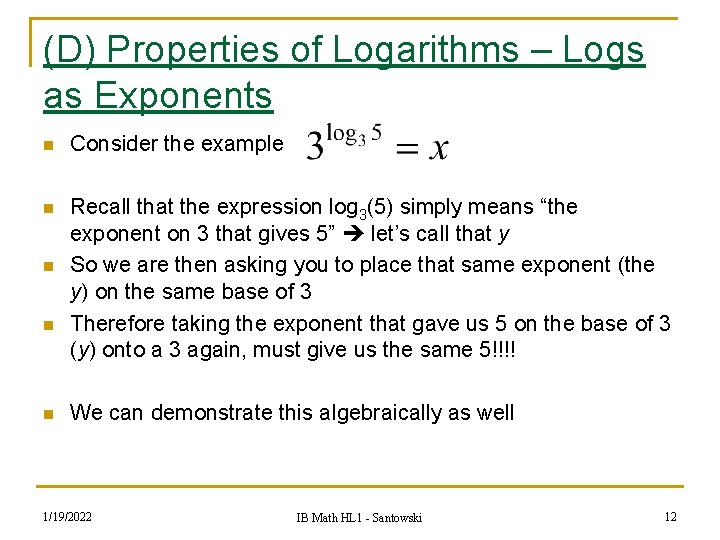
(D) Properties of Logarithms – Logs as Exponents n Consider the example n Recall that the expression log 3(5) simply means “the exponent on 3 that gives 5” let’s call that y So we are then asking you to place that same exponent (the y) on the same base of 3 Therefore taking the exponent that gave us 5 on the base of 3 (y) onto a 3 again, must give us the same 5!!!! n n n We can demonstrate this algebraically as well 1/19/2022 IB Math HL 1 - Santowski 12
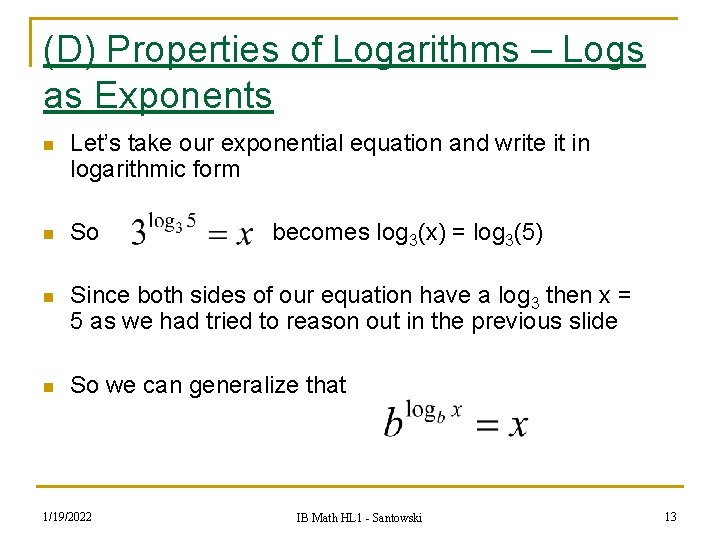
(D) Properties of Logarithms – Logs as Exponents n Let’s take our exponential equation and write it in logarithmic form n So n Since both sides of our equation have a log 3 then x = 5 as we had tried to reason out in the previous slide n So we can generalize that 1/19/2022 becomes log 3(x) = log 3(5) IB Math HL 1 - Santowski 13
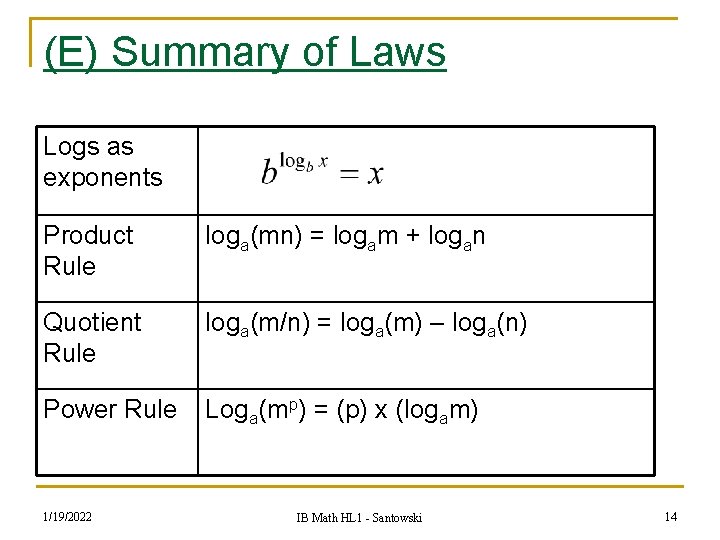
(E) Summary of Laws Logs as exponents Product Rule loga(mn) = logam + logan Quotient Rule loga(m/n) = loga(m) – loga(n) Power Rule Loga(mp) = (p) x (logam) 1/19/2022 IB Math HL 1 - Santowski 14
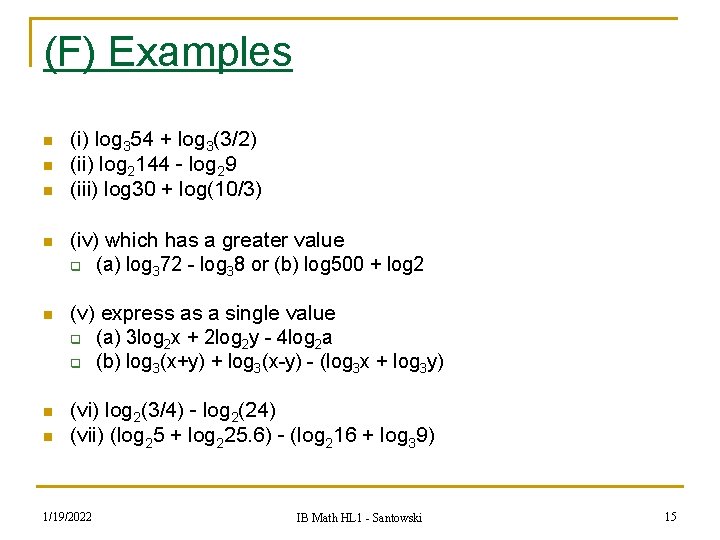
(F) Examples n n n (i) log 354 + log 3(3/2) (ii) log 2144 - log 29 (iii) log 30 + log(10/3) n (iv) which has a greater value q (a) log 372 - log 38 or (b) log 500 + log 2 n (v) express as a single value q (a) 3 log 2 x + 2 log 2 y - 4 log 2 a q (b) log 3(x+y) + log 3(x-y) - (log 3 x + log 3 y) n (vi) log 2(3/4) - log 2(24) (vii) (log 25 + log 225. 6) - (log 216 + log 39) n 1/19/2022 IB Math HL 1 - Santowski 15
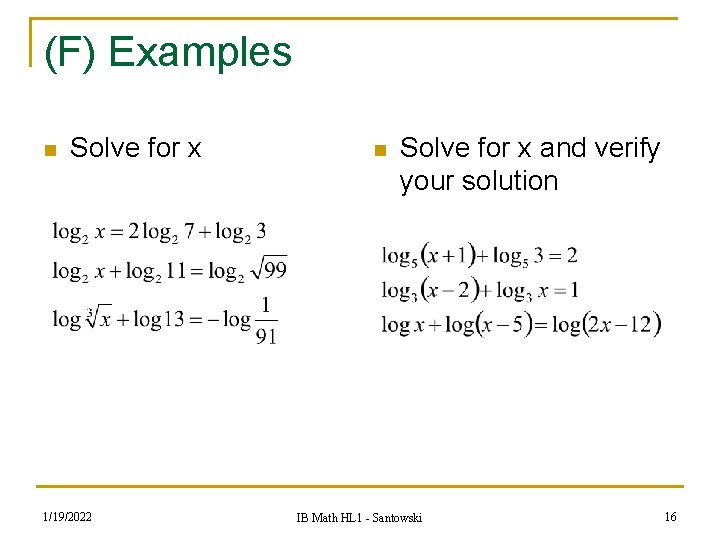
(F) Examples n Solve for x 1/19/2022 n Solve for x and verify your solution IB Math HL 1 - Santowski 16
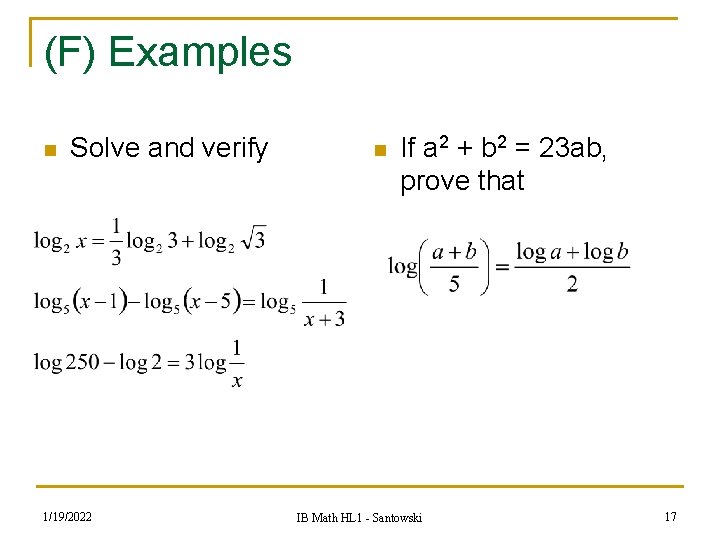
(F) Examples n Solve and verify 1/19/2022 n If a 2 + b 2 = 23 ab, prove that IB Math HL 1 - Santowski 17
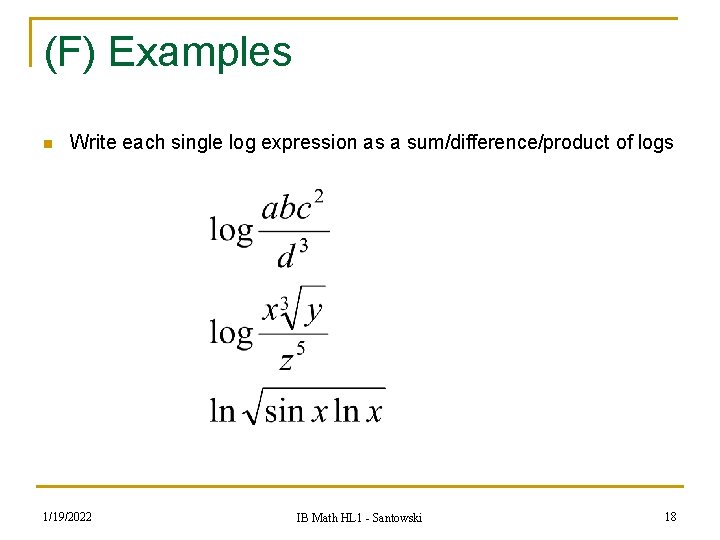
(F) Examples n Write each single log expression as a sum/difference/product of logs 1/19/2022 IB Math HL 1 - Santowski 18
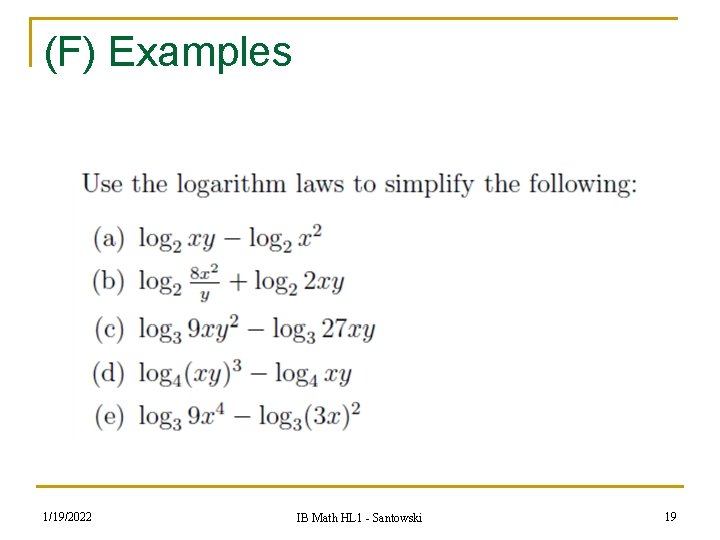
(F) Examples 1/19/2022 IB Math HL 1 - Santowski 19
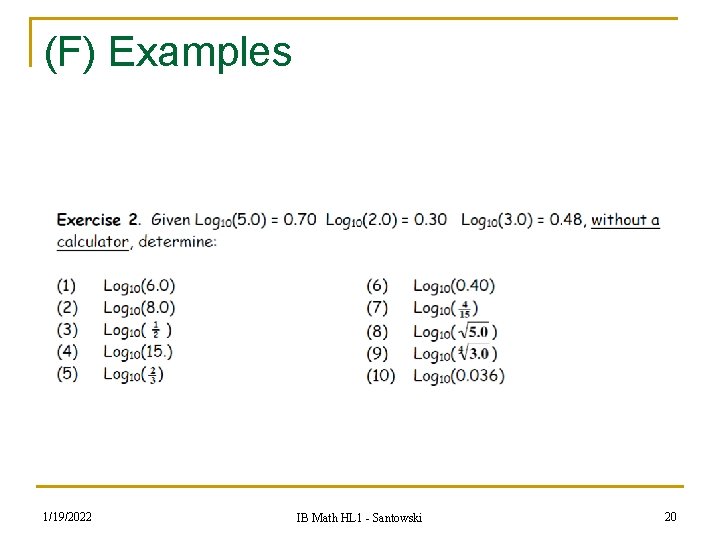
(F) Examples 1/19/2022 IB Math HL 1 - Santowski 20
- Slides: 20