
LESSON 2 Strategies for Teaching LESSON 2 Strategies

- Slides: 33
LESSON 2: Strategies for Teaching
LESSON 2: Strategies for Teaching How can you develop an effective lesson plan? Think about the “Essential Question” and Quick Write your thoughts in your Cadet Notebook.
LESSON 2: Strategies for Teaching Inquire – What do you already know? Think about what you know about the phases of learning.
LESSON 2: Strategies for Teaching (U 4 C 1 L 2: F 1) Which statement most accurately reflects how you feel about lesson plans? A) They are an essential tool to organize the information and activities used in class. B) They are useful for most people to organize instruction but some people don't need them. C) They might be necessary for new information but otherwise not helpful. D) They are such a waste of time—a good teacher should be able to just get up there and do it.
LESSON 2: Strategies for Teaching Prepare for this lesson by discussing the key questions of this Student Learning Plan. • What will you accomplish in this lesson? • What will you learn in this lesson? • Why is the lesson important? • When will you have successfully met the lesson’s purpose?
LESSON 2: Strategies for Teaching Learning Objectives • Explain the purpose of a lesson plan • Describe the four phases of a lesson plan • Relate teaching and learning to the four phase lesson plan model • Explore cooperative learning strategies • Define key words: group dynamics, lesson competency, lesson plan
LESSON 2: Strategies for Teaching Complete Exercise #1 – Match the Learning Phase.
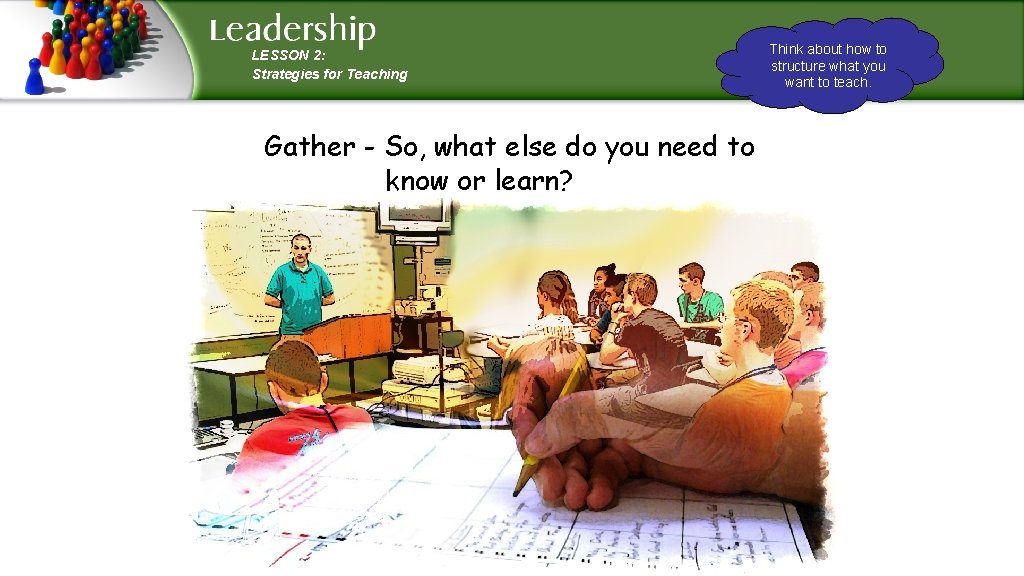
LESSON 2: Strategies for Teaching Gather - So, what else do you need to know or learn? Think about how to structure what you want to teach.
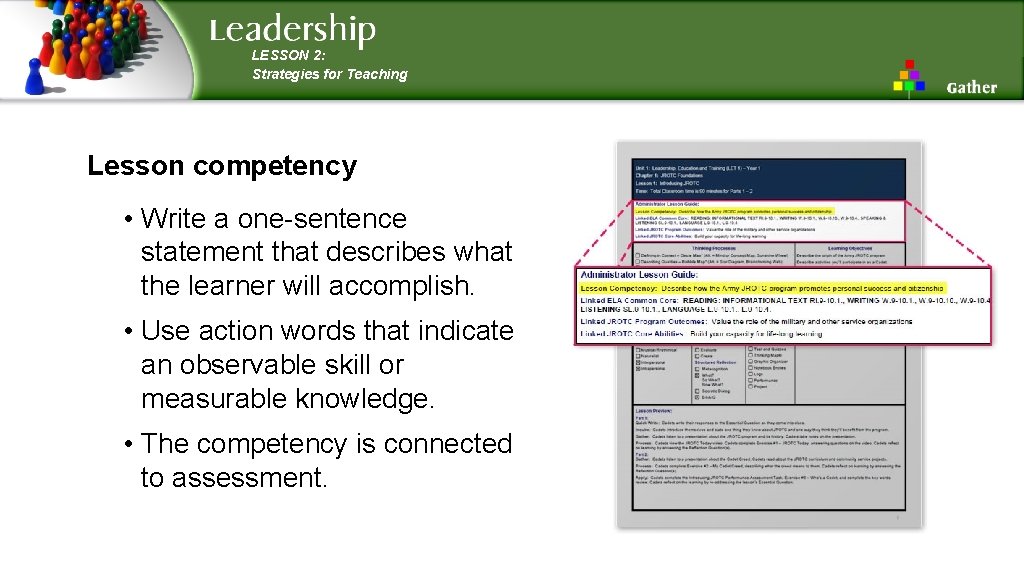
LESSON 2: Strategies for Teaching Lesson plans indicate the: • Specific skill or concept they are teaching—the competency • Supporting ideas for the skill or concept • Sequence they should teach the content • Performance standards of the lesson—how the instructor will know students have learned the content
LESSON 2: Strategies for Teaching Lesson competency • Write a one-sentence statement that describes what the learner will accomplish. • Use action words that indicate an observable skill or measurable knowledge. • The competency is connected to assessment.
LESSON 2: Strategies for Teaching • Read the “Four Phase Lesson Plan” section in your student text. • Make corrections to Exercise #1 – Match the Learning Phase as needed.
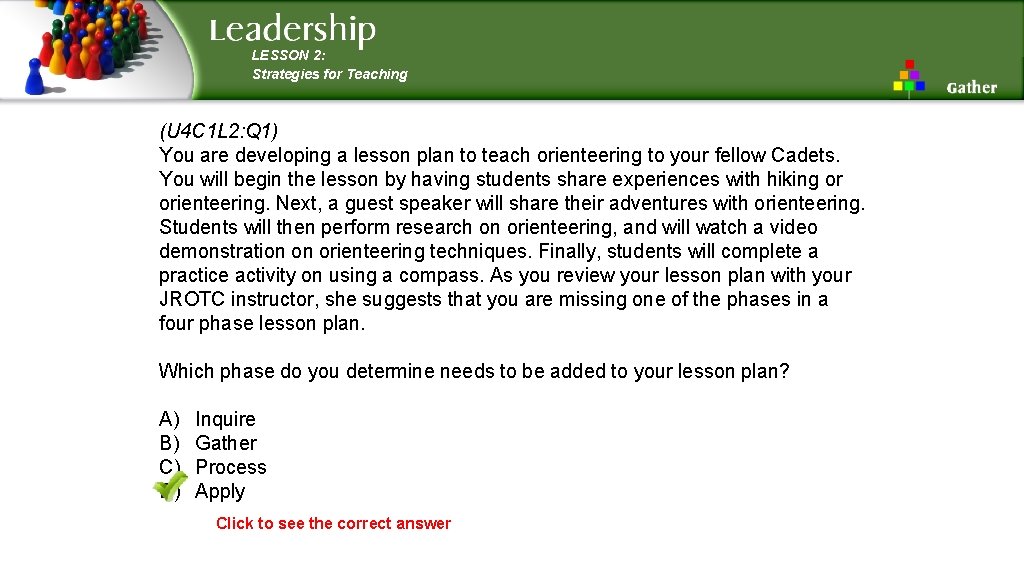
LESSON 2: Strategies for Teaching (U 4 C 1 L 2: Q 1) You are developing a lesson plan to teach orienteering to your fellow Cadets. You will begin the lesson by having students share experiences with hiking or orienteering. Next, a guest speaker will share their adventures with orienteering. Students will then perform research on orienteering, and will watch a video demonstration on orienteering techniques. Finally, students will complete a practice activity on using a compass. As you review your lesson plan with your JROTC instructor, she suggests that you are missing one of the phases in a four phase lesson plan. Which phase do you determine needs to be added to your lesson plan? A) B) C) D) Inquire Gather Process Apply Click to see the correct answer
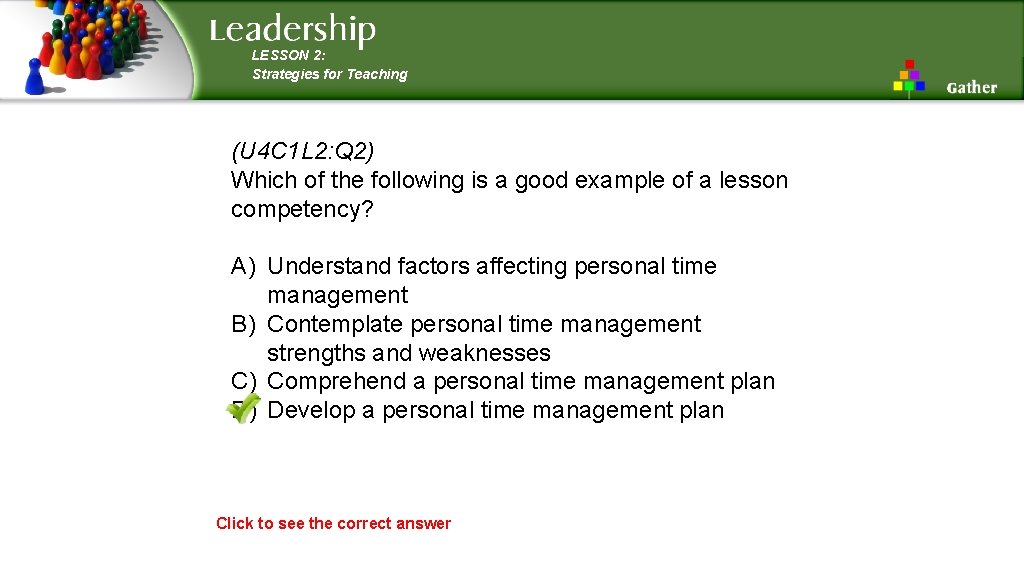
LESSON 2: Strategies for Teaching (U 4 C 1 L 2: Q 2) Which of the following is a good example of a lesson competency? A) Understand factors affecting personal time management B) Contemplate personal time management strengths and weaknesses C) Comprehend a personal time management plan D) Develop a personal time management plan Click to see the correct answer
LESSON 2: Strategies for Teaching (U 4 C 1 L 2: Q 3) Which learning phase addresses this question: What ways can students make relationships among the information, concepts, or skills? A) B) C) D) Inquire Gather Process Apply Click to see the correct answer
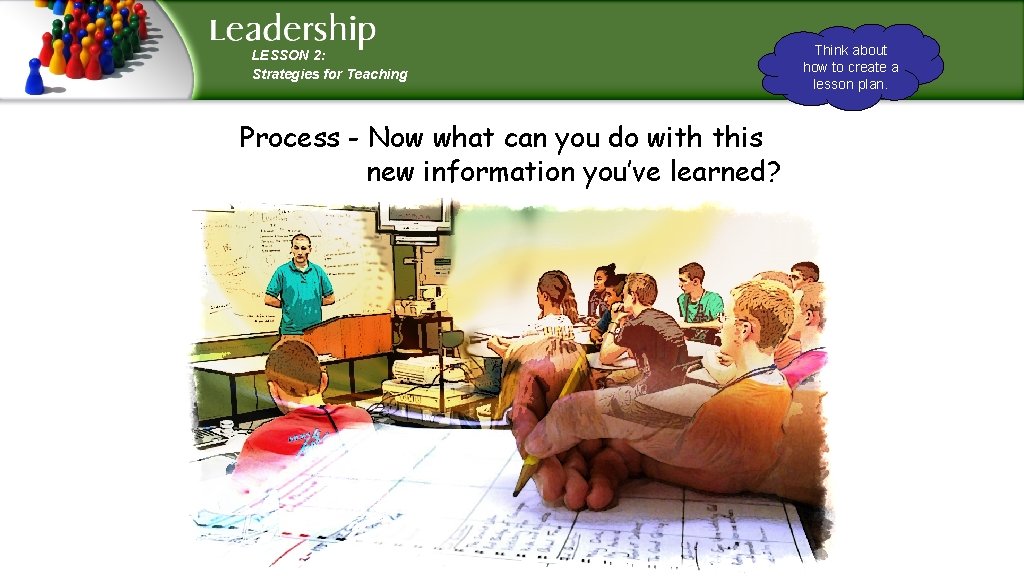
LESSON 2: Strategies for Teaching Process - Now what can you do with this new information you’ve learned? Think about how to create a lesson plan.
LESSON 2: Strategies for Teaching Use Exercise #2 – Lesson Plan Draft to begin work on revising or creating a lesson plan.
LESSON 2: Strategies for Teaching Reflection: • Which phase of learning was the most difficult for you to develop? • Why do you think lesson plans are limited to one competency?
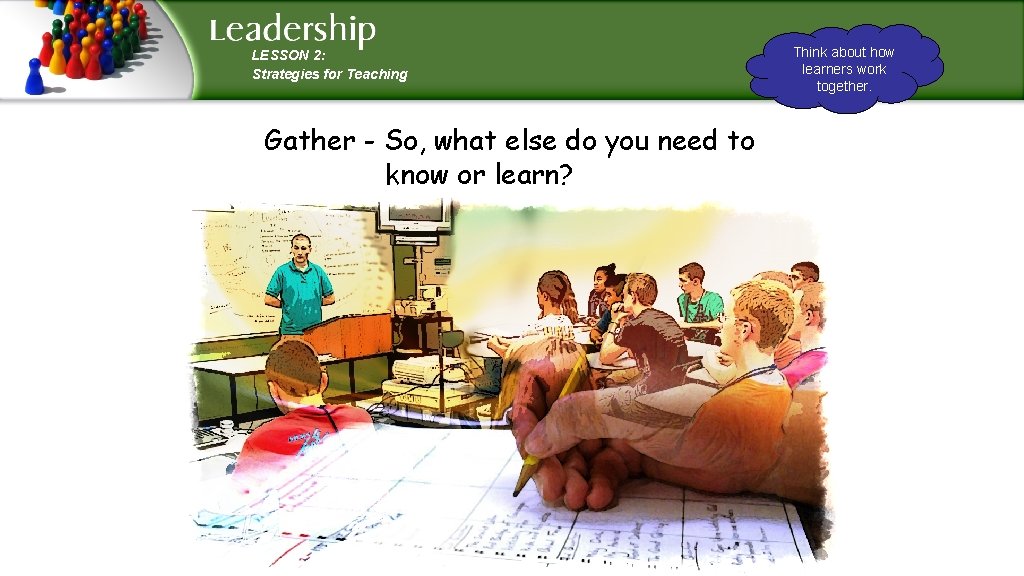
LESSON 2: Strategies for Teaching Gather - So, what else do you need to know or learn? Think about how learners work together.
LESSON 2: Strategies for Teaching • Read the “Using Cooperative Learning Strategies with Groups” section in your student text. • Take notes in your Cadet Notebook.
LESSON 2: Strategies for Teaching Participate in a class discussion on how cooperative learning strategies can be used in the four phases of learning.
LESSON 2: Strategies for Teaching (U 4 C 1 L 2: Q 4) Select the option that does NOT correctly complete the following sentence. “Team-building strategies are important in cooperative learning because _________. ” A) effective cooperative learning teams will enhance the effectiveness of cooperative learning B) effective cooperative learning teams tend to be more creative than individual students or non-cooperative groups C) effective cooperative learning teams require all team members to participate D) effective cooperative learning teams will be better prepared to compete against one another Click to see the correct answer
LESSON 2: Strategies for Teaching (U 4 C 1 L 2: Q 5) Which of the following are team-building exercises? A) Developing a team cheer; selecting a team color to represent the personality of the group B) Choosing a symbol; selecting a celebratory food C) Designing a team logo; naming the team; creating a team song D) All of the choices Click to see the correct answer
LESSON 2: Strategies for Teaching (U 4 C 1 L 2: Q 6) Which of the following are team-building exercises? A) She wants students to respond to questions about the Bill of Rights. Think-Pair-Share is a strategy for facilitating question response and discussion in a group setting. B) She wants students to establish effective team relationships that incorporate elements of the Bill of Rights. Think-Pair. Share is an effective team building strategy. C) She wants students to learn lesson material about the Bill of Rights. Think-Pair-Share is a cooperative learning strategy that can help accomplish this goal. D) She wants students to think about the relationship between the Bill of Rights and sharing. Think-Pair-Share is a strategy for learning about sharing. Click to see the correct answer
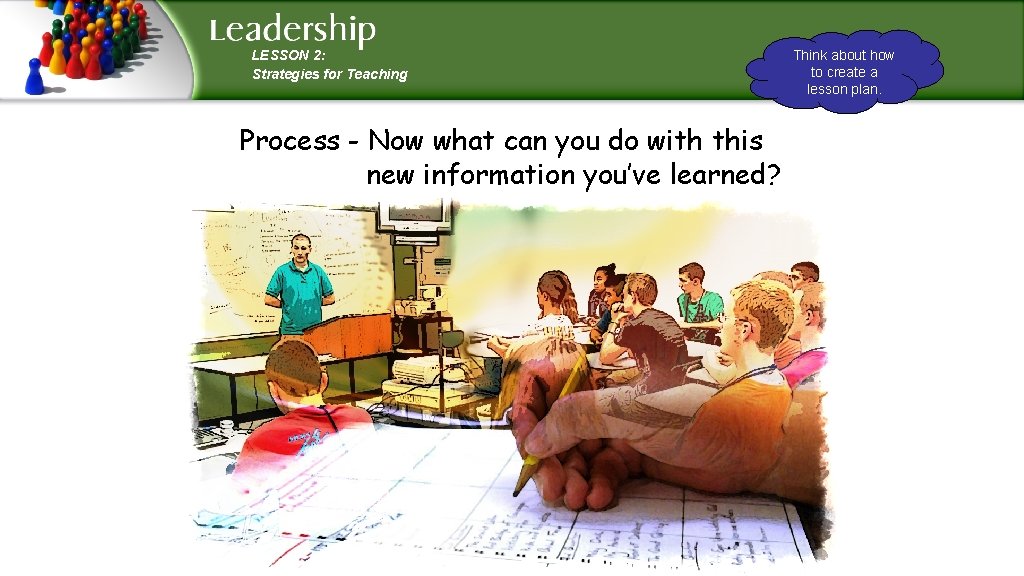
LESSON 2: Strategies for Teaching Process - Now what can you do with this new information you’ve learned? Think about how to create a lesson plan.
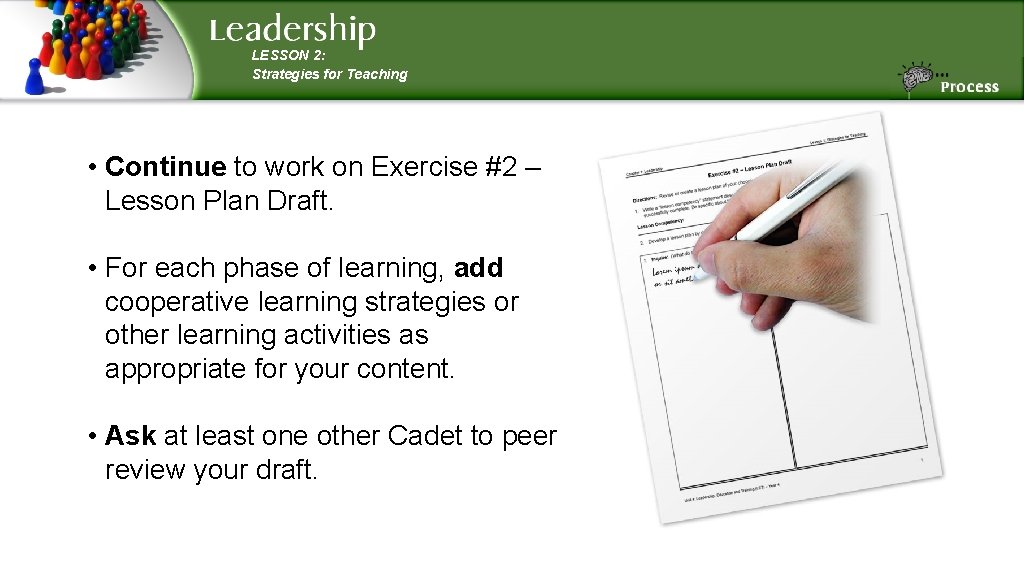
LESSON 2: Strategies for Teaching • Continue to work on Exercise #2 – Lesson Plan Draft. • For each phase of learning, add cooperative learning strategies or other learning activities as appropriate for your content. • Ask at least one other Cadet to peer review your draft.
LESSON 2: Strategies for Teaching Reflection: • From your own experience as a learner, what are some of the challenges in using cooperative learning strategies? • What kinds of content seem to work best with cooperative learning strategies? Which learning phases work best?
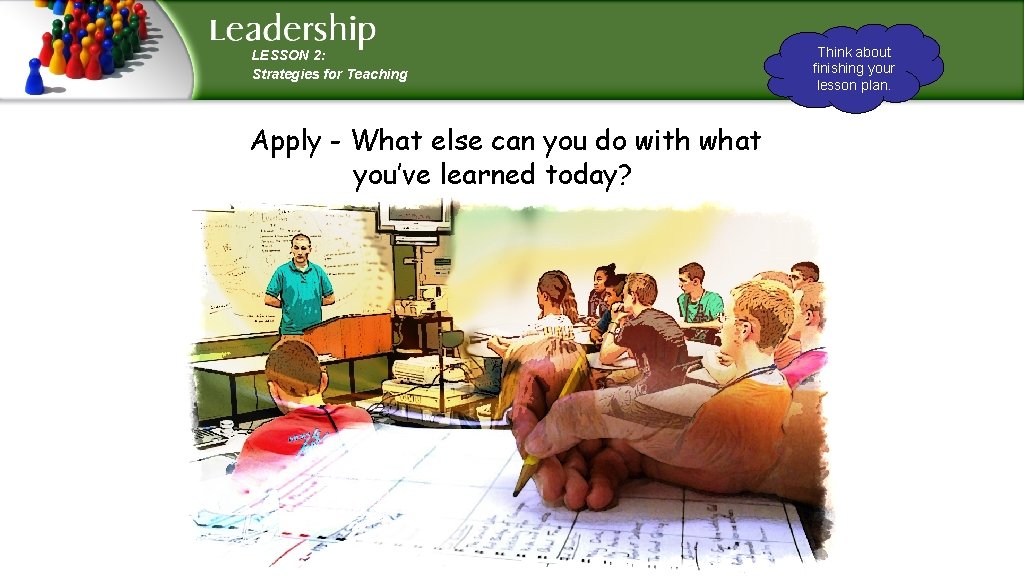
LESSON 2: Strategies for Teaching Apply - What else can you do with what you’ve learned today? Think about finishing your lesson plan.
LESSON 2: Strategies for Teaching Performance Assessment Task • Complete the Strategies for Teaching Performance Assessment Task. • Submit your completed performance assessment task to your instructor feedback and a grade.
LESSON 2: Strategies for Teaching Insert Keywords HTML page with links to the games the CPS questions
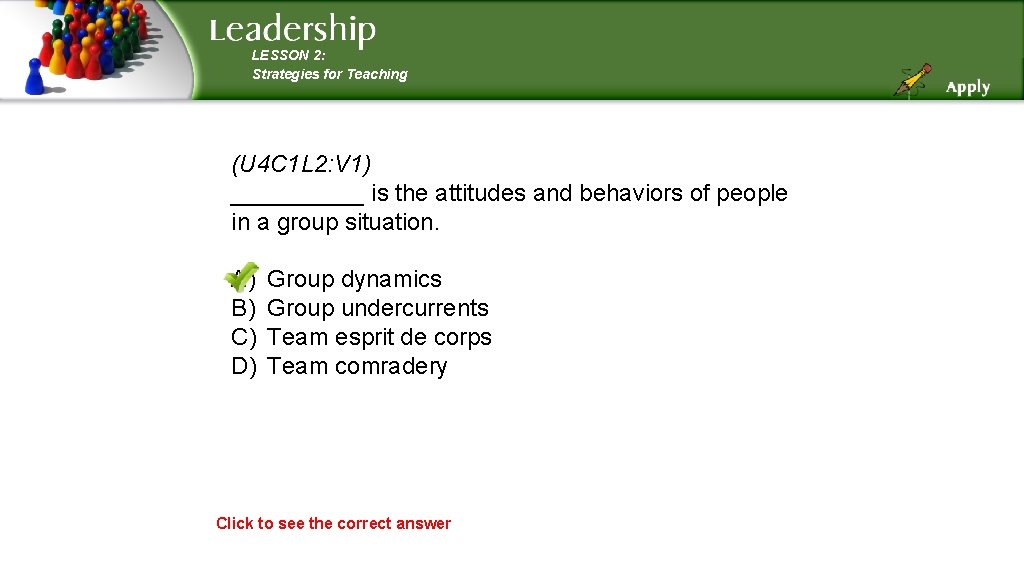
LESSON 2: Strategies for Teaching (U 4 C 1 L 2: V 1) _____ is the attitudes and behaviors of people in a group situation. A) B) C) D) Group dynamics Group undercurrents Team esprit de corps Team comradery Click to see the correct answer
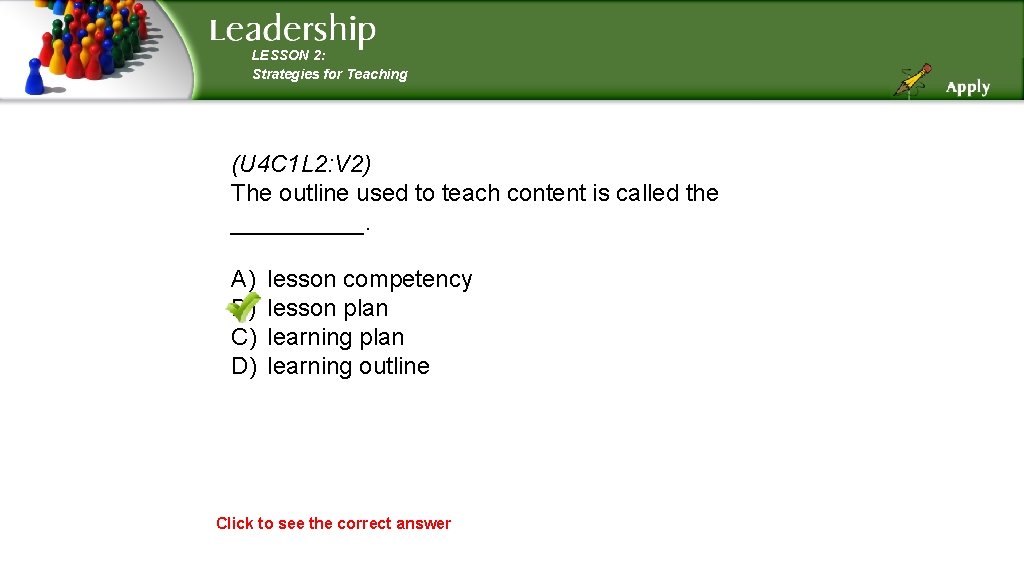
LESSON 2: Strategies for Teaching (U 4 C 1 L 2: V 2) The outline used to teach content is called the _____. A) B) C) D) lesson competency lesson plan learning outline Click to see the correct answer
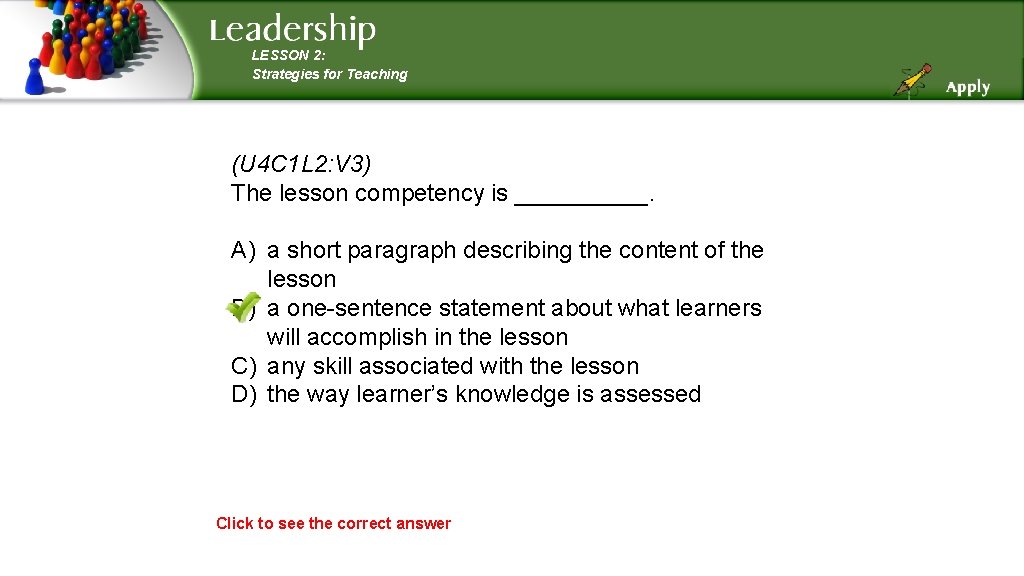
LESSON 2: Strategies for Teaching (U 4 C 1 L 2: V 3) The lesson competency is _____. A) a short paragraph describing the content of the lesson B) a one-sentence statement about what learners will accomplish in the lesson C) any skill associated with the lesson D) the way learner’s knowledge is assessed Click to see the correct answer
LESSON 2: Strategies for Teaching How can you develop an effective lesson plan? Think about the Essential Question and revise your original answer to the Quick Write.