
Lesson 2 Name Stories Jackie Chan Who is


- Slides: 24
Lesson 2 Name Stories
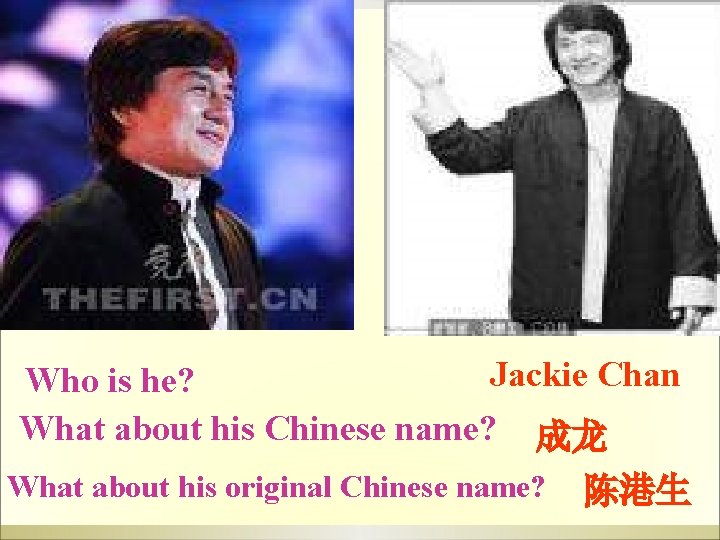
Jackie Chan Who is he? What about his Chinese name? 成龙 What about his original Chinese name? 陈港生
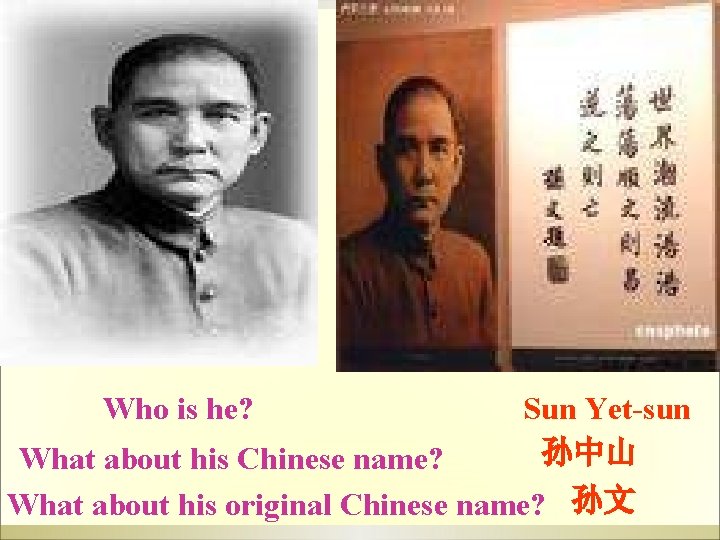
Who is he? Sun Yet-sun 孙中山 What about his Chinese name? What about his original Chinese name? 孙文
Jackie Chan 成龙 陈港生 Sun Yet-sun 孙中山 孙文 Compared their Chinese names, do you know the history of their name. Why did they change their name? Do their name have any specific meanings?
His original name was Chen Gang sh(陈 港生), which tells his birthplace. In his acting career, he first had a stage name(艺 名) Chen Yuan long(陈元龙). Later, a film director gave him another stage name Cheng long(成龙), which has two aspects of meanings: the first one is to express the director’s wish that Cheng could become famous, just like a dragon- the symbol of China; the second it is hoped that Cheng would follow the example of another wellknown Chinese martial star(功夫明星), Li Xiaolong(李小龙).
Pair work 1. What’s your name? 2. What does it mean? 3. And why did your parents give you the name?
Listening Listen to the three students talking about their names. Which of them matches the following descriptions?
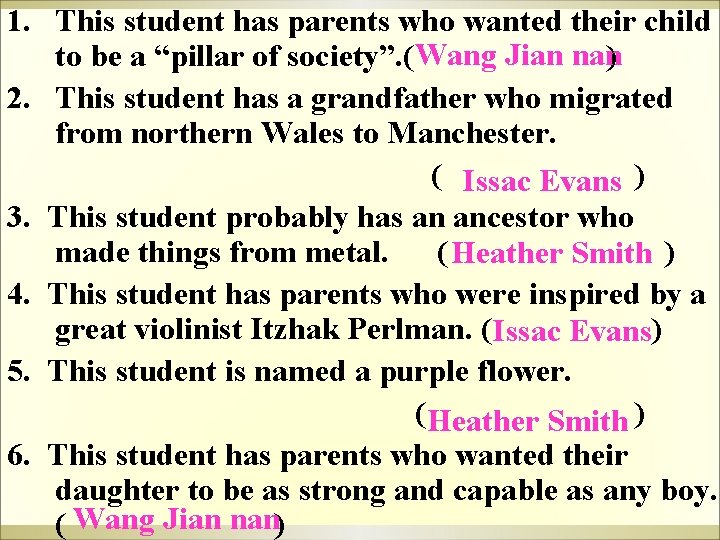
1. This student has parents who wanted their child to be a “pillar of society”. ( Wang Jian nan ) 2. This student has a grandfather who migrated from northern Wales to Manchester. ( Issac Evans ) 3. This student probably has an ancestor who made things from metal. ( Heather Smith ) 4. This student has parents who were inspired by a great violinist Itzhak Perlman. ( Issac Evans) 5. This student is named a purple flower. ( Heather Smith ) 6. This student has parents who wanted their daughter to be as strong and capable as any boy. ( Wang Jian nan)
Let’s read a name story Complete the passage with these phrasal verbs, exercise 5
Read the passage in Exercise 5 and fill in the blanks with the phrasal verbs.
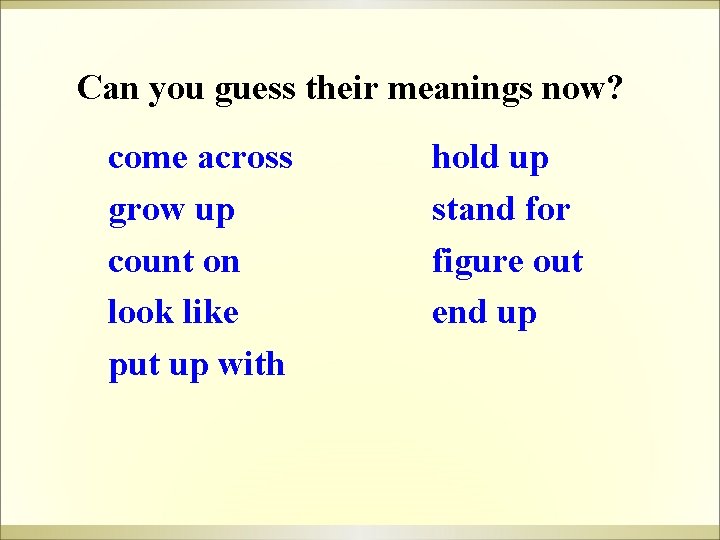
Can you guess their meanings now? come across grow up count on look like put up with hold up stand for figure out end up
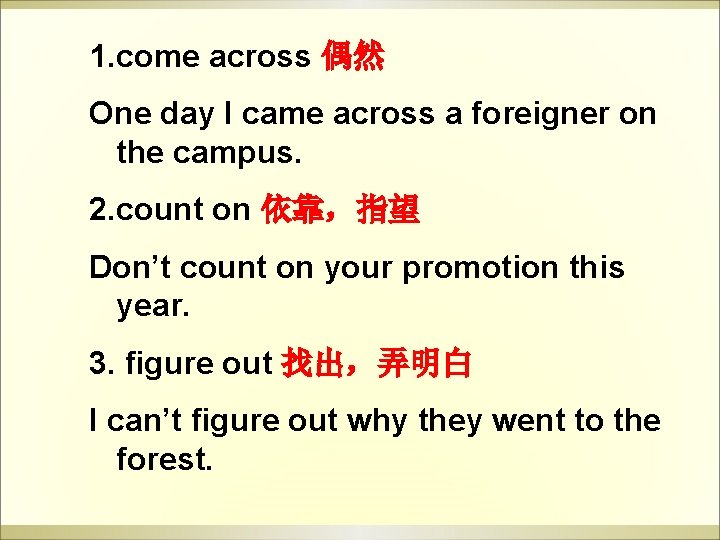
1. come across 偶然 One day I came across a foreigner on the campus. 2. count on 依靠,指望 Don’t count on your promotion this year. 3. figure out 找出,弄明白 I can’t figure out why they went to the forest.
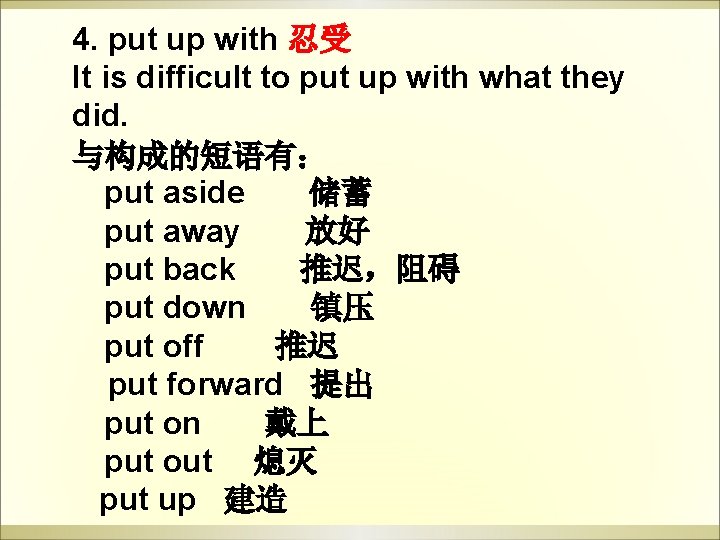
4. put up with 忍受 It is difficult to put up with what they did. 与构成的短语有: put aside 储蓄 put away 放好 put back 推迟,阻碍 put down 镇压 put off 推迟 put forward 提出 put on 戴上 put out 熄灭 put up 建造
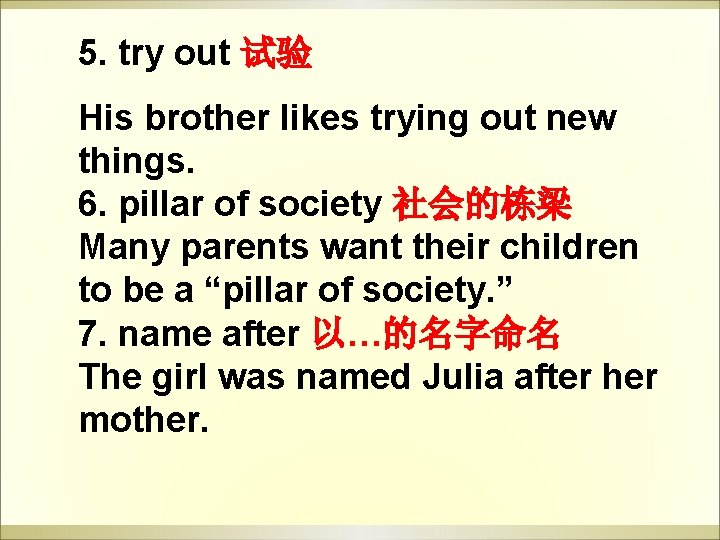
5. try out 试验 His brother likes trying out new things. 6. pillar of society 社会的栋梁 Many parents want their children to be a “pillar of society. ” 7. name after 以…的名字命名 The girl was named Julia after her mother.
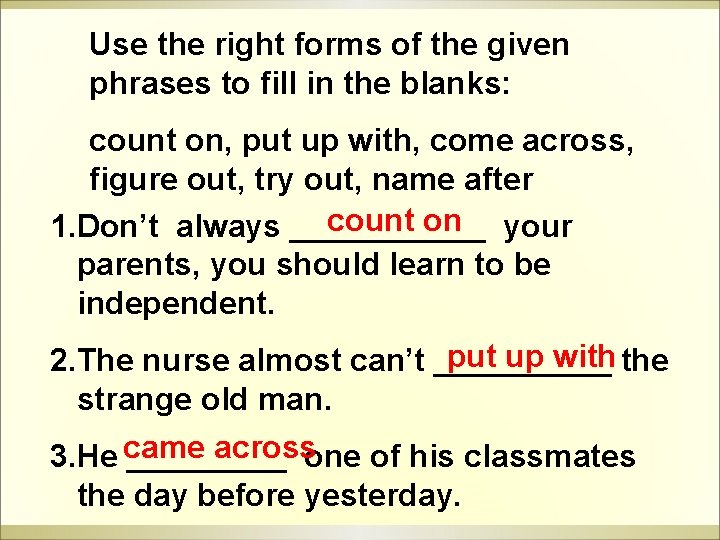
Use the right forms of the given phrases to fill in the blanks: count on, put up with, come across, figure out, try out, name after count on your 1. Don’t always ______ parents, you should learn to be independent. put up with the 2. The nurse almost can’t _____ strange old man. acrossone of his classmates 3. He came _____ the day before yesterday.
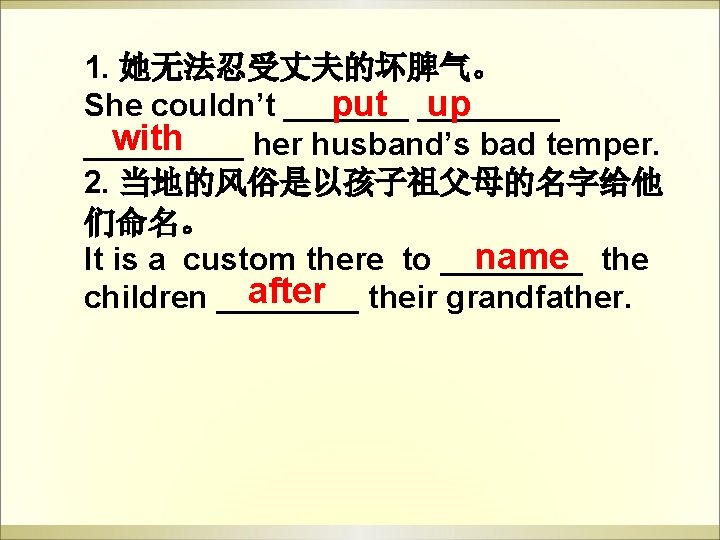
1. 她无法忍受丈夫的坏脾气。 put ____ up She couldn’t _______ with _____ her husband’s bad temper. 2. 当地的风俗是以孩子祖父母的名字给他 们命名。 name the It is a custom there to ____ after their grandfather. children ____
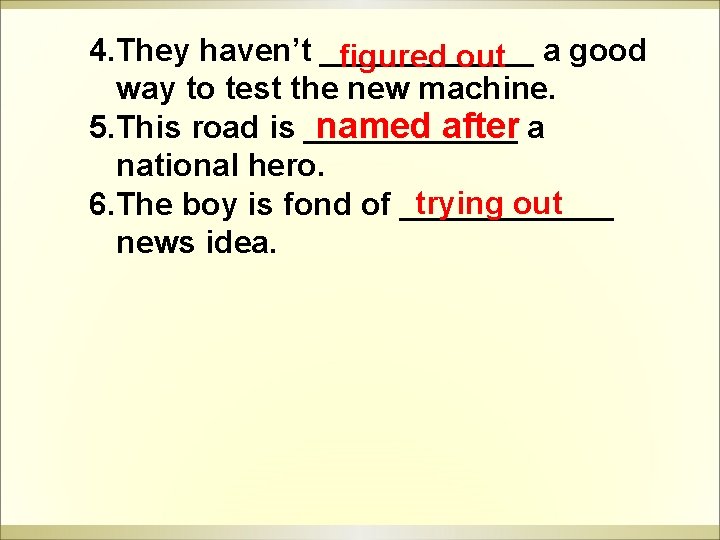
4. They haven’t ______ figured out a good way to test the new machine. 5. This road is ______ named after a national hero. trying out 6. The boy is fond of ______ news idea.
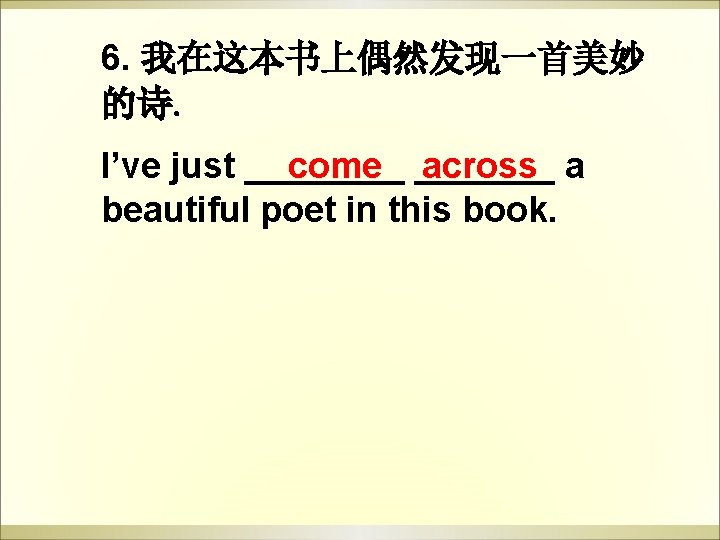
6. 我在这本书上偶然发现一首美妙 的诗。 come _______ across a I’ve just ____ beautiful poet in this book.
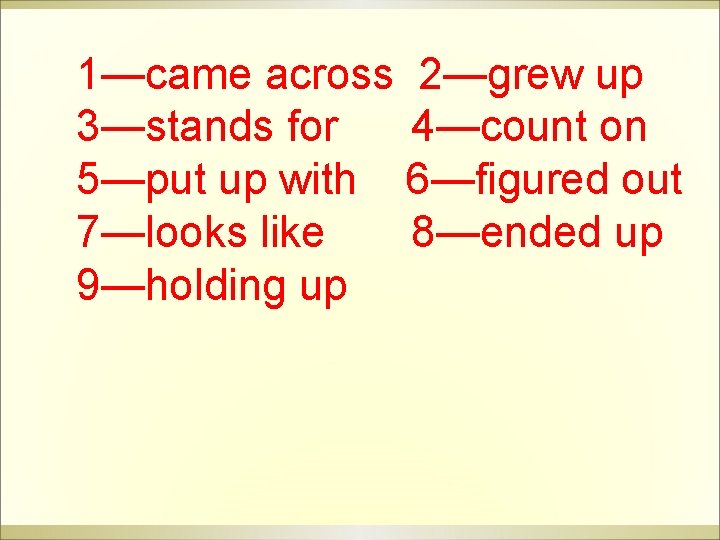
1—came across 2—grew up 3—stands for 4—count on 5—put up with 6—figured out 7—looks like 8—ended up 9—holding up
Culture Linking
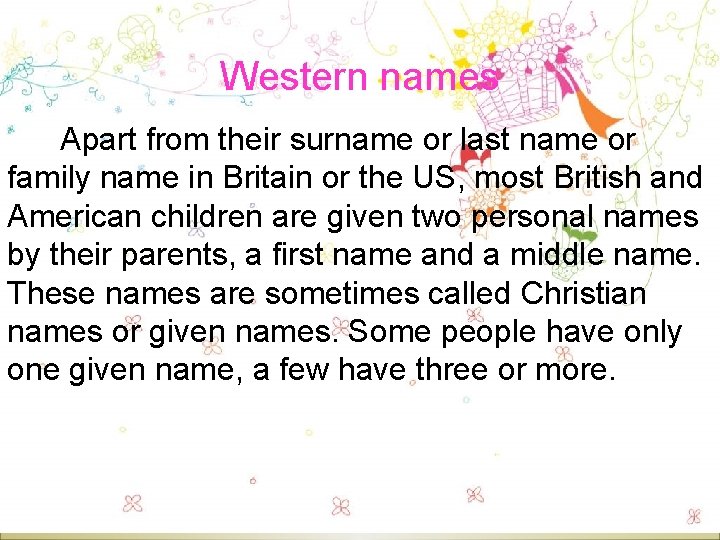
Western names Apart from their surname or last name or family name in Britain or the US, most British and American children are given two personal names by their parents, a first name and a middle name. These names are sometimes called Christian names or given names. Some people have only one given name, a few have three or more.
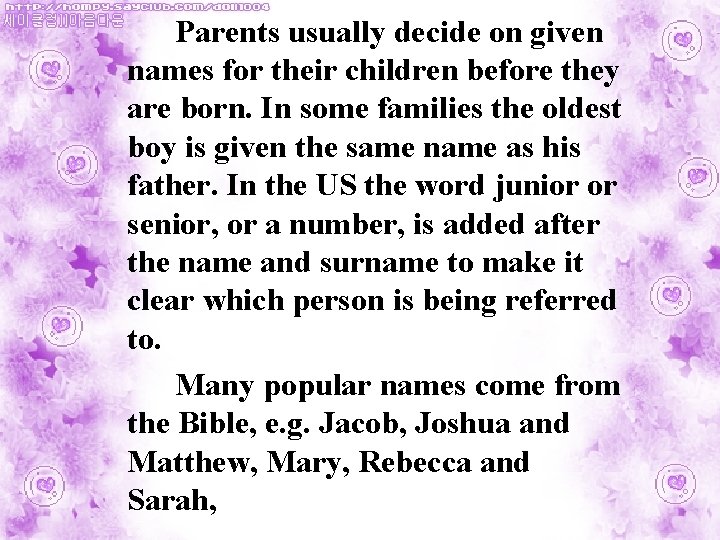
Parents usually decide on given names for their children before they are born. In some families the oldest boy is given the same name as his father. In the US the word junior or senior, or a number, is added after the name and surname to make it clear which person is being referred to. Many popular names come from the Bible, e. g. Jacob, Joshua and Matthew, Mary, Rebecca and Sarah,
though this does not imply that the people who choose them are religious. Other people give their children the name of somebody they admire, such as a famous sports personality, or a film or pop star. In Britain the names William and Harry have become common again since the sons of Prince Charles were given these names.
Discussion Where do Chinese families get their names from? What kinds of trends can be seen in the names people choose for their children?