
LESSON 2 Histology The Study of Animal Tissues






- Slides: 46
LESSON 2 Histology: The Study of Animal Tissues 4 -1
Talkie Time and Recap 4 -2
Competencies 1. Identify the Types of Animal Tissues 2. Enumerate and explain the functions of tissues (types) 3. Describe the characteristics of each tissue 4 -3
Video Time: Types of Tissue 1. Enumerate the Types of Animal Tissues 2. Explain the functions of tissues (types) 3. Describe the characteristics of each tissue 4 -4
Tissues and Histology • Tissues are collections of similar cells and the substances that surround them. • Tissues are communities of cells embedded in a structural framework or matrix performing a definite function. • Tissue Level of Organization – Epithelial – Connective – Vascular – Muscle – Nervous • Histology: Microscopic Study of Tissues 4 -5
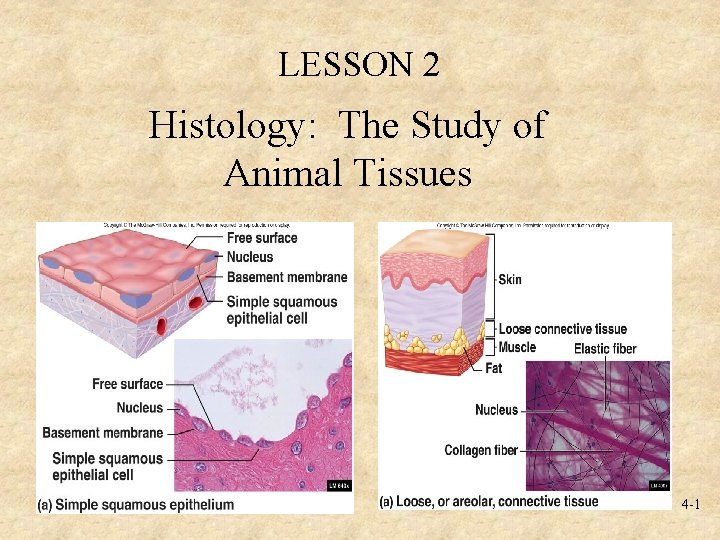
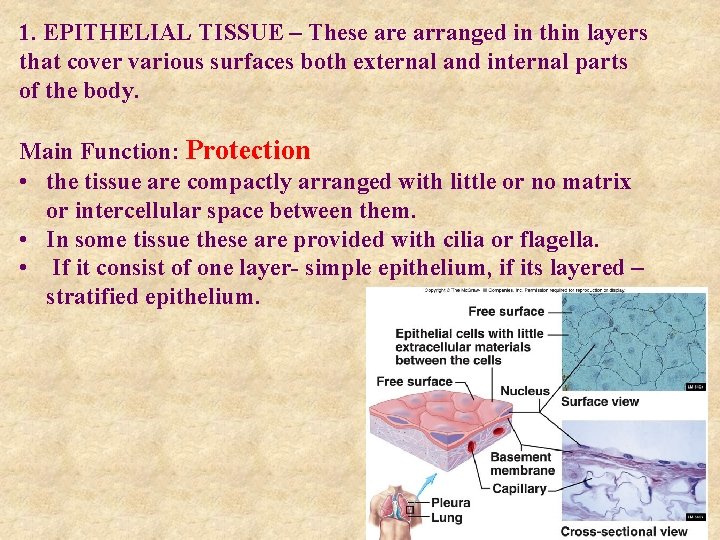
1. EPITHELIAL TISSUE – These arranged in thin layers that cover various surfaces both external and internal parts of the body. Main Function: Protection • the tissue are compactly arranged with little or no matrix or intercellular space between them. • In some tissue these are provided with cilia or flagella. • If it consist of one layer- simple epithelium, if its layered – stratified epithelium. 4 -6
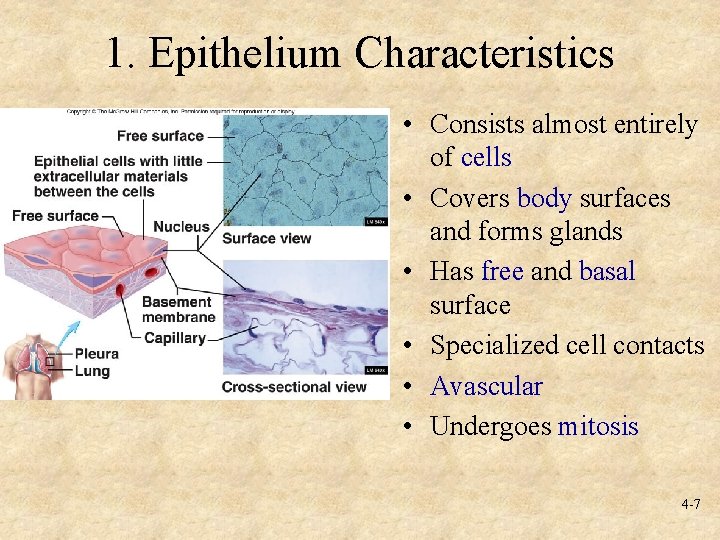
1. Epithelium Characteristics • Consists almost entirely of cells • Covers body surfaces and forms glands • Has free and basal surface • Specialized cell contacts • Avascular • Undergoes mitosis 4 -7
Functions of Epithelia • • • Protecting underlying structures Acting as barriers Permitting the passage of substances Secreting substances Absorbing substances 4 -8
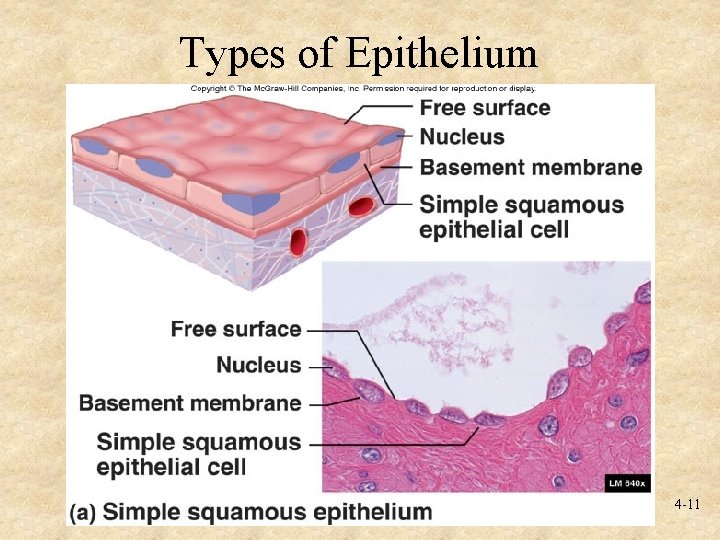
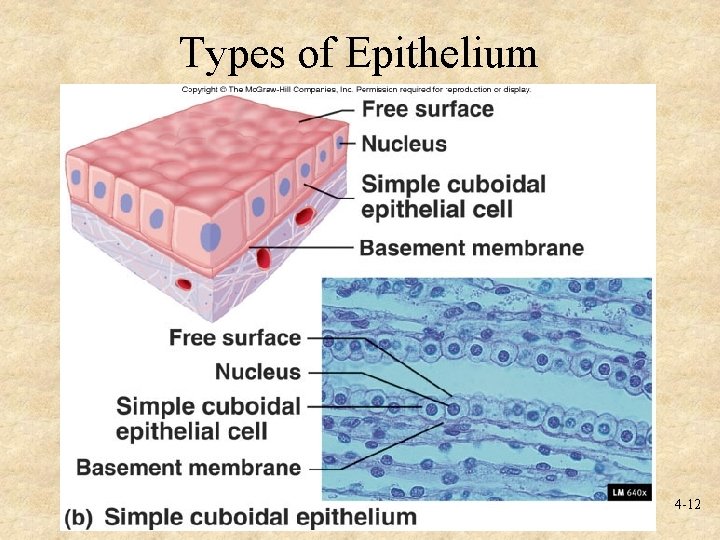
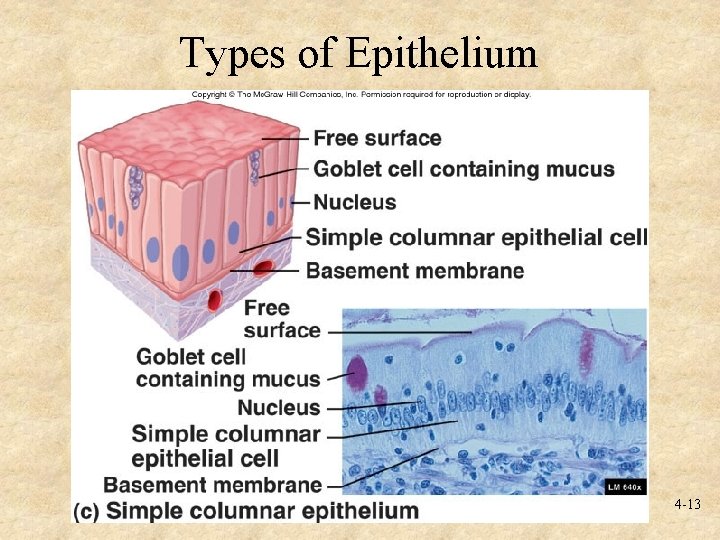
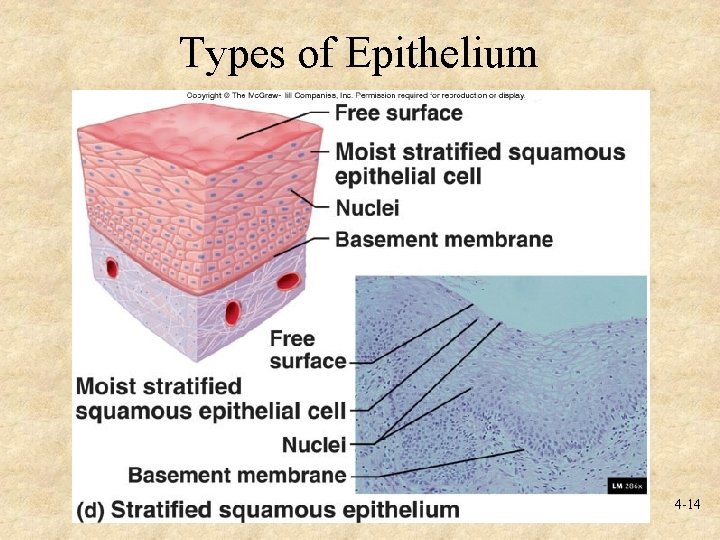
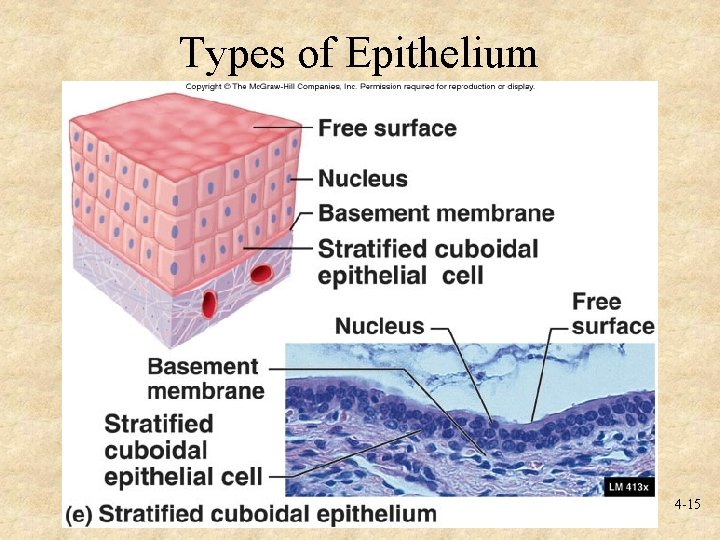
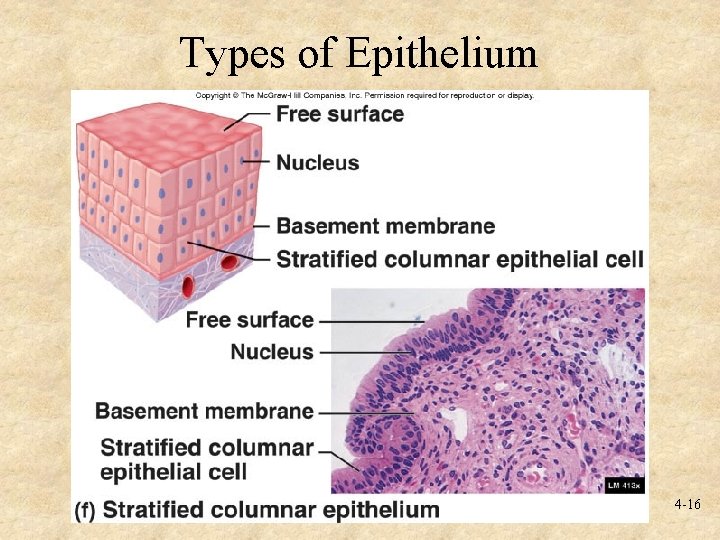
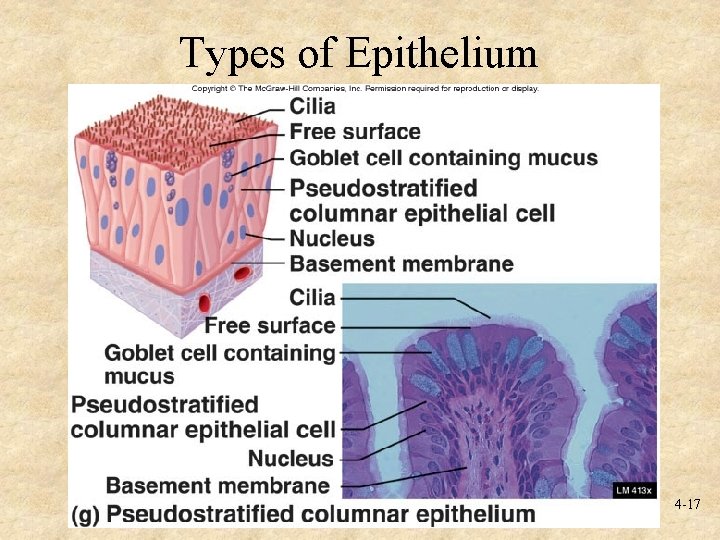
Kinds: 1. Squamous Epithelium – cells are flat and polygonal resembling like tiles in the pavement. Found in outermost part of the skin. 2. Columnar Epithelium – elongated and prismatic due to the pressure exerted by the neighboring cells. The epithelium is found in the linings of the digestive tube. 3. Ciliated Epithelium – specially found in trachea. With hair-like structure known as cilia. 4. Cuboidal Epithelium – found in the lumen of the kidney. 4 -9
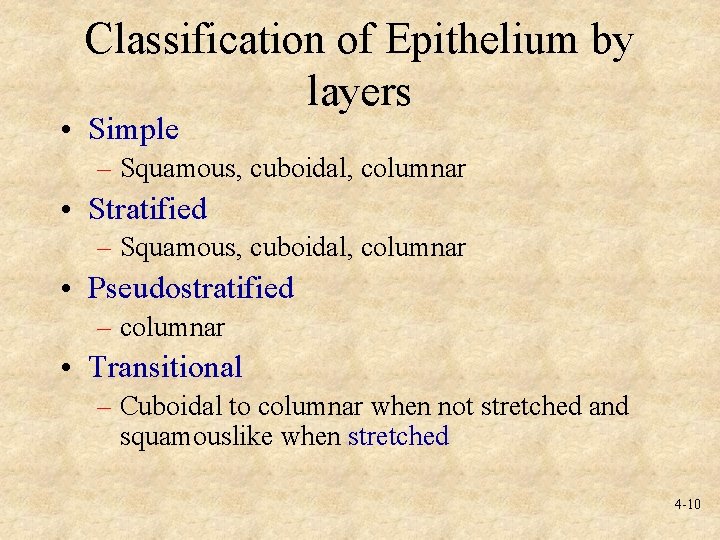
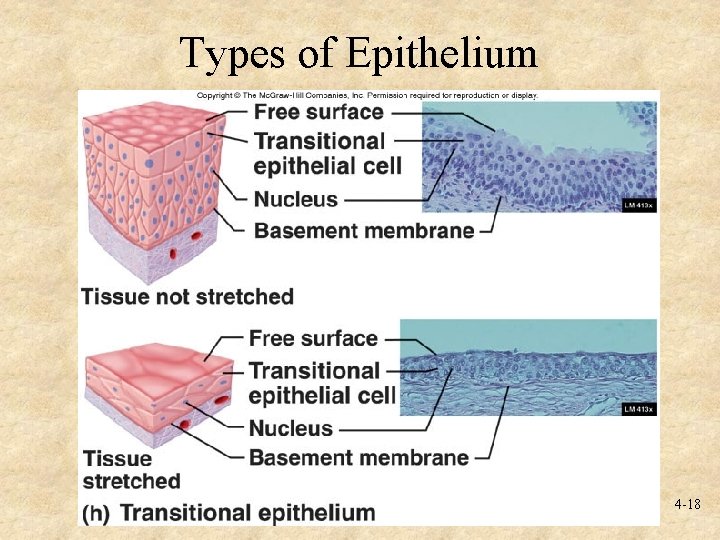
Classification of Epithelium by layers • Simple – Squamous, cuboidal, columnar • Stratified – Squamous, cuboidal, columnar • Pseudostratified – columnar • Transitional – Cuboidal to columnar when not stretched and squamouslike when stretched 4 -10
Types of Epithelium 4 -11
Types of Epithelium 4 -12
Types of Epithelium 4 -13
Types of Epithelium 4 -14
Types of Epithelium 4 -15
Types of Epithelium 4 -16
Types of Epithelium 4 -17
Types of Epithelium 4 -18
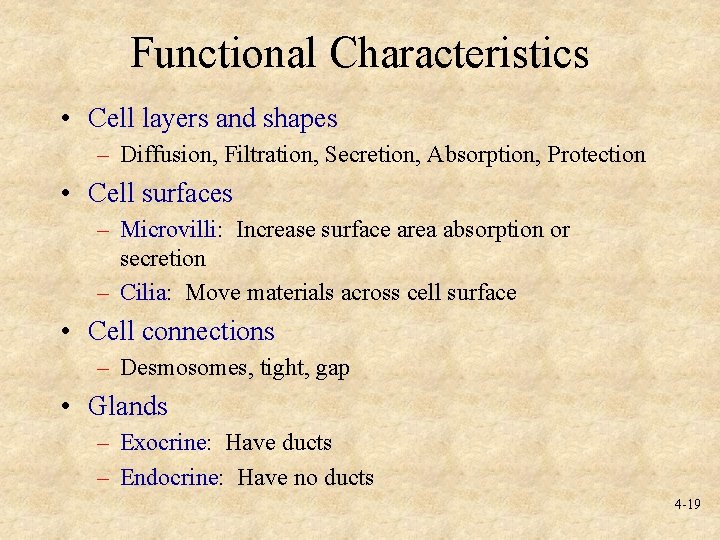
Functional Characteristics • Cell layers and shapes – Diffusion, Filtration, Secretion, Absorption, Protection • Cell surfaces – Microvilli: Increase surface area absorption or secretion – Cilia: Move materials across cell surface • Cell connections – Desmosomes, tight, gap • Glands – Exocrine: Have ducts – Endocrine: Have no ducts 4 -19
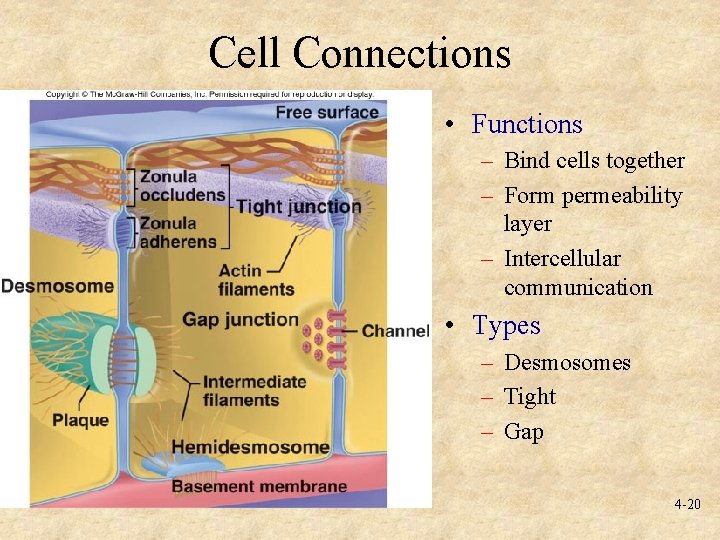
Cell Connections • Functions – Bind cells together – Form permeability layer – Intercellular communication • Types – Desmosomes – Tight – Gap 4 -20
2. Connective Tissue • Abundant • Consists of cell separated by extracellular matrix • Diverse • Performs variety of important functions CONNECTIVE TISSUE – This tissue supports, bounds and connects together the different parts of the body. Cells are loosely arranged, with large amount of matrix between them. 4 -21
Functions of Connective Tissue • Enclosing and separating as capsules around organs • Connecting tissues to one another as tendons and ligaments • Supporting and moving as bones • Storing as fat • Cushioning and insulating as fat • Transporting as blood • Protecting as cells of the immune system 4 -22
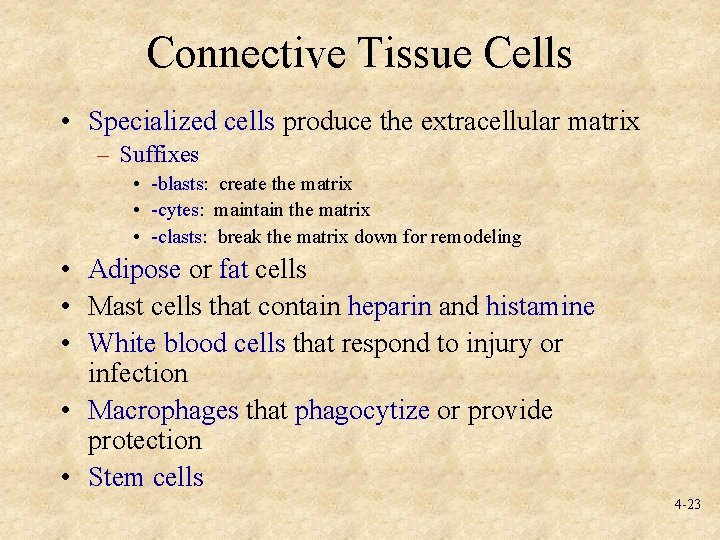
Connective Tissue Cells • Specialized cells produce the extracellular matrix – Suffixes • -blasts: create the matrix • -cytes: maintain the matrix • -clasts: break the matrix down for remodeling • Adipose or fat cells • Mast cells that contain heparin and histamine • White blood cells that respond to injury or infection • Macrophages that phagocytize or provide protection • Stem cells 4 -23
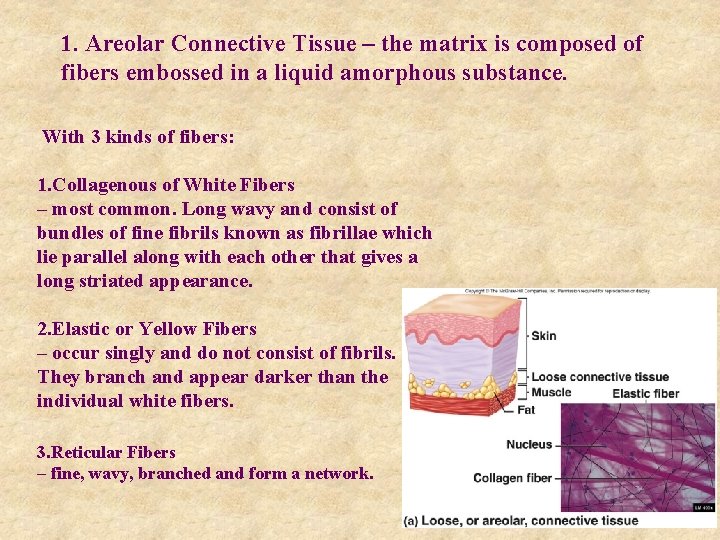
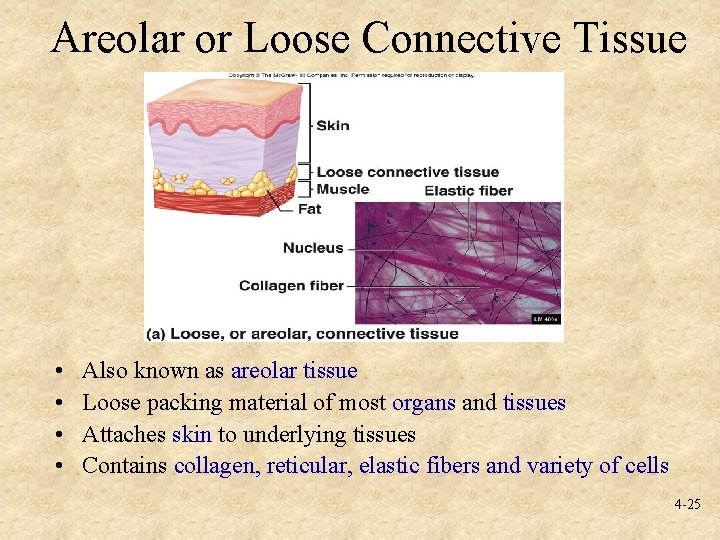
1. Areolar Connective Tissue – the matrix is composed of fibers embossed in a liquid amorphous substance. With 3 kinds of fibers: 1. Collagenous of White Fibers – most common. Long wavy and consist of bundles of fine fibrils known as fibrillae which lie parallel along with each other that gives a long striated appearance. 2. Elastic or Yellow Fibers – occur singly and do not consist of fibrils. They branch and appear darker than the individual white fibers. 3. Reticular Fibers – fine, wavy, branched and form a network.
Areolar or Loose Connective Tissue • • Also known as areolar tissue Loose packing material of most organs and tissues Attaches skin to underlying tissues Contains collagen, reticular, elastic fibers and variety of cells 4 -25
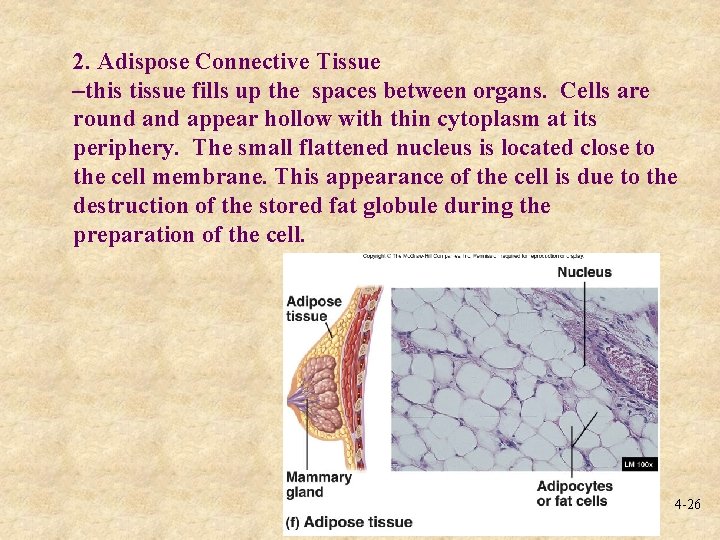
2. Adispose Connective Tissue –this tissue fills up the spaces between organs. Cells are round appear hollow with thin cytoplasm at its periphery. The small flattened nucleus is located close to the cell membrane. This appearance of the cell is due to the destruction of the stored fat globule during the preparation of the cell. 4 -26
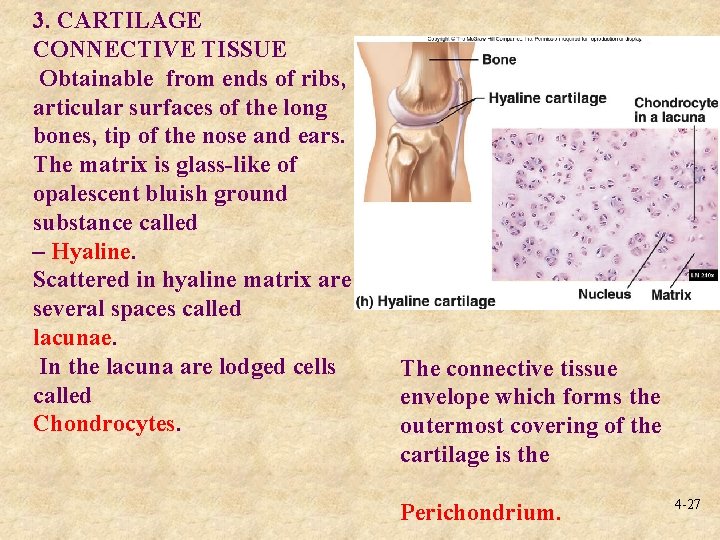
3. CARTILAGE CONNECTIVE TISSUE Obtainable from ends of ribs, articular surfaces of the long bones, tip of the nose and ears. The matrix is glass-like of opalescent bluish ground substance called – Hyaline. Scattered in hyaline matrix are several spaces called lacunae. In the lacuna are lodged cells called Chondrocytes. The connective tissue envelope which forms the outermost covering of the cartilage is the Perichondrium. 4 -27
Fibrocartilage • Slightly compressible and very tough • Found in areas of body where a great deal of pressure is applied to joints – Knee, jaw, between vertebrae 4 -28
Elastic Cartilage • Rigid but elastic properties – External ears, epiglottis 4 -29
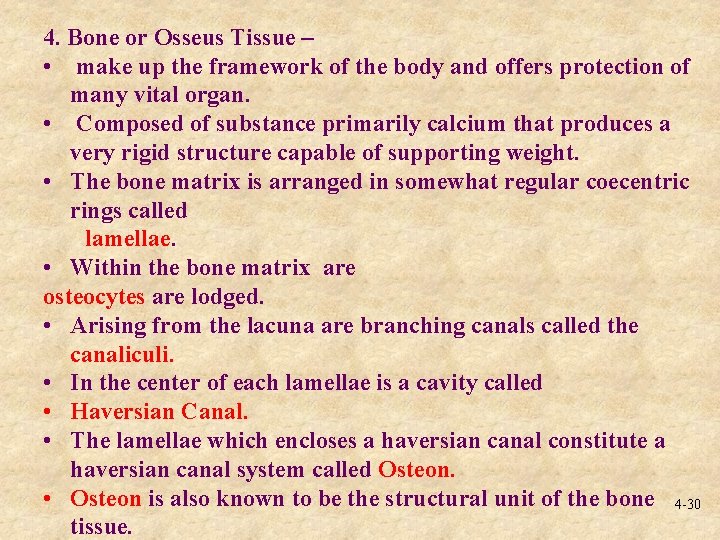
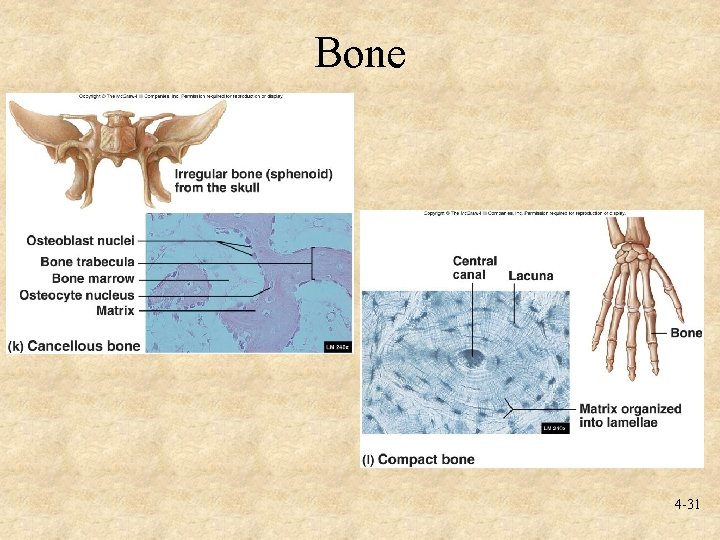
4. Bone or Osseus Tissue – • make up the framework of the body and offers protection of many vital organ. • Composed of substance primarily calcium that produces a very rigid structure capable of supporting weight. • The bone matrix is arranged in somewhat regular coecentric rings called lamellae. • Within the bone matrix are osteocytes are lodged. • Arising from the lacuna are branching canals called the canaliculi. • In the center of each lamellae is a cavity called • Haversian Canal. • The lamellae which encloses a haversian canal constitute a haversian canal system called Osteon. • Osteon is also known to be the structural unit of the bone 4 -30 tissue.
Bone 4 -31
3. VASCULAR TISSUE The Blood or vascular tissue is a circulating tissue. It functions as the transporting medium in the body carrying gases to and from the tissues. It also protects the body from the effects of disease causing foreign organism. This tissue is composed of a liquid medium and formed elements. 4 -32
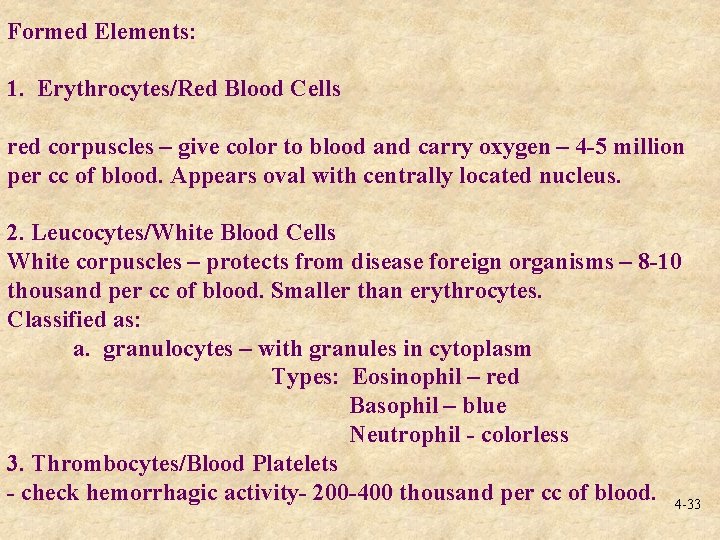
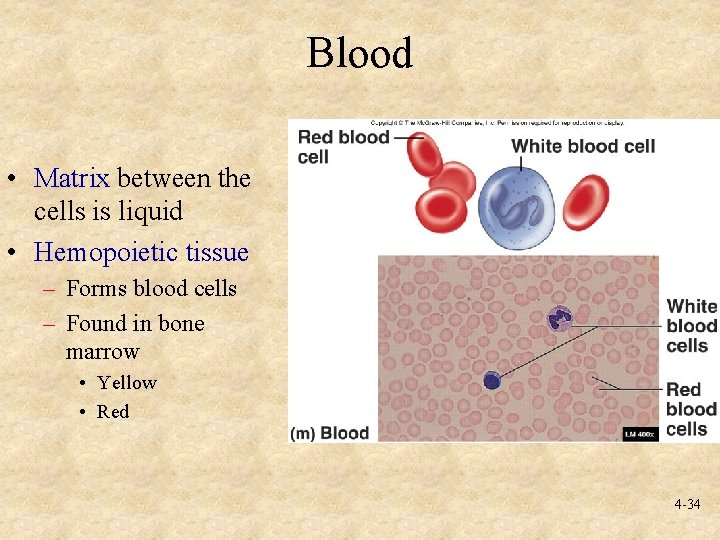
Formed Elements: 1. Erythrocytes/Red Blood Cells red corpuscles – give color to blood and carry oxygen – 4 -5 million per cc of blood. Appears oval with centrally located nucleus. 2. Leucocytes/White Blood Cells White corpuscles – protects from disease foreign organisms – 8 -10 thousand per cc of blood. Smaller than erythrocytes. Classified as: a. granulocytes – with granules in cytoplasm Types: Eosinophil – red Basophil – blue Neutrophil - colorless 3. Thrombocytes/Blood Platelets - check hemorrhagic activity- 200 -400 thousand per cc of blood. 4 -33
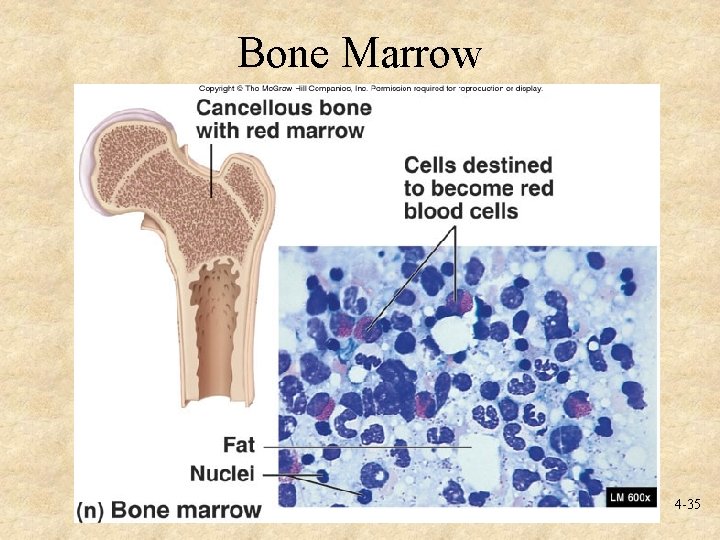
Blood • Matrix between the cells is liquid • Hemopoietic tissue – Forms blood cells – Found in bone marrow • Yellow • Red 4 -34
Bone Marrow 4 -35
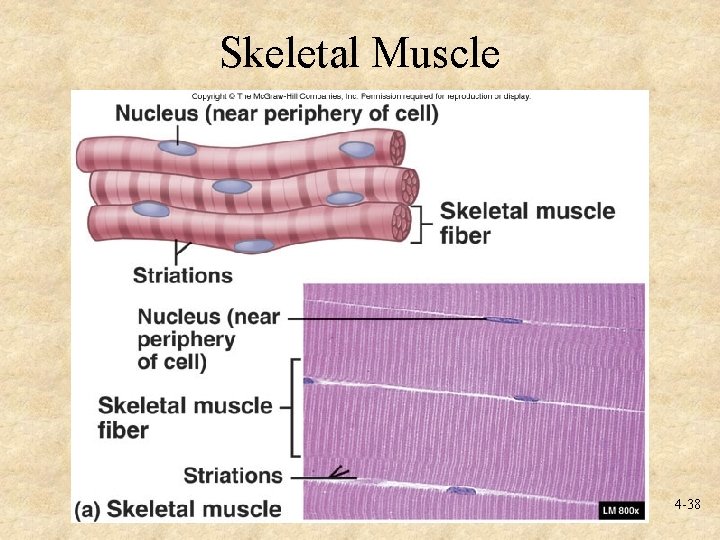
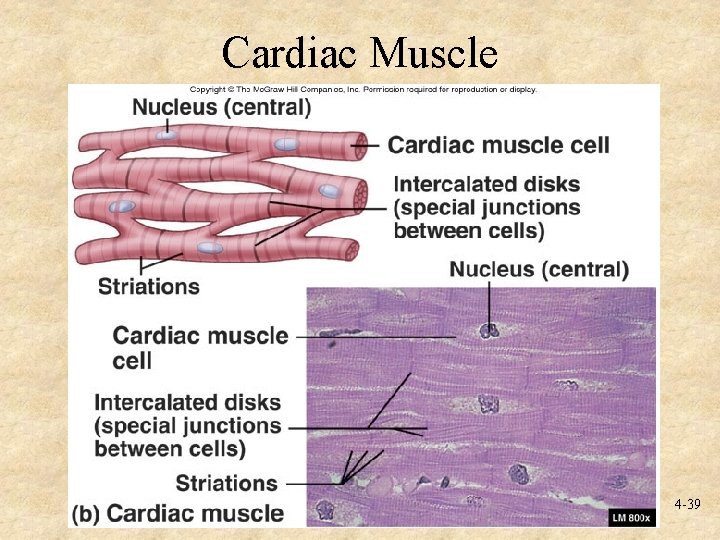
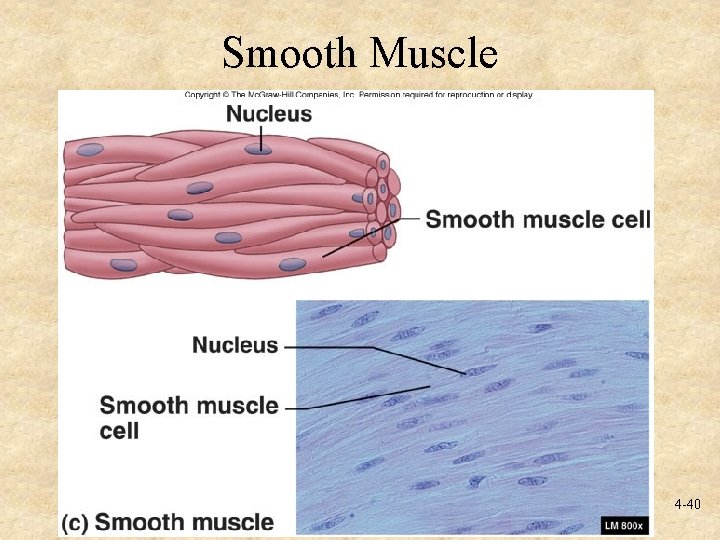
4. MUSCULAR TISSUE - This tissue has one primary function that is for contraction. The contractility of this tissue causes movements in animals from place or another. A. Skeletal or Striated Voluntary Muscle Tissue attached to bones. With a membrane called sarcolemma. B. Cardiac or Involuntary Muscle Tissue – composes the wall of the heart. C. Visceral or Smooth Unstriated Involuntary Muscle Tissue – linings of the visceral organs such as blood vessels, intestine, stomach, uterus and other visceral organs. 4 -36
Muscle Tissue • Characteristics – Contracts or shortens with force – Moves entire body and pumps blood • Types – Skeletal • Striated and voluntary – Cardiac • Striated and involuntary – Smooth • Nonstriated and involuntary 4 -37
Skeletal Muscle 4 -38
Cardiac Muscle 4 -39
Smooth Muscle 4 -40
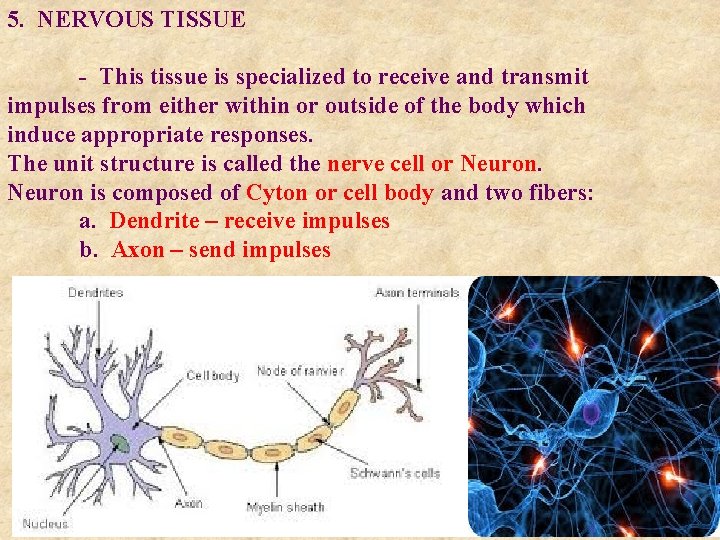
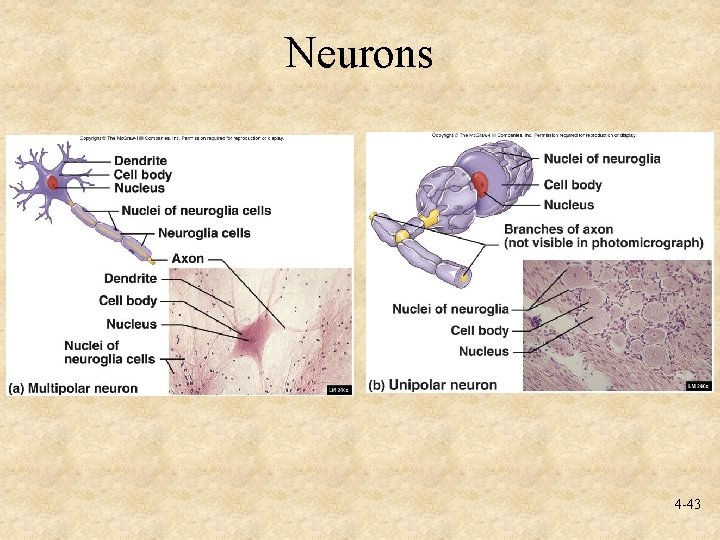
5. NERVOUS TISSUE - This tissue is specialized to receive and transmit impulses from either within or outside of the body which induce appropriate responses. The unit structure is called the nerve cell or Neuron is composed of Cyton or cell body and two fibers: a. Dendrite – receive impulses b. Axon – send impulses 4 -41
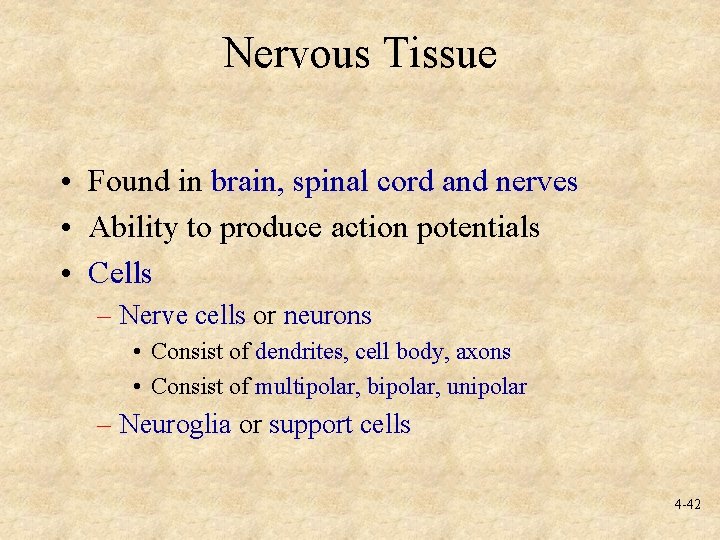
Nervous Tissue • Found in brain, spinal cord and nerves • Ability to produce action potentials • Cells – Nerve cells or neurons • Consist of dendrites, cell body, axons • Consist of multipolar, bipolar, unipolar – Neuroglia or support cells 4 -42
Neurons 4 -43
Tissues and Aging • Cells divide more slowly in older than younger people • Tendons and ligaments become less flexible and more fragile • Arterial walls become less elastic • Rate of blood cell synthesis declines in elderly • Injuries are harder to heal in elderly 4 -44
Tissue Viewing 4 -45
Applied Questions: 1. How will the knowledge on Tissues help you understand (significance) life? 2. What are common diseases affecting Tissues? 4 -46