
Lesson 2 Friction Kinetic and Static Friction Friction

- Slides: 12
Lesson 2 Friction
Kinetic and Static Friction • Friction is a force that opposes the motion of two surfaces that are in contact with each other. • There are two types of friction—static friction and kinetic friction.
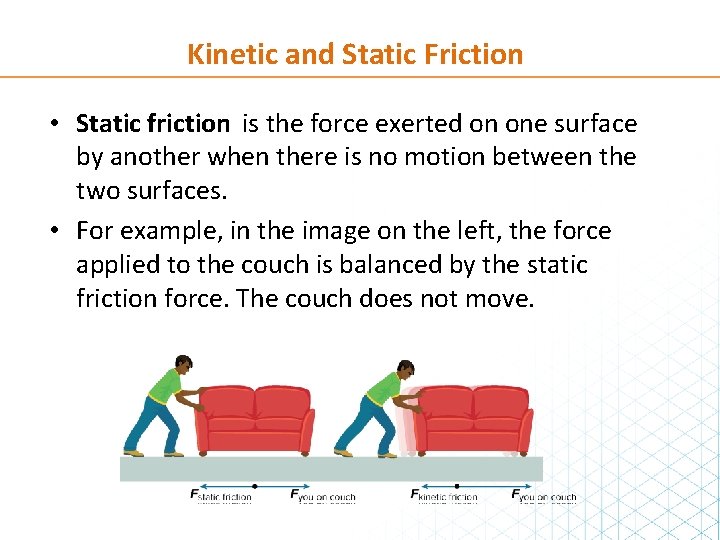
Kinetic and Static Friction • Static friction is the force exerted on one surface by another when there is no motion between the two surfaces. • For example, in the image on the left, the force applied to the couch is balanced by the static friction force. The couch does not move.
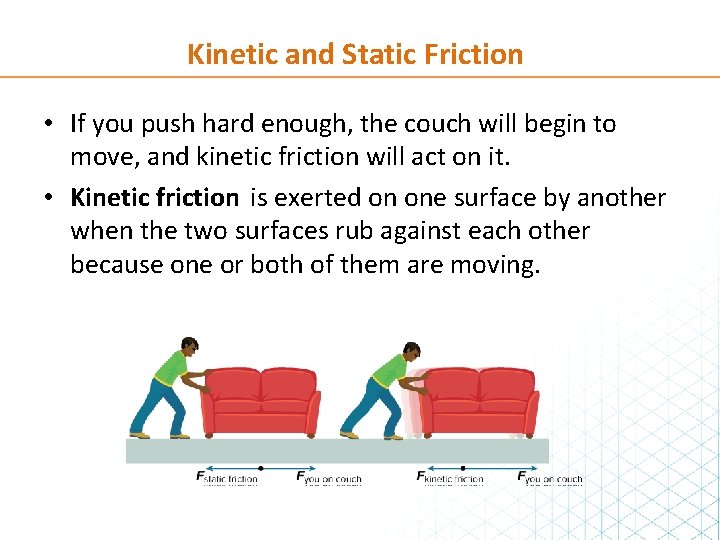
Kinetic and Static Friction • If you push hard enough, the couch will begin to move, and kinetic friction will act on it. • Kinetic friction is exerted on one surface by another when the two surfaces rub against each other because one or both of them are moving.
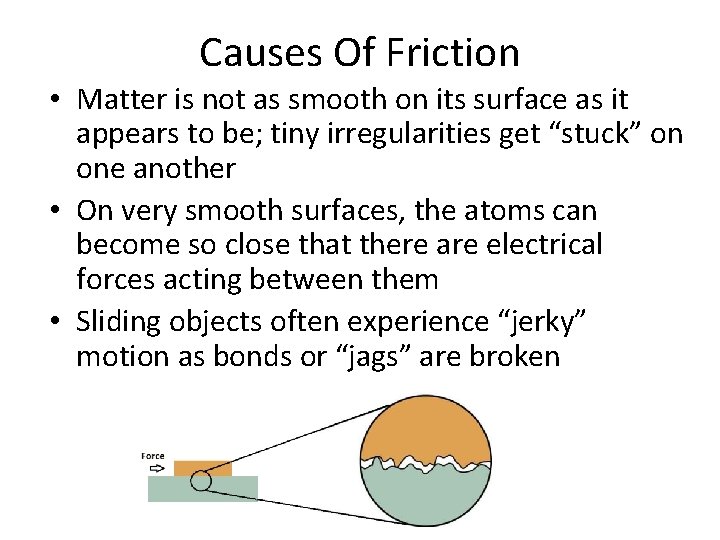
Causes Of Friction • Matter is not as smooth on its surface as it appears to be; tiny irregularities get “stuck” on one another • On very smooth surfaces, the atoms can become so close that there are electrical forces acting between them • Sliding objects often experience “jerky” motion as bonds or “jags” are broken
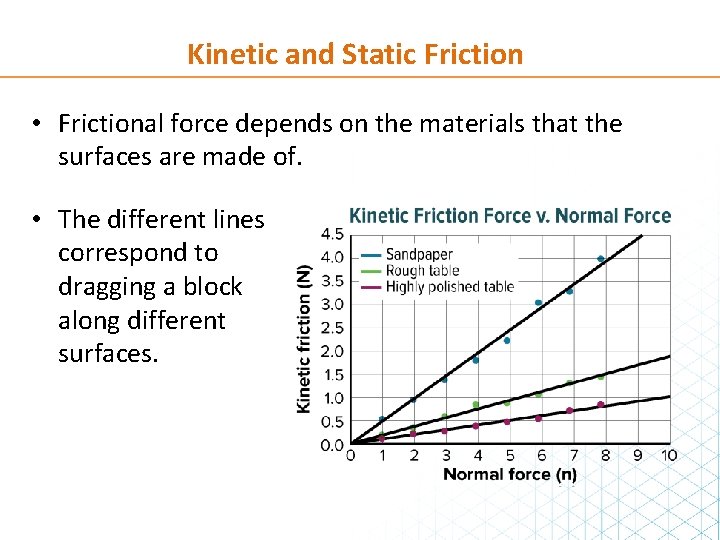
Kinetic and Static Friction • Frictional force depends on the materials that the surfaces are made of. • The different lines correspond to dragging a block along different surfaces.
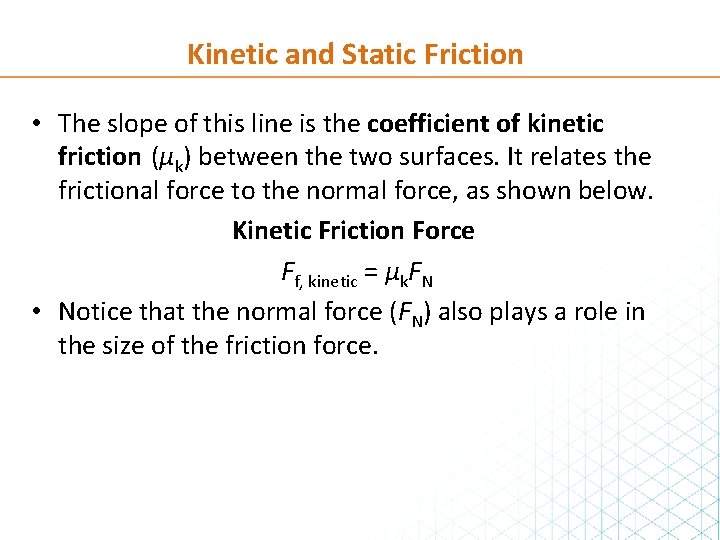
Kinetic and Static Friction • The slope of this line is the coefficient of kinetic friction (μk) between the two surfaces. It relates the frictional force to the normal force, as shown below. Kinetic Friction Force Ff, kinetic = μk. FN • Notice that the normal force (FN) also plays a role in the size of the friction force.
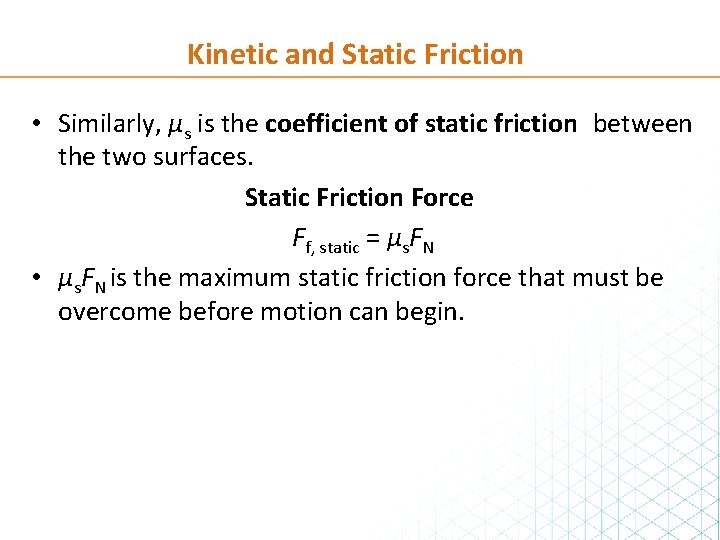
Kinetic and Static Friction • Similarly, μs is the coefficient of static friction between the two surfaces. Static Friction Force Ff, static = μs. FN • μs. FN is the maximum static friction force that must be overcome before motion can begin.
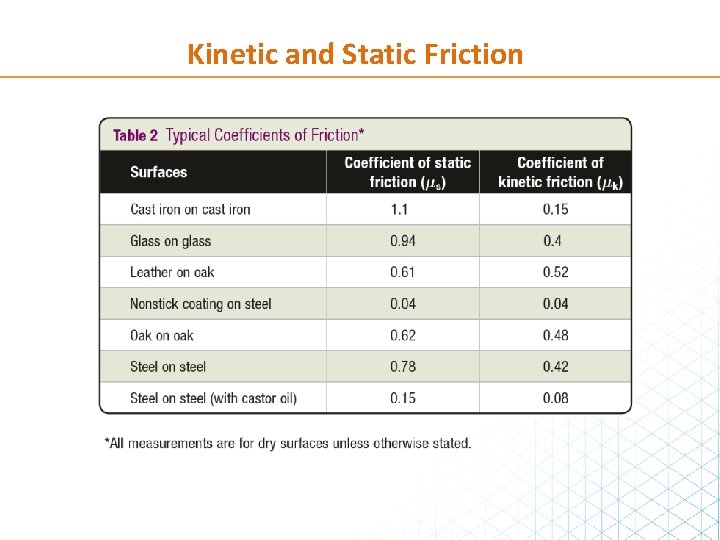
Kinetic and Static Friction
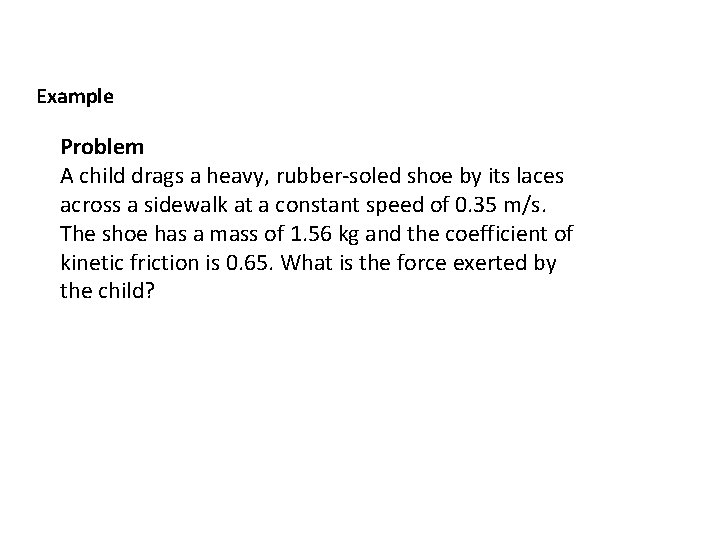
Example Problem A child drags a heavy, rubber-soled shoe by its laces across a sidewalk at a constant speed of 0. 35 m/s. The shoe has a mass of 1. 56 kg and the coefficient of kinetic friction is 0. 65. What is the force exerted by the child?
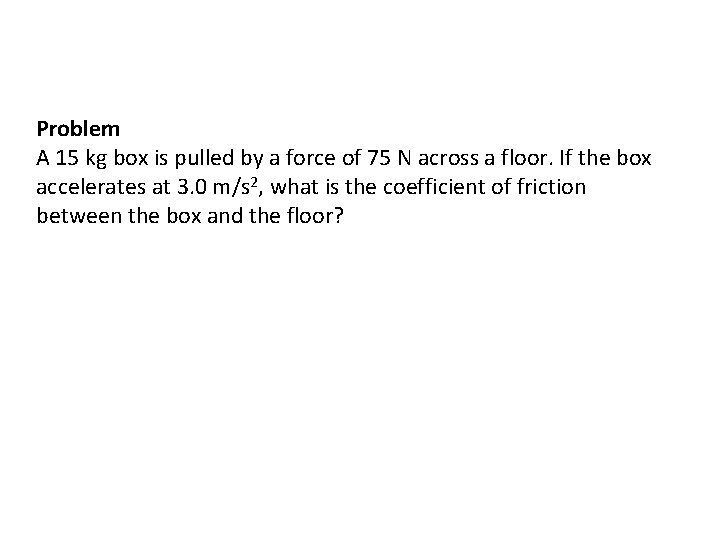
Problem A 15 kg box is pulled by a force of 75 N across a floor. If the box accelerates at 3. 0 m/s 2, what is the coefficient of friction between the box and the floor?