
Lesson 2 Exponents Introduction l Overview Exponents form

- Slides: 11
Lesson 2 Exponents
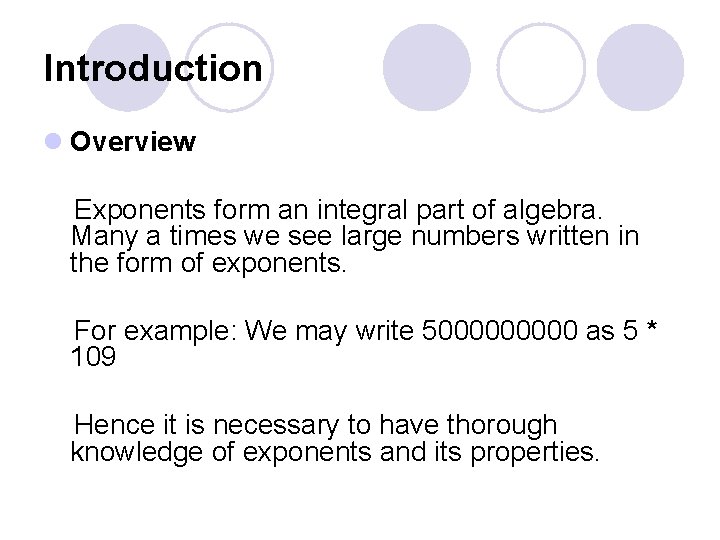
Introduction l Overview Exponents form an integral part of algebra. Many a times we see large numbers written in the form of exponents. For example: We may write 500000 as 5 * 109 Hence it is necessary to have thorough knowledge of exponents and its properties.
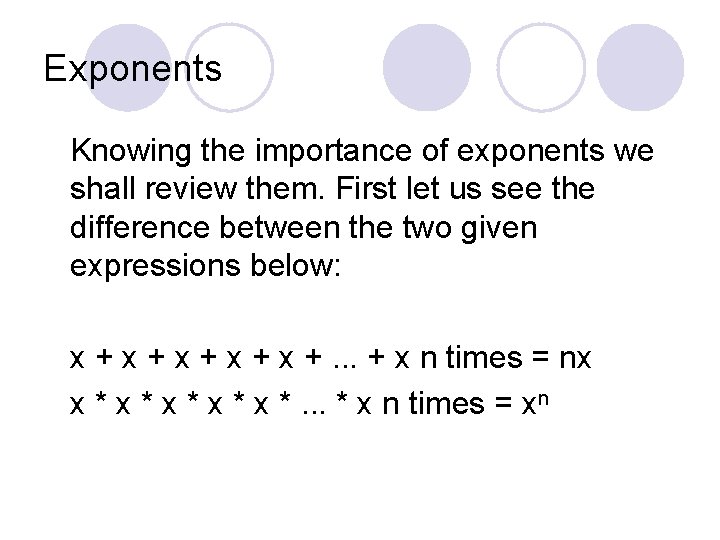
Exponents Knowing the importance of exponents we shall review them. First let us see the difference between the two given expressions below: x + x + x +. . . + x n times = nx x * x * x *. . . * x n times = xn
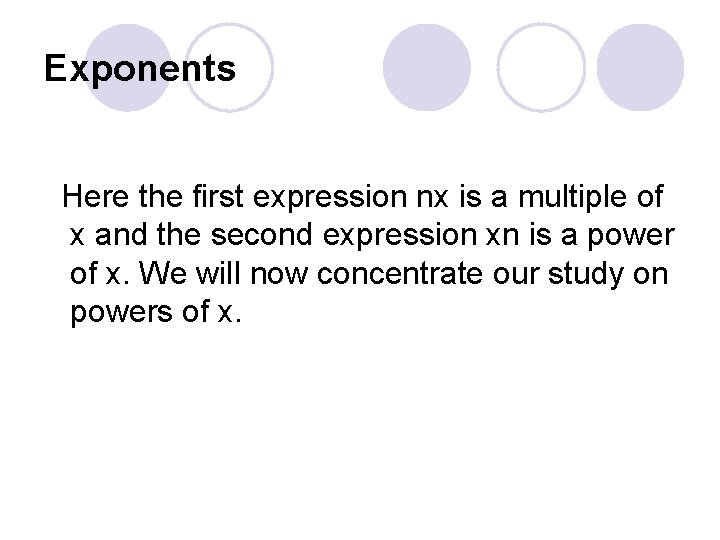
Exponents Here the first expression nx is a multiple of x and the second expression xn is a power of x. We will now concentrate our study on powers of x.
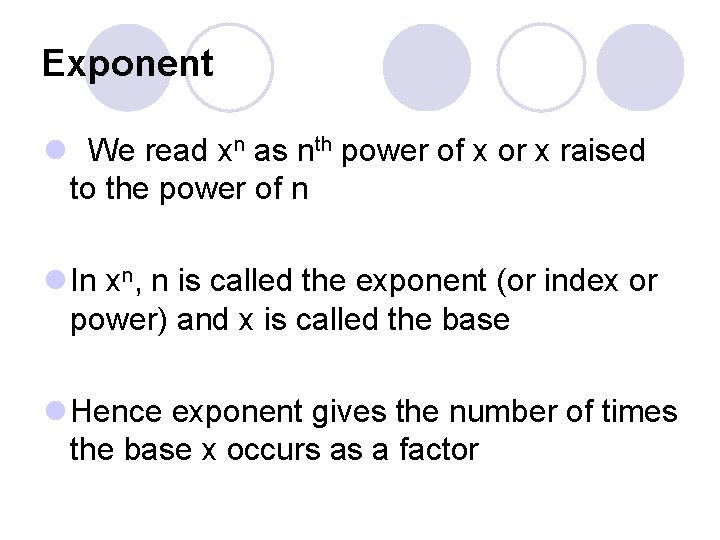
Exponent l We read xn as nth power of x or x raised to the power of n l In xn, n is called the exponent (or index or power) and x is called the base l Hence exponent gives the number of times the base x occurs as a factor
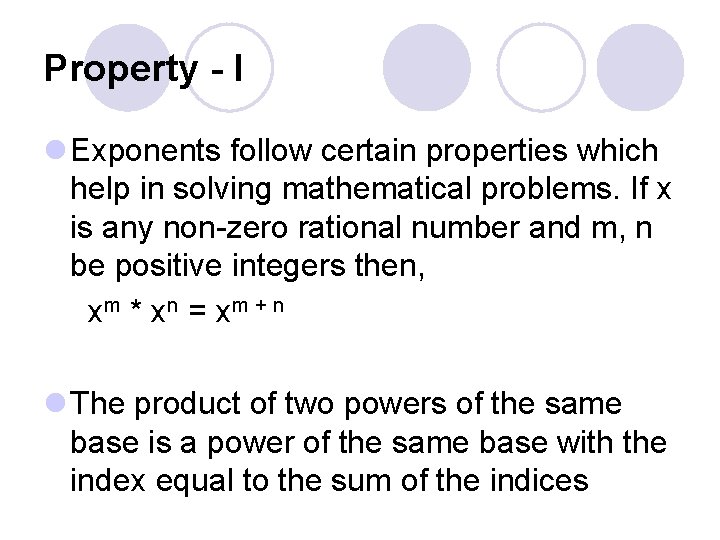
Property - I l Exponents follow certain properties which help in solving mathematical problems. If x is any non-zero rational number and m, n be positive integers then, x m * xn = x m + n l The product of two powers of the same base is a power of the same base with the index equal to the sum of the indices
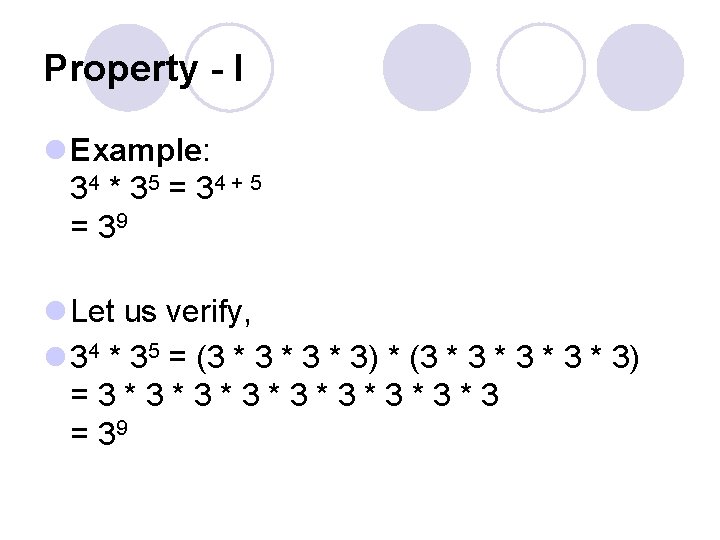
Property - I l Example: 34 * 3 5 = 3 4 + 5 = 39 l Let us verify, l 34 * 35 = (3 * 3 * 3) * (3 * 3 * 3) =3*3*3*3*3 = 39
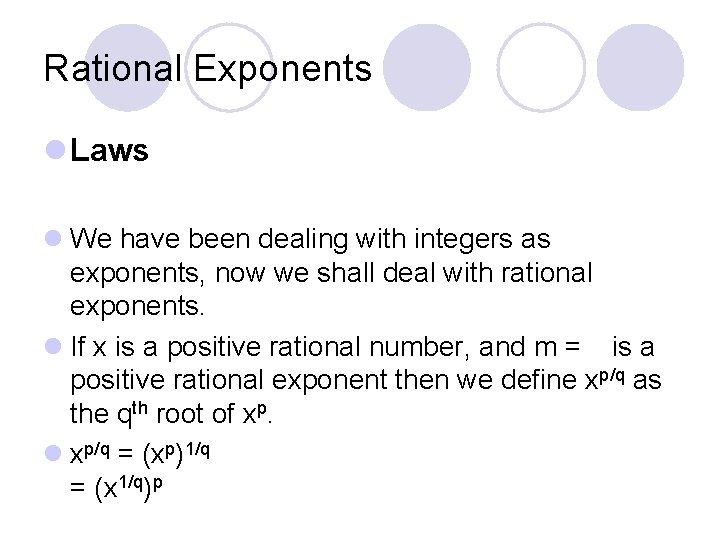
Rational Exponents l Laws l We have been dealing with integers as exponents, now we shall deal with rational exponents. l If x is a positive rational number, and m = is a positive rational exponent then we define xp/q as the qth root of xp. l xp/q = (xp)1/q = (x 1/q)p
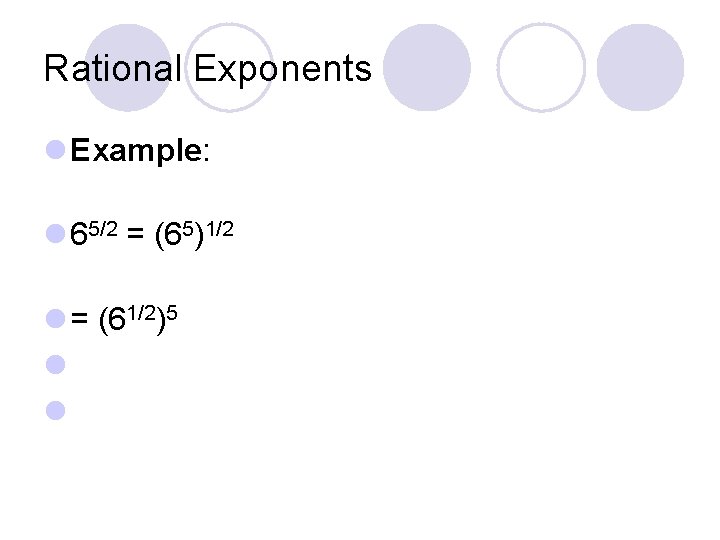
Rational Exponents l Example: l 65/2 = (65)1/2 l = (61/2)5 l l
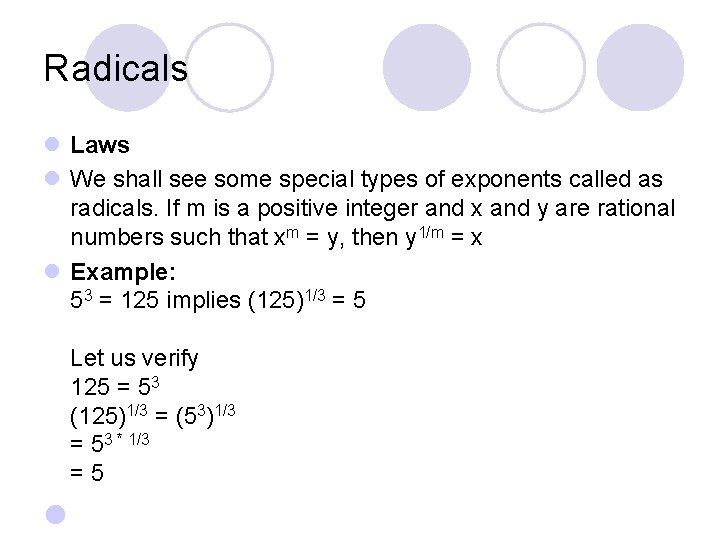
Radicals l Laws l We shall see some special types of exponents called as radicals. If m is a positive integer and x and y are rational numbers such that xm = y, then y 1/m = x l Example: 53 = 125 implies (125)1/3 = 5 Let us verify 125 = 53 (125)1/3 = (53)1/3 = 53 * 1/3 =5 l
References l Online Free SAT Study Guide: SAT Guide l http: //www. proprofs. com/sat/studyguide/index. shtml