
Lesson 2 Europe Faces Revolutions Setting the Stage
- Slides: 6
Lesson 2 Europe Faces Revolutions
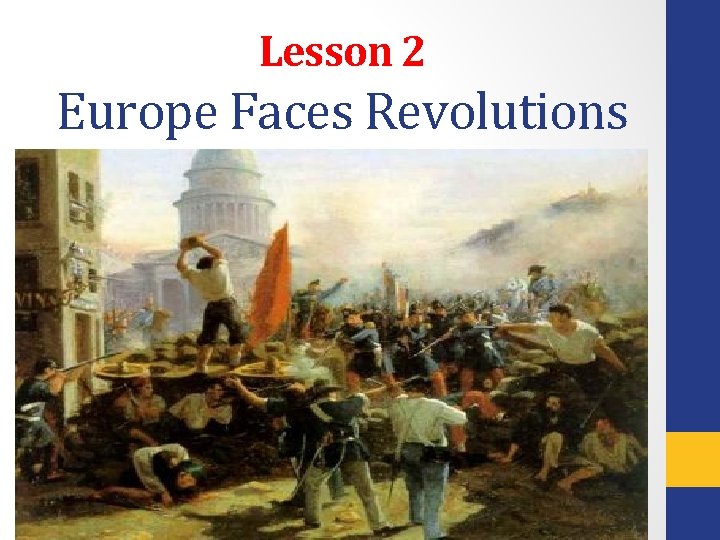
Setting the Stage • As Revolutionaries shook the colonies in Latin America, Europe was also undergoing dramatic changes. Under the leadership of Prince Metternich of Austria, the Congress of Vienna had tried to restore the old monarchies and territorial divisions that had existed before the French Revolution. On an international level, this attempt to turn back history succeeded. For the next century, European countries seldom turned to war to solve their differences. Within countries, however, the effort failed. Revolutions erupted across Europe between 1815 and 1848.
Clash of Philosophies During the first half of the 1800 s, three political ideologies struggled for supremacy in European societies. Each believed its style was the best form of government. 1. Conservative: usually wealthy property owners and nobility. They argued for protecting the traditional monarchies of Europe. 2. Liberal: mostly middle-class business leaders and merchants. They wanted to give more power to elected parliaments, but only the educated and the landowners would vote. 3. Radical: favored drastic change to extend democracy to all people. They believed that governments should practice the ideals of the French Revolution –liberty, equality, and brotherhood. Some radicals believed in anarchism – a belief that government is harmful and not needed.
Nationalism Develops • As conservatives, liberals, and radicals debated issues of government, a new movement called nationalism emerged. • Nationalism is the belief that people’s greatest loyalty should NOT be to a king or an empire but to a nation of people who share a common culture and history. • Most of the people who believed in nationalism were either liberals or radicals. In most cases, the liberal middle class – teachers, lawyers, and business people – led the struggle for constitutional government and the formation of nationstates. • A nation-state is a nation that has its own independent government, and defends its own territory and way of life. • Read Pg. 233 Nationalism
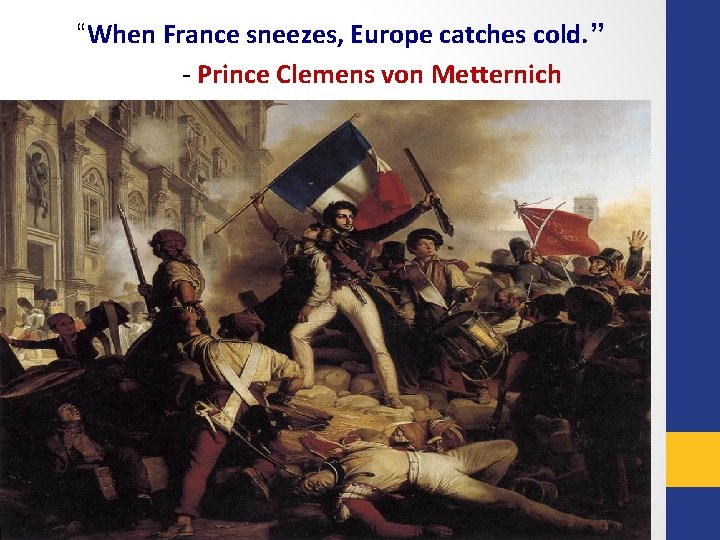
“When France sneezes, Europe catches cold. ” - Prince Clemens von Metternich
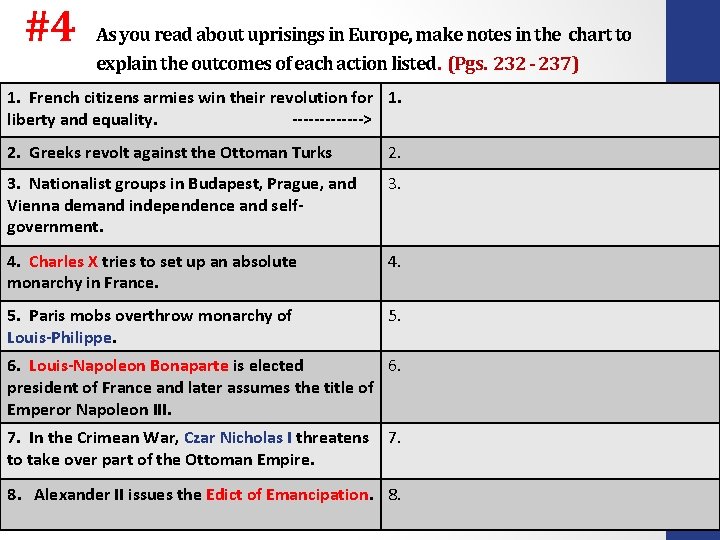
#4 As you read about uprisings in Europe, make notes in the chart to explain the outcomes of each action listed. (Pgs. 232 - 237) 1. French citizens armies win their revolution for 1. liberty and equality. -------> 2. Greeks revolt against the Ottoman Turks 2. 3. Nationalist groups in Budapest, Prague, and Vienna demand independence and selfgovernment. 3. 4. Charles X tries to set up an absolute monarchy in France. 4. 5. Paris mobs overthrow monarchy of Louis-Philippe. 5. 6. Louis-Napoleon Bonaparte is elected 6. president of France and later assumes the title of Emperor Napoleon III. 7. In the Crimean War, Czar Nicholas I threatens to take over part of the Ottoman Empire. 7. 8. Alexander II issues the Edict of Emancipation. 8.