
Lesson 2 Difference between terrestrial and aquati ecosystem
Lesson 2: Difference between terrestrial and aquati ecosystem
Components of terrestrial ecosystem • Living components: It consists of vegetation and wildlife, they will be exposed each of them as follows: 1 - Vegetation: It is the source of food for human beings. In addition absorbs carbon dioxide and released oxygen, which is no life without him. Moreover, it is the source of many medical and industrial materials such as medicines and timber. 2 - Wildlife: They like animals, birds and other wildlife. It works to achieve a balance between the various components of this system.
Components of terrestrial ecosystem Nonliving components: It consists of the soil, mountains and archaeological heritage and civilization, which is taken up the explanation in the following: 1 - The soil Soil is a mixture of minerals, organic matter, gases, liquids, and countless organisms that together support life on Earth. 2 - Mountains Is a large landform that stretches above the surrounding land in a limited area, usually in the form of a peak. A mountain is generally steeper than a hill.
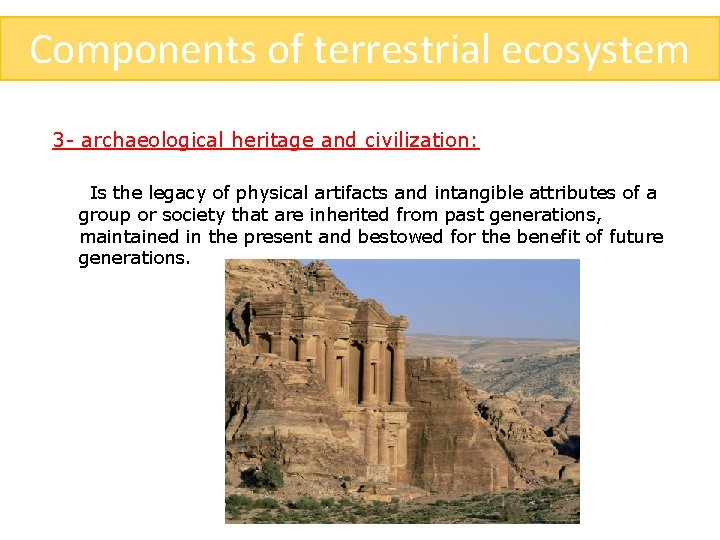
Components of terrestrial ecosystem 3 - archaeological heritage and civilization: Is the legacy of physical artifacts and intangible attributes of a group or society that are inherited from past generations, maintained in the present and bestowed for the benefit of future generations.
Components of terrestrial ecosystem 1 - Layers in an aquatic ecosystems include the material on the bottom of the water body, most commonly sand, rocks or mud. Next is the water itself, which could be freshwater or saltwater and static or moving. For example a river flows, but a swamp is stagnant and does not move. The top layer is the air above the water. This is important because it oxygenates the water and chemicals from the air dissolve in the water and affect its clarity and quality.
Components of terrestrial ecosystem 2 - Microorganisms are very small life forms that you cannot see with the naked eye unless in big groups, such as algae or fungi. They exist in large numbers within the ecosystem's layers. Whilst they may cause disease such as dysentery, within an ecosystem they are crucial because they decompose and recycle material to remove polluting matter. If a fish dies, for example, it would be toxic to the water if it was not decomposed and disposed of by the microorganisms. Microorganisms also provide nitrogen to regulate the environment for the survival of other organisms.
Components of terrestrial ecosystem 3 - Macro-organisms are the larger things you can see within an aquatic ecosystem. Plants and animals are both macroorganisms. The plants are crucial to the ecosystem for reoxygenating water and providing a habitat for creatures. Animals are varied in size and type from crustaceans to whales. Similar to other habitats, the animals in an ecosystem have predators and operate according to a natural food chain. For example, plankton eats microorganisms, fish eat plankton, seals eat fish and sharks eat fish. This chain controls population levels.
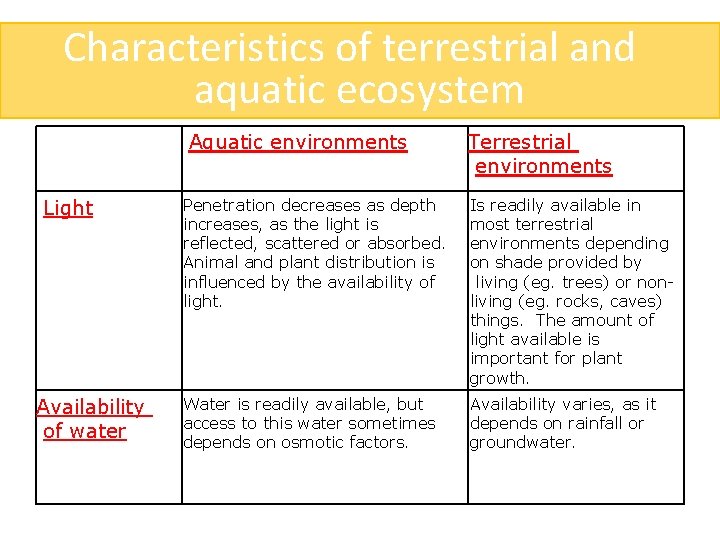
Characteristics of terrestrial and aquatic ecosystem Aquatic environments Light Availability of water Terrestrial environments Penetration decreases as depth increases, as the light is reflected, scattered or absorbed. Animal and plant distribution is influenced by the availability of light. Is readily available in most terrestrial environments depending on shade provided by living (eg. trees) or nonliving (eg. rocks, caves) things. The amount of light available is important for plant growth. Water is readily available, but access to this water sometimes depends on osmotic factors. Availability varies, as it depends on rainfall or groundwater.
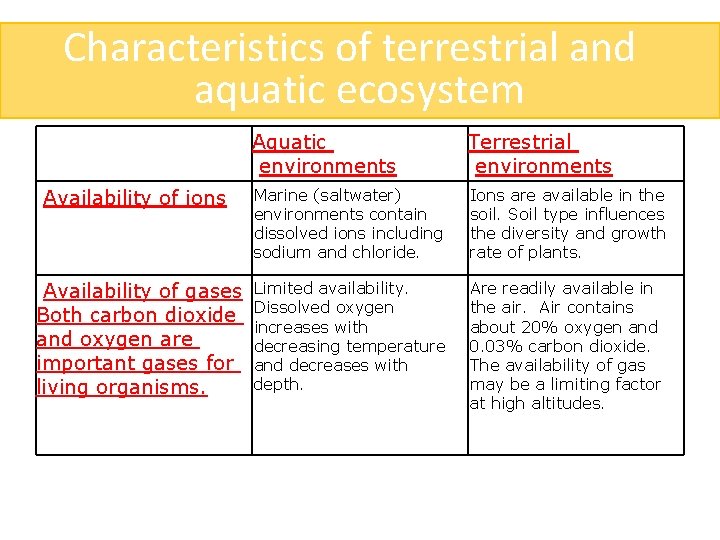
Characteristics of terrestrial and aquatic ecosystem Aquatic environments Terrestrial environments Availability of ions Marine (saltwater) environments contain dissolved ions including sodium and chloride. Ions are available in the soil. Soil type influences the diversity and growth rate of plants. Availability of gases Both carbon dioxide and oxygen are important gases for living organisms. Limited availability. Dissolved oxygen increases with decreasing temperature and decreases with depth. Are readily available in the air. Air contains about 20% oxygen and 0. 03% carbon dioxide. The availability of gas may be a limiting factor at high altitudes.
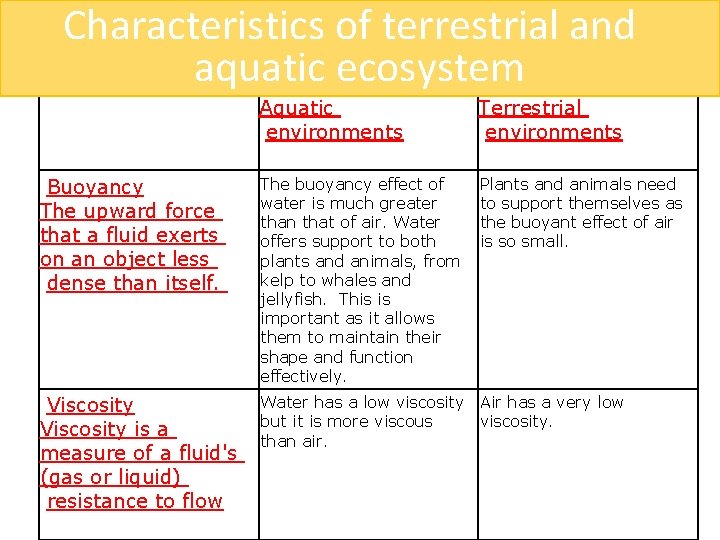
Characteristics of terrestrial and aquatic ecosystem Aquatic environments Terrestrial environments Buoyancy The upward force that a fluid exerts on an object less dense than itself. The buoyancy effect of water is much greater than that of air. Water offers support to both plants and animals, from kelp to whales and jellyfish. This is important as it allows them to maintain their shape and function effectively. Plants and animals need to support themselves as the buoyant effect of air is so small. Viscosity is a measure of a fluid's (gas or liquid) resistance to flow Water has a low viscosity Air has a very low but it is more viscous viscosity. than air.
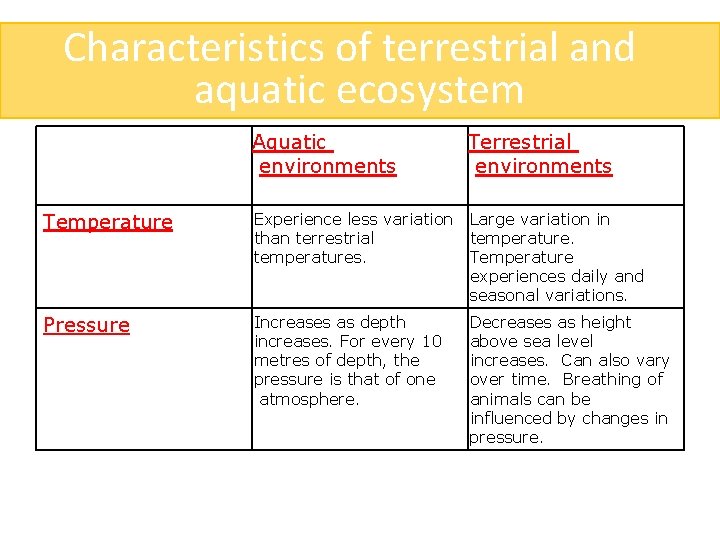
Characteristics of terrestrial and aquatic ecosystem Aquatic environments Terrestrial environments Temperature Experience less variation than terrestrial temperatures. Large variation in temperature. Temperature experiences daily and seasonal variations. Pressure Increases as depth increases. For every 10 metres of depth, the pressure is that of one atmosphere. Decreases as height above sea level increases. Can also vary over time. Breathing of animals can be influenced by changes in pressure.
- Slides: 11