
Lesson 2 Designing a Competitive Business Model and
Lesson 2 Designing a Competitive Business Model and Building a Solid Strategic Plan. Conducting a Feasibility Analysis and Crafting a Winning Business Plan
Strategic Management �The process of developing a game plan to guide a company as it strives to accomplish its vision, mission, goals and objectives and to keep it from staying off course.
Importance of strategic management to a small business �Small companies that lack clear strategies may achieve success in the short run, but as soon as competitive conditions stiffen or an unanticipated threat arises, they hit the wall and fold. �Strategic management is the mechanism for operating successfully in a chaotic competitive environment. �The biggest change business owners face is unfolding now: the shift in the world’s economy from a base of financial to intellectual capital.
Cont…. . �Intellectual capital comprises 3 components: Ø Human capital Ø Structural capital Ø Customer capital
Building a Competitive Advantage �Competitive advantage: - the aggregation of factors that sets a small business apart from its competitors and gives it a unique position in the market superior to its competition. �Building a competitive advantage is not enough but key is building a sustainable competitive advantage. �Core competencies: - a unique set of capabilities that a company develops in key operational areas that allow it to vault past competitors.
Cont…. � 1. Products they sell � 2. Services they provide � 3. Pricing they offer � 4. Way they sell.
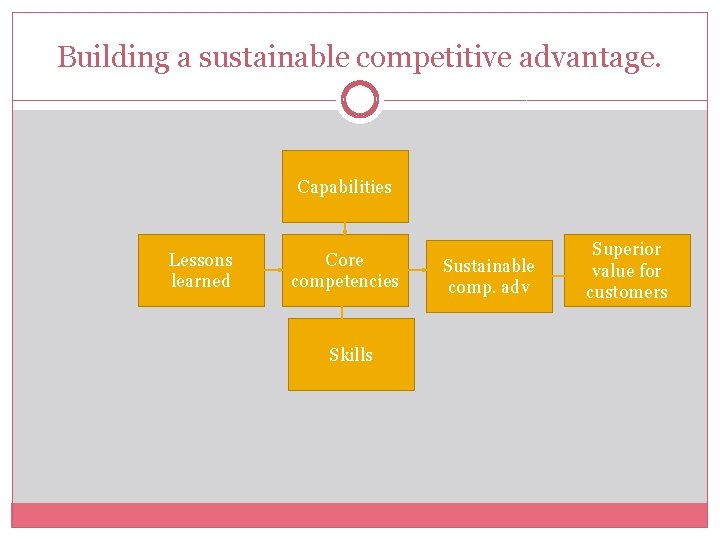
Building a sustainable competitive advantage. Capabilities Lessons learned Core competencies Skills Sustainable comp. adv Superior value for customers
The strategic management process �Step 1: - develop a clear vision and translate it into a meaningful mission statement. �Vision A clearly defined vision helps a company in three ways: Ø Vision provides direction. Ø Vision determines decisions. Ø Vision motivates people. Ø Vision allows for perseverance in the face of adversity. �Mission statement : - an enduring declaration of a company’s purpose that addresses the first question of any business venture: what business am I in?
Cont…. �Elements of a mission statement ü The purpose of the company ü The business we are in ü The values of the company.
Step 2: - assess the company’s strengths and weaknesses �Strengths: - positive internal factors that a company can use to accomplish its mission, goals, and objectives. �Weaknesses: - negative internal factors that inhibit the accomplishment of a company’s mission, goals and objectives.
Step 3: scan the environment for significant opportunities and threats facing the business �Opportunities: - positive external options that a firm can exploit to accomplish its mission, goals and objectives. �Threats: - negative external forces that inhibit a company’s ability to achieve its mission, goals and objectives.
Step 4: identify the key factors for success in the business. �Key success factors KSF’s: - the factors that determine a company’s ability to compete successfully in an industry. Ø Trained managers Ø Careful site selection Ø High food quality Ø Cleanliness
Step 5: Analyze the competition �Competitor analysis Ø Direct competitor Ø Significant competitor Ø Indirect competitors. �Competitive profile matrix : - a tool that allow a business owner to evaluate their companies against major competitors using the key success factors for that market. �Knowledge management: - the practice of gathering, organizing and disseminating the collective wisdom and experience of a company’s employees for the purpose of strengthening its competitive position.
Step 6: Create company goals and objectives �Goals: - a broad, long range attributes a business seeks to accomplish, they tend to be general and sometimes even abstract. �Objectives: - more specific targets of performance, commonly addressing areas such as profitability, productivity, growth and other key aspects of a business. Ø They are specific and measurable Ø They are assignable Ø They are realistic, yet challenging. Ø They are timely Ø They are written down.
Step 7: Formulate strategic options and select the appropriate strategies. �Strategy: - a road map of the actions an entrepreneur draws up to fulfill a company’s mission, goals and objectives. �Three strategic options: 1. Cost leadership strategy : - a strategy which a company strives to be the lowest cost producer relative to its competitors in the industry 2. Differentiation strategy: - a strategy in which a company seeks to build customer loyalty by positioning its goods or services in a unique or different fashion.
Cont…. 3. Focus strategy: - a strategy in which a company selects one or more market segments, identifies customers, special needs, wants and interests and approaches them with a good or service designed to excel in meeting those needs, wants and interests.
Step 8: Translate strategic plans in to action plans �Implementing the strategy Step 9: Establish accurate controls �Controlling the strategy Ø Balanced scorecard: - a set of multidimensional measurements that are unique to a company and that incorporate both financial and operational measures to give managers a quick yet comprehensive picture of a company’s overall performance.
Conducting a Feasibility Analysis and Crafting a Winning Business Plan
Feasibility Analysis �The process of determining whether an entrepreneur’s idea is a viable foundation for creating a successful business.
Conducting a Feasibility Analysis �A feasibility analysis consists of 3 interrelated components: ØAn industry and market feasibility analysis ØA product or service feasibility analysis ØA financial feasibility analysis.
1. Industry and market feasibility analysis �How large is the industry? �How far is it growing? �How intense is the level of competition? Etc. Five forces model: - a model that recognizes the power of five forces – �Rivalry among companies competing in the industry. �Bargaining power of suppliers to the industry �Bargaining power of buyers �Threats of new entrants to the industry �Threat of substitute products or services.
Cont…. . �Business prototyping: -a process in which entrepreneurs test their business models on a small scale before committing serious resources to launch a business that might not work.
2. Product or service feasibility analysis �An analysis that determines the degree to which a product or service idea appeals to potential customers and identifies the resources necessary to produce the product or provide the service. Ø Primary research: - information that an entrepreneur collects first hand analyzes. Ø Secondary research: - information that has already been compiled and is available for use often at a very reasonable cost or sometimes even free. Primary research includes Ø Customer surveys and questionnaires
Cont…. Ø Focus group: - a market research technique that involves enlisting a small number of potential customers to give feedback on specific issues about a product or service Secondary research includes: Ø Trade associations and business directories Ø Demographic data Ø Census data Ø Forecasts Ø Market research Ø Articles. Ø Local data Ø World wide web.
Cont…. . �Prototypes: - an original, functional model of a new product that entrepreneurs can put in to the hands of potential customers so they can see it , test it and use it. �In –home trial: - a research technique that involves sending researchers in to customers homes to observe them as they use the company’s product or service.
3. Financial feasibility analysis �Capital requirements �Estimated earnings �Return on investment
Why develop a Business Plan �Business Plan: - a written summary of an entrepreneur’s proposed business venture, its operational and financial details , its marketing opportunities and strategy, and its managers skills and abilities.
What lenders and investors look for in a business plan �Five C’s OF credit: Ø Capital Ø Capacity Ø Collateral Ø Character Ø Conditions
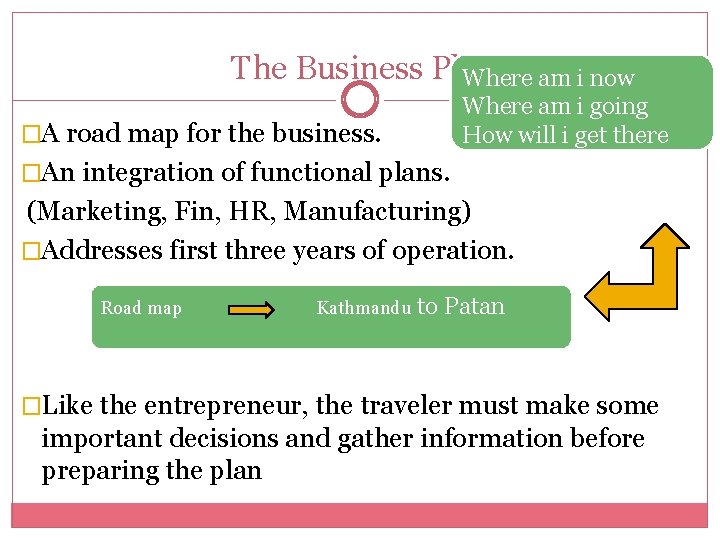
The Business Plan Where am i now Where am i going How will i get there �A road map for the business. �An integration of functional plans. (Marketing, Fin, HR, Manufacturing) �Addresses first three years of operation. Road map Kathmandu to Patan �Like the entrepreneur, the traveler must make some important decisions and gather information before preparing the plan
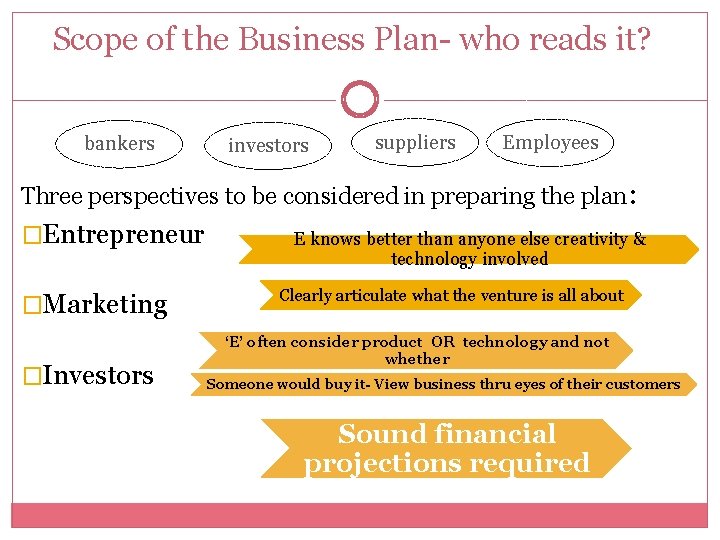
Scope of the Business Plan- who reads it? bankers investors suppliers Employees Three perspectives to be considered in preparing the plan: �Entrepreneur �Marketing �Investors E knows better than anyone else creativity & technology involved Clearly articulate what the venture is all about ‘E’ often consider product OR technology and not whether Someone would buy it- View business thru eyes of their customers Sound financial projections required
�Depth and detail in the business plan depend on: Size and scope of the proposed new venture. Nature of the product or market -comprehensive plan for Portable Computer / retail video store / ecommerce business Size of the market. Competition. Potential growth.
Value of the Business Plan (1 of 2) �Valuable to the entrepreneur, potential investors, or even new personnel. �It is important to these people because: Helps determine viability of the venture in a designated market. Provides guidance to the entrepreneur in organizing his or her planning activities. Serves as an important tool in helping to obtain financing.
Value of the Business Plan (2 of 2) �The thinking process required to complete the plan is a valuable experience for the entrepreneur. Provides a self-assessment by the entrepreneur. Forces the entrepreneur to bring objectivity to the idea. Helps consider obstacles that might prevent the venture from succeeding. Similar to role playing. Allows to plan ways to avoid such obstacles. �If required, the entrepreneur may decide to terminate the business endeavor.
Other benefits �The entrepreneur develops and examines operating strategies �Provides measurable benchmarks for comparing forecasts with actual results �Guides the venture operation towards success. �Provides the details of the market potential and plans for financial sources �Useful guide for assessing the individual entrepreneurs planning and managerial ability
Evaluating the Plan �The business plan must address: Strengths of management and personnel. Product or service. Available resources. �Entrepreneur prepares a first draft of the business plan from a personal viewpoint. Appropriate changes are necessary as entrepreneur is aware of the audience. � Suppliers. � Customers. � Potential suppliers of capital.
Lenders and Investors �Lenders: Primarily interested ability of the new venture to pay back the debt. �Banks: Want facts with an objective analysis and all the potential risk �Investors, particularly venture capitalists, have different needs: Place more emphasis on the entrepreneur’s character Spend much time conducting background checks. Investors will also demand high rates of return.
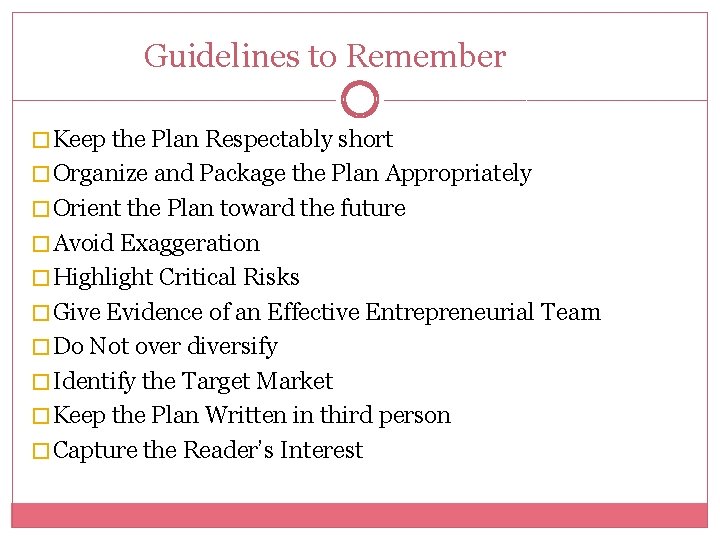
Guidelines to Remember � Keep the Plan Respectably short � Organize and Package the Plan Appropriately � Orient the Plan toward the future � Avoid Exaggeration � Highlight Critical Risks � Give Evidence of an Effective Entrepreneurial Team � Do Not over diversify � Identify the Target Market � Keep the Plan Written in third person � Capture the Reader’s Interest
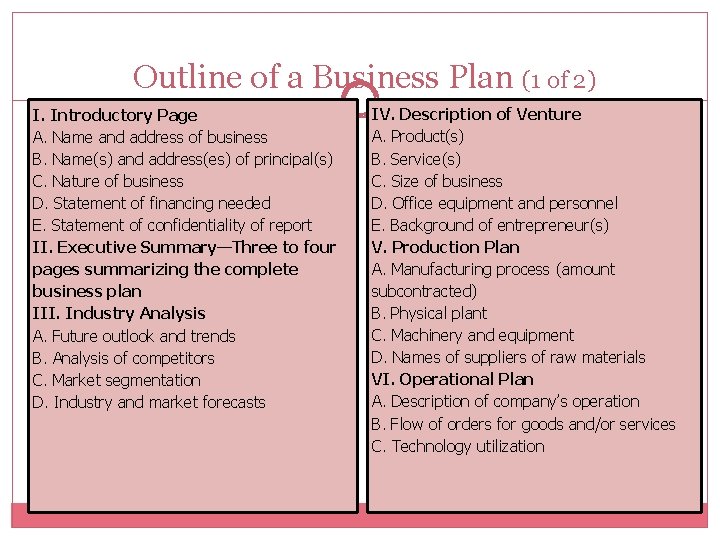
Outline of a Business Plan (1 of 2) I. Introductory Page A. Name and address of business B. Name(s) and address(es) of principal(s) C. Nature of business D. Statement of financing needed E. Statement of confidentiality of report II. Executive Summary—Three to four pages summarizing the complete business plan III. Industry Analysis A. Future outlook and trends B. Analysis of competitors C. Market segmentation D. Industry and market forecasts IV. Description of Venture A. Product(s) B. Service(s) C. Size of business D. Office equipment and personnel E. Background of entrepreneur(s) V. Production Plan A. Manufacturing process (amount subcontracted) B. Physical plant C. Machinery and equipment D. Names of suppliers of raw materials VI. Operational Plan A. Description of company’s operation B. Flow of orders for goods and/or services C. Technology utilization
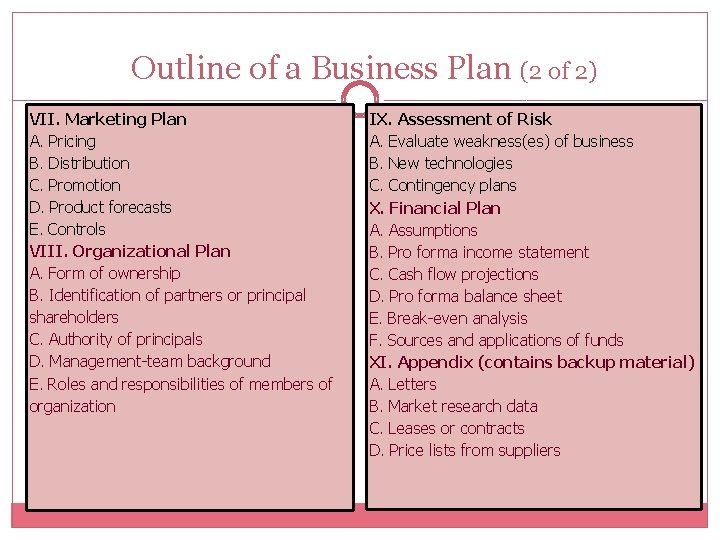
Outline of a Business Plan (2 of 2) VII. Marketing Plan A. Pricing B. Distribution C. Promotion D. Product forecasts E. Controls VIII. Organizational Plan A. Form of ownership B. Identification of partners or principal shareholders C. Authority of principals D. Management-team background E. Roles and responsibilities of members of organization IX. Assessment of Risk A. Evaluate weakness(es) of business B. New technologies C. Contingency plans X. Financial Plan A. Assumptions B. Pro forma income statement C. Cash flow projections D. Pro forma balance sheet E. Break-even analysis F. Sources and applications of funds XI. Appendix (contains backup material) A. Letters B. Market research data C. Leases or contracts D. Price lists from suppliers
Components of a Business Plan �A business plan: Should be comprehensive. Should help the entrepreneur clarify his or her thinking about the business.
Introductory Page: �Title or cover page that provides a brief summary of the business plan contents Name and address of the company Name of the entrepreneur with contact address Short paragraph describing the company and nature of business The amount of financial need: Equity Or Debt
Executive Summary �Very important section of the business Plan �Should not be taken lightly �Should address What is the business concept ? How is this business concept unique ? How are the individuals starting the business How will they make money and how much?
Executive Summary �Supporting evidence, such as data from marketing research, or contracts that strengthen the case should be included. �Other key factors should be also included Success of entrepreneur in other start ups Customer in hand
Environmental and Industry Analysis �Environmental analysis: assessment of external uncontrollable variables that may impact the business plan. �Identify trend and changes in National and International level Examples: Economy, culture, technology, legal concerns, �Industry analysis: reviews industry trends and competitive strategies. Examples: Industry demand, competition
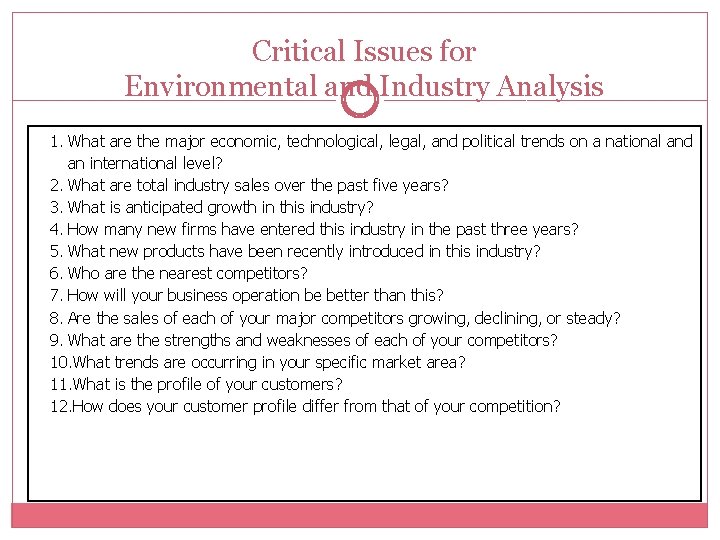
Critical Issues for Environmental and Industry Analysis 1. What are the major economic, technological, legal, and political trends on a national and an international level? 2. What are total industry sales over the past five years? 3. What is anticipated growth in this industry? 4. How many new firms have entered this industry in the past three years? 5. What new products have been recently introduced in this industry? 6. Who are the nearest competitors? 7. How will your business operation be better than this? 8. Are the sales of each of your major competitors growing, declining, or steady? 9. What are the strengths and weaknesses of each of your competitors? 10. What trends are occurring in your specific market area? 11. What is the profile of your customers? 12. How does your customer profile differ from that of your competition?
Description of Venture �Provides complete overview of the product(s), service(s), and operations of new venture. Components of the description are: Mission statement. Important factors that provide a clear description and understanding of the business venture. � Product(s) or service(s). � Location and size of the business. � Personnel and office equipment needed. � Background of the entrepreneur(s). � History of the venture.
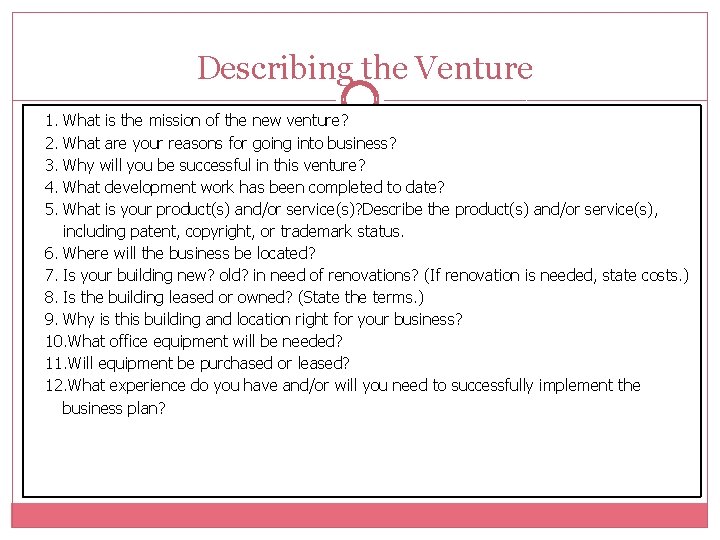
Describing the Venture 1. What is the mission of the new venture? 2. What are your reasons for going into business? 3. Why will you be successful in this venture? 4. What development work has been completed to date? 5. What is your product(s) and/or service(s)? Describe the product(s) and/or service(s), including patent, copyright, or trademark status. 6. Where will the business be located? 7. Is your building new? old? in need of renovations? (If renovation is needed, state costs. ) 8. Is the building leased or owned? (State the terms. ) 9. Why is this building and location right for your business? 10. What office equipment will be needed? 11. Will equipment be purchased or leased? 12. What experience do you have and/or will you need to successfully implement the business plan?
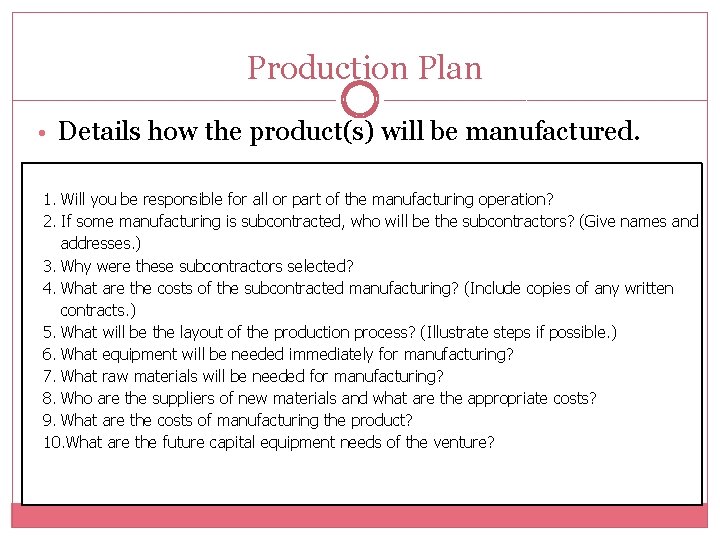
Production Plan • Details how the product(s) will be manufactured. 1. Will you be responsible for all or part of the manufacturing operation? 2. If some manufacturing is subcontracted, who will be the subcontractors? (Give names and addresses. ) 3. Why were these subcontractors selected? 4. What are the costs of the subcontracted manufacturing? (Include copies of any written contracts. ) 5. What will be the layout of the production process? (Illustrate steps if possible. ) 6. What equipment will be needed immediately for manufacturing? 7. What raw materials will be needed for manufacturing? 8. Who are the suppliers of new materials and what are the appropriate costs? 9. What are the costs of manufacturing the product? 10. What are the future capital equipment needs of the venture?
Operation Plan �All businesses (manufacturing or nonmanufacturing) should include an operations plan as part of the business plan. Goes beyond the manufacturing process. Might include storage of manufactured products, shipping inventory control procedure. If a Retail Operation or Service: 1. From whom will merchandise be purchased? 2. How will the inventory control system operate? 3. What are the storage needs of the venture and how will they be promoted? 4. How will the goods flow to the customer? 5. Chronologically, what are the steps involved in a business transaction? 6. What are the technology utilization requirements to service customers effectively?
Organizational Plan �Describes form of ownership and lines of authority and responsibility of members of new venture. �In case of a: Partnership: � Terms of the partnership should be included. Corporation: � Shares of stock authorized and share options. � Names, addresses, and resumes of the directors and officers of the corporation. � Organization chart.
Organizational Plan • Key question that entrepreneurs should ask 1. What is the form of ownership of the organization? 2. If a partnership, who are the partners and what are the terms of agreement? 3. If incorporated, who are the principal shareholders and how much stock do they own? 4. How many share of voting or nonvoting stock have been issues and what type? 5. Who are the members of the board of directors? 6. Who has check-signing authority or control? 7. Who are the members of the management team and what are their backgrounds? 8. What are the roles and responsibilities of each members of the management team? 9. What are the salaries, bonuses, or other forms of payment for each member of the management team?
Marketing Plan �Describes market conditions and strategy related to how the product(s) and service(s) will be distributed, priced, and promoted. �Describes: Marketing research evidence. Specific forecasts for a product(s) or service(s). Budget and appropriate controls needed for marketing strategy decisions. �Potential investors regard the marketing plan as critical to the success of the new venture.
Financial Plan � Provides with complete picture of how much & when funds are coming into the Organization- Where funds are going. How much cash is available & projected financial position of the firm � Projections of key financial data that determine economic feasibility and necessary financial investment commitment. � Three financial areas: Summarize the forecasted sales and the appropriate expenses for at least the first three years. Cash flow figures Projected balance sheet.
�Helps new venture with most common problem- lack of cash �Explain to potential investor Plans to meet financial obligations How would he pay off debt or provide good ROI � 3 Years of projected financial data to satisfy any outside investors �First year should reflect Monthly data
Assessment of Risk • Identifies potential hazards and alternative strategies to meet business plan goals and objectives. • Assessment of risk should be based on: ▫ ▫ ▫ Potential risks to the new venture. Discussion of what might happen if risks become reality. Strategy employed to prevent, minimize, or respond. • Major risks for a new venture could result from: ▫ ▫ ▫ Competitor’s reaction. Weaknesses in marketing/ production/ management team. New advances in technology.
Appendix �Contains any backup material that is not necessary in the text of the document. �May include: Letters from customers, distributors, or subcontractors. Secondary data or primary research data used to support plan decisions. Leases, contracts, or other types of agreements. Price lists from suppliers and competitors.
Making the business plan presentation �Demonstrate enthusiasm but don’t be over emotional �Know your audience thoroughly. �“Hook” your audience quickly �Hit the highlights �Keep your presentation simple �Avoid the use of technological terms �Use visual aids �Close by reinforcing the nature of the opportunity �Be prepared for questions �Follow up with every investor--- don’t wait be proactive.
Don’t make these business plan mistakes �Failure to explain the business opportunity clearly �Unrealistic projections �Overly simplistic assumptions �Weak competitor analysis �Failure to describe the company’s competitive advantage �A sloppy plan that contains errors �Exaggerating the qualifications of the management team �A plan that is incomplete.
- Slides: 58