
Lesson 2 CPR and First Aid for Shock

- Slides: 29
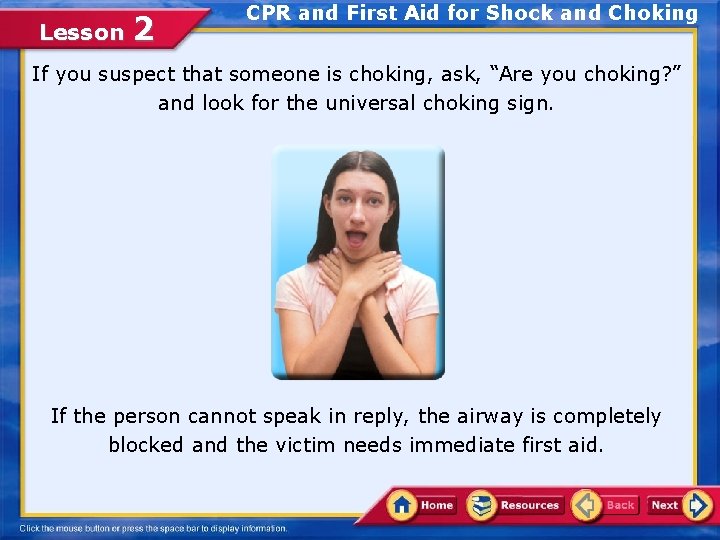
Lesson 2 CPR and First Aid for Shock and Choking If you suspect that someone is choking, ask, “Are you choking? ” and look for the universal choking sign. If the person cannot speak in reply, the airway is completely blocked and the victim needs immediate first aid.
Lesson 2 Lesson Objectives In this lesson, you will learn to: • Describe the steps for responding to life-threatening emergencies • Demonstrategies for responding to an emergency situation requiring CPR • Identify strategies for responding to a shock or choking victim
Lesson 2 Life-Threatening Emergencies What to Do in an Emergency Situation • In an emergency you need to act quickly—the first few minutes after a medical crisis are usually the most critical. • The key is knowing what to do, remaining calm, and making a decision to act. • If the victim in an emergency is unresponsive, you must begin immediately the chain of survival.
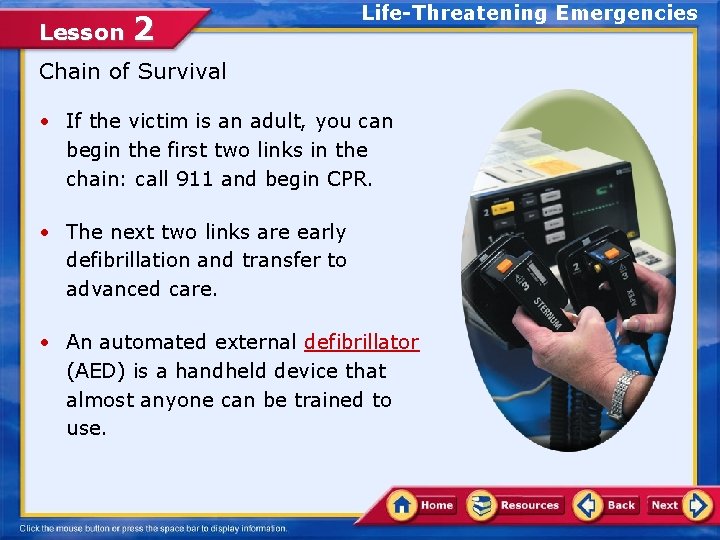
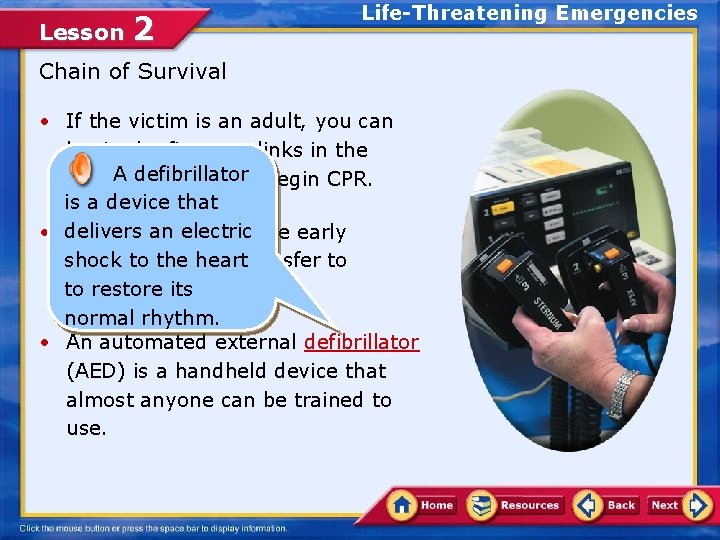
Lesson 2 Life-Threatening Emergencies Chain of Survival • If the victim is an adult, you can begin the first two links in the chain: call 911 and begin CPR. • The next two links are early defibrillation and transfer to advanced care. • An automated external defibrillator (AED) is a handheld device that almost anyone can be trained to use.
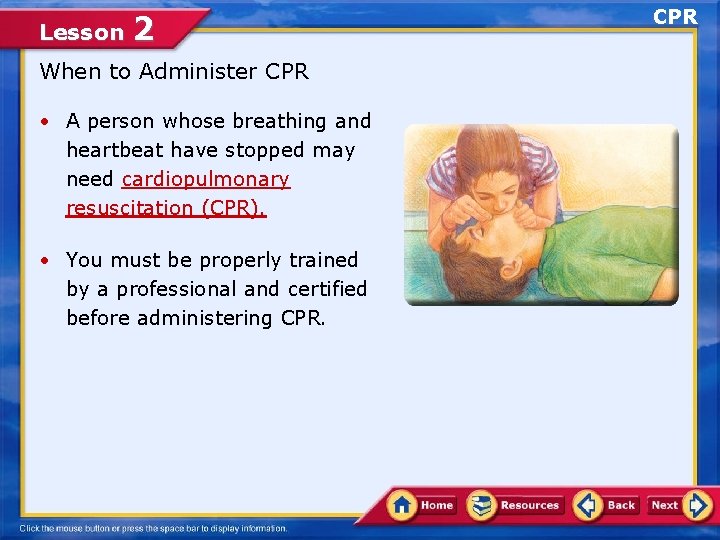
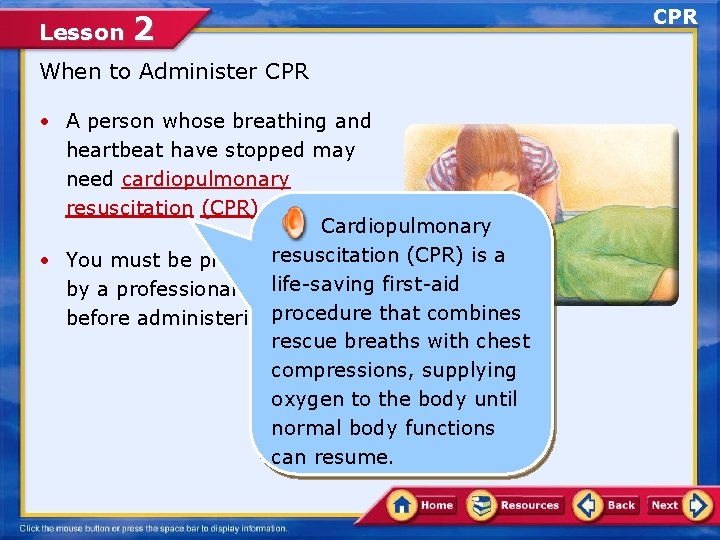
Lesson 2 When to Administer CPR • A person whose breathing and heartbeat have stopped may need cardiopulmonary resuscitation (CPR). • You must be properly trained by a professional and certified before administering CPR
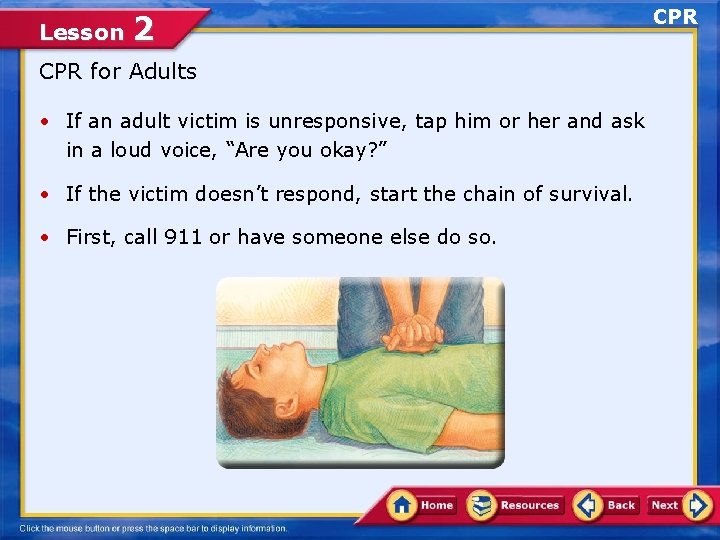
Lesson 2 CPR for Adults • If an adult victim is unresponsive, tap him or her and ask in a loud voice, “Are you okay? ” • If the victim doesn’t respond, start the chain of survival. • First, call 911 or have someone else do so. CPR
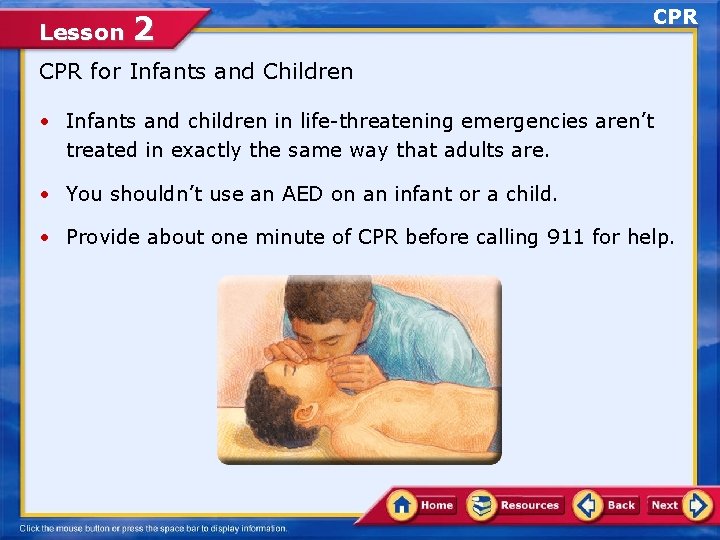
Lesson 2 CPR for Infants and Children • Infants and children in life-threatening emergencies aren’t treated in exactly the same way that adults are. • You shouldn’t use an AED on an infant or a child. • Provide about one minute of CPR before calling 911 for help.
Lesson 2 First Aid for Choking Shock • When something happens to reduce blood flow throughout the body, limiting the amount of oxygen carried to the cells, shock may occur. • This life-threatening emergency requires immediate medical attention. • Common symptoms of shock include restlessness or irritability; altered consciousness; nausea; pale or ashen appearance; cool, moist skin; and rapid breathing and pulse.
Lesson 2 First Aid for Choking Ways to Help a Shock Victim • Have the victim lie down. • Phone 911 or the local emergency number. • Control any external bleeding. • Elevate the legs about 12 inches. This helps the blood return to the heart. • Never give the victim anything to eat or drink. Eating or drinking could cause vomiting. • Reassure the victim.
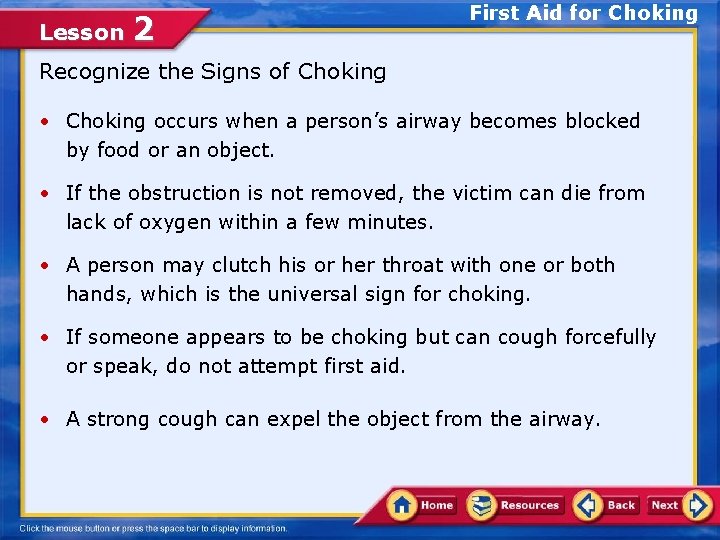
Lesson 2 First Aid for Choking Recognize the Signs of Choking • Choking occurs when a person’s airway becomes blocked by food or an object. • If the obstruction is not removed, the victim can die from lack of oxygen within a few minutes. • A person may clutch his or her throat with one or both hands, which is the universal sign for choking. • If someone appears to be choking but can cough forcefully or speak, do not attempt first aid. • A strong cough can expel the object from the airway.
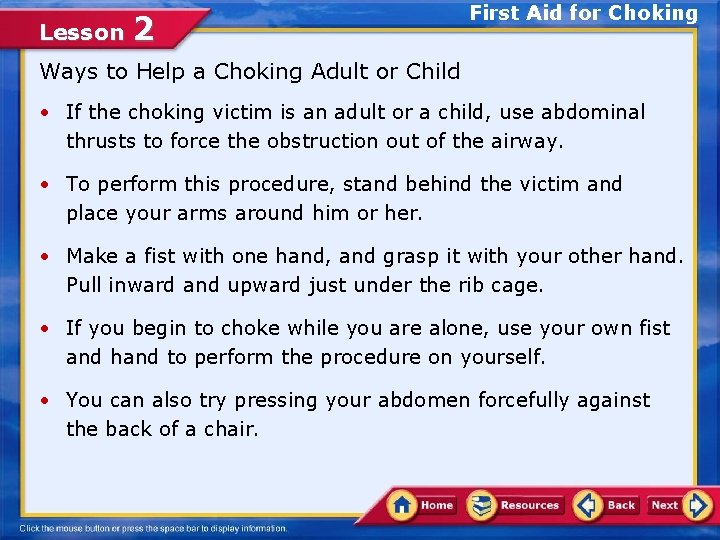
Lesson 2 First Aid for Choking Ways to Help a Choking Adult or Child • If the choking victim is an adult or a child, use abdominal thrusts to force the obstruction out of the airway. • To perform this procedure, stand behind the victim and place your arms around him or her. • Make a fist with one hand, and grasp it with your other hand. Pull inward and upward just under the rib cage. • If you begin to choke while you are alone, use your own fist and hand to perform the procedure on yourself. • You can also try pressing your abdomen forcefully against the back of a chair.
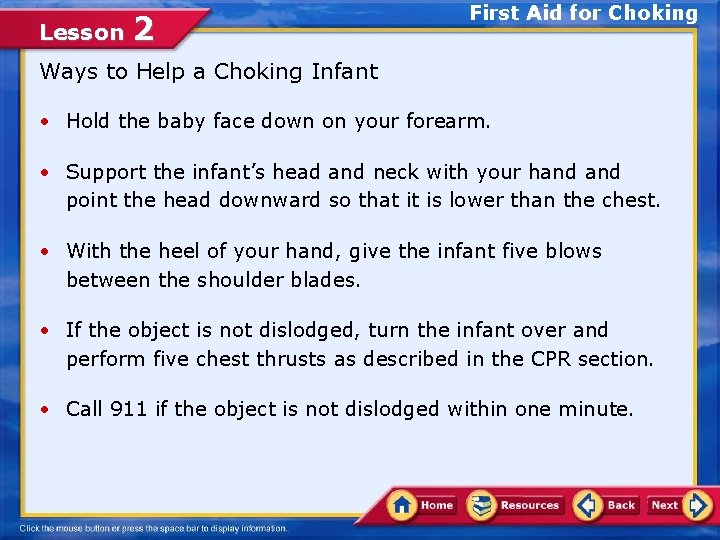
Lesson 2 First Aid for Choking Ways to Help a Choking Infant • Hold the baby face down on your forearm. • Support the infant’s head and neck with your hand point the head downward so that it is lower than the chest. • With the heel of your hand, give the infant five blows between the shoulder blades. • If the object is not dislodged, turn the infant over and perform five chest thrusts as described in the CPR section. • Call 911 if the object is not dislodged within one minute.
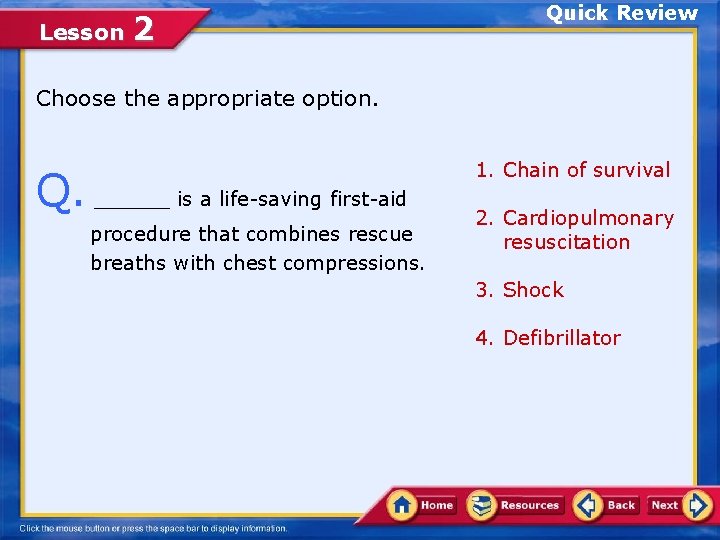
Lesson 2 Quick Review Choose the appropriate option. Q. ______ is a life-saving first-aid procedure that combines rescue breaths with chest compressions. 1. Chain of survival 2. Cardiopulmonary resuscitation 3. Shock 4. Defibrillator
Lesson 2 Quick Review - Answer A. 2. Cardiopulmonary resuscitation is a life-saving first-aid procedure that combines rescue breaths with chest compressions. Click Next to attempt another question.
Lesson 2 Quick Review Choose the appropriate option. Q. You should give a shock victim something to eat or drink because eating or drinking calms the nerves. True False
Lesson 2 Quick Review - Answer A. False. You should never give a shock victim something to eat or drink because it could cause vomiting. Click Next to attempt another question.
Lesson 2 Quick Review Choose the appropriate option. Q. Clutching the throat with one or True both hands is the universal sign for choking. False
Lesson 2 Quick Review - Answer A. True. Clutching the throat with one or both hands is the universal sign for choking.
Lesson 2 End of Lesson 2 Click Home to view the Main menu.
Lesson 2 Life-Threatening Emergencies What to Do in an Emergency Situation The chain of • In an emergency you need to act quickly—the survival is a first few minutes after a medical crisis are usually the most critical. sequence of actions that maximize the • The key is knowing what to do, remaining calm, and victim’s chances of making a decision to act. survival. • If the victim in an emergency is unresponsive, you must begin immediately the chain of survival.
Lesson 2 Life-Threatening Emergencies Chain of Survival • If the victim is an adult, you can begin the first two links in the A defibrillator chain: call 911 and begin CPR. is a device that electric • delivers The nextan two links are early shock to the heart defibrillation and transfer to to restore care. its advanced normal rhythm. • An automated external defibrillator (AED) is a handheld device that almost anyone can be trained to use.
Lesson 2 When to Administer CPR • A person whose breathing and heartbeat have stopped may need cardiopulmonary resuscitation (CPR). Cardiopulmonary resuscitation (CPR) is a • You must be properly trained by a professional andlife-saving certified first-aid that combines before administeringprocedure CPR. rescue breaths with chest compressions, supplying oxygen to the body until normal body functions can resume. CPR
Lesson 2 First Aid for Choking Shock • When something happens to reduce blood flow throughout the body, limiting the amount of oxygen carried to the cells, shock may occur. • This life-threatening emergency requires immediate Shock is a failure of medical attention. the cardiovascular system to keep an • Common symptoms of supply shock include adequate of bloodrestlessness or irritability; altered consciousness; circulating to the vitalnausea; pale or ashen appearance; organs cool, moist skin; and rapid breathing and of the body. pulse.
Lesson 2 Quick Review - Answer A. Correct! Cardiopulmonary resuscitation is a life-saving first-aid procedure that combines rescue breaths with chest compressions. Click Next to attempt another question.
Lesson 2 Quick Review - Answer You have answered the question incorrectly. Go back to try again, or click Next to view the correct answer.
Lesson 2 Quick Review - Answer A. Correct! You should never give a shock victim something to eat or drink because it could cause vomiting. Click Next to attempt another question.
Lesson 2 Quick Review - Answer You have answered the question incorrectly. Go back to try again, or click Next to view the correct answer.
Lesson 2 Quick Review - Answer A. Correct! Clutching the throat with one or both hands is the universal sign for choking.
Lesson 2 Quick Review - Answer You have answered the question incorrectly. Go back to try again, or click Next to view the correct answer.