
Lesson 2 Control of Microbial Growth Foodborne Disease
Lesson 2 Control of Microbial Growth & Foodborne Disease Pathogens in Fresh Fruits & Vegetables Lesson 2 of 4 Supported in part by a USDA-CSREES grant entitled “Improving Safety of Complex Food Items using Electron Beam Technology. ” Authors: Dr. Tom A. Vestal & Dr. Frank J. Dainello: Texas Agri. Life Extension Service Mr. Jeff Lucas: Texas A&M University These slides contain notes which augment the actual slide presentation. You may view the notes by clicking on the “normal view” icon in the lower left-hand corner of your screen, or by selecting “Normal” in the “View” dropdown box from your toolbar’s menu.
Lesson 2 Objectives • Describe the factors used to control microbial growth. • Identify and describe the pathogenic microorganisms responsible for foodborne disease in fresh fruits and vegetables. • Describe causes and origins of foodborne diseases in fresh fruits and vegetables from pathogenic microorganisms. • Describe the methods of control for the pathogenic microorganisms responsible for the foodborne disease in fresh fruits and vegetables. www. tamu. edu/ebeam
Lesson 2 Microbiological Agents of Foodborne Disease • Bacterial • Viral • Parasitic Reminder: To view the notes, from the toolbar click “View” then from the dropdown box which appears click “Normal”. www. tamu. edu/ebeam
Lesson 2 Factors Influencing the Growth of Microorganisms in Food • Intrinsic Factors – Naturally occurring compounds or product characteristics which inhibit growth of microorganisms. • Extrinsic Factors – Storage conditions or characteristics which can be manipulated to restrict or inhibit microbial growth www. tamu. edu/ebeam
Lesson 2 Bacterial Agents of Foodborne Disease • Gram negative* – Salmonella – Shigella spp. – Pathogenic Escherichia coli – Escherichia coli O 157: H 7 – Campylobacter • Gram positive* – Listeria monocytogenes – Clostridium botulinum – Bacillus cereus * Defined in the notes section. www. tamu. edu/ebeam
Lesson 2 Viral Agents of Foodborne Disease • Hepatitis A • Noroviruses www. tamu. edu/ebeam
Lesson 2 Parasitic Agents of Foodborne Disease • Giardia • Cyclospora • Cryptosporidium www. tamu. edu/ebeam
Lesson 2 Intrinsic Factors • • p. H water activity antimicrobial substances competing microflora www. tamu. edu/ebeam
Lesson 2 Intrinsic Factors Used to Control Microbial Growth in Foods • p. H or Acidity – p. H <4. 6 • Water Activity (Aw) – <0. 85 www. tamu. edu/ebeam
Lesson 2 Intrinsic Factors Used to Destroy Microorganisms in Foods (Continued) • Antimicrobial Substances Antimicrobials – Organic Acids: Lactic, citric and acetic acid, acidified sodium chloride – Bacteriocins: Chemicals manufactured by certain microorganisms. • Competing Microflora – Antagonism www. tamu. edu/ebeam
Lesson 2 Extrinsic Factors Used to Control Microbial Growth in Foods • • Time/Temperature Moisture Recontamination Packaging environment www. tamu. edu/ebeam
Lesson 2 Extrinsic Factors Used to Control Microbial Growth in Foods • Time/Temperature – Microbial Growth Temperatures • Cool foods quickly. • Heat foods properly. • Moisture – Products with a water activity below 0. 85 do not support the growth of bacterial pathogens. • Examples include dried fruits such as prunes and raisins. www. tamu. edu/ebeam
Lesson 2 Extrinsic Factors (Continued) • Recontamination – Employee hygiene/hand-washing – Equipment cleanliness and sanitation • Packaging Environment – Modified Atmosphere – Vacuum www. tamu. edu/ebeam

Lesson 2 Controlling Microbial Growth with Stabilization The “Hurdle Concept” employs multiple intrinsic and extrinsic factors to control microbial growth. www. tamu. edu/ebeam
Lesson 2 Microbial Foodborne Pathogens www. tamu. edu/ebeam
Lesson 2 Salmonella - Ranks 2 nd in Number of Cases • Gram negative bacteria, anaerobic, non-spore forming rod • Growth temperature: 41. 5° - 113° deg. F • Minimum water activity: 0. 95 • p. H Growth range: 4. 0 - 9. 0 • Generation time: 25 minutes (104° F ) • CDC reports over 40, 000 cases annually (second to Campylobacter) • Widely distributed in nature; humans and animals are primary reservoirs – Primary habitat is the intestinal tract of birds, reptiles, farm animals, humans and insects. – Organism is shed in fecal material. – Asymptomatic carriers may routinely shed organism contaminating food and water. Jay, J. M. , (2000). Modern Food Microbiology. Aspen Publishers. www. tamu. edu/ebeam
Lesson 2 Salmonella (Continued) • Salmonellosis – Caused by the consumption of food and water contaminated with sufficient numbers of the genus Salmonella. – Symptomatic numbers in the range of 5 logs (105) to 9 logs (109) required; numbers of organisms required for on-set of disease varies by species. – Symptoms • Symptoms usually develop within 12 to 24 hours although longer times have been known to occur. • Symptoms consist of nausea, vomiting, diarrhea, abdominal pain, fevers and chills. Headaches and muscular weakness have been reported. • Symptoms last 2 - 3 days. – Clinical Importance • May be fatal to the very young, very old, and those with weakened immune systems. Jay, J. M. , (2000). Modern Food Microbiology. Aspen Publishers. www. tamu. edu/ebeam
Lesson 2 Salmonella • Control of Salmonella – Avoid fecal contamination. – Prevent cross-contamination from one raw or cooked food to another. – Follow proper hand-washing, personal hygiene, and food handling practices. – Follow proper food preparation practices in foodservice establishments (restaurants) and in the home. – Electronic or radioisotope irradiation of food products Jay, J. M. , (2000). Modern Food Microbiology. Aspen Publishers. www. tamu. edu/ebeam
Lesson 2 Shigella species (spp. ) • • • Gram negative bacteria, anaerobic, non-spore forming rod Growth temperature: 50° to 118. 4° F Minimum water activity: unknown p. H Growth range: optimum 6 -8; growth as low as p. H 5. 0. Source: human intestinal tract; no known non-human reservoirs • Shigellosis: 12% of reported food poisoning cases 19731987. – As few as 10 organisms needed to cause infection – Caused by fecal-oral route due to poor personal hygiene – Symptoms: dysentery which varies from mild to severe – Reported found in day care centers www. tamu. edu/ebeam Jay, J. M. , (2000). Modern Food Microbiology. Aspen Publishers.
Lesson 2 Shigella spp. • Control of Shigella – Proper personal hygiene • hand-washing • elimination of human error in food handling leading to contamination – Adequate toilet facilities in fruit and vegetable harvest areas – Treatment of fresh produce with anti-microbial substances – Eliminate cross-contamination from unprocessed to processed products – Proper disposal and treatment of sewage – Proper chlorination of water Jay, J. M. , (2000). Modern Food Microbiology. Aspen Publishers. www. tamu. edu/ebeam
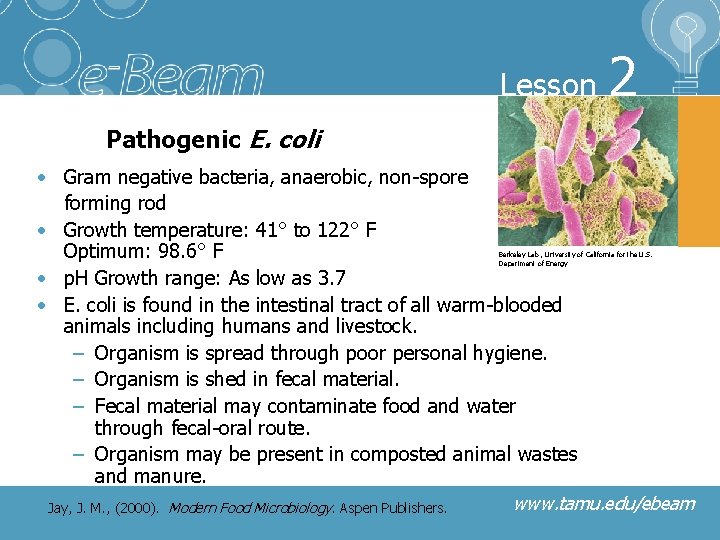
Lesson 2 Pathogenic E. coli • Gram negative bacteria, anaerobic, non-spore forming rod • Growth temperature: 41° to 122° F Optimum: 98. 6° F • p. H Growth range: As low as 3. 7 • E. coli is found in the intestinal tract of all warm-blooded animals including humans and livestock. – Organism is spread through poor personal hygiene. – Organism is shed in fecal material. – Fecal material may contaminate food and water through fecal-oral route. – Organism may be present in composted animal wastes and manure. Berkeley Lab , University of California for the U. S. Department of Energy Jay, J. M. , (2000). Modern Food Microbiology. Aspen Publishers. www. tamu. edu/ebeam
Lesson 2 Pathogenic E. coli • Travelers’ Diarrhea – Typical of symptoms from E. coli infection. – Acute watery diarrhea – Caused by consumption of contaminated food and/or water – Enteropathogenic E. coli • do not produce enterotoxins • generally infects children under 1 year of age – Enterotoxigenic E. coli • produces 2 types of heat stable enterotoxin after colonization of intestine • infects children and adults Jay, J. M. , (2000). Modern Food Microbiology. Aspen Publishers. www. tamu. edu/ebeam
Lesson 2 Pathogenic E. coli • Control of Pathogenic E. coli – Good agricultural practices • Elimination of animal wastes and manure as fertilizer • Provide proper toilet facilities for fruit and vegetable crop harvesters – Proper personal hygiene • Proper employee hygiene practices • Proper hand-washing facilities • Prevent fecal-oral route contamination – Raw material control – Proper heating and cooling of foods – Avoid cross-contamination of raw and processed foods – Proper food plant sanitation Jay, J. M. , (2000). Modern Food Microbiology. Aspen Publishers. www. tamu. edu/ebeam
Lesson 2 Escherichia coli O 157: H 7 • • Gram negative bacteria, anaerobic, non-spore forming rod Growth temperature: 44. 6° - 114. 8° F Faculitative Minimum water activity: 0. 95 p. H Growth range: 4. 4 - 9. 0 E. coli are naturally occurring organisms which may in some circumstances become contaminates of safe food processing facilities. Causes 2, 100 hospitalizations and 61 deaths annually according to CDC. Foodborne Disease: First recognized as a pathogen in 1982. – Children and elderly most susceptible – Caused by as few as 10 cells – Onset: abdominal pain and watery diarrhea – Later stages: Bloody diarrhea, kidney failure (hemolytic uremic syndrome) & death. Jay, J. M. , (2000). Modern Food Microbiology. Aspen Publishers. www. tamu. edu/ebeam
Lesson 2 E. coli O 157: H 7 • Control of 0157: H 7 – Good agricultural practices – Elimination of animal waste as fertilizer – Good manufacturing practices – Pasteurization of food products – Electronic or radioisotope irradiation of food products – Proper sanitation and cooking throughout to 160° F Jay, J. M. , (2000). Modern Food Microbiology. Aspen Publishers. www. tamu. edu/ebeam
Lesson 2 Listeria monocytogenes • • • Gram positive bacteria, anaerobic, non-spore forming rod Growth temperature: 32° to 113° F Water activity: >0. 92 p. H growth range: 4. 35 to 9. 6 Widespread in nature; found in dairy, meat, poultry, fish, fruits and vegetables. • Listeriosis – Recognized as a foodborne pathogen in 1981. – Highest mortality rate of all known foodborne pathogens. – Bacterial pathogen that invades the human cells. – Cellular invasion is a result of a toxin called Listeriolysin O. Jay, J. M. , (2000). Modern Food Microbiology. Aspen Publishers. www. tamu. edu/ebeam
Lesson 2 Listeria monocytogenes (Continued) • Listeriolysin O – Listeriolysin O causes pores to form in the intestine (epithelium) and cells of the infected immune system whereby Listeria gains entrance to those cells. – Manifestations of the Disease causes 1, 600 cases and 415 deaths annually according to FDA/CFSAN. • Abortion • Neonatal meningitis • Adult Listeriosis • Gastroenteritis Jay, J. M. , (2000). Modern Food Microbiology. Aspen Publishers. www. tamu. edu/ebeam
Lesson 2 Listeria monocytogenes (Continued) • Controlled through a combination of the following • Testing • Sanitation • Intervention strategies: – post-packaging pasteurization – growth inhibitors • Electronic or radioisotope irradiation of food products Jay, J. M. , (2000). Modern Food Microbiology. Aspen Publishers. www. tamu. edu/ebeam
Lesson 2 Clostridium botulinum • Gram positive, anaerobic bacteria, spore-forming rod • Has been found in soil, marine and lake sediments, feces, carcasses of dead animals, foil-wrapped potatoes, rotting vegetation and food. • Heat resistant spores are widely distributed • Must prevent growth and toxin formation • Botulism – First identified in 1896 – Growth produces potent neurotoxins which are some of the most lethal substances known. – Toxin binds to nerve endings with symptoms arising 12 to 72 hours after consumption. – Symptoms include: nausea, vomiting, fatigue, dizziness, headache, dryness of skin, mouth and throat, paralysis of muscles, double vision, and difficulty breathing. Jay, J. M. , (2000). Modern Food Microbiology. Aspen Publishers. www. tamu. edu/ebeam
Lesson 2 Clostridium botulinum (Continued) • Botulism continued. – Treatment involves administration of an antitoxin (available from the CDC) and continued supportive care including respiratory support. – Estimated mortality is less than 10%. – If left untreated and undiagnosed death may result. – Primary cause is insufficient heat treatment of canned foods including home canned vegetables and contamination of anaerobically packaged (vacuum) containing Clostridial spores followed by temperature abuse. – One concern is modified atmosphere packaging of fresh-cut vegetables with low oxygen permeable packaging which allows for complete oxygen depletion and the creation of an anaerobic condition. – Vegetables may be contaminated easily with spores of C. botulinum due to soil contact. Jay, J. M. , (2000). Modern Food Microbiology. Aspen Publishers. www. tamu. edu/ebeam
Lesson 2 Clostridium botulinum (Continued) • Control – Proper canning of commercial and home-canned foods. – Prevent the creation of anaerobic conditions, ( ex. foil wrapped, left-over baked potatoes. – Acidify products to a p. H of < 4. 6. – Water activity below 0. 93. – Storage temperature below 40° deg. F. – Salt levels of 10%. Less salt required when used with nitrites. – Interaction between p. H, temperature and salt (sodium chloride) content. • There is synergy between p. H, temperature and salt. • Levels less than those stated above can be used if all three are used in combination. • Inhibition must be established through challenge studies (scientific experiments) conducted in the laboratory. Jay, J. M. , (2000). Modern Food Microbiology. Aspen Publishers. www. tamu. edu/ebeam
Lesson 2 Bacillus cereus • • Gram positive, aerobic bacteria, spore-forming rod Grows over a wide temperature range of 5 o. C (41 o. F) – 35 o. C (95 o. F). Widely distributed in nature Bacillus cereus foodborne disease – Viable cell counts of 100, 000 cells/gram have shown to cause disease. – Foods such as rice, pasta, meat & poultry, vegetable dishes, soups, puddings and sauces have been implicated in disease outbreaks. – Two Food Poisoning Syndromes • Emetic syndrome • Diarrheal syndrome Jay, J. M. , (2000). Modern Food Microbiology. Aspen Publishers. www. tamu. edu/ebeam
Lesson 2 Bacillus cereus (Continued) • Control – Raw material and ingredient control – Rapidly cooling of heated foods Jay, J. M. , (2000). Modern Food Microbiology. Aspen Publishers. www. tamu. edu/ebeam
Lesson 2 Hepatitis A Virus • • Most prominent foodborne virus Incubation period is 15 to 45 days Fecal-oral route is the mode of transmission From 1983 through 1987, there were 1, 067 cases of Hepatitis A resulting in 1 death • October-November 2003, Hepatitis A outbreaks linked to Mexican green onions affecting people in Tennessee, North Carolina and Georgia with 530 confirmed cases and three deaths. Jay, J. M. , (2000). Modern Food Microbiology. Aspen Publishers. www. tamu. edu/ebeam
Lesson 2 Noroviruses • 42% of nonbacterial outbreaks reported to CDC between 1976 and 1980 were found to be Norwalk virus. • > 23 million cases each year (Mead, J. Infectious Diseases, 2002) • More resistant to chlorine disinfection than the Hepatitis A virus. • Can withstand 5 -6 ppm of chlorine. • Incubation period is 18 to 48 hours • Symptoms – nausea – vomiting – diarrhea – abdominal cramps Jay, J. M. , (2000). Modern Food Microbiology. Aspen Publishers. www. tamu. edu/ebeam
Lesson 2 Foodborne Parasites • Foodborne parasites that can be contracted by consuming certain foods are protozoans. • Protozoans are organisms similar to algae and flagellate fungi. • Parasites of particular concern in fresh-cut produce are: – Giardia lamblia – Cyclospora cayetanesis – Cryptosporidium parvum www. tamu. edu/ebeam
Lesson 2 Giardiasis • • Caused by Giardia lamblia. Exists in environmental waters. Organism is resistant to chlorine levels used in the water supply. Cysts are the primary form in waters. Muskrats and beavers harbor the organism and are the major source for water contamination. Cysts begin active growth in the upper small intestine and begin to absorb nutrients. Symptoms may last from several months to a year. – Abdominal cramps, diarrhea, abdominal distention, malnutrition & weight loss Vegetables are contaminated from use of contaminated water or from vegetables being handled by asymptomatic carriers. www. tamu. edu/ebeam
Lesson 2 Cyclosporiasis Caused by Cyclosporiasis cayetanensis Exists in contaminated water Cysts are resistant to chlorine Cysts have been found in drinking water stored in tanks Intestinal pathogen found in feces-contaminated water Has been isolated from waste-water Symptoms – diarrhea, loss of appetite, fatigue, and weight loss • Organism parasitizes the epithelial cells of the small instestine • Fruits and vegetables are contaminated by using contaminated water • • www. tamu. edu/ebeam
Lesson 2 Cryptosporidiosis Caused by Cryptosporidium parvum Present in environmental waters Cysts invade host cells where sexual reproduction occurs Chlorine and ozone are ineffective at destroying organism Human cryptosporidiosis may be acquired by person-to-person contact, person-to-animal contact, or through contaminated food or water. • Symptoms – profuse diarrhea, abdominal pain, low-grade fever, & vomiting. • Fruits and vegetables are contaminated by use of contaminated wash water or through an infected food-handler through the fecal-oral route. www. tamu. edu/ebeam • • •
Lesson 2 Prevention of Foodborne Parasitic Disease • Prevent fecal-oral transmission by proper personal hygiene. • Eliminate the asymptomatic food handler from food processing environments. • Good Agricultural Practices • Use potable water from an approved source. • Heating food or water to pasteurization temperatures. www. tamu. edu/ebeam
Number of Reported Foodborne Disease Cases for Selected Foods in U. S. 1988 -1992 Lesson 2 Number of Foodborne Disease Outbreaks and Illnesses for Selected Foods in the U. S. for 1988– 1992 and 1993 -1997 www. tamu. edu/ebeam Centers for Disease Control, MMWR, October 25, 1996/Vol. 45/No. SS-5 Centers for Disease Control, MMWR, March 17, 2000/Vol. 49/No. SS-1
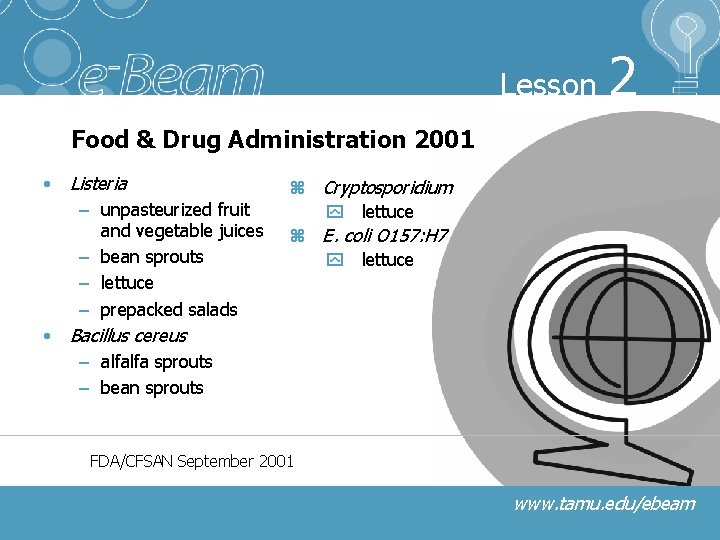
Lesson 2 Food & Drug Administration 2001 • Listeria – unpasteurized fruit and vegetable juices – bean sprouts – lettuce – prepacked salads • Bacillus cereus – alfalfa sprouts – bean sprouts Cryptosporidium lettuce E. coli O 157: H 7 lettuce FDA/CFSAN September 2001 www. tamu. edu/ebeam
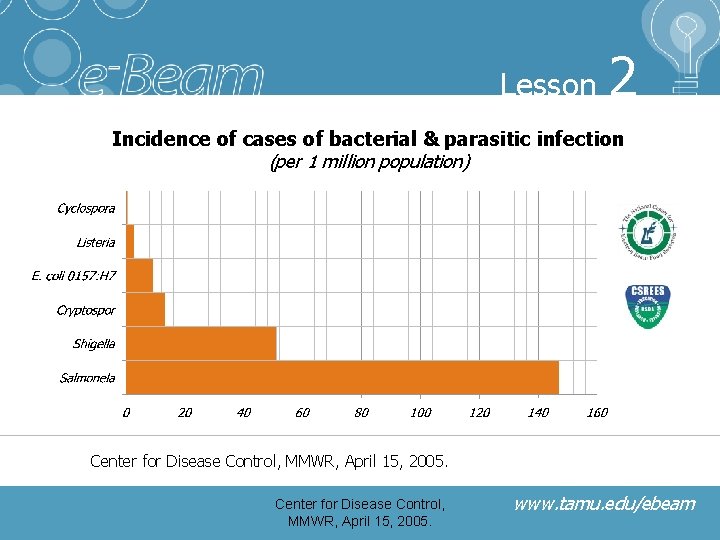
Lesson 2 Incidence of cases of bacterial & parasitic infection (per 1 million population) Center for Disease Control, MMWR, April 15, 2005. www. tamu. edu/ebeam
Lesson 2 Centers for Disease Control “. . further efforts are needed to sustain these declines and to improve prevention of foodborne infections; efforts should be enhanced to reduce pathogens in food animal reservoirs and to prevent contamination of produce. ” Center for Disease Control, MMWR, April 15, 2005. www. tamu. edu/ebeam
Lesson 2 Conclusion Many important topics were discussed in this module. • We have discussed the means by which microbial growth is reduced with both intrinsic and extrinsic factors. • We have introduced combining intrinsic and extrinsic factors to use the Hurdle Concept. • We have discussed the nature of bacterial, viral, and parasitic foodborne disease agents and mechanisms for their control. • And we learned which bacterial & parasitic infections are most prominent. In the next module, we will discuss the strategies in use currently to reduce or eliminate pathogens in fresh-cut produce. www. tamu. edu/ebeam
- Slides: 45