
LESSON 2 COMPANIES CLASSIFICATION Learning objectives 1 Defining
LESSON -2 COMPANIES & CLASSIFICATION
Learning objectives. 1. Defining the word “Company”. 2. Different types of Company. 3. Terminologies = Organization, Corporate, Business, Business Man 4. Differences Between Sole Proprietorship and Partnership. 5. Differences Public and Private Company. 6. Limited Company, Joint Stock Company. 7. Advantages and disadvantages of different types companies. 8. Factory and functional departments of a business/company. 2
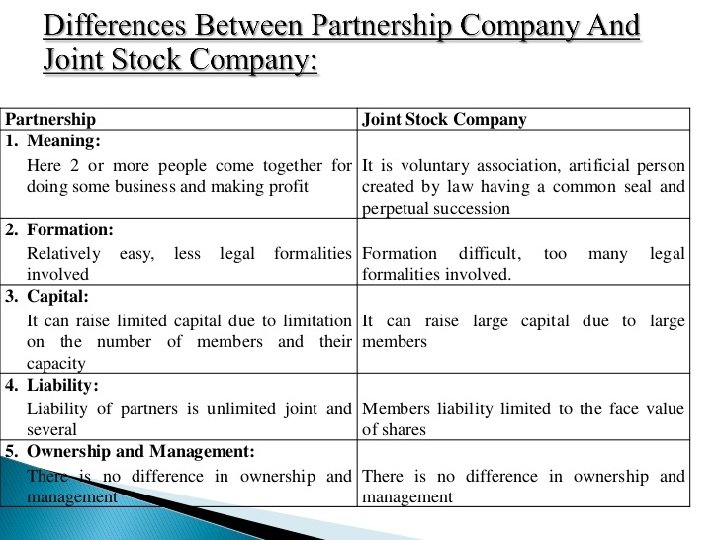
Company What is a Company ▪ Company ordinarily means an association of a number of individuals formed for some common purpose - trade, exchange, business, activities, function, program etc. ▫ When a company is registered, it is clothed with a legal personality and has the same rights and powers as a human being has. ▫ Its existence is distinct and separate from that of its members. ▫ The members may die or change but the company goes on till it is wound up on the grounds mentioned in the ordinance. ▪ Thus a company is an artificial person. ▫ It can act only through some human agency called the board of directors. ▫ They control and administer the affairs of the company and act as its agent. 3
Definition Of a Company ▪ A company is an association of persons united for a common purpose - Justice James ▪ A company is an association of many persons who contribute money or money’s worth to a common stock and employs it in some trade or business, and who share the profit and loss (as the case may be) arising there from. - James Stephenson 4
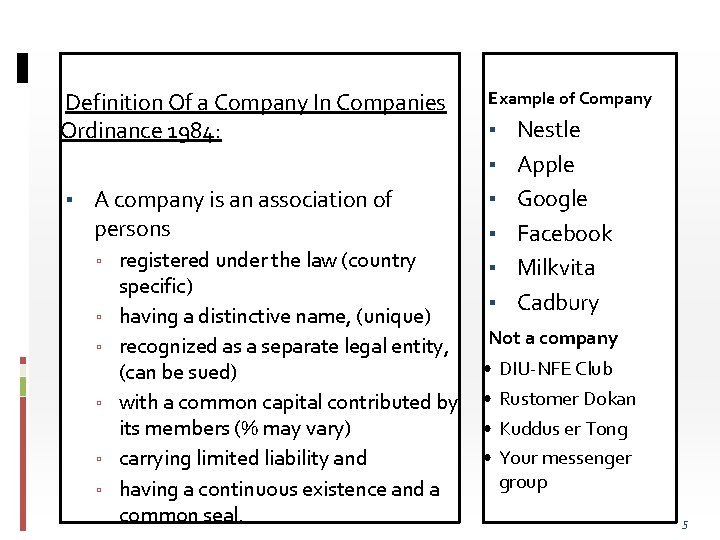
Definition Of a Company In Companies Ordinance 1984: ▪ A company is an association of persons ▫ registered under the law (country ▫ ▫ ▫ specific) having a distinctive name, (unique) recognized as a separate legal entity, (can be sued) with a common capital contributed by its members (% may vary) carrying limited liability and having a continuous existence and a common seal. Example of Company ▪ ▪ ▪ Nestle Apple Google Facebook Milkvita Cadbury Not a company • • DIU-NFE Club Rustomer Dokan Kuddus er Tong Your messenger group 5
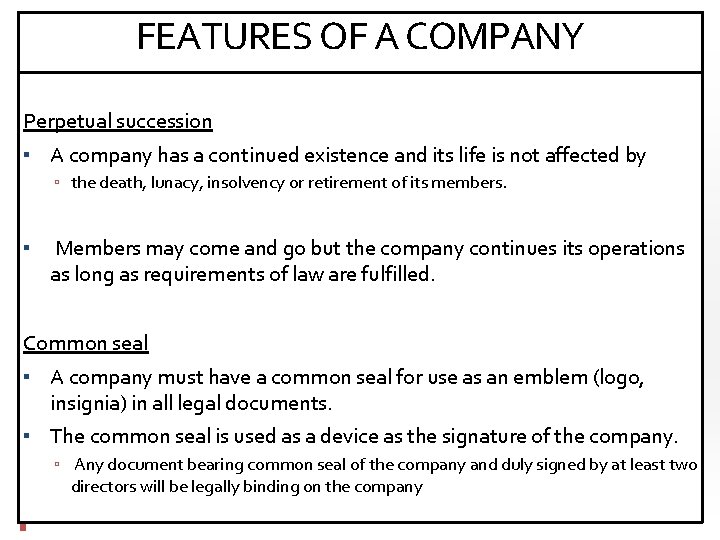
FEATURES OF A COMPANY Perpetual succession ▪ A company has a continued existence and its life is not affected by ▫ the death, lunacy, insolvency or retirement of its members. ▪ Members may come and go but the company continues its operations as long as requirements of law are fulfilled. Common seal ▪ A company must have a common seal for use as an emblem (logo, insignia) in all legal documents. ▪ The common seal is used as a device as the signature of the company. ▫ Any document bearing common seal of the company and duly signed by at least two directors will be legally binding on the company
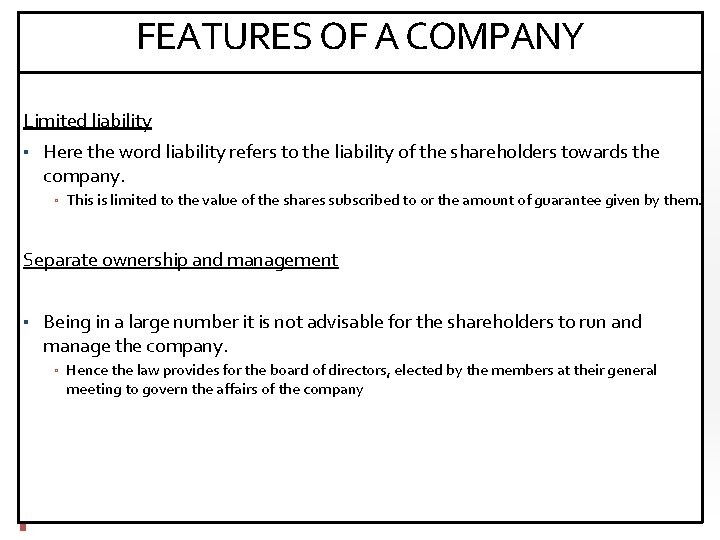
FEATURES OF A COMPANY Limited liability ▪ Here the word liability refers to the liability of the shareholders towards the company. ▫ This is limited to the value of the shares subscribed to or the amount of guarantee given by them. Separate ownership and management ▪ Being in a large number it is not advisable for the shareholders to run and manage the company. ▫ Hence the law provides for the board of directors, elected by the members at their general meeting to govern the affairs of the company
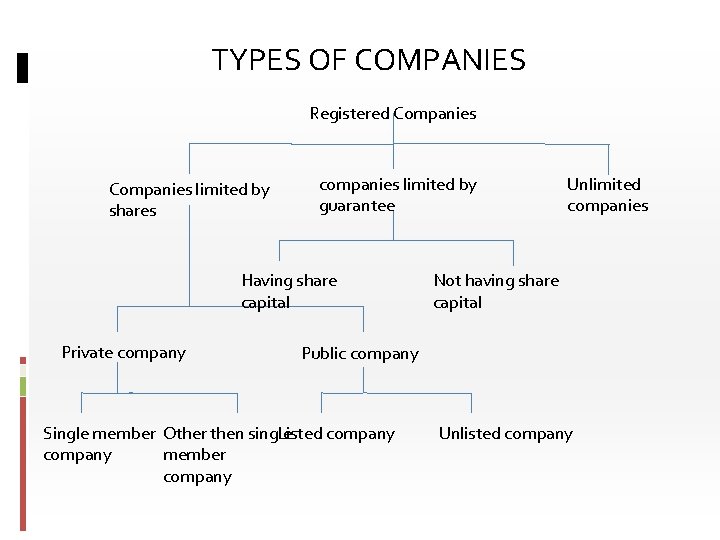
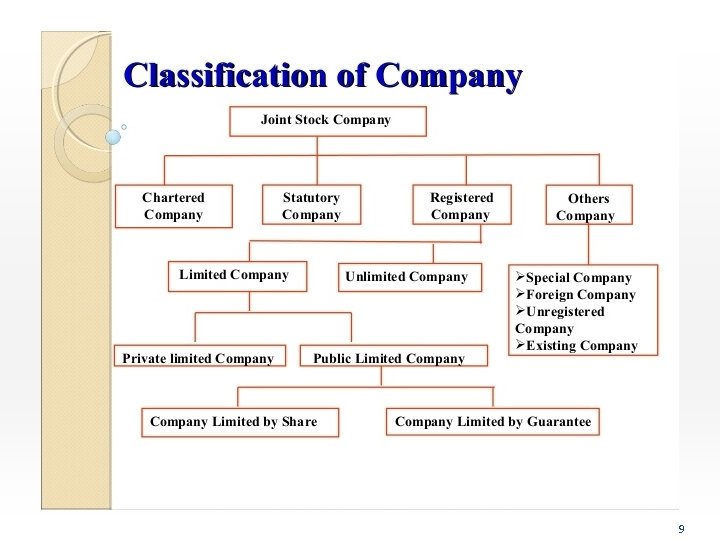
TYPES OF COMPANIES Registered Companies limited by shares companies limited by guarantee Having share capital Private company Unlimited companies Not having share capital Public company Single member Other then single Listed company member company Unlisted company
9
TYPES OF COMPANIES Company Limited by Shares: It means a company memorandum of association limits the liabilities of its members to the amount unpaid, if any, on the shares held by them in the capital of the company. ▫ It is the most popular and important among the registered companies ▫ It is a company which keeps the liability of its members limited up to the value of the shares purchased by them ▫ It is essential for such companies to use the word Limited at the end of their names so that the people know the liability of its members is limited �Most of the industrial and commercial companies in Pakistan are registered as companies limited by shares.
TYPES OF COMPANIES Company Limited by Guarantee: It means a company whose memorandum of association limits the ▪ liabilities of its members to the amount as the members may respectively undertake to contribute to the assets of the company in the event of its winding up. ▪ This company may or may not have a share capital. ▫ In Bangladesh company limited by guarantee use the words (guarantee) Limited (Ltd. ) as the last words of their names
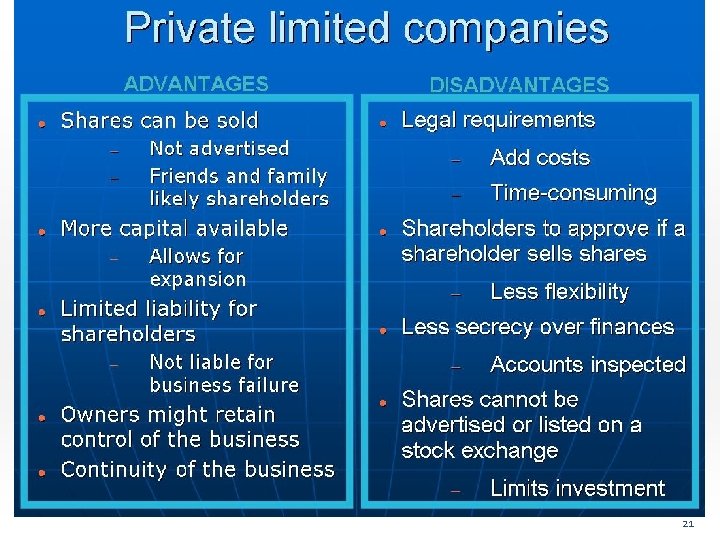
On The Basis Of Articles Of Association By virtue of provisions of articles, companies can further be divided into the following categories Private Company A. B. C. Restrict the rights to transfer its shares, If any; Limits the maximum number of its members to fifty; and Prohibits any invitation to the public to subscribe for the shares or debentures of the company
TYPES OF COMPANIES Unlimited Company: It is a company which is registered ▫ without limiting the liability of its members to the extent of value of the shares held by them. ▫ In other words, in case if such companies there is no limit of liability of members to contribute the assets on a winding up. ▫ Now-a-days such type of companies are not found in
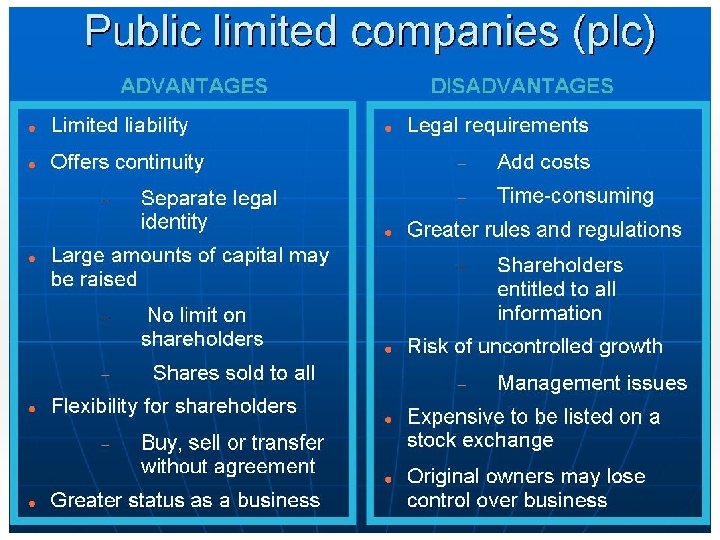
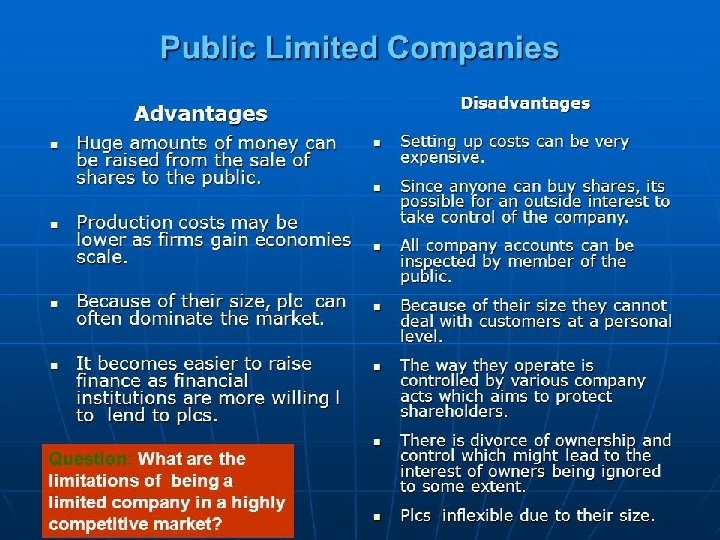
Public Company: It is a company which is not a private company. It is a company which does not : a. limits the maximum numbers of its members; b. Restrict the right to transfer its shares, if any; and c. Prohibit from inviting public to subscribe for the shares or debentures of the company. A public limited company can be formed with at least
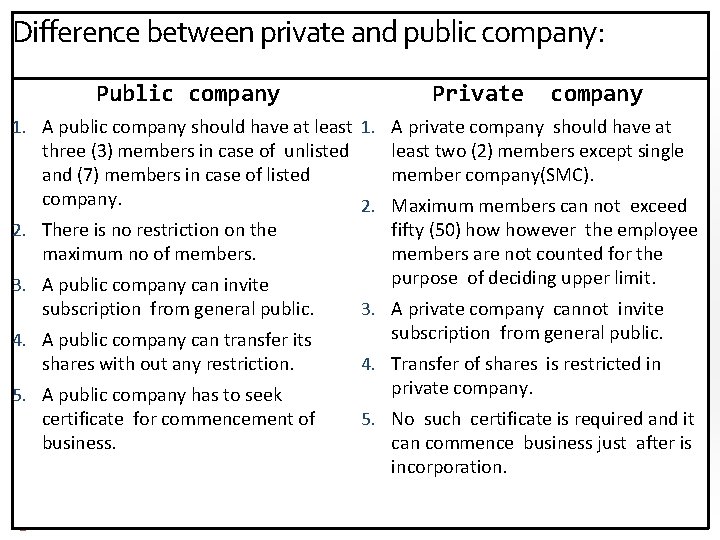
Difference between private and public company: Public company Private company 1. A public company should have at least 1. A private company should have at least two (2) members except single three (3) members in case of unlisted member company(SMC). and (7) members in case of listed company. 2. Maximum members can not exceed fifty (50) however the employee 2. There is no restriction on the members are not counted for the maximum no of members. purpose of deciding upper limit. 3. A public company can invite subscription from general public. 4. A public company can transfer its shares with out any restriction. 5. A public company has to seek certificate for commencement of business. 3. A private company cannot invite subscription from general public. 4. Transfer of shares is restricted in private company. 5. No such certificate is required and it can commence business just after is incorporation.
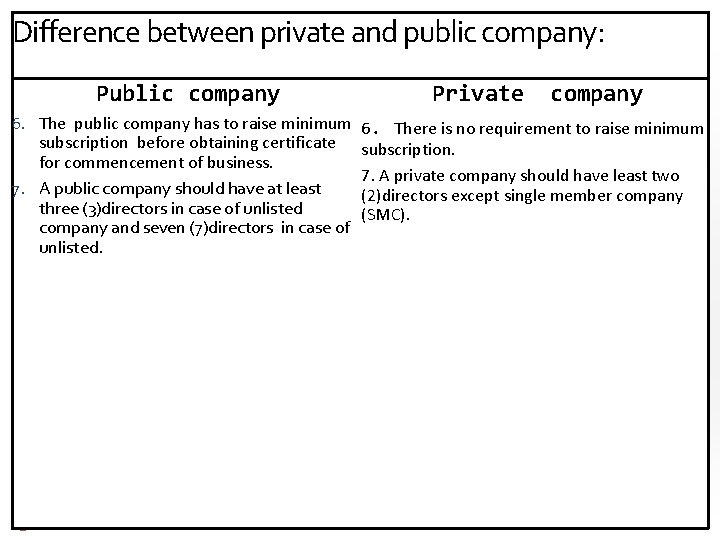
Difference between private and public company: Public company Private company 6. The public company has to raise minimum 6. There is no requirement to raise minimum subscription before obtaining certificate subscription. for commencement of business. 7. A private company should have least two 7. A public company should have at least (2)directors except single member company three (3)directors in case of unlisted (SMC). company and seven (7)directors in case of unlisted.
Public limited companies may further be classified in two categories. ❑ Listed Companies: The companies whose securities are allowed to be treated on a stock exchange are called listed companies. ❑ Un-Listed Companies: The companies whose securities are not allowed to be treated on a stock exchange are called un-listed companies.
Associations not for profit [section 42]: If the securities and exchange commission of Pakistan is satisfied with an association which has been formed or is capable of being formed as a limited company that it meets the conditions specified by companies ordinance 1984 , the companies may grant a License and direct that the association be registered as a limited company with out the addition of word “limited”, ”(private ) limited ”or “(guarantee) limited” as the case may be, to its name and the association may be registered accordingly
TYPES OF COMPANIES Chartered Company ▪ Chartered Companies are formed by the means of a special charter granted by the head of state, or King or queen of the crown. ▪ Normally these enjoy certain exclusive rights and privileges on other association of persons. ▫ The east India Company and Charted Bank of England are examples of such type of companies. ▪ Prior to the passing of modern companies legislation, these were the only types of companies. ▫ Now they are relatively rare, except for very old companies that still survive (of which there are still many, particularly many British banks)
Government Company ▪ A government Company is a company of which more than 50 percent of the paid up capital is held by the government. ▪ A company which is subsidiary of a government company automatically becomes a government company.
21
22
23
24
25

- Slides: 26