
LESSON 2 B 2 TELLING TIME OBJECTIVES In
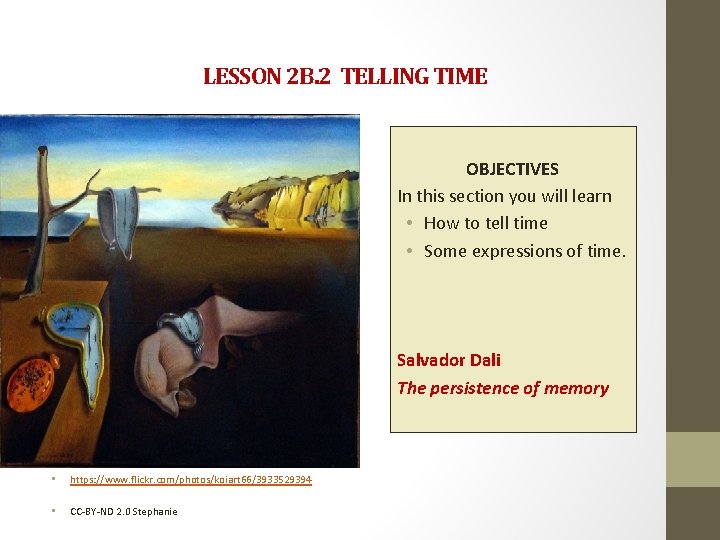
LESSON 2 B. 2 TELLING TIME OBJECTIVES In this section you will learn • How to tell time • Some expressions of time. Salvador Dali The persistence of memory • https: //www. flickr. com/photos/koiart 66/3933529394 • CC-BY-ND 2. 0 Stephanie
OVERVIEW • The most common way of asking the time is: Quelle heure est-il? (What time is it? ) • -Read about how to tell the time for the first half hour: Il est deux heures dix (it’s 2: 10) addition • -and for the second half hour: Il est trois heures moins dix (It’s 2: 50) substraction * (=It’s three minus ten) (You must always include the word HEURE/S) • Also: Midi (noon)/ minuit (midnight): Il est midi/ Il est minuit • -Notice: Il est une heure and Il est trois heures (singular and plural) * Of course, you can also say Il est deux heures cinquante (2: 50), however, be aware that for this class you must use the subtraction method.
OVERVIEW Expressions for telling time As usual, you must practice and memorize them. Example: Il est dix heures du matin (in the morning) Il est dix heures du soir (in the evening) Il est quatre heures de l’après-midi (in the afternoon)
Overview -Notice the difference between telling the time and expressing the time of an event: Il est cinq heures et quart La classe est à 10 heures et demie (. . . it's at. . . ) Je rentre chez moi à dix heures du soir (I return home at 10 p. m) -------------------------------------------Examples: 1) On arrive au café à dix heures et demie du matin 2)Nous parlons avec le professeur à midi 3)Je rentre tard, à onze heures et quart du soir 4)On regarde la télé a neuf heures du soir 5)Elles mangent vers* deux heures moins le quart de l’après-midi 6) Il commence très tôt**, à huit heures vingt du matin *about/around **early CC-BY Roger Celis
- Slides: 4