
LESSON 2 ALLOCATING SCARCE RESOURCES 1 Have you
- Slides: 11
LESSON 2 ALLOCATING SCARCE RESOURCES 1. Have you ever had difficulty getting something you wanted? 2. Why can’t you have everything you want? 3. How do we decide as a society who gets what? 4. What institution provides the framework for controlling allocation of goods and services? 2 HIGH SCHOOL ECONOMICS 3 RD EDITION © COUNCIL FOR ECONOMIC EDUCATION, NEW YORK, NY
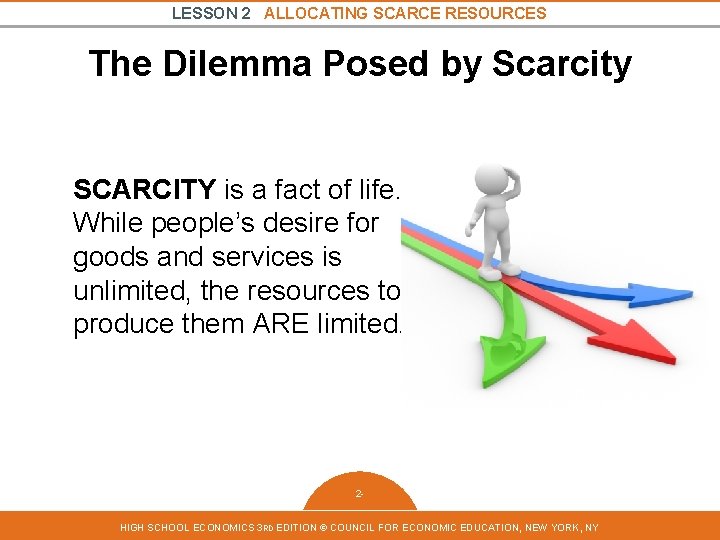
LESSON 2 ALLOCATING SCARCE RESOURCES The Dilemma Posed by Scarcity SCARCITY is a fact of life. While people’s desire for goods and services is unlimited, the resources to produce them ARE limited. 2 HIGH SCHOOL ECONOMICS 3 RD EDITION © COUNCIL FOR ECONOMIC EDUCATION, NEW YORK, NY
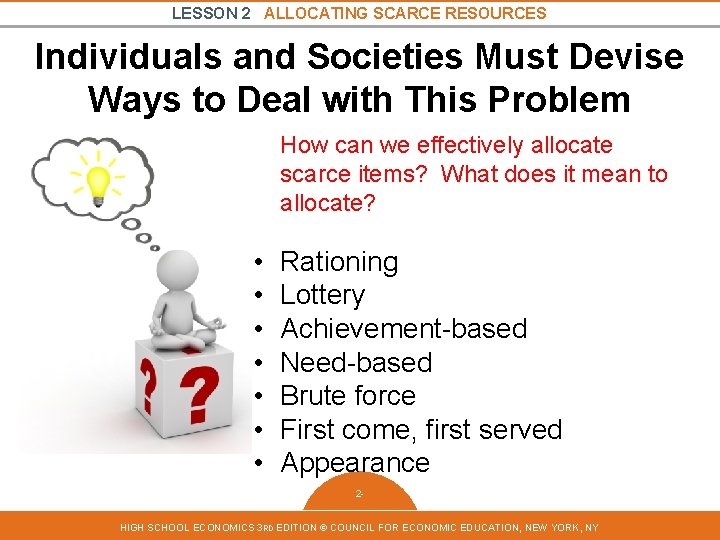
LESSON 2 ALLOCATING SCARCE RESOURCES Individuals and Societies Must Devise Ways to Deal with This Problem How can we effectively allocate scarce items? What does it mean to allocate? • • Rationing Lottery Achievement-based Need-based Brute force First come, first served Appearance 2 - HIGH SCHOOL ECONOMICS 3 RD EDITION © COUNCIL FOR ECONOMIC EDUCATION, NEW YORK, NY
LESSON 2 ALLOCATING SCARCE RESOURCES Since everyone can’t have everything they want, what should be the goal of any allocation method? -fairness? -equity? -provide for the most need? -provide the greatest benefit? 2 HIGH SCHOOL ECONOMICS 3 RD EDITION © COUNCIL FOR ECONOMIC EDUCATION, NEW YORK, NY
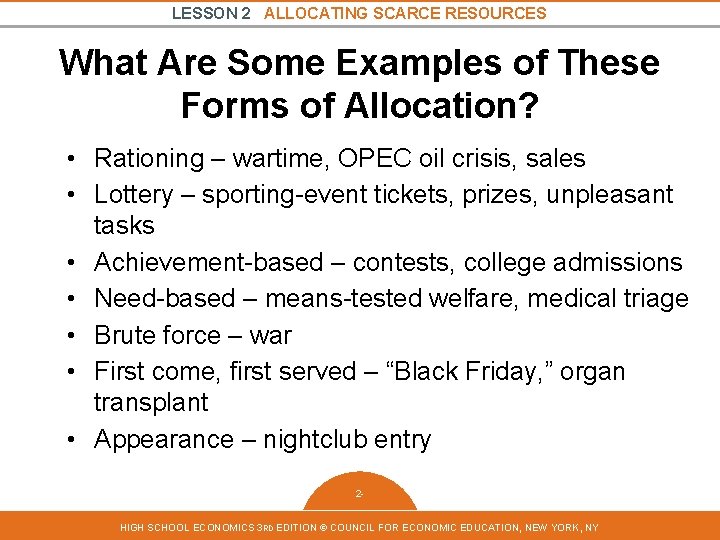
LESSON 2 ALLOCATING SCARCE RESOURCES What Are Some Examples of These Forms of Allocation? • Rationing – wartime, OPEC oil crisis, sales • Lottery – sporting-event tickets, prizes, unpleasant tasks • Achievement-based – contests, college admissions • Need-based – means-tested welfare, medical triage • Brute force – war • First come, first served – “Black Friday, ” organ transplant • Appearance – nightclub entry 2 HIGH SCHOOL ECONOMICS 3 RD EDITION © COUNCIL FOR ECONOMIC EDUCATION, NEW YORK, NY
LESSON 2 ALLOCATING SCARCE RESOURCES Gallery Walk: Provide reasons why each method might work well. 2 HIGH SCHOOL ECONOMICS 3 RD EDITION © COUNCIL FOR ECONOMIC EDUCATION, NEW YORK, NY
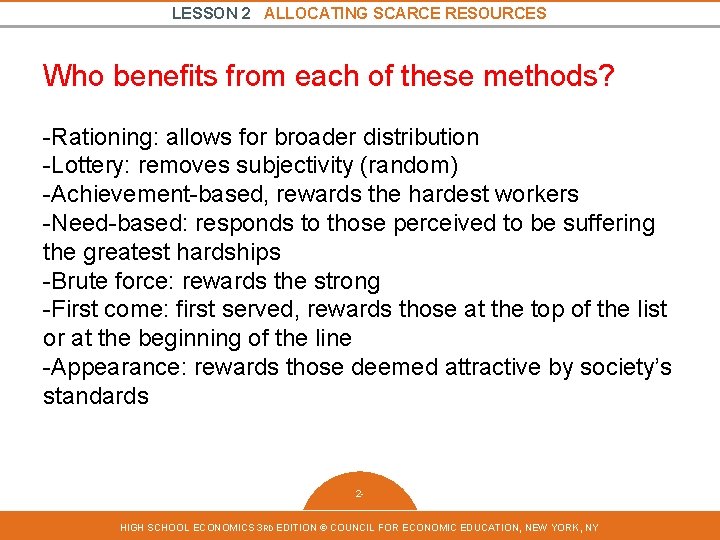
LESSON 2 ALLOCATING SCARCE RESOURCES Who benefits from each of these methods? -Rationing: allows for broader distribution -Lottery: removes subjectivity (random) -Achievement-based, rewards the hardest workers -Need-based: responds to those perceived to be suffering the greatest hardships -Brute force: rewards the strong -First come: first served, rewards those at the top of the list or at the beginning of the line -Appearance: rewards those deemed attractive by society’s standards 2 HIGH SCHOOL ECONOMICS 3 RD EDITION © COUNCIL FOR ECONOMIC EDUCATION, NEW YORK, NY
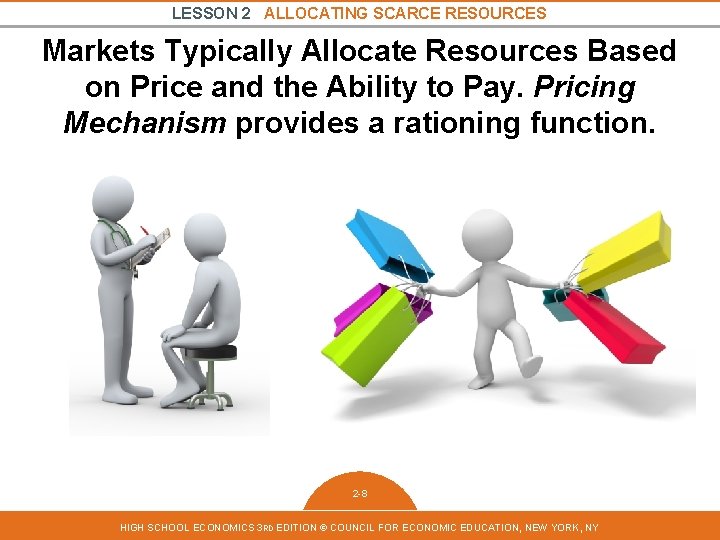
LESSON 2 ALLOCATING SCARCE RESOURCES Markets Typically Allocate Resources Based on Price and the Ability to Pay. Pricing Mechanism provides a rationing function. 2 -8 HIGH SCHOOL ECONOMICS 3 RD EDITION © COUNCIL FOR ECONOMIC EDUCATION, NEW YORK, NY
LESSON 2 ALLOCATING SCARCE RESOURCES -Without a central pricing authority, the market and its pricing mechanism serve as a regulating device to equate demand with supply. -For example, when there is a shortage of an item, prices are bid up, satisfying those willing to pay the higher price. -When there’s a surplus prices fall, opening up purchase opportunities for more customers. -Higher prices send a signal to increase output. -Lower prices signal it is time to cut-back on production Definition: Price mechanism refers to the system where the forces of demand supply determine the prices of commodities and the changes therein. 2 -9 HIGH SCHOOL ECONOMICS 3 RD EDITION © COUNCIL FOR ECONOMIC EDUCATION, NEW YORK, NY
LESSON 2 ALLOCATING SCARCE RESOURCES Classroom Discussion: 1. Why is it necessary for society to develop a mechanism to allocate goods, services, and resources? 2. Why is the market system an effective method to allocate scarce goods, services, and resources? 3. Under what circumstances do some people view the market system as unacceptable for allocating scarce goods, services, and resource? 2 -10 HIGH SCHOOL ECONOMICS 3 RD EDITION © COUNCIL FOR ECONOMIC EDUCATION, NEW YORK, NY
LESSON 2 ALLOCATING SCARCE RESOURCES Assessment: Create a claim and develop a constructed response that expresses your opinion on the following idea: Our population is aging and soon an inordinate amount of the nation's resources will be dedicated to care for the elderly. The labor market is in flux as it becomes more difficult to define the skills that producers need. Humanity’s fundamental problem has always been scarcity, but our resources and desires have never been on more divergent paths. Since everyone can’t have everything they want, what should be the goal of any allocation method? -fairness? -equity? provide for the most need? -provide the greatest benefit? Directions 1. Discuss the condition of scarcity 2. Evaluate each method of resource allocation. 3. Make a claim regarding which method you think is best and argue your point using evidence from classroom discussions and notes. 2 -11 HIGH SCHOOL ECONOMICS 3 RD EDITION © COUNCIL FOR ECONOMIC EDUCATION, NEW YORK, NY