
Lesson 2 3 Writing Equations from Graphs Modeling


- Slides: 15
Lesson 2. 3 Writing Equations from Graphs Modeling Using Trigonometric Functions
Lesson Objectives At the end of the lesson, students can: • Given a sine or cosine graph, write the equation. • Model real-world scenarios using trigonometric functions.
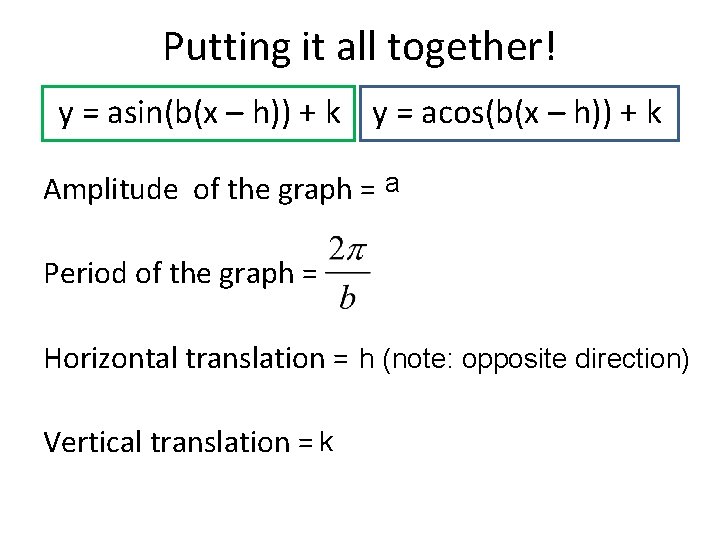
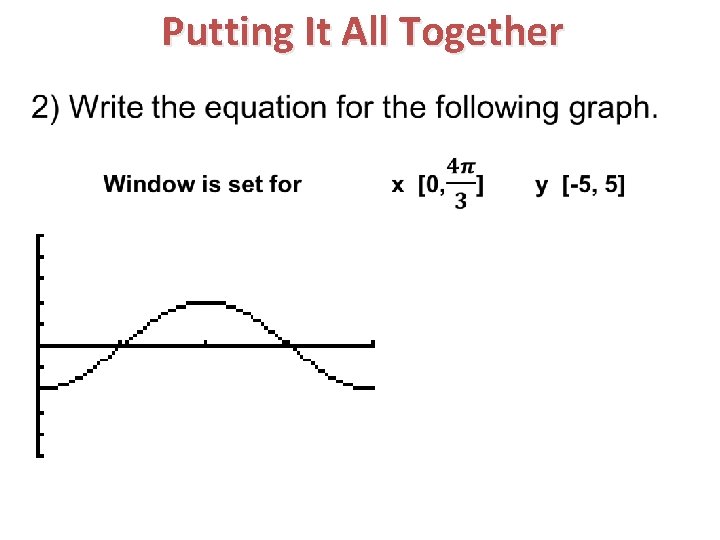
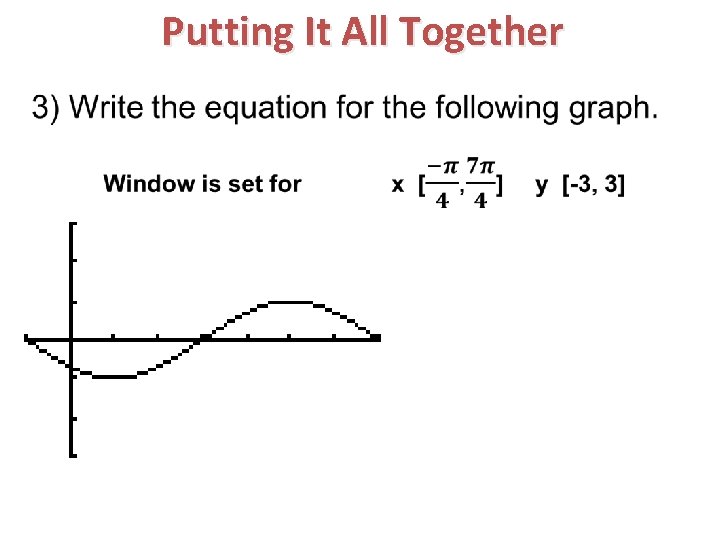
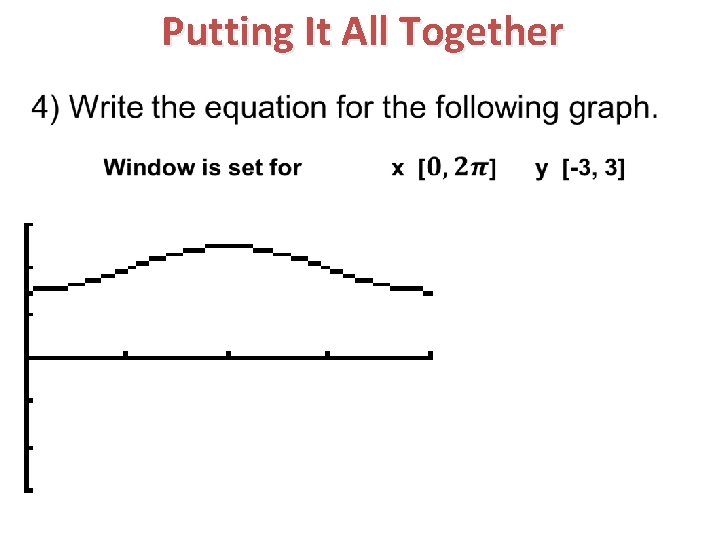
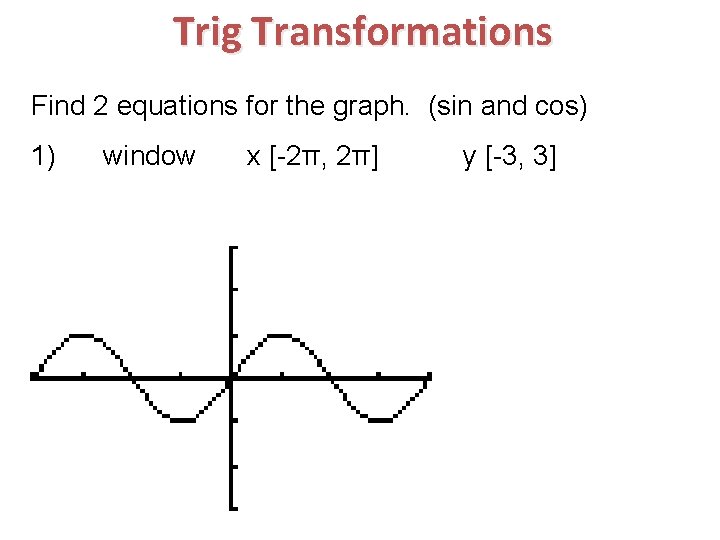
Putting it all together! y = asin(b(x – h)) + k y = acos(b(x – h)) + k Amplitude of the graph = a Period of the graph = Horizontal translation = h (note: opposite direction) Vertical translation = k
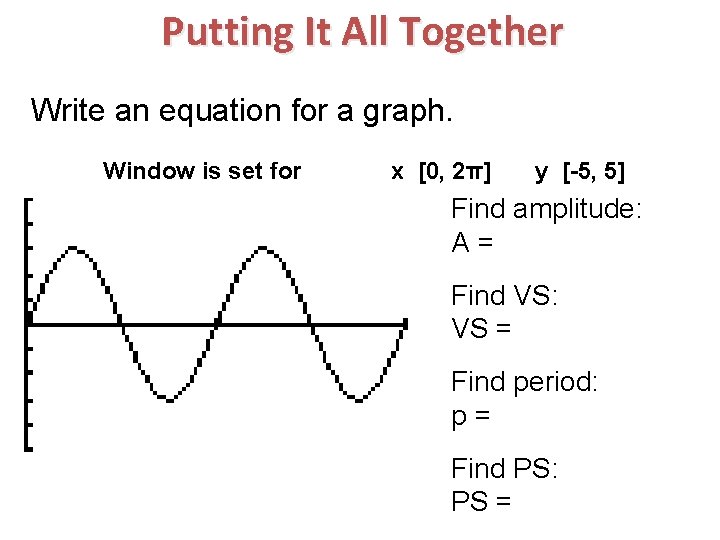
Putting It All Together Write an equation for a graph. Window is set for x [0, 2π] y [-5, 5] Find amplitude: A = Find VS: VS = Find period: p = Find PS: PS =
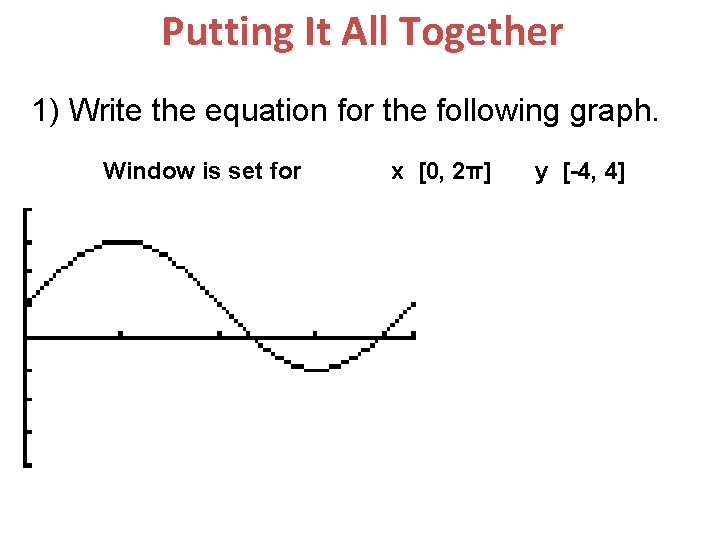
Putting It All Together 1) Write the equation for the following graph. Window is set for x [0, 2π] y [-4, 4]
Putting It All Together
Putting It All Together
Putting It All Together
Trig Transformations Find 2 equations for the graph. (sin and cos) 1) window x [-2π, 2π] y [-3, 3]
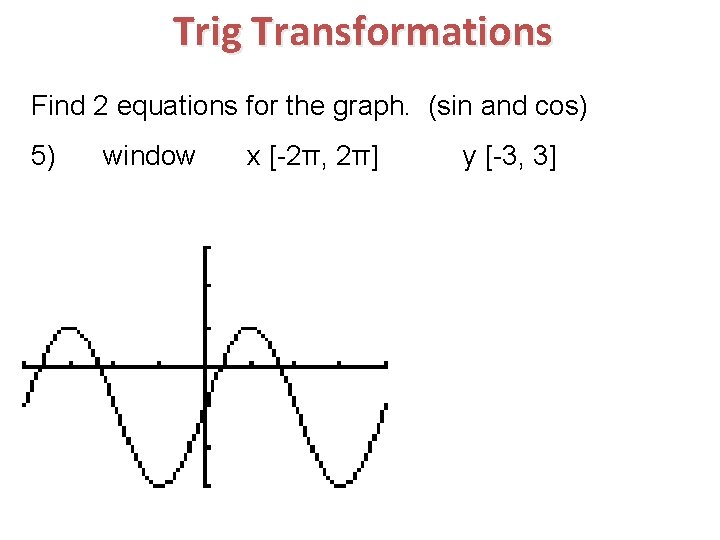
Trig Transformations Find 2 equations for the graph. (sin and cos) 5) window x [-2π, 2π] y [-3, 3]
Calculating the ebb and flow of tides One particular July 4 th in Galveston, TX, high tide occurred at 9: 36 AM. At that time the water at the end of the 61 st Street Pier was 2. 7 meters deep. Low tide occurred at 3: 48 PM, at which time the water was only 2. 1 meters deep. Assume that the depth of the water is a sinusoidal function of time with a period of half a lunar day (about 12 hours and 24 minutes). a) At what time on the 4 th of July did the first low tide occur? b) What was the approximate depth of the water at 6 AM and at 3 PM that day? c) What was the first time on July 4 th when the water was 2. 4 meters deep?
Blood Pressure • The function P(t) = 120 + 30 sin(2πt) models the blood pressure (in millimeters of mercury) for a person who has a (high) blood pressure of 150/90; t represents seconds. a) What is the period of this function? b) How many heartbeats are there each minute? c) Graph this function to model a 10 -sec time interval.
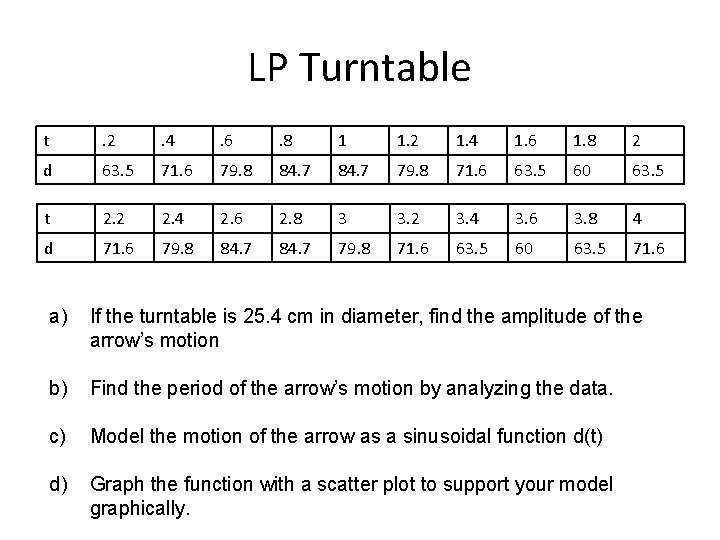
LP Turntable • A suction-cup-tipped arrow is secured vertically to the outer edge of a turntable designed for playing LP phonograph records (ask your parents). A motion detector is situated 60 cm away. The turntable is switched on and a motion detector measures the distance to the arrow as it revolves around the turntable. The table on the next slide shows the distance d as a function of time during the first 4 seconds.
LP Turntable t . 2 . 4 . 6 . 8 1 1. 2 1. 4 1. 6 1. 8 2 d 63. 5 71. 6 79. 8 84. 7 79. 8 71. 6 63. 5 60 63. 5 t 2. 2 2. 4 2. 6 2. 8 3 3. 2 3. 4 3. 6 3. 8 4 d 71. 6 79. 8 84. 7 79. 8 71. 6 63. 5 60 63. 5 71. 6 a) If the turntable is 25. 4 cm in diameter, find the amplitude of the arrow’s motion b) Find the period of the arrow’s motion by analyzing the data. c) Model the motion of the arrow as a sinusoidal function d(t) d) Graph the function with a scatter plot to support your model graphically.