
Lesson 2 2 Stopping Braking and Backing Apparatus
Lesson 2 -2: Stopping, Braking and Backing Apparatus
Student Performance Objective • After completing this lesson, the student shall be able to identify safety considerations when stopping, braking and backing an emergency vehicle. In addition, students will be able to demonstrate skills in safely operating and driving an apparatus. FIRE 130 -PPT-2 -2 -1
Overview • Stopping and Braking Apparatus • Backing Apparatus • Communicating while backing Apparatus FIRE 130 -PPT-2 -2 -2
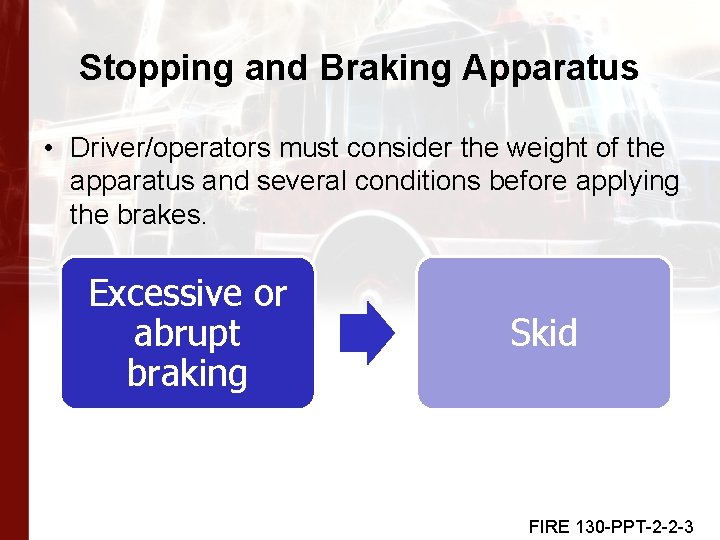
Stopping and Braking Apparatus • Driver/operators must consider the weight of the apparatus and several conditions before applying the brakes. Excessive or abrupt braking Skid FIRE 130 -PPT-2 -2 -3
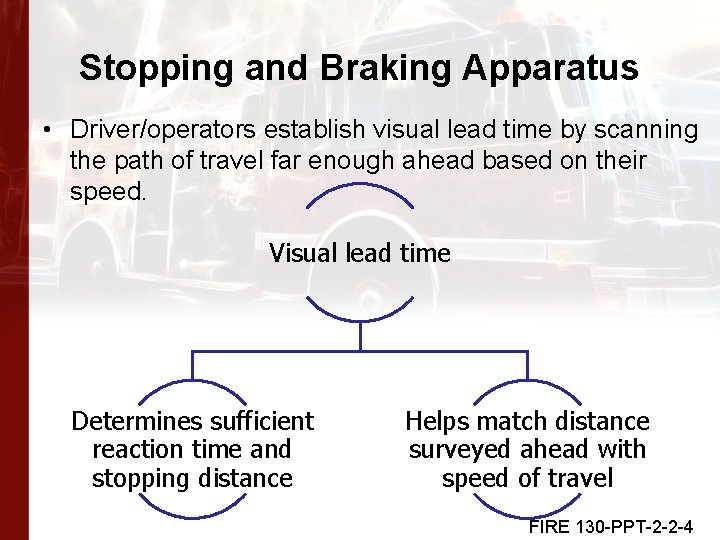
Stopping and Braking Apparatus • Driver/operators establish visual lead time by scanning the path of travel far enough ahead based on their speed. Visual lead time Determines sufficient reaction time and stopping distance Helps match distance surveyed ahead with speed of travel FIRE 130 -PPT-2 -2 -4
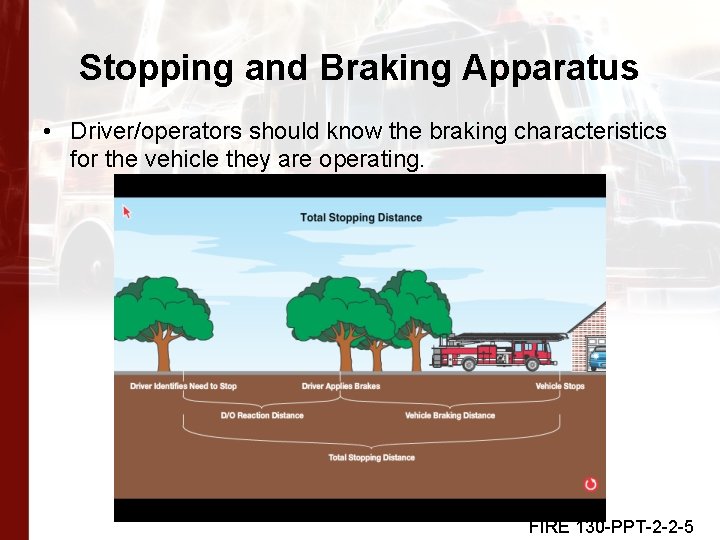
Stopping and Braking Apparatus • Driver/operators should know the braking characteristics for the vehicle they are operating. FIRE 130 -PPT-2 -2 -5
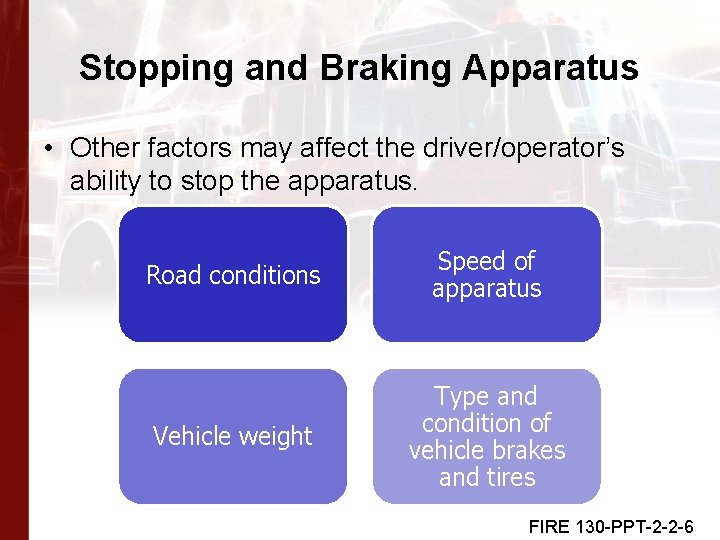
Stopping and Braking Apparatus • Other factors may affect the driver/operator’s ability to stop the apparatus. Road conditions Speed of apparatus Vehicle weight Type and condition of vehicle brakes and tires FIRE 130 -PPT-2 -2 -6
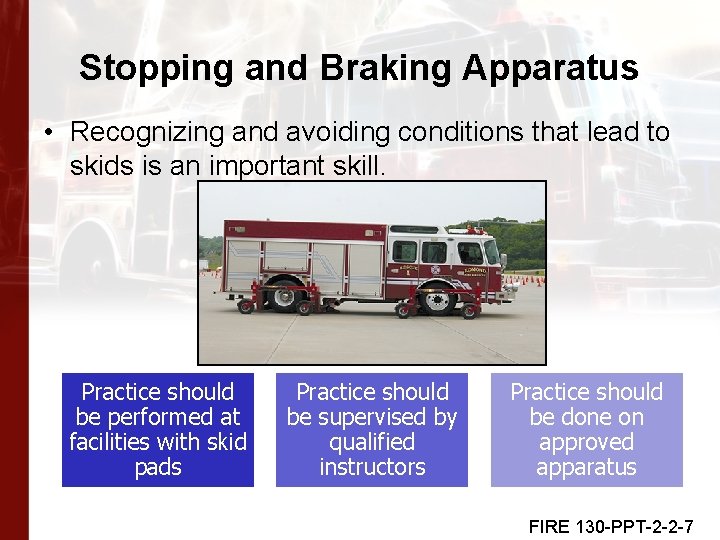
Stopping and Braking Apparatus • Recognizing and avoiding conditions that lead to skids is an important skill. Practice should be performed at facilities with skid pads Practice should be supervised by qualified instructors Practice should be done on approved apparatus FIRE 130 -PPT-2 -2 -7
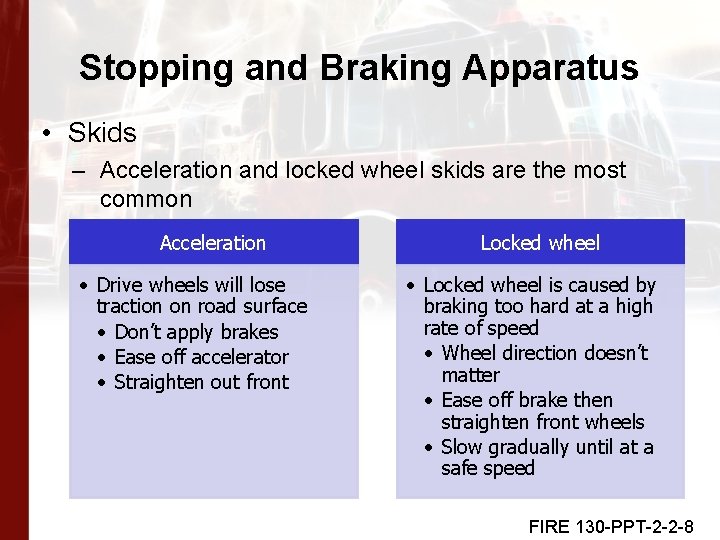
Stopping and Braking Apparatus • Skids – Acceleration and locked wheel skids are the most common Acceleration • Drive wheels will lose traction on road surface • Don’t apply brakes • Ease off accelerator • Straighten out front Locked wheel • Locked wheel is caused by braking too hard at a high rate of speed • Wheel direction doesn’t matter • Ease off brake then straighten front wheels • Slow gradually until at a safe speed FIRE 130 -PPT-2 -2 -8
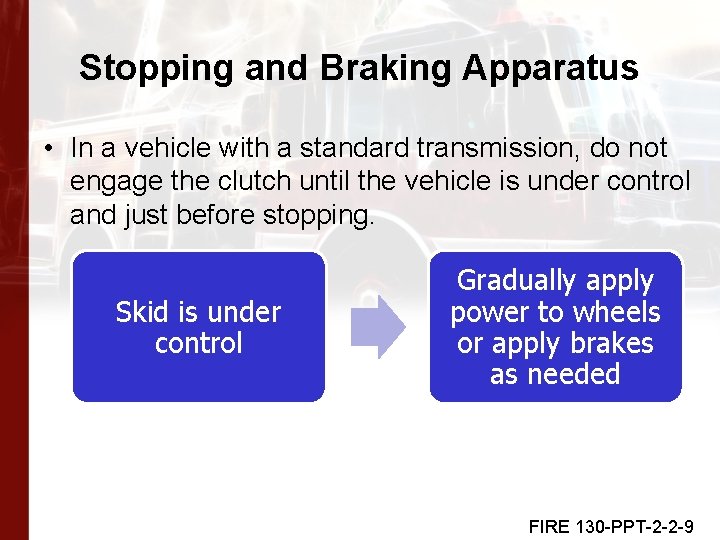
Stopping and Braking Apparatus • In a vehicle with a standard transmission, do not engage the clutch until the vehicle is under control and just before stopping. Skid is under control Gradually apply power to wheels or apply brakes as needed FIRE 130 -PPT-2 -2 -9
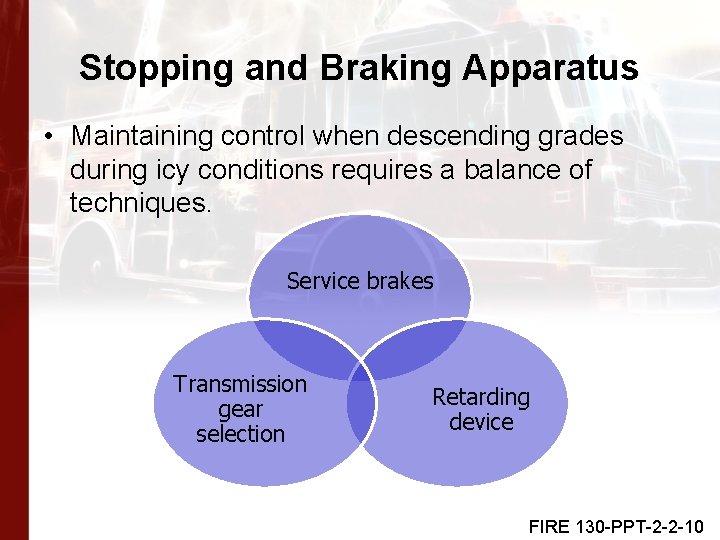
Stopping and Braking Apparatus • Maintaining control when descending grades during icy conditions requires a balance of techniques. Service brakes Transmission gear selection Retarding device FIRE 130 -PPT-2 -2 -10
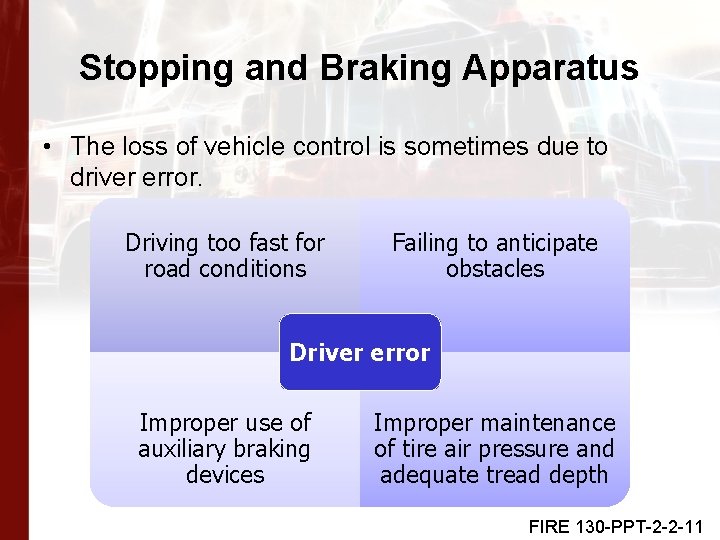
Stopping and Braking Apparatus • The loss of vehicle control is sometimes due to driver error. Driving too fast for road conditions Failing to anticipate obstacles Driver error Improper use of auxiliary braking devices Improper maintenance of tire air pressure and adequate tread depth FIRE 130 -PPT-2 -2 -11
Stopping and Braking Apparatus • Most new apparatus are equipped with an allwheel ABS. Minimize chance of skid when brakes are applied forcefully Maintain steady pressure on brake rather than pumping pedal Realize that some apparatus automatically shut off auxiliary brake if ABS activates Recognize that apparatus without ABS require auxiliary brake to be manually deactivated FIRE 130 -PPT-2 -2 -12
Stopping and Braking Apparatus • Auxiliary braking systems help reduce brake fade and service maintenance costs. Exhaust brakes Engine compression brakes Electromagnetic retarders Transmission retarders FIRE 130 -PPT-2 -2 -13
Stopping and Braking Apparatus • Driver/operators should be aware of traction features on apparatus and trained how to use them. Auxiliary traction control systems ATC DCDL Interaxle differential lock FIRE 130 -PPT-2 -2 -14
Stopping and Braking Apparatus • Stability control systems are designed to help prevent roll-overs or tipping. Roll Stability Control Electronic Stability Control Reduces vehicle instabilities • Electronic Stability control cannot prevent all instabilities from occurring • Driver/Operator should always use safe driving techniques FIRE 130 -PPT-2 -2 -15
Backing Apparatus • Backing fire apparatus can be a hazardous action because of the vehicle’s size and because the mirrors do not provide a full view around the apparatus FIRE 130 -PPT-2 -2 -16
Backing Apparatus • Driver/operators should always follow SOPs and local ordinances when backing vehicles. Safety guidelines should always be followed All apparatus should be equipped with a warning alarm Some apparatus may be equipped with backup cameras Use all means at your disposal to safely back apparatus FIRE 130 -PPT-2 -2 -17
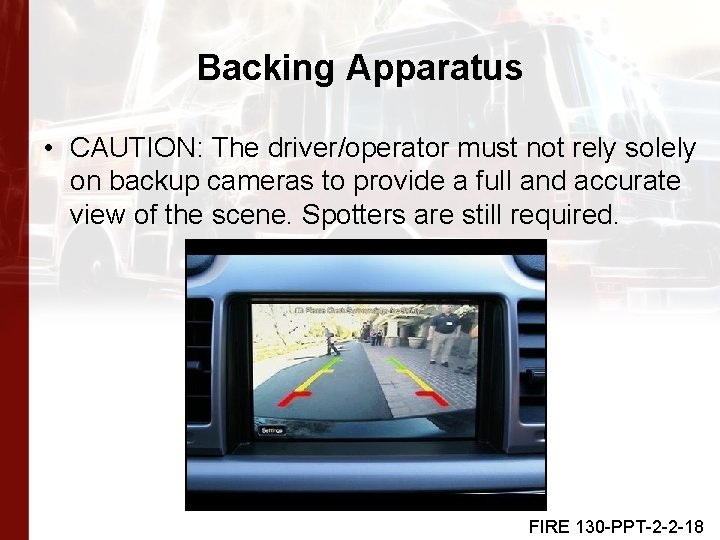
Backing Apparatus • CAUTION: The driver/operator must not rely solely on backup cameras to provide a full and accurate view of the scene. Spotters are still required. FIRE 130 -PPT-2 -2 -18
Backing Communication • Communication between the driver and backer (spotter) is important to avoid accidents and personal injury. Radio or hand signals Spotters • • Use Reflective vests Deploy an Appropriate number Keep in sight at all times Stop backing when spotters deem situation unsafe FIRE 130 -PPT-2 -2 -19
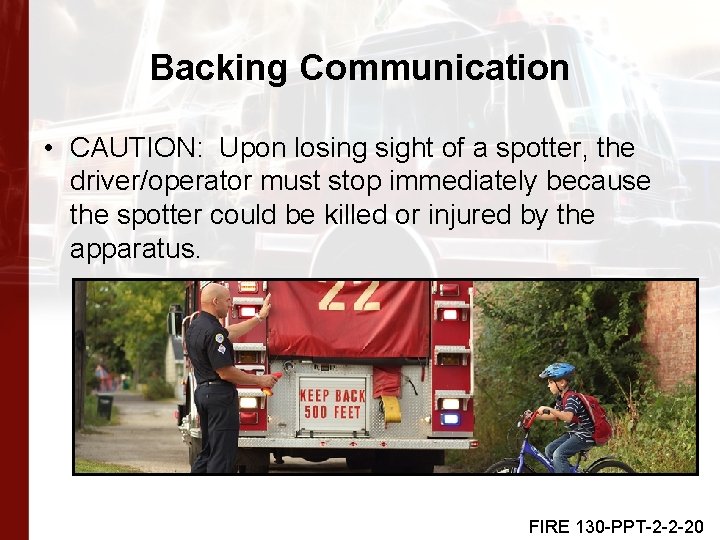
Backing Communication • CAUTION: Upon losing sight of a spotter, the driver/operator must stop immediately because the spotter could be killed or injured by the apparatus. FIRE 130 -PPT-2 -2 -20
Backing Communication • Spotters should always be positioned in the vision of the driver/operator. The spotter should Remain visible in the driver’s side mirror Remain visible in the right side mirror if hazards are present Remain in the same mirror once position has been established Keep away from shadows or glare spots Request additional spotters if necessary FIRE 130 -PPT-2 -2 -21
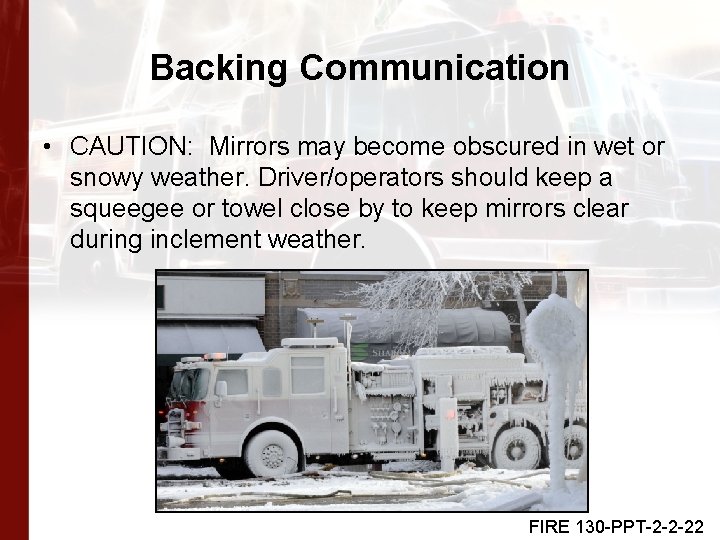
Backing Communication • CAUTION: Mirrors may become obscured in wet or snowy weather. Driver/operators should keep a squeegee or towel close by to keep mirrors clear during inclement weather. FIRE 130 -PPT-2 -2 -22
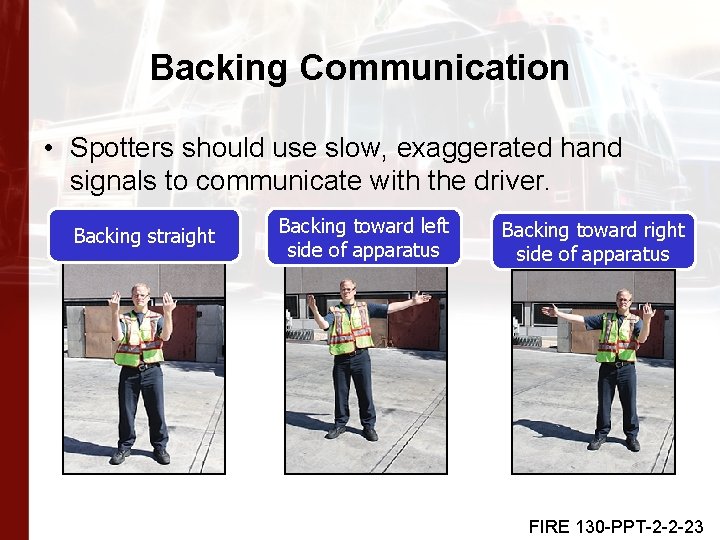
Backing Communication • Spotters should use slow, exaggerated hand signals to communicate with the driver. Backing straight Backing toward left side of apparatus Backing toward right side of apparatus FIRE 130 -PPT-2 -2 -23
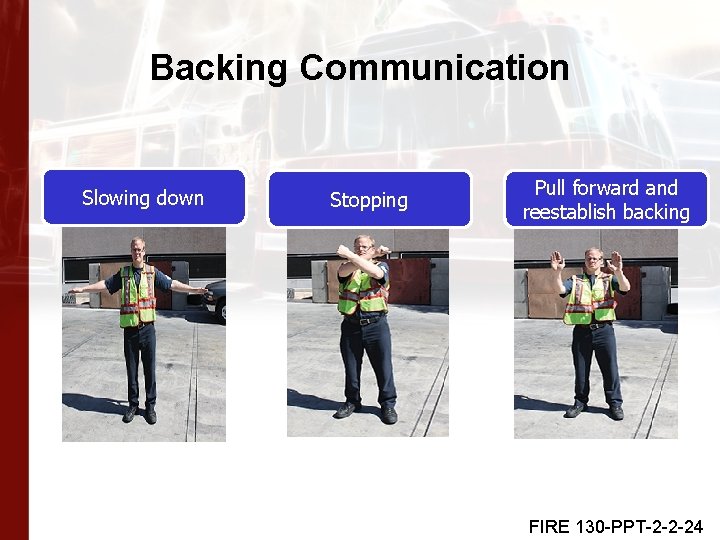
Backing Communication Slowing down Stopping Pull forward and reestablish backing FIRE 130 -PPT-2 -2 -24
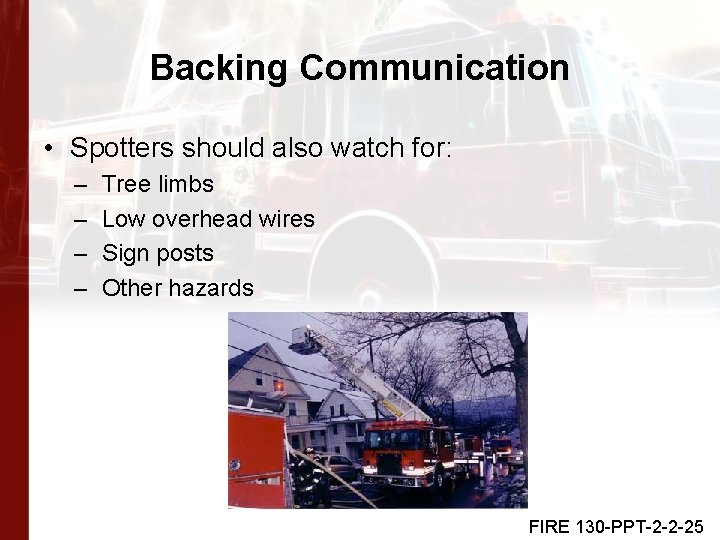
Backing Communication • Spotters should also watch for: – – Tree limbs Low overhead wires Sign posts Other hazards FIRE 130 -PPT-2 -2 -25
Student Performance Objective • After completing this lesson, the student shall be able to identify safety considerations when stopping, braking and backing an emergency vehicle. In addition, students will be able to demonstrate skills in safely operating and driving an apparatus. FIRE 130 -PPT-2 -2 -26
Review • Stopping and Braking Apparatus • Backing Apparatus • Communicating while backing Apparatus FIRE 130 -PPT-2 -2 -27
- Slides: 28