
Lesson 2 1 Use Inductive Reasoning Describe how
Lesson 2. 1 Use Inductive Reasoning
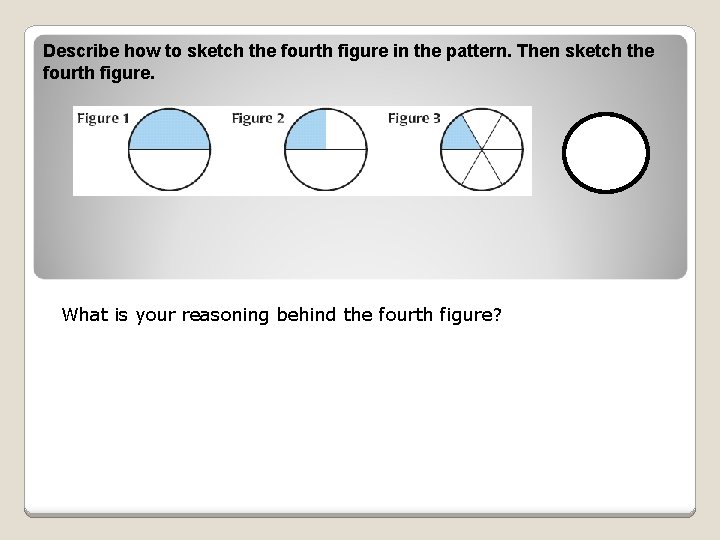
Describe how to sketch the fourth figure in the pattern. Then sketch the fourth figure. What is your reasoning behind the fourth figure?
�Describe the pattern in the numbers -7, -21, -63, -189, . . . And write the next three numbers in the pattern.
Inductive Reasoning �Making a unproven statement about something by observation is called a conjecture. �Conjectures are made using inductive reasoning. You recognize a pattern based on specific cases. �It may not be true for all cases.


Test a Conjecture � Numbers such as 3, 4, and 5 are called consecutive integers. Make and test a conjecture about the sum of any three consecutive integers. Step 1: Try a few sums. Conjecture: Step 2: Test the conjecture with other numbers.
� Recall, conjectures are based on multiple observations. Whenever we are able to find an instance in which the conjecture is false, the entire conjecture is untrue. This false example is referred to as a counterexample.
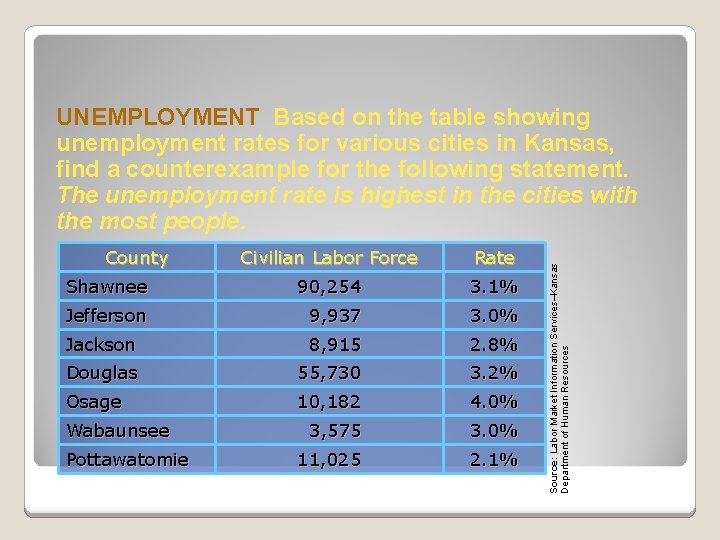
County Civilian Labor Force Rate Shawnee 90, 254 3. 1% Jefferson 9, 937 3. 0% Jackson 8, 915 2. 8% Douglas 55, 730 3. 2% Osage 10, 182 4. 0% 3, 575 3. 0% 11, 025 2. 1% Wabaunsee Pottawatomie Source: Labor Market Information Services–Kansas Department of Human Resources UNEMPLOYMENT Based on the table showing unemployment rates for various cities in Kansas, find a counterexample for the following statement. The unemployment rate is highest in the cities with the most people.

Counterexample: A specific case for which a conjecture is false. �Example: The sum of two numbers is always greater than the larger number.
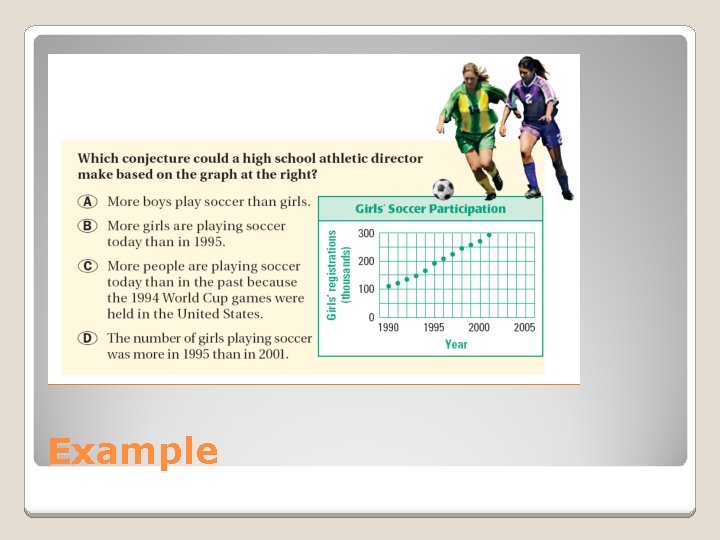
Example
More Examples �Find a counterexample: The value of x² is always greater than the value of x. �Supplementary adjacent. angels are always
�How do you use inductive reasoning in mathematics?
- Slides: 13