
Lesson 2 1 Inductive Reasoning and Conjecture Lesson
- Slides: 77
Lesson 2 -1 Inductive Reasoning and Conjecture Lesson 2 -2 Logic Lesson 2 -3 Conditional Statements Lesson 2 -4 Deductive Reasoning Lesson 2 -5 Postulates and Paragraph Proofs Lesson 2 -6 Algebraic Proof Lesson 2 -7 Proving Segment Relationships Lesson 2 -8 Proving Angle Relationships
Example 1 Patterns and Conjecture Example 2 Geometric Conjecture Example 3 Find a Counterexample
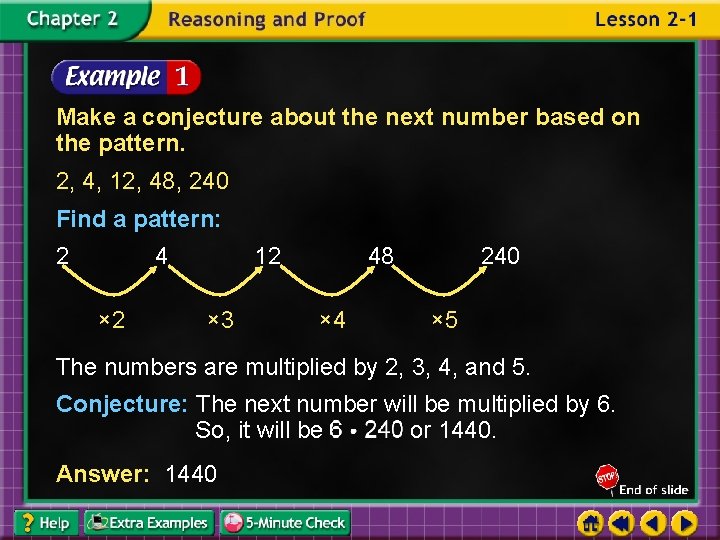
Make a conjecture about the next number based on the pattern. 2, 4, 12, 48, 240 Find a pattern: 2 4 × 2 12 × 3 48 × 4 240 × 5 The numbers are multiplied by 2, 3, 4, and 5. Conjecture: The next number will be multiplied by 6. So, it will be or 1440. Answer: 1440
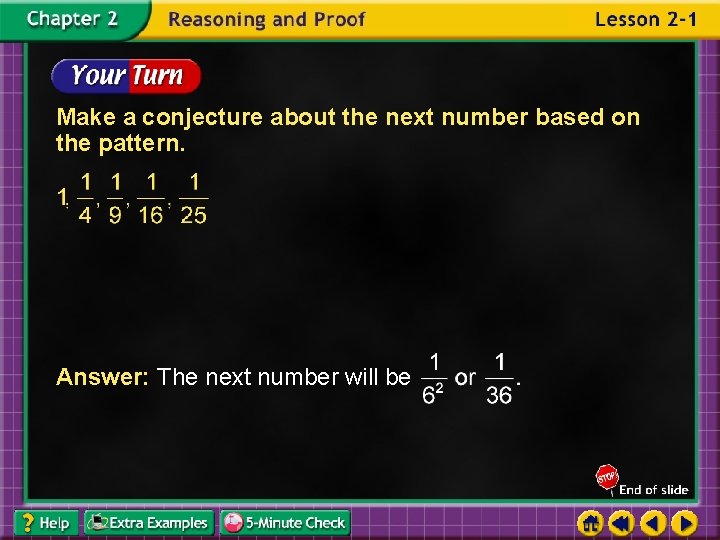
Make a conjecture about the next number based on the pattern. Answer: The next number will be
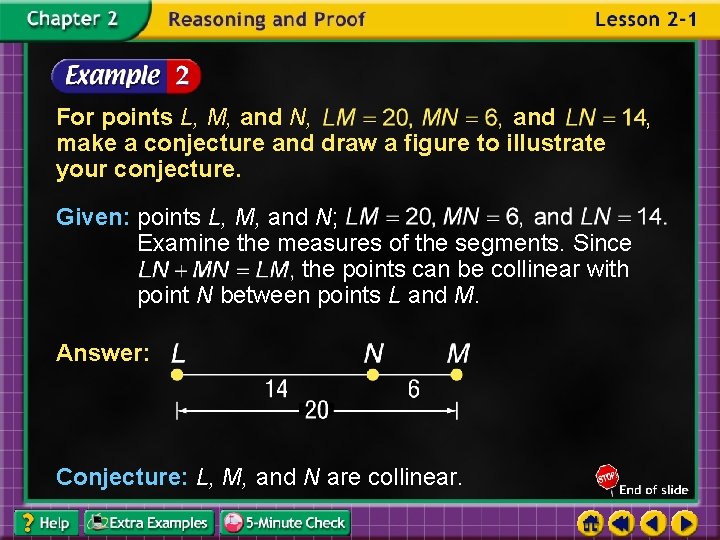
For points L, M, and N, and make a conjecture and draw a figure to illustrate your conjecture. Given: points L, M, and N; Examine the measures of the segments. Since the points can be collinear with point N between points L and M. Answer: Conjecture: L, M, and N are collinear. ,
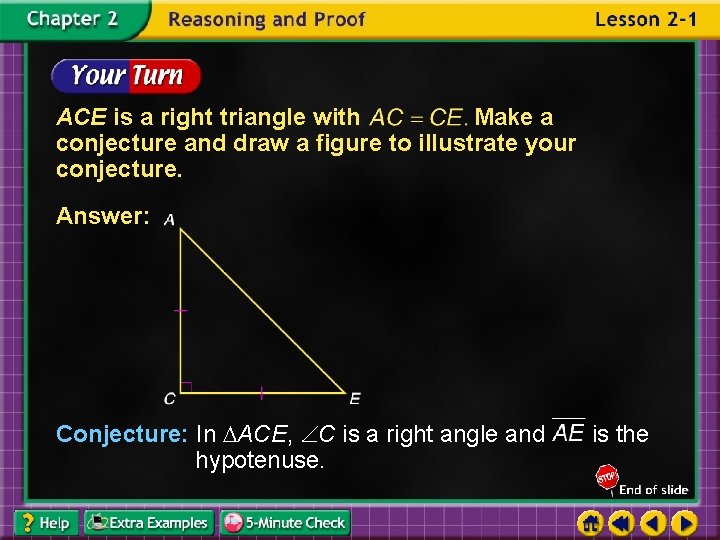
ACE is a right triangle with Make a conjecture and draw a figure to illustrate your conjecture. Answer: Conjecture: In ACE, C is a right angle and hypotenuse. is the
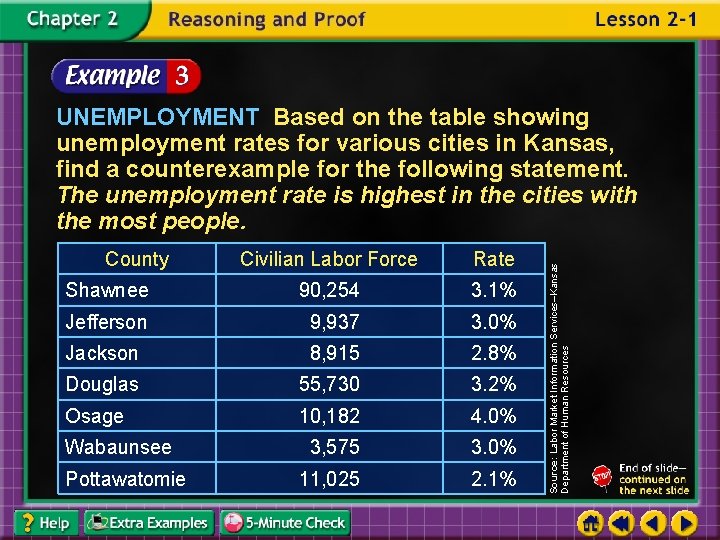
County Civilian Labor Force Rate Shawnee 90, 254 3. 1% Jefferson 9, 937 3. 0% Jackson 8, 915 2. 8% Douglas 55, 730 3. 2% Osage 10, 182 4. 0% 3, 575 3. 0% 11, 025 2. 1% Wabaunsee Pottawatomie Source: Labor Market Information Services–Kansas Department of Human Resources UNEMPLOYMENT Based on the table showing unemployment rates for various cities in Kansas, find a counterexample for the following statement. The unemployment rate is highest in the cities with the most people.
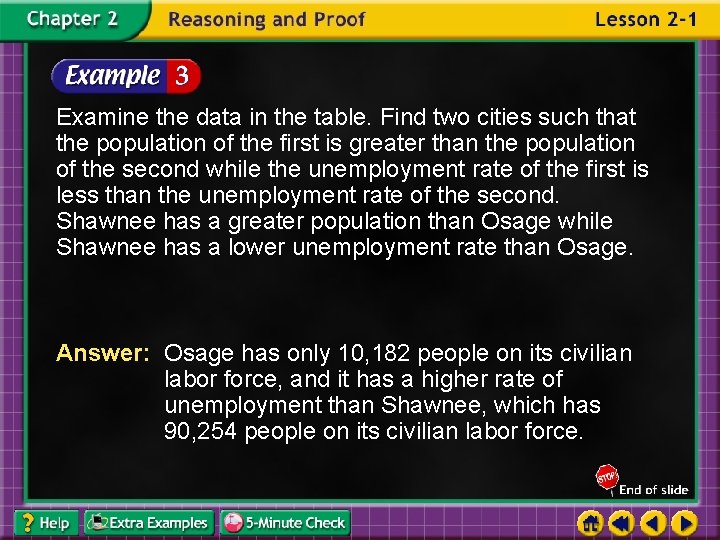
Examine the data in the table. Find two cities such that the population of the first is greater than the population of the second while the unemployment rate of the first is less than the unemployment rate of the second. Shawnee has a greater population than Osage while Shawnee has a lower unemployment rate than Osage. Answer: Osage has only 10, 182 people on its civilian labor force, and it has a higher rate of unemployment than Shawnee, which has 90, 254 people on its civilian labor force.
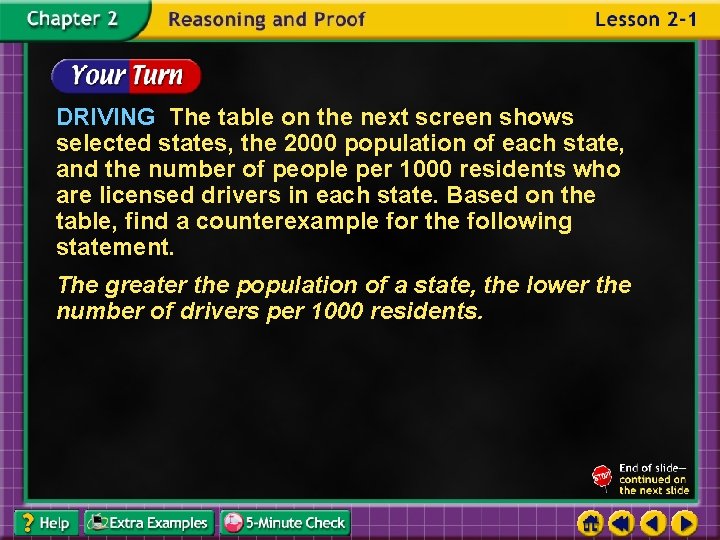
DRIVING The table on the next screen shows selected states, the 2000 population of each state, and the number of people per 1000 residents who are licensed drivers in each state. Based on the table, find a counterexample for the following statement. The greater the population of a state, the lower the number of drivers per 1000 residents.
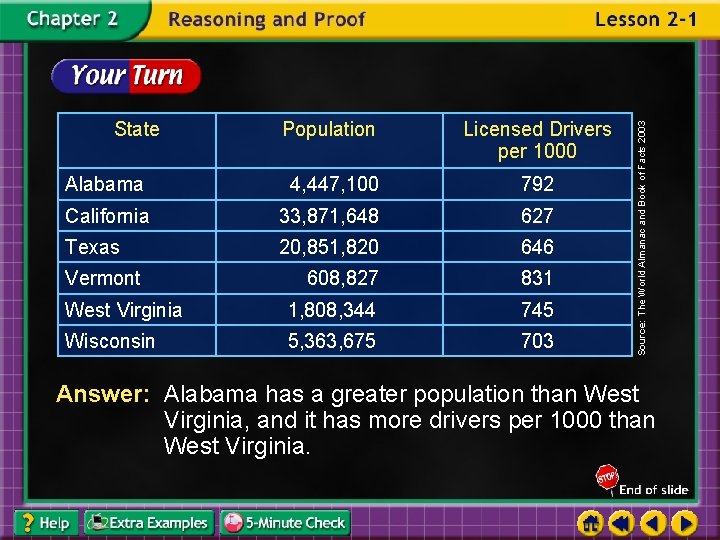
Population Licensed Drivers per 1000 Alabama 4, 447, 100 792 California 33, 871, 648 627 Texas 20, 851, 820 646 608, 827 831 West Virginia 1, 808, 344 745 Wisconsin 5, 363, 675 703 Vermont Source: The World Almanac and Book of Facts 2003 State Answer: Alabama has a greater population than West Virginia, and it has more drivers per 1000 than West Virginia.
Example 1 Truth Values of Conjunctions Example 2 Truth Values of Disjunctions Example 3 Use Venn Diagrams Example 4 Construct Truth Tables
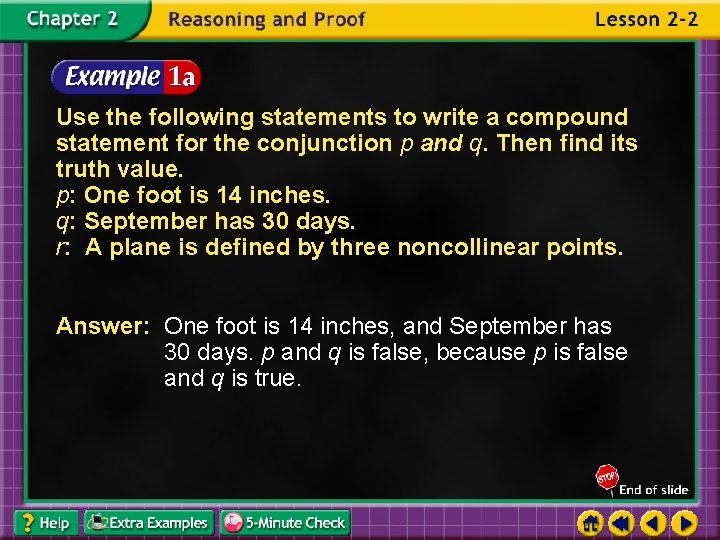
Use the following statements to write a compound statement for the conjunction p and q. Then find its truth value. p: One foot is 14 inches. q: September has 30 days. r: A plane is defined by three noncollinear points. Answer: One foot is 14 inches, and September has 30 days. p and q is false, because p is false and q is true.
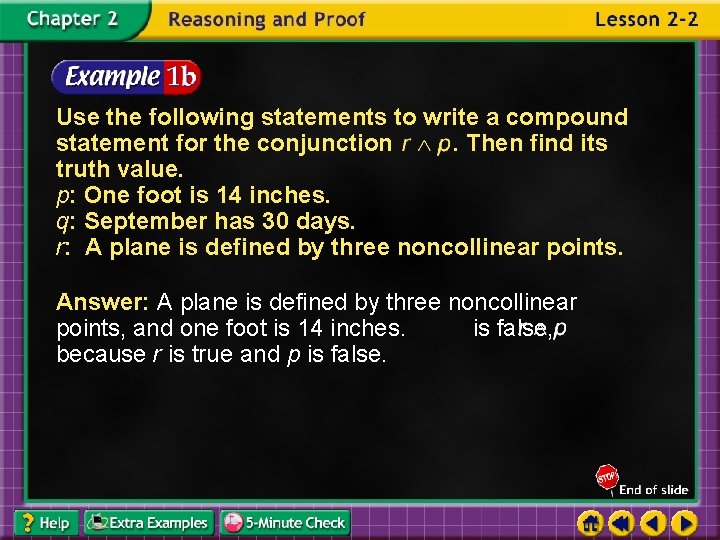
Use the following statements to write a compound statement for the conjunction. Then find its truth value. p: One foot is 14 inches. q: September has 30 days. r: A plane is defined by three noncollinear points. Answer: A plane is defined by three noncollinear points, and one foot is 14 inches. is false, because r is true and p is false.
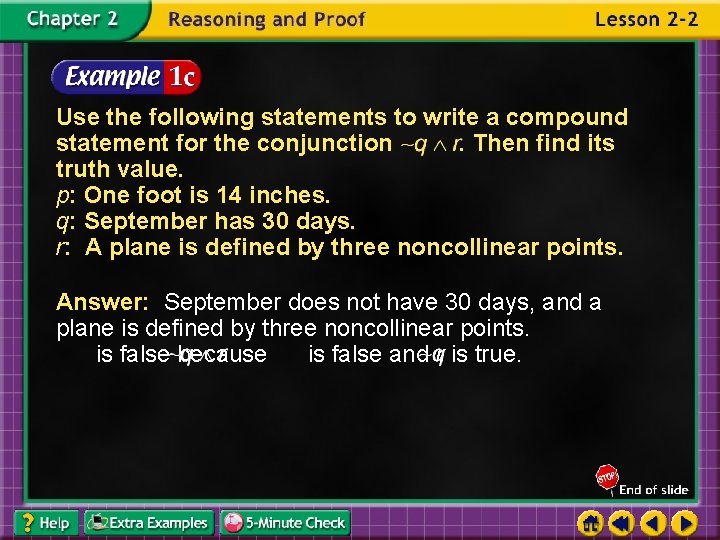
Use the following statements to write a compound statement for the conjunction. Then find its truth value. p: One foot is 14 inches. q: September has 30 days. r: A plane is defined by three noncollinear points. Answer: September does not have 30 days, and a plane is defined by three noncollinear points. is false because is false and r is true.
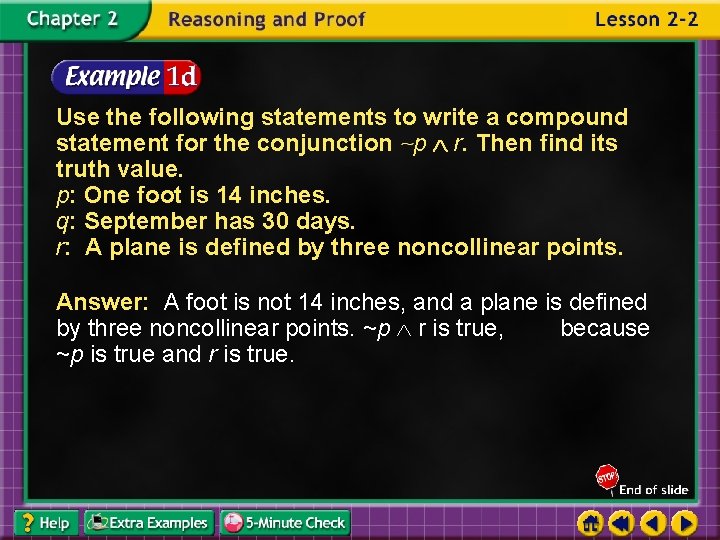
Use the following statements to write a compound statement for the conjunction p r. Then find its truth value. p: One foot is 14 inches. q: September has 30 days. r: A plane is defined by three noncollinear points. Answer: A foot is not 14 inches, and a plane is defined by three noncollinear points. ~p r is true, because ~p is true and r is true.
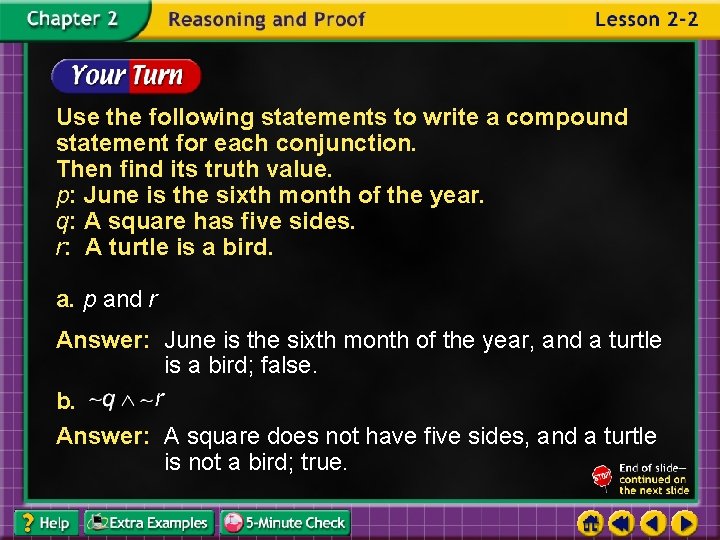
Use the following statements to write a compound statement for each conjunction. Then find its truth value. p: June is the sixth month of the year. q: A square has five sides. r: A turtle is a bird. a. p and r Answer: June is the sixth month of the year, and a turtle is a bird; false. b. Answer: A square does not have five sides, and a turtle is not a bird; true.
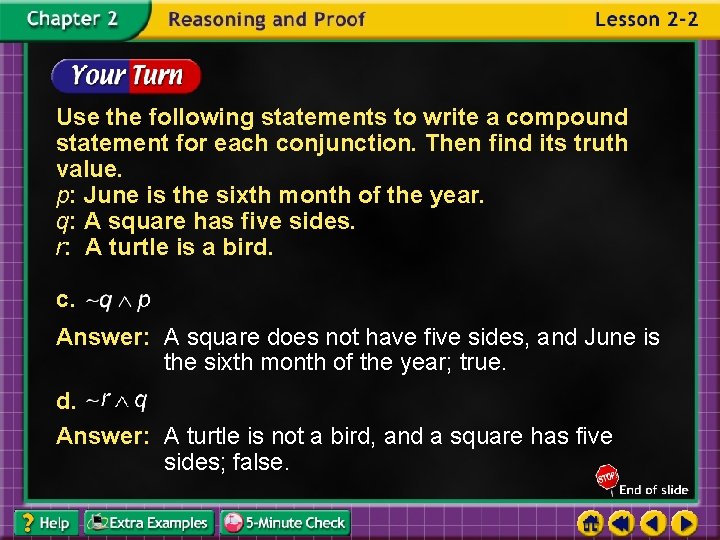
Use the following statements to write a compound statement for each conjunction. Then find its truth value. p: June is the sixth month of the year. q: A square has five sides. r: A turtle is a bird. c. Answer: A square does not have five sides, and June is the sixth month of the year; true. d. Answer: A turtle is not a bird, and a square has five sides; false.
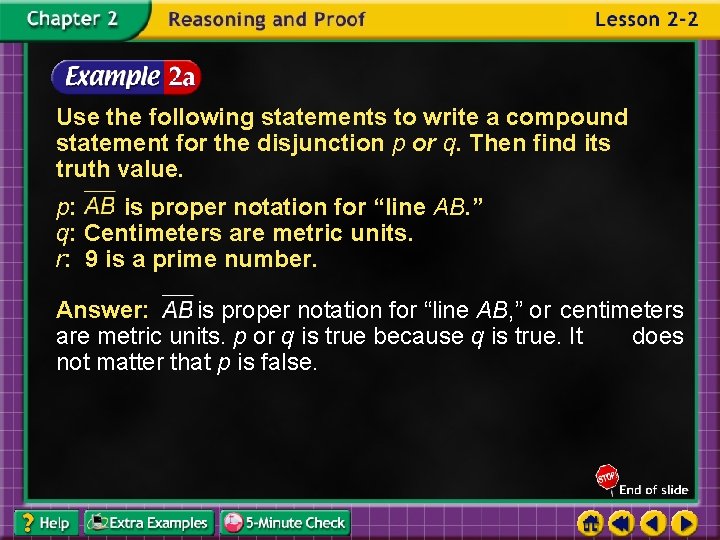
Use the following statements to write a compound statement for the disjunction p or q. Then find its truth value. p: is proper notation for “line AB. ” q: Centimeters are metric units. r: 9 is a prime number. Answer: is proper notation for “line AB, ” or centimeters are metric units. p or q is true because q is true. It does not matter that p is false.
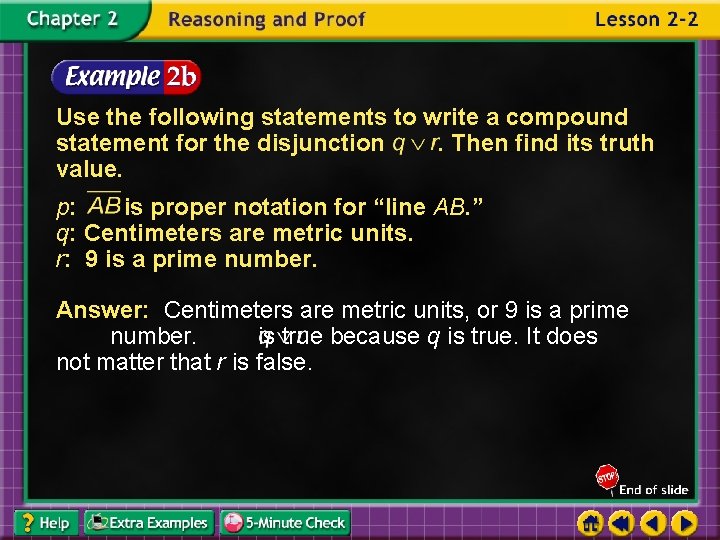
Use the following statements to write a compound statement for the disjunction. Then find its truth value. p: is proper notation for “line AB. ” q: Centimeters are metric units. r: 9 is a prime number. Answer: Centimeters are metric units, or 9 is a prime number. is true because q is true. It does not matter that r is false.
Use the following statements to write a compound statement for each disjunction. Then find its truth value. p: 6 is an even number. q: A cow has 12 legs r: A triangle has 3 sides. a. p or r Answer: 6 is an even number, or a triangle as 3 sides; true. b. Answer: A cow does not have 12 legs, or a triangle does not have 3 sides; true.
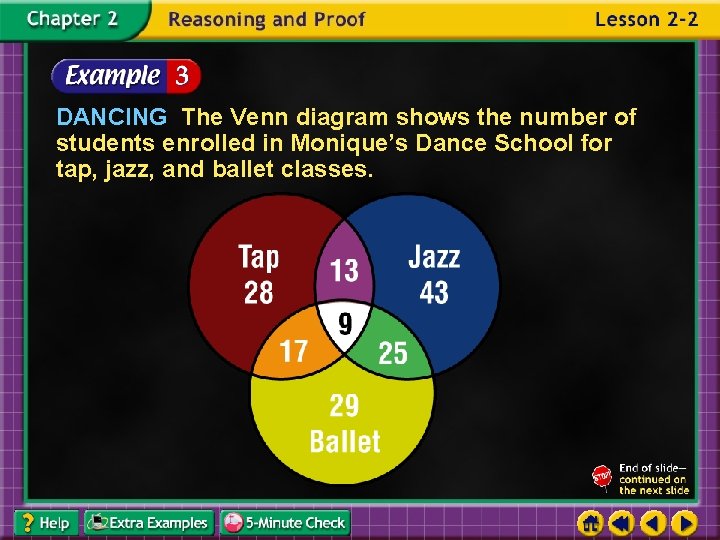
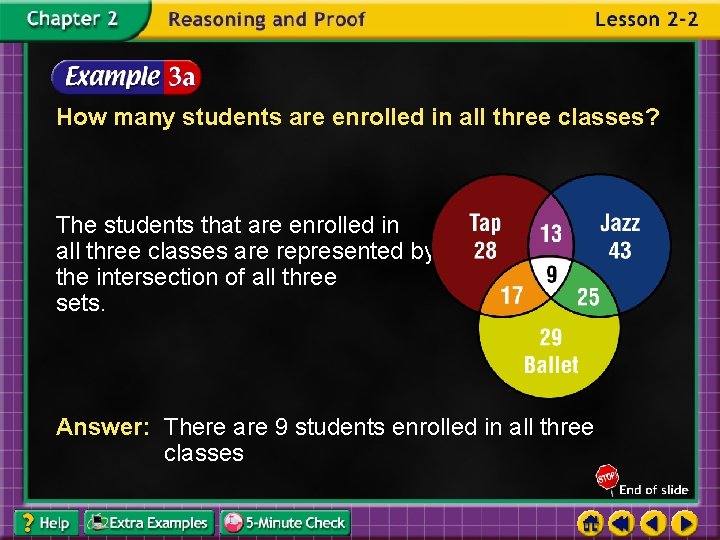
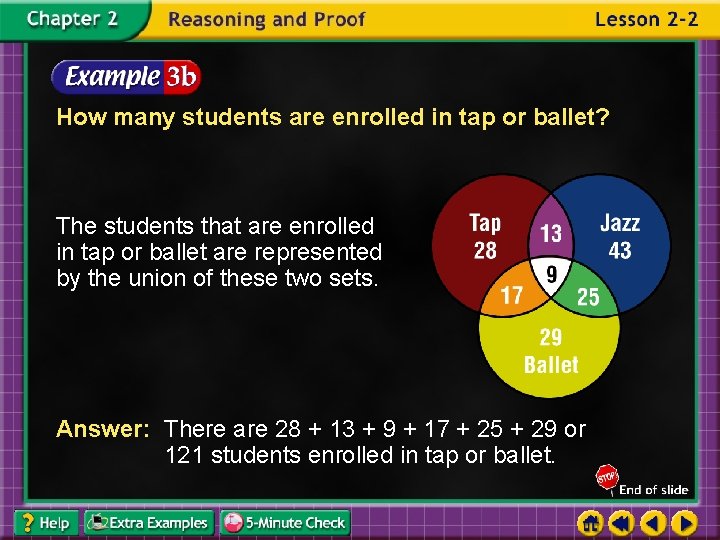
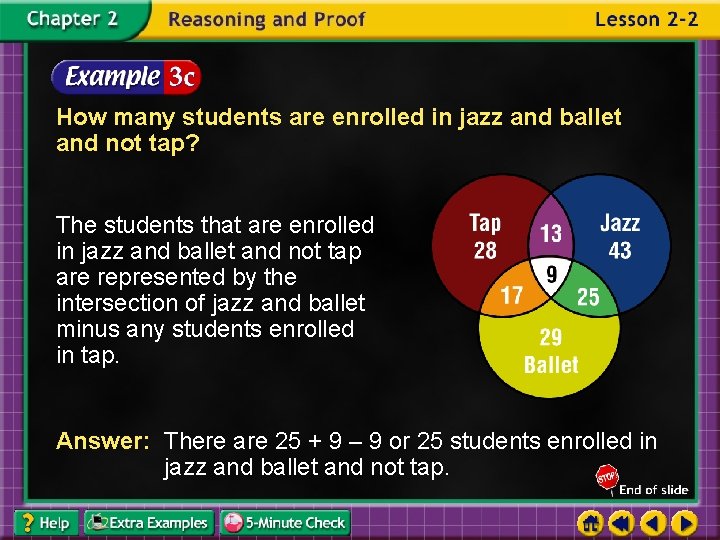
DANCING The Venn diagram shows the number of students enrolled in Monique’s Dance School for tap, jazz, and ballet classes.
How many students are enrolled in all three classes? The students that are enrolled in all three classes are represented by the intersection of all three sets. Answer: There are 9 students enrolled in all three classes
How many students are enrolled in tap or ballet? The students that are enrolled in tap or ballet are represented by the union of these two sets. Answer: There are 28 + 13 + 9 + 17 + 25 + 29 or 121 students enrolled in tap or ballet.
How many students are enrolled in jazz and ballet and not tap? The students that are enrolled in jazz and ballet and not tap are represented by the intersection of jazz and ballet minus any students enrolled in tap. Answer: There are 25 + 9 – 9 or 25 students enrolled in jazz and ballet and not tap.
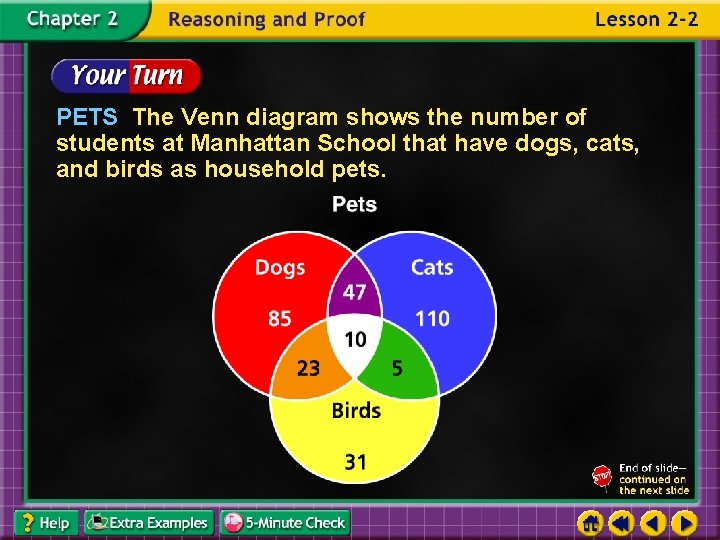
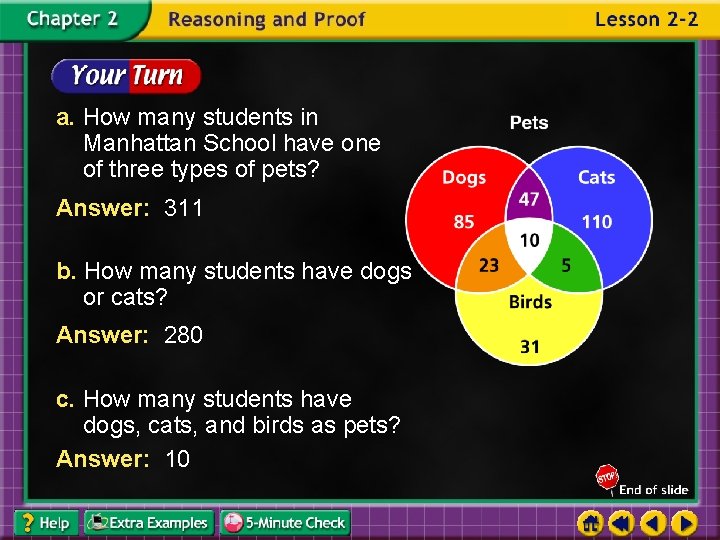
PETS The Venn diagram shows the number of students at Manhattan School that have dogs, cats, and birds as household pets.
a. How many students in Manhattan School have one of three types of pets? Answer: 311 b. How many students have dogs or cats? Answer: 280 c. How many students have dogs, cats, and birds as pets? Answer: 10
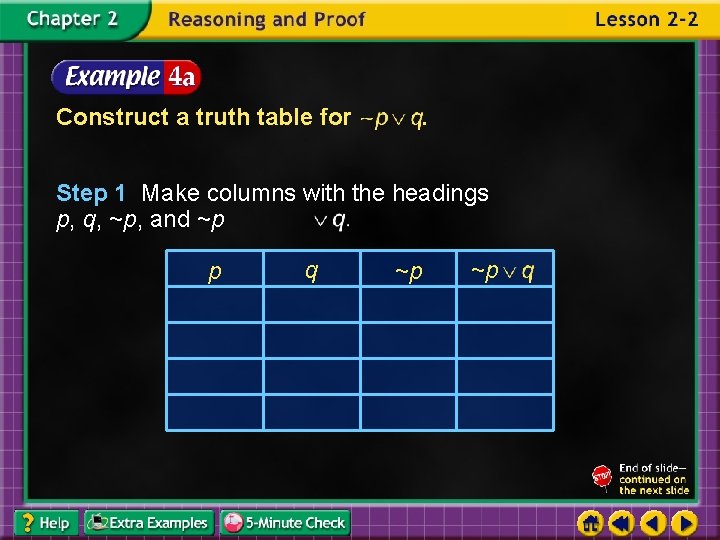
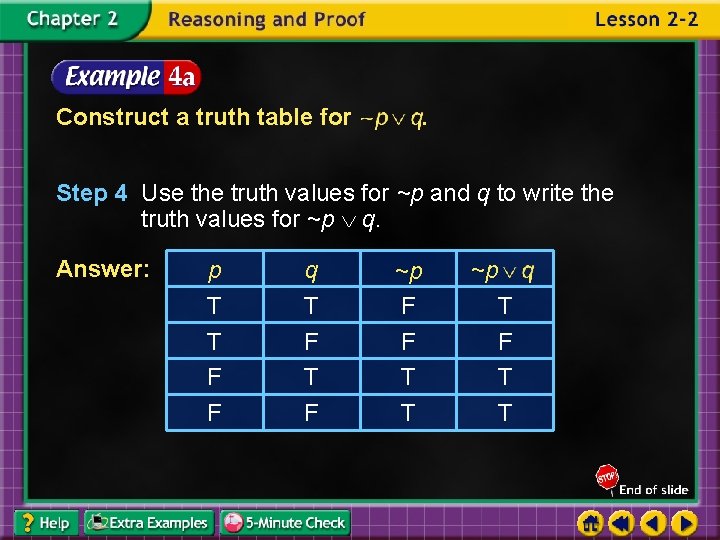
Construct a truth table for . Step 1 Make columns with the headings p, q, ~p, and ~p p q ~p ~p
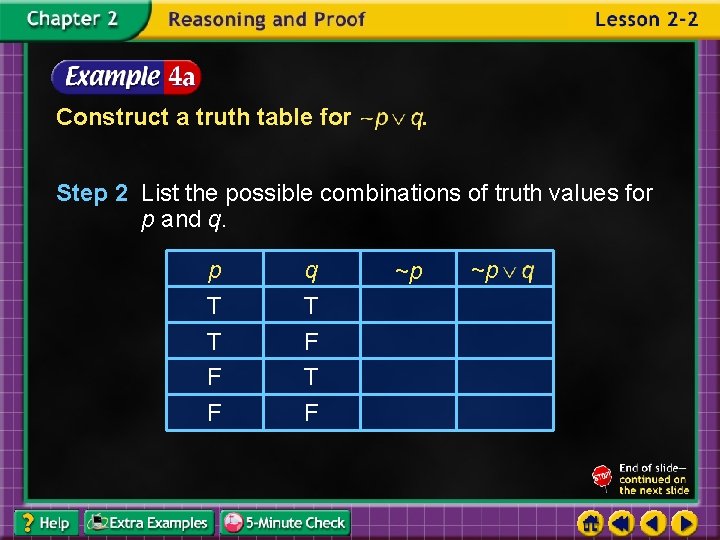
Construct a truth table for . Step 2 List the possible combinations of truth values for p and q. p T T F F q T F ~p ~p
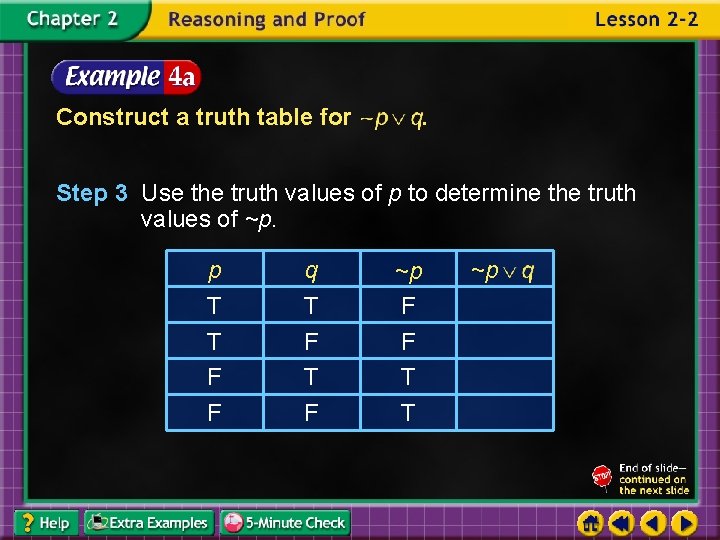
Construct a truth table for . Step 3 Use the truth values of p to determine the truth values of ~p. p T T F F q T F ~p F F T T ~p
Construct a truth table for . Step 4 Use the truth values for ~p and q to write the truth values for ~p q. Answer: p T T F F q T F ~p F F T T ~p T F T T
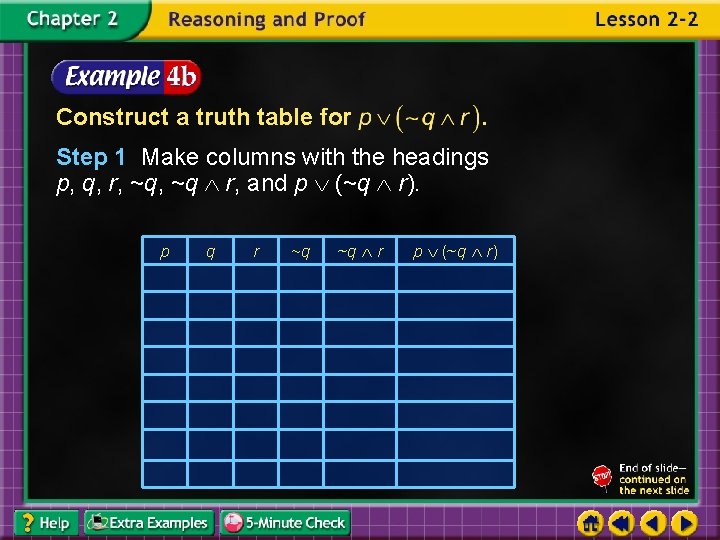
Construct a truth table for . Step 1 Make columns with the headings p, q, r, ~q r, and p (~q r). p q r ~q ~q r p (~q r)
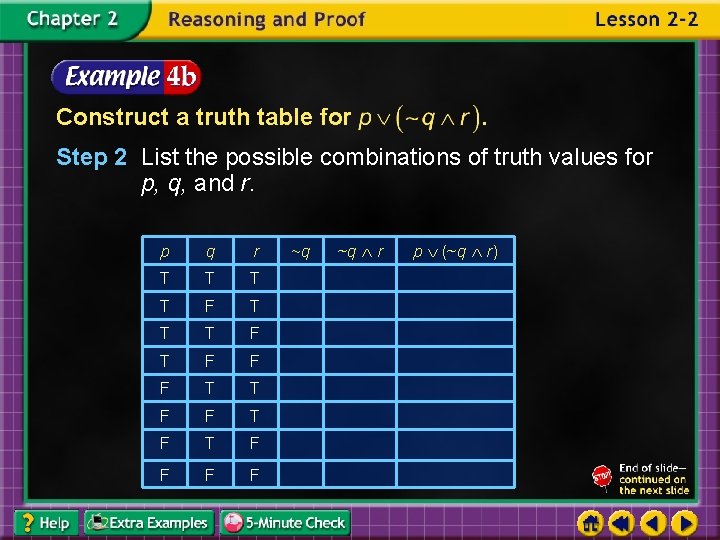
Construct a truth table for . Step 2 List the possible combinations of truth values for p, q, and r. p q r T T F T T T F F F T T F F ~q ~q r p (~q r)
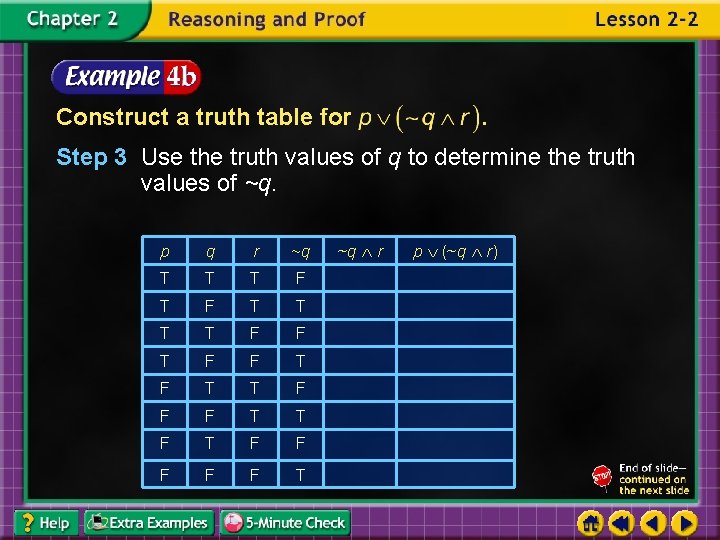
Construct a truth table for . Step 3 Use the truth values of q to determine the truth values of ~q. p q r ~q T T T F F T F T T F F F T ~q r p (~q r)
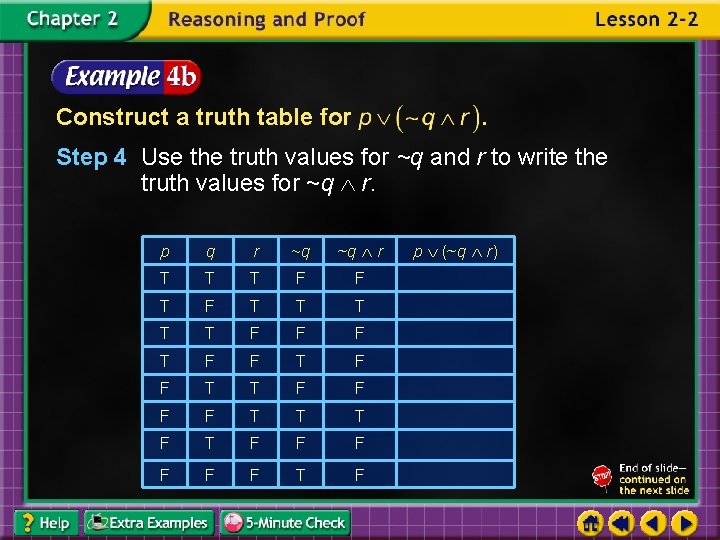
Construct a truth table for . Step 4 Use the truth values for ~q and r to write the truth values for ~q r. p q r ~q ~q r T T T F F F T F F T T T F F F F T F p (~q r)
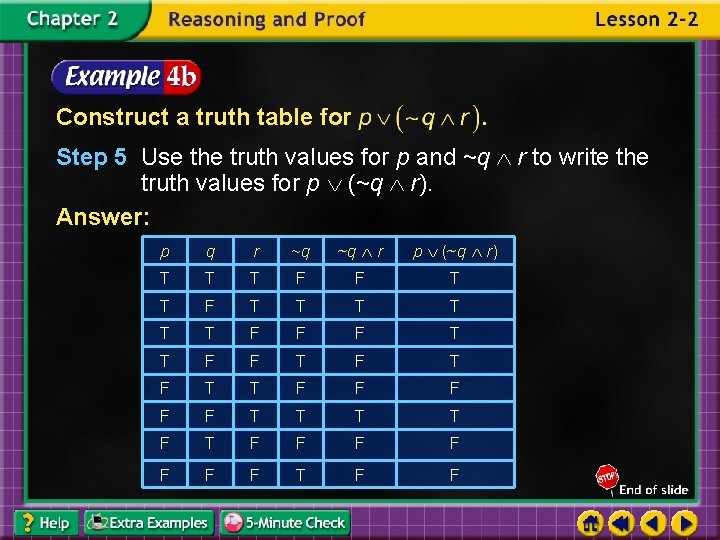
Construct a truth table for . Step 5 Use the truth values for p and ~q r to write the truth values for p (~q r). Answer: p q r ~q ~q r p (~q r) T T T F F T T T T F F F T T F F T F T T F F F T T F T F F F F T F F
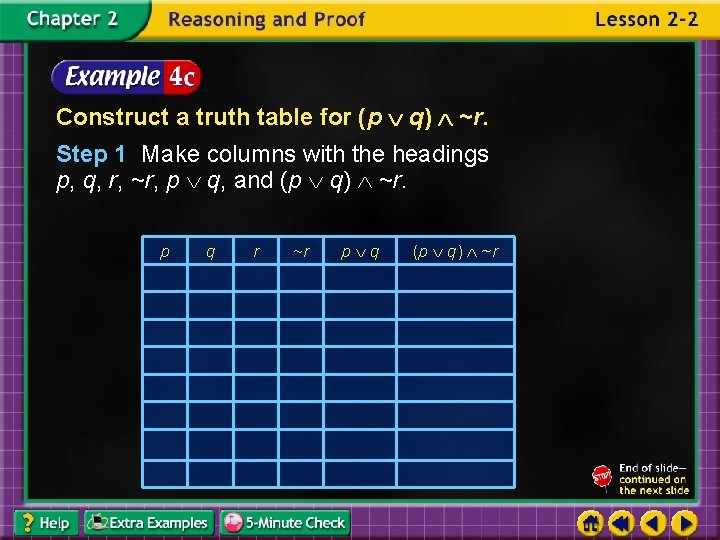
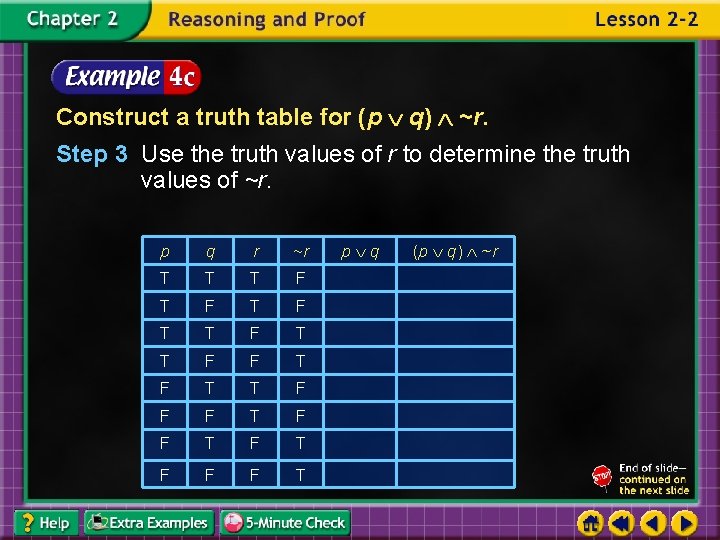
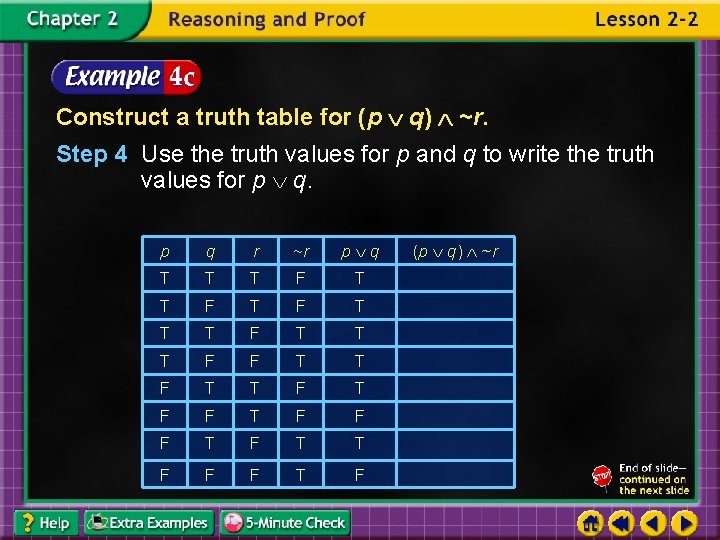
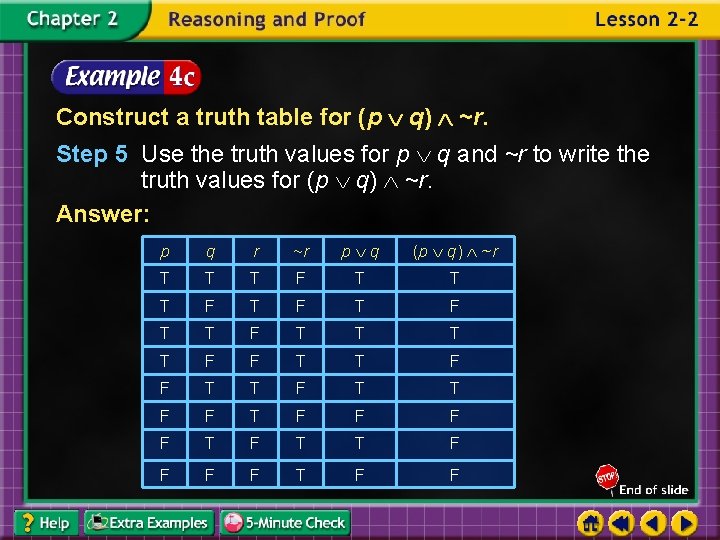
Construct a truth table for (p q) ~r. Step 1 Make columns with the headings p, q, r, ~r, p q, and (p q) ~r. p q r ~r p q (p q) ~r
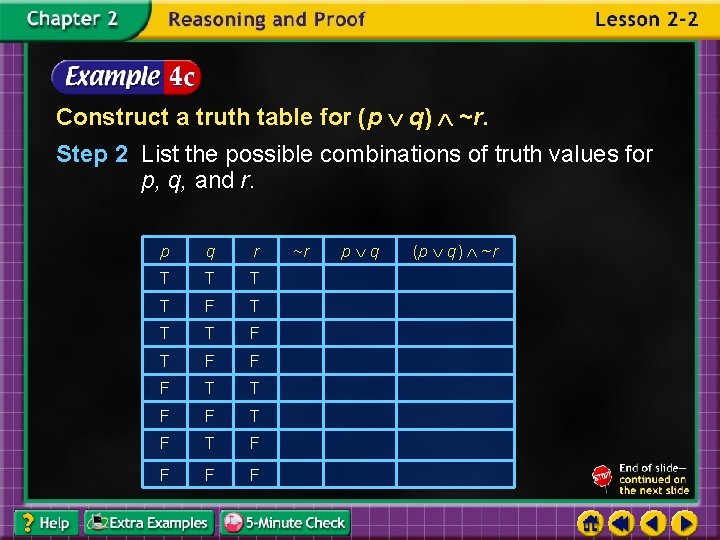
Construct a truth table for (p q) ~r. Step 2 List the possible combinations of truth values for p, q, and r. p q r T T F T T T F F F T T F F ~r p q (p q) ~r
Construct a truth table for (p q) ~r. Step 3 Use the truth values of r to determine the truth values of ~r. p q r ~r T T T F T F T T F F F T F T F F F T p q (p q) ~r
Construct a truth table for (p q) ~r. Step 4 Use the truth values for p and q to write the truth values for p q. p q r ~r p q T T T F T F T T T F F T T F T F F F T F (p q) ~r
Construct a truth table for (p q) ~r. Step 5 Use the truth values for p q and ~r to write the truth values for (p q) ~r. Answer: p q r ~r p q (p q) ~r T T T F T F T T F F T T F F F F T T F F
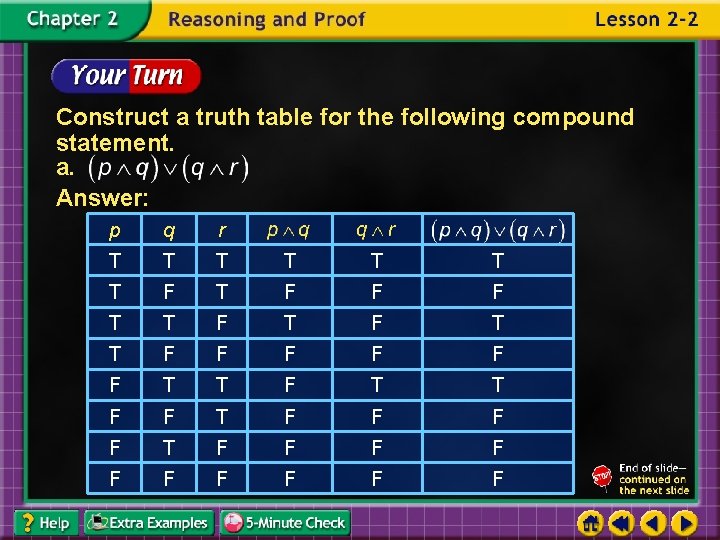
Construct a truth table for the following compound statement. a. Answer: p q r T T T T F F F T T F F T F F F F
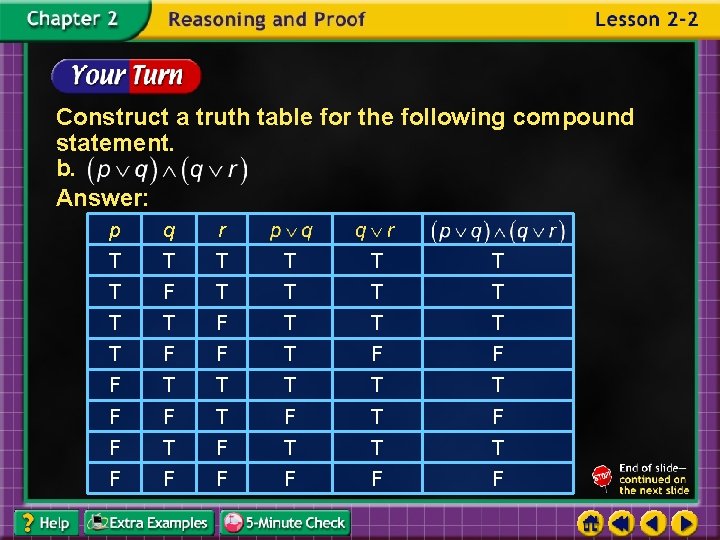
Construct a truth table for the following compound statement. b. Answer: p q r T T T T F T T F F F T T T F F T F T T T F F F
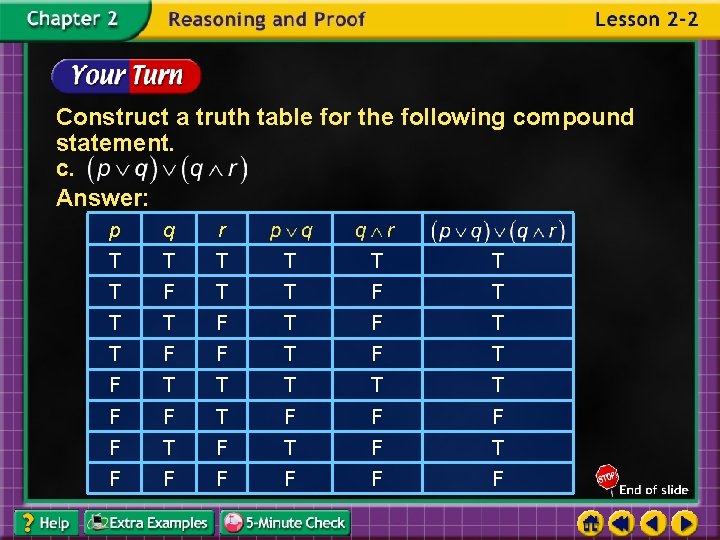
Construct a truth table for the following compound statement. c. Answer: p q r T T T T F T T F F T F T T T F F F F T F T F F F
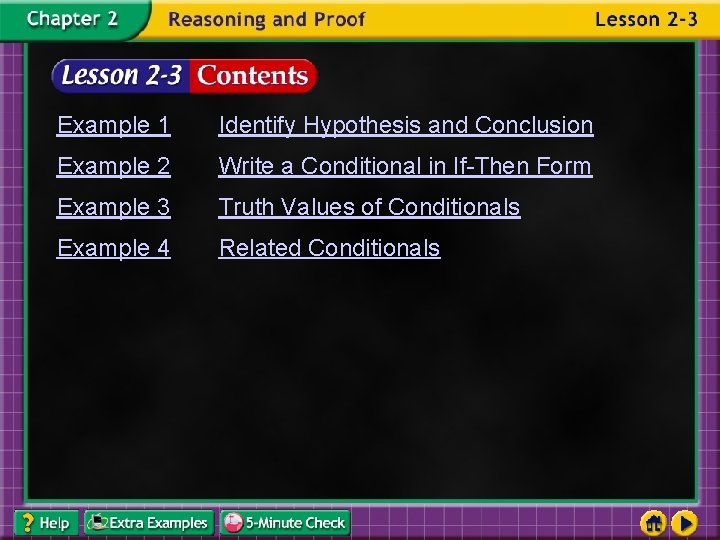
Example 1 Identify Hypothesis and Conclusion Example 2 Write a Conditional in If-Then Form Example 3 Truth Values of Conditionals Example 4 Related Conditionals
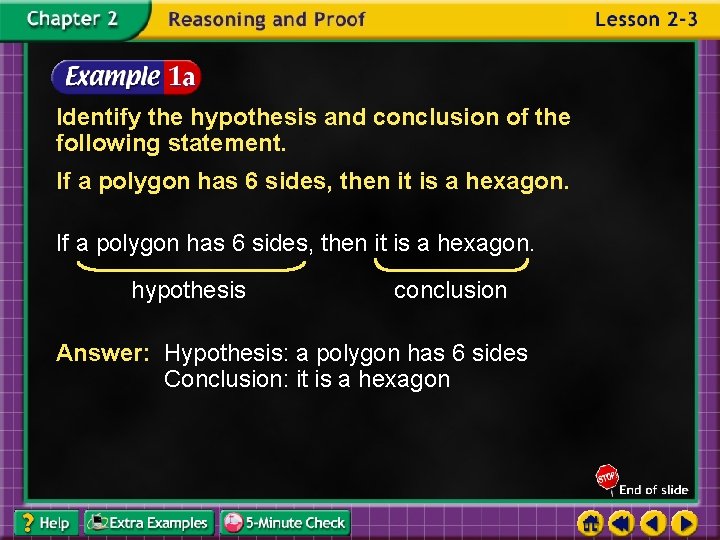
Identify the hypothesis and conclusion of the following statement. If a polygon has 6 sides, then it is a hexagon. hypothesis conclusion Answer: Hypothesis: a polygon has 6 sides Conclusion: it is a hexagon
Identify the hypothesis and conclusion of the following statement. Tamika will advance to the next level of play if she completes the maze in her computer game. Answer: Hypothesis: Tamika completes the maze in her computer game Conclusion: she will advance to the next level of play
Identify the hypothesis and conclusion of each statement. a. If you are a baby, then you will cry. Answer: Hypothesis: you are a baby Conclusion: you will cry b. To find the distance between two points, you can use the Distance Formula. Answer: Hypothesis: you want to find the distance between two points Conclusion: you can use the Distance Formula
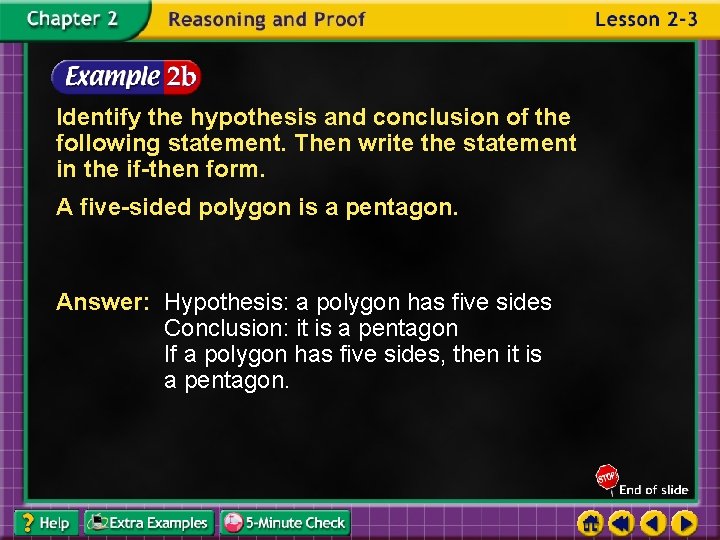
Identify the hypothesis and conclusion of the following statement. Then write the statement in the if-then form. Distance is positive. Sometimes you must add information to a statement. Here you know that distance is measured or determined. Answer: Hypothesis: a distance is determined Conclusion: it is positive If a distance is determined, then it is positive.
Identify the hypothesis and conclusion of the following statement. Then write the statement in the if-then form. A five-sided polygon is a pentagon. Answer: Hypothesis: a polygon has five sides Conclusion: it is a pentagon If a polygon has five sides, then it is a pentagon.
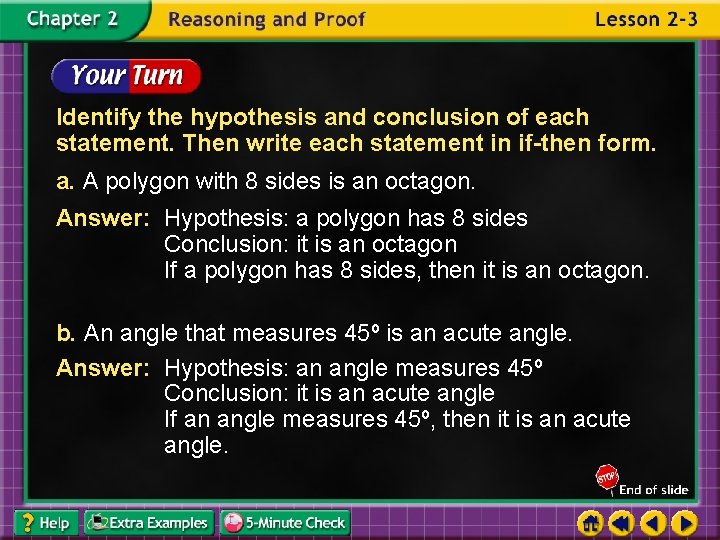
Identify the hypothesis and conclusion of each statement. Then write each statement in if-then form. a. A polygon with 8 sides is an octagon. Answer: Hypothesis: a polygon has 8 sides Conclusion: it is an octagon If a polygon has 8 sides, then it is an octagon. b. An angle that measures 45º is an acute angle. Answer: Hypothesis: an angle measures 45º Conclusion: it is an acute angle If an angle measures 45º, then it is an acute angle.
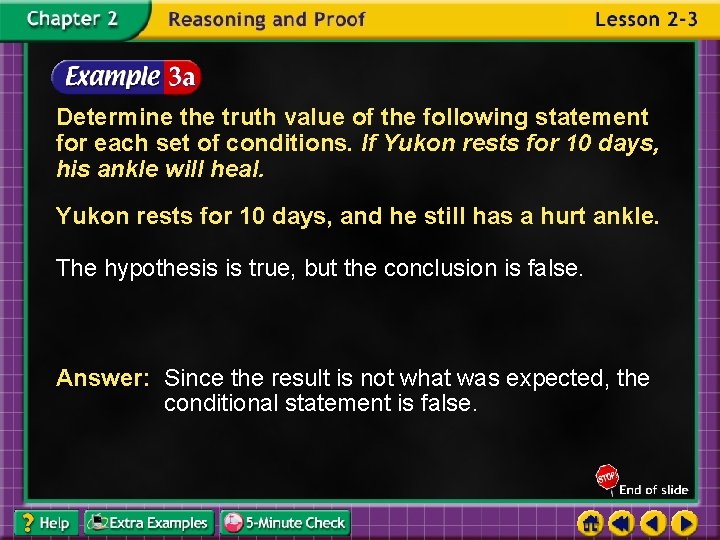
Determine the truth value of the following statement for each set of conditions. If Yukon rests for 10 days, his ankle will heal. Yukon rests for 10 days, and he still has a hurt ankle. The hypothesis is true, but the conclusion is false. Answer: Since the result is not what was expected, the conditional statement is false.
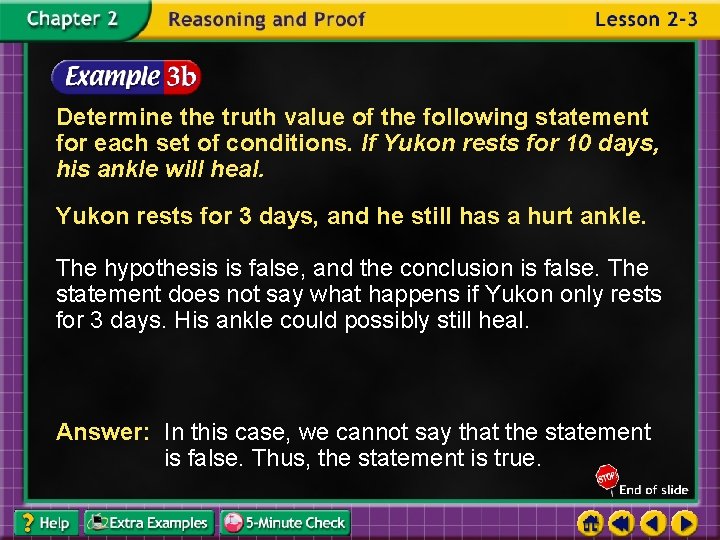
Determine the truth value of the following statement for each set of conditions. If Yukon rests for 10 days, his ankle will heal. Yukon rests for 3 days, and he still has a hurt ankle. The hypothesis is false, and the conclusion is false. The statement does not say what happens if Yukon only rests for 3 days. His ankle could possibly still heal. Answer: In this case, we cannot say that the statement is false. Thus, the statement is true.
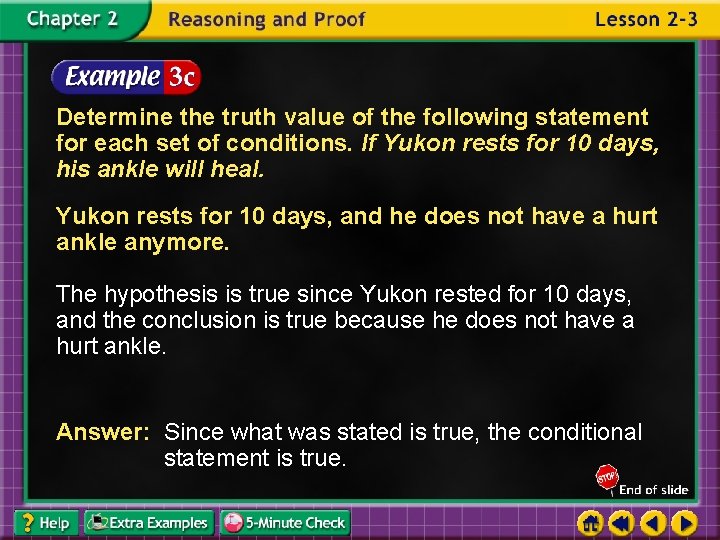
Determine the truth value of the following statement for each set of conditions. If Yukon rests for 10 days, his ankle will heal. Yukon rests for 10 days, and he does not have a hurt ankle anymore. The hypothesis is true since Yukon rested for 10 days, and the conclusion is true because he does not have a hurt ankle. Answer: Since what was stated is true, the conditional statement is true.
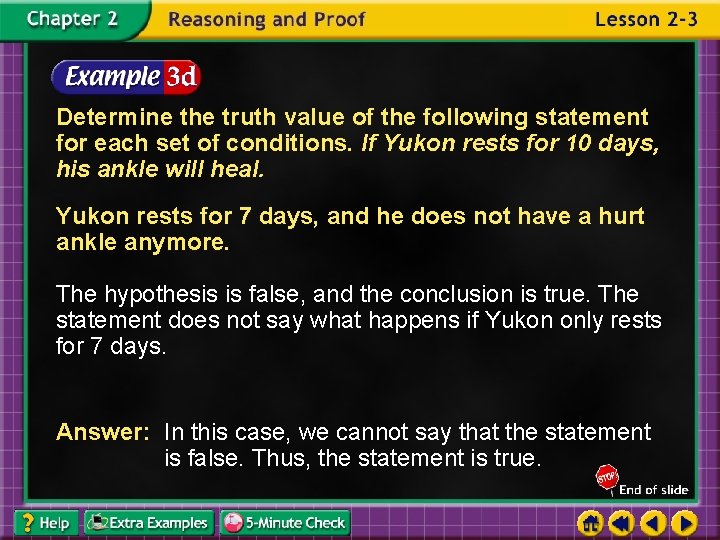
Determine the truth value of the following statement for each set of conditions. If Yukon rests for 10 days, his ankle will heal. Yukon rests for 7 days, and he does not have a hurt ankle anymore. The hypothesis is false, and the conclusion is true. The statement does not say what happens if Yukon only rests for 7 days. Answer: In this case, we cannot say that the statement is false. Thus, the statement is true.
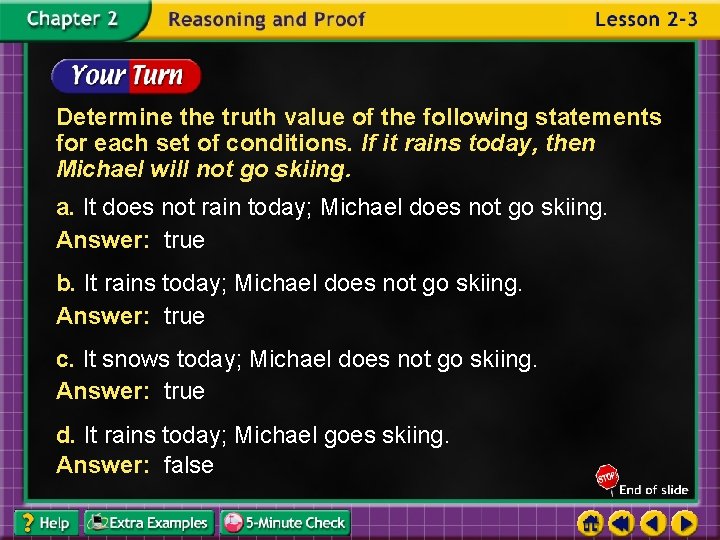
Determine the truth value of the following statements for each set of conditions. If it rains today, then Michael will not go skiing. a. It does not rain today; Michael does not go skiing. Answer: true b. It rains today; Michael does not go skiing. Answer: true c. It snows today; Michael does not go skiing. Answer: true d. It rains today; Michael goes skiing. Answer: false
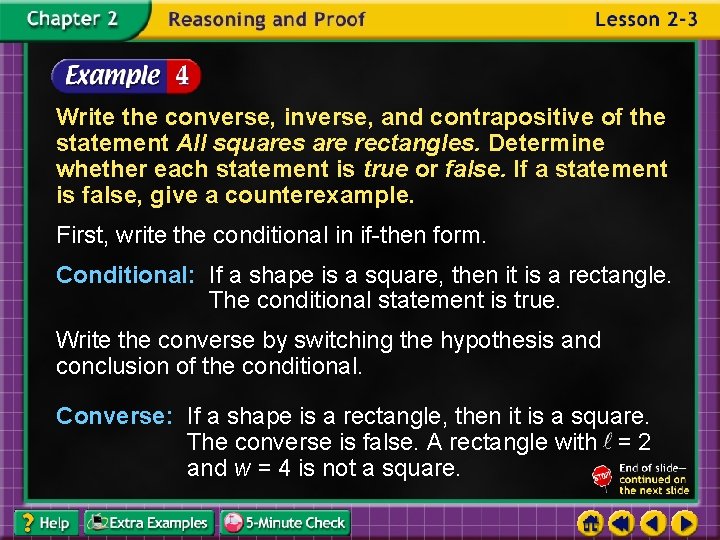
Write the converse, inverse, and contrapositive of the statement All squares are rectangles. Determine whether each statement is true or false. If a statement is false, give a counterexample. First, write the conditional in if-then form. Conditional: If a shape is a square, then it is a rectangle. The conditional statement is true. Write the converse by switching the hypothesis and conclusion of the conditional. Converse: If a shape is a rectangle, then it is a square. The converse is false. A rectangle with = 2 and w = 4 is not a square.
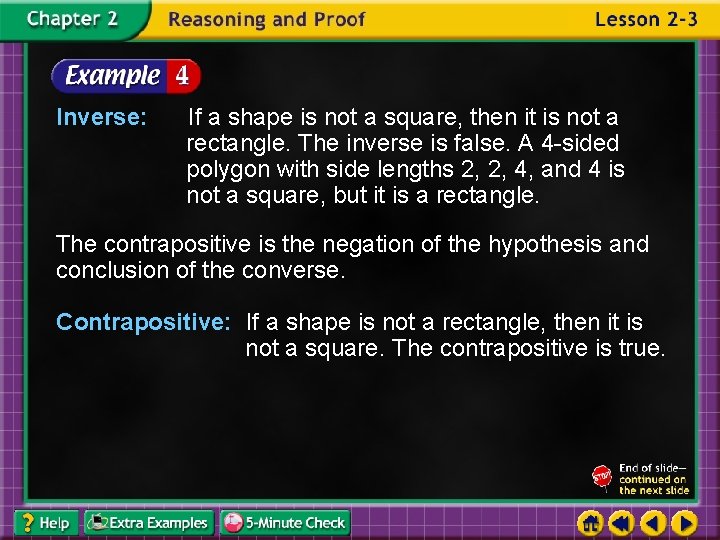
Inverse: If a shape is not a square, then it is not a rectangle. The inverse is false. A 4 -sided polygon with side lengths 2, 2, 4, and 4 is not a square, but it is a rectangle. The contrapositive is the negation of the hypothesis and conclusion of the converse. Contrapositive: If a shape is not a rectangle, then it is not a square. The contrapositive is true.
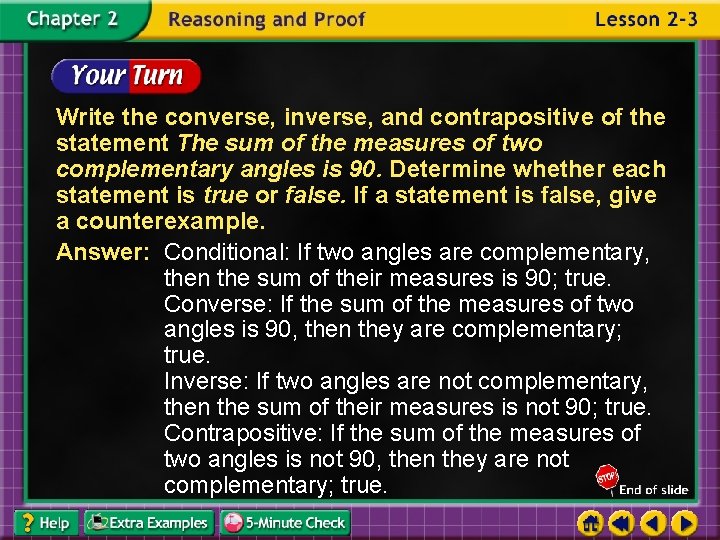
Write the converse, inverse, and contrapositive of the statement The sum of the measures of two complementary angles is 90. Determine whether each statement is true or false. If a statement is false, give a counterexample. Answer: Conditional: If two angles are complementary, then the sum of their measures is 90; true. Converse: If the sum of the measures of two angles is 90, then they are complementary; true. Inverse: If two angles are not complementary, then the sum of their measures is not 90; true. Contrapositive: If the sum of the measures of two angles is not 90, then they are not complementary; true.
Example 1 Determine Valid Conclusions Example 2 Determine Valid Conclusions From Two Conditionals Example 3 Analyze Conclusions
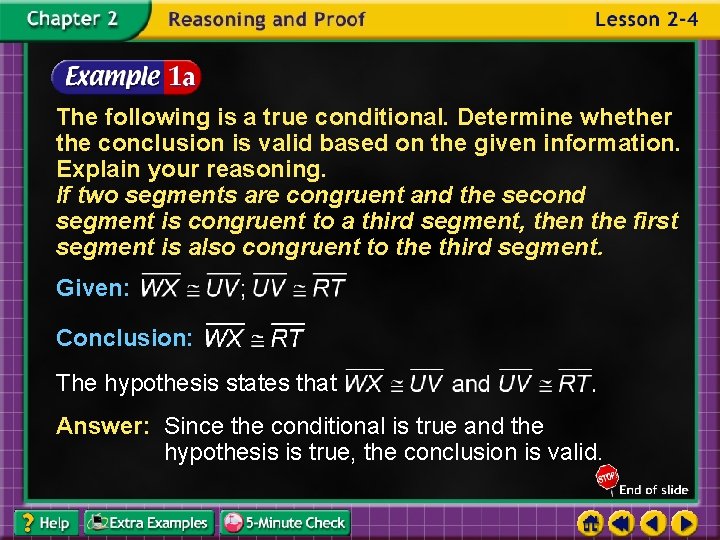
The following is a true conditional. Determine whether the conclusion is valid based on the given information. Explain your reasoning. If two segments are congruent and the second segment is congruent to a third segment, then the first segment is also congruent to the third segment. Given: Conclusion: The hypothesis states that Answer: Since the conditional is true and the hypothesis is true, the conclusion is valid.
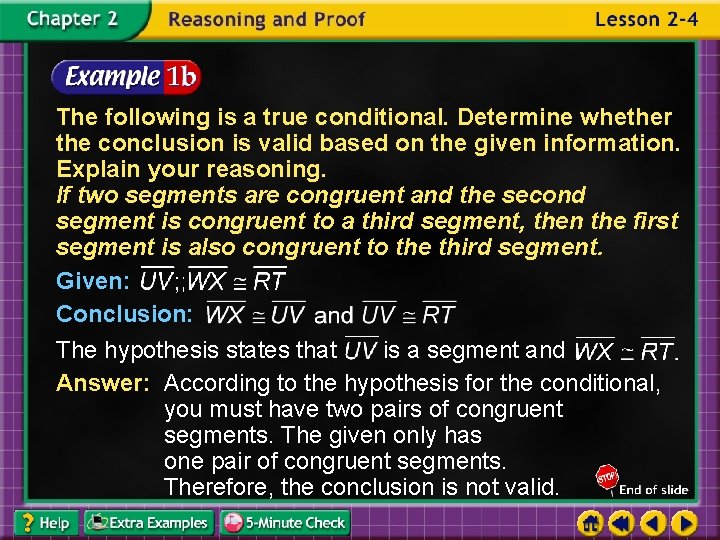
The following is a true conditional. Determine whether the conclusion is valid based on the given information. Explain your reasoning. If two segments are congruent and the second segment is congruent to a third segment, then the first segment is also congruent to the third segment. Given: Conclusion: The hypothesis states that is a segment and Answer: According to the hypothesis for the conditional, you must have two pairs of congruent segments. The given only has one pair of congruent segments. Therefore, the conclusion is not valid.
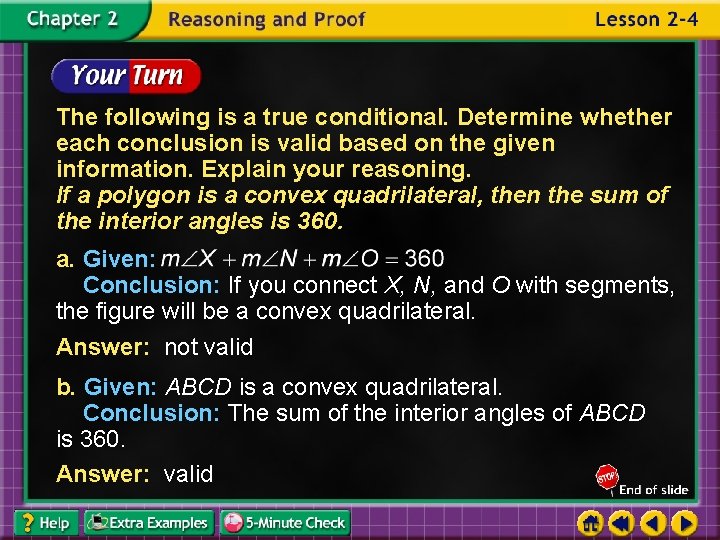
The following is a true conditional. Determine whether each conclusion is valid based on the given information. Explain your reasoning. If a polygon is a convex quadrilateral, then the sum of the interior angles is 360. a. Given: Conclusion: If you connect X, N, and O with segments, the figure will be a convex quadrilateral. Answer: not valid b. Given: ABCD is a convex quadrilateral. Conclusion: The sum of the interior angles of ABCD is 360. Answer: valid
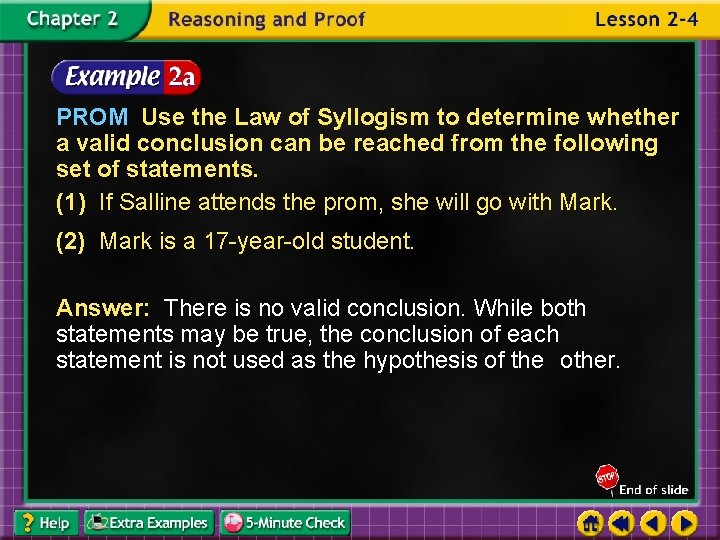
PROM Use the Law of Syllogism to determine whether a valid conclusion can be reached from the following set of statements. (1) If Salline attends the prom, she will go with Mark. (2) Mark is a 17 -year-old student. Answer: There is no valid conclusion. While both statements may be true, the conclusion of each statement is not used as the hypothesis of the other.
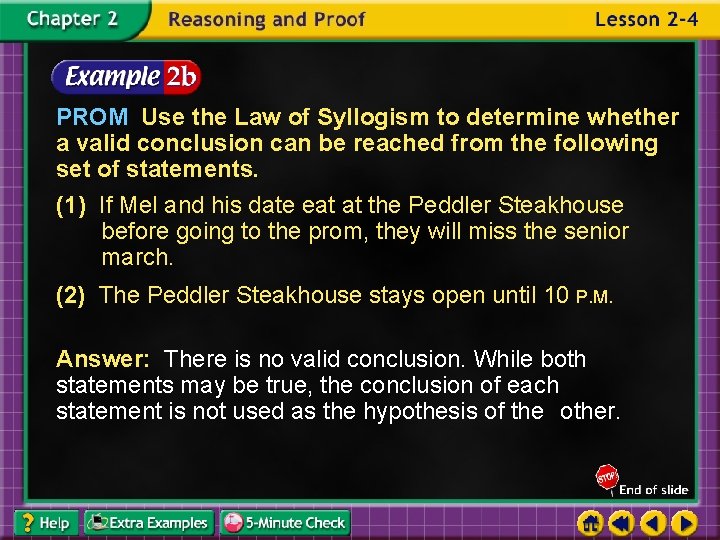
PROM Use the Law of Syllogism to determine whether a valid conclusion can be reached from the following set of statements. (1) If Mel and his date eat at the Peddler Steakhouse before going to the prom, they will miss the senior march. (2) The Peddler Steakhouse stays open until 10 P. M. Answer: There is no valid conclusion. While both statements may be true, the conclusion of each statement is not used as the hypothesis of the other.
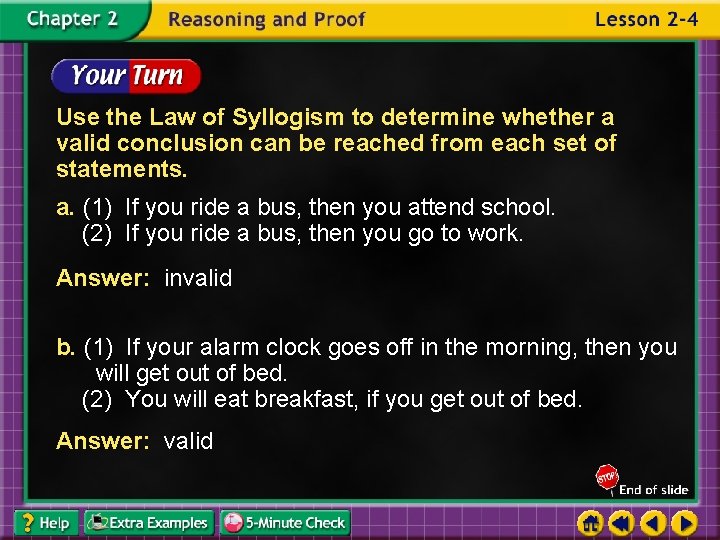
Use the Law of Syllogism to determine whether a valid conclusion can be reached from each set of statements. a. (1) If you ride a bus, then you attend school. (2) If you ride a bus, then you go to work. Answer: invalid b. (1) If your alarm clock goes off in the morning, then you will get out of bed. (2) You will eat breakfast, if you get out of bed. Answer: valid
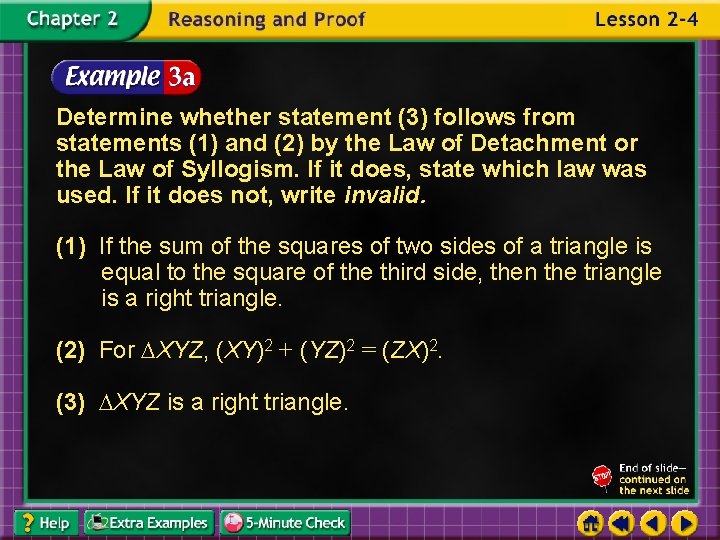
Determine whether statement (3) follows from statements (1) and (2) by the Law of Detachment or the Law of Syllogism. If it does, state which law was used. If it does not, write invalid. (1) If the sum of the squares of two sides of a triangle is equal to the square of the third side, then the triangle is a right triangle. (2) For XYZ, (XY)2 + (YZ)2 = (ZX)2. (3) XYZ is a right triangle.
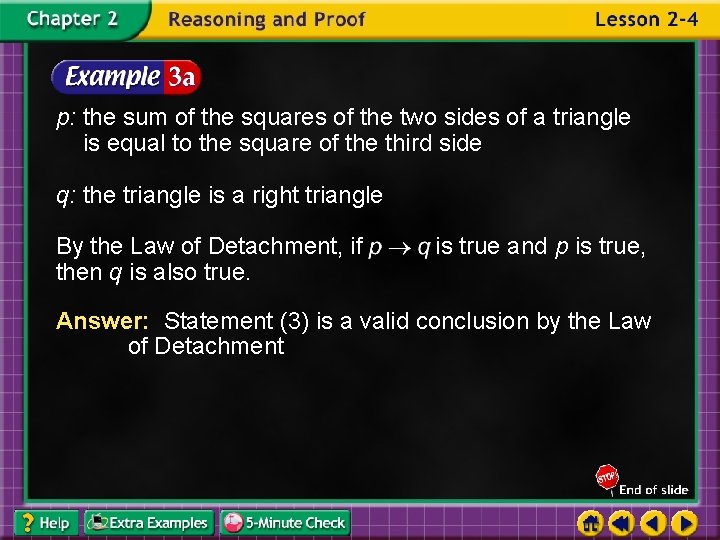
p: the sum of the squares of the two sides of a triangle is equal to the square of the third side q: the triangle is a right triangle By the Law of Detachment, if then q is also true. is true and p is true, Answer: Statement (3) is a valid conclusion by the Law of Detachment
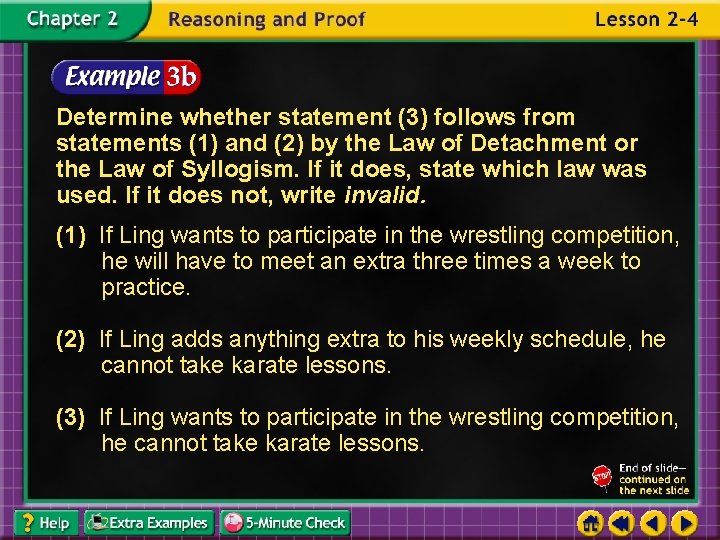
Determine whether statement (3) follows from statements (1) and (2) by the Law of Detachment or the Law of Syllogism. If it does, state which law was used. If it does not, write invalid. (1) If Ling wants to participate in the wrestling competition, he will have to meet an extra three times a week to practice. (2) If Ling adds anything extra to his weekly schedule, he cannot take karate lessons. (3) If Ling wants to participate in the wrestling competition, he cannot take karate lessons.
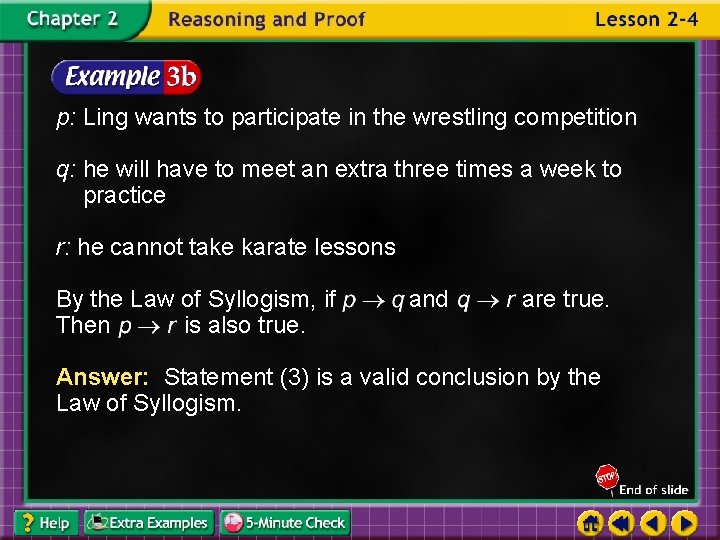
p: Ling wants to participate in the wrestling competition q: he will have to meet an extra three times a week to practice r: he cannot take karate lessons By the Law of Syllogism, if Then is also true. and are true. Answer: Statement (3) is a valid conclusion by the Law of Syllogism.
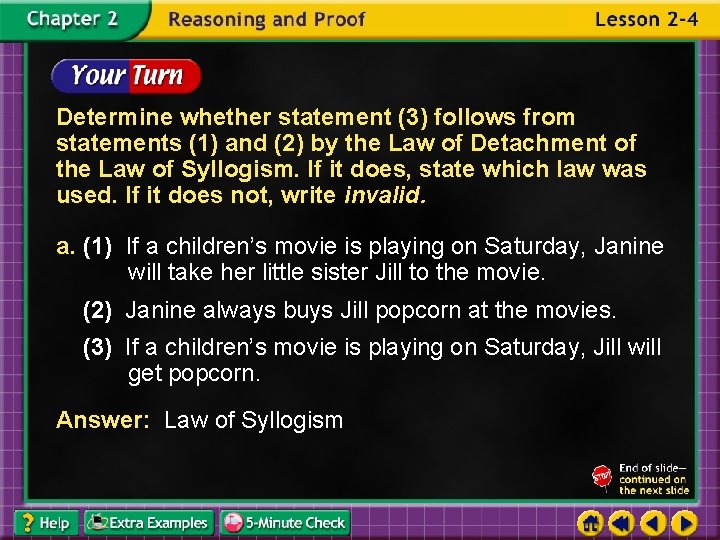
Determine whether statement (3) follows from statements (1) and (2) by the Law of Detachment of the Law of Syllogism. If it does, state which law was used. If it does not, write invalid. a. (1) If a children’s movie is playing on Saturday, Janine will take her little sister Jill to the movie. (2) Janine always buys Jill popcorn at the movies. (3) If a children’s movie is playing on Saturday, Jill will get popcorn. Answer: Law of Syllogism
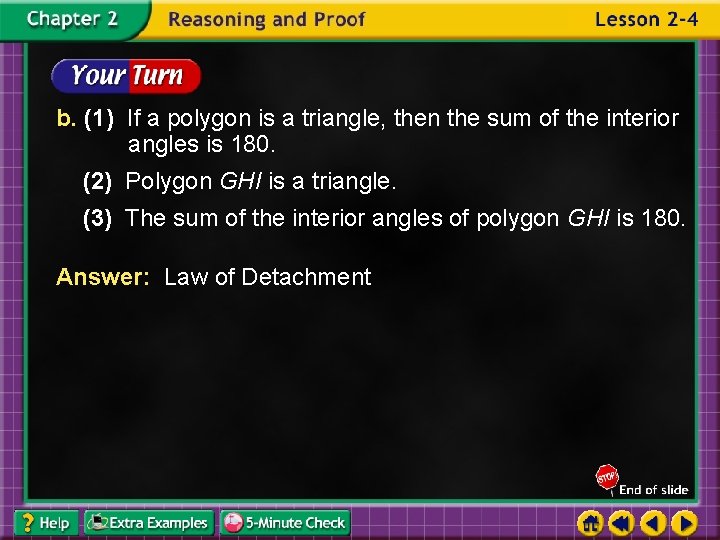
b. (1) If a polygon is a triangle, then the sum of the interior angles is 180. (2) Polygon GHI is a triangle. (3) The sum of the interior angles of polygon GHI is 180. Answer: Law of Detachment