
Lesson 2 1 Heat Temperature and Conduction Pradhan



- Slides: 47
Lesson 2. 1 Heat, Temperature, and Conduction Pradhan 2013
Key Concepts • Adding energy (heating) atoms and molecules increases their motion, resulting in an increase in temperature. • Removing energy (cooling) atoms and molecules decreases their motion, resulting in a decrease in temperature. • Energy can be added or removed from a substance through a process called conduction. • In conduction, faster-moving molecules contact slower-moving molecules and transfer energy to them.
Key Concepts • During conduction the slower-moving molecules speed up and the faster-moving molecules slow down. • Temperature is a measure of the average kinetic energy of the atoms or molecules of a substance. • Heat is the transfer of energy from a substance at a higher temperature to a substance at a lower temperature. • Some materials are better conductors of heat than others.
DO NOW 9/23 1. Did you ever put a metal spoon in hot soup or hot chocolate and then touch the spoon to your mouth? What do you think might be happening, between the molecules in the soup and the atoms in the spoon, to make the spoon get hot?
• something is going on at the molecular level that causes one substance to be able to make another hotter.
what happens when roomtemperature metal is placed in hot water. • Question to investigate: Why does the temperature of an object change when it is placed in hot water?
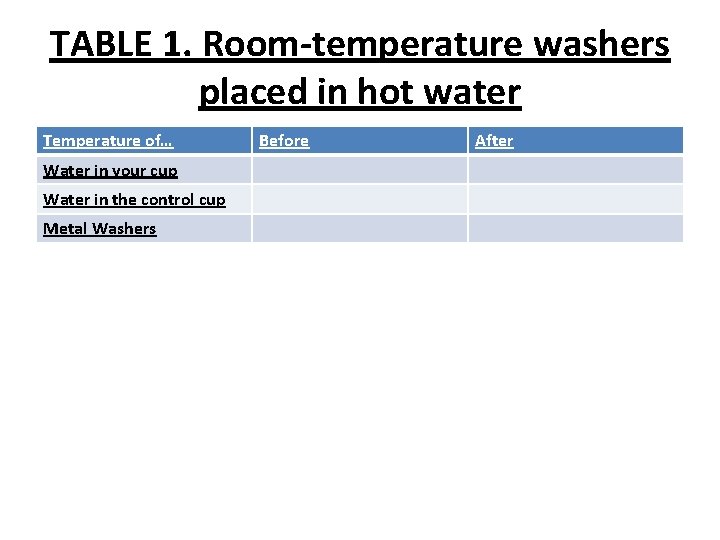
TABLE 1. Room-temperature washers placed in hot water Temperature of… Water in your cup Water in the control cup Metal Washers Before After
Procedures 1. TECHNICIAN. Place a thermometer in your cup to measure the initial temperature of the water. Record the temperature of the water in the “Before” column in the chart on the activity sheet. Be sure to also record the initial temperature of the water in the control cup. 2. TECHNICIAN. Use anothermometer to measure the temperature of the washers. Record this in the “Before” column.
Make a prediction • What will happen to the temperature of the water and the washers if you place the washers into the hot water?
Procedure 3. With thermometer still in the water, hold the string and lower the metal washers all the way into the hot water. 4. Observe any change in the temperature of the water. Leave the washers in the water until the temperature stops changing. Record the temperature of the water in each cup in the “After” column.
Procedure • Remove the washers from the water. Then take and record the temperature of the washers in the “After” column. • Empty the cup in a waste container or sink.
Expected Results • The temperature of the water will decrease a bit and the temperature of the washers will increase a bit. The amount of temperature decrease and increase is really not that important. What is important is that there is a temperature decrease in the water and a temperature increase in the washers.
• How do you think the temperature will change if you place hot washers into roomtemperature water?
• Ms. Pradhan will pour about 30 milliliters of room-temperature water into the control cup. Place a thermometer in the cup and tell students the temperature of the water.
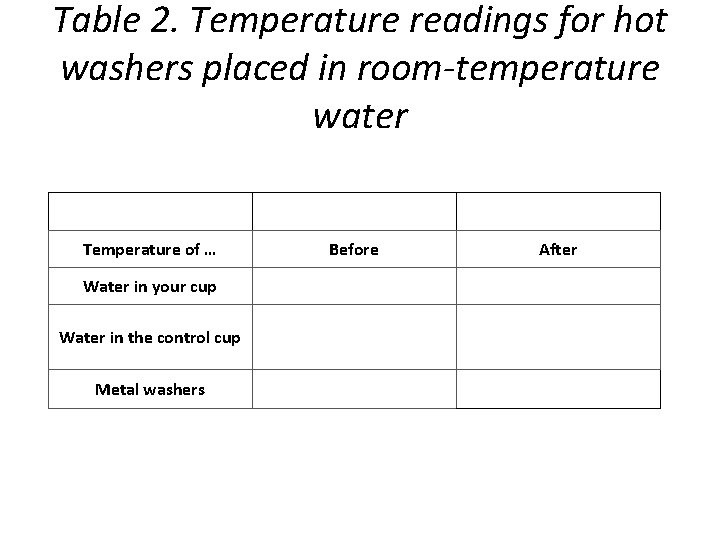
Table 2. Temperature readings for hot washers placed in room-temperature water Temperature of … Water in your cup Water in the control cup Metal washers Before After
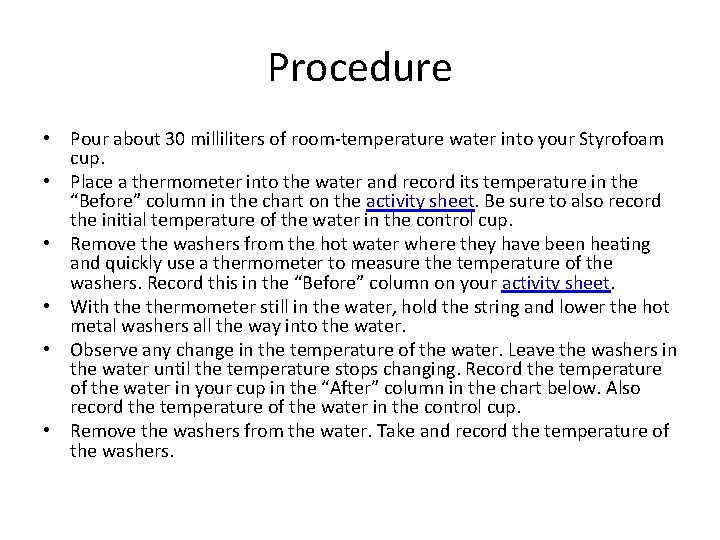
Procedure • Pour about 30 milliliters of room-temperature water into your Styrofoam cup. • Place a thermometer into the water and record its temperature in the “Before” column in the chart on the activity sheet. Be sure to also record the initial temperature of the water in the control cup. • Remove the washers from the hot water where they have been heating and quickly use a thermometer to measure the temperature of the washers. Record this in the “Before” column on your activity sheet. • With thermometer still in the water, hold the string and lower the hot metal washers all the way into the water. • Observe any change in the temperature of the water. Leave the washers in the water until the temperature stops changing. Record the temperature of the water in your cup in the “After” column in the chart below. Also record the temperature of the water in the control cup. • Remove the washers from the water. Take and record the temperature of the washers.
What happened to the temperature of the washers?
Expected results • The temperature of the water increases and the temperature of the washers decreases.
How did the temperature of the washers and water change in both parts of the activity?
• Based on your data, students should realize that the temperature of both the washers and water changed.
Knowing what you do about heating and cooling atoms and molecules, why do you think the temperature changed?
• 1. Why do you think the temperature of the water in your cup changes more than the water in the control cup?
Heated Spoon Animation
Heated Spoon • The water molecules in the hot water are moving faster than the atoms in the spoon. The water molecules strike the atoms of the spoon and transfer some of their energy to these atoms. This is how the energy from the water is transferred to the spoon. This increases the motion of the atoms in the spoon. Since the motion of the atoms in the spoon increases, the temperature of the spoon increases.
• It is not easy to notice, but when the fastmoving water molecules hit the spoon and speed up the atoms in the spoon, the water molecules slow down a little. So when energy is transferred from the water to the spoon, the spoon gets warmer and the water gets cooler.
• When fast-moving atoms or molecules hit slower-moving atoms or molecules and increase their speed, energy is transferred. The energy that is transferred is called heat. This energy transfer process is called conduction. • Ex: When a spoon is placed in hot water it heats up.
Cooled Spoon
• The atoms in the spoon are moving faster than the water molecules in the cold water. The fastermoving atoms in the spoon transfer some of their energy to the water molecules. This causes the water molecules to move a little faster and the temperature of the water to increase. Since the atoms in the spoon transfer some of their energy to the water molecules, the atoms in the spoon slow down a little. This causes the temperature of the spoon to decrease.
In the first part of the animation, you saw what happens when a spoon is placed in hot water. 2. Explain, on the molecular level, how energy was transferred from the hot water to the room-temperature spoon.
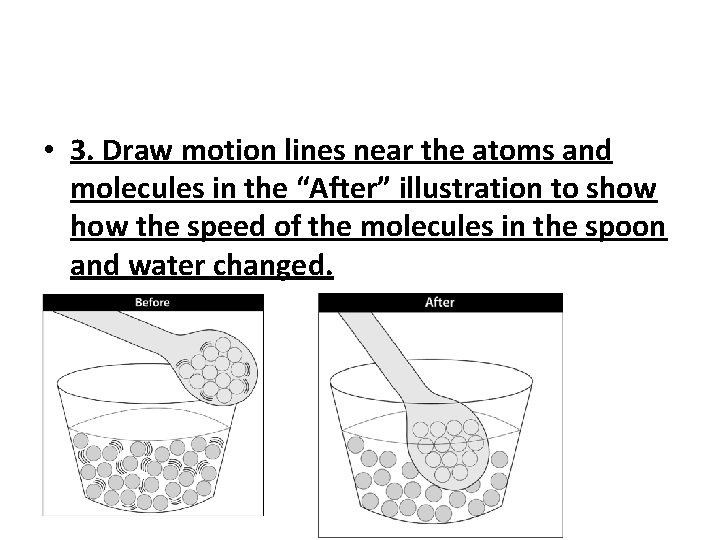
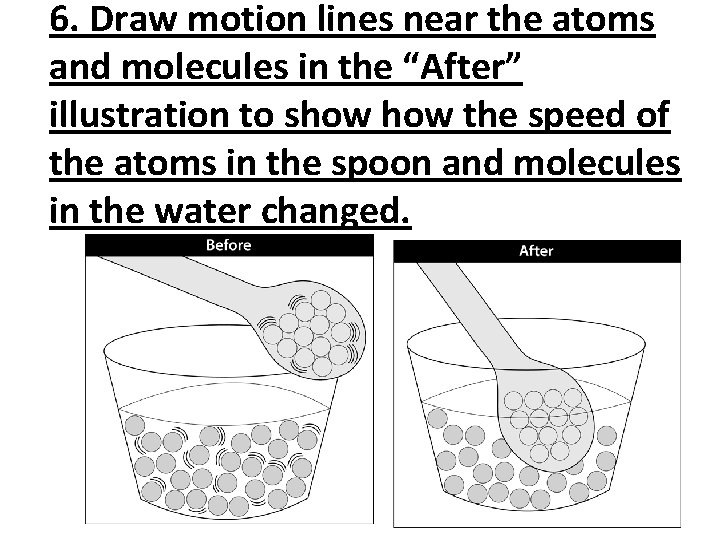
• 3. Draw motion lines near the atoms and molecules in the “After” illustration to show the speed of the molecules in the spoon and water changed.
Describe how the process of conduction caused the temperature of the washers and water to change in the activity. • Room-temperature washers in hot water • When the room-temperature washers are placed in hot water, the fastermoving water molecules hit the slower-moving metal atoms and make the atoms in the washers move a little faster. This causes the temperature of the washers to increase. Since some of the energy from the water was transferred to the metal to speed them up, the motion of the water molecules decreases. This causes the temperature of the water to decrease. • Hot washers in room-temperature water • When the hot metal washers are placed in the room temperature water, the faster-moving metal atoms hit the slower-moving water molecules and make the water molecules move a little faster. This causes the temperature of the water to increase. Since some of the energy from the metal atoms was transferred to the water molecules to speed them up, the motion of the metal atoms decreases. This causes the temperature of the washers to decrease.
How does the motion of the atoms or molecules of a substance affect the temperature of the substance? • If the atoms or molecules of a substance are moving faster, the substance has a higher temperature. If its atoms or molecules are moving slower, then it has a lower temperature.
What is conduction? • Conduction occurs when two substances at different temperatures are in contact. Energy is always transferred from the substance with the higher temperature to the one at lower temperature. As energy is transferred from the hotter substance to the colder one, the colder substance gets warmer and the hotter substance gets cooler. Eventually the two substances become the same temperature.
Misconceptions • Students tend to understand heating but often have a misconception about how things are cooled. Just like heating a substance, cooling a substance also works by conduction. But instead of focusing on the slower-moving molecules speeding up, you focus on the faster-moving molecules slowing down. The faster -moving atoms or molecules of the hotter substance contact slower -moving atoms or molecules of the cooler substance. The fastermoving atoms and molecules transfer some of their energy to the slower-moving atoms and molecules. The atoms and molecules of the hotter substance slow down, and its temperature decreases. An object or substance can’t get colder by adding “coldness” to it. Something can only get colder by having its atoms and molecules transfer their energy to something that is colder.
For this activity, the change in distance between water molecules or between atoms in the spoon is not the focus, and therefore it is not shown in the model.
4. Now that you know what happens when a spoon is placed in hot water, explain what happened in the activity: • Why did the metal washers get warmer? • Why did the water get cooler?
Hot spoon placed in room-temperature water In the next part of the animation, you saw what happens when a hot spoon is placed in roomtemperature water. 5. Explain, on the molecular level, how the heat was conducted from the hot spoon to the room -temperature water.
6. Draw motion lines near the atoms and molecules in the “After” illustration to show the speed of the atoms in the spoon and molecules in the water changed.
7. Now that you know what happens when a hot spoon is placed in room-temperature water, explain what happened in the activity: • Why did the hot metal washers get cooler? • Why did the water get warmer?
The following animation shows that at any temperature, the atoms or molecules of a substance are moving at a variety of speeds. Some molecules are moving faster than others, some slower, but most are in-between. • http: //www. colorado. edu/physics/Physics. Initi ative/Physics 2000/bec/temperature. html
• Anything that has mass and is moving, no matter how big or small, has a certain amount of energy, called kinetic energy. • The temperature of a substance gives you information about the kinetic energy of its molecules. The faster the molecules of a substance move, the higher the kinetic energy, and the higher the temperature. • The slower the molecules move, the lower the kinetic energy, and the lower the temperature. • Since there are so many molecules of a substance, temperature is actually a measure of the average kinetic energy of the molecules of a substance.
• These ideas apply to solids, liquids, and gases. The little balls represent molecules and change color to help visualize their speed and kinetic energy. At room-temperature, the molecules are going at a variety of speeds. The slow ones are blue, the faster ones are purple or pink, and the fastest are red. • At any temperature, most of the molecules are moving at about the same speed and have about the same kinetic energy, but there always some that are moving slower and some that are moving faster. The temperature is actually a combination, or average, of the kinetic energy of the molecules. If you could place a thermometer in this animation, it would be struck by molecules going at different speeds so it would register the average kinetic energy of the molecules. • Individual molecules change speed based on their collisions with other molecules. Ex. Animation: Molecules transfer their kinetic energy to other molecules through conduction. When a fast-moving molecule hits a slower-moving molecule, the slower molecule speeds up (and turns more red) and the faster molecule slows down (and turns more blue).
What do you notice about the molecules as energy is added? • As energy is added, more molecules are moving faster. There are more pink and red molecules but there are still some slowermoving blue ones.
What do you notice about the molecules as energy is removed? • As energy is removed, more molecules are moving slower. There are more purple and blue molecules, but a few still change to pink.
• Touch the metal part of your chair or desk leg and then touch the cover of a textbook. Do these surfaces feel like they are the same or a different temperature? • Why does the metal feel colder even though it is the same temperature as the cardboard?
Conducting Animation • Even though the metal feels colder, the metal and the cardboard are actually the same temperature. If you don’t believe this, you can use a thermometer to take the temperature of metal and cardboard in the room. After being in the same room with the same air temperature, both surfaces should be at the same temperature.
• The molecules in your finger are moving faster than the molecules in the room-temperature metal. Therefore the energy from your finger is transferred to the metal. Because metal is a good conductor, the energy is transferred away from the surface through the metal. The molecules in your skin slow down as your finger continues to lose energy to the metal, so your finger feels cooler. • Like the metal, the molecules in your finger are moving faster than the molecules in the room-temperature cardboard. Energy is transferred from your finger to the surface of the cardboard. But because cardboard is a poor conductor, the energy is not easily transferred away from the surface through the cardboard. The molecules in your skin move at about the same speed. Because your finger does not lose much energy to the cardboard, your finger stays warm.