
Lesson 19 Value Word Problems AA Means AAA
Lesson 19: Value Word Problems, AA Means AAA
Value word problems are a genre of problems in which one or more statements in the problem are about the value of items. The total value of one kind is the value of one item times the number of items of that kind. For example, every nickel has a value of 5 N cents; thus, N nickels would have N a value of 5 N cents. In a like D manner, the Dtotal value of N dimes would be 10 N cents.
We will begin value problems with problems that contain two statements of equality that lead to two equations in two unknowns. Either substitution or elimination can be used to solve these equations.
Example: Karamagu had 50 nickels and dimes whose value was $4. How many of each kind of coin did he have?
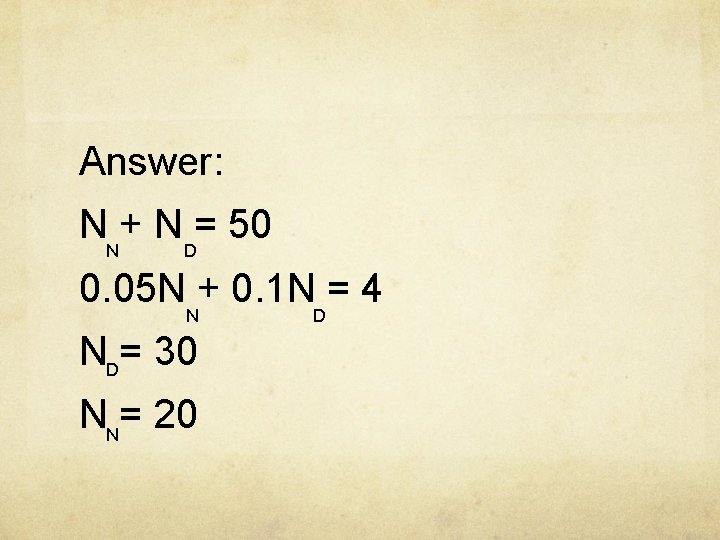
Answer: NN+ ND= 50 0. 05 N + 0. 1 N = 4 N ND= 30 NN= 20 D
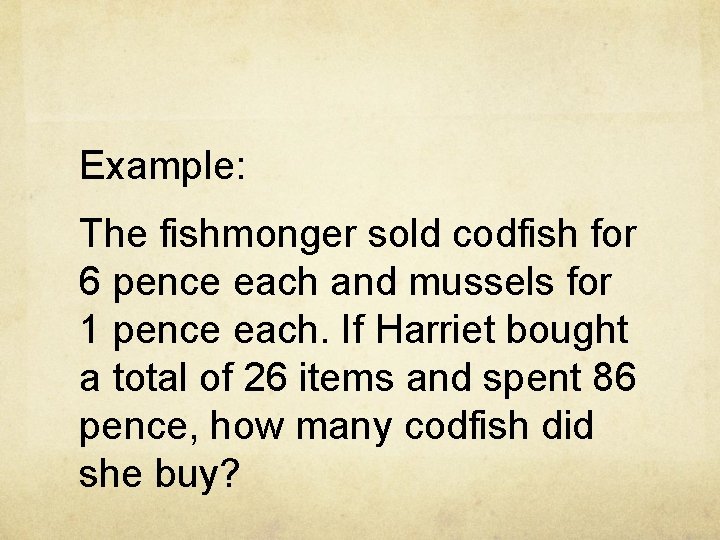
Example: The fishmonger sold codfish for 6 pence each and mussels for 1 pence each. If Harriet bought a total of 26 items and spent 86 pence, how many codfish did she buy?
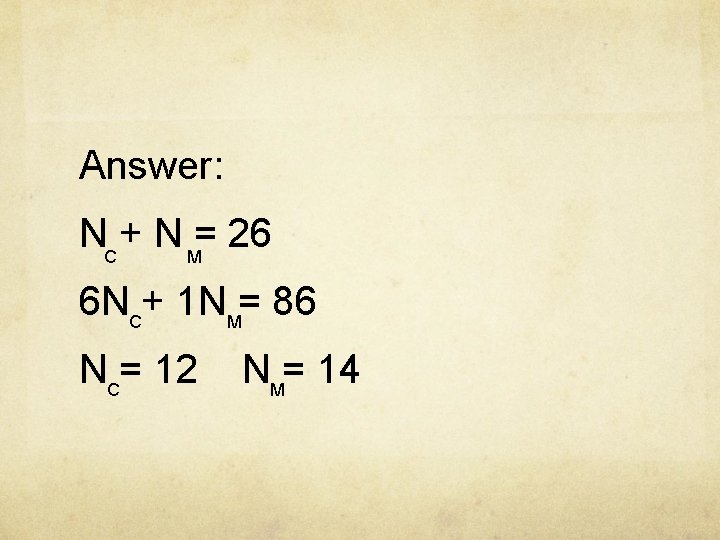
Answer: NC + N M= 26 6 NC+ 1 NM= 86 NC= 12 NM= 14
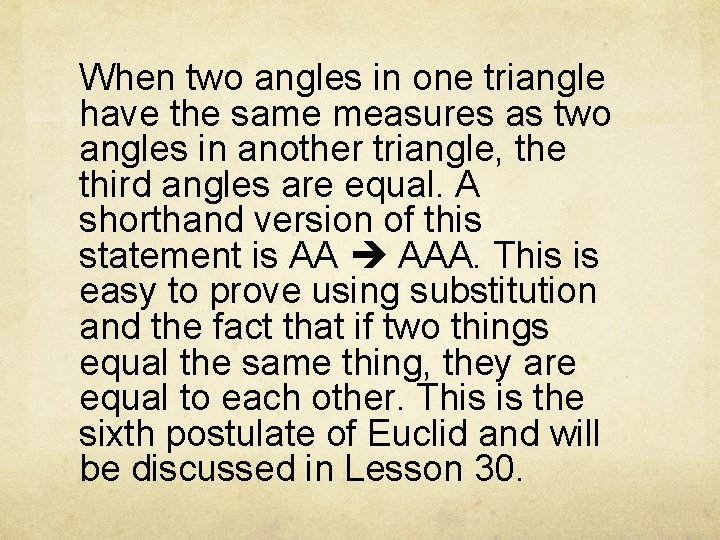
When two angles in one triangle have the same measures as two angles in another triangle, the third angles are equal. A shorthand version of this statement is AA AAA. This is easy to prove using substitution and the fact that if two things equal the same thing, they are equal to each other. This is the sixth postulate of Euclid and will be discussed in Lesson 30.
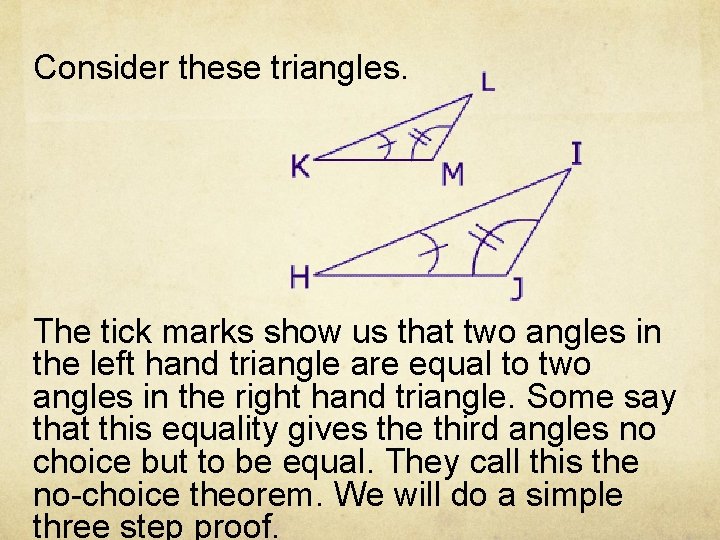
Consider these triangles. The tick marks show us that two angles in the left hand triangle are equal to two angles in the right hand triangle. Some say that this equality gives the third angles no choice but to be equal. They call this the no-choice theorem. We will do a simple three step proof.
The sum of the measures of the angles in both triangles is 180°. <K + <M + <L = 180 and <H + < J + < I = 180 Now we solve the equation on the left for angle L and the equation on the right for angle I. <L = 180 - <K - <M <J and <I = 180 - <H -
In the left hand equation, we will replace <K with its equivalent, which is <H, and replace <M with its equivalent, which is angle J. <L = 180 - <H - <J <J and <L = 180 - <H - Since angle L and I both equal the same sum, these two angles must be equal.
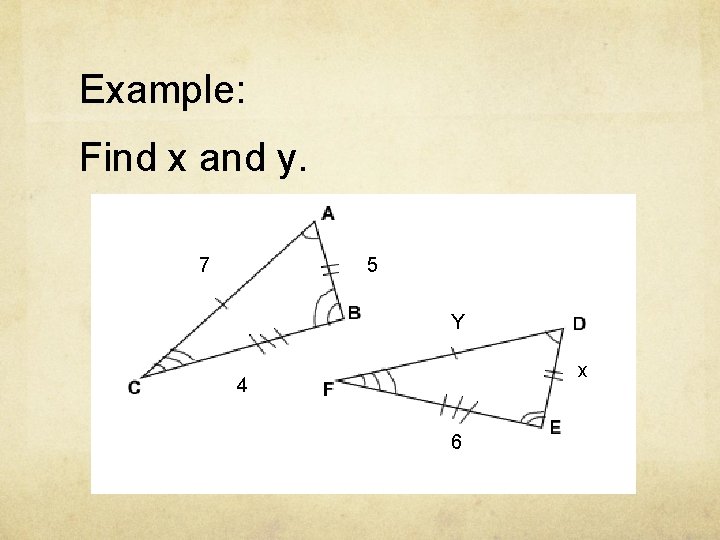
Example: Find x and y. 7 5 Y x 4 6
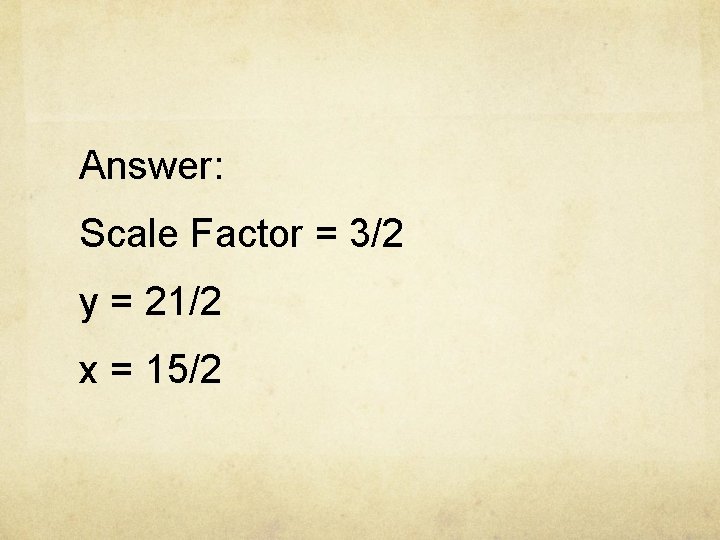
Answer: Scale Factor = 3/2 y = 21/2 x = 15/2
- Slides: 13