
Lesson 19 Recursion CS 1 John Cole 1
- Slides: 32
Lesson 19 Recursion CS 1 -- John Cole 1
Recursion • 1. (n) The act of cursing again. • 2. see recursion • 3. The concept of functions which can call themselves. CS 1 Lesson 19: Recursion -- John Cole 2
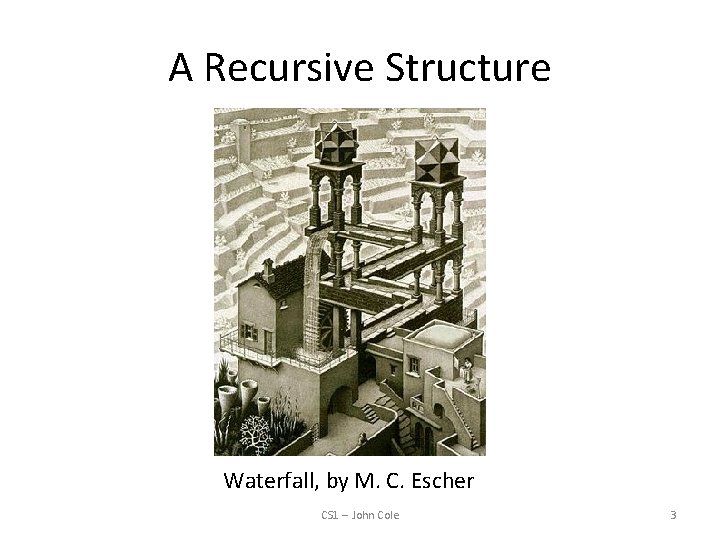
A Recursive Structure Waterfall, by M. C. Escher CS 1 -- John Cole 3
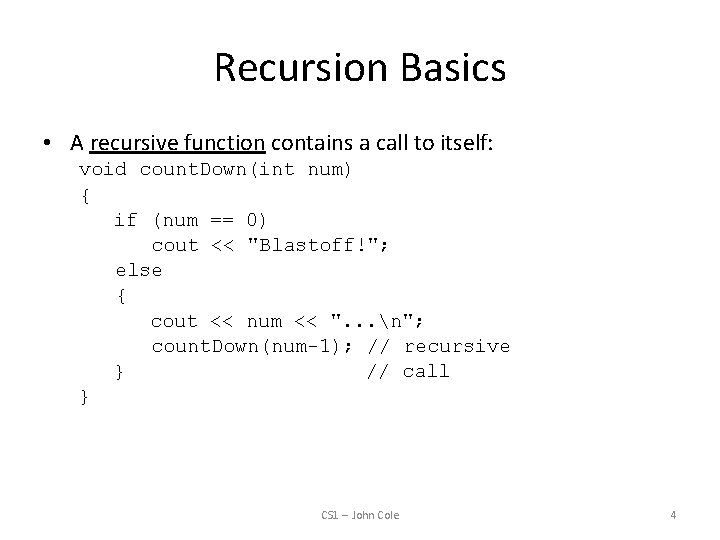
Recursion Basics • A recursive function contains a call to itself: void count. Down(int num) { if (num == 0) cout << "Blastoff!"; else { cout << num << ". . . n"; count. Down(num-1); // recursive } // call } CS 1 -- John Cole 4
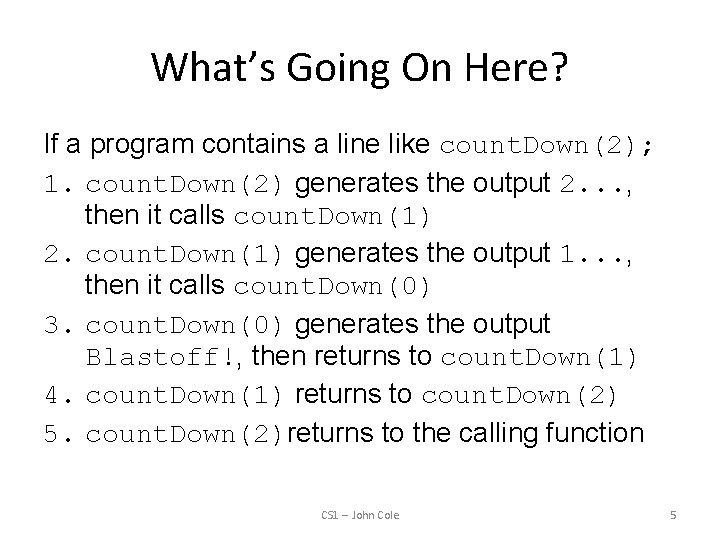
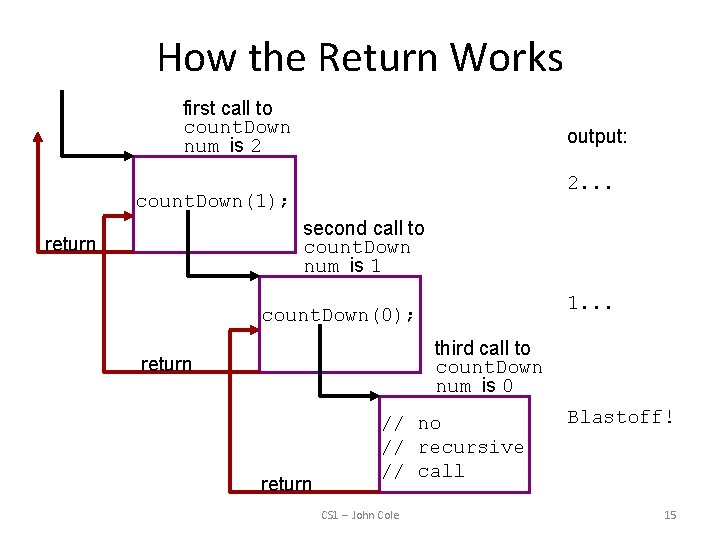
What’s Going On Here? If a program contains a line like count. Down(2); 1. count. Down(2) generates the output 2. . . , then it calls count. Down(1) 2. count. Down(1) generates the output 1. . . , then it calls count. Down(0) 3. count. Down(0) generates the output Blastoff!, then returns to count. Down(1) 4. count. Down(1) returns to count. Down(2) 5. count. Down(2)returns to the calling function CS 1 -- John Cole 5
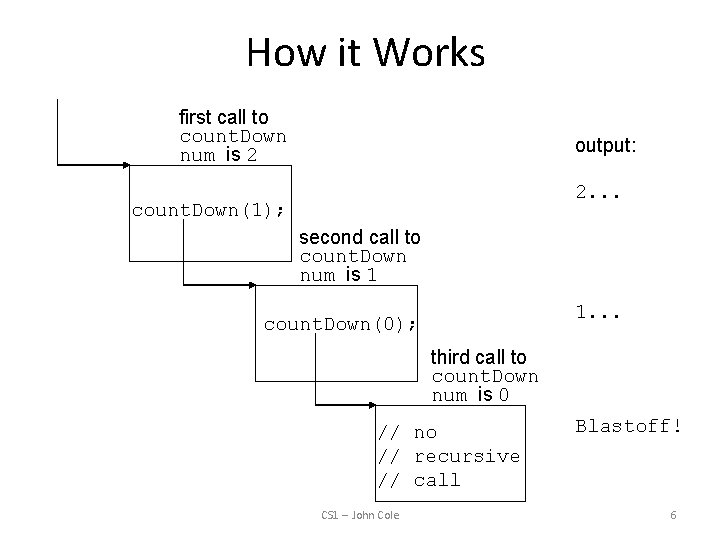
How it Works first call to count. Down num is 2 output: 2. . . count. Down(1); second call to count. Down num is 1 1. . . count. Down(0); third call to count. Down num is 0 // no // recursive // call CS 1 -- John Cole Blastoff! 6
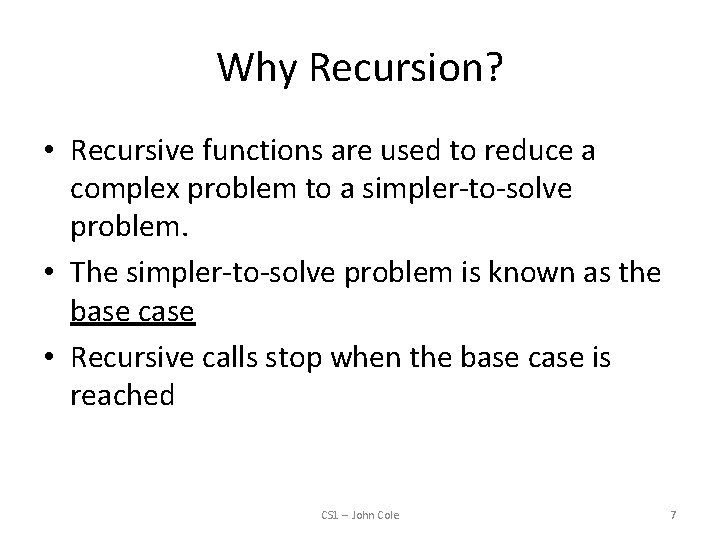
Why Recursion? • Recursive functions are used to reduce a complex problem to a simpler-to-solve problem. • The simpler-to-solve problem is known as the base case • Recursive calls stop when the base case is reached CS 1 -- John Cole 7
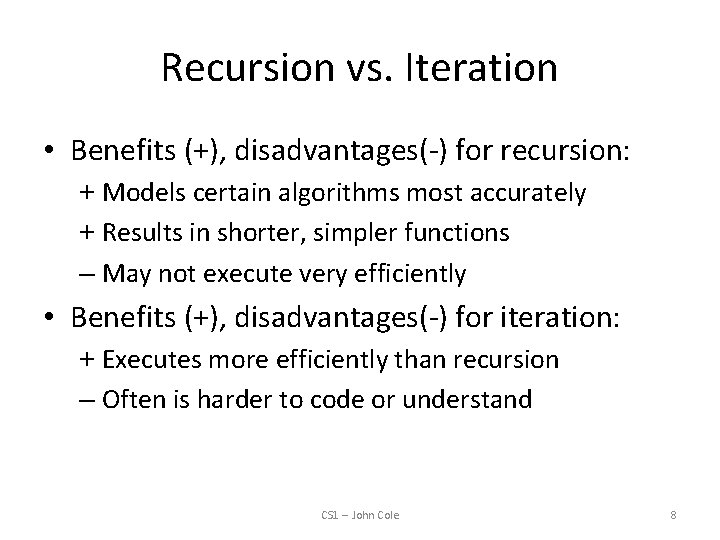
Recursion vs. Iteration • Benefits (+), disadvantages(-) for recursion: + Models certain algorithms most accurately + Results in shorter, simpler functions – May not execute very efficiently • Benefits (+), disadvantages(-) for iteration: + Executes more efficiently than recursion – Often is harder to code or understand CS 1 -- John Cole 8
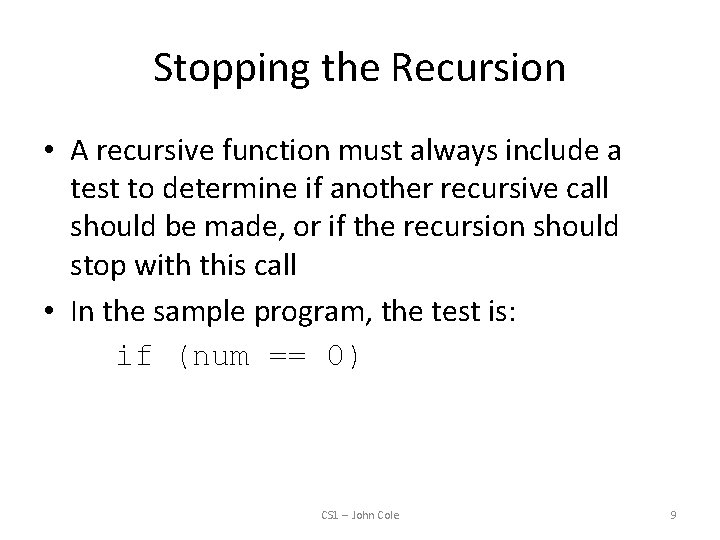
Stopping the Recursion • A recursive function must always include a test to determine if another recursive call should be made, or if the recursion should stop with this call • In the sample program, the test is: if (num == 0) CS 1 -- John Cole 9
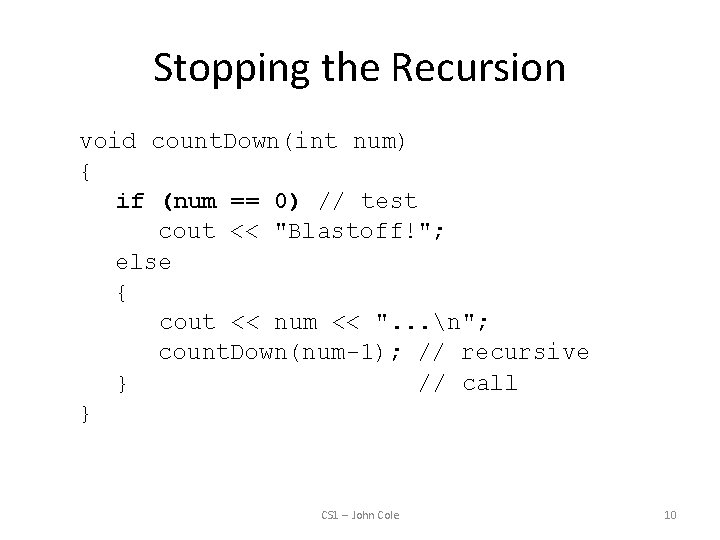
Stopping the Recursion void count. Down(int num) { if (num == 0) // test cout << "Blastoff!"; else { cout << num << ". . . n"; count. Down(num-1); // recursive } // call } CS 1 -- John Cole 10
Stopping the Recursion • Recursion uses a process of breaking a problem down into smaller problems until the problem can be solved • In the count. Down function, a different value is passed to the function each time it is called • Eventually, the parameter reaches the value in the test, and the recursion stops CS 1 -- John Cole 11
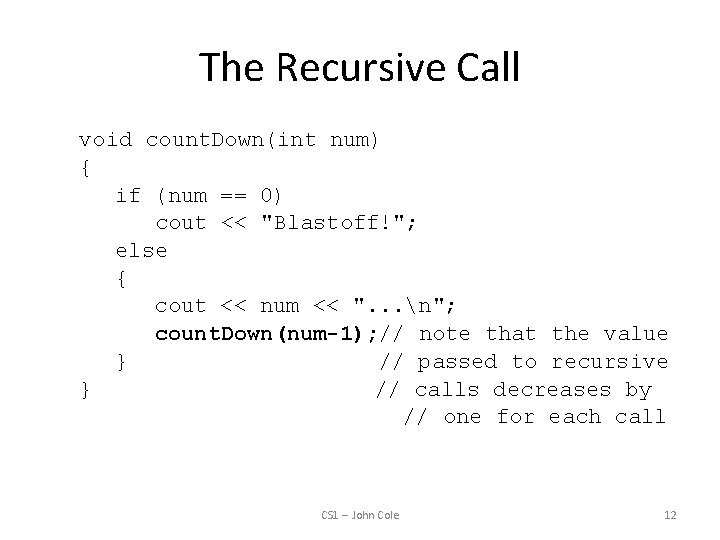
The Recursive Call void count. Down(int num) { if (num == 0) cout << "Blastoff!"; else { cout << num << ". . . n"; count. Down(num-1); // note that the value } // passed to recursive } // calls decreases by // one for each call CS 1 -- John Cole 12
How It Works • Each time a recursive function is called, a new copy of the function runs, with new instances of parameters and local variables created • That is, a new stack frame is created • As each copy finishes executing, it returns to the copy of the function that called it • When the initial copy finishes executing, it returns to the part of the program that made the initial call to the function CS 1 -- John Cole 13
How It Works • Remember, a new stack frame with new instances of local variables (and parameters) is created • Thus the variable num in the “countdown” example is not the same memory location in each of the calls CS 1 -- John Cole 14
How the Return Works first call to count. Down num is 2 output: 2. . . count. Down(1); second call to count. Down num is 1 return 1. . . count. Down(0); third call to count. Down num is 0 return // no // recursive // call CS 1 -- John Cole Blastoff! 15
Types of Recursion • Direct – a function calls itself • Indirect – function A calls function B, and function B calls function A – function A calls function B, which calls …, which calls function A CS 1 -- John Cole 16
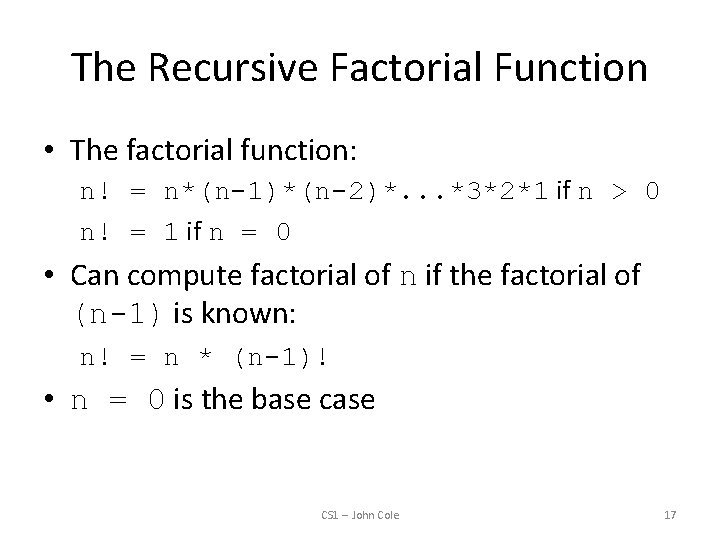
The Recursive Factorial Function • The factorial function: n! = n*(n-1)*(n-2)*. . . *3*2*1 if n > 0 n! = 1 if n = 0 • Can compute factorial of n if the factorial of (n-1) is known: n! = n * (n-1)! • n = 0 is the base case CS 1 -- John Cole 17
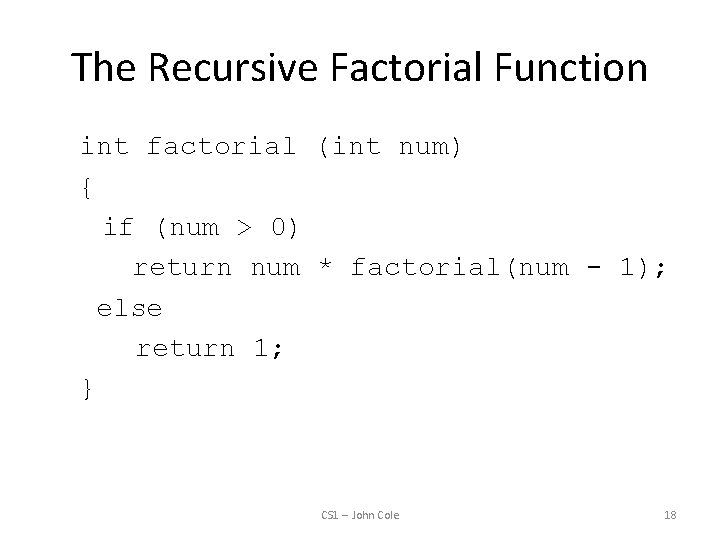
The Recursive Factorial Function int factorial (int num) { if (num > 0) return num * factorial(num - 1); else return 1; } CS 1 -- John Cole 18
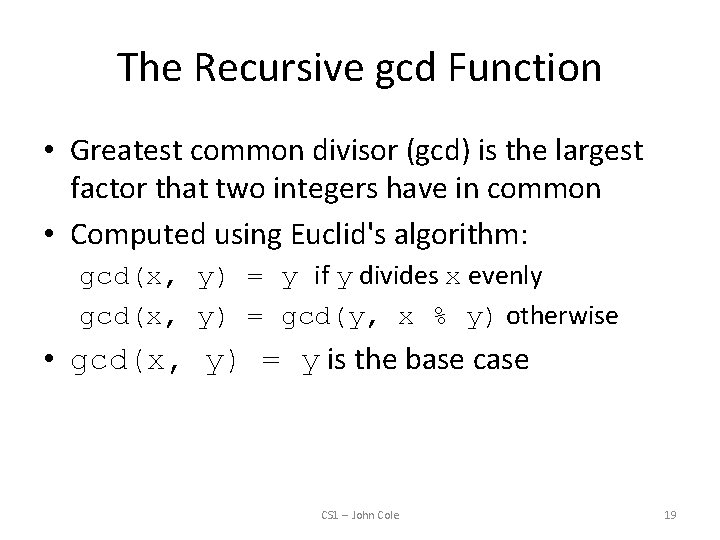
The Recursive gcd Function • Greatest common divisor (gcd) is the largest factor that two integers have in common • Computed using Euclid's algorithm: gcd(x, y) = y if y divides x evenly gcd(x, y) = gcd(y, x % y) otherwise • gcd(x, y) = y is the base case CS 1 -- John Cole 19
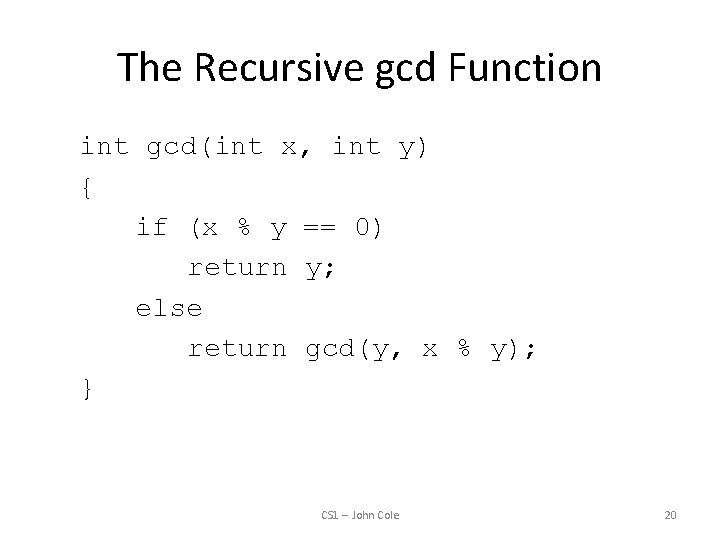
The Recursive gcd Function int gcd(int x, int y) { if (x % y == 0) return y; else return gcd(y, x % y); } CS 1 -- John Cole 20
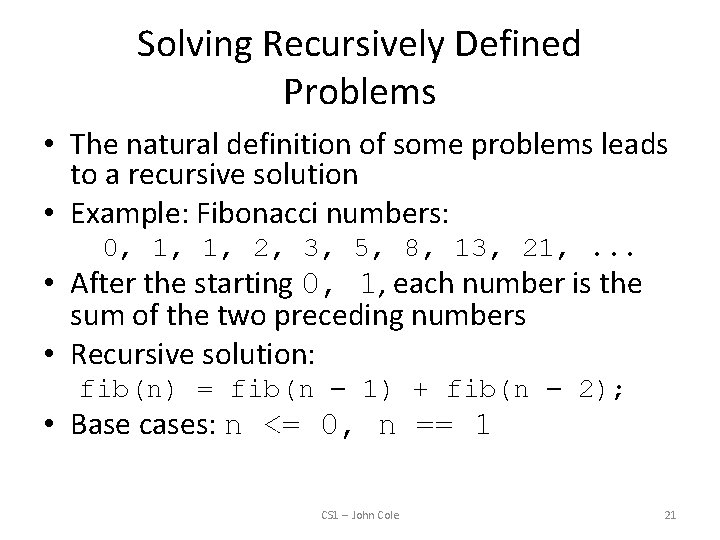
Solving Recursively Defined Problems • The natural definition of some problems leads to a recursive solution • Example: Fibonacci numbers: 0, 1, 1, 2, 3, 5, 8, 13, 21, . . . • After the starting 0, 1, each number is the sum of the two preceding numbers • Recursive solution: fib(n) = fib(n – 1) + fib(n – 2); • Base cases: n <= 0, n == 1 CS 1 -- John Cole 21
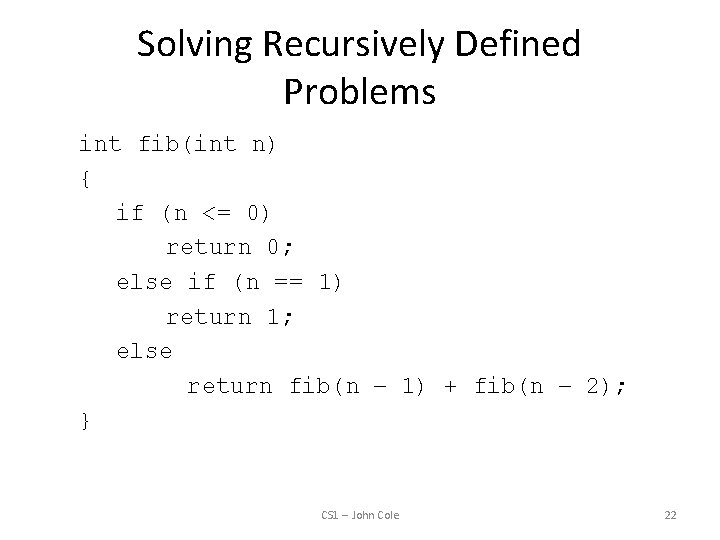
Solving Recursively Defined Problems int fib(int n) { if (n <= 0) return 0; else if (n == 1) return 1; else return fib(n – 1) + fib(n – 2); } CS 1 -- John Cole 22
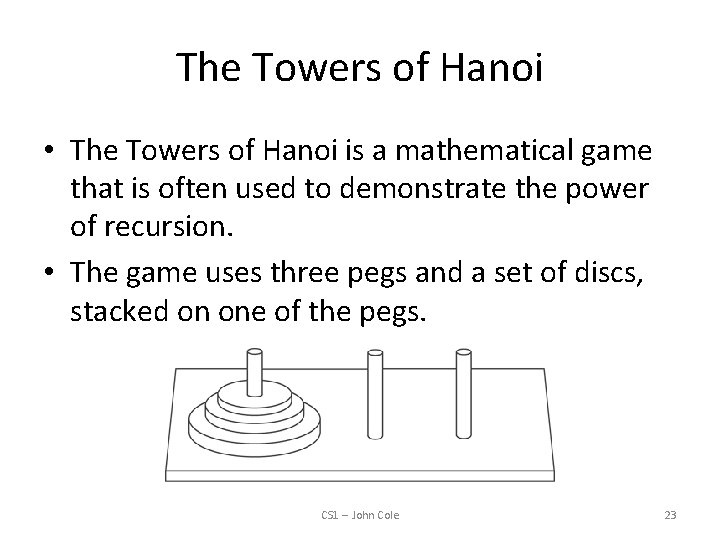
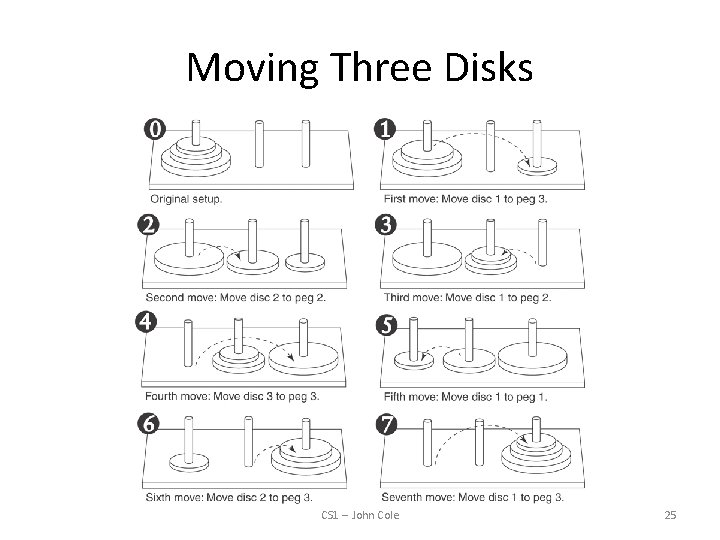
The Towers of Hanoi • The Towers of Hanoi is a mathematical game that is often used to demonstrate the power of recursion. • The game uses three pegs and a set of discs, stacked on one of the pegs. CS 1 -- John Cole 23
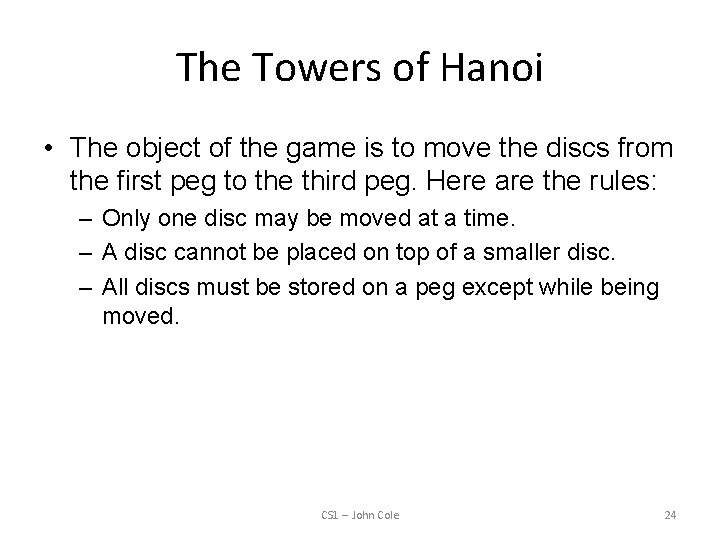
The Towers of Hanoi • The object of the game is to move the discs from the first peg to the third peg. Here are the rules: – Only one disc may be moved at a time. – A disc cannot be placed on top of a smaller disc. – All discs must be stored on a peg except while being moved. CS 1 -- John Cole 24
Moving Three Disks CS 1 -- John Cole 25
The Towers of Hanoi • The following statement describes the overall solution to the problem: – Move n discs from peg 1 to peg 3 using peg 2 as a temporary peg. CS 1 -- John Cole 26
The Towers of Hanoi • Algorithm – To move n discs from peg A to peg C, using peg B as a temporary peg: If n > 0 Then Move n – 1 discs from peg A to peg B, using peg C as a temporary peg. Move the remaining disc from the peg A to peg C. Move n – 1 discs from peg B to peg C, using peg A as a temporary peg. End If CS 1 -- John Cole 27
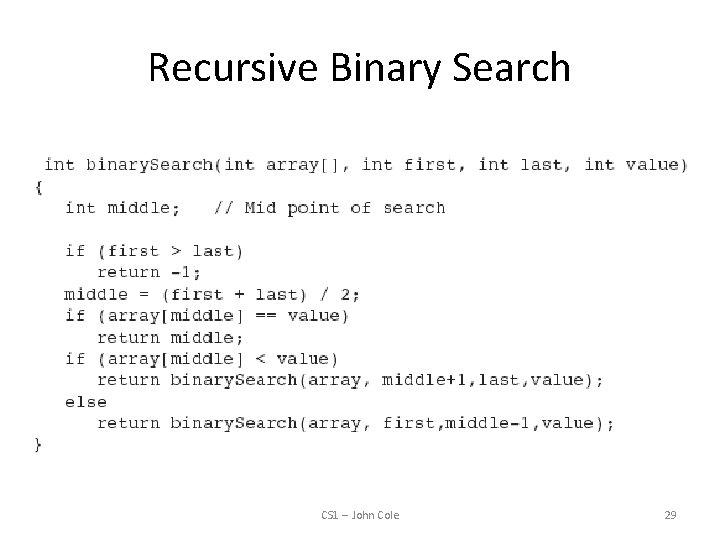
Recursive Binary Search • The binary search algorithm can easily be written to use recursion • Base cases: desired value is found, or no more array elements to search • Algorithm (array in ascending order): – If middle element of array segment is desired value, then done – Else, if the middle element is too large, repeat binary search in first half of array segment – Else, if the middle element is too small, repeat binary search on the second half of array segment CS 1 -- John Cole 28
Recursive Binary Search CS 1 -- John Cole 29
Quicksort • Recursive algorithm that can sort an array or a linear linked list • Determines an element/node to use as pivot value: CS 1 -- John Cole 30
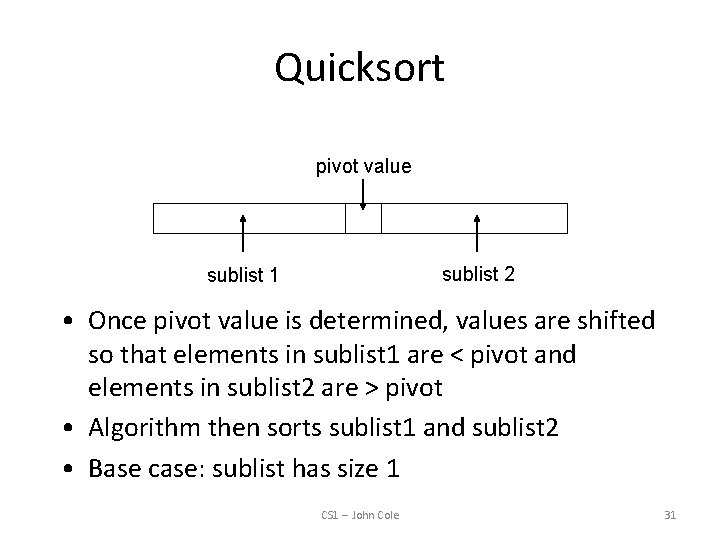
Quicksort pivot value sublist 2 sublist 1 • Once pivot value is determined, values are shifted so that elements in sublist 1 are < pivot and elements in sublist 2 are > pivot • Algorithm then sorts sublist 1 and sublist 2 • Base case: sublist has size 1 CS 1 -- John Cole 31
Exhaustive and Enumeration Algorithms • Exhaustive algorithm: search a set of combinations to find an optimal one Example: change for a certain amount of money that uses the fewest coins • Uses the generation of all possible combinations when determining the optimal one. • Anything where backtracking is needed. CS 1 -- John Cole 32