
Lesson 17 Evaluating an Exemplar Third Body Paragraph
Lesson 17 Evaluating an Exemplar Third Body Paragraph 1
Evaluating an Exemplar Third Body Paragraph We will look at the exemplar third body paragraph and pick out the strengths of the paragraph. Notice that some words or phrases represent more than one strength. 2
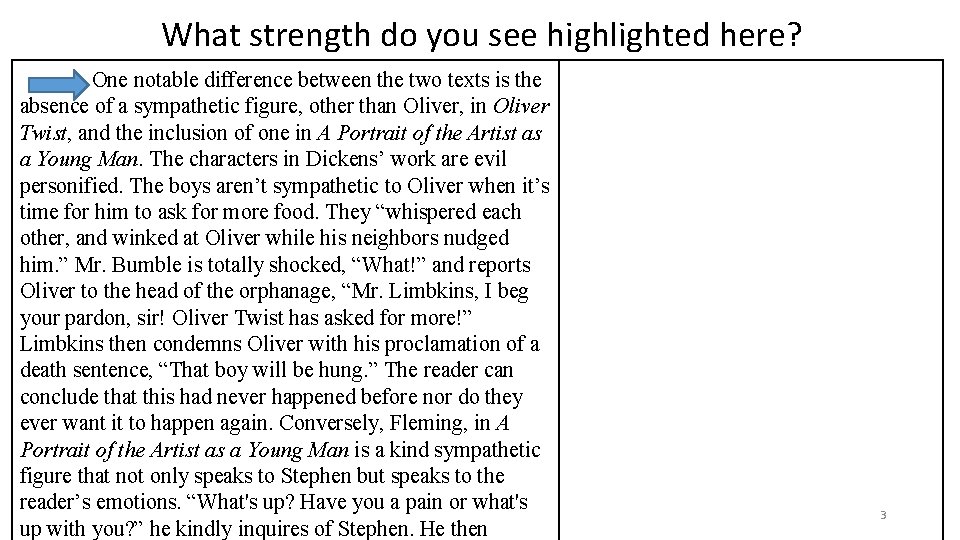
What strength do you see highlighted here? One notable difference between the two texts is the absence of a sympathetic figure, other than Oliver, in Oliver Twist, and the inclusion of one in A Portrait of the Artist as a Young Man. The characters in Dickens’ work are evil personified. The boys aren’t sympathetic to Oliver when it’s time for him to ask for more food. They “whispered each other, and winked at Oliver while his neighbors nudged him. ” Mr. Bumble is totally shocked, “What!” and reports Oliver to the head of the orphanage, “Mr. Limbkins, I beg your pardon, sir! Oliver Twist has asked for more!” Limbkins then condemns Oliver with his proclamation of a death sentence, “That boy will be hung. ” The reader can conclude that this had never happened before nor do they ever want it to happen again. Conversely, Fleming, in A Portrait of the Artist as a Young Man is a kind sympathetic figure that not only speaks to Stephen but speaks to the reader’s emotions. “What's up? Have you a pain or what's up with you? ” he kindly inquires of Stephen. He then 3
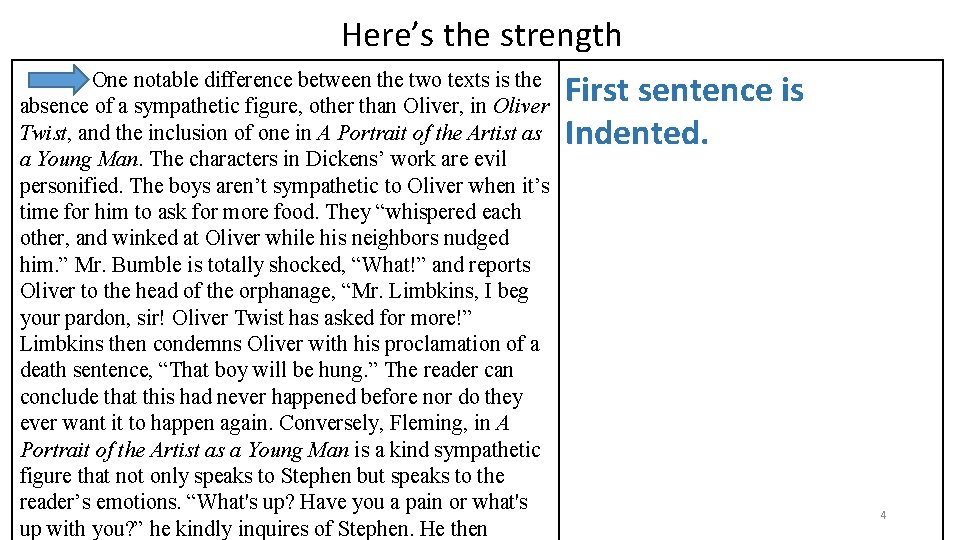
Here’s the strength One notable difference between the two texts is the absence of a sympathetic figure, other than Oliver, in Oliver Twist, and the inclusion of one in A Portrait of the Artist as a Young Man. The characters in Dickens’ work are evil personified. The boys aren’t sympathetic to Oliver when it’s time for him to ask for more food. They “whispered each other, and winked at Oliver while his neighbors nudged him. ” Mr. Bumble is totally shocked, “What!” and reports Oliver to the head of the orphanage, “Mr. Limbkins, I beg your pardon, sir! Oliver Twist has asked for more!” Limbkins then condemns Oliver with his proclamation of a death sentence, “That boy will be hung. ” The reader can conclude that this had never happened before nor do they ever want it to happen again. Conversely, Fleming, in A Portrait of the Artist as a Young Man is a kind sympathetic figure that not only speaks to Stephen but speaks to the reader’s emotions. “What's up? Have you a pain or what's up with you? ” he kindly inquires of Stephen. He then First sentence is Indented. 4
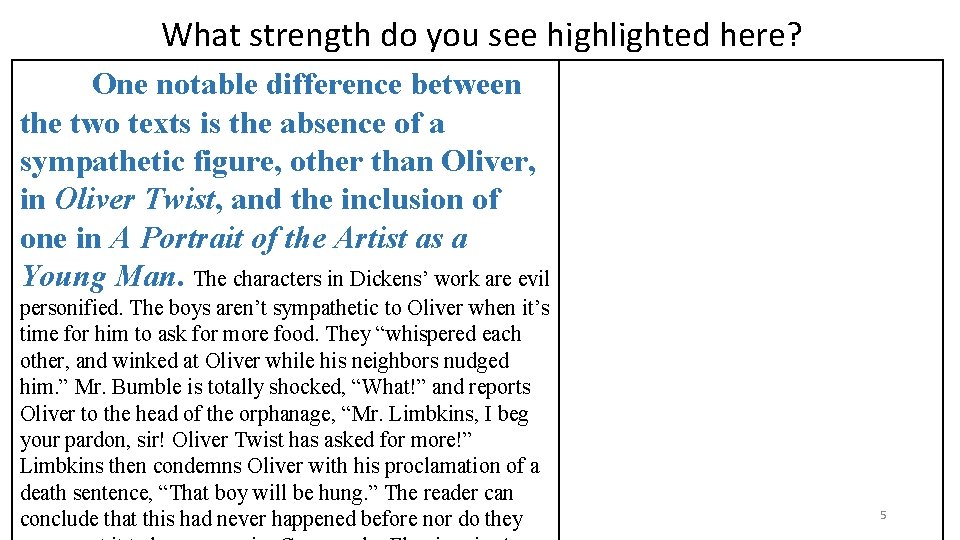
What strength do you see highlighted here? One notable difference between the two texts is the absence of a sympathetic figure, other than Oliver, in Oliver Twist, and the inclusion of one in A Portrait of the Artist as a Young Man. The characters in Dickens’ work are evil personified. The boys aren’t sympathetic to Oliver when it’s time for him to ask for more food. They “whispered each other, and winked at Oliver while his neighbors nudged him. ” Mr. Bumble is totally shocked, “What!” and reports Oliver to the head of the orphanage, “Mr. Limbkins, I beg your pardon, sir! Oliver Twist has asked for more!” Limbkins then condemns Oliver with his proclamation of a death sentence, “That boy will be hung. ” The reader can conclude that this had never happened before nor do they 5
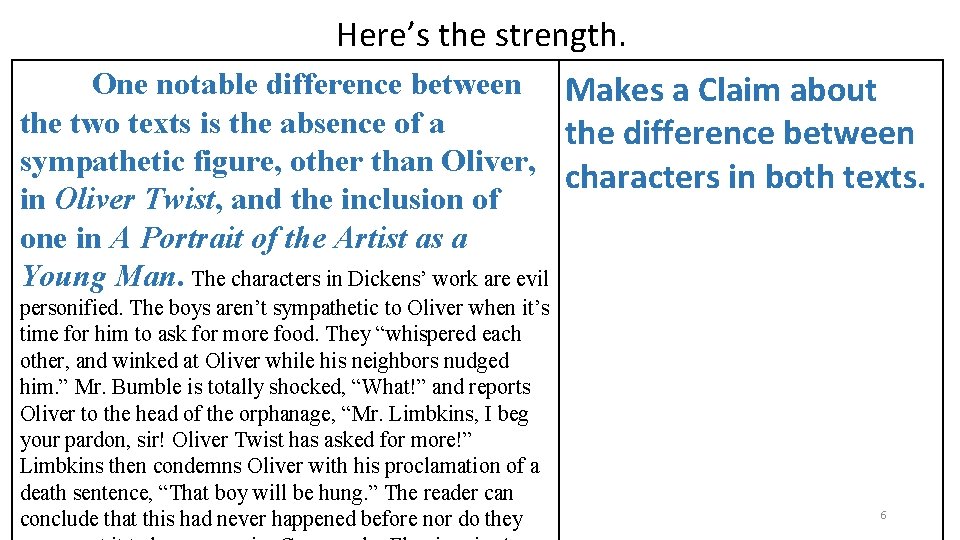
Here’s the strength. One notable difference between Makes a Claim about the two texts is the absence of a the difference between sympathetic figure, other than Oliver, characters in both texts. in Oliver Twist, and the inclusion of one in A Portrait of the Artist as a Young Man. The characters in Dickens’ work are evil personified. The boys aren’t sympathetic to Oliver when it’s time for him to ask for more food. They “whispered each other, and winked at Oliver while his neighbors nudged him. ” Mr. Bumble is totally shocked, “What!” and reports Oliver to the head of the orphanage, “Mr. Limbkins, I beg your pardon, sir! Oliver Twist has asked for more!” Limbkins then condemns Oliver with his proclamation of a death sentence, “That boy will be hung. ” The reader can conclude that this had never happened before nor do they 6
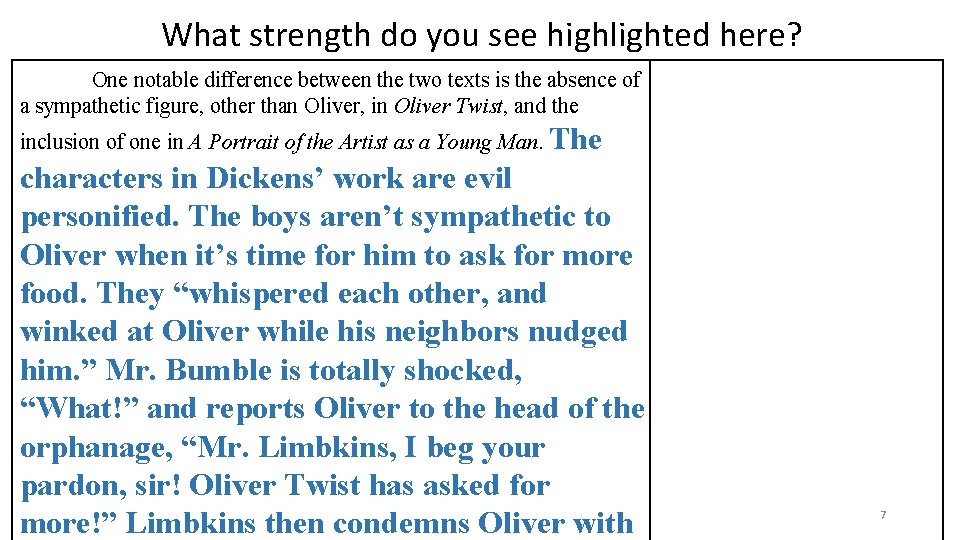
What strength do you see highlighted here? One notable difference between the two texts is the absence of a sympathetic figure, other than Oliver, in Oliver Twist, and the inclusion of one in A Portrait of the Artist as a Young Man. The characters in Dickens’ work are evil personified. The boys aren’t sympathetic to Oliver when it’s time for him to ask for more food. They “whispered each other, and winked at Oliver while his neighbors nudged him. ” Mr. Bumble is totally shocked, “What!” and reports Oliver to the head of the orphanage, “Mr. Limbkins, I beg your pardon, sir! Oliver Twist has asked for more!” Limbkins then condemns Oliver with 7
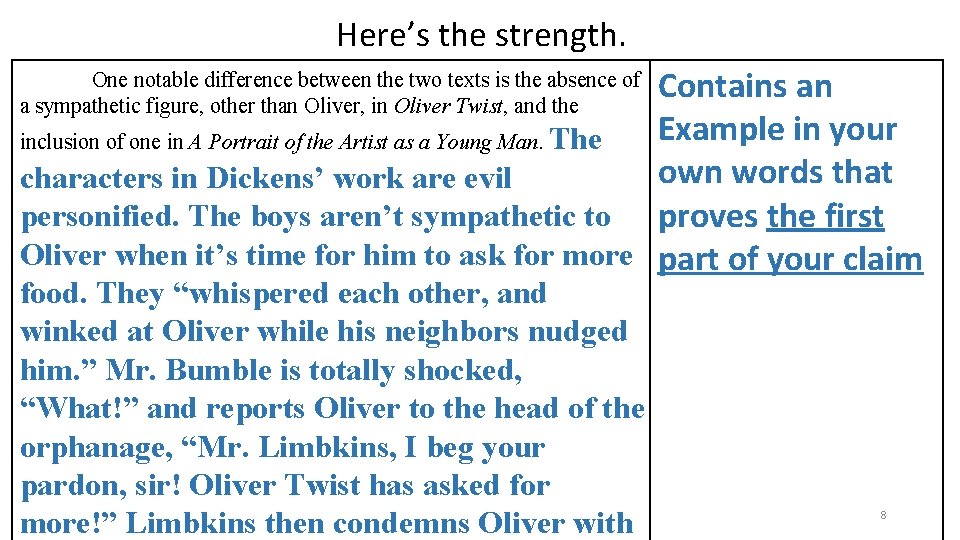
Here’s the strength. Contains an Example in your inclusion of one in A Portrait of the Artist as a Young Man. The own words that characters in Dickens’ work are evil personified. The boys aren’t sympathetic to proves the first Oliver when it’s time for him to ask for more part of your claim One notable difference between the two texts is the absence of a sympathetic figure, other than Oliver, in Oliver Twist, and the food. They “whispered each other, and winked at Oliver while his neighbors nudged him. ” Mr. Bumble is totally shocked, “What!” and reports Oliver to the head of the orphanage, “Mr. Limbkins, I beg your pardon, sir! Oliver Twist has asked for more!” Limbkins then condemns Oliver with 8
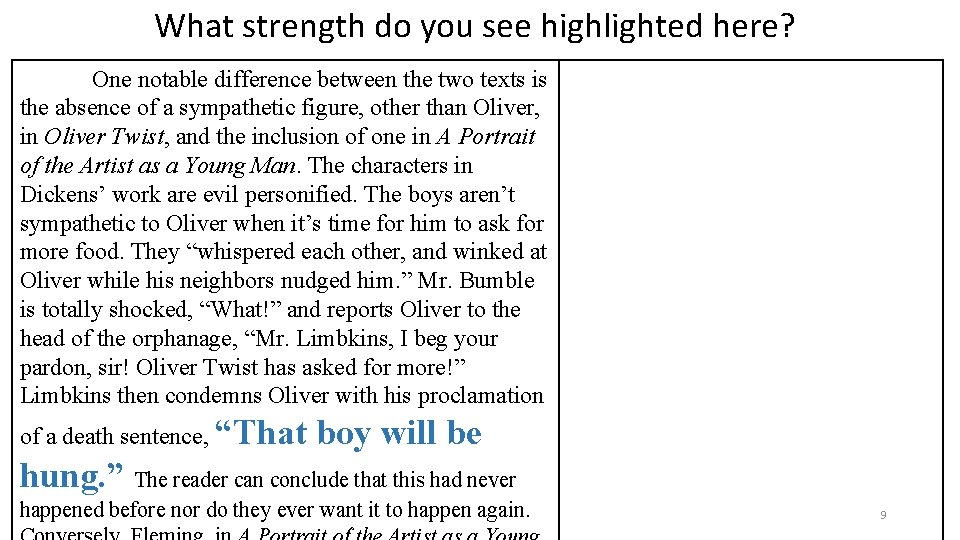
What strength do you see highlighted here? One notable difference between the two texts is the absence of a sympathetic figure, other than Oliver, in Oliver Twist, and the inclusion of one in A Portrait of the Artist as a Young Man. The characters in Dickens’ work are evil personified. The boys aren’t sympathetic to Oliver when it’s time for him to ask for more food. They “whispered each other, and winked at Oliver while his neighbors nudged him. ” Mr. Bumble is totally shocked, “What!” and reports Oliver to the head of the orphanage, “Mr. Limbkins, I beg your pardon, sir! Oliver Twist has asked for more!” Limbkins then condemns Oliver with his proclamation of a death sentence, “That boy will be hung. ” The reader can conclude that this had never happened before nor do they ever want it to happen again. 9
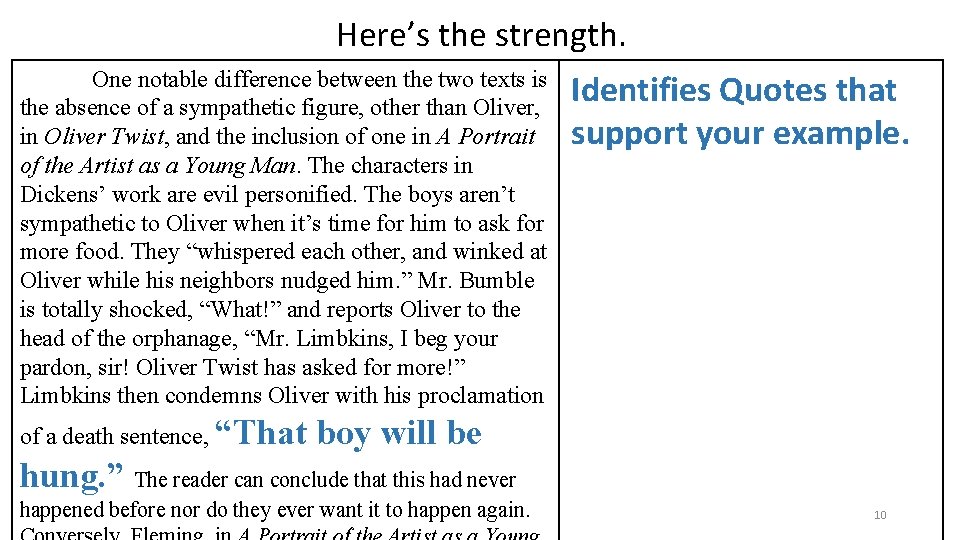
Here’s the strength. One notable difference between the two texts is the absence of a sympathetic figure, other than Oliver, in Oliver Twist, and the inclusion of one in A Portrait of the Artist as a Young Man. The characters in Dickens’ work are evil personified. The boys aren’t sympathetic to Oliver when it’s time for him to ask for more food. They “whispered each other, and winked at Oliver while his neighbors nudged him. ” Mr. Bumble is totally shocked, “What!” and reports Oliver to the head of the orphanage, “Mr. Limbkins, I beg your pardon, sir! Oliver Twist has asked for more!” Limbkins then condemns Oliver with his proclamation of a death sentence, “That Identifies Quotes that support your example. boy will be hung. ” The reader can conclude that this had never happened before nor do they ever want it to happen again. 10
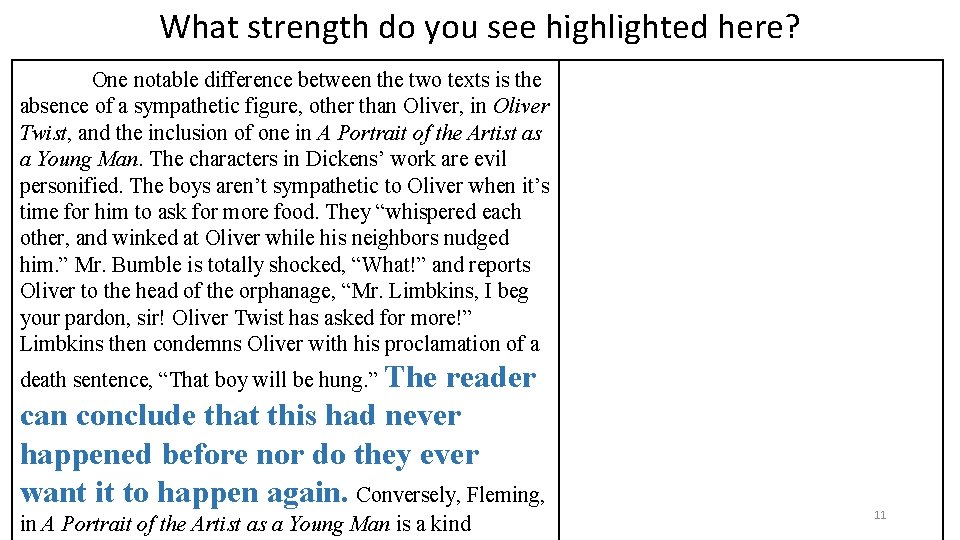
What strength do you see highlighted here? One notable difference between the two texts is the absence of a sympathetic figure, other than Oliver, in Oliver Twist, and the inclusion of one in A Portrait of the Artist as a Young Man. The characters in Dickens’ work are evil personified. The boys aren’t sympathetic to Oliver when it’s time for him to ask for more food. They “whispered each other, and winked at Oliver while his neighbors nudged him. ” Mr. Bumble is totally shocked, “What!” and reports Oliver to the head of the orphanage, “Mr. Limbkins, I beg your pardon, sir! Oliver Twist has asked for more!” Limbkins then condemns Oliver with his proclamation of a death sentence, “That boy will be hung. ” The reader can conclude that this had never happened before nor do they ever want it to happen again. Conversely, Fleming, in A Portrait of the Artist as a Young Man is a kind 11
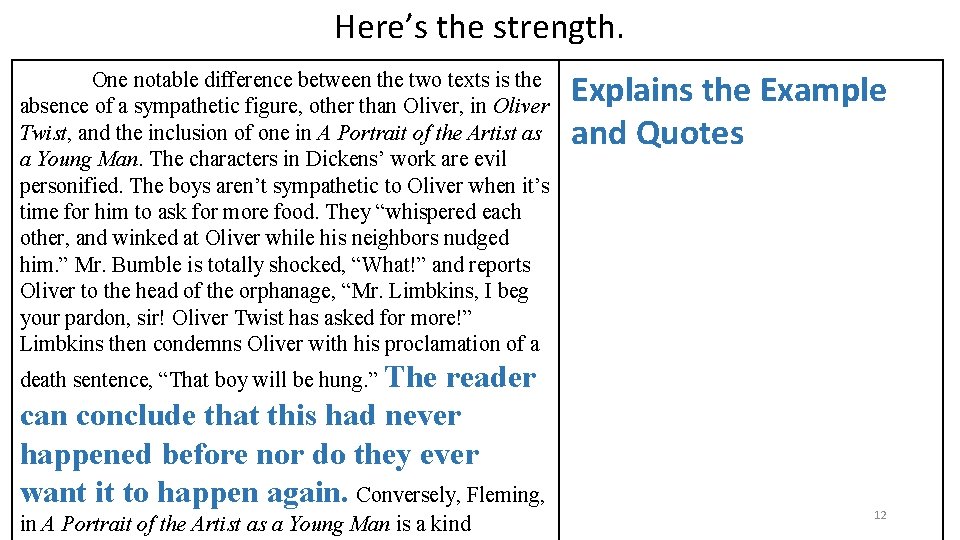
Here’s the strength. One notable difference between the two texts is the absence of a sympathetic figure, other than Oliver, in Oliver Twist, and the inclusion of one in A Portrait of the Artist as a Young Man. The characters in Dickens’ work are evil personified. The boys aren’t sympathetic to Oliver when it’s time for him to ask for more food. They “whispered each other, and winked at Oliver while his neighbors nudged him. ” Mr. Bumble is totally shocked, “What!” and reports Oliver to the head of the orphanage, “Mr. Limbkins, I beg your pardon, sir! Oliver Twist has asked for more!” Limbkins then condemns Oliver with his proclamation of a reader can conclude that this had never happened before nor do they ever want it to happen again. Conversely, Fleming, Explains the Example and Quotes death sentence, “That boy will be hung. ” The in A Portrait of the Artist as a Young Man is a kind 12
What strength do you see highlighted here? Oliver to the head of the orphanage, “Mr. Limbkins, I beg your pardon, sir! Oliver Twist has asked for more!” Limbkins then condemns Oliver with his proclamation of a death sentence, “That boy will be hung. ” The reader can conclude that this had never happened before nor do they Conversely, Fleming, in A Portrait of the Artist as a Young Man is a kind sympathetic figure that not only speaks to Stephen but speaks to the reader’s emotions. “What's up? Have ever want it to happen again. you a pain or what's up with you? ” he kindly inquires of Stephen. He then reassures Stephen that “It will go away. ” This is indicative of a kind sympathetic person who is 13
Here is the strength. Oliver to the head of the orphanage, “Mr. Limbkins, I beg your pardon, sir! Oliver Twist has asked for more!” Limbkins then condemns Oliver with his proclamation of a death sentence, “That boy will be hung. ” The reader can conclude that this had never happened before nor do they Conversely, Fleming, in A Portrait of the Artist as a Young Man is a kind sympathetic figure that not only speaks to Stephen but speaks to the reader’s emotions. “What's up? Have ever want it to happen again. you a pain or what's up with you? ” he kindly inquires of Stephen. He then reassures Stephen that “It will go away. ” This is indicative of a kind sympathetic person who is Gives an Example in your own words that proves the second part of your claim 14
What strength do you see highlighted here? Oliver to the head of the orphanage, “Mr. Limbkins, I beg your pardon, sir! Oliver Twist has asked for more!” Limbkins then condemns Oliver with his proclamation of a death sentence, “That boy will be hung. ” The reader can conclude that this had never happened before nor do they ever want it to happen again. Conversely, Fleming, in A Portrait of the Artist as a Young Man is a kind sympathetic figure that not only speaks to Stephen but speaks to the “What's up? Have you a pain or what's up with you? ” he kindly inquires of Stephen. He then reassures Stephen that “It will go away. ” This is indicative of a kind reader’s emotions. sympathetic person who is concerned for Stephen’s welfare. 15
Here’s the strength. Oliver to the head of the orphanage, “Mr. Limbkins, I beg your pardon, sir! Oliver Twist has asked for more!” Limbkins then condemns Oliver with his proclamation of a death sentence, “That boy will be hung. ” The reader can conclude that this had never happened before nor do they ever want it to happen again. Conversely, Fleming, in A Portrait of the Artist as a Young Man is a kind sympathetic figure that not only speaks to Stephen but speaks to the Identifies Quotes that support your example. “What's up? Have you a pain or what's up with you? ” he kindly inquires of Stephen. He then reassures Stephen that “It will go away. ” This is indicative of a kind reader’s emotions. sympathetic person who is concerned for Stephen’s welfare. 16
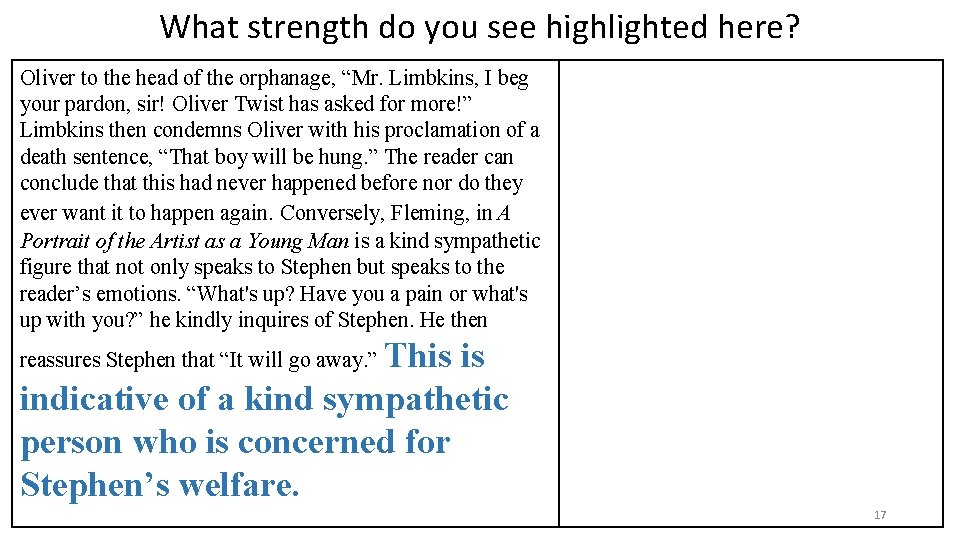
What strength do you see highlighted here? Oliver to the head of the orphanage, “Mr. Limbkins, I beg your pardon, sir! Oliver Twist has asked for more!” Limbkins then condemns Oliver with his proclamation of a death sentence, “That boy will be hung. ” The reader can conclude that this had never happened before nor do they ever want it to happen again. Conversely, Fleming, in A Portrait of the Artist as a Young Man is a kind sympathetic figure that not only speaks to Stephen but speaks to the reader’s emotions. “What's up? Have you a pain or what's up with you? ” he kindly inquires of Stephen. He then This is indicative of a kind sympathetic person who is concerned for Stephen’s welfare. reassures Stephen that “It will go away. ” 17
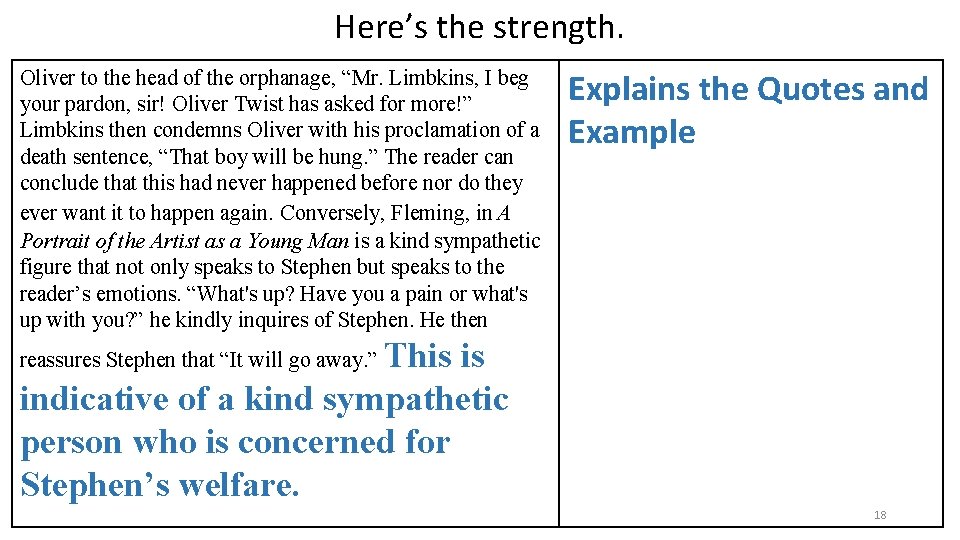
Here’s the strength. Oliver to the head of the orphanage, “Mr. Limbkins, I beg your pardon, sir! Oliver Twist has asked for more!” Limbkins then condemns Oliver with his proclamation of a death sentence, “That boy will be hung. ” The reader can conclude that this had never happened before nor do they ever want it to happen again. Conversely, Fleming, in A Portrait of the Artist as a Young Man is a kind sympathetic figure that not only speaks to Stephen but speaks to the reader’s emotions. “What's up? Have you a pain or what's up with you? ” he kindly inquires of Stephen. He then Explains the Quotes and Example This is indicative of a kind sympathetic person who is concerned for Stephen’s welfare. reassures Stephen that “It will go away. ” 18
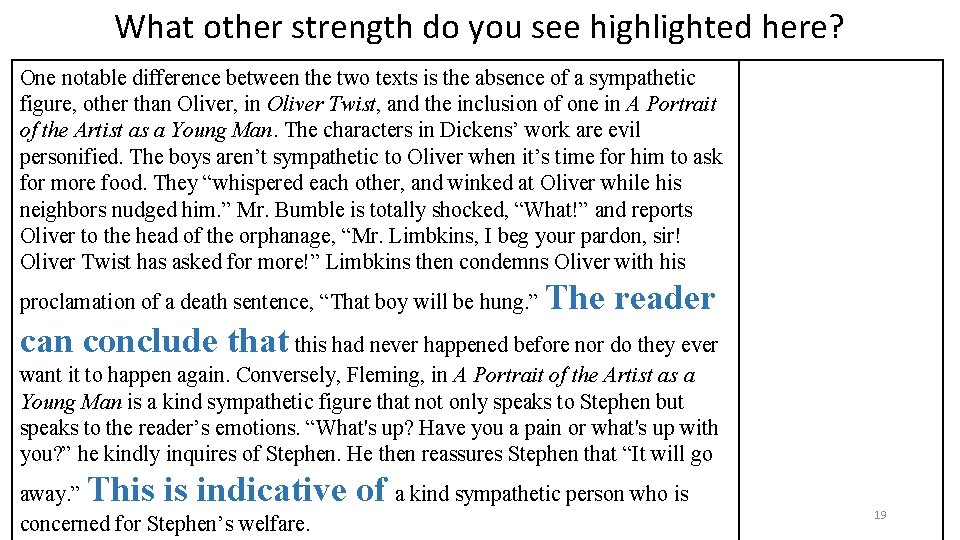
What other strength do you see highlighted here? One notable difference between the two texts is the absence of a sympathetic figure, other than Oliver, in Oliver Twist, and the inclusion of one in A Portrait of the Artist as a Young Man. The characters in Dickens’ work are evil personified. The boys aren’t sympathetic to Oliver when it’s time for him to ask for more food. They “whispered each other, and winked at Oliver while his neighbors nudged him. ” Mr. Bumble is totally shocked, “What!” and reports Oliver to the head of the orphanage, “Mr. Limbkins, I beg your pardon, sir! Oliver Twist has asked for more!” Limbkins then condemns Oliver with his proclamation of a death sentence, “That boy will be hung. ” The reader can conclude that this had never happened before nor do they ever want it to happen again. Conversely, Fleming, in A Portrait of the Artist as a Young Man is a kind sympathetic figure that not only speaks to Stephen but speaks to the reader’s emotions. “What's up? Have you a pain or what's up with you? ” he kindly inquires of Stephen. He then reassures Stephen that “It will go This is indicative of a kind sympathetic person who is away. ” concerned for Stephen’s welfare. 19
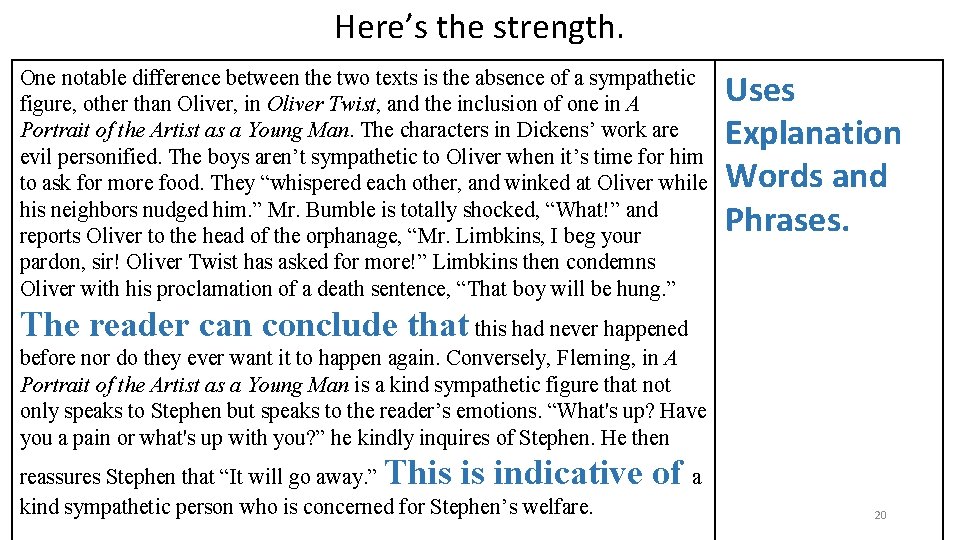
Here’s the strength. One notable difference between the two texts is the absence of a sympathetic figure, other than Oliver, in Oliver Twist, and the inclusion of one in A Portrait of the Artist as a Young Man. The characters in Dickens’ work are evil personified. The boys aren’t sympathetic to Oliver when it’s time for him to ask for more food. They “whispered each other, and winked at Oliver while his neighbors nudged him. ” Mr. Bumble is totally shocked, “What!” and reports Oliver to the head of the orphanage, “Mr. Limbkins, I beg your pardon, sir! Oliver Twist has asked for more!” Limbkins then condemns Oliver with his proclamation of a death sentence, “That boy will be hung. ” Uses Explanation Words and Phrases. The reader can conclude that this had never happened before nor do they ever want it to happen again. Conversely, Fleming, in A Portrait of the Artist as a Young Man is a kind sympathetic figure that not only speaks to Stephen but speaks to the reader’s emotions. “What's up? Have you a pain or what's up with you? ” he kindly inquires of Stephen. He then This is indicative of a reassures Stephen that “It will go away. ” kind sympathetic person who is concerned for Stephen’s welfare. 20
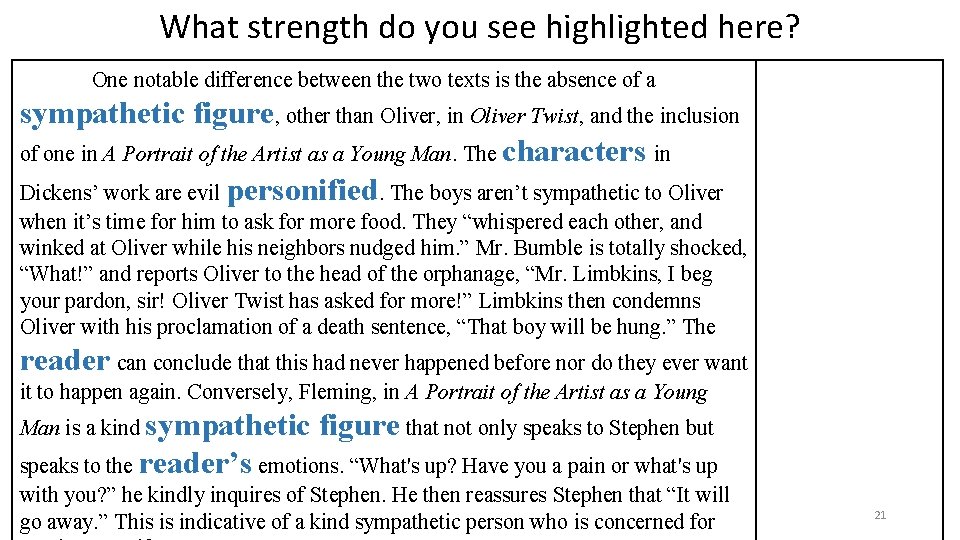
What strength do you see highlighted here? One notable difference between the two texts is the absence of a sympathetic figure, other than Oliver, in Oliver Twist, and the inclusion of one in A Portrait of the Artist as a Young Man. The characters in Dickens’ work are evil personified. The boys aren’t sympathetic to Oliver when it’s time for him to ask for more food. They “whispered each other, and winked at Oliver while his neighbors nudged him. ” Mr. Bumble is totally shocked, “What!” and reports Oliver to the head of the orphanage, “Mr. Limbkins, I beg your pardon, sir! Oliver Twist has asked for more!” Limbkins then condemns Oliver with his proclamation of a death sentence, “That boy will be hung. ” The reader can conclude that this had never happened before nor do they ever want it to happen again. Conversely, Fleming, in A Portrait of the Artist as a Young Man is a kind sympathetic figure that not only speaks to Stephen but speaks to the reader’s emotions. “What's up? Have you a pain or what's up with you? ” he kindly inquires of Stephen. He then reassures Stephen that “It will go away. ” This is indicative of a kind sympathetic person who is concerned for 21
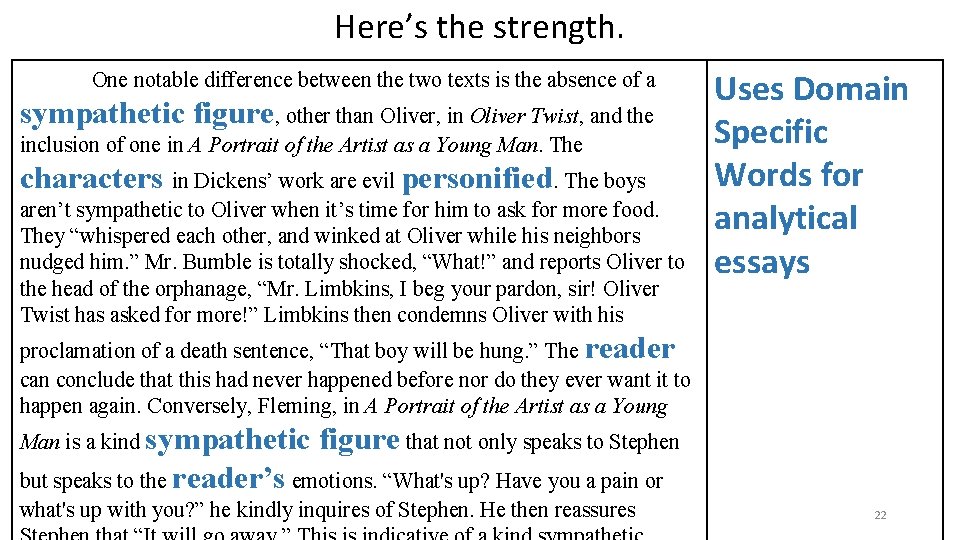
Here’s the strength. One notable difference between the two texts is the absence of a sympathetic figure, other than Oliver, in Oliver Twist, and the inclusion of one in A Portrait of the Artist as a Young Man. The characters in Dickens’ work are evil personified. The boys aren’t sympathetic to Oliver when it’s time for him to ask for more food. They “whispered each other, and winked at Oliver while his neighbors nudged him. ” Mr. Bumble is totally shocked, “What!” and reports Oliver to the head of the orphanage, “Mr. Limbkins, I beg your pardon, sir! Oliver Twist has asked for more!” Limbkins then condemns Oliver with his Uses Domain Specific Words for analytical essays proclamation of a death sentence, “That boy will be hung. ” The reader can conclude that this had never happened before nor do they ever want it to happen again. Conversely, Fleming, in A Portrait of the Artist as a Young Man is a kind sympathetic figure that not only speaks to Stephen but speaks to the reader’s emotions. “What's up? Have you a pain or what's up with you? ” he kindly inquires of Stephen. He then reassures 22
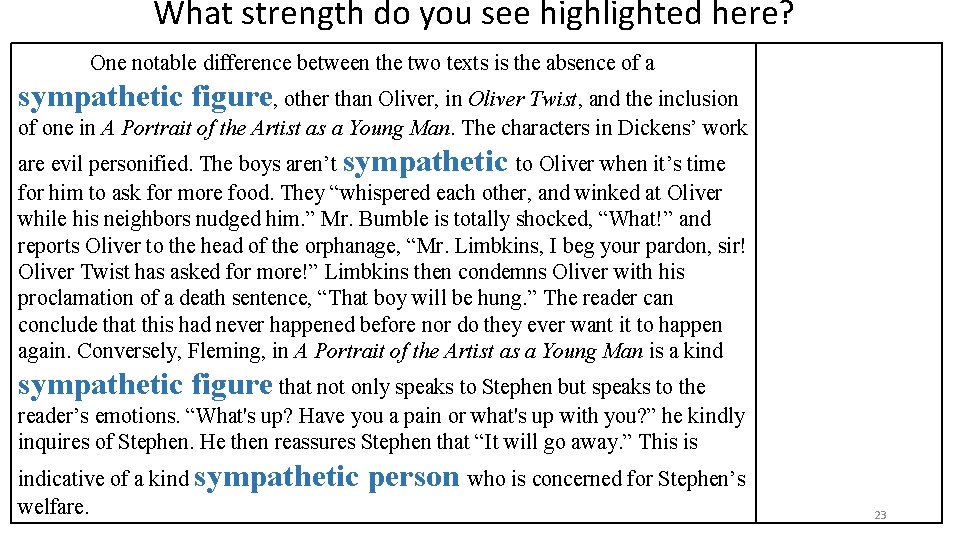
What strength do you see highlighted here? One notable difference between the two texts is the absence of a sympathetic figure, other than Oliver, in Oliver Twist, and the inclusion of one in A Portrait of the Artist as a Young Man. The characters in Dickens’ work are evil personified. The boys aren’t sympathetic to Oliver when it’s time for him to ask for more food. They “whispered each other, and winked at Oliver while his neighbors nudged him. ” Mr. Bumble is totally shocked, “What!” and reports Oliver to the head of the orphanage, “Mr. Limbkins, I beg your pardon, sir! Oliver Twist has asked for more!” Limbkins then condemns Oliver with his proclamation of a death sentence, “That boy will be hung. ” The reader can conclude that this had never happened before nor do they ever want it to happen again. Conversely, Fleming, in A Portrait of the Artist as a Young Man is a kind sympathetic figure that not only speaks to Stephen but speaks to the reader’s emotions. “What's up? Have you a pain or what's up with you? ” he kindly inquires of Stephen. He then reassures Stephen that “It will go away. ” This is indicative of a kind sympathetic welfare. person who is concerned for Stephen’s 23
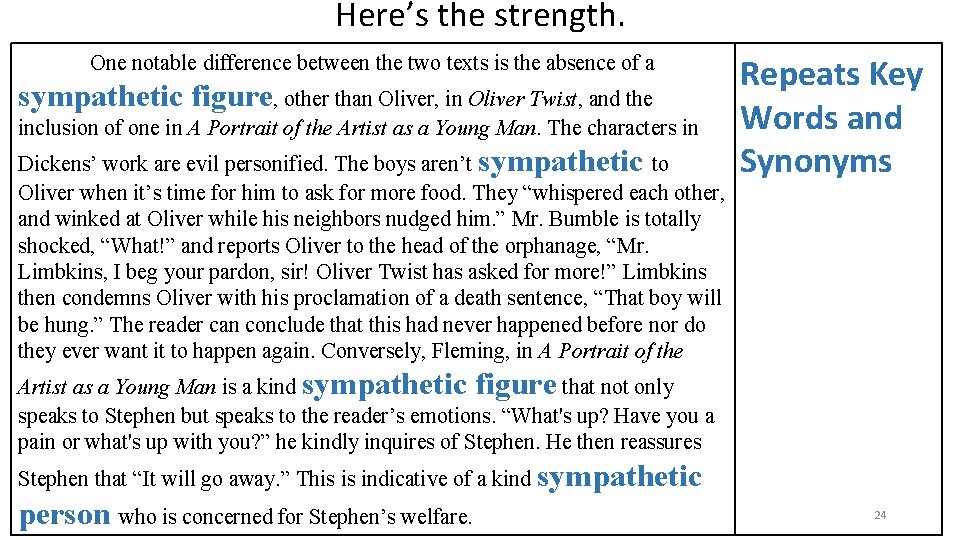
Here’s the strength. One notable difference between the two texts is the absence of a sympathetic figure, other than Oliver, in Oliver Twist, and the inclusion of one in A Portrait of the Artist as a Young Man. The characters in Dickens’ work are evil personified. The boys aren’t sympathetic to Oliver when it’s time for him to ask for more food. They “whispered each other, and winked at Oliver while his neighbors nudged him. ” Mr. Bumble is totally shocked, “What!” and reports Oliver to the head of the orphanage, “Mr. Limbkins, I beg your pardon, sir! Oliver Twist has asked for more!” Limbkins then condemns Oliver with his proclamation of a death sentence, “That boy will be hung. ” The reader can conclude that this had never happened before nor do they ever want it to happen again. Conversely, Fleming, in A Portrait of the Repeats Key Words and Synonyms Artist as a Young Man is a kind sympathetic figure that not only speaks to Stephen but speaks to the reader’s emotions. “What's up? Have you a pain or what's up with you? ” he kindly inquires of Stephen. He then reassures Stephen that “It will go away. ” This is indicative of a kind sympathetic person who is concerned for Stephen’s welfare. 24
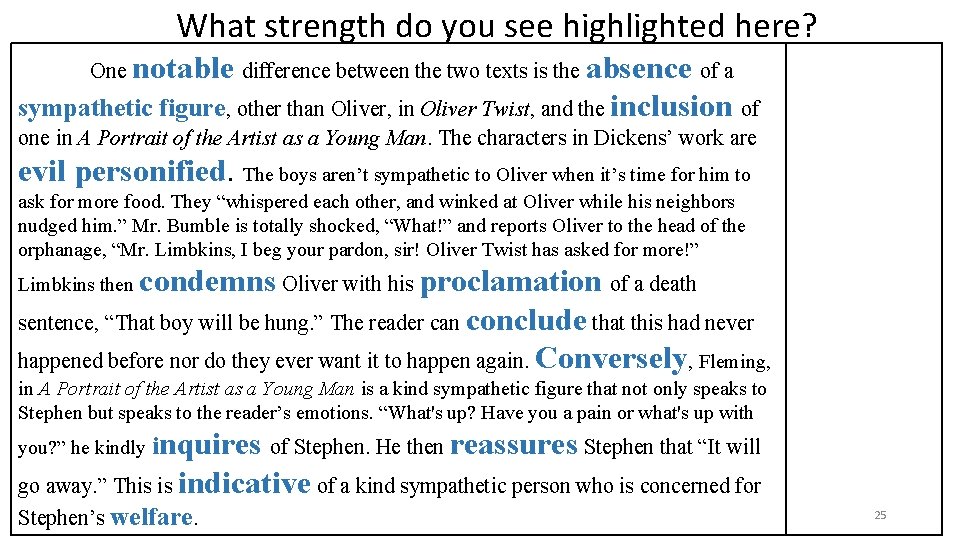
What strength do you see highlighted here? One notable difference between the two texts is the absence of a sympathetic figure, other than Oliver, in Oliver Twist, and the inclusion of one in A Portrait of the Artist as a Young Man. The characters in Dickens’ work are evil personified. The boys aren’t sympathetic to Oliver when it’s time for him to ask for more food. They “whispered each other, and winked at Oliver while his neighbors nudged him. ” Mr. Bumble is totally shocked, “What!” and reports Oliver to the head of the orphanage, “Mr. Limbkins, I beg your pardon, sir! Oliver Twist has asked for more!” condemns Oliver with his proclamation of a death sentence, “That boy will be hung. ” The reader can conclude that this had never happened before nor do they ever want it to happen again. Conversely, Fleming, Limbkins then in A Portrait of the Artist as a Young Man is a kind sympathetic figure that not only speaks to Stephen but speaks to the reader’s emotions. “What's up? Have you a pain or what's up with nquires of Stephen. He then reassures Stephen that “It will go away. ” This is indicative of a kind sympathetic person who is concerned for you? ” he kindly i Stephen’s welfare. 25
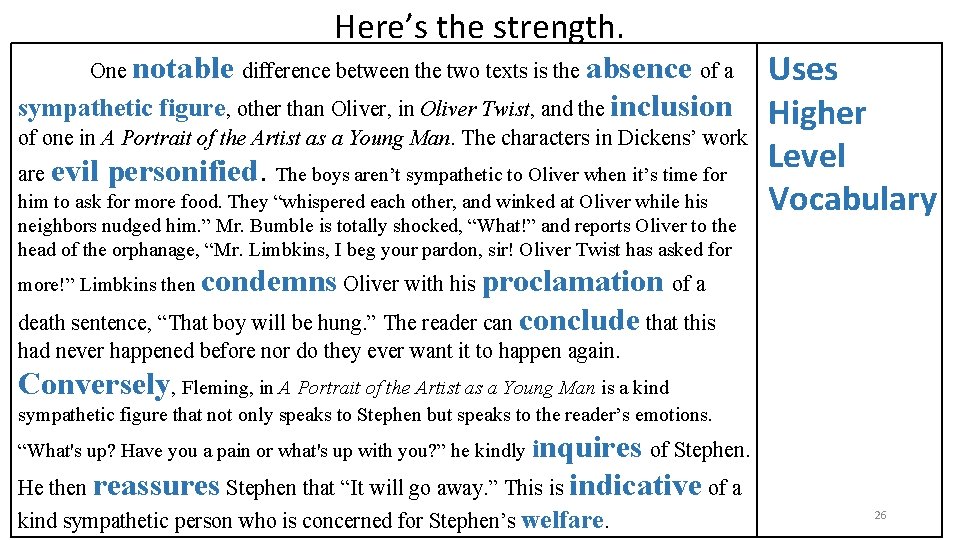
Here’s the strength. Uses sympathetic figure, other than Oliver, in Oliver Twist, and the inclusion Higher of one in A Portrait of the Artist as a Young Man. The characters in Dickens’ work Level are evil personified. The boys aren’t sympathetic to Oliver when it’s time for him to ask for more food. They “whispered each other, and winked at Oliver while his Vocabulary One notable difference between the two texts is the absence of a neighbors nudged him. ” Mr. Bumble is totally shocked, “What!” and reports Oliver to the head of the orphanage, “Mr. Limbkins, I beg your pardon, sir! Oliver Twist has asked for condemns Oliver with his proclamation of a death sentence, “That boy will be hung. ” The reader can conclude that this more!” Limbkins then had never happened before nor do they ever want it to happen again. Conversely, Fleming, in A Portrait of the Artist as a Young Man is a kind sympathetic figure that not only speaks to Stephen but speaks to the reader’s emotions. nquires of Stephen. He then reassures Stephen that “It will go away. ” This is indicative of a “What's up? Have you a pain or what's up with you? ” he kindly i kind sympathetic person who is concerned for Stephen’s welfare. 26
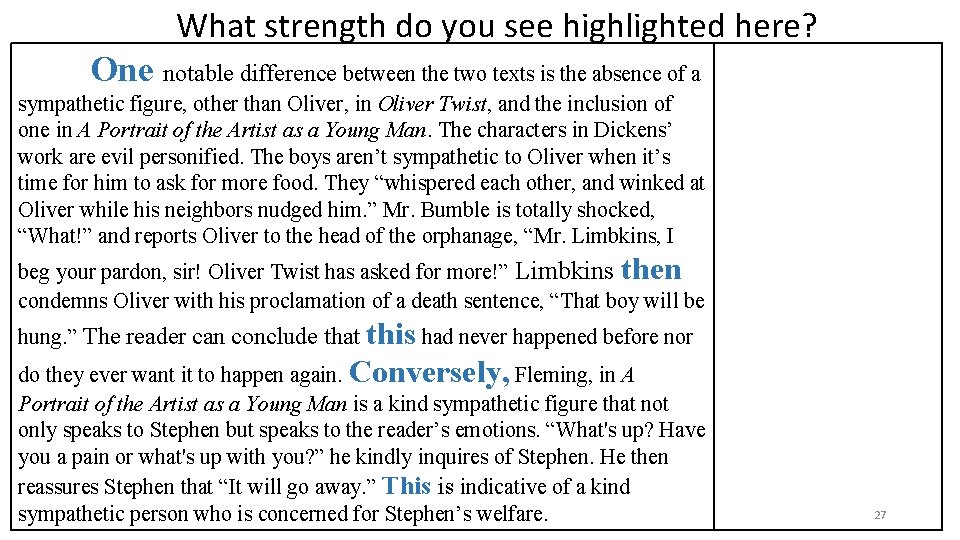
What strength do you see highlighted here? One notable difference between the two texts is the absence of a sympathetic figure, other than Oliver, in Oliver Twist, and the inclusion of one in A Portrait of the Artist as a Young Man. The characters in Dickens’ work are evil personified. The boys aren’t sympathetic to Oliver when it’s time for him to ask for more food. They “whispered each other, and winked at Oliver while his neighbors nudged him. ” Mr. Bumble is totally shocked, “What!” and reports Oliver to the head of the orphanage, “Mr. Limbkins, I beg your pardon, sir! Oliver Twist has asked for more!” Limbkins then condemns Oliver with his proclamation of a death sentence, “That boy will be hung. ” The reader can conclude that this had never happened before nor do they ever want it to happen again. Conversely, Fleming, in A Portrait of the Artist as a Young Man is a kind sympathetic figure that not only speaks to Stephen but speaks to the reader’s emotions. “What's up? Have you a pain or what's up with you? ” he kindly inquires of Stephen. He then reassures Stephen that “It will go away. ” This is indicative of a kind sympathetic person who is concerned for Stephen’s welfare. 27
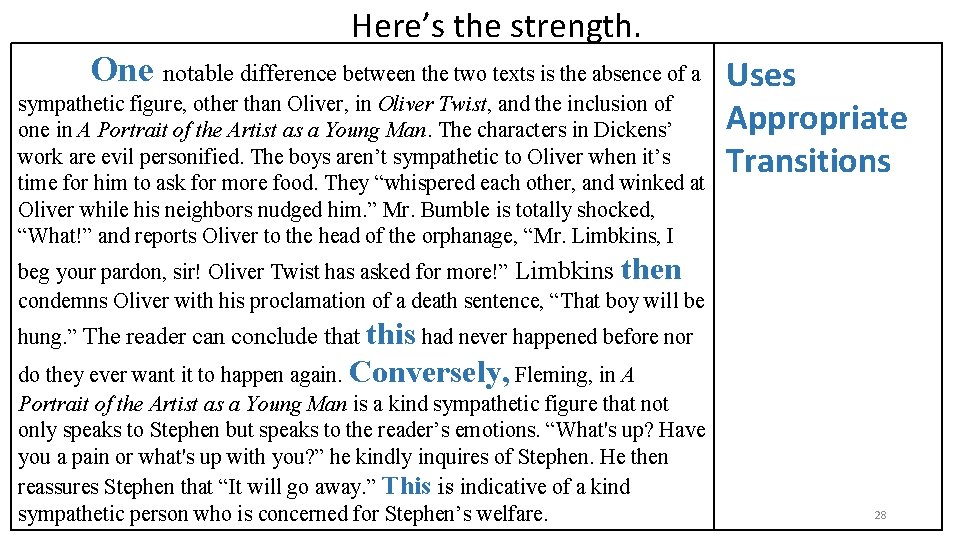
Here’s the strength. One notable difference between the two texts is the absence of a Uses sympathetic figure, other than Oliver, in Oliver Twist, and the inclusion of Appropriate one in A Portrait of the Artist as a Young Man. The characters in Dickens’ work are evil personified. The boys aren’t sympathetic to Oliver when it’s Transitions time for him to ask for more food. They “whispered each other, and winked at Oliver while his neighbors nudged him. ” Mr. Bumble is totally shocked, “What!” and reports Oliver to the head of the orphanage, “Mr. Limbkins, I beg your pardon, sir! Oliver Twist has asked for more!” Limbkins then condemns Oliver with his proclamation of a death sentence, “That boy will be hung. ” The reader can conclude that this had never happened before nor do they ever want it to happen again. Conversely, Fleming, in A Portrait of the Artist as a Young Man is a kind sympathetic figure that not only speaks to Stephen but speaks to the reader’s emotions. “What's up? Have you a pain or what's up with you? ” he kindly inquires of Stephen. He then reassures Stephen that “It will go away. ” This is indicative of a kind sympathetic person who is concerned for Stephen’s welfare. 28
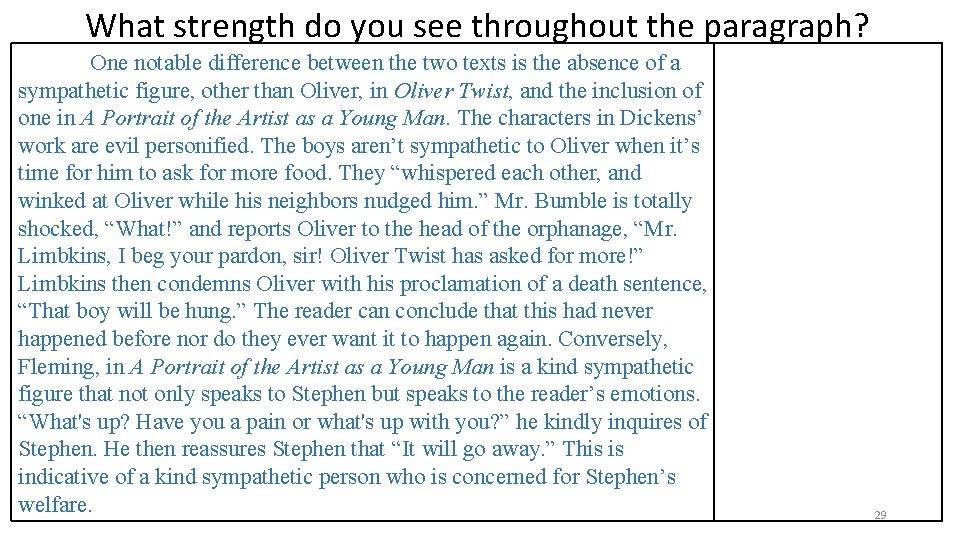
What strength do you see throughout the paragraph? One notable difference between the two texts is the absence of a sympathetic figure, other than Oliver, in Oliver Twist, and the inclusion of one in A Portrait of the Artist as a Young Man. The characters in Dickens’ work are evil personified. The boys aren’t sympathetic to Oliver when it’s time for him to ask for more food. They “whispered each other, and winked at Oliver while his neighbors nudged him. ” Mr. Bumble is totally shocked, “What!” and reports Oliver to the head of the orphanage, “Mr. Limbkins, I beg your pardon, sir! Oliver Twist has asked for more!” Limbkins then condemns Oliver with his proclamation of a death sentence, “That boy will be hung. ” The reader can conclude that this had never happened before nor do they ever want it to happen again. Conversely, Fleming, in A Portrait of the Artist as a Young Man is a kind sympathetic figure that not only speaks to Stephen but speaks to the reader’s emotions. “What's up? Have you a pain or what's up with you? ” he kindly inquires of Stephen. He then reassures Stephen that “It will go away. ” This is indicative of a kind sympathetic person who is concerned for Stephen’s welfare. 29
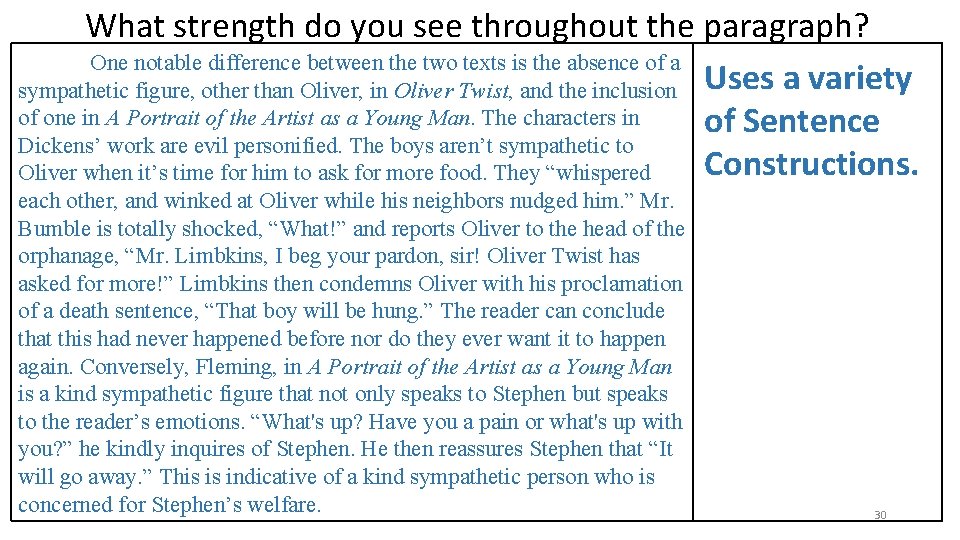
What strength do you see throughout the paragraph? One notable difference between the two texts is the absence of a sympathetic figure, other than Oliver, in Oliver Twist, and the inclusion Uses a variety of one in A Portrait of the Artist as a Young Man. The characters in of Sentence Dickens’ work are evil personified. The boys aren’t sympathetic to Constructions. Oliver when it’s time for him to ask for more food. They “whispered each other, and winked at Oliver while his neighbors nudged him. ” Mr. Bumble is totally shocked, “What!” and reports Oliver to the head of the orphanage, “Mr. Limbkins, I beg your pardon, sir! Oliver Twist has asked for more!” Limbkins then condemns Oliver with his proclamation of a death sentence, “That boy will be hung. ” The reader can conclude that this had never happened before nor do they ever want it to happen again. Conversely, Fleming, in A Portrait of the Artist as a Young Man is a kind sympathetic figure that not only speaks to Stephen but speaks to the reader’s emotions. “What's up? Have you a pain or what's up with you? ” he kindly inquires of Stephen. He then reassures Stephen that “It will go away. ” This is indicative of a kind sympathetic person who is concerned for Stephen’s welfare. 30
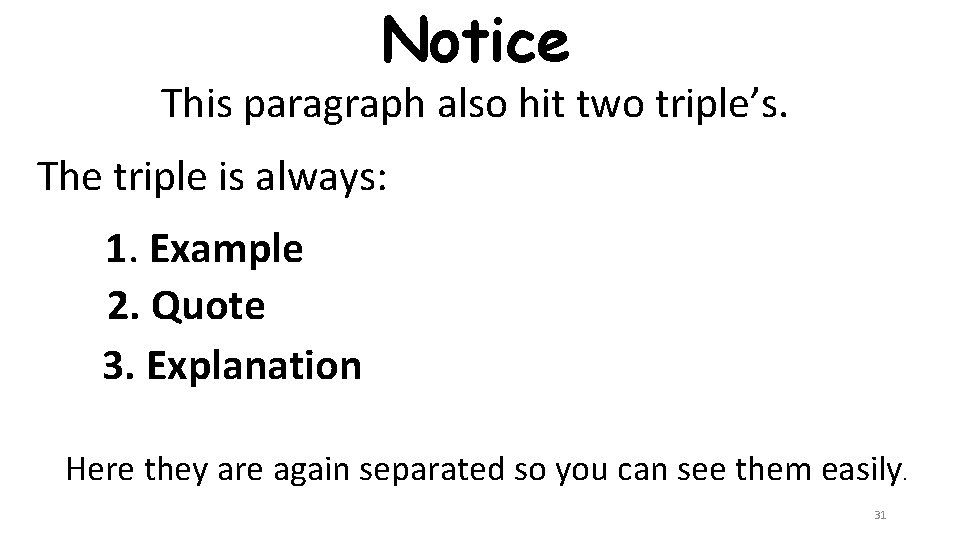
Notice This paragraph also hit two triple’s. The triple is always: 1. Example 2. Quote 3. Explanation Here they are again separated so you can see them easily. 31
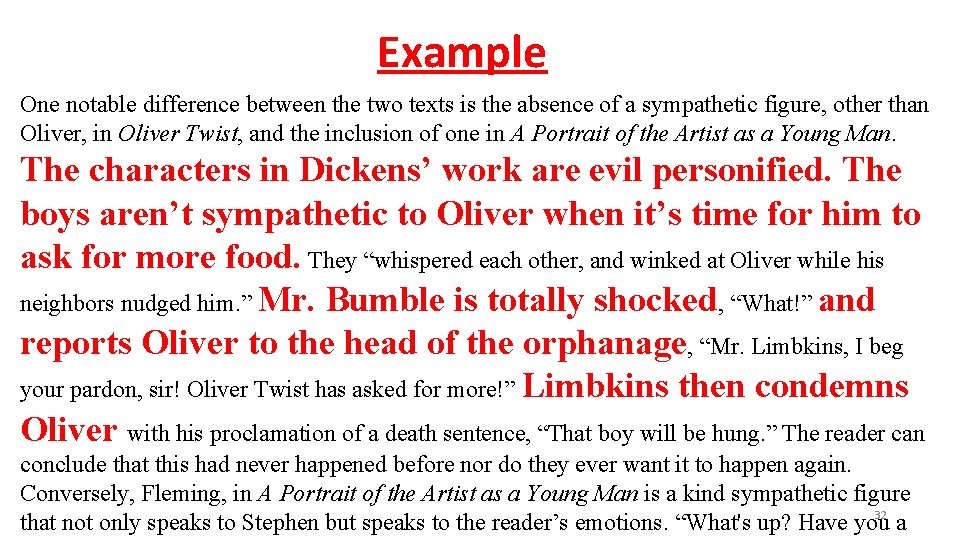
Example One notable difference between the two texts is the absence of a sympathetic figure, other than Oliver, in Oliver Twist, and the inclusion of one in A Portrait of the Artist as a Young Man. The characters in Dickens’ work are evil personified. The boys aren’t sympathetic to Oliver when it’s time for him to ask for more food. They “whispered each other, and winked at Oliver while his neighbors nudged him. ” Mr. Bumble is totally shocked, “What!” and reports Oliver to the head of the orphanage, “Mr. Limbkins, I beg your pardon, sir! Oliver Twist has asked for more!” Limbkins then condemns Oliver with his proclamation of a death sentence, “That boy will be hung. ” The reader can conclude that this had never happened before nor do they ever want it to happen again. Conversely, Fleming, in A Portrait of the Artist as a Young Man is a kind sympathetic figure 32 that not only speaks to Stephen but speaks to the reader’s emotions. “What's up? Have you a
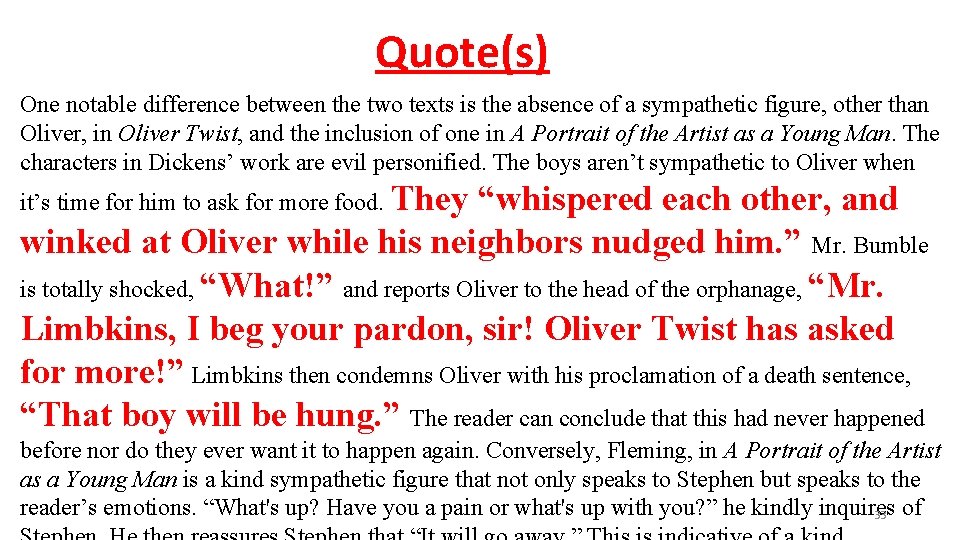
Quote(s) One notable difference between the two texts is the absence of a sympathetic figure, other than Oliver, in Oliver Twist, and the inclusion of one in A Portrait of the Artist as a Young Man. The characters in Dickens’ work are evil personified. The boys aren’t sympathetic to Oliver when it’s time for him to ask for more food. They “whispered each other, and winked at Oliver while his neighbors nudged him. ” Mr. Bumble is totally shocked, “What!” and reports Oliver to the head of the orphanage, “Mr. Limbkins, I beg your pardon, sir! Oliver Twist has asked for more!” Limbkins then condemns Oliver with his proclamation of a death sentence, “That boy will be hung. ” The reader can conclude that this had never happened before nor do they ever want it to happen again. Conversely, Fleming, in A Portrait of the Artist as a Young Man is a kind sympathetic figure that not only speaks to Stephen but speaks to the reader’s emotions. “What's up? Have you a pain or what's up with you? ” he kindly inquires 33 of
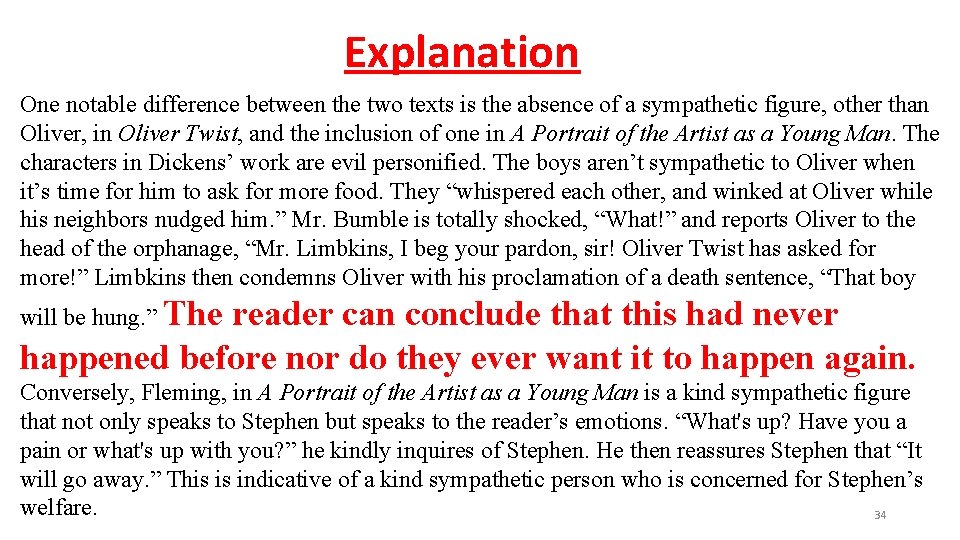
Explanation One notable difference between the two texts is the absence of a sympathetic figure, other than Oliver, in Oliver Twist, and the inclusion of one in A Portrait of the Artist as a Young Man. The characters in Dickens’ work are evil personified. The boys aren’t sympathetic to Oliver when it’s time for him to ask for more food. They “whispered each other, and winked at Oliver while his neighbors nudged him. ” Mr. Bumble is totally shocked, “What!” and reports Oliver to the head of the orphanage, “Mr. Limbkins, I beg your pardon, sir! Oliver Twist has asked for more!” Limbkins then condemns Oliver with his proclamation of a death sentence, “That boy will be hung. ” The reader can conclude that this had never happened before nor do they ever want it to happen again. Conversely, Fleming, in A Portrait of the Artist as a Young Man is a kind sympathetic figure that not only speaks to Stephen but speaks to the reader’s emotions. “What's up? Have you a pain or what's up with you? ” he kindly inquires of Stephen. He then reassures Stephen that “It will go away. ” This is indicative of a kind sympathetic person who is concerned for Stephen’s welfare. 34
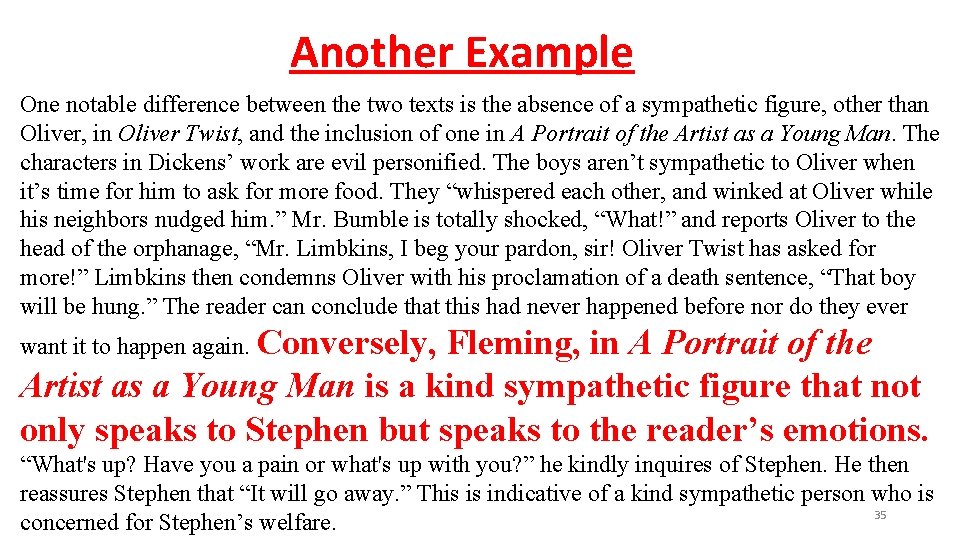
Another Example One notable difference between the two texts is the absence of a sympathetic figure, other than Oliver, in Oliver Twist, and the inclusion of one in A Portrait of the Artist as a Young Man. The characters in Dickens’ work are evil personified. The boys aren’t sympathetic to Oliver when it’s time for him to ask for more food. They “whispered each other, and winked at Oliver while his neighbors nudged him. ” Mr. Bumble is totally shocked, “What!” and reports Oliver to the head of the orphanage, “Mr. Limbkins, I beg your pardon, sir! Oliver Twist has asked for more!” Limbkins then condemns Oliver with his proclamation of a death sentence, “That boy will be hung. ” The reader can conclude that this had never happened before nor do they ever want it to happen again. Conversely, Fleming, in A Portrait of the Artist as a Young Man is a kind sympathetic figure that not only speaks to Stephen but speaks to the reader’s emotions. “What's up? Have you a pain or what's up with you? ” he kindly inquires of Stephen. He then reassures Stephen that “It will go away. ” This is indicative of a kind sympathetic person who is 35 concerned for Stephen’s welfare.
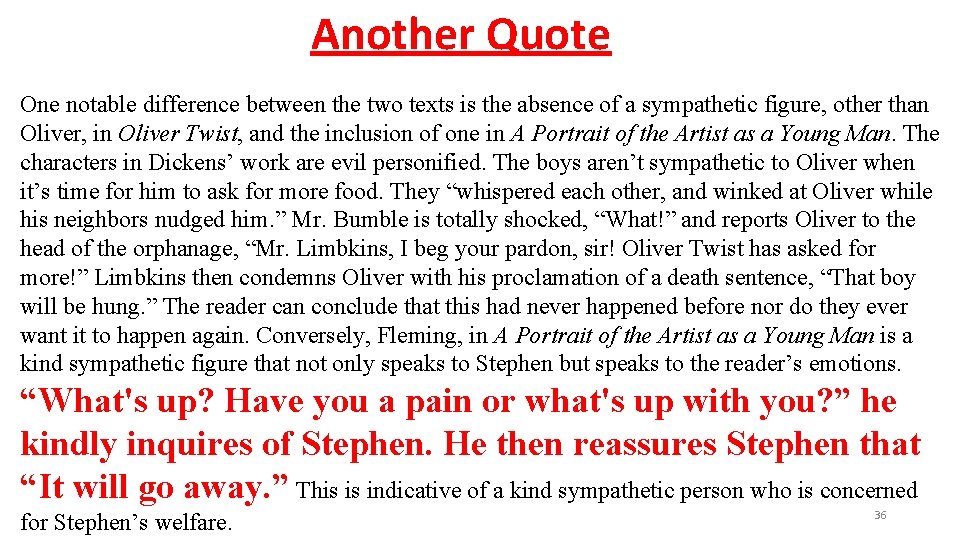
Another Quote One notable difference between the two texts is the absence of a sympathetic figure, other than Oliver, in Oliver Twist, and the inclusion of one in A Portrait of the Artist as a Young Man. The characters in Dickens’ work are evil personified. The boys aren’t sympathetic to Oliver when it’s time for him to ask for more food. They “whispered each other, and winked at Oliver while his neighbors nudged him. ” Mr. Bumble is totally shocked, “What!” and reports Oliver to the head of the orphanage, “Mr. Limbkins, I beg your pardon, sir! Oliver Twist has asked for more!” Limbkins then condemns Oliver with his proclamation of a death sentence, “That boy will be hung. ” The reader can conclude that this had never happened before nor do they ever want it to happen again. Conversely, Fleming, in A Portrait of the Artist as a Young Man is a kind sympathetic figure that not only speaks to Stephen but speaks to the reader’s emotions. “What's up? Have you a pain or what's up with you? ” he kindly inquires of Stephen. He then reassures Stephen that “It will go away. ” This is indicative of a kind sympathetic person who is concerned for Stephen’s welfare. 36
Another Explanation One notable difference between the two texts is the absence of a sympathetic figure, other than Oliver, in Oliver Twist, and the inclusion of one in A Portrait of the Artist as a Young Man. The characters in Dickens’ work are evil personified. The boys aren’t sympathetic to Oliver when it’s time for him to ask for more food. They “whispered each other, and winked at Oliver while his neighbors nudged him. ” Mr. Bumble is totally shocked, “What!” and reports Oliver to the head of the orphanage, “Mr. Limbkins, I beg your pardon, sir! Oliver Twist has asked for more!” Limbkins then condemns Oliver with his proclamation of a death sentence, “That boy will be hung. ” The reader can conclude that this had never happened before nor do they ever want it to happen again. Conversely, Fleming, in A Portrait of the Artist as a Young Man is a kind sympathetic figure that not only speaks to Stephen but speaks to the reader’s emotions. “What's up? Have you a pain or what's up with you? ” he kindly inquires of Stephen. He then reassures Stephen that “It will go away. ” This is indicative of a kind sympathetic person who is concerned for Stephen’s welfare. 37
This Paragraph has two triples too! 38
Time to Revise Your Writing Now that you have evaluated an exemplar third body paragraph, use what you have learned to revise the paragraph that you wrote. Do not copy the exemplar paragraph but use it as a guide to make your paragraph better. Show your revisions by crossing out words, phrases, and sentences and writing improved words, phrases and sentences above them. Draw arrows and carats (an inverted v, ) to show an insert of additional words, phrases, and sentences. 39
- Slides: 39