
LESSON 16 The Internet and Education Brief History
LESSON 16 The Internet and Education
Brief History of Internet The Internet was the result of some visionary thinking by the people in the early 1960 s who saw the great potential value in allowing computers to share information on research and development in scientific and military fields. J. C. R Licklider of MIT first proposed a global network of computers in 1962, and moved over to the Defense Advanced Research Projects Agency (DARPA) in late 1952 to head the work to develop it. Leonard Kleinwork of MIT and later UCLA developed theory of packet switching, which was to form the basis of Internet Connections.
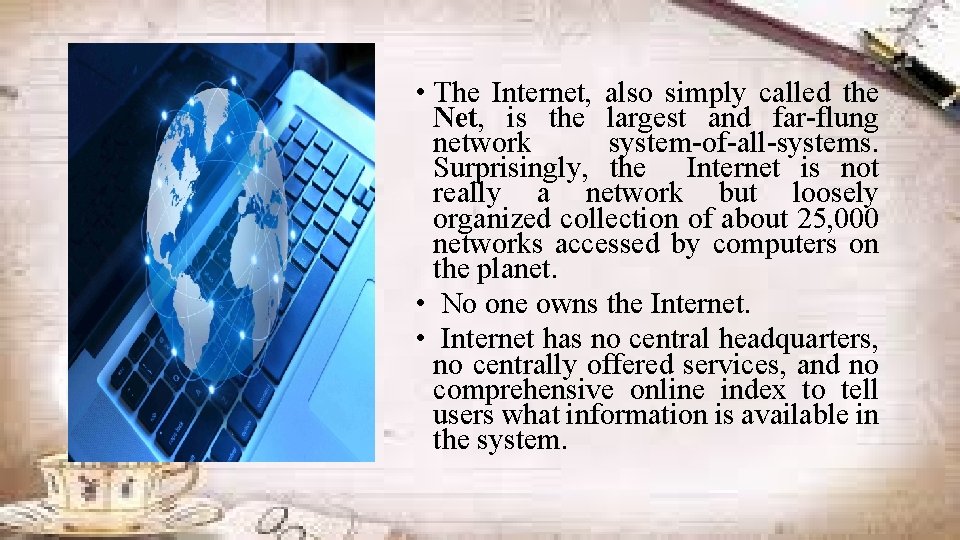
• The Internet, also simply called the Net, is the largest and far-flung network system-of-all-systems. Surprisingly, the Internet is not really a network but loosely organized collection of about 25, 000 networks accessed by computers on the planet. • No one owns the Internet. • Internet has no central headquarters, no centrally offered services, and no comprehensive online index to tell users what information is available in the system.


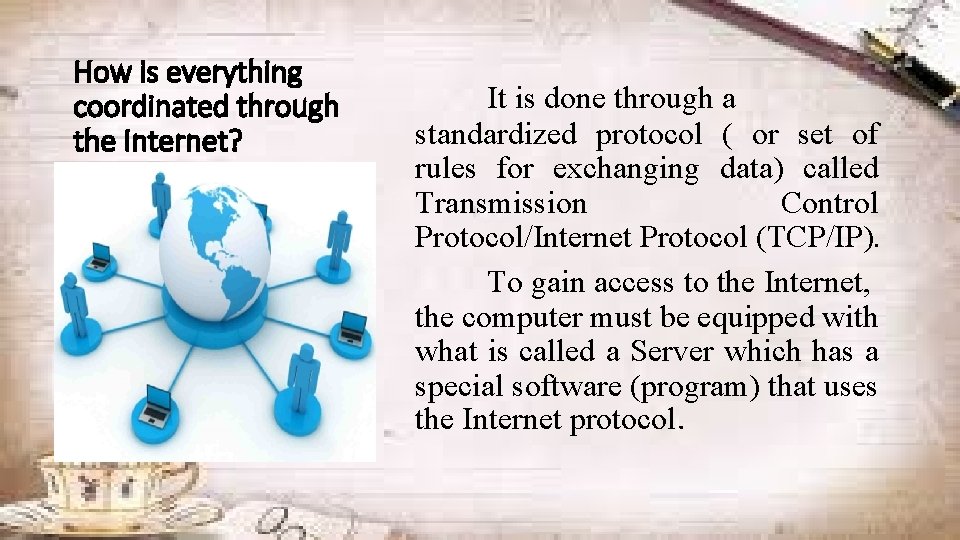
How is everything coordinated through the Internet? It is done through a standardized protocol ( or set of rules for exchanging data) called Transmission Control Protocol/Internet Protocol (TCP/IP). To gain access to the Internet, the computer must be equipped with what is called a Server which has a special software (program) that uses the Internet protocol.

Getting around the Net The vast sea of information now in the Internet, including news and trivia, is an overwhelming challenge to those who wish to navigate it. Everyday, the Net userpopulation and the available information continue to grow , and new ways are continuously being developed to tour the Internet.
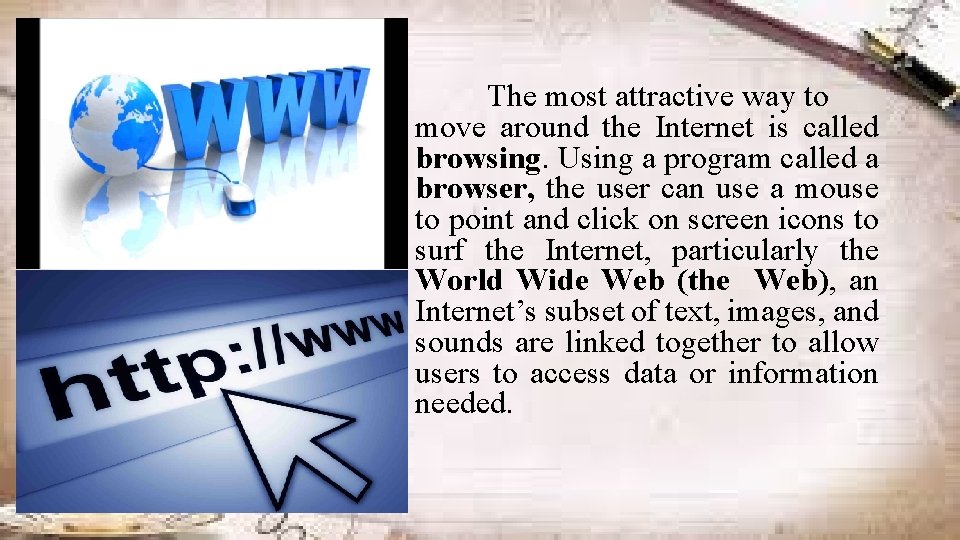
The most attractive way to move around the Internet is called browsing. Using a program called a browser, the user can use a mouse to point and click on screen icons to surf the Internet, particularly the World Wide Web (the Web), an Internet’s subset of text, images, and sounds are linked together to allow users to access data or information needed.
• The future of the Internet seems limitless. • Many experts predict that the Internet is destined to become the centerpiece of all online communications on the planet and in some future time in the solar system using interplanetary satellite communication stations.
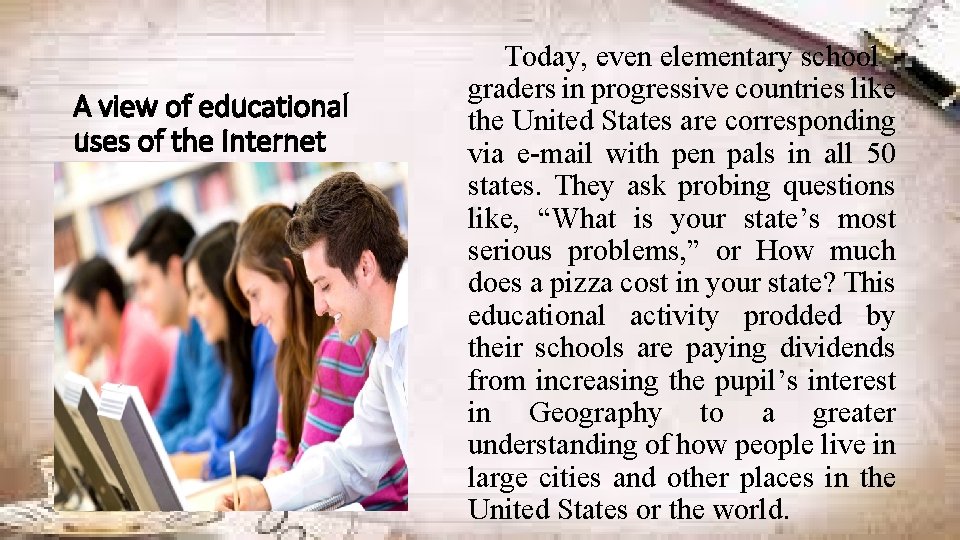
A view of educational uses of the Internet Today, even elementary school graders in progressive countries like the United States are corresponding via e-mail with pen pals in all 50 states. They ask probing questions like, “What is your state’s most serious problems, ” or How much does a pizza cost in your state? This educational activity prodded by their schools are paying dividends from increasing the pupil’s interest in Geography to a greater understanding of how people live in large cities and other places in the United States or the world.
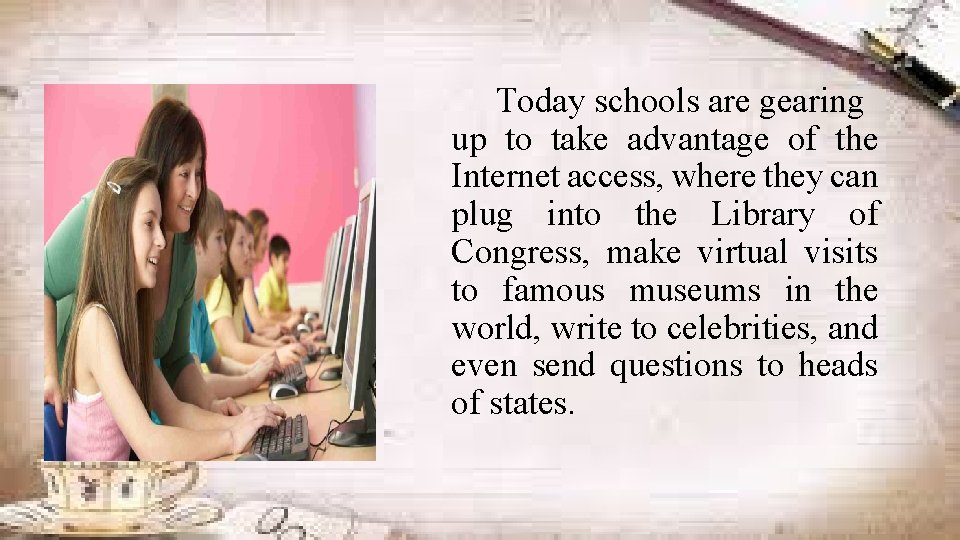
Today schools are gearing up to take advantage of the Internet access, where they can plug into the Library of Congress, make virtual visits to famous museums in the world, write to celebrities, and even send questions to heads of states.
ation both in sophistication and appeal. There is now a wider choice from rote arithmetic or grammar lessons to discovery and innovation projects. But the real possibility today is connecting with the world outside homes, classrooms, and Internet cafes.
Implications of Internet for Education 1. The potential of the Internet offers individual learners increased freedom from physical limitations of the world.
Implications of Internet for Education 2. Internet is seen to support a new culture of learning. 3. The capacity of Internet to support a mass connectivity between people and information.
mus THE END !!! Prepared By: Ma. Dianne Alyssa O. Guerra Joyce P. Ramirez BSED-TLE 311
- Slides: 16