
Lesson 16 Distribution Packaging 16 Short History of
Lesson 16 Distribution Packaging 第 16课 运输包装
Short History of Distribution Packaging in the USA Distribution packaging emerged in the 1800 s as the industrial revolution blossomed and manufacturers began shipping their goods nationwide via railroad. - Paper did not enter the distribution arena as protective packaging until the early 1900 s, when corrugated boxes first appeared as shipping containers. - From the end of World War I to the end of World War II, the use ratio of corrugated to wood containers went from 20/80 to 80/20. - Pallets became popular for industrial use following World War II, and unitizing of high-volume products for shipment accelerated in the 1950 s. - Plastics began appearing in the early 1960 s with various foams replacing corrugated, rubberized fiber, and wood-based products as interior packaging.
Functions and Goals of Distribution Packaging The functions of distribution packaging can be summarized as follows: Containment Protection Performance Communication - Most distribution packaging should address the following goals: Product protection: Ease of handling and storage Shipping effectiveness Manufacturing efficiency: Ease of identification Customer needs Environmental responsibility
The Cost of Packaging It was estimated that expenditures for all packaging materials, including expendable (one-way) shipping pallets, were approximately $100 billion in 1997. Of this total, about one-third was in the form of distribution packaging. - The largest single segment of distribution packaging is corrugated shipping containers, at approximately 20% of total expenditures and 60% of distribution packaging costs. - It has been estimated that although actual freight claims paid by carriers for damaging goods is approximately $2 billion, the actual cost to them and to shippers is really more than $10 billion per year. - Our goal in package design is to minimize the cost of both packaging and damage.
The Package Design Process To develop an optimum distribution package that is both functional and cost-effective, you will need more than just assistance from your packaging suppliers. - Although your experience with a product line and a supplier's experience with packaging materials are both helpful in designing packaging, both of you should consider many factors in addition to the product and the packaging. - Your scope of consideration should include all aspects of the distribution system, including customers, carriers, and distributors, as well as the manufacturing plant, packaging line, warehousing, and shipping. To be successful in distribution package design, take a total-system approach.
Taking a Total System Approach to Package Design Once created, a package has an influence on and is influenced by everyone and everything it encounters. -Most of these encounters affect manufacturing and distribution costs or product integrity, with indirect impact on sales. - A general rule of thumb is that the total cost of transportation is between 3 and 10 times as much as packaging on average for all shipments. A small reduction in package size or weight could mean substantial savings in transportation costs, as well as in handling and storage. - An inverse relationship exists between packaging cost and maintaining product integrity with low damage rates, as shown in Figure 14. 1. An increase in packaging costs provides more protection to the contents and therefore lowers the potential for damage.

Taking a Total System Approach to Package Design Figure 16. 1 The optimum packaging system balances costs from excessive damagewith the costs of overpackaging
Taking a Total System Approach to Package Design The real cost of getting the product safely to market is the sum of packaging and damage. - Optimizing total cost is the true goal of packaging design. - No matter where in the company your packaging design function is located, in engineering, manufacturing, shipping, or elsewhere, try to include all factors in a total-system approach for an optimum design. The Protective Package Concept Product + Package = Distribution environment Figure 16. 2 depicts the consequences of an imbalance in this equation, showing what happens when a product plus its package are not exactly what is needed to survive in the distribution process.
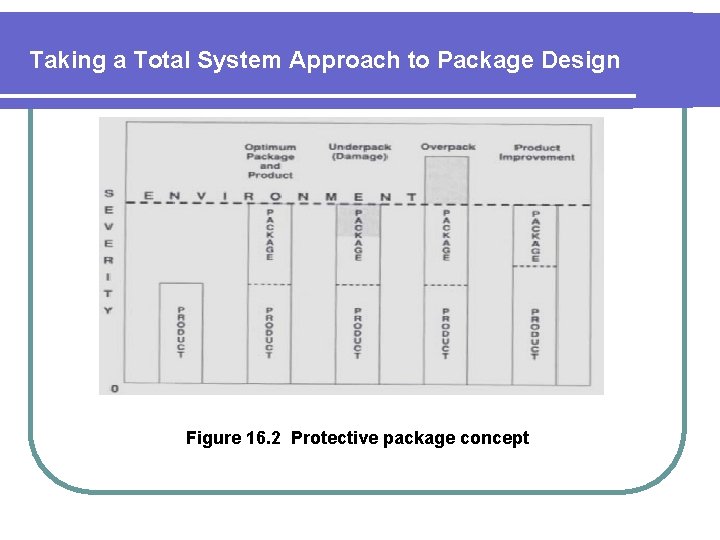
Taking a Total System Approach to Package Design Figure 16. 2 Protective package concept
Taking a Total System Approach to Package Design Severity is the quantitative measure of the environment, which can be anyone or a combination of hazards in distribution. hazards severity the rough-handling hazard to 30 inches of drop a 20 -pound package the compression (storage) hazard 10 packages high in warehousing the high temperature hazard 1300 F. Product represents the measured level of resistance to damage of the product. - An optimum solution: the product's measured level of damage resistance plus the packaging's measured abilities to protect the product are exactly equal to the expected environmental hazard(s)
Taking a Total System Approach to Package Design For example, a product with 15 -inch drop resistance is packaged in material that will dissipate the shock generated in the 30 inches of drop height the packaged product is expected to encounter in the distribution environment. - When the package provides less protective capacity than needed for the environment, this underpackaging will result in damage. - Overpackaging. The package protection level is higher than the environment requires. - It may be possible to improve the product as an alternative to more packaging. - The most elusive part of the package-plus-product equation is the distribution environment.
The 10 -Step Process of Distribution Packaging Design A 10 -step procedure will help you design a distribution package that provides maximum performance at least overall cost. 1. Identify the Physical Characteristics of the Product 2. Determine Marketing and Distribution Requirements 3. Learn about the Environmental Hazards Your Packages Will Encounter 4. Consider Packaging and Unitizing Alternatives 5. Design the Distribution package 6. Determine Quality of Protection through Performance-Testing 7. Redesign Package (and Unit Load) until It Successfully Passes All Tests 8. Redesign the Product if Indicated and Feasible 9. Develop the Packaging Methods 10. Document All Work
A Final Check Here is another suggestion. For any package design project, after completing the 10 -step procedure above, check your work against the list of important considerations as follows. By doing so you will significantly reduce the potential for an unpleasant surprise when shipments begin. Package Design Project Checklist Have you: 1. Considered the solid waste aspects of the package and unit load, and their alternatives, to minimize impact on the environment?
A Final Check 2. Pondered the use of returnable/reusable containers and dunnage? 3. Contemplated all cost factors in the distribution cycle: handling, storage, transportation? 4. Compared the cost of this package with company/plant averages for similar products? 5. Considered all possible alternatives in materials and methods? 6. Used industry standards for materials and design criteria where possible? 7. Performance-tested the design against accepted industry standards? 8. Documented the design using the company's specification system? 9. Checked damage and customer complaints on this product line? 10. Satisfied all rules and regulations applying to this product for all distribution modes it is expected to encounter?
The Warehouse The distribution warehouse is a central collecting point for a particular good or a particular merchandising chain. Finished goods are forwarded to and held at the warehouse until selected and assembled into a customer order. The warehouse environment is not well understood by many shippers. A typical dry groceries warehouse may contain 20, 000 individual stock items. A hardware chain warehouse holds upwards of 40, 000 stock items. Product arrives at the central warehouse in bulk or unitized, is broken down or reunitized according to the warehouse's needs, and then is arranged for stock-picking. Stockpicking is the process of selecting individual items to fill an order for a particular store or destination. Central warehouses serve large customer areas; in some instances one or two warehouses may essentially serve the entire nation.
The Warehouse A product must fit the warehouse's material handling system. This often means palleting loose loads or repalleting loads from nonstandard pallets. Depending on the operation, anywhere from 33 to 70% of product received at a warehouse must be handled manually before an order is placed in stock. Manual handling, in addition to being costly, is also a primary source of damage from dropping. In the picking aisles, stock must be clearly identifiable from every side. Multicolor graphic displays serve only to obscure vital information from the picker. A box labeled "Golden Triangle Farms" does not inform the stock-picker of the contents. Containers should be strong enough to be dragged off the pallet by one end, and stiff enough that they don't distort and release their contents when handled in less than ideal fashion. Glue flaps must have enough adhesive to resist abusive handling.
The Warehouse An assembled order may contain items as disparate as eight mirrors, six assorted clocks, a case of oil, four shock absorbers, a stepladder, and a Mepps #4 fishing lure. These and other items are assembled on a mixed pallet for transport to the retail outlet. Containers must be easily handled by the picker and should be readily packed onto a mixed-order pallet. Container orientation on mixed-load pallets will tend to be on a "best fit" basis, regardless of "This side up" and "Do not stack" labels. It may be possible to pack a trapezoidal container efficiently on your pallet, but odd shapes do not pack well in a mixed-product pallet load. Use boxes with a rectangular cross section wherever possible.
Unit Loads Pallets It is simpler to move one 1, 000 -kilogram load than it is to move a thousand 1 - kilogram loads. Loads are most commonly unitized on pallets, a platform that can be picked up by the tines of a forklift truck. Another technique uses slip sheets, tough fiberboard or plastic sheets on which the load is stacked. The truck used with slip sheets has a clamp mechanism that grasps a protruding edge of the sheet and pulls the sheet and load onto a platform attached to the truck. A third method of handling a large group of assembled objects is with a clamp truck, a mechanism that picks up loads by exerting pressure from both sides of the load.
Unit Loads Each method has its advantages and disadvantages. Slip sheets are economical, take up little space, and are light. However, the equipment is not universally available, is more expensive, and is slower to operate. Pallets are universally adaptable to a variety of handling situations and locations. However, pallets are costly, take up space, and can be difficult to dispose of. Clamp trucks use no added materials, but the geometry and character of the load must be such that it can be squeezed between the truck's clamps. Most pallets are made of wood, and choice of wood species has a great impact on cost and durability. The denser and stiffer the wood, the greater the pallet's durability and usually the greater its cost. Well-made hardwood pallets are the most durable and cost-effective option of the many material choices available. Other materials are usually selected for considerations other than durability.
Unit Loads There are many possible pallet sizes and designs; however, for the sake of standardized distribution, certain sizes and designs predominate. By convention, a pallet's size is stated length first, with length defined as the top dimension along the stringer or stringer board ( Figure 16. 3). About a third of all pallets are nominally 40 by 48 inches, the standard set by members of the Grocery Manufacturers of America. This size is also very close to the international 1, 000 by 1, 200 mm size. The two broad categories of pallet design are stringer and block types (Figure 16. 3). A range of variations is available within each design type:
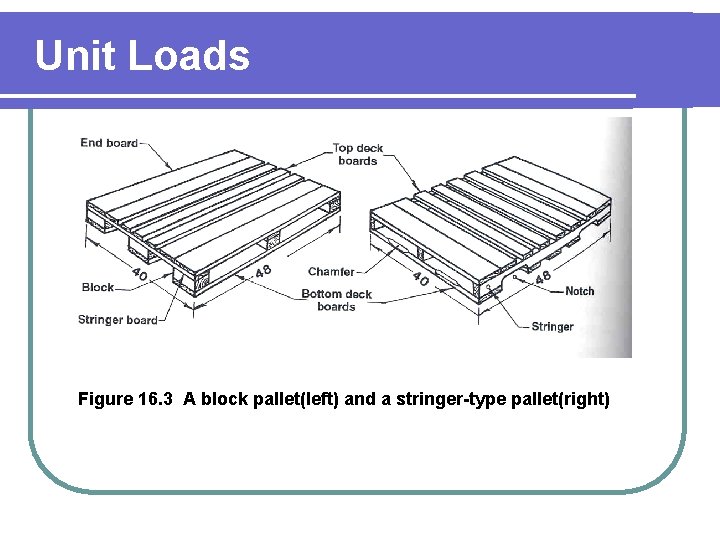
Unit Loads Figure 16. 3 A block pallet(left) and a stringer-type pallet(right)
Unit Loads Reversible pallets have similar top and bottom decks. Nonreversible designs have different top and bottom decks, with only the top deck designed to be a load-carrying platform. · Wing pallets have the stringers inset so that the deck boards overhang. This allows for the pallets to be handled by slings. Pallets can be single wing or double wing, depending on whether one or both decks overhang the stringers. ·Two-way-entry pallets have solid stringers and can be entered only from the two ends. · Block-type pallets are four-way entry, since any equipment can enter the pallet from all four directions. A partial four-way has notches cut into the stringer bottoms. A forklift's tines can enter from any direction, but a hand truck can only enter from two directions.
Unit Loads In addition to providing a product platform, the pallet is a buffer against the handling environment. A forklift driver placing a pallet into position cannot see the exact placement location: he stops when he hits something. Viewed in this context, practices such as deliberate pallet perimeter overhang can only lead to problems, and warehouse operators condemn this habit. The Food Marketing Institute holds pallet issues responsible for about half of all observed damage and cites poor pallet footprint as the single largest cause of shipping damage. Of this damage, 50% is attributed to poor pallet stability and 35% is attributed to pallet overhang. Pallet maintenance programs are essential. A common and easily remedied problem is fasteners working their way out of the wood.
Unit Loads Unit Load Efficiency Warehouse floor space is rented by area, and the more product that can be put into that area, the better. Trucks loaded with light product should have the available volume completely filled to carry the maximum amount of product per trip. Area and cube utilization should be every packager's concern. Optimum area and cube utilization begins with the design of the primary package. Primary dimensions should be considered in terms of possible packing orientations in the shipping container, impact on corrugated board use in the shipping container, and palleting pattern and space utilization.
Unit Loads “Arrangement” refers to packing patterns used when placing primary packages into a shipper. Traditionally, the problem was solved through intuition, experience, and a few nominal calculations. However, small cartons, packed 24 to a shipper, may have over a thousand possible orientation and palleting solutions. Computer "arrangement" programs are available that will calculate all the implications of size decisions in minutes. Typical input data for a palleting-efficiency computer program are : · Data pertaining to the primary container · Allowed primary design changes, if required · Data pertaining to the proposed shipping case · Data pertaining to palleting requirements
Unit Loads Typical output data for such a program might provide the following information: · Optimum dimensions for the primary container · Optimum packing orientations for selected primary containers · Inside and outside case dimensions for each selected case type ·Number of units per pallet for each primary/case option ·Area and cube utilization for each primary/case option · Recommended pallet patterns, including "walk-around" views ·Dimensional details of the pallet pattern · Material areas used in primary, divider, and case construction ·Relative cost factors for each construction ·Relative compression values for corrugated board constructions ·Proposed maximum warehouse stacking heights
Unit Loads A thorough system analysis (including losses) can lead to substantial savings. A major business equipment manufacturer found that it had poor shipping experience because of the hundreds of different package sizes in the product line. The company designed a modular system, and all products were designed to fit one of 17 standard box sizes. Besides significant inventory reduction, the company gained substantial transport savings, since larger, more stable pallet loads could be built with the modular system. More-secure pallet loads resulted in further savings through reduced product damage.
Unit Loads Stabilizing Unit Loads Unit loads often need to be stabilized in order to retain load geometry and order during shipping and handling. Strapping is used mostly for heavier goods. Care must be taken that strapping does not cut into the corrugated container, impairing strength qualities. Cord is sometimes used as a more economical alternative, also causing cut-in problems. Corner guards should be used to prevent cut-in where strapping or cord is the necessary choice. Shrinkwrapping is rarely used for load unitizing due to high installation and energy costs. Today's material of choice is stretch-wrapping. A good stretch-wrap application consists of two overlapped wraps extending 50 mm down the pallet to bind the load to the pallet. The wraps should overlap about 40% up the pallet side. Three overlapping wraps extending 50 mm past the top of the load finish the pallet.
Unit Loads Hand-wrapping a pallet with stretch material costs about $1. 40. Machine-wrapping provides better material control and typically reduces the cost to about $1. 00. Machines with prestretch features reduce this cost still further. More costly open netting is used where air circulation is essential. Load stability can be increased through the use of high-friction printing inks and coatings or by the application of adhesive-like compounds. Adhesives can be designed to produce a high-tack local bond. One variation is the use of a bead of hot-melt adhesive formulated to have relatively poor cohesive strength. The bead forms a readily sheared bond between two box surfaces. However, systems that bond boxes together have caused handling problems and are not a popular load-stabilizing method with some warehouses.
Unit Loads Caps and trays made of fiberboard or corrugated board are used to provide shape to unstable loads, to provide bottom protection against rough pallet surfaces, and, when used on top of a load, to increase the platform quality for the next pallet. Tier sheets improve available compression strength and increase stability by distributing weight and encouraging layers to act as a unit.
- Slides: 30