
Lesson 16 2 Types Sources of Credit Consumer
- Slides: 18
Lesson 16. 2 Types & Sources of Credit Consumer Math
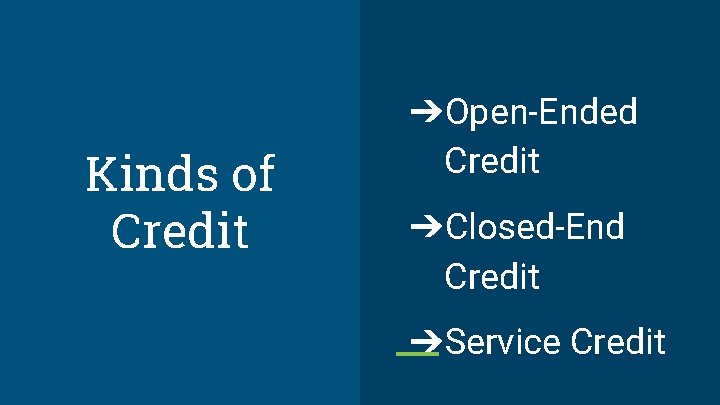
Kinds of Credit ➔Open-Ended Credit ➔Closed-End Credit ➔Service Credit
Open-Ended Credit ➔ Definition : an agreement to lend the borrower an amount up to a stated limit and to allow borrowing up to that limit again, whenever the balance falls below the limit. ➔ Example: Credit Card Accounts ➔ Borrower usually has a choice of repaying the entire balance within 30 days or repaying it over a number of months/years. ➔ Can be used again and again, as long as the balance owed doesnot exceed the limit. ➔ Types
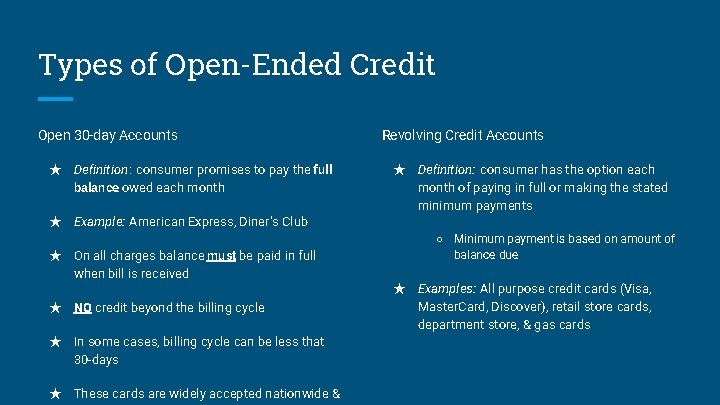
Types of Open-Ended Credit Open 30 -day Accounts ★ Definition : consumer promises to pay the full balance owed each month Revolving Credit Accounts ★ Definition: consumer has the option each month of paying in full or making the stated minimum payments ★ Example: American Express, Diner’s Club ★ On all charges balance must be paid in full when bill is received ★ NO credit beyond the billing cycle ★ In some cases, billing cycle can be less that 30 -days ★ These cards are widely accepted nationwide & ○ Minimum payment is based on amount of balance due ★ Examples: All purpose credit cards (Visa, Master. Card, Discover), retail store cards, department store, & gas cards
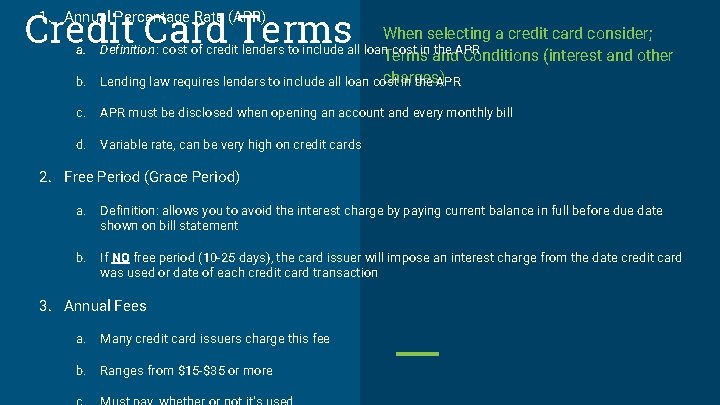
Credit Card Terms 1. Annual Percentage Rate (APR) When selecting a credit card consider; a. Definition : cost of credit lenders to include all loan. Terms cost in the APR and Conditions (interest and other charges) b. Lending law requires lenders to include all loan cost in the APR c. APR must be disclosed when opening an account and every monthly bill d. Variable rate, can be very high on credit cards 2. Free Period (Grace Period) a. Definition: allows you to avoid the interest charge by paying current balance in full before due date shown on bill statement b. If NO free period (10 -25 days), the card issuer will impose an interest charge from the date credit card was used or date of each credit card transaction 3. Annual Fees a. Many credit card issuers charge this fee b. Ranges from $15 -$35 or more
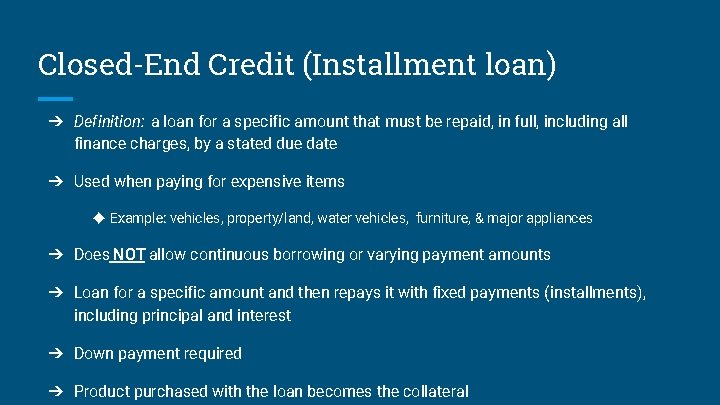
Closed-End Credit (Installment loan) ➔ Definition: a loan for a specific amount that must be repaid, in full, including all finance charges, by a stated due date ➔ Used when paying for expensive items ◆ Example: vehicles, property/land, water vehicles, furniture, & major appliances ➔ Does NOT allow continuous borrowing or varying payment amounts ➔ Loan for a specific amount and then repays it with fixed payments (installments), including principal and interest ➔ Down payment required ➔ Product purchased with the loan becomes the collateral
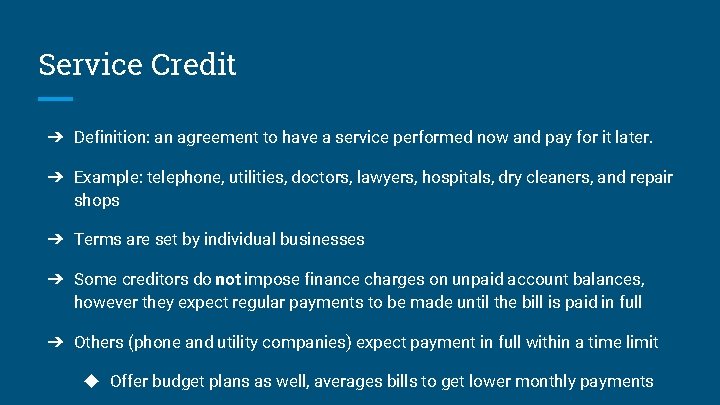
Service Credit ➔ Definition: an agreement to have a service performed now and pay for it later. ➔ Example: telephone, utilities, doctors, lawyers, hospitals, dry cleaners, and repair shops ➔ Terms are set by individual businesses ➔ Some creditors do not impose finance charges on unpaid account balances, however they expect regular payments to be made until the bill is paid in full ➔ Others (phone and utility companies) expect payment in full within a time limit ◆ Offer budget plans as well, averages bills to get lower monthly payments
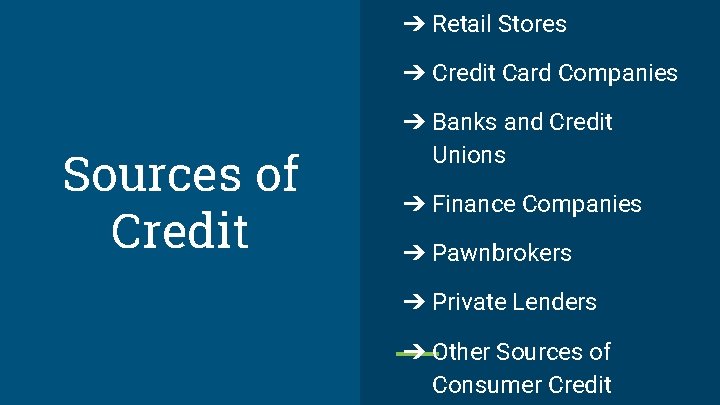
➔ Retail Stores ➔ Credit Card Companies Sources of Credit ➔ Banks and Credit Unions ➔ Finance Companies ➔ Pawnbrokers ➔ Private Lenders ➔ Other Sources of Consumer Credit
Retail Stores ➔Many retail stores offer their own credit cards ◆ Example: Costco, Macy’s, Saks, Kohls, Target, Walmart, Amazon, . . . ➔These cards are only accepted at that specific store ➔Store credit customers often receive discounts, advance notice of sales, and other privileges not offered to cash customers ➔Most retail stores also accept credit cards issued by major credit card companies
Credit Card Companies ➔All-purpose credit cards that are generally accepted nationwide and internationally ◆ Visa, Master. Card, American Express, and Discover ➔Can get an all-purpose credit card through financial institution or from various organizations ➔Affinity cards : credit cards sponsored by professional organizations, college alumni associations, and some travel industry companies ◆ Donates a portion of the annual fees or charges to the sponsoring organization, or qualifies you for free travel or other bonuses
Credit Card Companies Cont. ➔Automatic line of credit up to the limit of the card ➔Cash advance: money borrowed against the credit card limit ◆ Cash loan taken from your line of credit rather than making a purchase with it ◆ Access this money at a teller machine, at a customer service desk at the bank, or by writing an access check against the credit card account ● Looks just like regular checks, however they are supplied by the credit card company and are treated like a purchase ● You must then pay back the cash advance in the same way you pay for credit card purchases
Bank and Credit Unions ➔Offer credit cards and closed-end loans to individual and companies ➔Loan money to consumers for specific purchases ◆ Examples: home, car, or vacation ➔Interest on closed-end loans tend to be lower than on credit cards ➔Credit Unions ◆ Only make loans to their members ◆ Interest rates generally lower that interest rates charged by banks , because credit unions are nonprofit and are organized for the benefit of the members
Finance Companies ➔ Charge high interest rates for the use of their money ◆ Because they are willing to take risk that banks and credit unions won’t take ◆ Form of protection for finance companies ➔ In many cases, people that get turned down by banks and credit unions can get loans at finance companies ➔ 2 nd to banks in volume of credit extended ➔ Take more risks than banks, and therefore more careful to protect their loans ➔ Will receive a call for explanation, if you do not make your payment when it’s due
Finance Companies Cont. ➔ Uniform Small-Loan Law ◆ Most states permit loans of up to $5, 000 and allows interest rates up to 42% per year ➔ Growth of finance companies is due to efforts to eliminate loan sharks ◆ Unlicensed lenders who charge illegally high interest rates ➔ Still difficult to eliminate such practice, that take advantage of the poorest members of society who can least afford to pay ➔ Usury laws set maximum interest rates that may be charged for loans ◆ Where the law exist, finance companies charge the maximum
Two Types of Finance Companies Consumer Finance Company ➔ Mostly consumer loans to purchase consumer durables ◆ Items expected to last several years ● Examples: automobile, refrigerator, or stereo Sales Finance Company ➔ manufacturer-related , that makes loans through authorized representatives ➔ Example: General Motors Acceptance Corporation (GMAC) finances General Motors automobile dealers and their customers ➔ Well-known: Household Finance and Beneficial Finance Both types of finance companies borrow money from banks and lend it to comsumers at higher rates
Pawnbrokers ➔Definition: a legal business that makes high-interest loans based on the value of personal possessions pledged as collateral ➔Possessions that are readily salable are usually acceptable collateral ◆ Customer brings in item(s) to be appraised, pawnbroker then makes a loan for considerably less than the appraised value of the item(s). ◆ Some pawnshops give only 10%-25% of the value of the article; most give 50%-60%. ◆ Example: ring appraised at $500, you can borrow $50 -$250 with ring as collateral. You turn over the ring to pawnbroker and receive the money, a receipt and certain length of time to redeem the ring by paying back the loan plus interest. If you do not pay back the loan within the time, the pawnbroker will sell your ring and keep the proceeds of the sale.
Private Lenders ➔Most common source of cash loans ➔May or may not charge interest ➔Example: parents, other relatives, friends, etc.
Other Sources of Consumer Credit ➔Life insurance policies ◆ Some life insurance policies build cash value ● policyholders can borrow at low interest rates against the value of their policy ◆ The loan does not have to be repaid, but interest will be charged ◆ Amount of the loan will reduce the value of the life insurance policy ➔If you have a certificate of deposit with a financial institution you can borrow money against the certificate ◆ Certificate is used as collateral