
LESSON 15 Objective Divide decimals using place value
LESSON 15 Objective: Divide decimals using place value understanding, including remainders in the smallest unit.
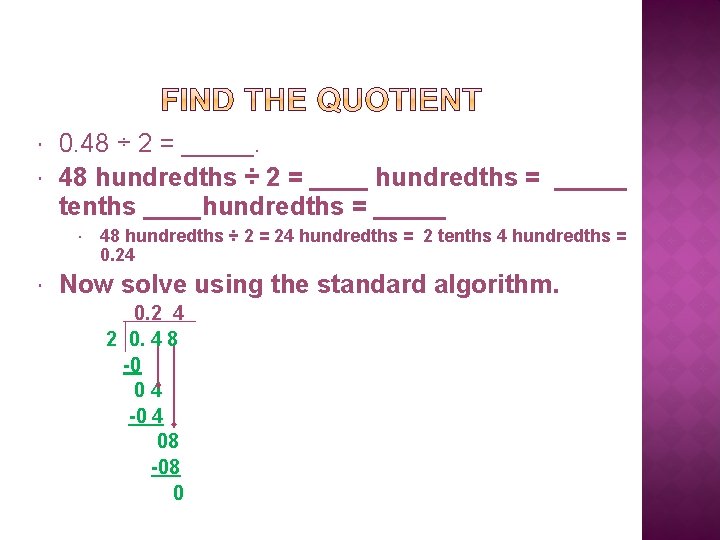
0. 48 ÷ 2 = _____. 48 hundredths ÷ 2 = ____ hundredths = _____ tenths ____hundredths = _____ 48 hundredths ÷ 2 = 24 hundredths = 2 tenths 4 hundredths = 0. 24 Now solve using the standard algorithm. 0. 2 4 2 0. 4 8 -0 04 -0 4 08 -08 0
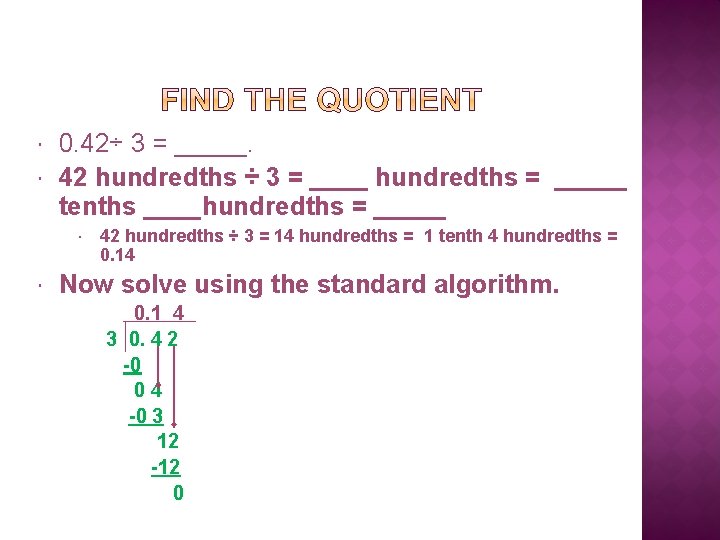
0. 42÷ 3 = _____. 42 hundredths ÷ 3 = ____ hundredths = _____ tenths ____hundredths = _____ 42 hundredths ÷ 3 = 14 hundredths = 1 tenth 4 hundredths = 0. 14 Now solve using the standard algorithm. 0. 1 4 3 0. 4 2 -0 04 -0 3 12 -12 0
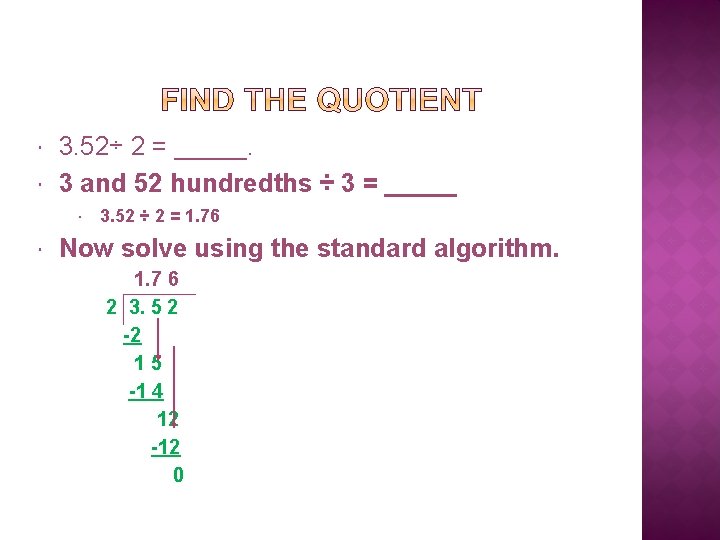
3. 52÷ 2 = _____. 3 and 52 hundredths ÷ 3 = _____ 3. 52 ÷ 2 = 1. 76 Now solve using the standard algorithm. 1. 7 6 2 3. 5 2 -2 15 -1 4 12 -12 0
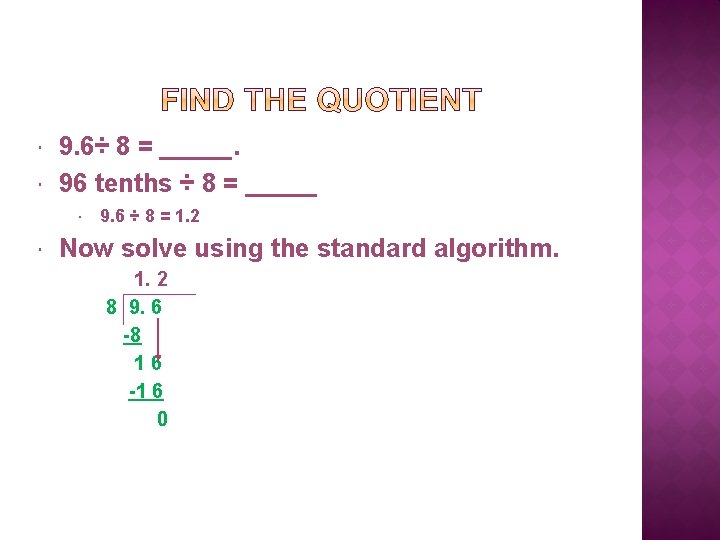
9. 6÷ 8 = _____. 96 tenths ÷ 8 = _____ 9. 6 ÷ 8 = 1. 2 Now solve using the standard algorithm. 1. 2 8 9. 6 -8 16 -1 6 0
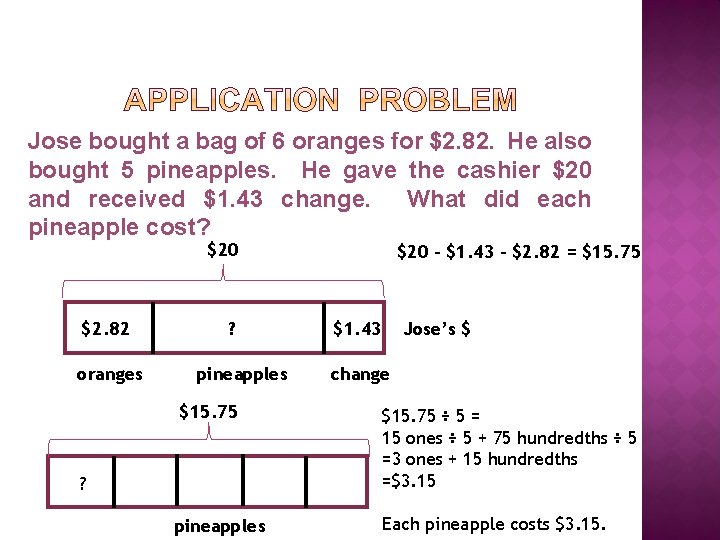
Jose bought a bag of 6 oranges for $2. 82. He also bought 5 pineapples. He gave the cashier $20 and received $1. 43 change. What did each pineapple cost? $20 $2. 82 oranges ? pineapples $20 - $1. 43 - $2. 82 = $15. 75 $1. 43 Jose’s $ change $15. 75 ÷ 5 = 15 ones ÷ 5 + 75 hundredths ÷ 5 =3 ones + 15 hundredths =$3. 15 pineapples Each pineapple costs $3. 15. ?
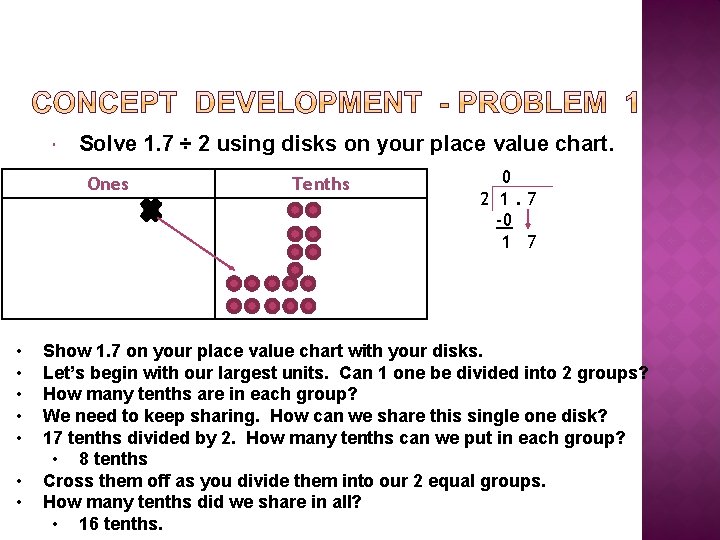
Solve 1. 7 ÷ 2 using disks on your place value chart. Ones • • Tenths 0 2 1. 7 -0 1 7 Show 1. 7 on your place value chart with your disks. Let’s begin with our largest units. Can 1 one be divided into 2 groups? How many tenths are in each group? We need to keep sharing. How can we share this single one disk? 17 tenths divided by 2. How many tenths can we put in each group? • 8 tenths Cross them off as you divide them into our 2 equal groups. How many tenths did we share in all? • 16 tenths.
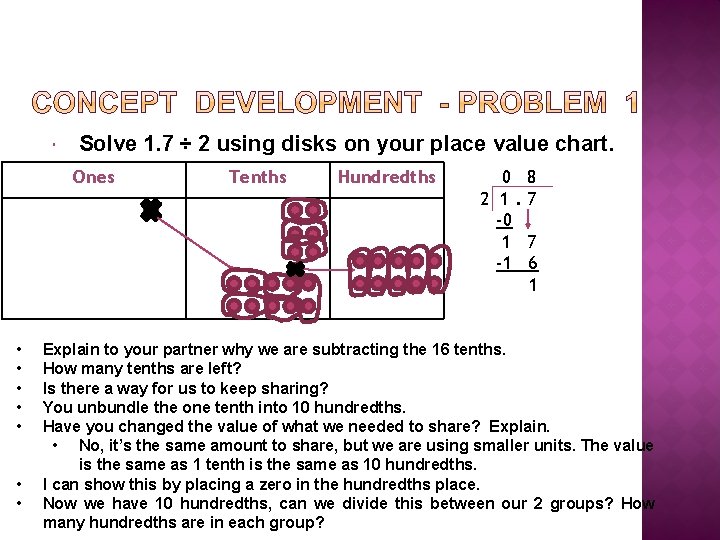
Solve 1. 7 ÷ 2 using disks on your place value chart. Ones • • Tenths Hundredths 0 2 1. -0 1 -1 8 7 7 6 1 Explain to your partner why we are subtracting the 16 tenths. How many tenths are left? Is there a way for us to keep sharing? You unbundle the one tenth into 10 hundredths. Have you changed the value of what we needed to share? Explain. • No, it’s the same amount to share, but we are using smaller units. The value is the same as 1 tenth is the same as 10 hundredths. I can show this by placing a zero in the hundredths place. Now we have 10 hundredths, can we divide this between our 2 groups? How many hundredths are in each group?
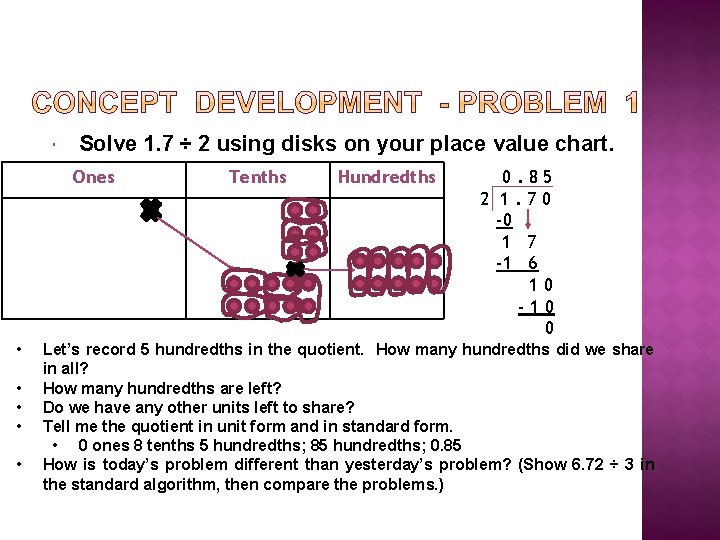
Solve 1. 7 ÷ 2 using disks on your place value chart. Ones • • • Tenths Hundredths 0. 85 2 1. 70 -0 1 7 -1 6 10 -10 0 Let’s record 5 hundredths in the quotient. How many hundredths did we share in all? How many hundredths are left? Do we have any other units left to share? Tell me the quotient in unit form and in standard form. • 0 ones 8 tenths 5 hundredths; 85 hundredths; 0. 85 How is today’s problem different than yesterday’s problem? (Show 6. 72 ÷ 3 in the standard algorithm, then compare the problems. )
Show 2. 6 ÷ 4 on your place value mat and work the problem using the standard algorithm. Ones Tenths Hundredths
17 ÷ 4 = _____ Look at this problem; what do you notice? Turn and share with your partner. In fourth grade we recorded the remainder as r 1. What we have we done today that lets us keep sharing the remainder? We can trade it for tenths or hundredths and keep dividing in between our groups. Now solve this problem using the place value chart with your partner. Partner A will draw the number disks and Partner B will solve using the standard algorithm. Compare your work. Match each number in the algorithm with its counterpart in the drawing.
17 ÷ 4 = _____ Look at this problem; what do you notice? Turn and share with your partner. In fourth grade we recorded the remainder as r 1. What we have we done today that lets us keep sharing the remainder? We can trade it for tenths or hundredths and keep dividing in between our groups. Now solve this problem using the place value chart with your partner. Partner A will draw the number disks and Partner B will solve using the standard algorithm. Compare your work. Match each number in the algorithm with its counterpart in the drawing. 17 ÷ 4 = 4. 25
22 ÷ 8 = _____ Now solve this problem using the place value chart with your partner. Partner B will draw the number disks and Partner A will solve using the standard algorithm. Compare your work. Match each number in the algorithm with its counterpart in the drawing. 22 ÷ 8 = 2. 75
In your journal, solve the following problems using the standard algorithm. When you are finished, compare your answers with your neighbor. 7. 7 ÷ 4 = _____ 7. 7 ÷ 4 = 1. 925 0. 84 ÷ 4 = _____ 0. 84 ÷ 4 = 0. 21
Complete Problem Set in small groups. Check answers and discuss difficulties. Handout Exit Ticket and independently. Handout Homework.
- Slides: 16