
LESSON 15 INVENTORY MODELS DETERMINISTIC EOQ MODEL FOR



- Slides: 22
LESSON 15 INVENTORY MODELS (DETERMINISTIC) EOQ MODEL FOR PRODUCTION PLANNING Outline • EOQ Model for Production Planning – The multi-product inventory control model with a finite production rate – An example showing the problem with separate EPQ computation – The procedure – An example 1
EOQ Model for Production Planning • This model is an extension of the EPQ model • Consider the problem of producing many products in a single facility. The facility may produce only one product at a time. • In each production cycle there is only one setup for each product, and the products are produced in the same sequence in each production cycle. This assumption is called the rotation cycle policy. • For example, if there are three products A, B and C, then a production sequence under the rotation cycle policy is A, B, C, …. 2
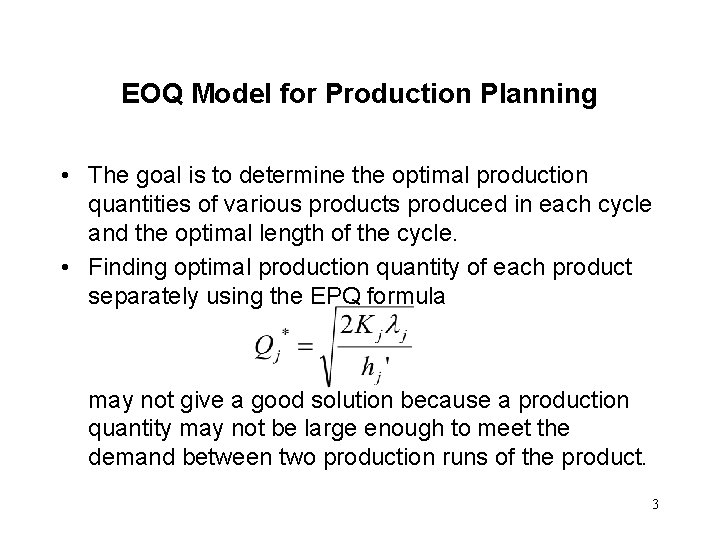
EOQ Model for Production Planning • The goal is to determine the optimal production quantities of various products produced in each cycle and the optimal length of the cycle. • Finding optimal production quantity of each product separately using the EPQ formula may not give a good solution because a production quantity may not be large enough to meet the demand between two production runs of the product. 3
EOQ Model for Production Planning • For example, suppose that there are three products A, B and C, then a production sequence under the rotation cycle policy is A, B, C, …. • The production quantity of product A obtained from the EPQ formula may not be large enough to meet the demand during the production run of products B and C. • The next example elaborates on the problem of using EPQ formula separately for each product. 4
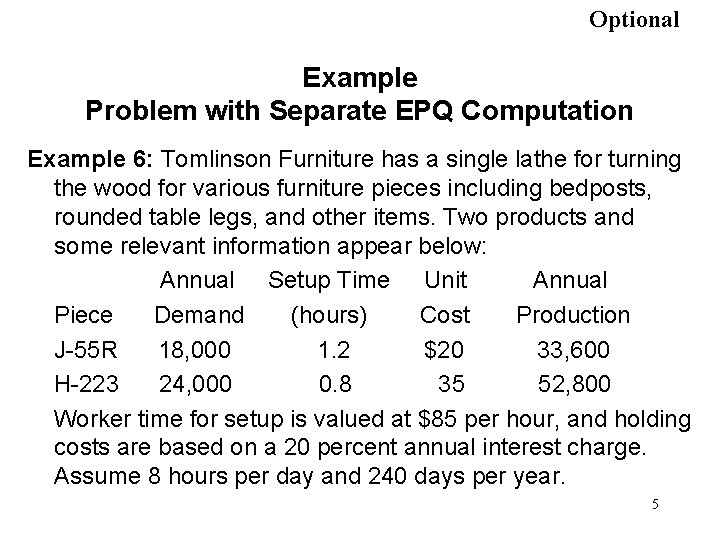
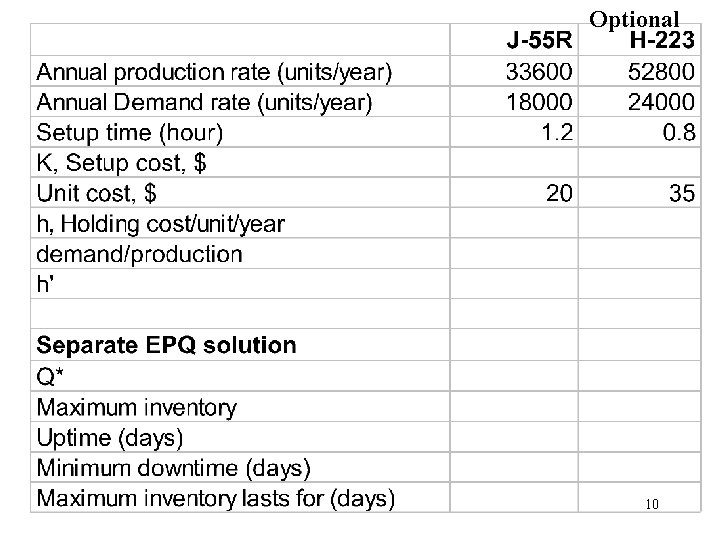
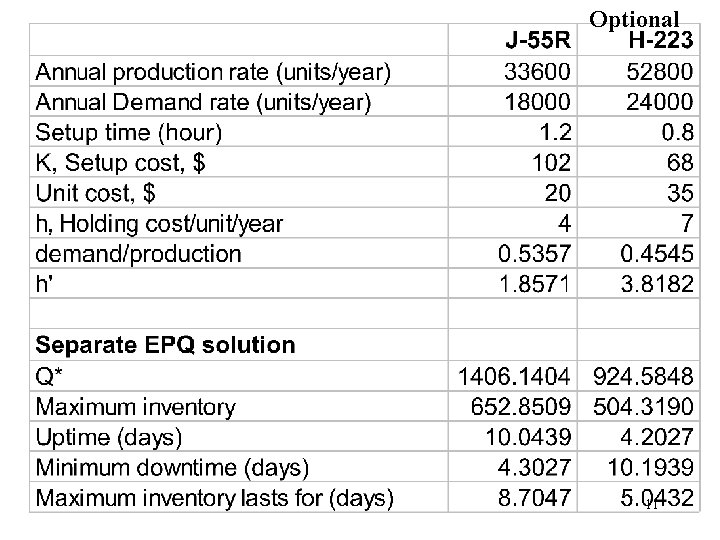
Optional Example Problem with Separate EPQ Computation Example 6: Tomlinson Furniture has a single lathe for turning the wood for various furniture pieces including bedposts, rounded table legs, and other items. Two products and some relevant information appear below: Annual Setup Time Unit Annual Piece Demand (hours) Cost Production J-55 R 18, 000 1. 2 $20 33, 600 H-223 24, 000 0. 8 35 52, 800 Worker time for setup is valued at $85 per hour, and holding costs are based on a 20 percent annual interest charge. Assume 8 hours per day and 240 days per year. 5
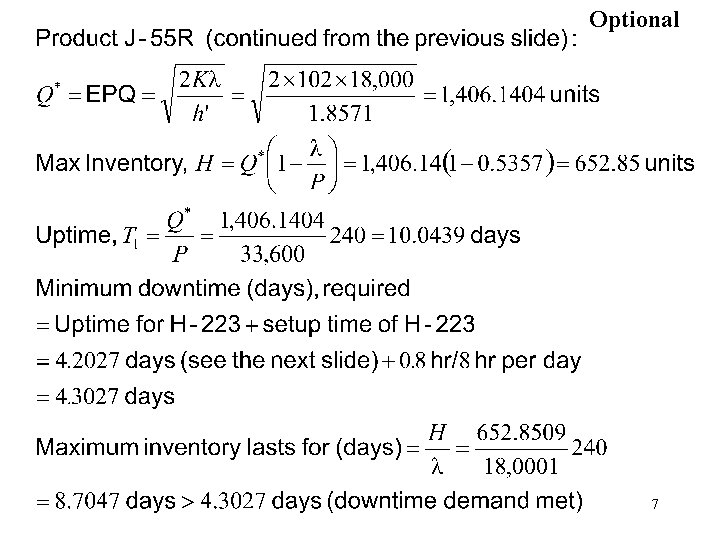
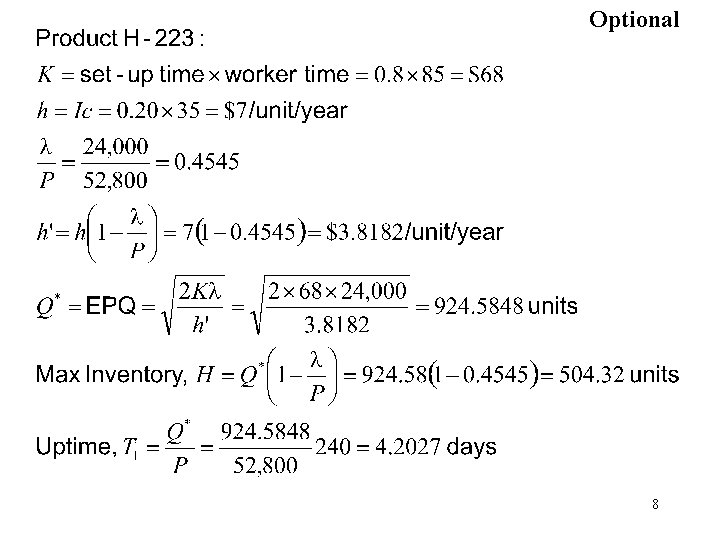
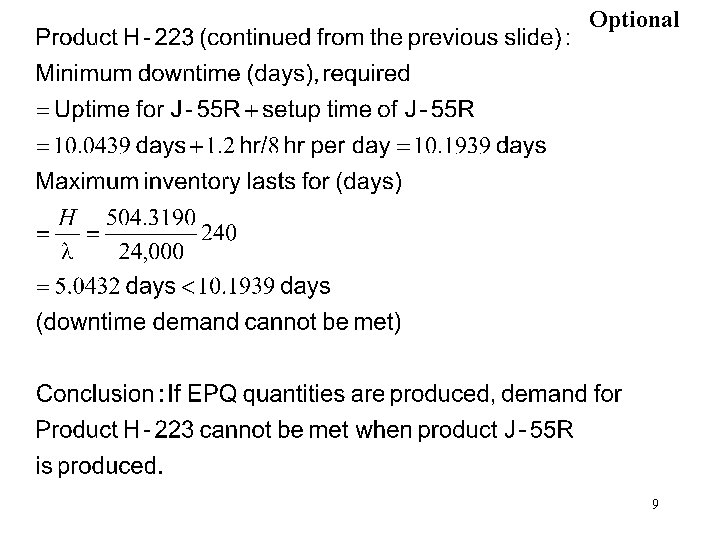
Optional Example Problem with Separate EPQ Computation Find the optimal production quantities separately for each product and show that production quantity of H-223 is not large enough to meet the demand between two production runs of H-223. 6
Optional 7
Optional 8
Optional 9
Optional 10
Optional 11
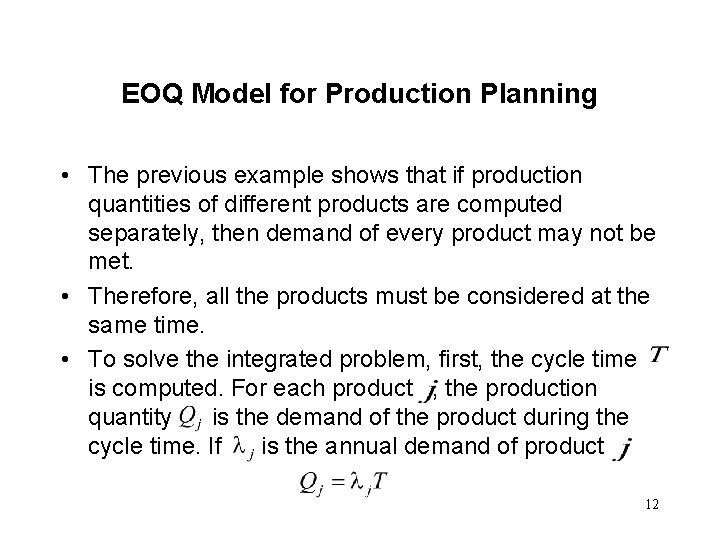
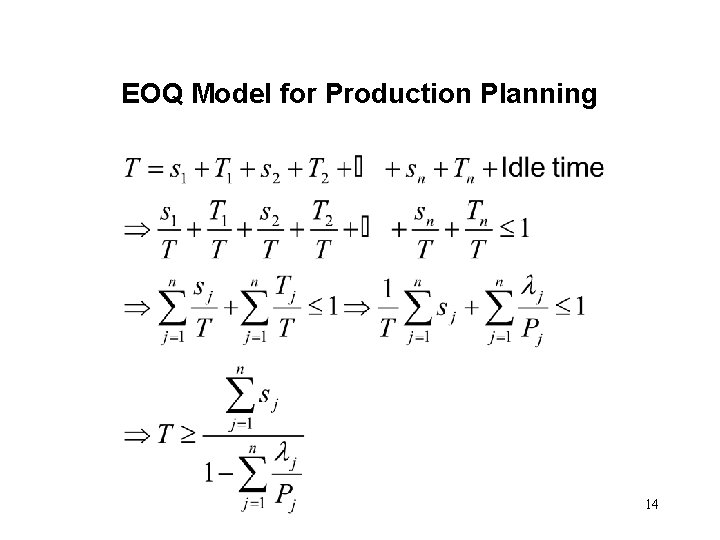
EOQ Model for Production Planning • The previous example shows that if production quantities of different products are computed separately, then demand of every product may not be met. • Therefore, all the products must be considered at the same time. • To solve the integrated problem, first, the cycle time is computed. For each product , the production quantity is the demand of the product during the cycle time. If is the annual demand of product 12
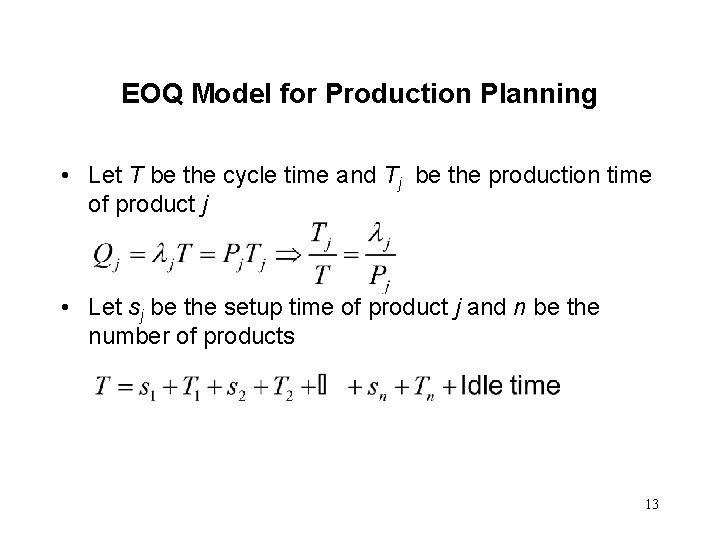
EOQ Model for Production Planning • Let T be the cycle time and Tj be the production time of product j • Let sj be the setup time of product j and n be the number of products 13
EOQ Model for Production Planning 14
EOQ Model for Production Planning • Two rules for T* • T* is the maximum of the two. T* = max (Cycle 1, Cycle 2) 15
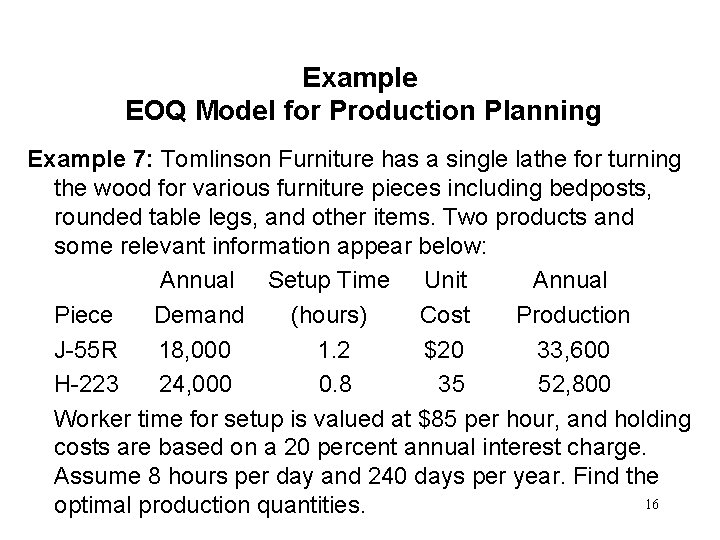
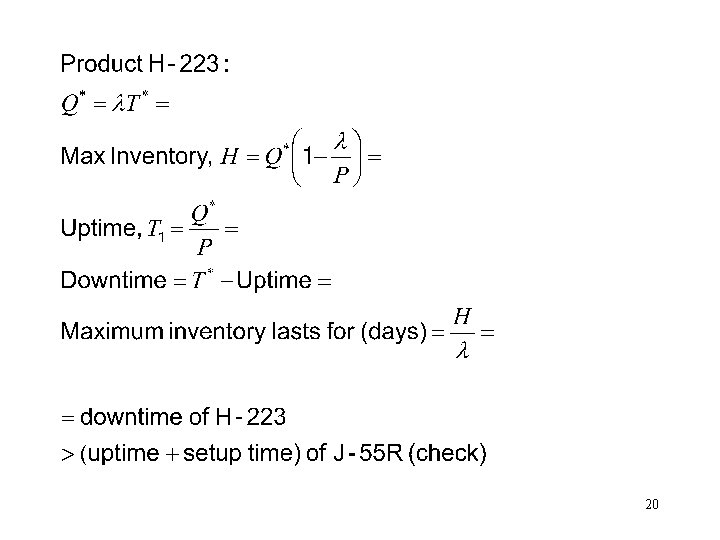
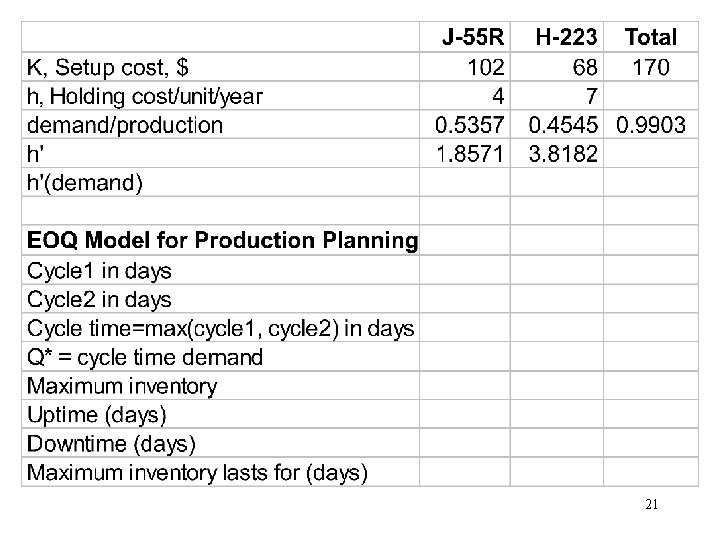
Example EOQ Model for Production Planning Example 7: Tomlinson Furniture has a single lathe for turning the wood for various furniture pieces including bedposts, rounded table legs, and other items. Two products and some relevant information appear below: Annual Setup Time Unit Annual Piece Demand (hours) Cost Production J-55 R 18, 000 1. 2 $20 33, 600 H-223 24, 000 0. 8 35 52, 800 Worker time for setup is valued at $85 per hour, and holding costs are based on a 20 percent annual interest charge. Assume 8 hours per day and 240 days per year. Find the 16 optimal production quantities.
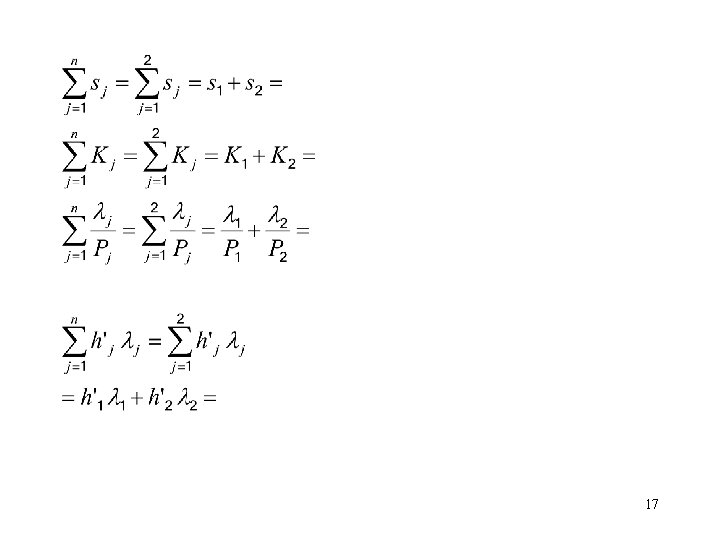
17
18
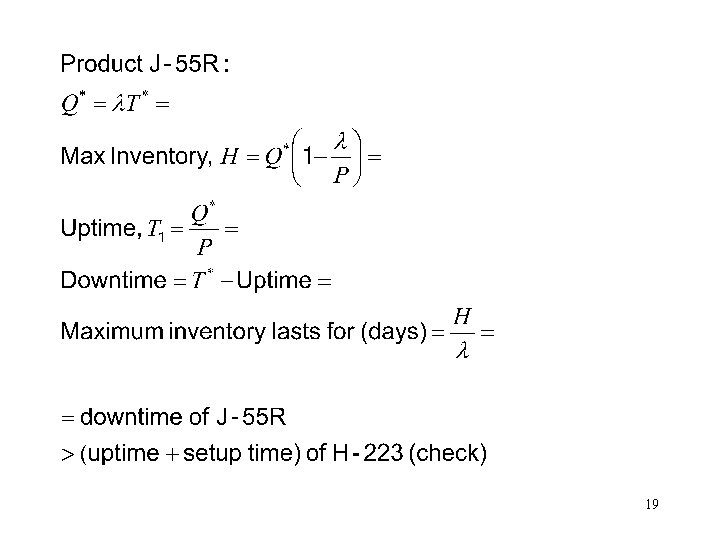
19
20
21
READING AND EXERCISES Lesson 15 Reading: Section 4. 9 , pp. 226 -229 (4 th Ed. ), pp. 215 -220 (5 th Ed. ) Exercise: 29, 30 pp. 230 -231(4 th Ed. ), pp. 219 -220 (5 th Ed. ) 22