
Lesson 15 Induction Motor Testing LockRotor and Noload

- Slides: 17
Lesson 15: Induction Motor Testing: Lock-Rotor and No-load Tests ET 332 b Ac Motors, Generators and Power Systems Lesson 15_et 332 b. pptx 1
Learning Objectives After this presentation you will be able to: Ø Ø Ø Conduct locked rotor tests on 3 -phase induction motors Conduct no-load tests on 3 -phase induction motors Use measurements from lock rotor and no-load tests to find motor circuit parameters Lesson 15_et 332 b. pptx 2
Finding Induction Motor Parameters Dc Test - finds R 1, the stator conductor resistance Procedure: Formulas 1. ) Apply dc voltage to stator 2. ) Adjust dc source until rated current flows For wye connected stator For delta connected stator Lesson 15_et 332 b. pptx 3
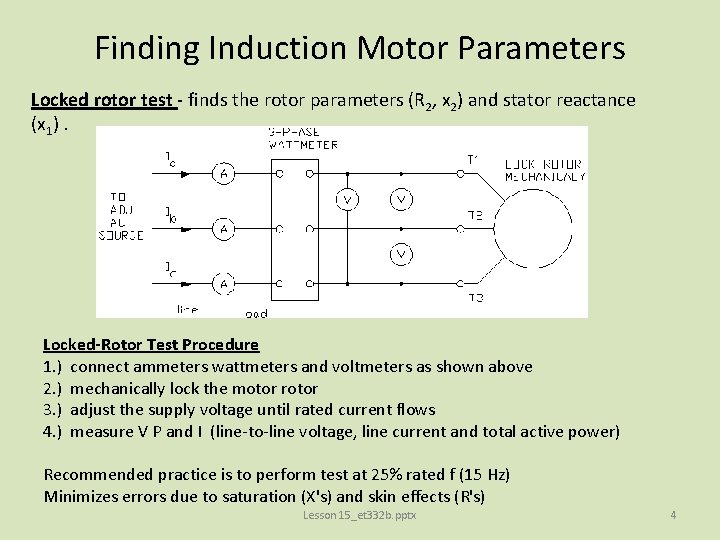
Finding Induction Motor Parameters Locked rotor test - finds the rotor parameters (R 2, x 2) and stator reactance (x 1). Locked-Rotor Test Procedure 1. ) connect ammeters wattmeters and voltmeters as shown above 2. ) mechanically lock the motor rotor 3. ) adjust the supply voltage until rated current flows 4. ) measure V P and I (line-to-line voltage, line current and total active power) Recommended practice is to perform test at 25% rated f (15 Hz) Minimizes errors due to saturation (X's) and skin effects (R's) Lesson 15_et 332 b. pptx 4
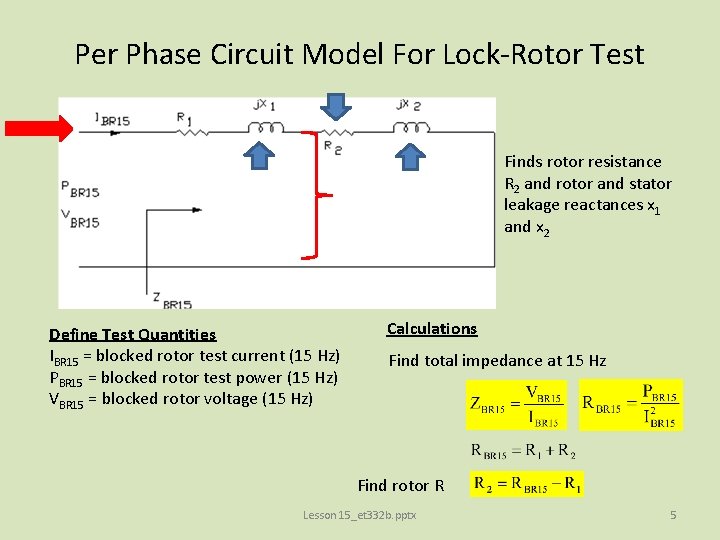
Per Phase Circuit Model For Lock-Rotor Test Finds rotor resistance R 2 and rotor and stator leakage reactances x 1 and x 2 Define Test Quantities IBR 15 = blocked rotor test current (15 Hz) PBR 15 = blocked rotor test power (15 Hz) VBR 15 = blocked rotor voltage (15 Hz) Calculations Find total impedance at 15 Hz Find rotor R Lesson 15_et 332 b. pptx 5
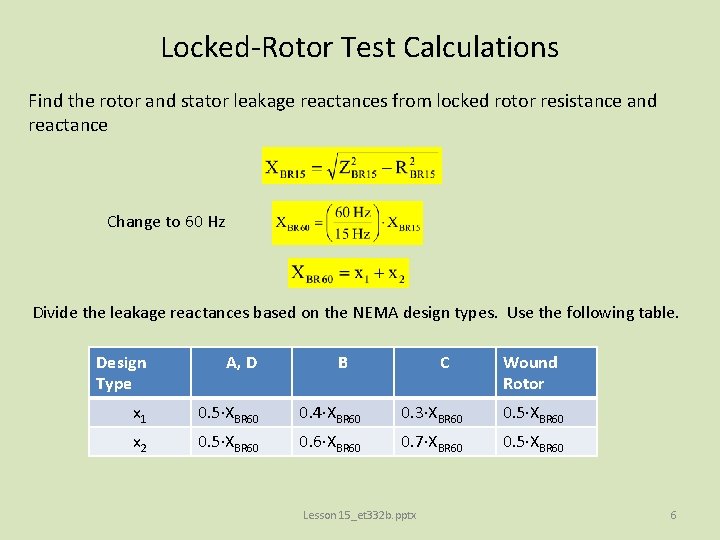
Locked-Rotor Test Calculations Find the rotor and stator leakage reactances from locked rotor resistance and reactance Change to 60 Hz Divide the leakage reactances based on the NEMA design types. Use the following table. Design Type A, D B C x 1 0. 5∙XBR 60 0. 4∙XBR 60 0. 3∙XBR 60 0. 5∙XBR 60 x 2 0. 5∙XBR 60 0. 6∙XBR 60 0. 7∙XBR 60 0. 5∙XBR 60 Lesson 15_et 332 b. pptx Wound Rotor 6
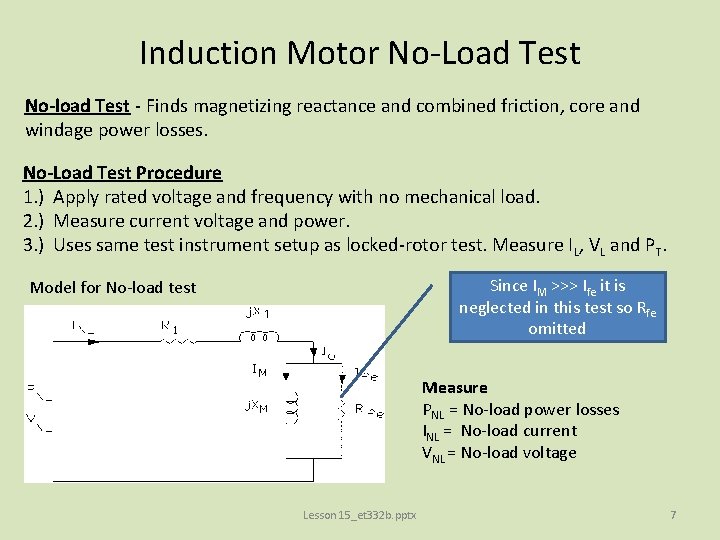
Induction Motor No-Load Test No-load Test - Finds magnetizing reactance and combined friction, core and windage power losses. No-Load Test Procedure 1. ) Apply rated voltage and frequency with no mechanical load. 2. ) Measure current voltage and power. 3. ) Uses same test instrument setup as locked-rotor test. Measure IL, VL and PT. Since IM >>> Ife it is neglected in this test so Rfe omitted Model for No-load test Measure PNL = No-load power losses INL = No-load current VNL = No-load voltage Lesson 15_et 332 b. pptx 7
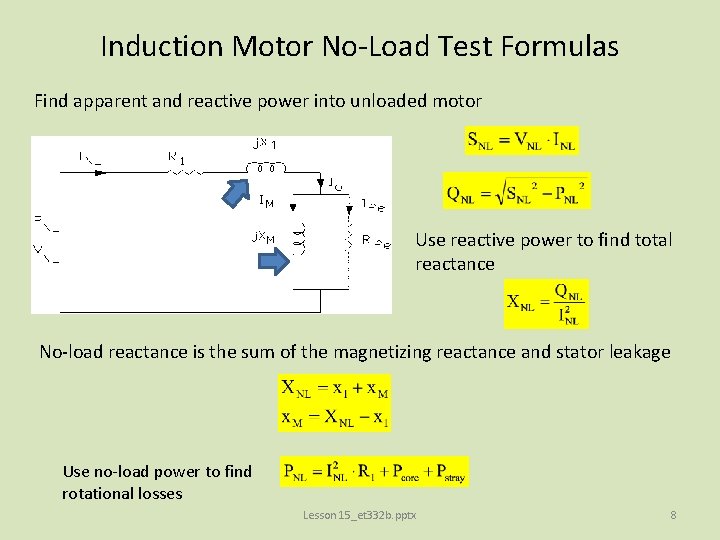
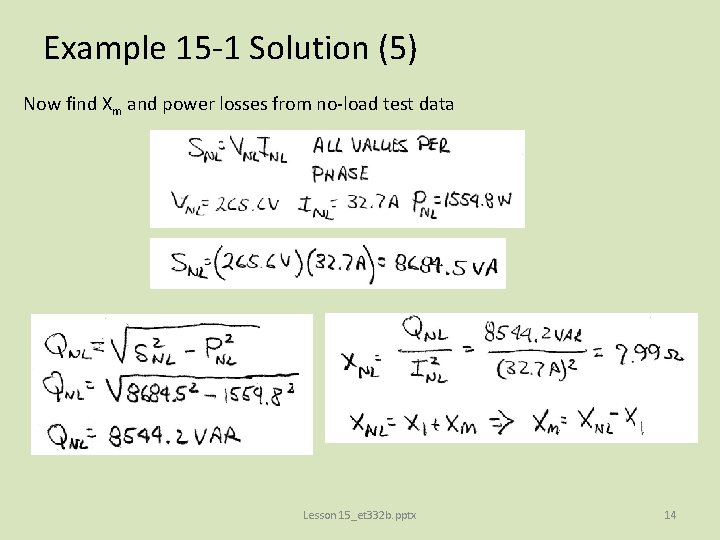
Induction Motor No-Load Test Formulas Find apparent and reactive power into unloaded motor Use reactive power to find total reactance No-load reactance is the sum of the magnetizing reactance and stator leakage Use no-load power to find rotational losses Lesson 15_et 332 b. pptx 8
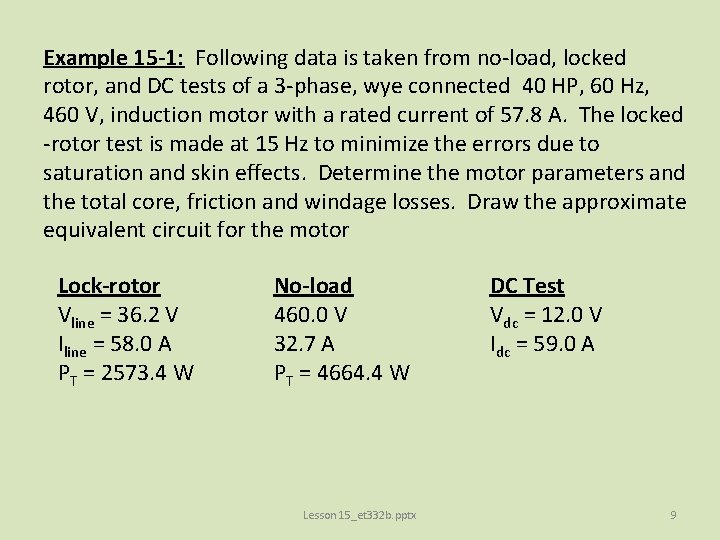
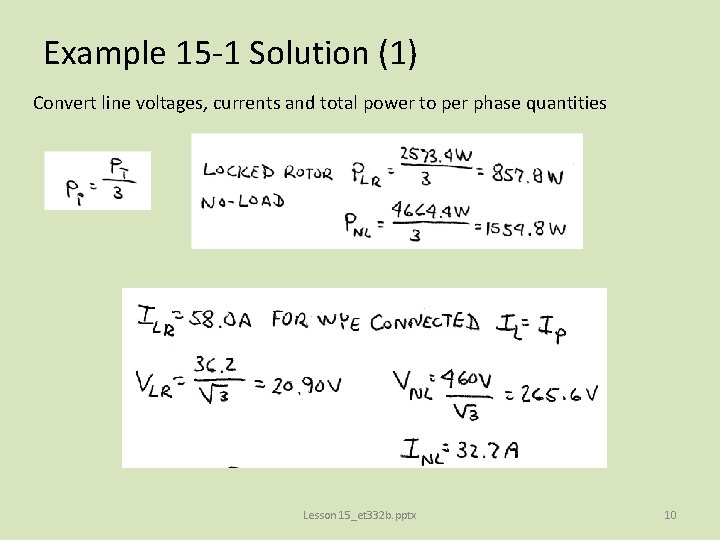
Example 15 -1: Following data is taken from no-load, locked rotor, and DC tests of a 3 -phase, wye connected 40 HP, 60 Hz, 460 V, induction motor with a rated current of 57. 8 A. The locked -rotor test is made at 15 Hz to minimize the errors due to saturation and skin effects. Determine the motor parameters and the total core, friction and windage losses. Draw the approximate equivalent circuit for the motor Lock-rotor Vline = 36. 2 V Iline = 58. 0 A PT = 2573. 4 W No-load 460. 0 V 32. 7 A PT = 4664. 4 W Lesson 15_et 332 b. pptx DC Test Vdc = 12. 0 V Idc = 59. 0 A 9
Example 15 -1 Solution (1) Convert line voltages, currents and total power to per phase quantities Lesson 15_et 332 b. pptx 10
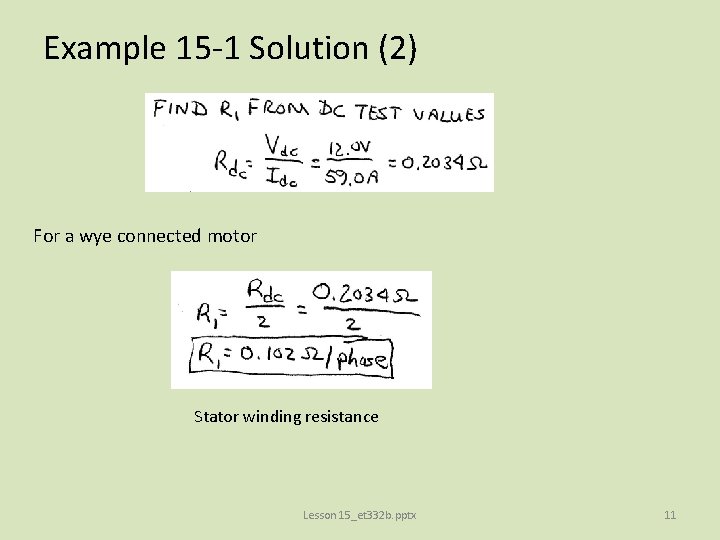
Example 15 -1 Solution (2) For a wye connected motor Stator winding resistance Lesson 15_et 332 b. pptx 11
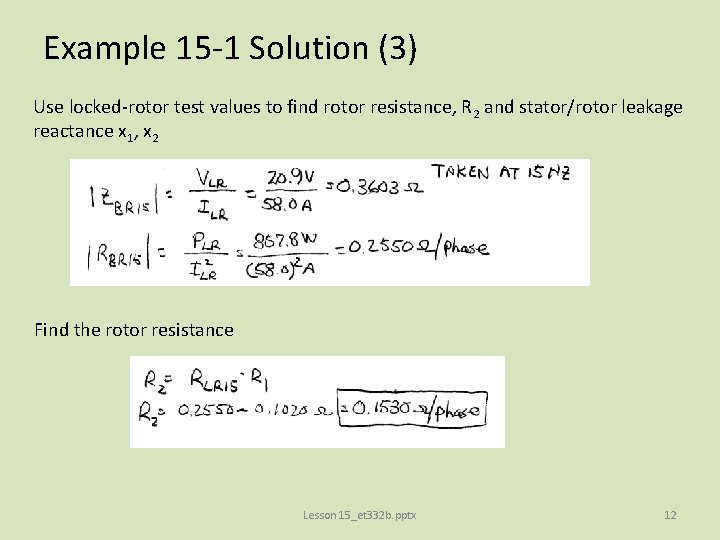
Example 15 -1 Solution (3) Use locked-rotor test values to find rotor resistance, R 2 and stator/rotor leakage reactance x 1, x 2 Find the rotor resistance Lesson 15_et 332 b. pptx 12
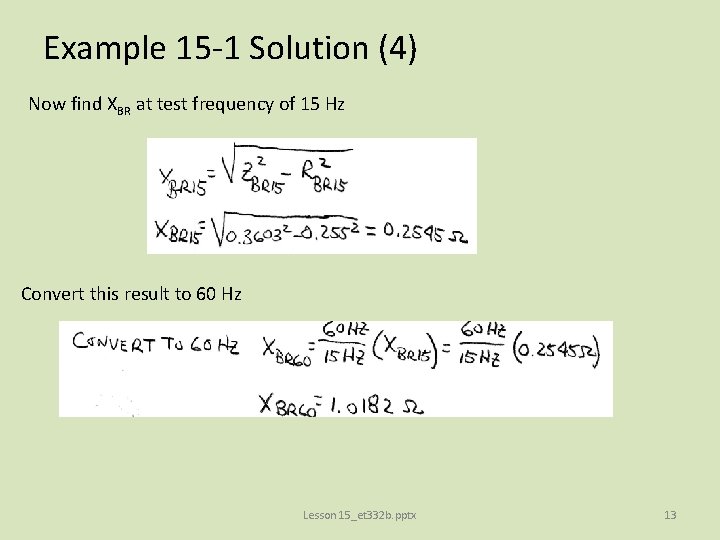
Example 15 -1 Solution (4) Now find XBR at test frequency of 15 Hz Convert this result to 60 Hz Lesson 15_et 332 b. pptx 13
Example 15 -1 Solution (5) Now find Xm and power losses from no-load test data Lesson 15_et 332 b. pptx 14
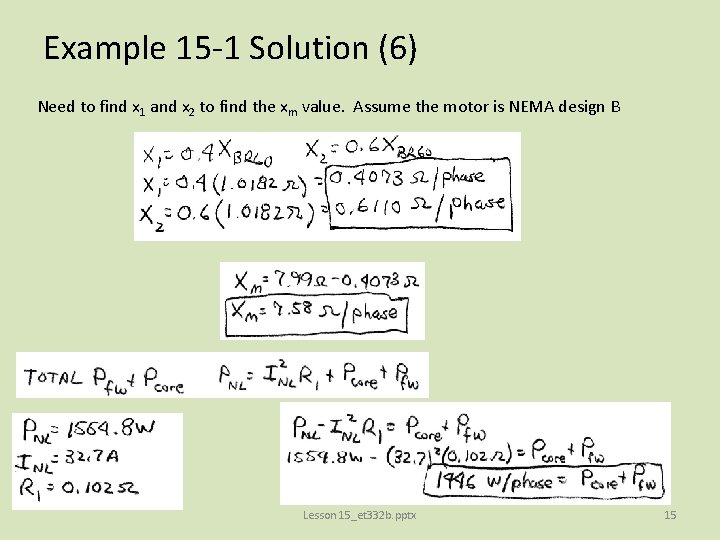
Example 15 -1 Solution (6) Need to find x 1 and x 2 to find the xm value. Assume the motor is NEMA design B Lesson 15_et 332 b. pptx 15
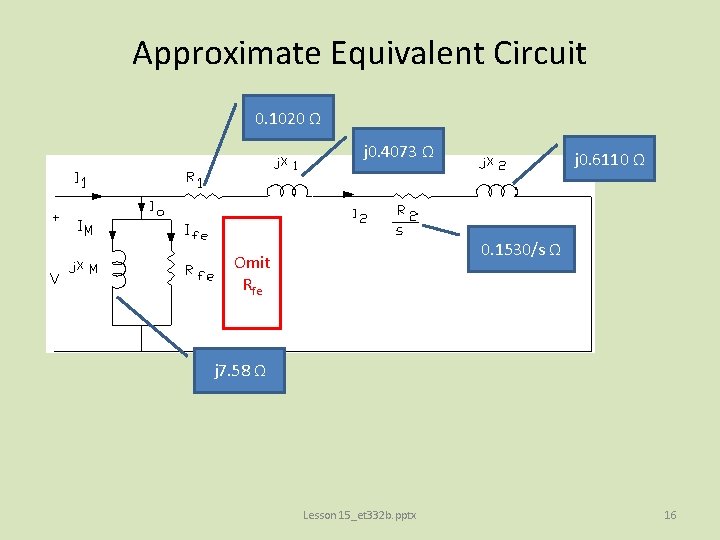
Approximate Equivalent Circuit 0. 1020 Ω j 0. 4073 Ω j 0. 6110 Ω 0. 1530/s Ω Omit Rfe j 7. 58 Ω Lesson 15_et 332 b. pptx 16
ET 332 b Ac Motors, Generators and Power Systems END LESSON 15: INDUCTION MOTOR TESTING: LOCK-ROTOR AND NO-LOAD TESTS Lesson 15_et 332 b. pptx 17