
Lesson 15 Evaluating an Exemplar Second Body Paragraph
Lesson 15 Evaluating an Exemplar Second Body Paragraph 1
Evaluating an Exemplar Second Body Paragraph We will look at the exemplar second paragraph and pick out the strengths of the paragraph. Notice that some words or phrases represent more than one strength. 2
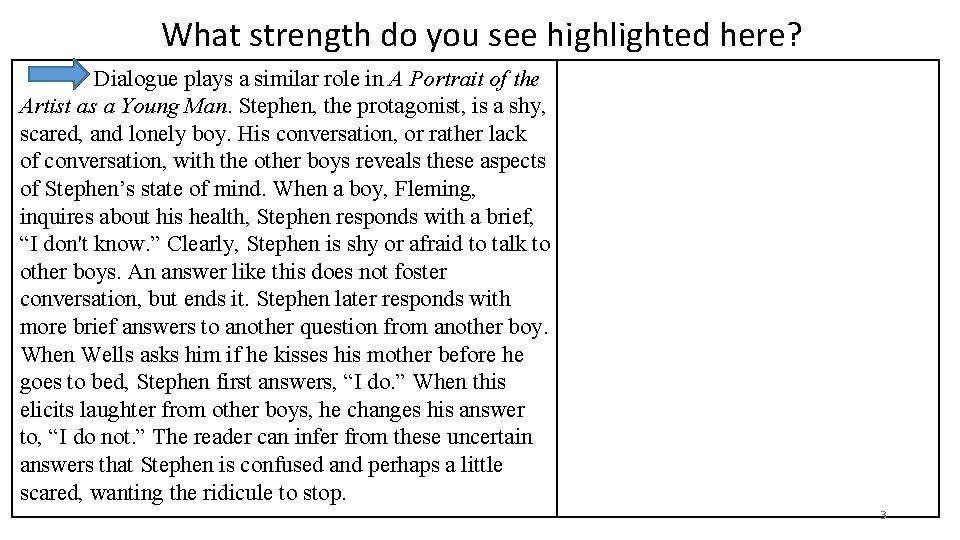
What strength do you see highlighted here? Dialogue plays a similar role in A Portrait of the Artist as a Young Man. Stephen, the protagonist, is a shy, scared, and lonely boy. His conversation, or rather lack of conversation, with the other boys reveals these aspects of Stephen’s state of mind. When a boy, Fleming, inquires about his health, Stephen responds with a brief, “I don't know. ” Clearly, Stephen is shy or afraid to talk to other boys. An answer like this does not foster conversation, but ends it. Stephen later responds with more brief answers to another question from another boy. When Wells asks him if he kisses his mother before he goes to bed, Stephen first answers, “I do. ” When this elicits laughter from other boys, he changes his answer to, “I do not. ” The reader can infer from these uncertain answers that Stephen is confused and perhaps a little scared, wanting the ridicule to stop. 3
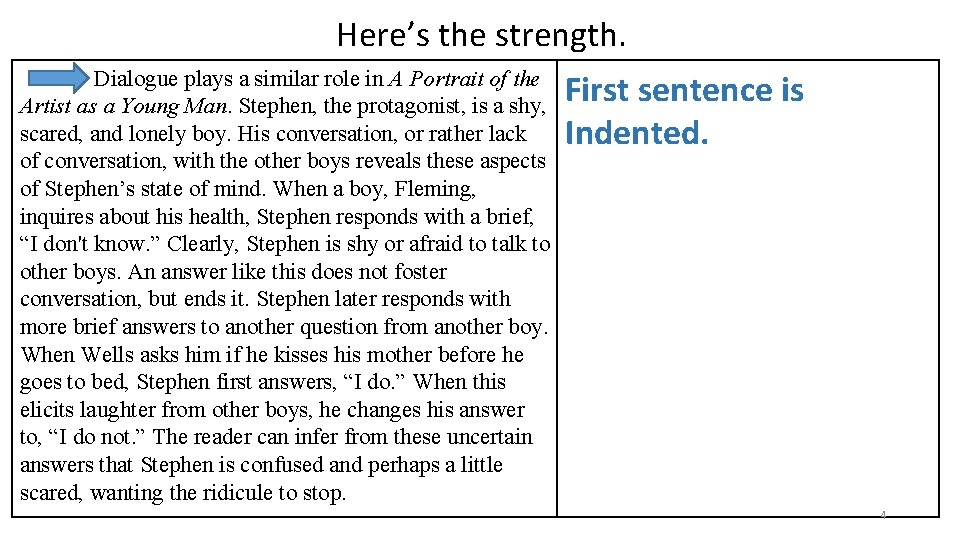
Here’s the strength. Dialogue plays a similar role in A Portrait of the Artist as a Young Man. Stephen, the protagonist, is a shy, scared, and lonely boy. His conversation, or rather lack of conversation, with the other boys reveals these aspects of Stephen’s state of mind. When a boy, Fleming, inquires about his health, Stephen responds with a brief, “I don't know. ” Clearly, Stephen is shy or afraid to talk to other boys. An answer like this does not foster conversation, but ends it. Stephen later responds with more brief answers to another question from another boy. When Wells asks him if he kisses his mother before he goes to bed, Stephen first answers, “I do. ” When this elicits laughter from other boys, he changes his answer to, “I do not. ” The reader can infer from these uncertain answers that Stephen is confused and perhaps a little scared, wanting the ridicule to stop. First sentence is Indented. 4
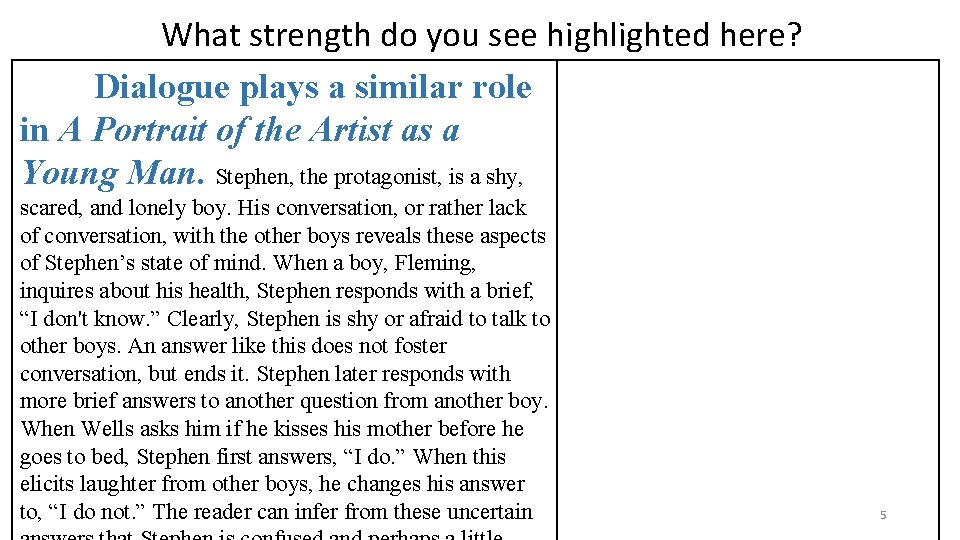
What strength do you see highlighted here? Dialogue plays a similar role in A Portrait of the Artist as a Young Man. Stephen, the protagonist, is a shy, scared, and lonely boy. His conversation, or rather lack of conversation, with the other boys reveals these aspects of Stephen’s state of mind. When a boy, Fleming, inquires about his health, Stephen responds with a brief, “I don't know. ” Clearly, Stephen is shy or afraid to talk to other boys. An answer like this does not foster conversation, but ends it. Stephen later responds with more brief answers to another question from another boy. When Wells asks him if he kisses his mother before he goes to bed, Stephen first answers, “I do. ” When this elicits laughter from other boys, he changes his answer to, “I do not. ” The reader can infer from these uncertain 5
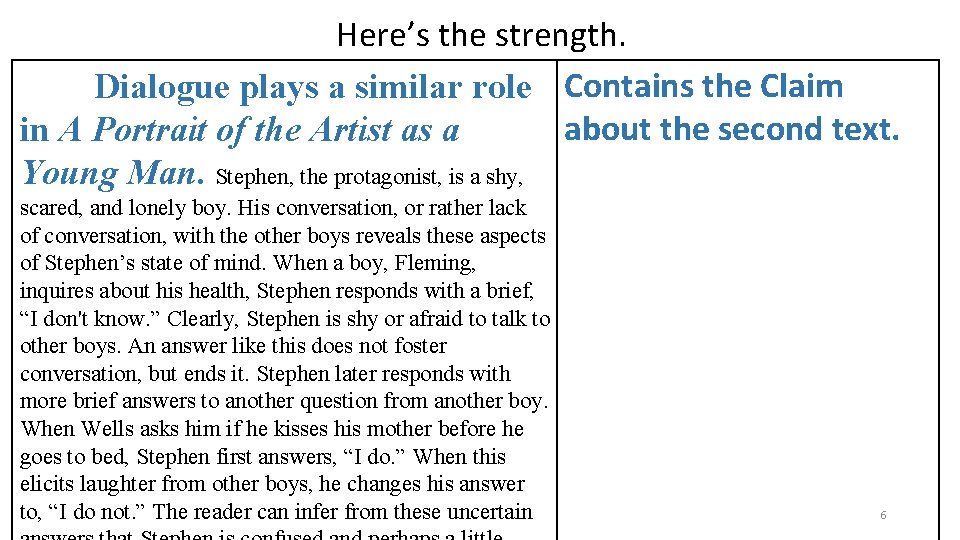
Here’s the strength. Dialogue plays a similar role Contains the Claim about the second text. in A Portrait of the Artist as a Young Man. Stephen, the protagonist, is a shy, scared, and lonely boy. His conversation, or rather lack of conversation, with the other boys reveals these aspects of Stephen’s state of mind. When a boy, Fleming, inquires about his health, Stephen responds with a brief, “I don't know. ” Clearly, Stephen is shy or afraid to talk to other boys. An answer like this does not foster conversation, but ends it. Stephen later responds with more brief answers to another question from another boy. When Wells asks him if he kisses his mother before he goes to bed, Stephen first answers, “I do. ” When this elicits laughter from other boys, he changes his answer to, “I do not. ” The reader can infer from these uncertain 6
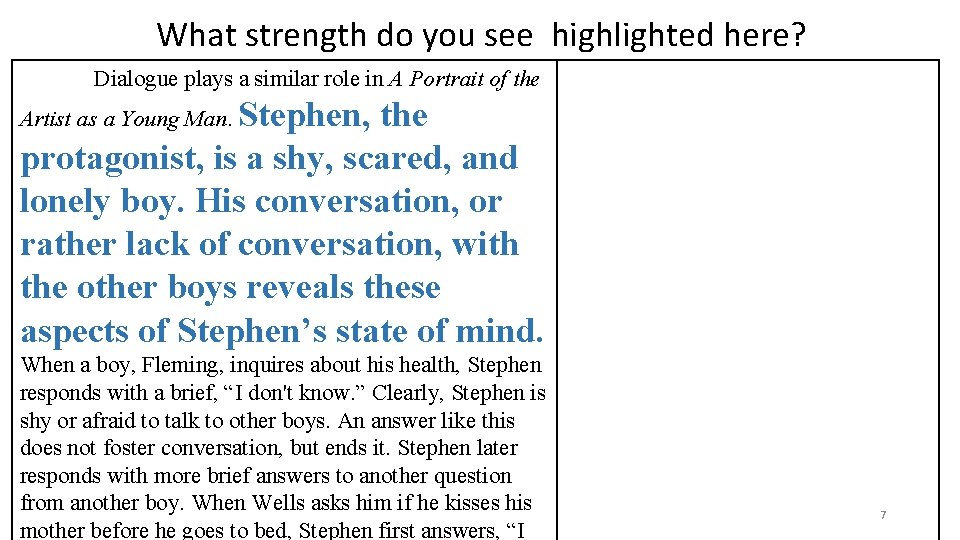
What strength do you see highlighted here? Dialogue plays a similar role in A Portrait of the Artist as a Young Man. Stephen, the protagonist, is a shy, scared, and lonely boy. His conversation, or rather lack of conversation, with the other boys reveals these aspects of Stephen’s state of mind. When a boy, Fleming, inquires about his health, Stephen responds with a brief, “I don't know. ” Clearly, Stephen is shy or afraid to talk to other boys. An answer like this does not foster conversation, but ends it. Stephen later responds with more brief answers to another question from another boy. When Wells asks him if he kisses his mother before he goes to bed, Stephen first answers, “I 7
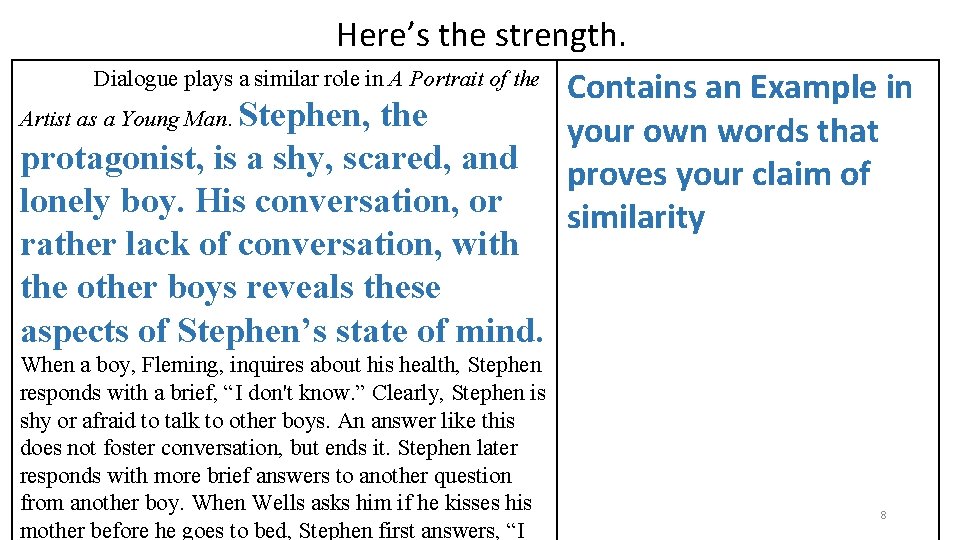
Here’s the strength. Dialogue plays a similar role in A Portrait of the Contains an Example in Artist as a Young Man. Stephen, the your own words that protagonist, is a shy, scared, and proves your claim of lonely boy. His conversation, or similarity rather lack of conversation, with the other boys reveals these aspects of Stephen’s state of mind. When a boy, Fleming, inquires about his health, Stephen responds with a brief, “I don't know. ” Clearly, Stephen is shy or afraid to talk to other boys. An answer like this does not foster conversation, but ends it. Stephen later responds with more brief answers to another question from another boy. When Wells asks him if he kisses his mother before he goes to bed, Stephen first answers, “I 8
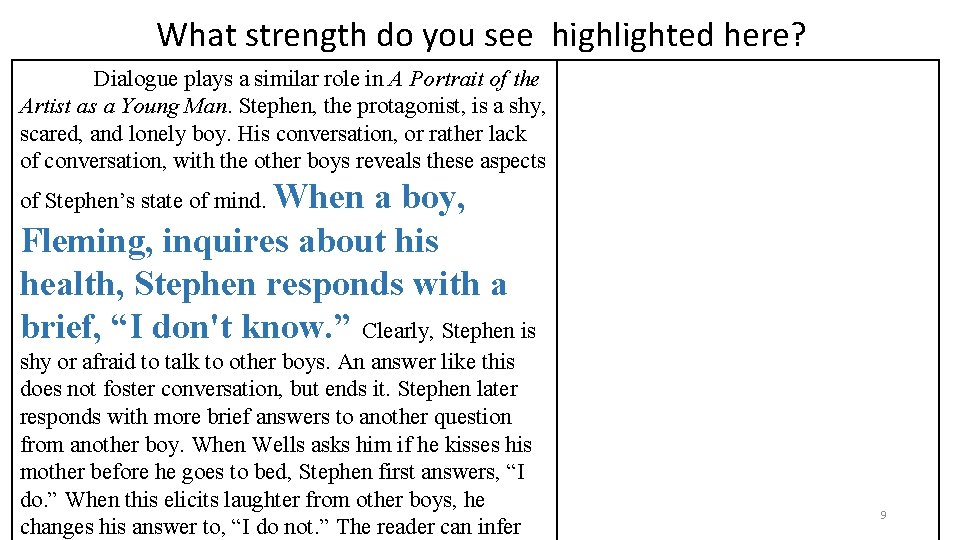
What strength do you see highlighted here? Dialogue plays a similar role in A Portrait of the Artist as a Young Man. Stephen, the protagonist, is a shy, scared, and lonely boy. His conversation, or rather lack of conversation, with the other boys reveals these aspects of Stephen’s state of mind. When a boy, Fleming, inquires about his health, Stephen responds with a brief, “I don't know. ” Clearly, Stephen is shy or afraid to talk to other boys. An answer like this does not foster conversation, but ends it. Stephen later responds with more brief answers to another question from another boy. When Wells asks him if he kisses his mother before he goes to bed, Stephen first answers, “I do. ” When this elicits laughter from other boys, he changes his answer to, “I do not. ” The reader can infer 9
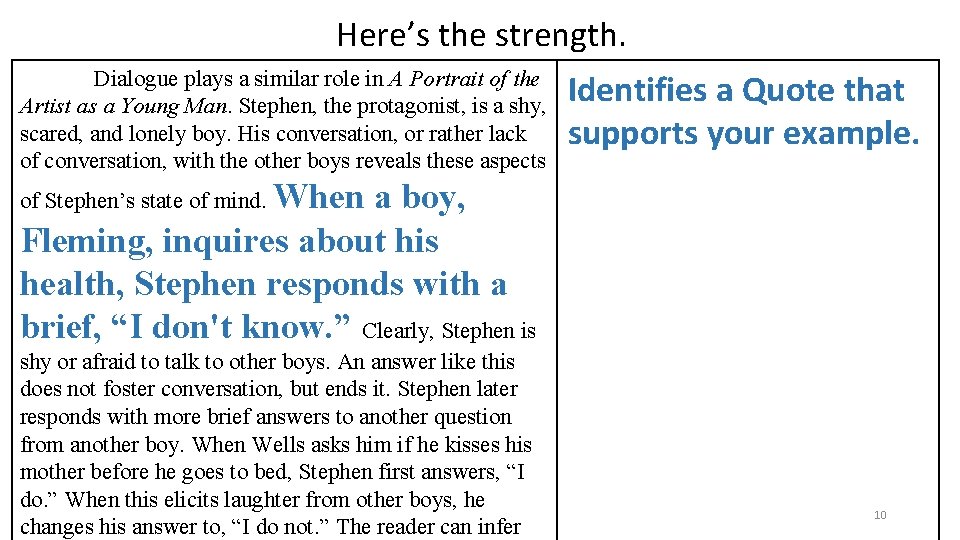
Here’s the strength. Dialogue plays a similar role in A Portrait of the Artist as a Young Man. Stephen, the protagonist, is a shy, scared, and lonely boy. His conversation, or rather lack of conversation, with the other boys reveals these aspects Identifies a Quote that supports your example. of Stephen’s state of mind. When a boy, Fleming, inquires about his health, Stephen responds with a brief, “I don't know. ” Clearly, Stephen is shy or afraid to talk to other boys. An answer like this does not foster conversation, but ends it. Stephen later responds with more brief answers to another question from another boy. When Wells asks him if he kisses his mother before he goes to bed, Stephen first answers, “I do. ” When this elicits laughter from other boys, he changes his answer to, “I do not. ” The reader can infer 10
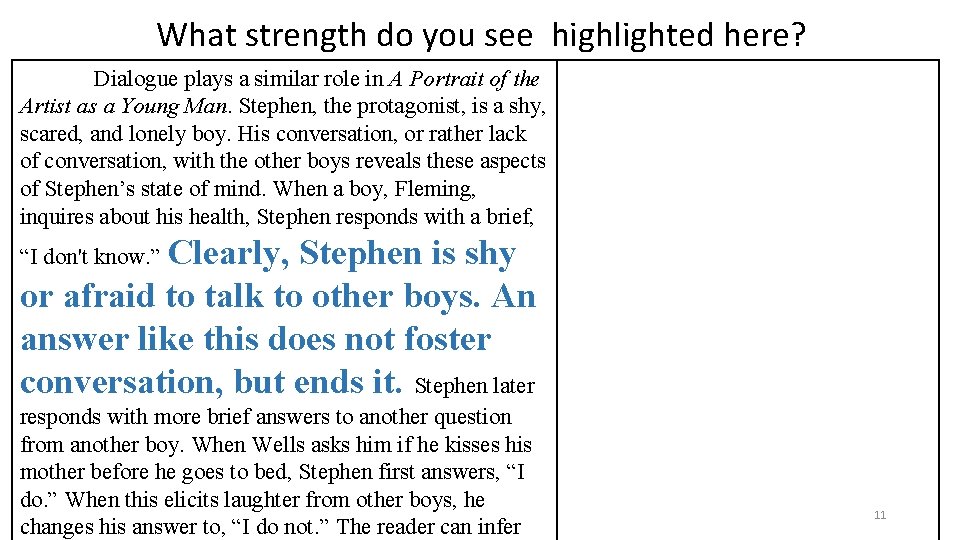
What strength do you see highlighted here? Dialogue plays a similar role in A Portrait of the Artist as a Young Man. Stephen, the protagonist, is a shy, scared, and lonely boy. His conversation, or rather lack of conversation, with the other boys reveals these aspects of Stephen’s state of mind. When a boy, Fleming, inquires about his health, Stephen responds with a brief, “I don't know. ” Clearly, Stephen is shy or afraid to talk to other boys. An answer like this does not foster conversation, but ends it. Stephen later responds with more brief answers to another question from another boy. When Wells asks him if he kisses his mother before he goes to bed, Stephen first answers, “I do. ” When this elicits laughter from other boys, he changes his answer to, “I do not. ” The reader can infer 11
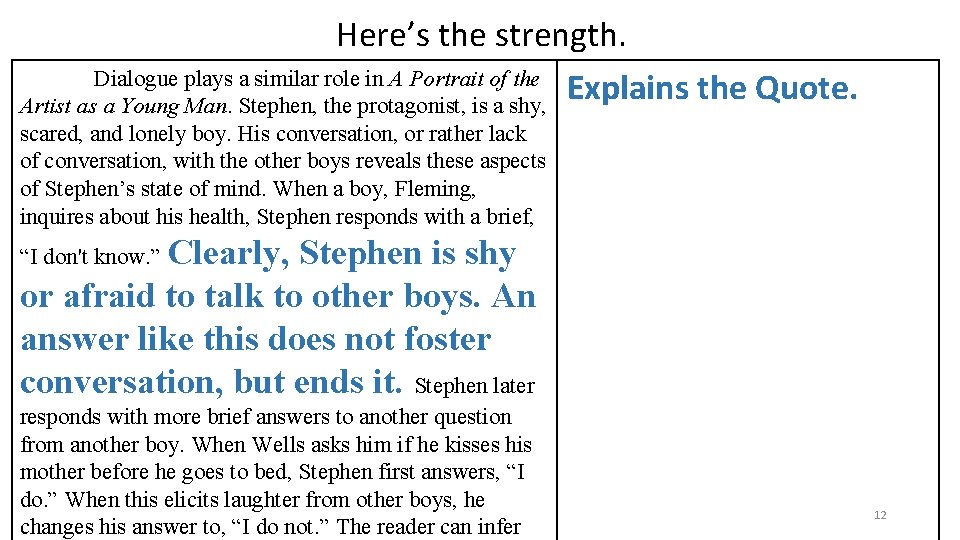
Here’s the strength. Dialogue plays a similar role in A Portrait of the Explains the Quote. Artist as a Young Man. Stephen, the protagonist, is a shy, scared, and lonely boy. His conversation, or rather lack of conversation, with the other boys reveals these aspects of Stephen’s state of mind. When a boy, Fleming, inquires about his health, Stephen responds with a brief, “I don't know. ” Clearly, Stephen is shy or afraid to talk to other boys. An answer like this does not foster conversation, but ends it. Stephen later responds with more brief answers to another question from another boy. When Wells asks him if he kisses his mother before he goes to bed, Stephen first answers, “I do. ” When this elicits laughter from other boys, he changes his answer to, “I do not. ” The reader can infer 12
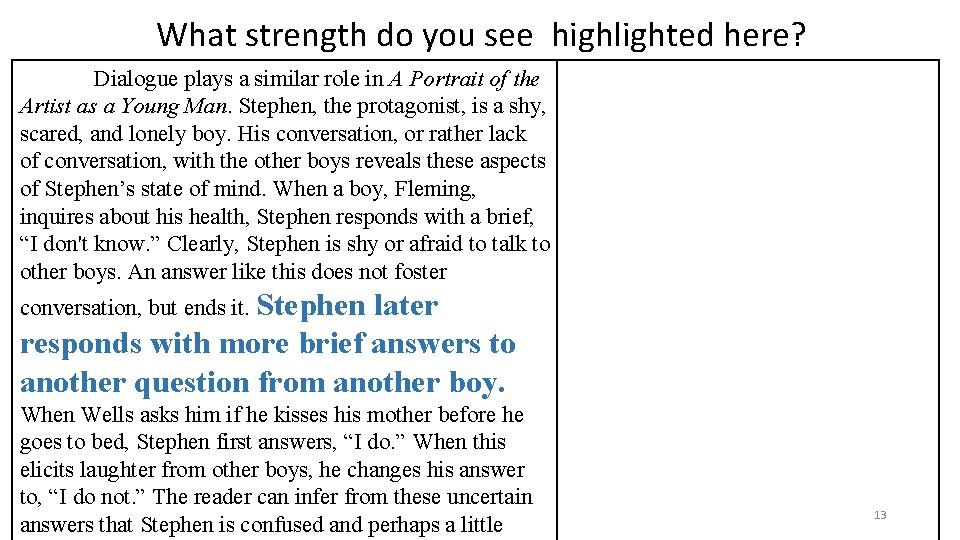
What strength do you see highlighted here? Dialogue plays a similar role in A Portrait of the Artist as a Young Man. Stephen, the protagonist, is a shy, scared, and lonely boy. His conversation, or rather lack of conversation, with the other boys reveals these aspects of Stephen’s state of mind. When a boy, Fleming, inquires about his health, Stephen responds with a brief, “I don't know. ” Clearly, Stephen is shy or afraid to talk to other boys. An answer like this does not foster conversation, but ends it. Stephen later responds with more brief answers to another question from another boy. When Wells asks him if he kisses his mother before he goes to bed, Stephen first answers, “I do. ” When this elicits laughter from other boys, he changes his answer to, “I do not. ” The reader can infer from these uncertain answers that Stephen is confused and perhaps a little 13
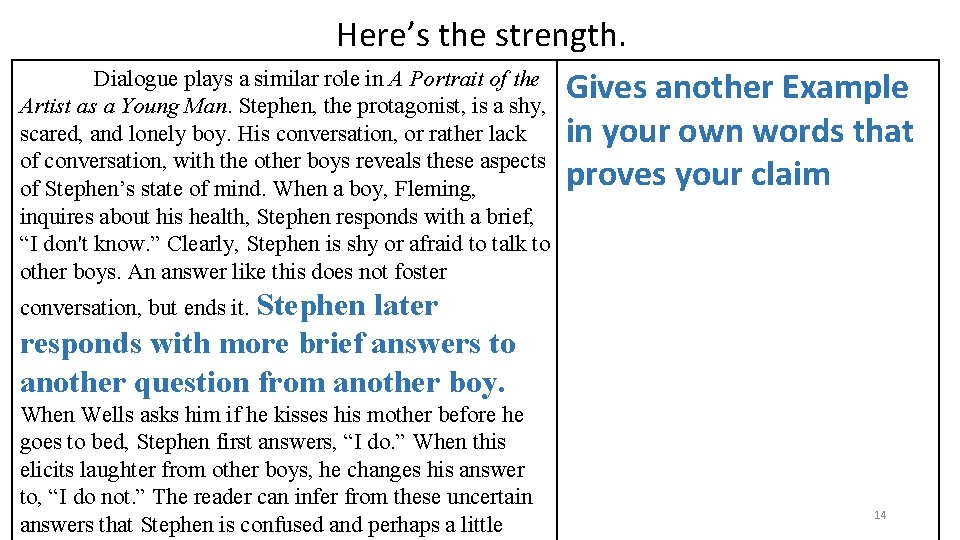
Here’s the strength. Dialogue plays a similar role in A Portrait of the Gives another Example Artist as a Young Man. Stephen, the protagonist, is a shy, scared, and lonely boy. His conversation, or rather lack in your own words that of conversation, with the other boys reveals these aspects proves your claim of Stephen’s state of mind. When a boy, Fleming, inquires about his health, Stephen responds with a brief, “I don't know. ” Clearly, Stephen is shy or afraid to talk to other boys. An answer like this does not foster conversation, but ends it. Stephen later responds with more brief answers to another question from another boy. When Wells asks him if he kisses his mother before he goes to bed, Stephen first answers, “I do. ” When this elicits laughter from other boys, he changes his answer to, “I do not. ” The reader can infer from these uncertain answers that Stephen is confused and perhaps a little 14
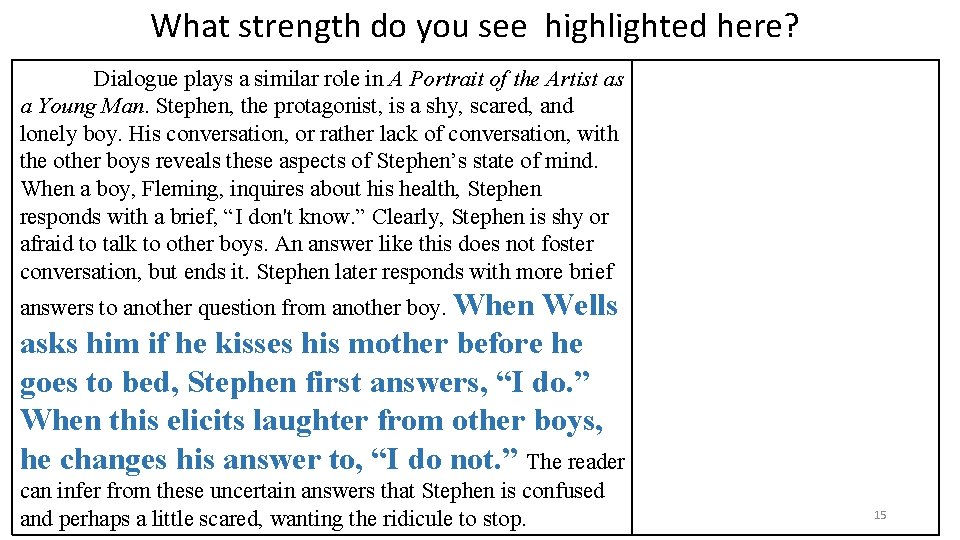
What strength do you see highlighted here? Dialogue plays a similar role in A Portrait of the Artist as a Young Man. Stephen, the protagonist, is a shy, scared, and lonely boy. His conversation, or rather lack of conversation, with the other boys reveals these aspects of Stephen’s state of mind. When a boy, Fleming, inquires about his health, Stephen responds with a brief, “I don't know. ” Clearly, Stephen is shy or afraid to talk to other boys. An answer like this does not foster conversation, but ends it. Stephen later responds with more brief answers to another question from another boy. When Wells asks him if he kisses his mother before he goes to bed, Stephen first answers, “I do. ” When this elicits laughter from other boys, he changes his answer to, “I do not. ” The reader can infer from these uncertain answers that Stephen is confused and perhaps a little scared, wanting the ridicule to stop. 15
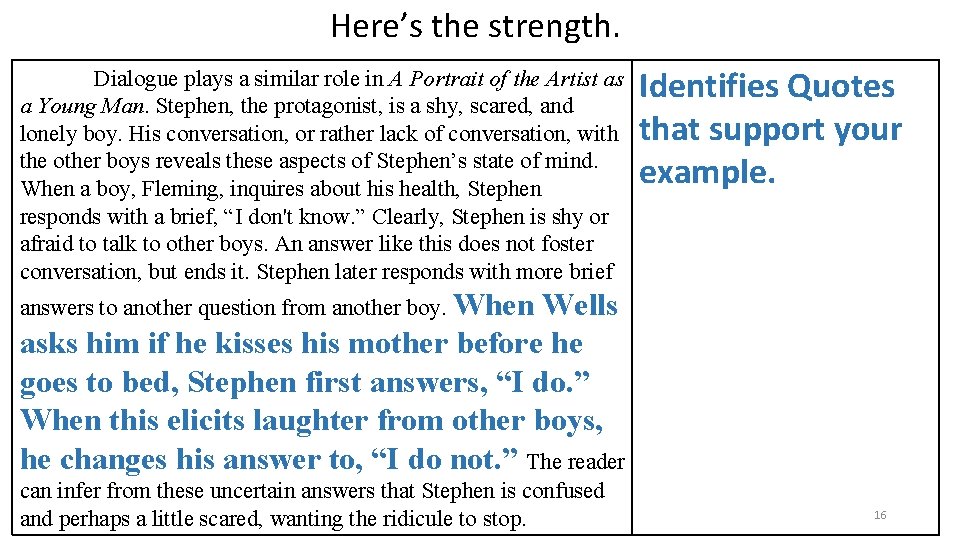
Here’s the strength. Dialogue plays a similar role in A Portrait of the Artist as a Young Man. Stephen, the protagonist, is a shy, scared, and lonely boy. His conversation, or rather lack of conversation, with the other boys reveals these aspects of Stephen’s state of mind. When a boy, Fleming, inquires about his health, Stephen responds with a brief, “I don't know. ” Clearly, Stephen is shy or afraid to talk to other boys. An answer like this does not foster conversation, but ends it. Stephen later responds with more brief Identifies Quotes that support your example. answers to another question from another boy. When Wells asks him if he kisses his mother before he goes to bed, Stephen first answers, “I do. ” When this elicits laughter from other boys, he changes his answer to, “I do not. ” The reader can infer from these uncertain answers that Stephen is confused and perhaps a little scared, wanting the ridicule to stop. 16
What strength do you see highlighted here? Dialogue plays a similar role in A Portrait of the Artist as a Young Man. Stephen, the protagonist, is a shy, scared, and lonely boy. His conversation, or rather lack of conversation, with the other boys reveals these aspects of Stephen’s state of mind. When a boy, Fleming, inquires about his health, Stephen responds with a brief, “I don't know. ” Clearly, Stephen is shy or afraid to talk to other boys. An answer like this does not foster conversation, but ends it. Stephen later responds with more brief answers to another question from another boy. When Wells asks him if he kisses his mother before he goes to bed, Stephen first answers, “I do. ” When this elicits laughter from other boys, he changes his answer to, “I do not. ” The reader can infer from these uncertain answers that Stephen is confused and perhaps a little scared, wanting the ridicule to stop. 17
Here’s the strength. Dialogue plays a similar role in A Portrait of the Artist. as a Young Man. Stephen, the protagonist, is a shy, scared, and lonely boy. His conversation, or rather lack of conversation, with the other boys reveals these aspects of Stephen’s state of mind. When a boy, Fleming, inquires about his health, Stephen responds with a brief, “I don't know. ” Clearly, Stephen is shy or afraid to talk to other boys. An answer like this does not foster conversation, but ends it. Stephen later responds with more brief answers to another question from another boy. When Wells asks him if he kisses his mother before he goes to bed, Stephen first answers, “I do. ” When this elicits laughter Explains the Quotes from other boys, he changes his answer to, “I do not. ” The reader can infer from these uncertain answers that Stephen is confused and perhaps a little scared, wanting the ridicule to stop. 18
What strength do you see highlighted here? Dialogue plays a similar role in A Portrait of the Artist as a Young Man. Stephen, the protagonist, is a shy, scared, and lonely boy. His conversation, or rather lack of conversation, with the other boys reveals these aspects of Stephen’s state of mind. When a boy, Fleming, inquires about his health, Stephen responds with a brief, “I don't know. ” Clearly, Stephen is shy or afraid to talk to other boys. An answer like this does not foster conversation, but ends it. Stephen later responds with more brief answers to another question from another boy. When Wells asks him if he kisses his mother before he goes to bed, Stephen first answers, “I do. ” When this elicits laughter from other boys, he changes his answer to, “I do not. ” The reader can infer from these uncertain answers that Stephen is confused and perhaps a little scared, wanting the ridicule 19
Here’s the strength. Dialogue plays a similar role in A Portrait of Uses Domain Specific the Artist as a Young Man. Stephen, the protagonist, is a shy, scared, and lonely boy. His conversation, or rather lack of conversation, with the other boys reveals these aspects of Stephen’s state of mind. When a boy, Fleming, inquires about his health, Stephen responds with a brief, “I don't know. ” Clearly, Stephen is shy or afraid to talk to other boys. An answer like this does not foster conversation, but ends it. Stephen later responds with more brief answers to another question from another boy. When Wells asks him if he kisses his mother before he goes to bed, Stephen first answers, “I do. ” When this elicits laughter from other boys, he changes his answer to, “I do not. ” The reader can infer from these uncertain answers that Stephen is confused and perhaps a little scared, wanting the ridicule Words for fiction. 20
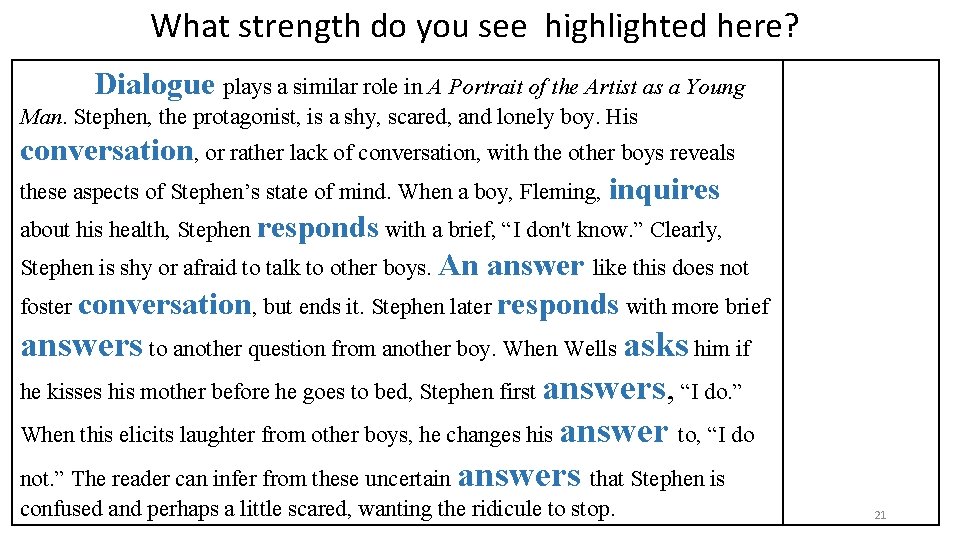
What strength do you see highlighted here? Dialogue plays a similar role in A Portrait of the Artist as a Young Man. Stephen, the protagonist, is a shy, scared, and lonely boy. His conversation, or rather lack of conversation, with the other boys reveals these aspects of Stephen’s state of mind. When a boy, Fleming, inquires about his health, Stephen responds with a brief, “I don't know. ” Clearly, Stephen is shy or afraid to talk to other boys. An answer like this does not foster conversation, but ends it. Stephen later responds with more brief answers to another question from another boy. When Wells asks him if he kisses his mother before he goes to bed, Stephen first answers, “I do. ” When this elicits laughter from other boys, he changes his answer to, “I do not. ” The reader can infer from these uncertain answers that Stephen is confused and perhaps a little scared, wanting the ridicule to stop. 21
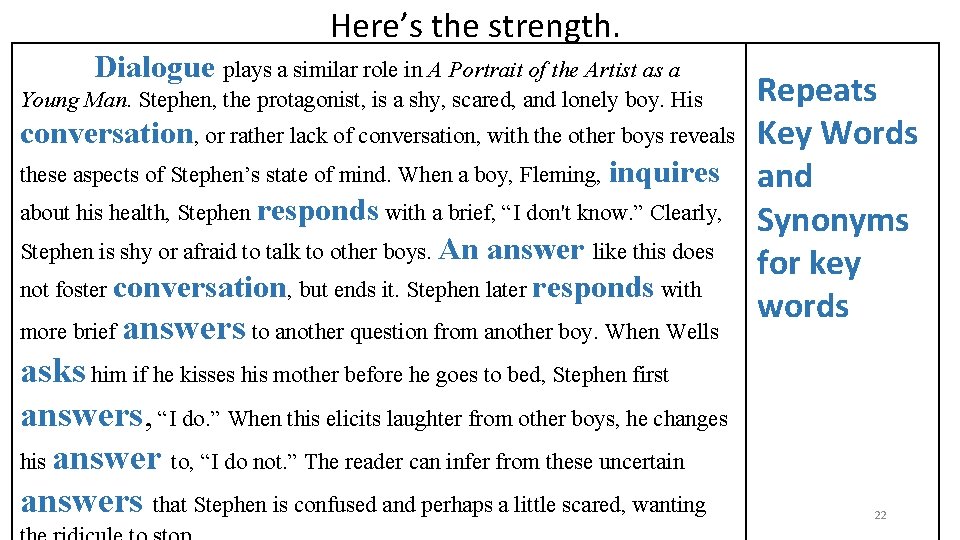
Here’s the strength. Dialogue plays a similar role in A Portrait of the Artist as a Young Man. Stephen, the protagonist, is a shy, scared, and lonely boy. His conversation, or rather lack of conversation, with the other boys reveals these aspects of Stephen’s state of mind. When a boy, Fleming, inquires about his health, Stephen responds with a brief, “I don't know. ” Clearly, Stephen is shy or afraid to talk to other boys. An answer like this does not foster conversation, but ends it. Stephen later responds with more brief answers to another question from another boy. When Wells asks him if he kisses his mother before he goes to bed, Stephen first answers, “I do. ” When this elicits laughter from other boys, he changes his answer to, “I do not. ” The reader can infer from these uncertain answers that Stephen is confused and perhaps a little scared, wanting Repeats Key Words and Synonyms for key words 22
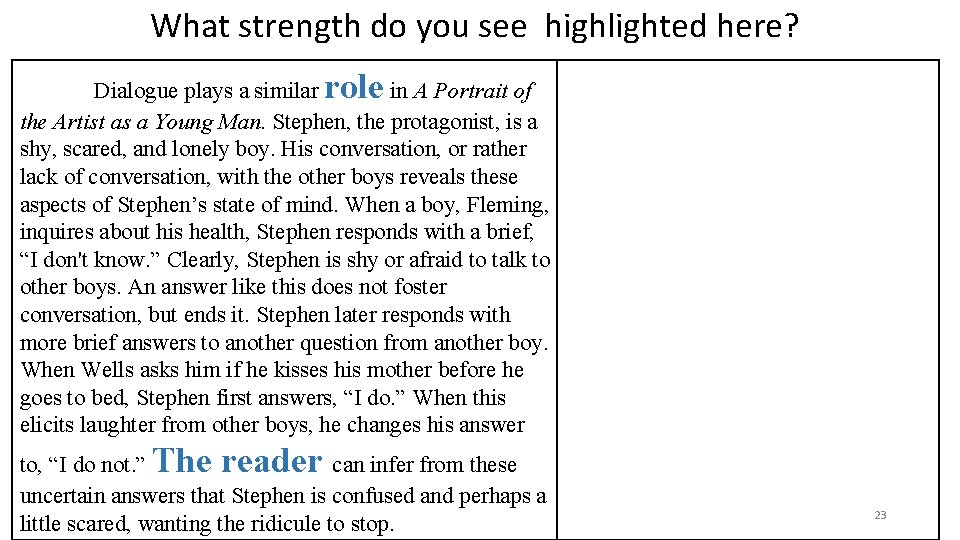
What strength do you see highlighted here? Dialogue plays a similar role in A Portrait of the Artist as a Young Man. Stephen, the protagonist, is a shy, scared, and lonely boy. His conversation, or rather lack of conversation, with the other boys reveals these aspects of Stephen’s state of mind. When a boy, Fleming, inquires about his health, Stephen responds with a brief, “I don't know. ” Clearly, Stephen is shy or afraid to talk to other boys. An answer like this does not foster conversation, but ends it. Stephen later responds with more brief answers to another question from another boy. When Wells asks him if he kisses his mother before he goes to bed, Stephen first answers, “I do. ” When this elicits laughter from other boys, he changes his answer to, “I do not. ” The reader can infer from these uncertain answers that Stephen is confused and perhaps a little scared, wanting the ridicule to stop. 23
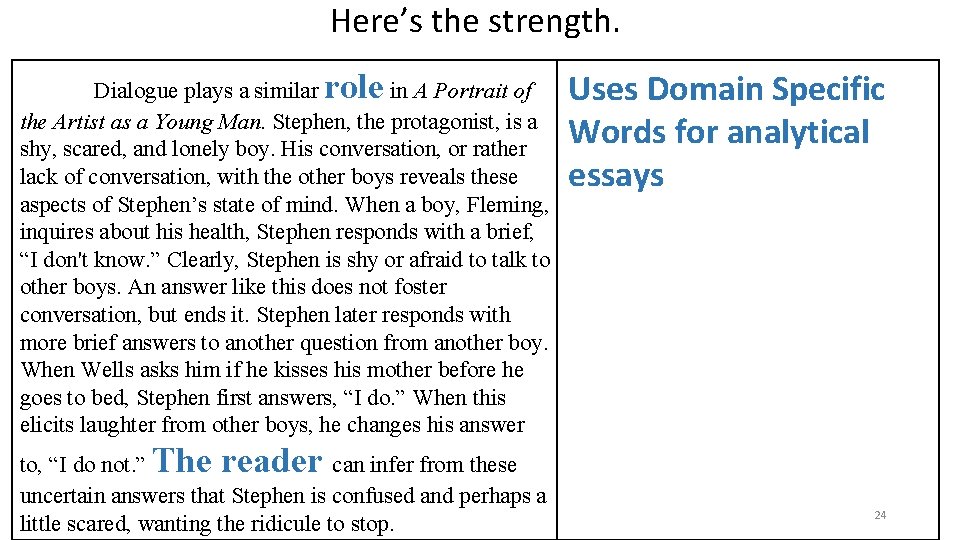
Here’s the strength. Dialogue plays a similar role in A Portrait of the Artist as a Young Man. Stephen, the protagonist, is a shy, scared, and lonely boy. His conversation, or rather lack of conversation, with the other boys reveals these aspects of Stephen’s state of mind. When a boy, Fleming, inquires about his health, Stephen responds with a brief, “I don't know. ” Clearly, Stephen is shy or afraid to talk to other boys. An answer like this does not foster conversation, but ends it. Stephen later responds with more brief answers to another question from another boy. When Wells asks him if he kisses his mother before he goes to bed, Stephen first answers, “I do. ” When this elicits laughter from other boys, he changes his answer to, “I do not. ” The reader can infer from these uncertain answers that Stephen is confused and perhaps a little scared, wanting the ridicule to stop. Uses Domain Specific Words for analytical essays 24
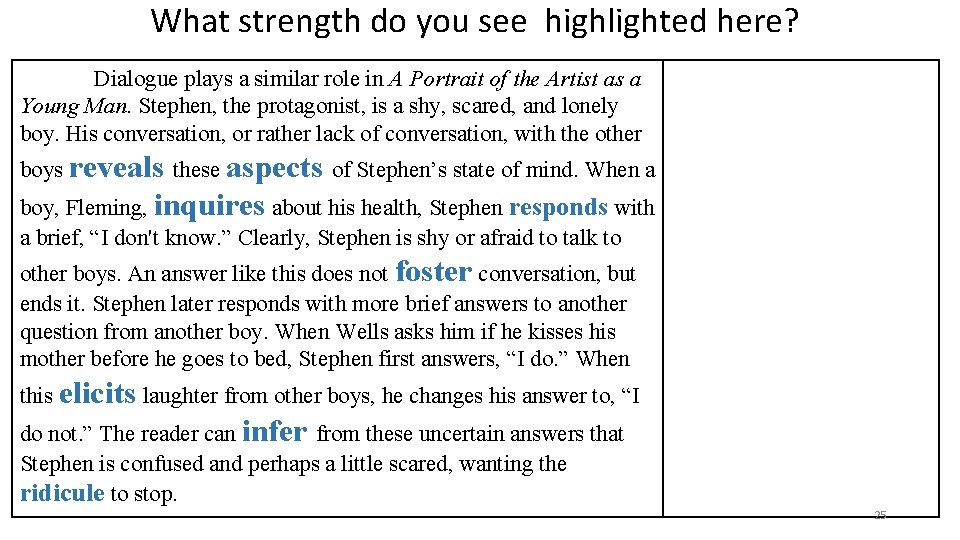
What strength do you see highlighted here? Dialogue plays a similar role in A Portrait of the Artist as a Young Man. Stephen, the protagonist, is a shy, scared, and lonely boy. His conversation, or rather lack of conversation, with the other boys reveals these aspects of Stephen’s state of mind. When a boy, Fleming, inquires about his health, Stephen responds with a brief, “I don't know. ” Clearly, Stephen is shy or afraid to talk to other boys. An answer like this does not foster conversation, but ends it. Stephen later responds with more brief answers to another question from another boy. When Wells asks him if he kisses his mother before he goes to bed, Stephen first answers, “I do. ” When this elicits laughter from other boys, he changes his answer to, “I do not. ” The reader can infer from these uncertain answers that Stephen is confused and perhaps a little scared, wanting the ridicule to stop. 25
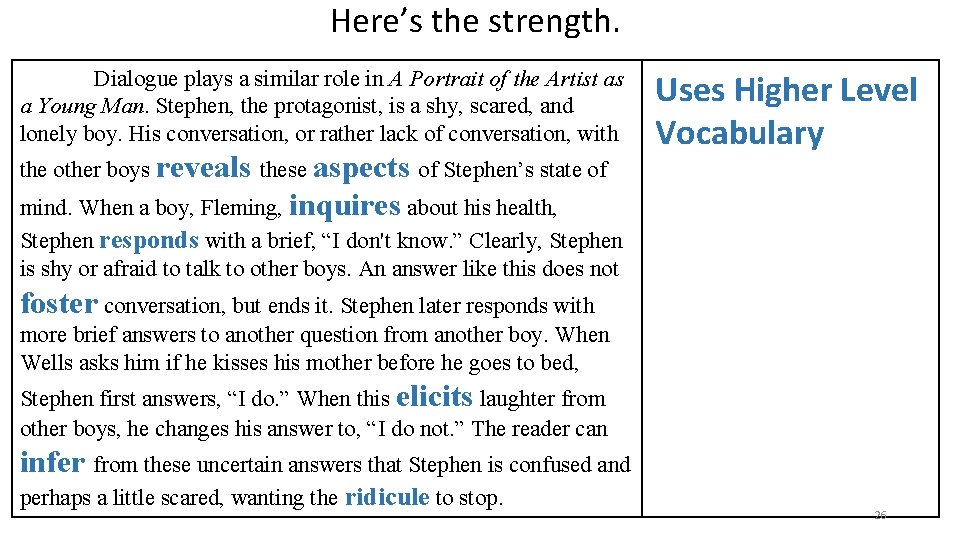
Here’s the strength. Dialogue plays a similar role in A Portrait of the Artist as a Young Man. Stephen, the protagonist, is a shy, scared, and lonely boy. His conversation, or rather lack of conversation, with the other boys reveals these aspects of Stephen’s state of Uses Higher Level Vocabulary mind. When a boy, Fleming, inquires about his health, Stephen responds with a brief, “I don't know. ” Clearly, Stephen is shy or afraid to talk to other boys. An answer like this does not foster conversation, but ends it. Stephen later responds with more brief answers to another question from another boy. When Wells asks him if he kisses his mother before he goes to bed, Stephen first answers, “I do. ” When this elicits laughter from other boys, he changes his answer to, “I do not. ” The reader can infer from these uncertain answers that Stephen is confused and perhaps a little scared, wanting the ridicule to stop. 26
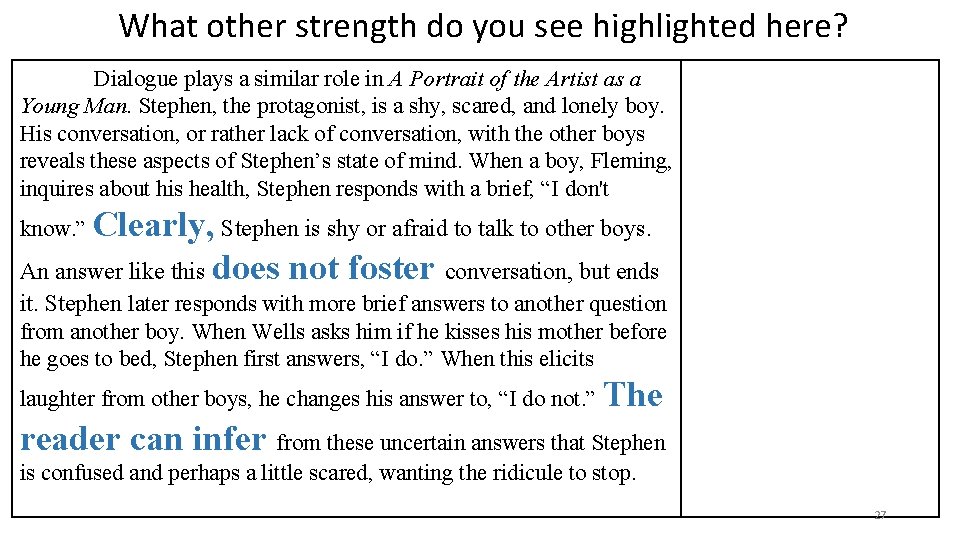
What other strength do you see highlighted here? Dialogue plays a similar role in A Portrait of the Artist as a Young Man. Stephen, the protagonist, is a shy, scared, and lonely boy. His conversation, or rather lack of conversation, with the other boys reveals these aspects of Stephen’s state of mind. When a boy, Fleming, inquires about his health, Stephen responds with a brief, “I don't know. ” Clearly, Stephen is shy or afraid to talk to other boys. An answer like this does not foster conversation, but ends it. Stephen later responds with more brief answers to another question from another boy. When Wells asks him if he kisses his mother before he goes to bed, Stephen first answers, “I do. ” When this elicits laughter from other boys, he changes his answer to, “I do not. ” The reader can infer from these uncertain answers that Stephen is confused and perhaps a little scared, wanting the ridicule to stop. 27
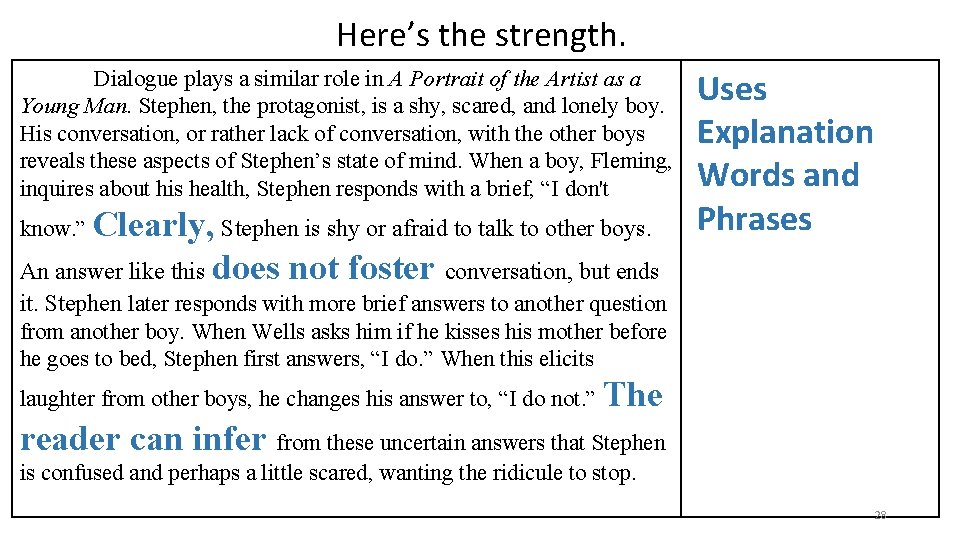
Here’s the strength. Dialogue plays a similar role in A Portrait of the Artist as a Young Man. Stephen, the protagonist, is a shy, scared, and lonely boy. His conversation, or rather lack of conversation, with the other boys reveals these aspects of Stephen’s state of mind. When a boy, Fleming, inquires about his health, Stephen responds with a brief, “I don't know. ” Clearly, Stephen is shy or afraid to talk to other boys. Uses Explanation Words and Phrases An answer like this does not foster conversation, but ends it. Stephen later responds with more brief answers to another question from another boy. When Wells asks him if he kisses his mother before he goes to bed, Stephen first answers, “I do. ” When this elicits laughter from other boys, he changes his answer to, “I do not. ” The reader can infer from these uncertain answers that Stephen is confused and perhaps a little scared, wanting the ridicule to stop. 28
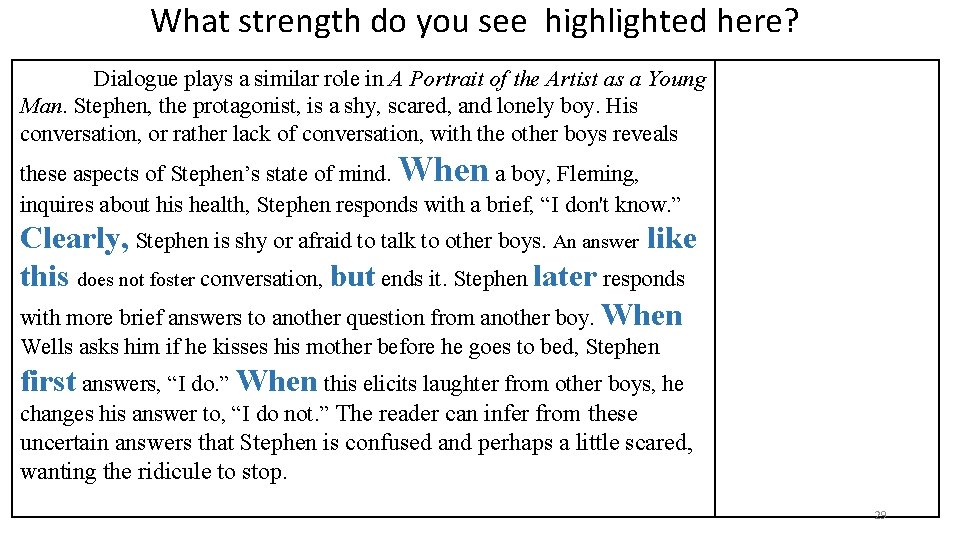
What strength do you see highlighted here? Dialogue plays a similar role in A Portrait of the Artist as a Young Man. Stephen, the protagonist, is a shy, scared, and lonely boy. His conversation, or rather lack of conversation, with the other boys reveals these aspects of Stephen’s state of mind. When a boy, Fleming, inquires about his health, Stephen responds with a brief, “I don't know. ” Clearly, Stephen is shy or afraid to talk to other boys. An answer like this does not foster conversation, but ends it. Stephen later responds with more brief answers to another question from another boy. When Wells asks him if he kisses his mother before he goes to bed, Stephen first answers, “I do. ” When this elicits laughter from other boys, he changes his answer to, “I do not. ” The reader can infer from these uncertain answers that Stephen is confused and perhaps a little scared, wanting the ridicule to stop. 29
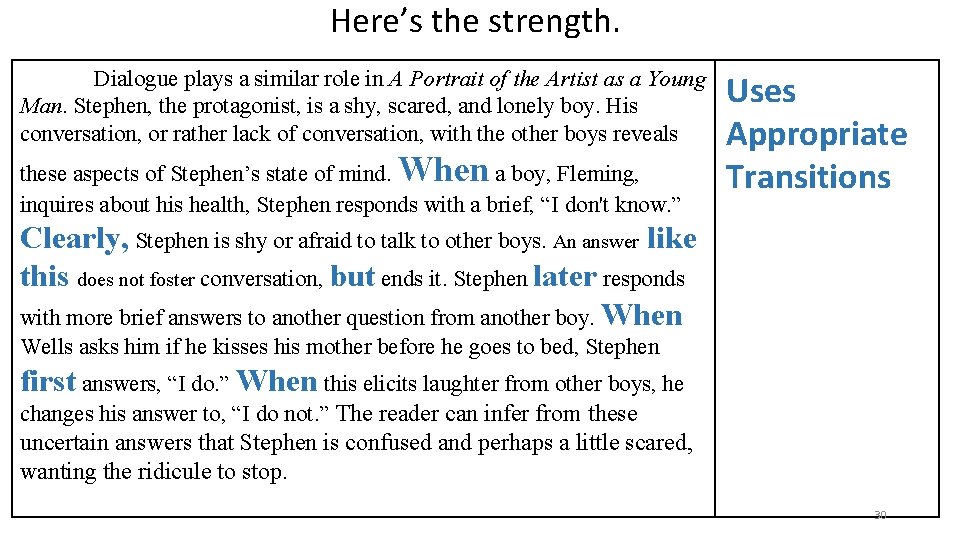
Here’s the strength. Dialogue plays a similar role in A Portrait of the Artist as a Young Man. Stephen, the protagonist, is a shy, scared, and lonely boy. His conversation, or rather lack of conversation, with the other boys reveals these aspects of Stephen’s state of mind. When a boy, Fleming, inquires about his health, Stephen responds with a brief, “I don't know. ” Uses Appropriate Transitions Clearly, Stephen is shy or afraid to talk to other boys. An answer like this does not foster conversation, but ends it. Stephen later responds with more brief answers to another question from another boy. When Wells asks him if he kisses his mother before he goes to bed, Stephen first answers, “I do. ” When this elicits laughter from other boys, he changes his answer to, “I do not. ” The reader can infer from these uncertain answers that Stephen is confused and perhaps a little scared, wanting the ridicule to stop. 30
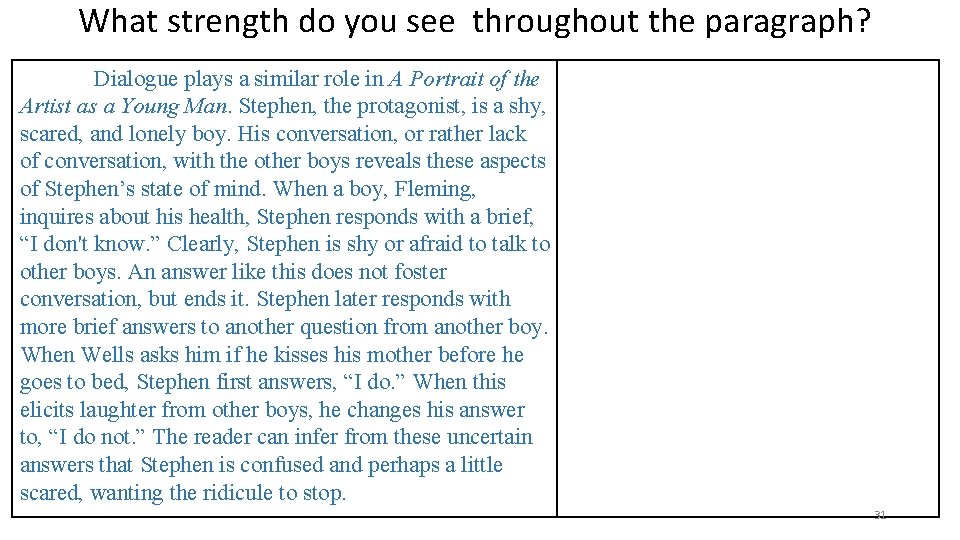
What strength do you see throughout the paragraph? Dialogue plays a similar role in A Portrait of the Artist as a Young Man. Stephen, the protagonist, is a shy, scared, and lonely boy. His conversation, or rather lack of conversation, with the other boys reveals these aspects of Stephen’s state of mind. When a boy, Fleming, inquires about his health, Stephen responds with a brief, “I don't know. ” Clearly, Stephen is shy or afraid to talk to other boys. An answer like this does not foster conversation, but ends it. Stephen later responds with more brief answers to another question from another boy. When Wells asks him if he kisses his mother before he goes to bed, Stephen first answers, “I do. ” When this elicits laughter from other boys, he changes his answer to, “I do not. ” The reader can infer from these uncertain answers that Stephen is confused and perhaps a little scared, wanting the ridicule to stop. 31
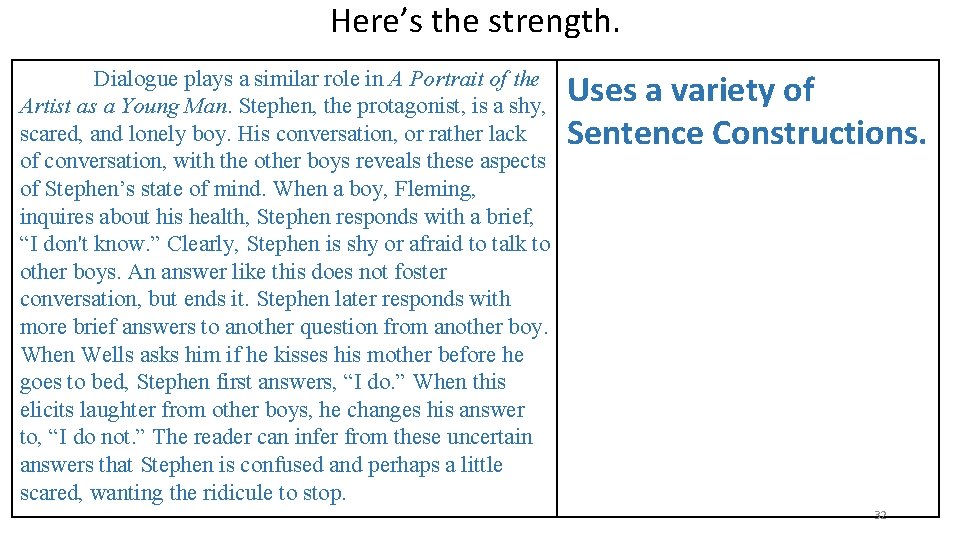
Here’s the strength. Dialogue plays a similar role in A Portrait of the Artist as a Young Man. Stephen, the protagonist, is a shy, scared, and lonely boy. His conversation, or rather lack of conversation, with the other boys reveals these aspects of Stephen’s state of mind. When a boy, Fleming, inquires about his health, Stephen responds with a brief, “I don't know. ” Clearly, Stephen is shy or afraid to talk to other boys. An answer like this does not foster conversation, but ends it. Stephen later responds with more brief answers to another question from another boy. When Wells asks him if he kisses his mother before he goes to bed, Stephen first answers, “I do. ” When this elicits laughter from other boys, he changes his answer to, “I do not. ” The reader can infer from these uncertain answers that Stephen is confused and perhaps a little scared, wanting the ridicule to stop. Uses a variety of Sentence Constructions. 32
Notice This paragraph hit two triple’s. The triple is always: 1. Example 2. Quote 3. Explanation Here they are again separated so you can see them easily. 33
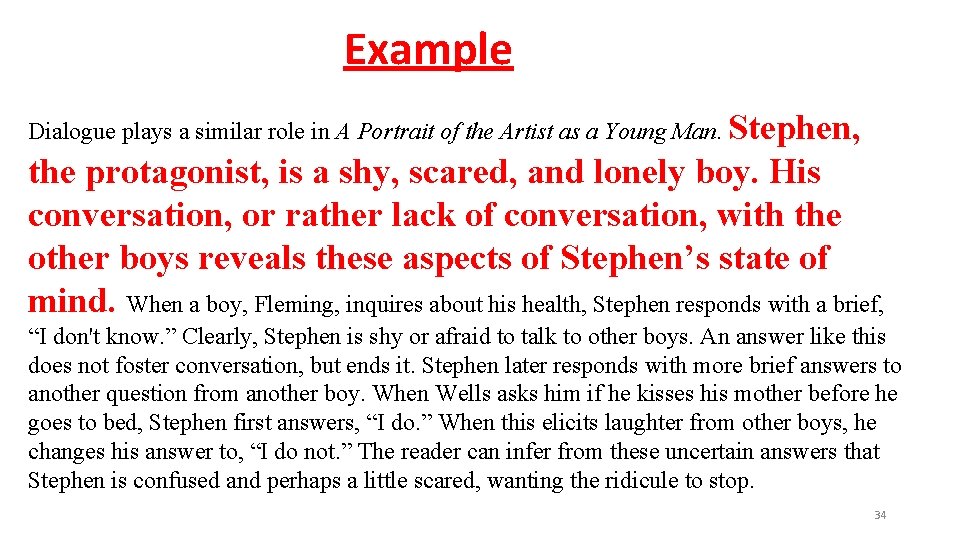
Example Dialogue plays a similar role in A Portrait of the Artist as a Young Man. Stephen, the protagonist, is a shy, scared, and lonely boy. His conversation, or rather lack of conversation, with the other boys reveals these aspects of Stephen’s state of mind. When a boy, Fleming, inquires about his health, Stephen responds with a brief, “I don't know. ” Clearly, Stephen is shy or afraid to talk to other boys. An answer like this does not foster conversation, but ends it. Stephen later responds with more brief answers to another question from another boy. When Wells asks him if he kisses his mother before he goes to bed, Stephen first answers, “I do. ” When this elicits laughter from other boys, he changes his answer to, “I do not. ” The reader can infer from these uncertain answers that Stephen is confused and perhaps a little scared, wanting the ridicule to stop. 34
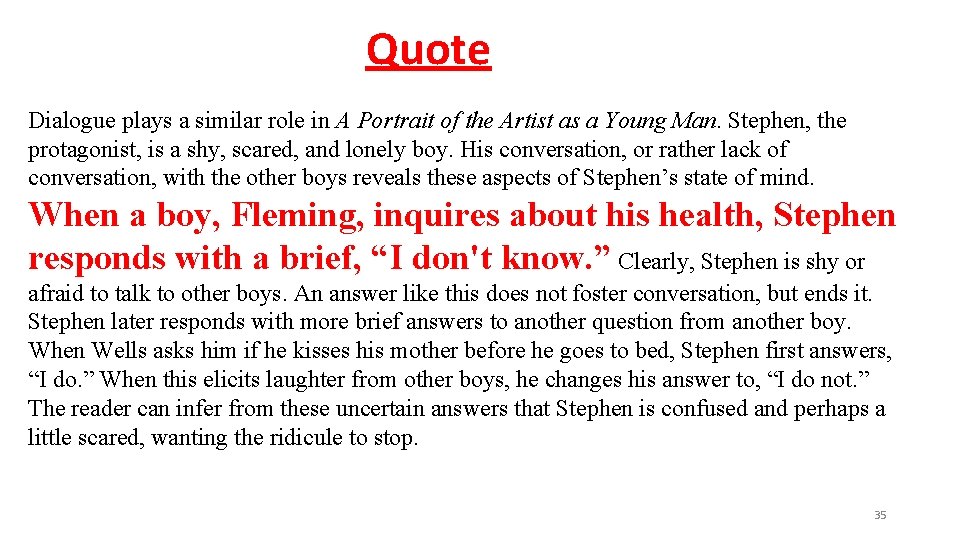
Quote Dialogue plays a similar role in A Portrait of the Artist as a Young Man. Stephen, the protagonist, is a shy, scared, and lonely boy. His conversation, or rather lack of conversation, with the other boys reveals these aspects of Stephen’s state of mind. When a boy, Fleming, inquires about his health, Stephen responds with a brief, “I don't know. ” Clearly, Stephen is shy or afraid to talk to other boys. An answer like this does not foster conversation, but ends it. Stephen later responds with more brief answers to another question from another boy. When Wells asks him if he kisses his mother before he goes to bed, Stephen first answers, “I do. ” When this elicits laughter from other boys, he changes his answer to, “I do not. ” The reader can infer from these uncertain answers that Stephen is confused and perhaps a little scared, wanting the ridicule to stop. 35
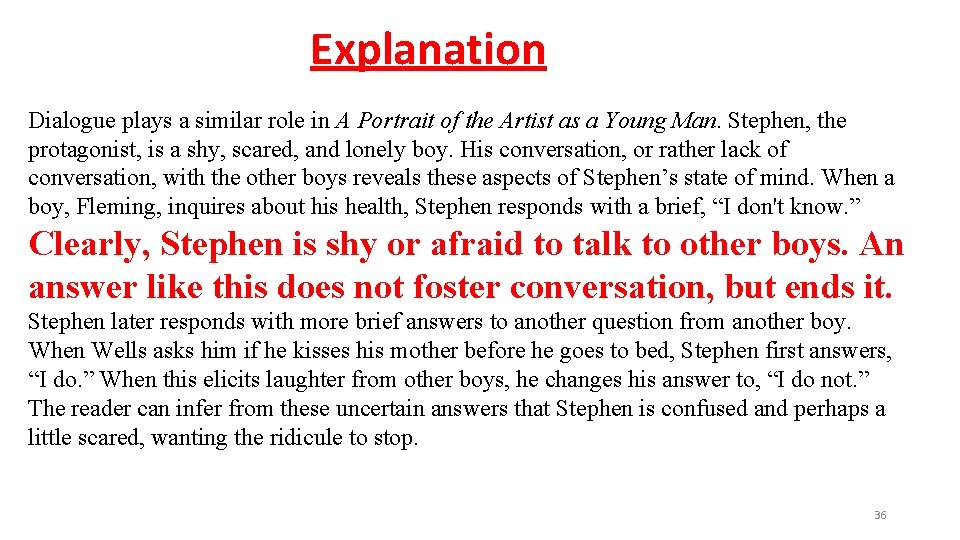
Explanation Dialogue plays a similar role in A Portrait of the Artist as a Young Man. Stephen, the protagonist, is a shy, scared, and lonely boy. His conversation, or rather lack of conversation, with the other boys reveals these aspects of Stephen’s state of mind. When a boy, Fleming, inquires about his health, Stephen responds with a brief, “I don't know. ” Clearly, Stephen is shy or afraid to talk to other boys. An answer like this does not foster conversation, but ends it. Stephen later responds with more brief answers to another question from another boy. When Wells asks him if he kisses his mother before he goes to bed, Stephen first answers, “I do. ” When this elicits laughter from other boys, he changes his answer to, “I do not. ” The reader can infer from these uncertain answers that Stephen is confused and perhaps a little scared, wanting the ridicule to stop. 36
Another Example Dialogue plays a similar role in A Portrait of the Artist as a Young Man. Stephen, the protagonist, is a shy, scared, and lonely boy. His conversation, or rather lack of conversation, with the other boys reveals these aspects of Stephen’s state of mind. When a boy, Fleming, inquires about his health, Stephen responds with a brief, “I don't know. ” Clearly, Stephen is shy or afraid to talk to other boys. An answer like this does not foster conversation, but ends it. Stephen later responds with more brief answers to another question from another boy. When Wells asks him if he kisses his mother before he goes to bed, Stephen first answers, “I do. ” When this elicits laughter from other boys, he changes his answer to, “I do not. ” The reader can infer from these uncertain answers that Stephen is confused and perhaps a little scared, wanting the ridicule to stop. 37
Another Quote Dialogue plays a similar role in A Portrait of the Artist as a Young Man. Stephen, the protagonist, is a shy, scared, and lonely boy. His conversation, or rather lack of conversation, with the other boys reveals these aspects of Stephen’s state of mind. When a boy, Fleming, inquires about his health, Stephen responds with a brief, “I don't know. ” Clearly, Stephen is shy or afraid to talk to other boys. An answer like this does not foster conversation, but ends it. Stephen later responds with more brief answers to another question from another boy. When Wells asks him if he kisses his mother before he goes to bed, Stephen first answers, “I do. ” When this elicits laughter from other boys, he changes his answer to, “I do not. ” The reader can infer from these uncertain answers that Stephen is confused and perhaps a little scared, wanting the ridicule to stop. 38
Another Explanation Dialogue plays a similar role in A Portrait of the Artist as a Young Man. Stephen, the protagonist, is a shy, scared, and lonely boy. His conversation, or rather lack of conversation, with the other boys reveals these aspects of Stephen’s state of mind. When a boy, Fleming, inquires about his health, Stephen responds with a brief, “I don't know. ” Clearly, Stephen is shy or afraid to talk to other boys. An answer like this does not foster conversation, but ends it. Stephen later responds with more brief answers to another question from another boy. When Wells asks him if he kisses his mother before he goes to bed, Stephen first answers, “I do. ” When this elicits laughter from other boys, he changes his answer to, “I do not. ” The reader can infer from these uncertain answers that Stephen is confused and perhaps a little scared, wanting the ridicule to stop. 39

This Paragraph has two triples! 40
Time to Revise Your Writing Now that you have evaluated an exemplar second body paragraph, use what you have learned to revise the paragraph that you wrote. Do not copy the exemplar paragraph but use it as a guide to make your paragraph better. Show your revisions by crossing out words, phrases, and sentences and writing improved words, phrases and sentences above them. Draw arrows and carats (an inverted v, ) to show an insert of additional words, phrases, and sentences. 41
- Slides: 41