
Lesson 15 3 Controlling Air Pollution 4 Since
- Slides: 5
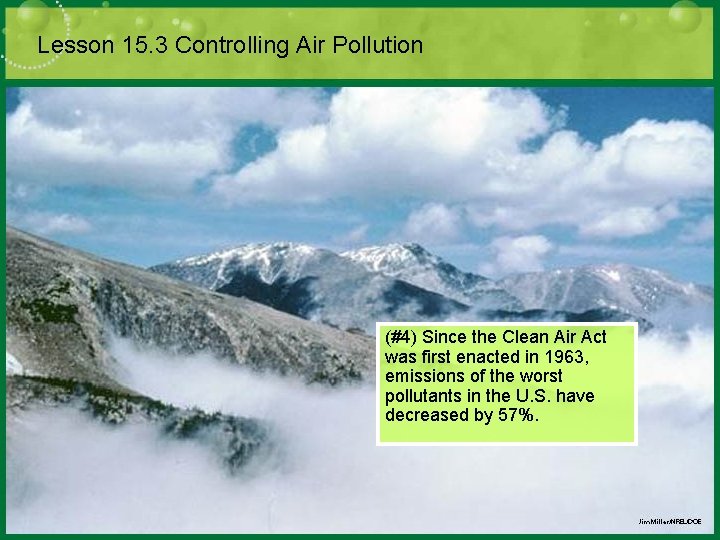
Lesson 15. 3 Controlling Air Pollution (#4) Since the Clean Air Act was first enacted in 1963, emissions of the worst pollutants in the U. S. have decreased by 57%.
Lesson 15. 3 Controlling Air Pollution The Clean Air Act • First passed in 1963 to protect human and environmental health by improving air quality; has been revised several times • (#1) Limits emissions of pollutants, sets standards for air quality, establishes a legal framework for suing industries that break the rules, and provides funding for pollution control • (#3)The Environmental Protection Agency (EPA) monitors and sets nationwide standards (#2) Did You Know? The clean air act limits the emissions of carbon monoxide and particulate matter based on the maximum amount humans can tolerate without being harmed.
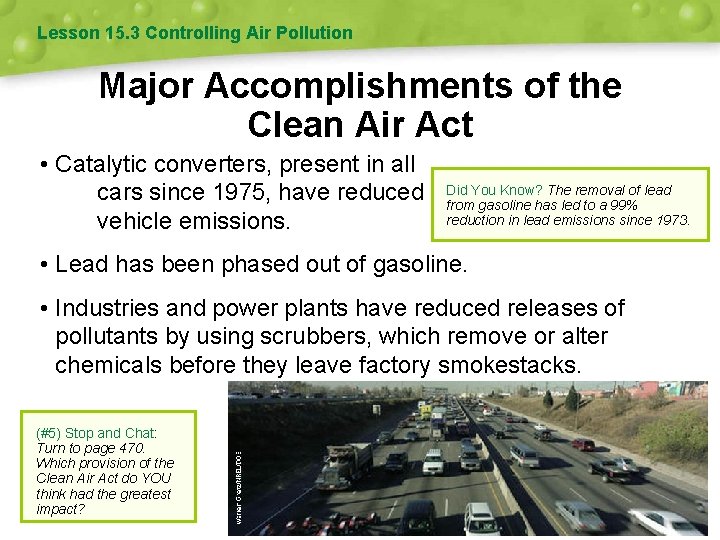
Lesson 15. 3 Controlling Air Pollution Major Accomplishments of the Clean Air Act • Catalytic converters, present in all cars since 1975, have reduced vehicle emissions. Did You Know? The removal of lead from gasoline has led to a 99% reduction in lead emissions since 1973. • Lead has been phased out of gasoline. • Industries and power plants have reduced releases of pollutants by using scrubbers, which remove or alter chemicals before they leave factory smokestacks. (#5) Stop and Chat: Turn to page 470. Which provision of the Clean Air Act do YOU think had the greatest impact?
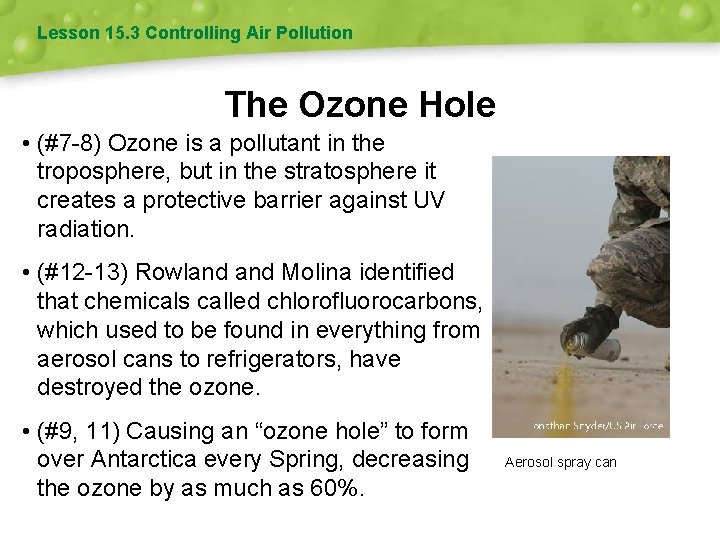
Lesson 15. 3 Controlling Air Pollution The Ozone Hole • (#7 -8) Ozone is a pollutant in the troposphere, but in the stratosphere it creates a protective barrier against UV radiation. • (#12 -13) Rowland Molina identified that chemicals called chlorofluorocarbons, which used to be found in everything from aerosol cans to refrigerators, have destroyed the ozone. • (#9, 11) Causing an “ozone hole” to form over Antarctica every Spring, decreasing the ozone by as much as 60%. Aerosol spray can
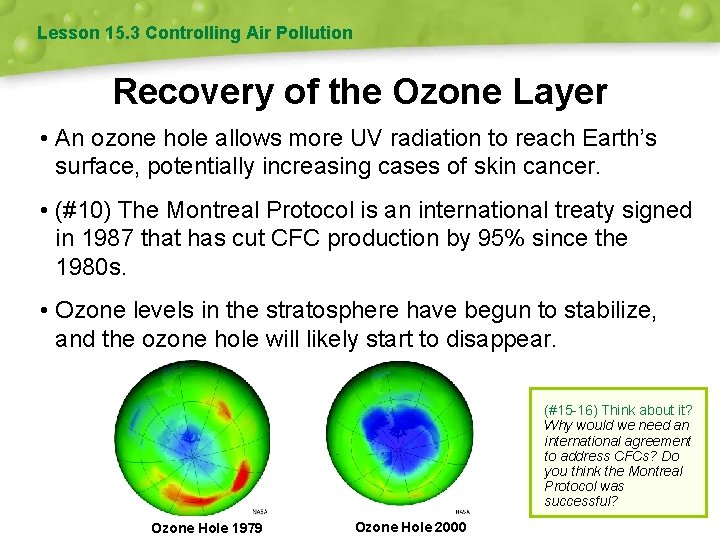
Lesson 15. 3 Controlling Air Pollution Recovery of the Ozone Layer • An ozone hole allows more UV radiation to reach Earth’s surface, potentially increasing cases of skin cancer. • (#10) The Montreal Protocol is an international treaty signed in 1987 that has cut CFC production by 95% since the 1980 s. • Ozone levels in the stratosphere have begun to stabilize, and the ozone hole will likely start to disappear. (#15 -16) Think about it? Why would we need an international agreement to address CFCs? Do you think the Montreal Protocol was successful? Ozone Hole 1979 Ozone Hole 2000