
Lesson 14 Radiotracers Introduction Basic principle All isotopes
Lesson 14 Radiotracers
Introduction • Basic principle: All isotopes of a given element will behave identically in most physical, environmental and biological environments. • Ea��� sier to detect radioactive atoms than stable atoms. • Simple • Cheap • Amazing breadth of applications. Now part of the standard arsenal of analytical techniques

Designing a Radiotracer Experiment • Radioactive isotopes of a given element behave the same as stable isotopes. • Isotope Eff� ect--Most concern for H, 15% effect for 12 C vs 14 C. • Nonisotopic tracers
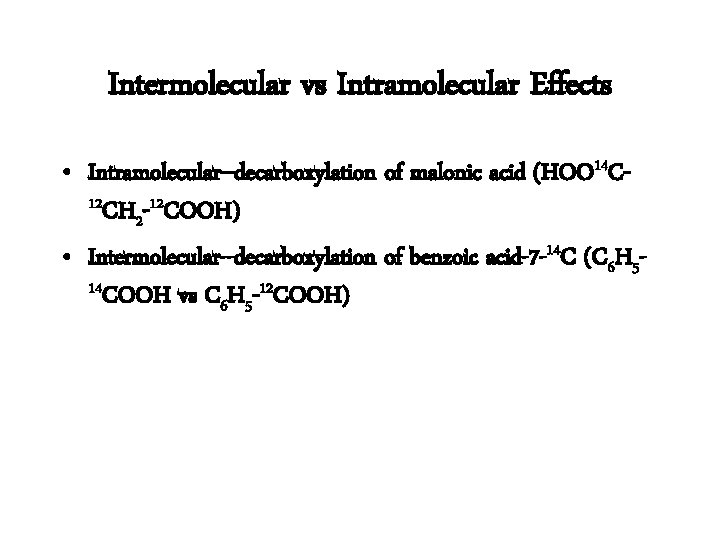
Intermolecular vs Intramolecular Effects • Intramolecular--decarboxylation of malonic acid (HOO 14 C 12 CH -12 COOH) 2 • Intermolecular--decarboxylation of benzoic acid-7 -14 C (C 6 H 514 COOH vs C H -12 COOH) 6 5
Basic Principle #2 • Radioactivity does not change the chemical and physical properties of the system. • Tracer activities, bond strengths, energy of emitted radiation • 3 H problem • “Daughter atom problems”

Basic Principle #3 • No deviation from normal physiological state. • Injecting stable as well as radioactive material

Basic Principle #4 • Chemical and physical form of the labeled material is the same as the un-labeled material. • Aqueous chemistry • Adsorption, carriers, carrier-tracer exchange • Radiochemical purity • Position of the label

Basic Principle #5 • Label stays intact
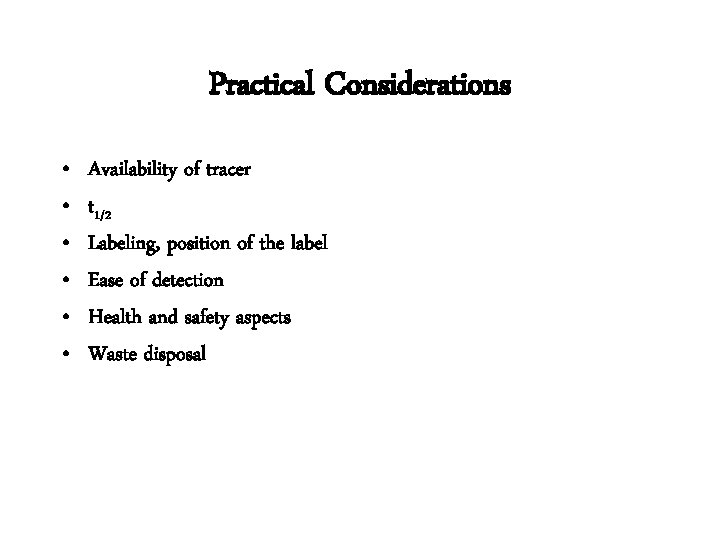
Practical Considerations • • • Availability of tracer t 1/2 Labeling, position of the label Ease of detection Health and safety aspects Waste disposal
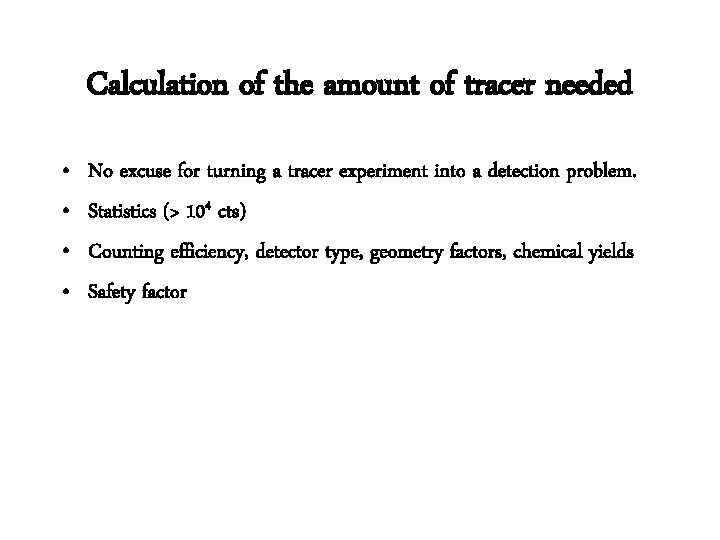
Calculation of the amount of tracer needed • • No excuse for turning a tracer experiment into a detection problem. Statistics (> 104 cts) Counting efficiency, detector type, geometry factors, chemical yields Safety factor
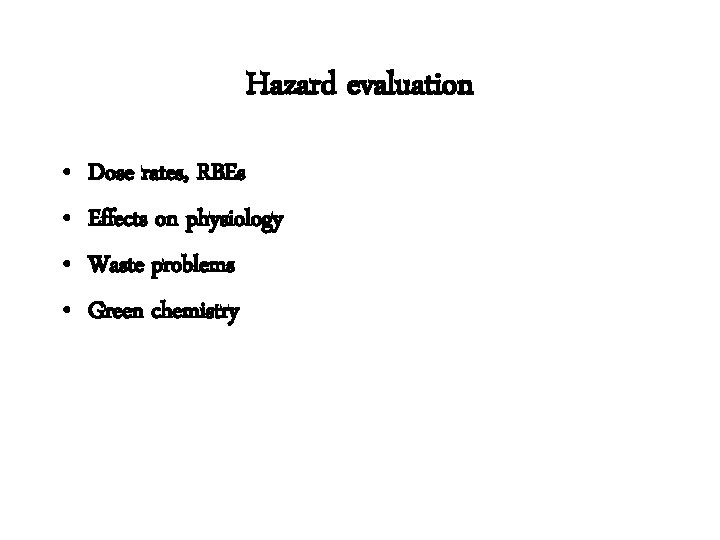
Hazard evaluation • • Dose rates, RBEs Effects on physiology Waste problems Green chemistry
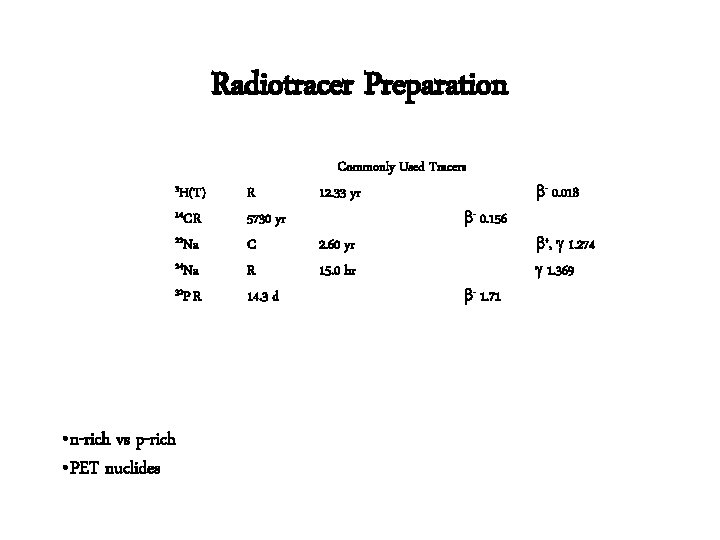
Radiotracer Preparation 3 H(T) 14 CR 22 Na 24 Na 32 P R • n-rich vs p-rich • PET nuclides R 5730 yr C R 14. 3 d Commonly Used Tracers 12. 33 yr - 0. 156 2. 60 yr 15. 0 hr - 1. 71 - 0. 018 +, 1. 274 1. 369
Labeling • Position: acetic-1 -14 C acid = CH 314 COOH, acetic-2 -14 C acid = 14 CH COOH 3 • Terms; Specifically labeled, U, N G
Methods of labeling • • Chemical synthesis, best except for chirality Biological synthesis, tedious Tritium Commercial supplier problems

Physical tracers • • • Wear, corrosion Mixing Fluid motion Pollutant tracing Measuring unknown volume
Chemical Applications • • Test separation procedures Ksp measurements Exchange reactions Chemical reaction mechanisms
Example • Cyclization of -phenoxyacetophenone to 2 phenylbenzofuran

Physical Isotope Effects • Gaseous diffusion • Distillation
Chemical Isotope Effects

Kinetic Isotope Effects

Biological applications Autoradiography

DNA Analysis
Radioimmunoassay
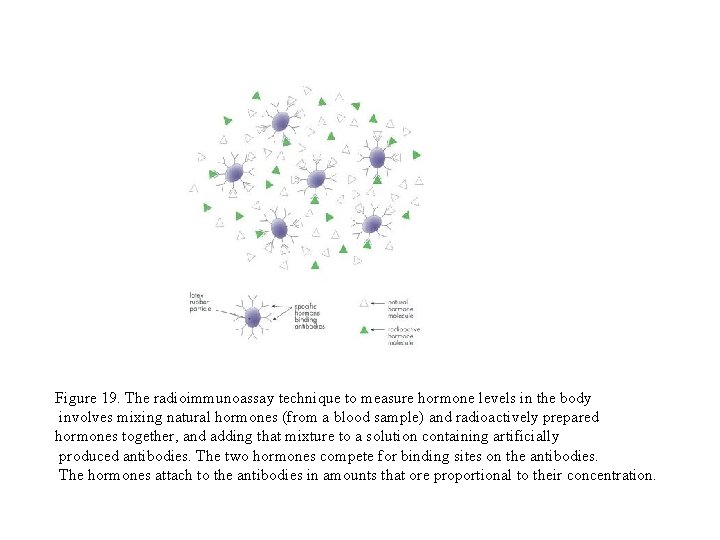
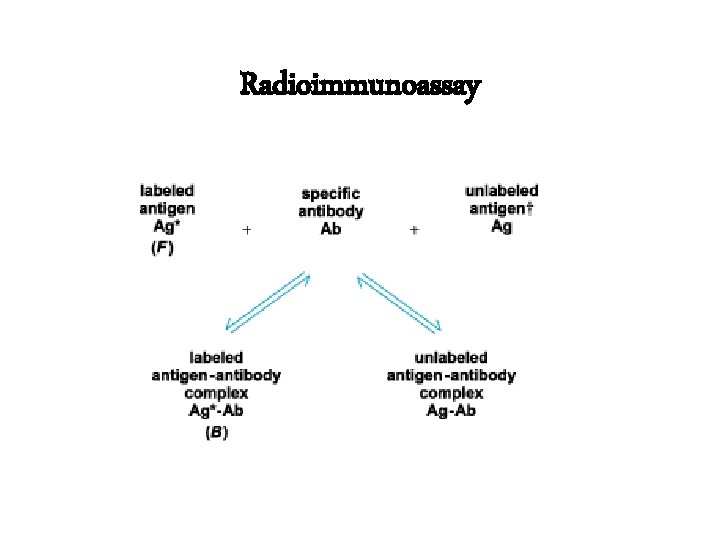
Figure 19. The radioimmunoassay technique to measure hormone levels in the body involves mixing natural hormones (from a blood sample) and radioactively prepared hormones together, and adding that mixture to a solution containing artificially produced antibodies. The two hormones compete for binding sites on the antibodies. The hormones attach to the antibodies in amounts that ore proportional to their concentration.
Environmental Applications of Radiotracers • Used in tracing pollutant motion in atmosphere, hydrosphere, lithosphere Advantages of radiotracers • Not influenced by state of system • Highly penetrating • Good detection sensitivity • If t 1/2 short, will disappear after expt. • Cheap BIG PROBLEM--HP
Typical Environmental Radiotracers • 41 Ar • 24 Na • 82 Br • 140 La
Industrial Uses of Radiotracers Nuclide 3 H 24 Na Application Self-luminous aircraft and exit signs Luminous dials, gauges, wrist watches Luminous paint Location of pipeline leaks Oil well studies 46 Sc Oil exploration tracer 55 Fe Analysis of electroplating solutions Defense power source 60 Co Surgical instrument and medicine sterilization Safety and reliability of oil burners 63 Ni Detection of explosives Voltage regulators and current surge protectors Heat power source
Nuclear Medicine • Therapy and diagnosis • Most important radionuclides are 99 Tcm and the I isotopes. Over 90% of procedures involve these nuclei
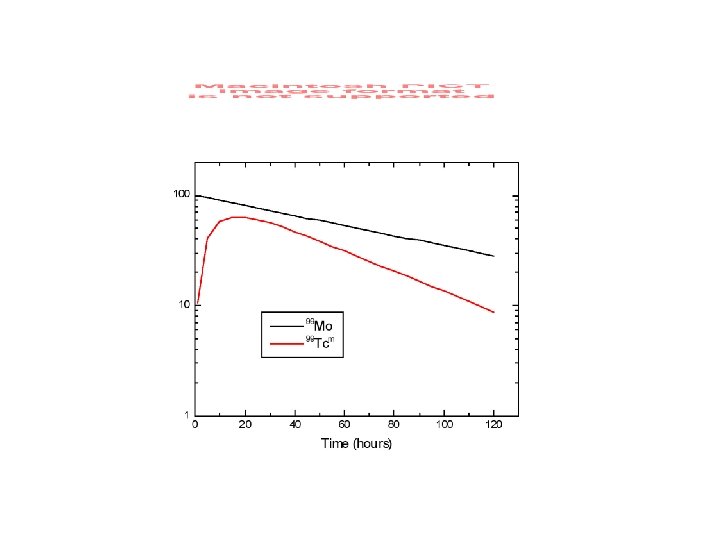
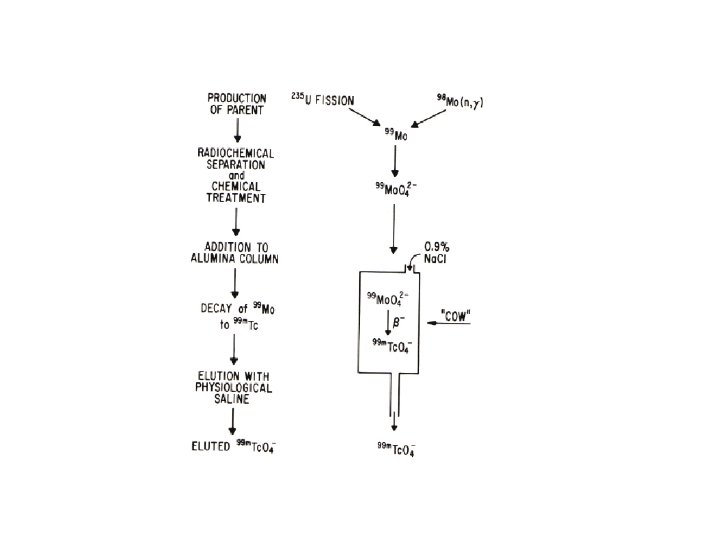
99 Tcm • 143 ke. V gamma rays • 6 hr t 1/2 • Use of generators
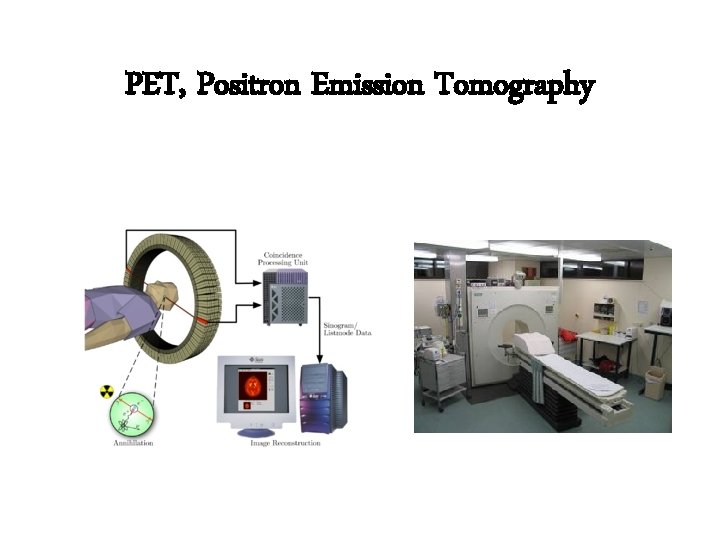
PET, Positron Emission Tomography

Isotope Dilution Analysis • Direct IDA • In direct IDA, we are faced with the problem of determining the amount of some inactive material A in a system. Let us define this unknown amount as x grams. To the system containing x grams of inactive A, we add y grams of active material A* of known activity D. Thus we know the specific activity of the added active material, S 1.
- Slides: 37