
Lesson 14 PostFielding Sustainment Analysis LOG 211 Lesson
- Slides: 36
Lesson 14 Post-Fielding Sustainment Analysis LOG 211 Lesson 14: Post-Fielding Sustainment Analysis FINAL v 1. 3 14 -1
Topic 1: Introduction What’s in it for me? The Post Fielding Sustainment Analysis (PFSA) uses field data to quantify system’s performance and suitability, and to assess the effectiveness of the Product Support Strategy (PSS) and Product Support Package (PSP) in meeting user requirements. Program Managers, Systems Engineers and Life Cycle Logisticians use PFSA data in the Sustaining Engineering process to develop Non-Material or Material Solutions to meet user needs, provide a useful capability and ensure Life Cycle Affordability. LOG 211 Lesson 14: Post-Fielding Sustainment Analysis FINAL v 1. 3 14 -2
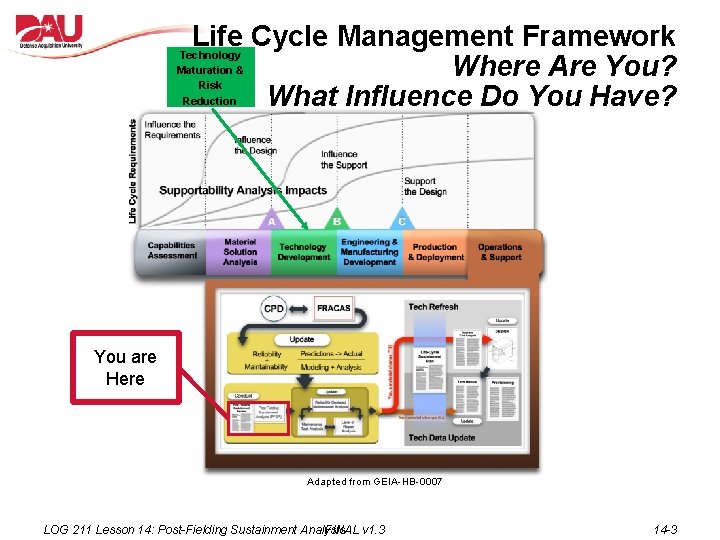
Life Cycle Management Framework Where Are You? What Influence Do You Have? Technology Maturation & Risk Reduction You are Here Adapted from GEIA-HB-0007 LOG 211 Lesson 14: Post-Fielding Sustainment Analysis FINAL v 1. 3 14 -3
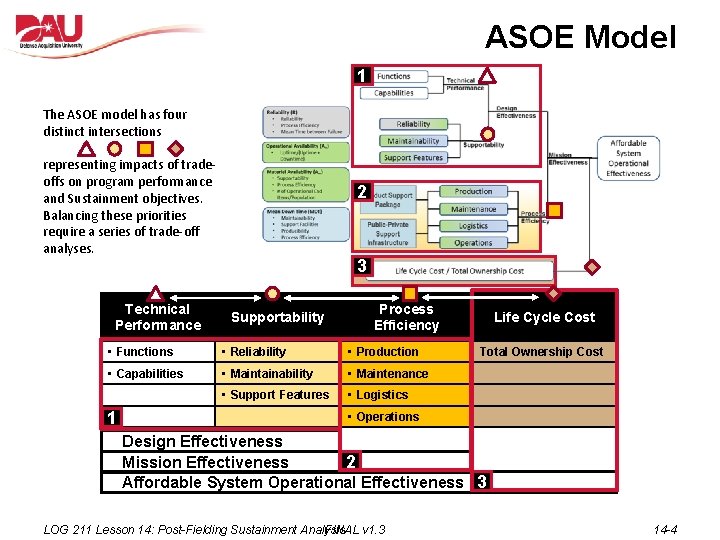
ASOE Model 1 The ASOE model has four distinct intersections representing impacts of tradeoffs on program performance and Sustainment objectives. Balancing these priorities require a series of trade-off analyses. Technical Performance 2 3 Supportability Process Efficiency • Functions • Reliability • Production • Capabilities • Maintainability • Maintenance • Support Features • Logistics 1 Life Cycle Cost Total Ownership Cost • Operations Design Effectiveness 2 Mission Effectiveness Affordable System Operational Effectiveness 3 LOG 211 Lesson 14: Post-Fielding Sustainment Analysis FINAL v 1. 3 14 -4
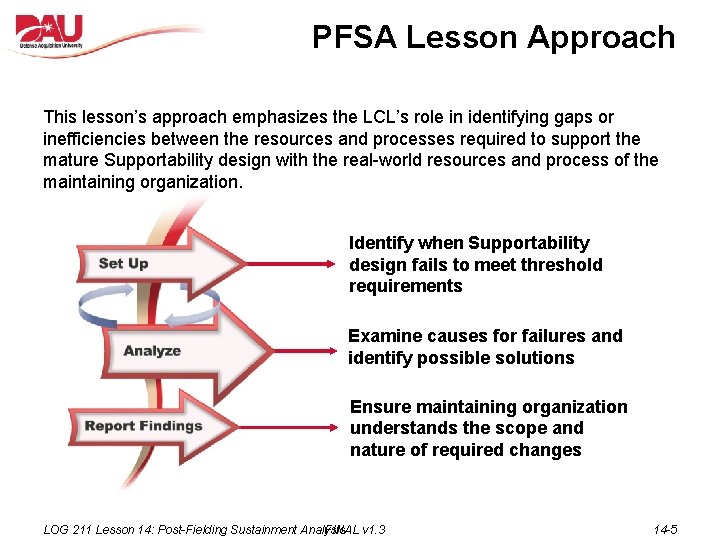
PFSA Lesson Approach This lesson’s approach emphasizes the LCL’s role in identifying gaps or inefficiencies between the resources and processes required to support the mature Supportability design with the real-world resources and process of the maintaining organization. Identify when Supportability design fails to meet threshold requirements Examine causes for failures and identify possible solutions Ensure maintaining organization understands the scope and nature of required changes LOG 211 Lesson 14: Post-Fielding Sustainment Analysis FINAL v 1. 3 14 -5
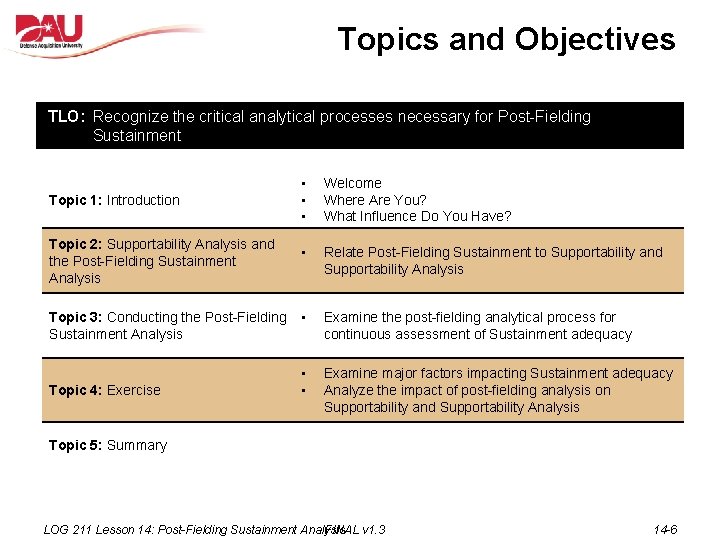
Topics and Objectives TLO: Recognize the critical analytical processes necessary for Post-Fielding Sustainment Topic Objectives Topic 1: Introduction • • • Welcome Where Are You? What Influence Do You Have? • Relate Post-Fielding Sustainment to Supportability and Supportability Analysis • Examine the post-fielding analytical process for continuous assessment of Sustainment adequacy • • Examine major factors impacting Sustainment adequacy Analyze the impact of post-fielding analysis on Supportability and Supportability Analysis Topic 2: Supportability Analysis and the Post-Fielding Sustainment Analysis Topic 3: Conducting the Post-Fielding Sustainment Analysis Topic 4: Exercise Topic 5: Summary LOG 211 Lesson 14: Post-Fielding Sustainment Analysis FINAL v 1. 3 14 -6
Topic 2: Supportability Analysis and the Post-Fielding Sustainment Analysis LOG 211 Lesson 14: Post-Fielding Sustainment Analysis FINAL v 1. 3 14 -7
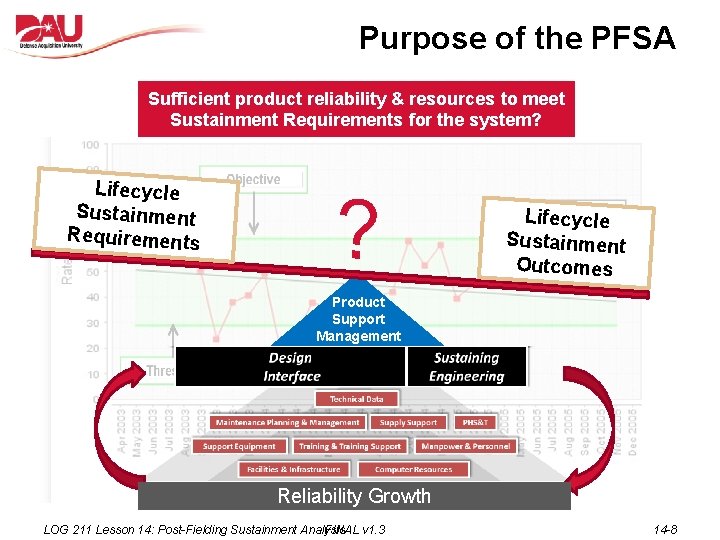
Purpose of the PFSA Sufficient product reliability & resources to meet Sustainment Requirements for the system? Lifecycle Sustainment Requirements ? Lifecycle Sustainment Outcomes Product Support Management Reliability Growth LOG 211 Lesson 14: Post-Fielding Sustainment Analysis FINAL v 1. 3 14 -8
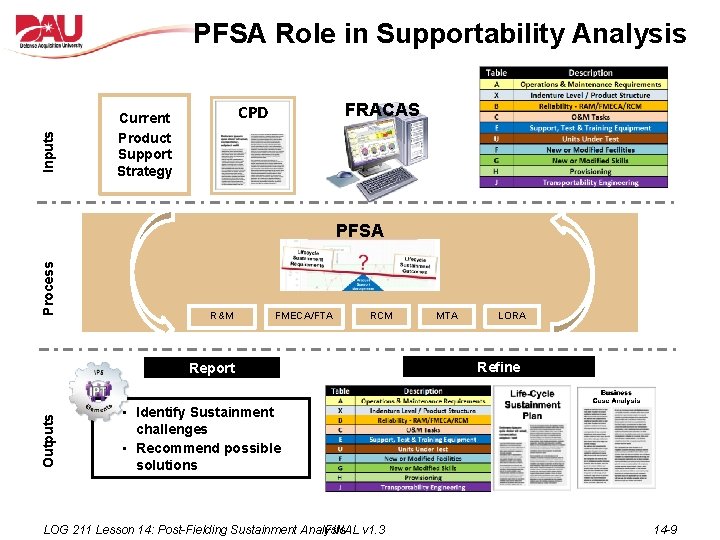
Inputs PFSA Role in Supportability Analysis FRACAS CPD Current Product Support Strategy Process PFSA R&M FMECA/FTA RCM Outputs Report MTA LORA Refine • Identify Sustainment challenges • Recommend possible solutions LOG 211 Lesson 14: Post-Fielding Sustainment Analysis FINAL v 1. 3 14 -9
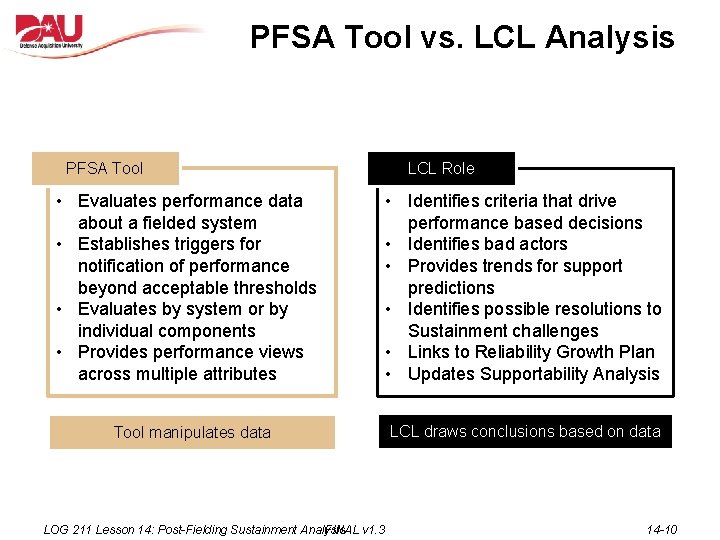
PFSA Tool vs. LCL Analysis PFSA Tool • Evaluates performance data about a fielded system • Establishes triggers for notification of performance beyond acceptable thresholds • Evaluates by system or by individual components • Provides performance views across multiple attributes Tool manipulates data LOG 211 Lesson 14: Post-Fielding Sustainment Analysis FINAL v 1. 3 LCL Role • Identifies criteria that drive performance based decisions • Identifies bad actors • Provides trends for support predictions • Identifies possible resolutions to Sustainment challenges • Links to Reliability Growth Plan • Updates Supportability Analysis LCL draws conclusions based on data 14 -10
Topic 3: Conducting the Post-Fielding Sustainment Analysis LOG 211 Lesson 14: Post-Fielding Sustainment Analysis FINAL v 1. 3 14 -11
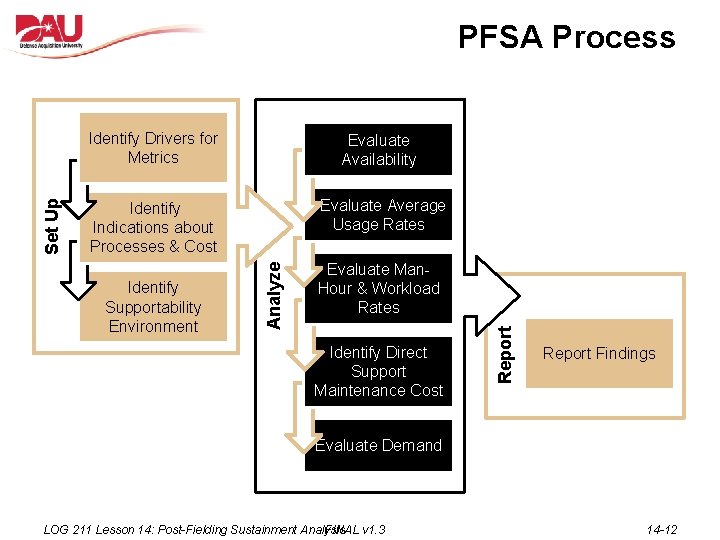
Identify Drivers for Metrics Evaluate Availability Identify Indications about Processes & Cost Evaluate Average Usage Rates Evaluate Man. Hour & Workload Rates Identify Direct Support Maintenance Cost Report Identify Supportability Environment Analyze Set Up PFSA Process Report Findings Evaluate Demand LOG 211 Lesson 14: Post-Fielding Sustainment Analysis FINAL v 1. 3 14 -12
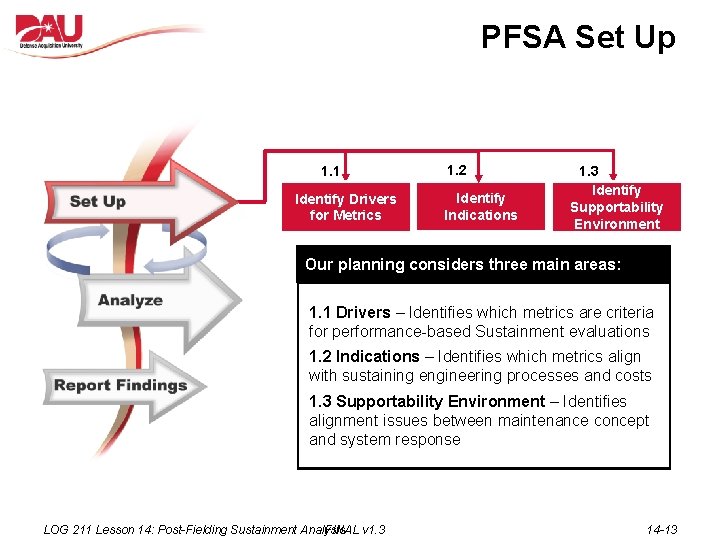
PFSA Set Up 1. 1 Identify Drivers for Metrics 1. 2 Identify Indications 1. 3 Identify Supportability Environment Our planning considers three main areas: 1. 1 Drivers – Identifies which metrics are criteria for performance-based Sustainment evaluations 1. 2 Indications – Identifies which metrics align with sustaining engineering processes and costs 1. 3 Supportability Environment – Identifies alignment issues between maintenance concept and system response LOG 211 Lesson 14: Post-Fielding Sustainment Analysis FINAL v 1. 3 14 -13
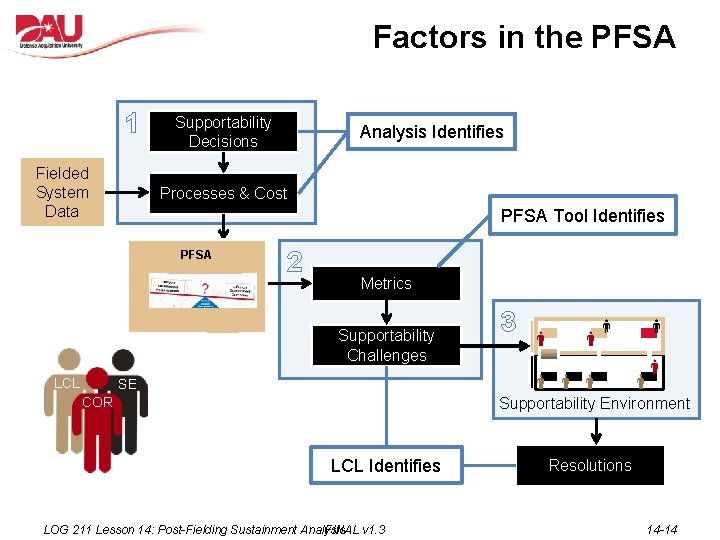
Factors in the PFSA 1 Fielded System Data Supportability Decisions Analysis Identifies Processes & Cost PFSA Tool Identifies PFSA 2 Metrics Supportability Challenges LCL 3 SE Supportability Environment COR LCL Identifies LOG 211 Lesson 14: Post-Fielding Sustainment Analysis FINAL v 1. 3 Resolutions 14 -14
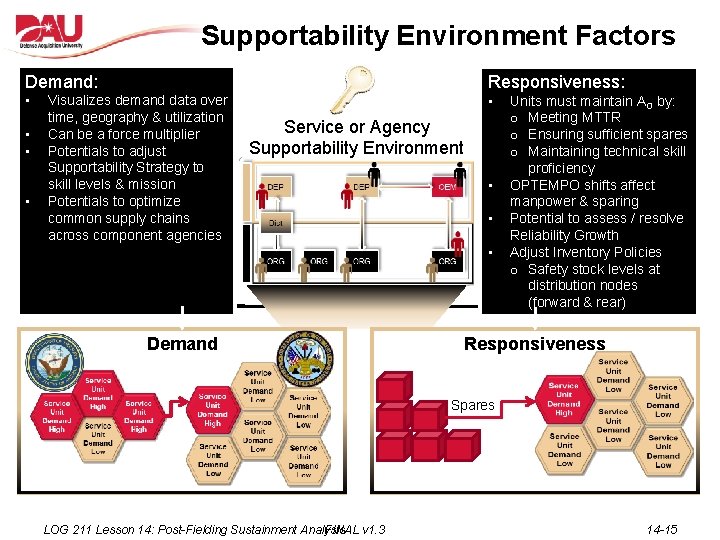
Supportability Environment Factors Demand: Responsiveness: • • • Visualizes demand data over time, geography & utilization Can be a force multiplier Potentials to adjust Supportability Strategy to skill levels & mission Potentials to optimize common supply chains across component agencies Service or Agency Supportability Environment • • • Demand Units must maintain AO by: o Meeting MTTR o Ensuring sufficient spares o Maintaining technical skill proficiency OPTEMPO shifts affect manpower & sparing Potential to assess / resolve Reliability Growth Adjust Inventory Policies o Safety stock levels at distribution nodes (forward & rear) Responsiveness Spares LOG 211 Lesson 14: Post-Fielding Sustainment Analysis FINAL v 1. 3 14 -15
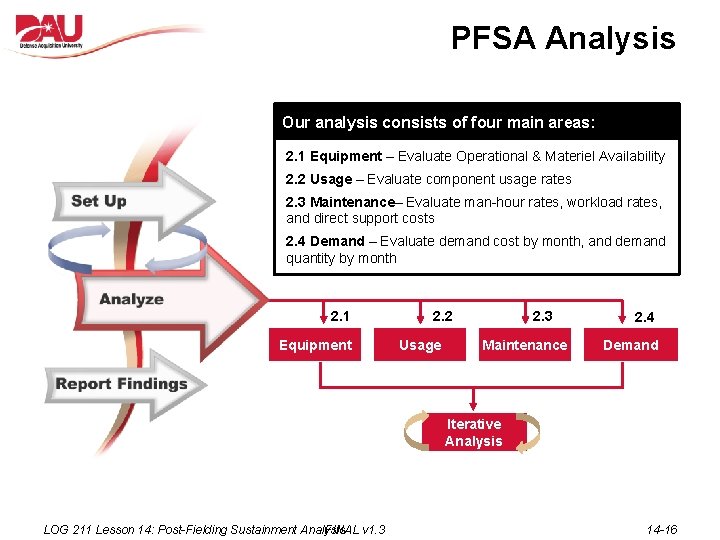
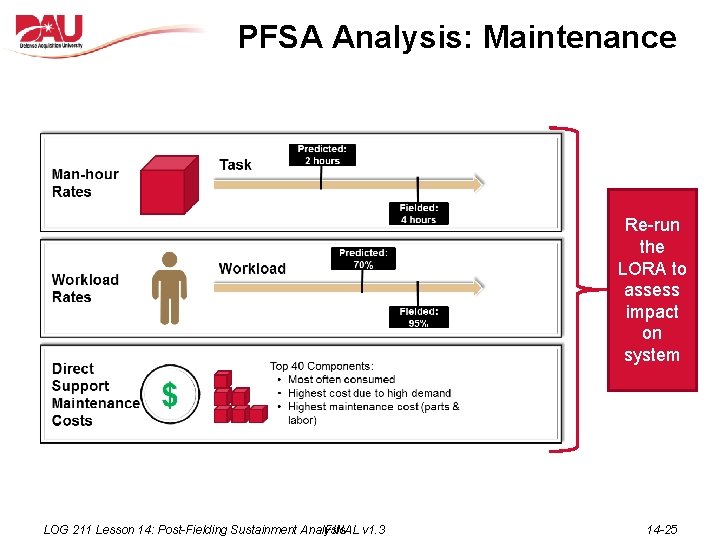
PFSA Analysis Our analysis consists of four main areas: 2. 1 Equipment – Evaluate Operational & Materiel Availability 2. 2 Usage – Evaluate component usage rates 2. 3 Maintenance– Evaluate man-hour rates, workload rates, and direct support costs 2. 4 Demand – Evaluate demand cost by month, and demand quantity by month 2. 1 Equipment 2. 2 Usage 2. 3 Maintenance 2. 4 Demand Iterative Analysis LOG 211 Lesson 14: Post-Fielding Sustainment Analysis FINAL v 1. 3 14 -16
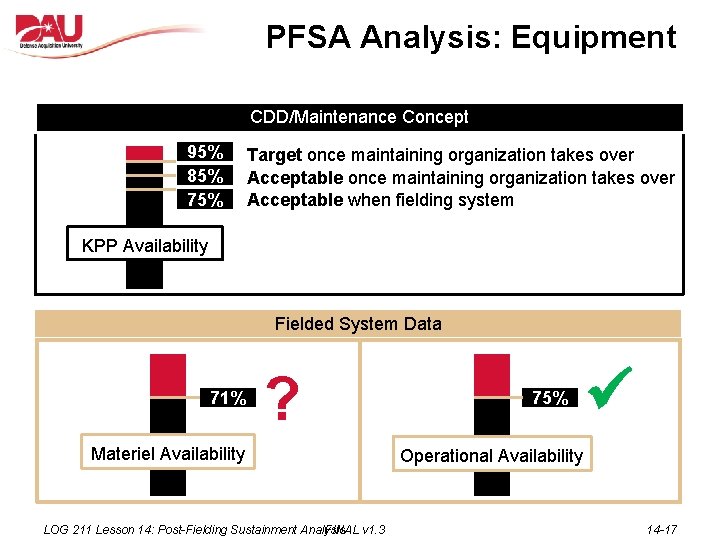
PFSA Analysis: Equipment CDD/Maintenance Concept 95% 85% 75% Target once maintaining organization takes over Acceptable when fielding system KPP Availability Fielded System Data 71% ? Materiel Availability LOG 211 Lesson 14: Post-Fielding Sustainment Analysis FINAL v 1. 3 75% Operational Availability 14 -17
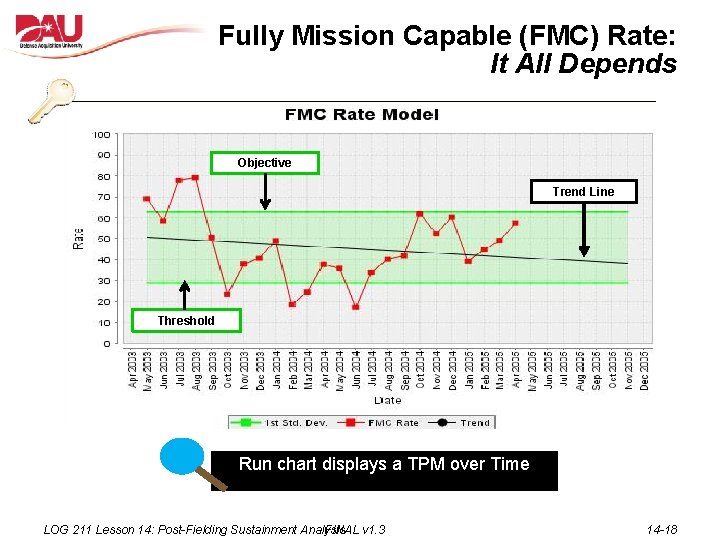
Fully Mission Capable (FMC) Rate: It All Depends Objective Trend Line Threshold Run chart displays a TPM over Time LOG 211 Lesson 14: Post-Fielding Sustainment Analysis FINAL v 1. 3 14 -18
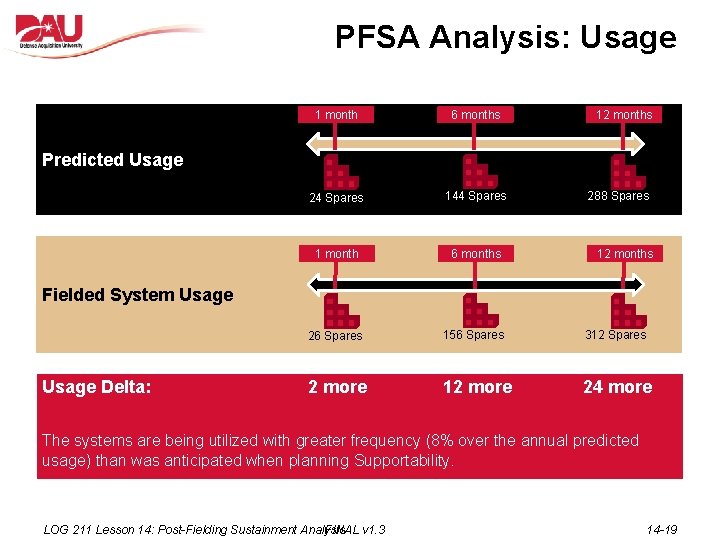
PFSA Analysis: Usage 12 months 1 month 6 months 24 Spares 144 Spares 1 month 6 months 26 Spares 156 Spares 312 Spares 2 more 12 more 24 more Predicted Usage 288 Spares 12 months Fielded System Usage Delta: The systems are being utilized with greater frequency (8% over the annual predicted usage) than was anticipated when planning Supportability. LOG 211 Lesson 14: Post-Fielding Sustainment Analysis FINAL v 1. 3 14 -19
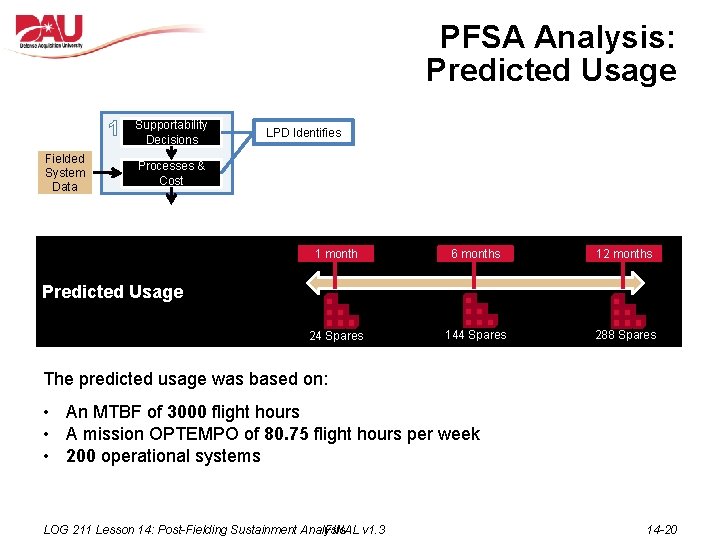
PFSA Analysis: Predicted Usage 1 Fielded System Data Supportability Decisions LPD Identifies Processes & Cost 1 month 6 months 12 months 24 Spares 144 Spares 288 Spares Predicted Usage The predicted usage was based on: • An MTBF of 3000 flight hours • A mission OPTEMPO of 80. 75 flight hours per week • 200 operational systems LOG 211 Lesson 14: Post-Fielding Sustainment Analysis FINAL v 1. 3 14 -20
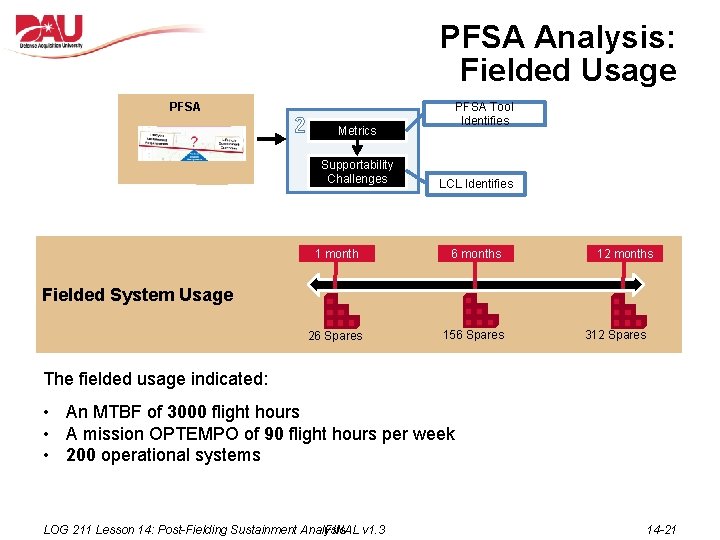
PFSA Analysis: Fielded Usage PFSA Tool Identifies PFSA 2 Metrics Supportability Challenges LCL Identifies 1 month 6 months 26 Spares 156 Spares 12 months Fielded System Usage 312 Spares The fielded usage indicated: • An MTBF of 3000 flight hours • A mission OPTEMPO of 90 flight hours per week • 200 operational systems LOG 211 Lesson 14: Post-Fielding Sustainment Analysis FINAL v 1. 3 14 -21
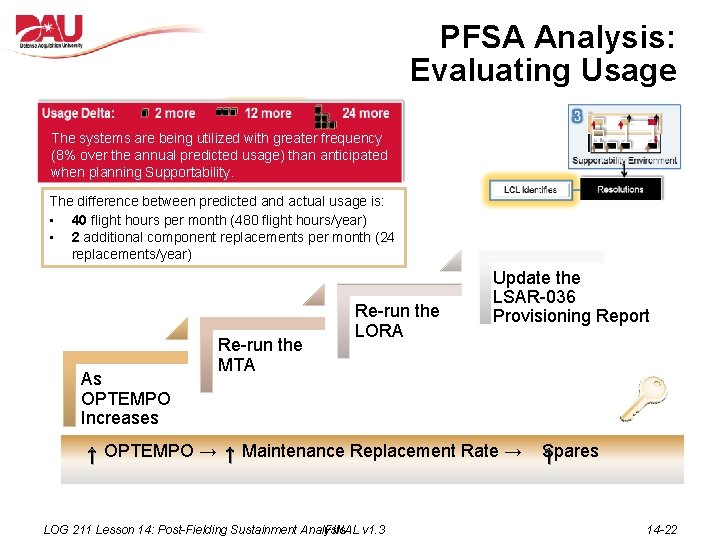
PFSA Analysis: Evaluating Usage The systems are being utilized with greater frequency (8% over the annual predicted usage) than anticipated when planning Supportability. The difference between predicted and actual usage is: • 40 flight hours per month (480 flight hours/year) • 2 additional component replacements per month (24 replacements/year) ↓ OPTEMPO → Maintenance Replacement Rate → ↓ LOG 211 Lesson 14: Post-Fielding Sustainment Analysis FINAL v 1. 3 Spares ↓ As OPTEMPO Increases Re-run the MTA Re-run the LORA Update the LSAR-036 Provisioning Report 14 -22
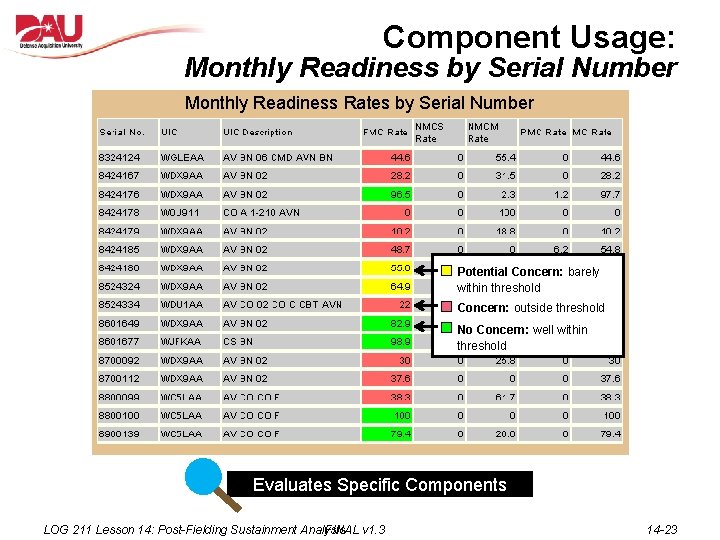
Component Usage: Monthly Readiness by Serial Number Monthly Readiness Rates by Serial Number Potential Concern: barely within threshold Concern: outside threshold No Concern: well within threshold Evaluates Specific Components LOG 211 Lesson 14: Post-Fielding Sustainment Analysis FINAL v 1. 3 14 -23
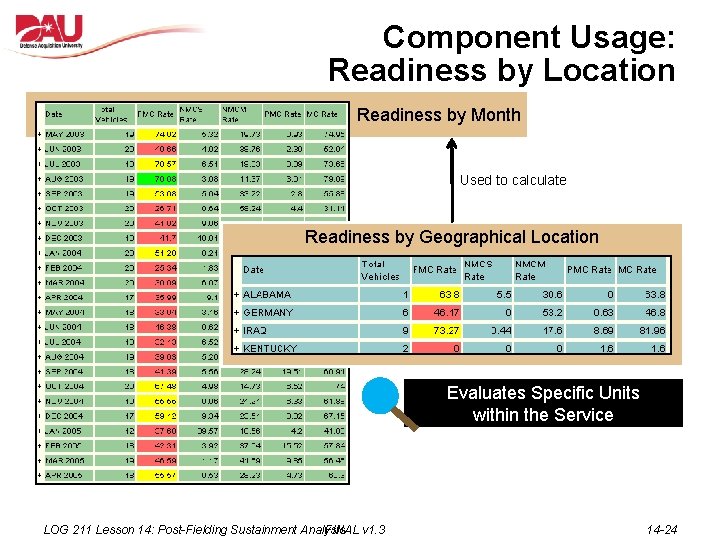
Component Usage: Readiness by Location Readiness by Month Used to calculate Readiness by Geographical Location Evaluates Specific Units within the Service LOG 211 Lesson 14: Post-Fielding Sustainment Analysis FINAL v 1. 3 14 -24
PFSA Analysis: Maintenance Re-run the LORA to assess impact on system LOG 211 Lesson 14: Post-Fielding Sustainment Analysis FINAL v 1. 3 14 -25
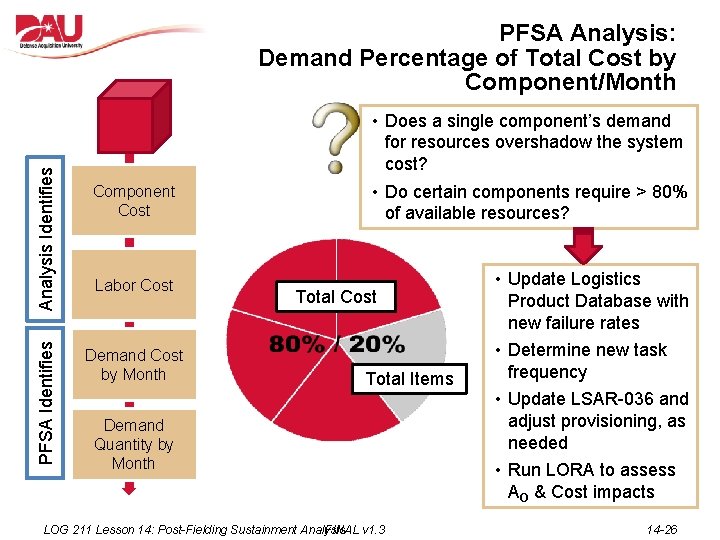
PFSA Identifies Analysis Identifies PFSA Analysis: Demand Percentage of Total Cost by Component/Month Component Cost Labor Cost Demand Cost by Month • Does a single component’s demand for resources overshadow the system cost? • Do certain components require > 80% of available resources? Total Cost Total Items Demand Quantity by Month LOG 211 Lesson 14: Post-Fielding Sustainment Analysis FINAL v 1. 3 • Update Logistics Product Database with new failure rates • Determine new task frequency • Update LSAR-036 and adjust provisioning, as needed • Run LORA to assess AO & Cost impacts 14 -26
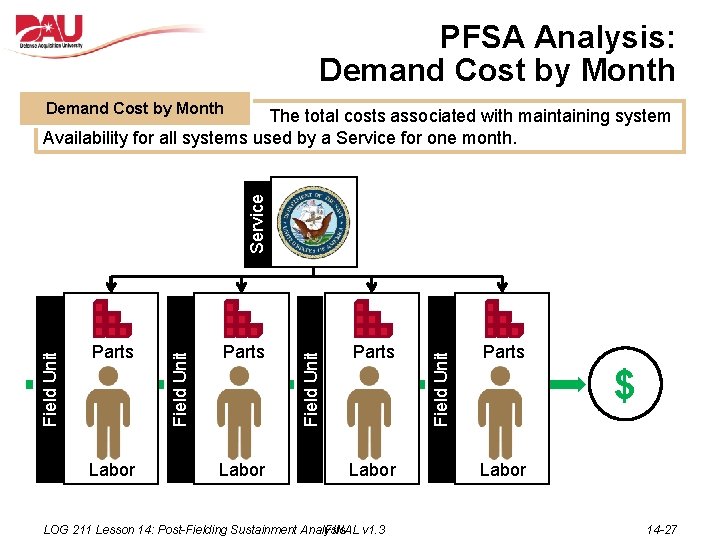
PFSA Analysis: Demand Cost by Month Labor Parts Labor LOG 211 Lesson 14: Post-Fielding Sustainment Analysis FINAL v 1. 3 Field Unit Parts Field Unit Service The total costs associated with maintaining system Availability for all systems used by a Service for one month. Parts $ Labor 14 -27
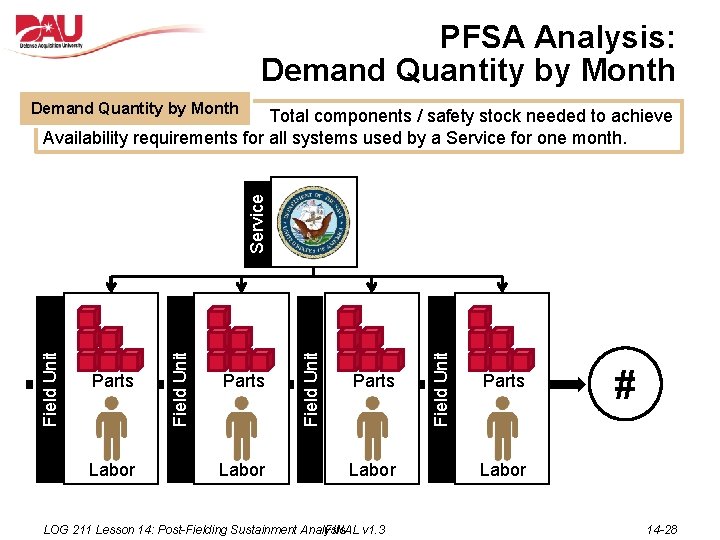
PFSA Analysis: Demand Quantity by Month Labor Parts Labor LOG 211 Lesson 14: Post-Fielding Sustainment Analysis FINAL v 1. 3 Field Unit Parts Field Unit Service Total components / safety stock needed to achieve Availability requirements for all systems used by a Service for one month. Parts # Labor 14 -28
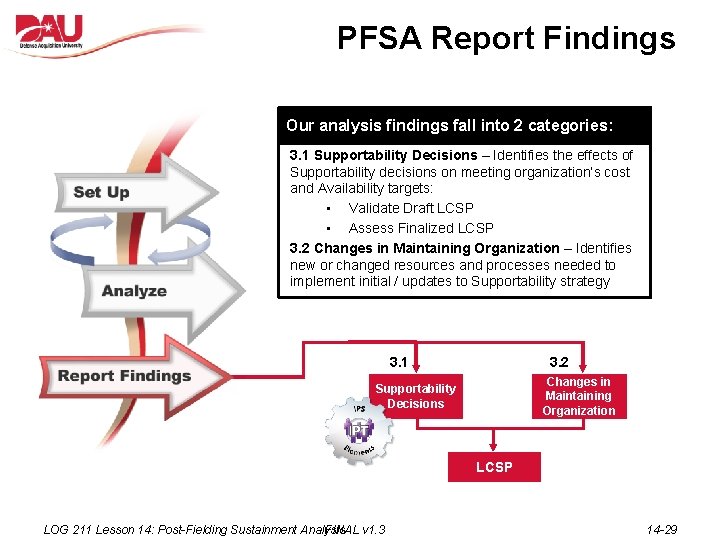
PFSA Report Findings Our analysis findings fall into 2 categories: 3. 1 Supportability Decisions – Identifies the effects of Supportability decisions on meeting organization’s cost and Availability targets: • Validate Draft LCSP • Assess Finalized LCSP 3. 2 Changes in Maintaining Organization – Identifies new or changed resources and processes needed to implement initial / updates to Supportability strategy 3. 1 3. 2 Changes in Maintaining Organization Supportability Decisions LCSP LOG 211 Lesson 14: Post-Fielding Sustainment Analysis FINAL v 1. 3 14 -29
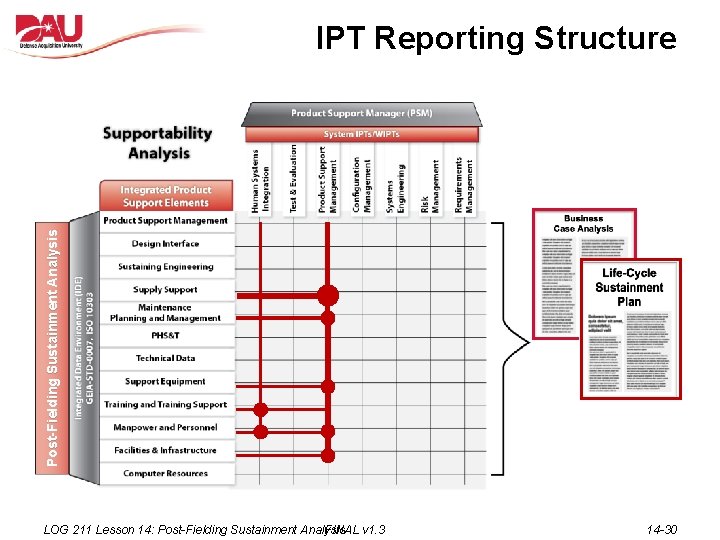
Post-Fielding Sustainment Analysis IPT Reporting Structure LOG 211 Lesson 14: Post-Fielding Sustainment Analysis FINAL v 1. 3 14 -30
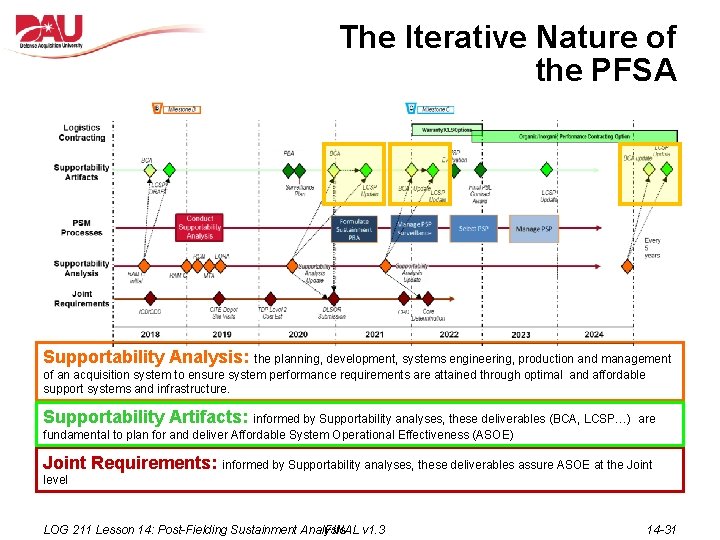
The Iterative Nature of the PFSA Supportability Analysis: the planning, development, systems engineering, production and management of an acquisition system to ensure system performance requirements are attained through optimal and affordable support systems and infrastructure. Supportability Artifacts: informed by Supportability analyses, these deliverables (BCA, LCSP…) are fundamental to plan for and deliver Affordable System Operational Effectiveness (ASOE) Joint Requirements: informed by Supportability analyses, these deliverables assure ASOE at the Joint level LOG 211 Lesson 14: Post-Fielding Sustainment Analysis FINAL v 1. 3 14 -31
Topic 4: Exercise LOG 211 Lesson 14: Post-Fielding Sustainment Analysis FINAL v 1. 3 14 -32
Which resolution best addresses a specific Supportability challenge? Key Question Exercise 13 Minutes Individual, Not Graded Directions In Blackboard, select the Exercise link in the Lesson 15: PFSA folder. LOG 211 Lesson 14: Post-Fielding Sustainment Analysis FINAL v 1. 3 14 -33
Topic 5: Summary LOG 211 Lesson 14: Post-Fielding Sustainment Analysis FINAL v 1. 3 14 -34
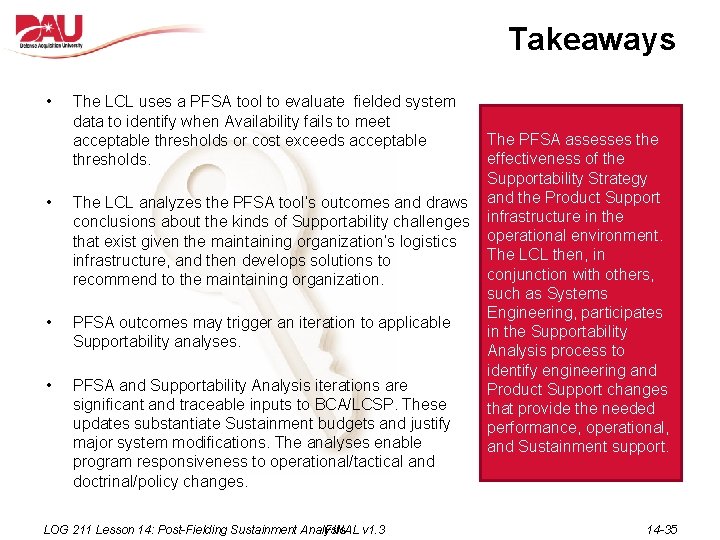
Takeaways • The LCL uses a PFSA tool to evaluate fielded system data to identify when Availability fails to meet acceptable thresholds or cost exceeds acceptable thresholds. • The LCL analyzes the PFSA tool’s outcomes and draws conclusions about the kinds of Supportability challenges that exist given the maintaining organization’s logistics infrastructure, and then develops solutions to recommend to the maintaining organization. • PFSA outcomes may trigger an iteration to applicable Supportability analyses. • PFSA and Supportability Analysis iterations are significant and traceable inputs to BCA/LCSP. These updates substantiate Sustainment budgets and justify major system modifications. The analyses enable program responsiveness to operational/tactical and doctrinal/policy changes. LOG 211 Lesson 14: Post-Fielding Sustainment Analysis FINAL v 1. 3 The PFSA assesses the effectiveness of the Supportability Strategy and the Product Support infrastructure in the operational environment. The LCL then, in conjunction with others, such as Systems Engineering, participates in the Supportability Analysis process to identify engineering and Product Support changes that provide the needed performance, operational, and Sustainment support. 14 -35
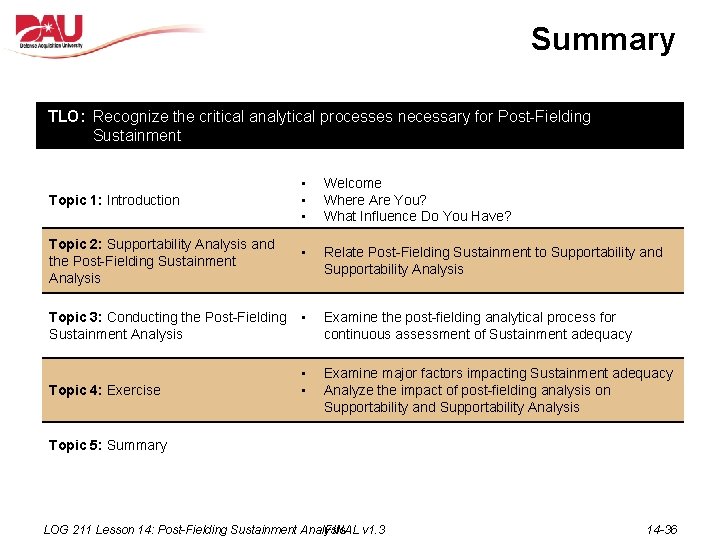
Summary TLO: Recognize the critical analytical processes necessary for Post-Fielding Sustainment Topic Objectives Topic 1: Introduction • • • Welcome Where Are You? What Influence Do You Have? • Relate Post-Fielding Sustainment to Supportability and Supportability Analysis • Examine the post-fielding analytical process for continuous assessment of Sustainment adequacy • • Examine major factors impacting Sustainment adequacy Analyze the impact of post-fielding analysis on Supportability and Supportability Analysis Topic 2: Supportability Analysis and the Post-Fielding Sustainment Analysis Topic 3: Conducting the Post-Fielding Sustainment Analysis Topic 4: Exercise Topic 5: Summary LOG 211 Lesson 14: Post-Fielding Sustainment Analysis FINAL v 1. 3 14 -36