
Lesson 13 Plate Tectonics I Geological Oceanography Basic
Lesson 13: Plate Tectonics I Geological Oceanography
Basic geology and the movement of tectonic plates 2 l The movement of Earth’s plates is fundamental to the physical structure of the planet Earth l To understand what we mean by the movement of plates, we need to learn some basic geology
Some geology fundamentals 1. 2. 3. 3 The Earth is composed of three layers: core, mantle and crust The Earth’s lithosphere is a rigid layer composed of part of the upper mantle and crust The Earth’s lithosphere is not continuous, but made up of large pieces which fit together like a puzzle
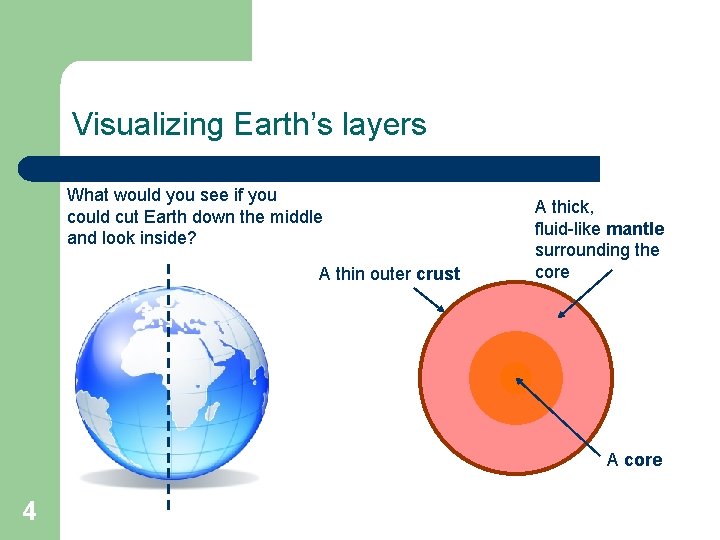
Visualizing Earth’s layers What would you see if you could cut Earth down the middle and look inside? A thin outer crust A thick, fluid-like mantle surrounding the core A core 4
There are two types of crust: oceanic crust and continental crust l l l 5 The thick continental crust and thin oceanic crust both lie on the more dense mantle Oceanic crust is younger, thinner and more dense than continental crust Continental crust tends to lie higher than oceanic crust and forms continents The very uppermost part of the mantle and the crust form rigid plates, called the lithosphere These plates cover the Earth and move with respect to one another

The lithosphere and asthenophere Continental crust Land Oceanic crust Ocean uppermost portion of mantle 6 The lithosphere is made up of rigid plates composed of the top of the upper mantle and the crust Lithosphere Beneath the uppermost layer of the mantle is an Asthenosphere area of weakness called the asthenosphere, on which the rigid plates move with respect to one another
You may have heard of Earth’s plates or plate tectonics – what exactly is a plate? 7 l Now you know about the composition of the lithosphere, but did you know it is not one continuous layer? l The lithosphere is actually composed of many large pieces that fit together like a puzzle l These large pieces are called plates
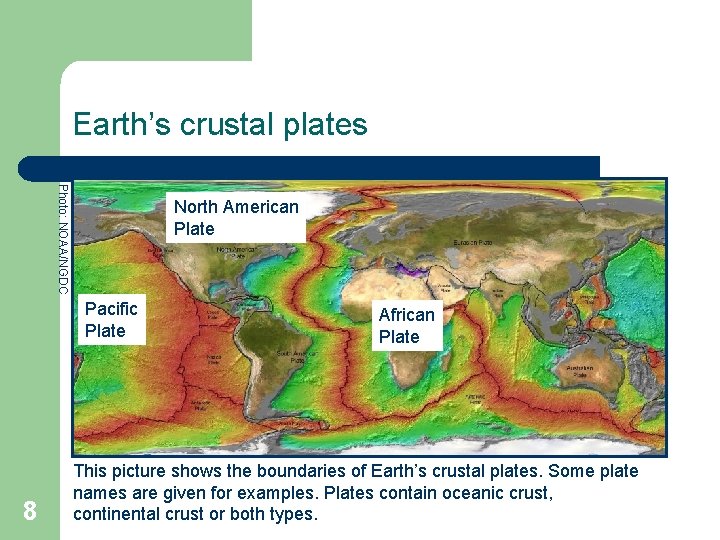
Earth’s crustal plates Photo: NOAA/NGDC North American Plate Pacific Plate 8 African Plate This picture shows the boundaries of Earth’s crustal plates. Some plate names are given for examples. Plates contain oceanic crust, continental crust or both types.
Earth’s plates are constantly moving l l Remember that the asthenosphere beneath the plates is relatively soft and plastic The asthenosphere is slowly, but constantly, moving The plates “floating” on top of this layer are thus always in motion. How do they move in relation to one another? They can: – – – 9 move past one another crash into one another even rise and sink

Plates move with respect to one another Photo: NOAA/NGDC 10 Eurasian Plate North American Plate For example, the North American plate and Eurasian plate are moving away from one another, forming a ridge.
How fast do plates move? In today’s activity, you will figure out how fast the Pacific Plate is moving 11
- Slides: 11