
Lesson 13 Conflict Resolution Skills Conflicts Occur everyday
- Slides: 14
Lesson 13 Conflict Resolution Skills
Conflicts • Occur everyday • Within relationships – family, school, community • Within yourself – centering on needs and values • Involves strong emotions that could help or hinder your judgment
What is “conflict? ” • A disagreement between two or more people or between two or more choices. • Four types of conflict • Three conflict response styles
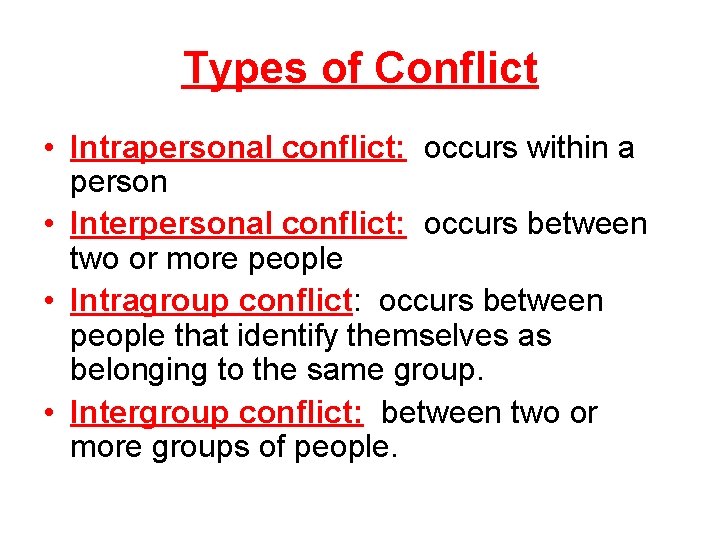
Types of Conflict • Intrapersonal conflict: occurs within a person • Interpersonal conflict: occurs between two or more people • Intragroup conflict: occurs between people that identify themselves as belonging to the same group. • Intergroup conflict: between two or more groups of people.
What is a conflict response style? • A pattern of behavior a person demonstrates when a conflict arises
Conflict Response Styles • Conflict avoidance: a person avoids disagreement at all costs. • Conflict confrontation: a person attempts to settle a disagreement in a hostile, defiant, and aggressive way. • Conflict resolution: a person uses conflict resolution skills to resolve a disagreement.
Conflict Resolution Skills • Steps that can be taken to settle a disagreement in a responsible way. • A person remains rationale and in control when having disagreements with others. • Good listening skills involved • Look for the win-win situation
10 Steps in Conflict Resolution • • Remain calm Set the tone Define the conflict Take responsibility for personal actions • Use I-message to express needs and feelings • Listen to needs and feelings of others • List and evaluate possible solutions • Agree on a solution • Keep your word & follow the agreement • Ask for assistance of trusted adult if the conflict can not be resolved
Using Mediation • Mediation: A process in which an outside person helps people in conflict reach a solution. • Mediator: a person who helps people in conflict reach a solution.
8 steps with mediation • A mediator is agreed upon • Set ground rules • Define the conflict • Identify solutions to the conflict • Evaluate suggested solutions • Negotiate a solution • Write and sign an agreement • Schedule a follow up meeting
Avoid discriminatory behavior • Discriminate: to treat some people or groups of people differently from others. • Prejudice: suspicion, intolerance, or irrational hatred directed at an individual or group. • Hate crime: a crime motivated by prejudice. • This type of behavior divides people. • People believe they are treated unfairly.
• Show respect for ALL people. • You must avoid doing this type of behavior • You must challenge others who do this type of behavior to not do it
6 Ways to Avoid Discriminatory Behavior • Challenge stereotypes: a prejudice attitude that assigns a specific quality or characteristic to all people who belong to a particular group. • Create synergy through diversity. – Synergy: positive outcome that occurs when different people cooperate and respect one another and create more energy for all. – Diversity: the quality of being different or varied.
• Show empathy for all people. – Empathy: the ability to share in another person’s emotions or feelings. • Avoid discriminatory comments. • Ask others to stop discriminatory behavior. • Learn about people who are different from you.