
Lesson 13 2 Comparing Two Proportions Knowledge Objectives
Lesson 13 - 2 Comparing Two Proportions
Knowledge Objectives • Identify the mean and standard deviation of the sampling distribution of p-hat 1 – p-hat 2. • List the conditions under which the sampling distribution of p-hat 1 – p-hat 2 is approximately Normal. • Identify the standard error of p-hat 1 – p-hat 2 when constructing a confidence interval for the difference between two population proportions. • Identify the three conditions under which it is appropriate to construct a confidence interval for the difference between two population proportions.
Knowledge Objectives • Explain why, in a significance test for the difference between two proportions, it is reasonable to combine (pool) your sample estimates to make a single estimate of the difference between the proportions. • Explain how the standard error of p-hat 1 – p-hat 2 differs between constructing a confidence interval for p-hat 1 – p-hat 2 and performing a hypothesis test for H 0: p 1 – p 2 = 0. • List the three conditions that need to be satisfied in order to do a significance test for the difference between two proportions.
Construction Objectives • Construct a confidence interval for the difference between two population proportions using the fourstep Inference Toolbox for confidence intervals • Conduct a significance test for the difference between two proportions using the Inference Toolbox
Vocabulary • Statistical Inference –
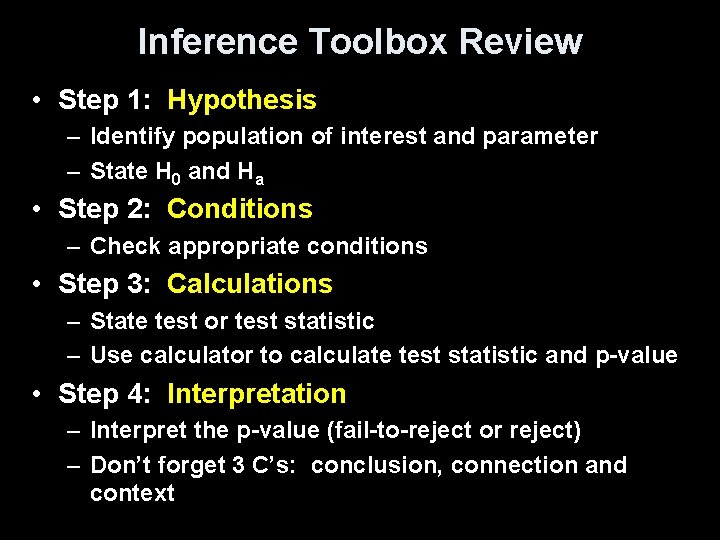
Inference Toolbox Review • Step 1: Hypothesis – Identify population of interest and parameter – State H 0 and Ha • Step 2: Conditions – Check appropriate conditions • Step 3: Calculations – State test or test statistic – Use calculator to calculate test statistic and p-value • Step 4: Interpretation – Interpret the p-value (fail-to-reject or reject) – Don’t forget 3 C’s: conclusion, connection and context

Difference in Two Proportions Testing a claim regarding the difference of two proportions requires that they both are approximately Normal
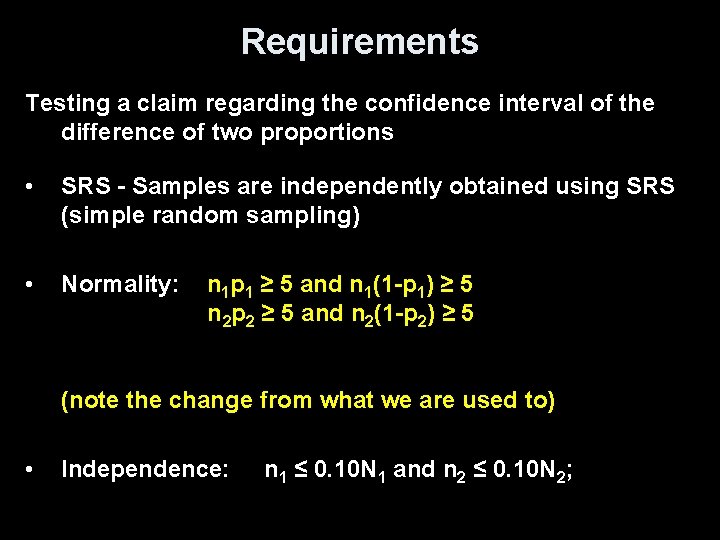
Requirements Testing a claim regarding the confidence interval of the difference of two proportions • SRS - Samples are independently obtained using SRS (simple random sampling) • Normality: n 1 p 1 ≥ 5 and n 1(1 -p 1) ≥ 5 n 2 p 2 ≥ 5 and n 2(1 -p 2) ≥ 5 (note the change from what we are used to) • Independence: n 1 ≤ 0. 10 N 1 and n 2 ≤ 0. 10 N 2;
Confidence Intervals
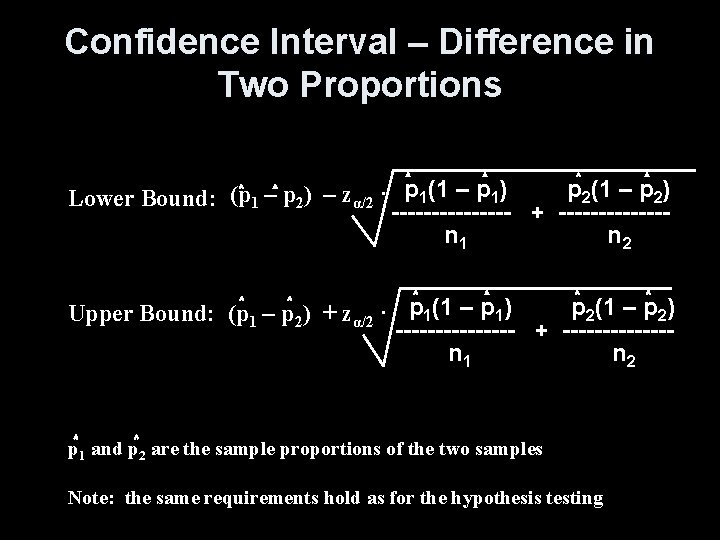
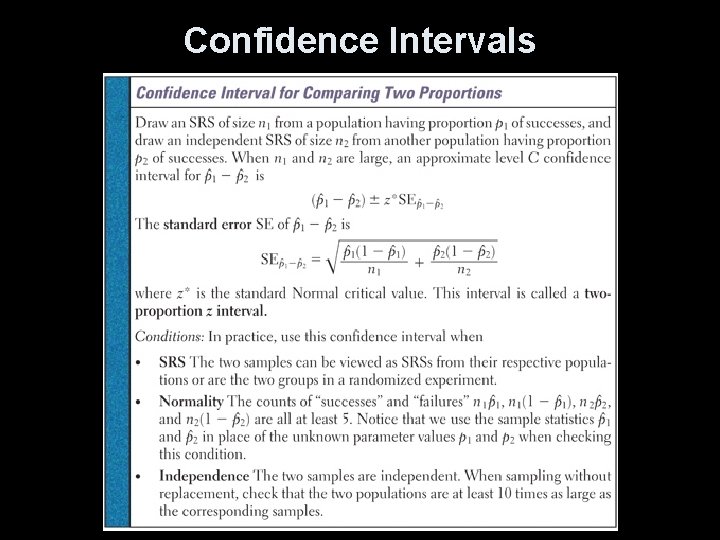
Confidence Interval – Difference in Two Proportions p 2(1 – p 2) Lower Bound: (p 1 – p 2) – zα/2 · p 1(1 – p 1) -------- + -------n 1 n 2 p 2(1 – p 2) Upper Bound: (p 1 – p 2) + zα/2 · p 1(1 – p 1) -------- + -------n 1 n 2 p 1 and p 2 are the sample proportions of the two samples Note: the same requirements hold as for the hypothesis testing
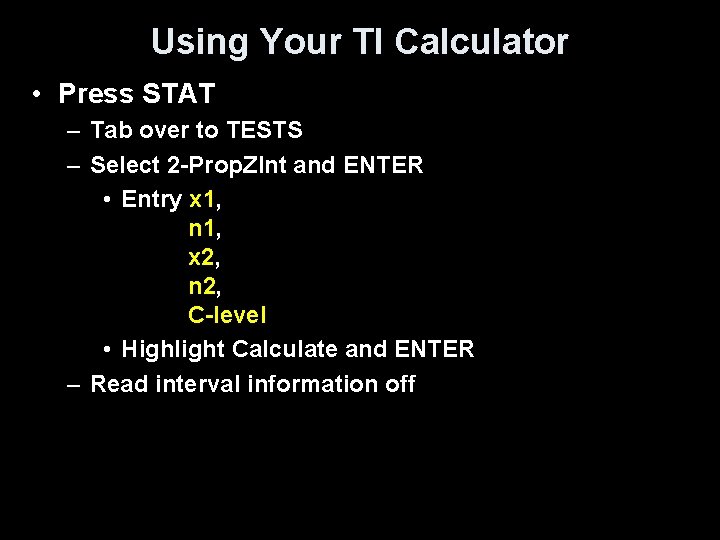
Using Your TI Calculator • Press STAT – Tab over to TESTS – Select 2 -Prop. ZInt and ENTER • Entry x 1, n 1, x 2, n 2, C-level • Highlight Calculate and ENTER – Read interval information off
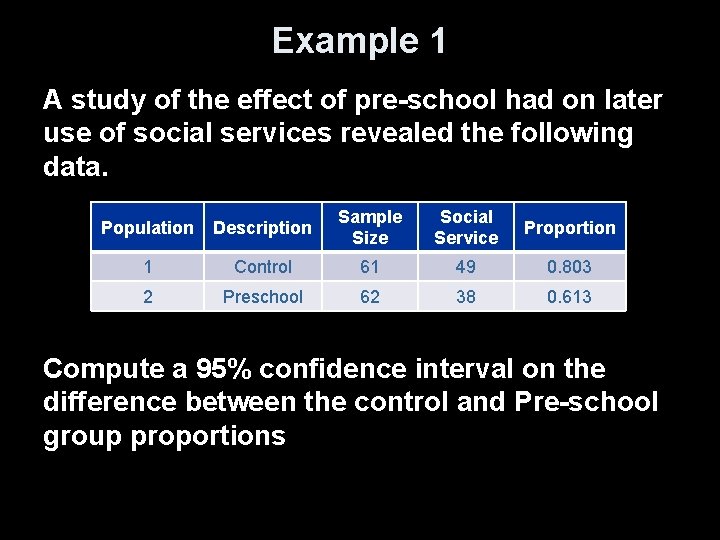
Example 1 A study of the effect of pre-school had on later use of social services revealed the following data. Population Description Sample Size Social Service Proportion 1 Control 61 49 0. 803 2 Preschool 62 38 0. 613 Compute a 95% confidence interval on the difference between the control and Pre-school group proportions
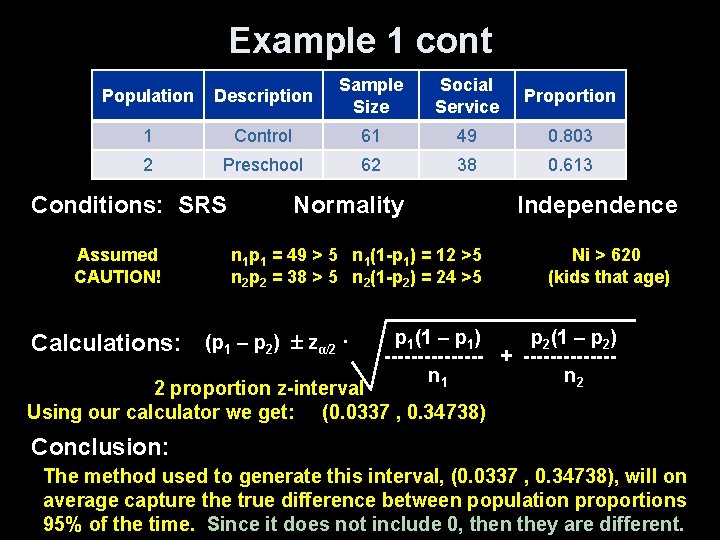
Example 1 cont Population Description Sample Size Social Service Proportion 1 Control 61 49 0. 803 2 Preschool 62 38 0. 613 Conditions: SRS Assumed CAUTION! Normality n 1 p 1 = 49 > 5 n 1(1 -p 1) = 12 >5 n 2 p 2 = 38 > 5 n 2(1 -p 2) = 24 >5 Calculations: (p 1 – p 2) zα/2 · Independence Ni > 620 (kids that age) p 1(1 – p 1) p 2(1 – p 2) -------- + -------n 1 n 2 2 proportion z-interval Using our calculator we get: (0. 0337 , 0. 34738) Conclusion: The method used to generate this interval, (0. 0337 , 0. 34738), will on average capture the true difference between population proportions 95% of the time. Since it does not include 0, then they are different.
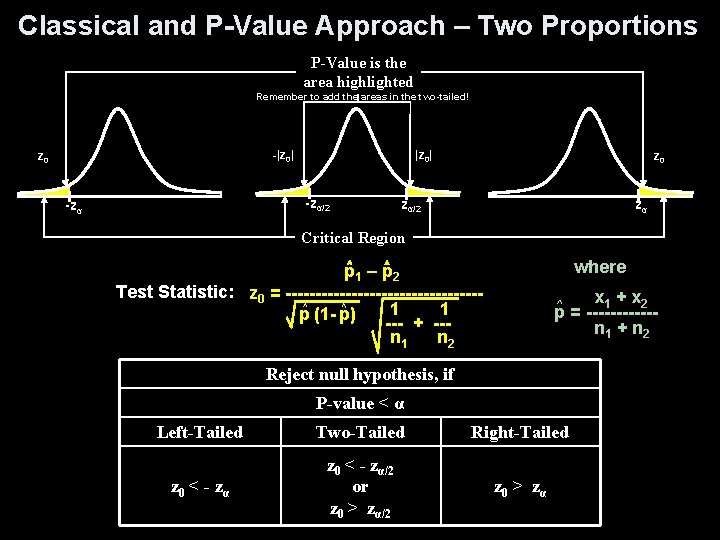
Classical and P-Value Approach – Two Proportions P-Value is the area highlighted Remember to add the areas in the two-tailed! -|z 0| z 0 |z 0| -zα/2 -zα z 0 zα/2 zα Critical Region where p 1 – p 2 Test Statistic: z 0 = ----------------1 1 p (1 - p) --- + --n 1 n 2 x 1 + x 2 p = ------n 1 + n 2 Reject null hypothesis, if P-value < α Left-Tailed Two-Tailed Right-Tailed z 0 < - z α z 0 < - zα/2 or z 0 > zα/2 z 0 > z α
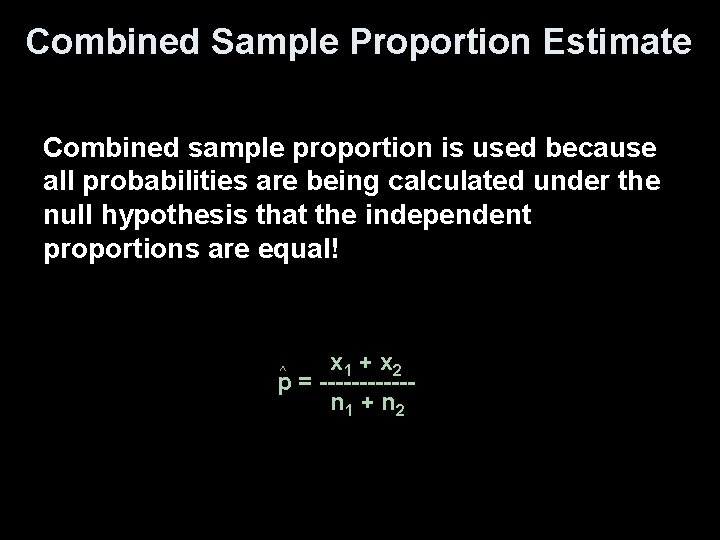
Combined Sample Proportion Estimate Combined sample proportion is used because all probabilities are being calculated under the null hypothesis that the independent proportions are equal! x 1 + x 2 p = ------n 1 + n 2
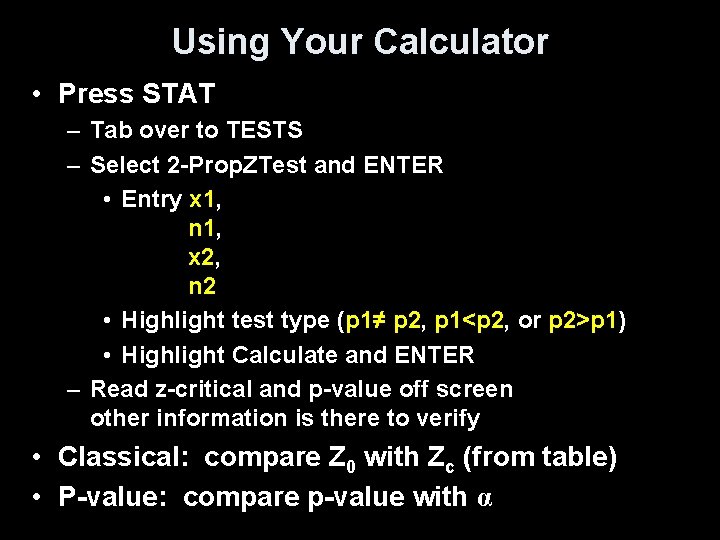
Using Your Calculator • Press STAT – Tab over to TESTS – Select 2 -Prop. ZTest and ENTER • Entry x 1, n 1, x 2, n 2 • Highlight test type (p 1≠ p 2, p 1<p 2, or p 2>p 1) • Highlight Calculate and ENTER – Read z-critical and p-value off screen other information is there to verify • Classical: compare Z 0 with Zc (from table) • P-value: compare p-value with α
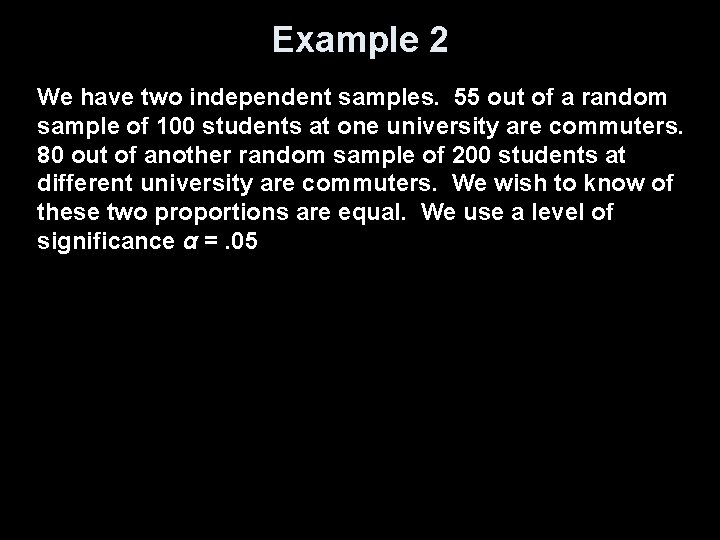
Example 2 We have two independent samples. 55 out of a random sample of 100 students at one university are commuters. 80 out of another random sample of 200 students at different university are commuters. We wish to know of these two proportions are equal. We use a level of significance α =. 05
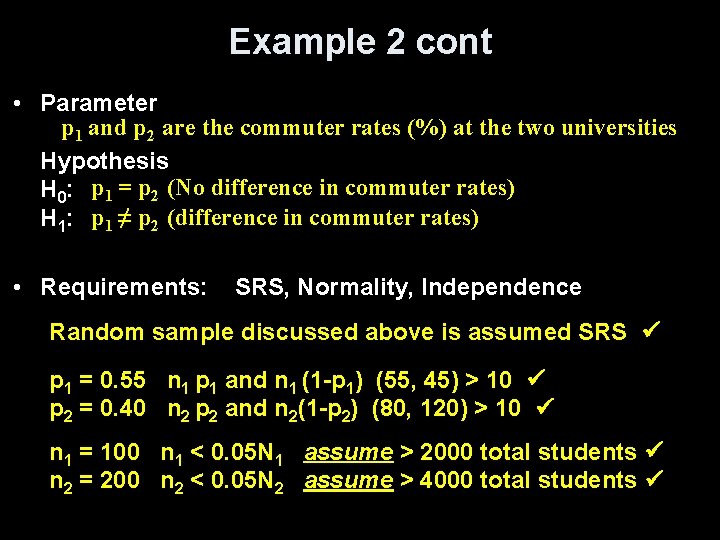
Example 2 cont • Parameter p 1 and p 2 are the commuter rates (%) at the two universities Hypothesis H 0: p 1 = p 2 (No difference in commuter rates) H 1: p 1 ≠ p 2 (difference in commuter rates) • Requirements: SRS, Normality, Independence Random sample discussed above is assumed SRS p 1 = 0. 55 n 1 p 1 and n 1 (1 -p 1) (55, 45) > 10 p 2 = 0. 40 n 2 p 2 and n 2(1 -p 2) (80, 120) > 10 n 1 = 100 n 1 < 0. 05 N 1 assume > 2000 total students n 2 = 200 n 2 < 0. 05 N 2 assume > 4000 total students
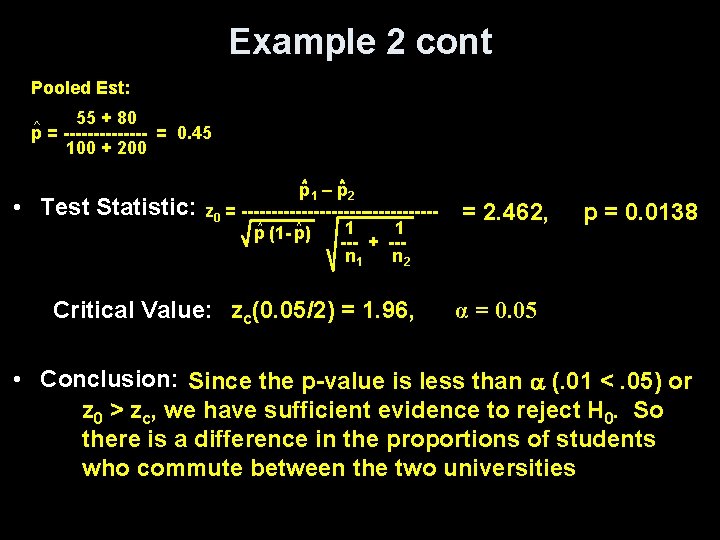
Example 2 cont Pooled Est: 55 + 80 p = ------- = 0. 45 100 + 200 • Test Statistic: p 1 – p 2 z 0 = ----------------1 1 p (1 - p) --- + --n 1 n 2 Critical Value: zc(0. 05/2) = 1. 96, = 2. 462, p = 0. 0138 α = 0. 05 • Conclusion: Since the p-value is less than (. 01 <. 05) or z 0 > zc, we have sufficient evidence to reject H 0. So there is a difference in the proportions of students who commute between the two universities
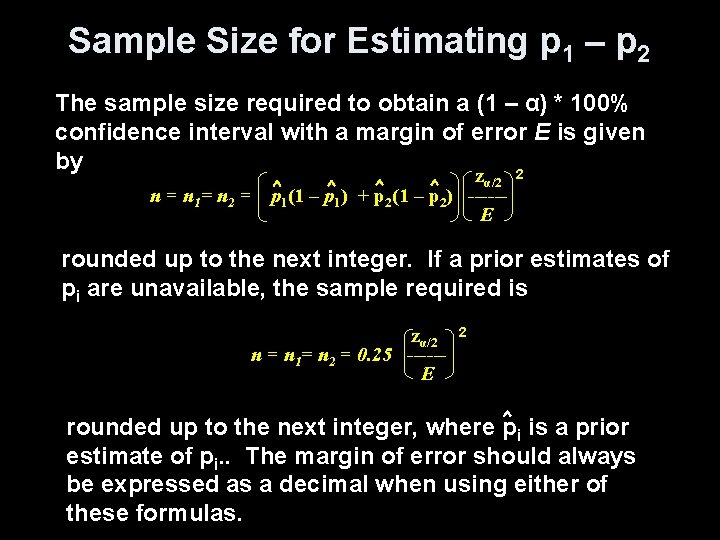
Sample Size for Estimating p 1 – p 2 The sample size required to obtain a (1 – α) * 100% confidence interval with a margin of error E is given by 2 n = n 1 = n 2 = zα/2 p 1(1 – p 1) + p 2(1 – p 2) -----E rounded up to the next integer. If a prior estimates of pi are unavailable, the sample required is zα/2 n = n 1= n 2 = 0. 25 -----E 2 rounded up to the next integer, where pi is a prior estimate of pi. . The margin of error should always be expressed as a decimal when using either of these formulas.
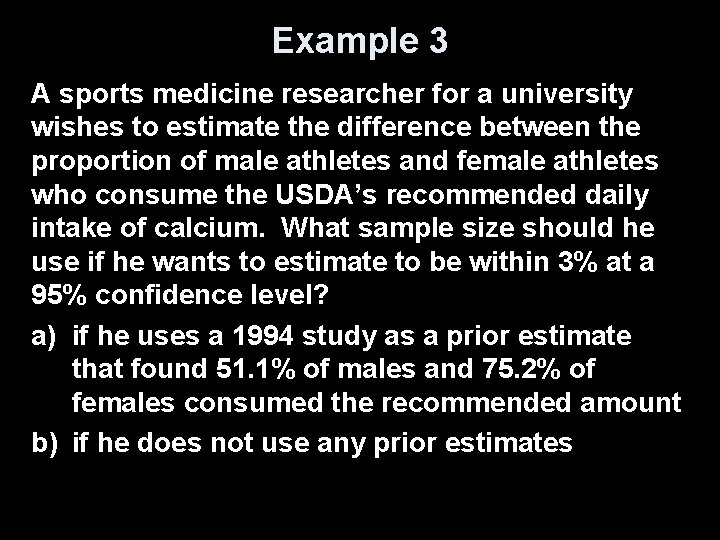
Example 3 A sports medicine researcher for a university wishes to estimate the difference between the proportion of male athletes and female athletes who consume the USDA’s recommended daily intake of calcium. What sample size should he use if he wants to estimate to be within 3% at a 95% confidence level? a) if he uses a 1994 study as a prior estimate that found 51. 1% of males and 75. 2% of females consumed the recommended amount b) if he does not use any prior estimates
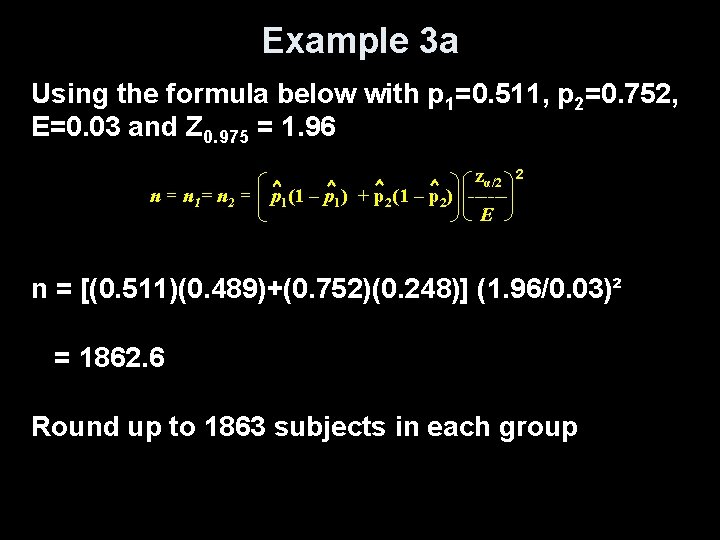
Example 3 a Using the formula below with p 1=0. 511, p 2=0. 752, E=0. 03 and Z 0. 975 = 1. 96 n = n 1 = n 2 = zα/2 p 1(1 – p 1) + p 2(1 – p 2) -----E 2 n = [(0. 511)(0. 489)+(0. 752)(0. 248)] (1. 96/0. 03)² = 1862. 6 Round up to 1863 subjects in each group
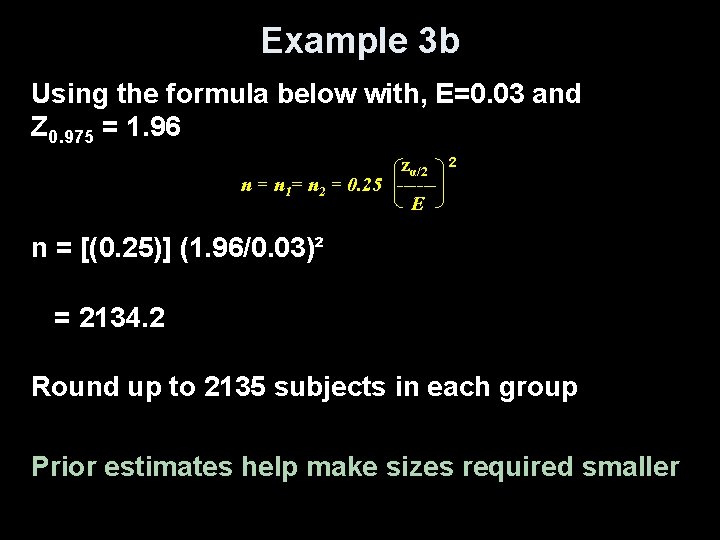
Example 3 b Using the formula below with, E=0. 03 and Z 0. 975 = 1. 96 zα/2 n = n 1= n 2 = 0. 25 -----E 2 n = [(0. 25)] (1. 96/0. 03)² = 2134. 2 Round up to 2135 subjects in each group Prior estimates help make sizes required smaller
Summary and Homework • Summary – We can compare proportions from two independent samples – We use a formula with the combined sample sizes and proportions for the standard error – The overall process, other than the formula for the standard error, are the general hypothesis test and confidence intervals process • Homework – pg 819 13. 29, 13. 30 and pg 821 13. 33 -35, 13. 38
- Slides: 24