
Lesson 12 Transfer Functions In The Laplace Domain
- Slides: 23
Lesson 12: Transfer Functions In The Laplace Domain ET 438 a Automatic Control Systems Technology lesson 12 et 438 a. pptx 1
Learning Objectives After this presentation you will be able to: Ø Ø Ø Define the terms pole, zero and eigenvalue as they pertain to transfer functions. Identify the location of poles and zeros on the complex plane. Develop transfer functions from OP AMP circuits using the Laplace variable. Develop transfer functions of electromechanical systems using the Laplace variable. Find the values of poles and zeros given a transfer function. lesson 12 et 438 a. pptx 2
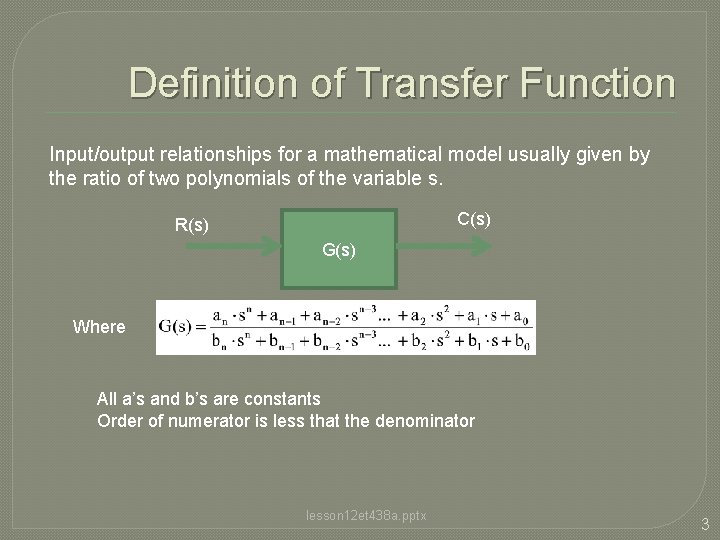
Definition of Transfer Function Input/output relationships for a mathematical model usually given by the ratio of two polynomials of the variable s. C(s) R(s) G(s) Where All a’s and b’s are constants Order of numerator is less that the denominator lesson 12 et 438 a. pptx 3
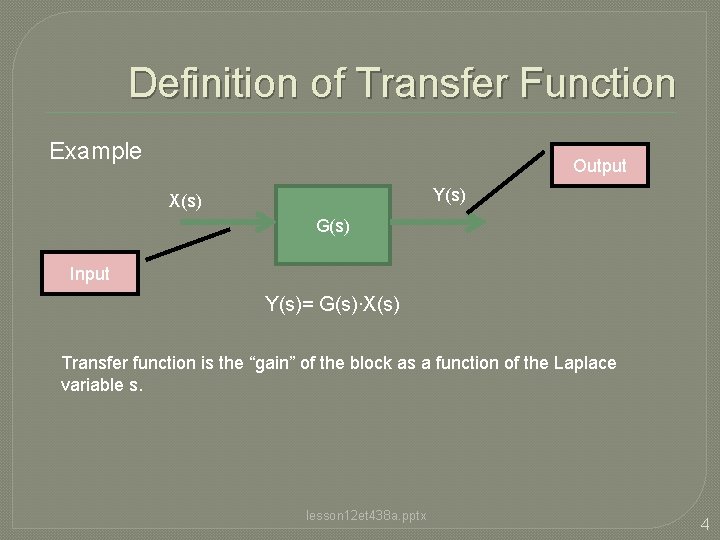
Definition of Transfer Function Example Output Y(s) X(s) G(s) Input Y(s)= G(s)∙X(s) Transfer function is the “gain” of the block as a function of the Laplace variable s. lesson 12 et 438 a. pptx 4
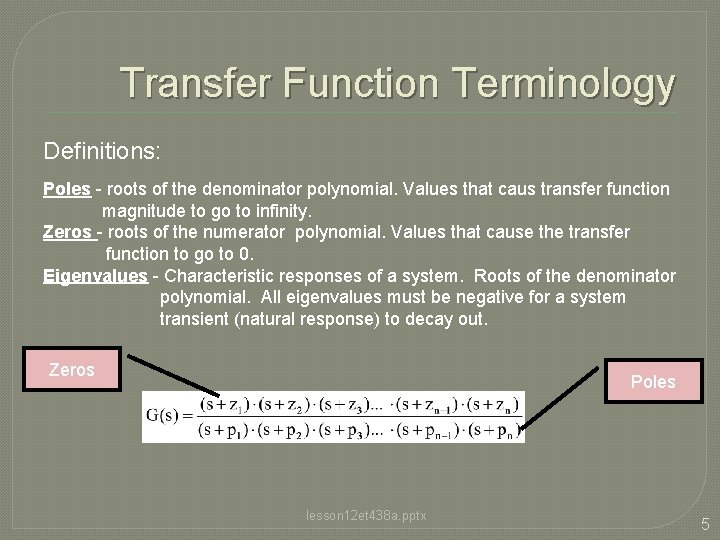
Transfer Function Terminology Definitions: Poles - roots of the denominator polynomial. Values that caus transfer function magnitude to go to infinity. Zeros - roots of the numerator polynomial. Values that cause the transfer function to go to 0. Eigenvalues - Characteristic responses of a system. Roots of the denominator polynomial. All eigenvalues must be negative for a system transient (natural response) to decay out. Zeros Poles lesson 12 et 438 a. pptx 5
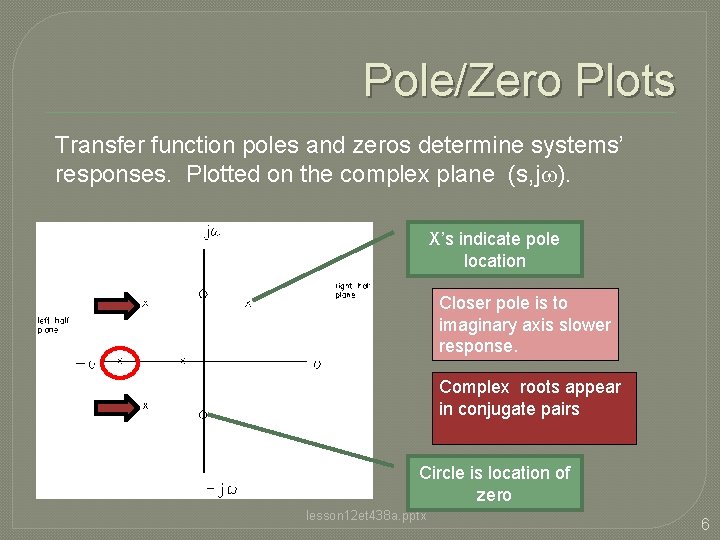
Pole/Zero Plots Transfer function poles and zeros determine systems’ responses. Plotted on the complex plane (s, jw). X’s indicate pole location Closer pole is to imaginary axis slower response. Complex roots appear in conjugate pairs Circle is location of zero lesson 12 et 438 a. pptx 6
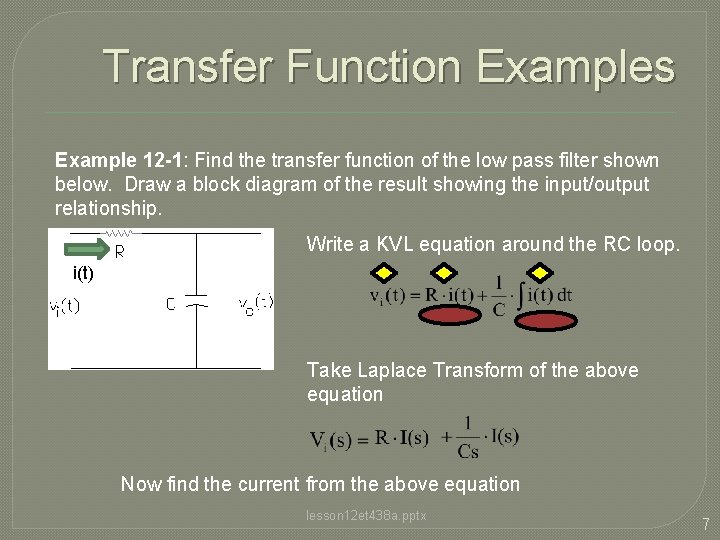
Transfer Function Examples Example 12 -1: Find the transfer function of the low pass filter shown below. Draw a block diagram of the result showing the input/output relationship. Write a KVL equation around the RC loop. i(t) Take Laplace Transform of the above equation Now find the current from the above equation lesson 12 et 438 a. pptx 7
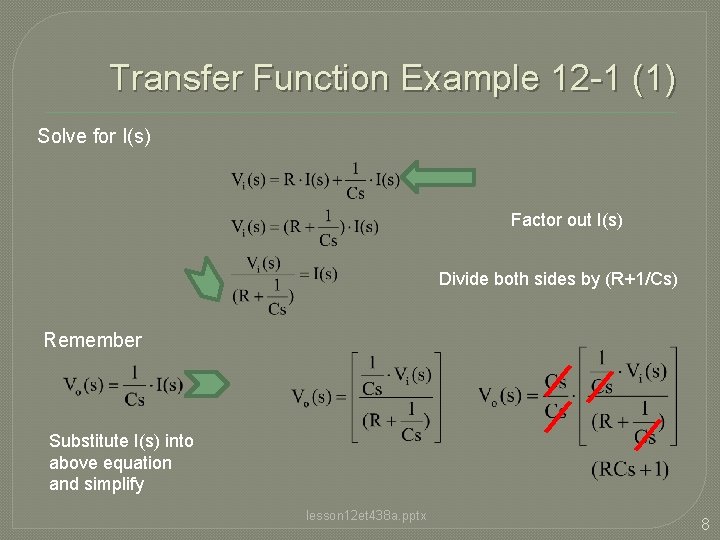
Transfer Function Example 12 -1 (1) Solve for I(s) Factor out I(s) Divide both sides by (R+1/Cs) Remember Substitute I(s) into above equation and simplify lesson 12 et 438 a. pptx 8
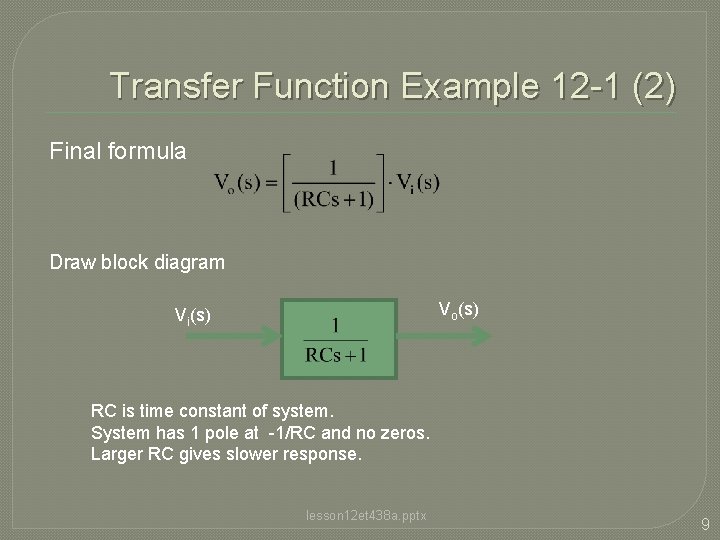
Transfer Function Example 12 -1 (2) Final formula Draw block diagram Vo(s) Vi(s) RC is time constant of system. System has 1 pole at -1/RC and no zeros. Larger RC gives slower response. lesson 12 et 438 a. pptx 9
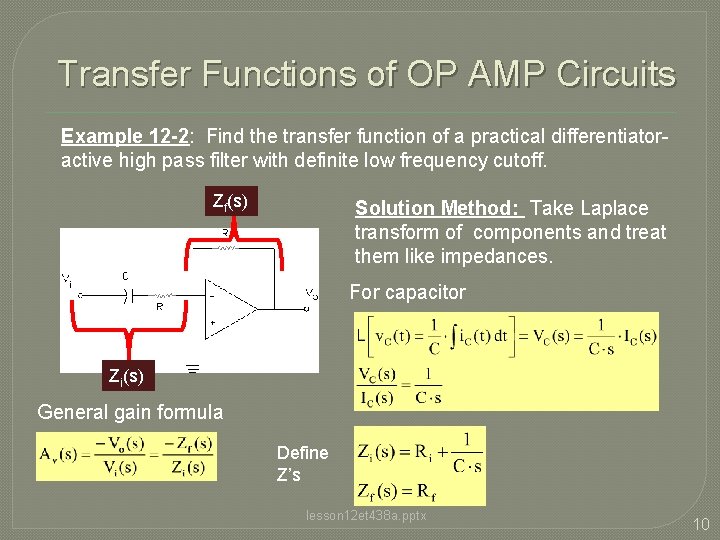
Transfer Functions of OP AMP Circuits Example 12 -2: Find the transfer function of a practical differentiatoractive high pass filter with definite low frequency cutoff. Zf(s) Solution Method: Take Laplace transform of components and treat them like impedances. For capacitor Zi(s) General gain formula Define Z’s lesson 12 et 438 a. pptx 10
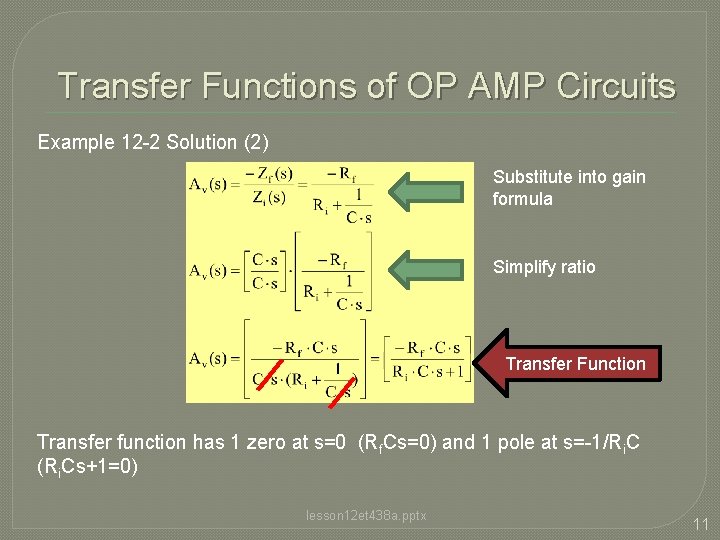
Transfer Functions of OP AMP Circuits Example 12 -2 Solution (2) Substitute into gain formula Simplify ratio Transfer Function Transfer function has 1 zero at s=0 (Rf. Cs=0) and 1 pole at s=-1/Ri. C (Ri. Cs+1=0) lesson 12 et 438 a. pptx 11
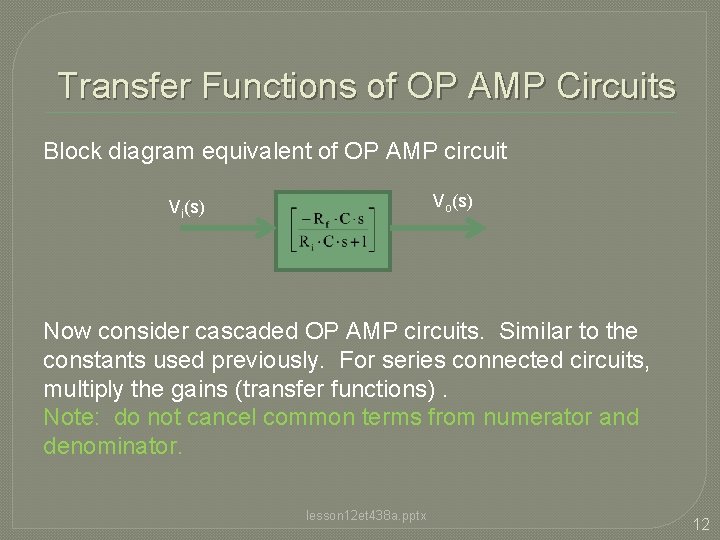
Transfer Functions of OP AMP Circuits Block diagram equivalent of OP AMP circuit Vo(s) Vi(s) Now consider cascaded OP AMP circuits. Similar to the constants used previously. For series connected circuits, multiply the gains (transfer functions). Note: do not cancel common terms from numerator and denominator. lesson 12 et 438 a. pptx 12
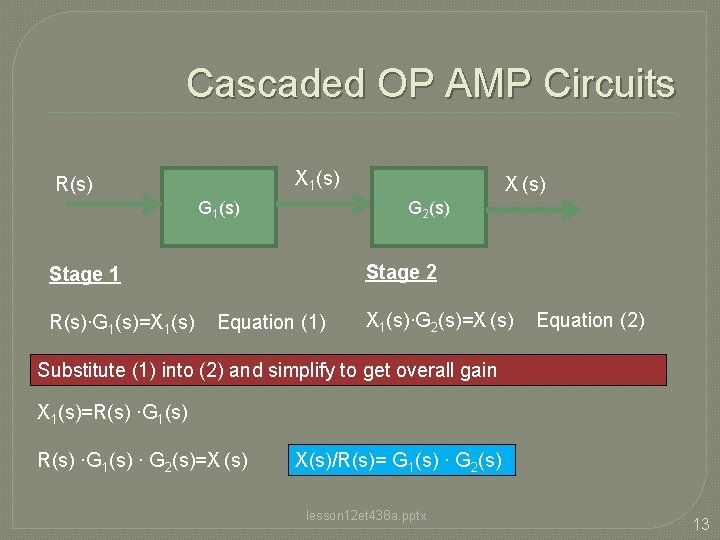
Cascaded OP AMP Circuits X 1(s) R(s) G 1(s) G 2(s) Stage 2 Stage 1 R(s)∙G 1(s)=X 1(s) X (s) Equation (1) X 1(s)∙G 2(s)=X (s) Equation (2) Substitute (1) into (2) and simplify to get overall gain X 1(s)=R(s) ∙G 1(s) ∙ G 2(s)=X (s) X(s)/R(s)= G 1(s) ∙ G 2(s) lesson 12 et 438 a. pptx 13
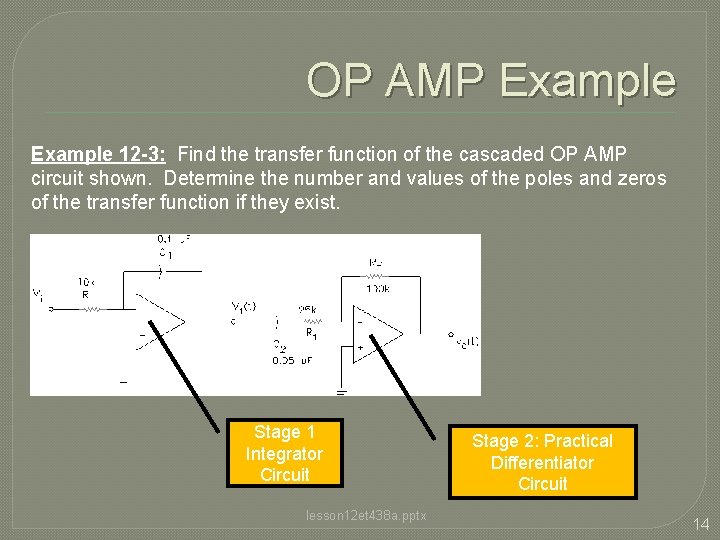
OP AMP Example 12 -3: Find the transfer function of the cascaded OP AMP circuit shown. Determine the number and values of the poles and zeros of the transfer function if they exist. Stage 1 Integrator Circuit lesson 12 et 438 a. pptx Stage 2: Practical Differentiator Circuit 14
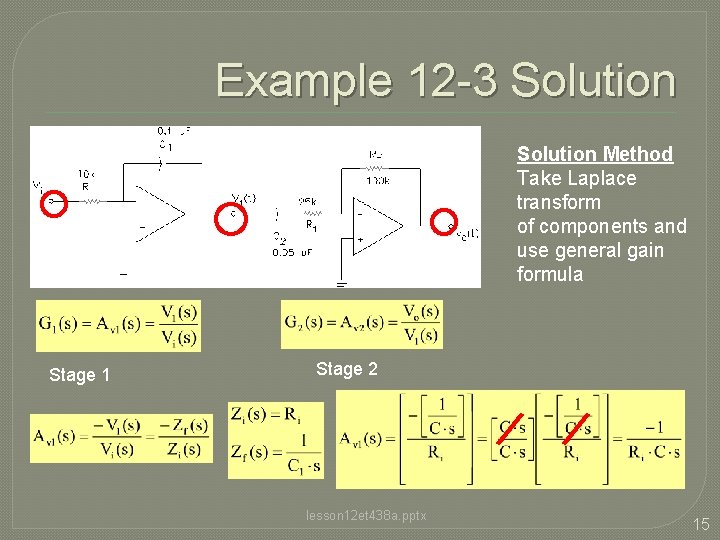
Example 12 -3 Solution Method Take Laplace transform of components and use general gain formula Stage 1 Stage 2 lesson 12 et 438 a. pptx 15
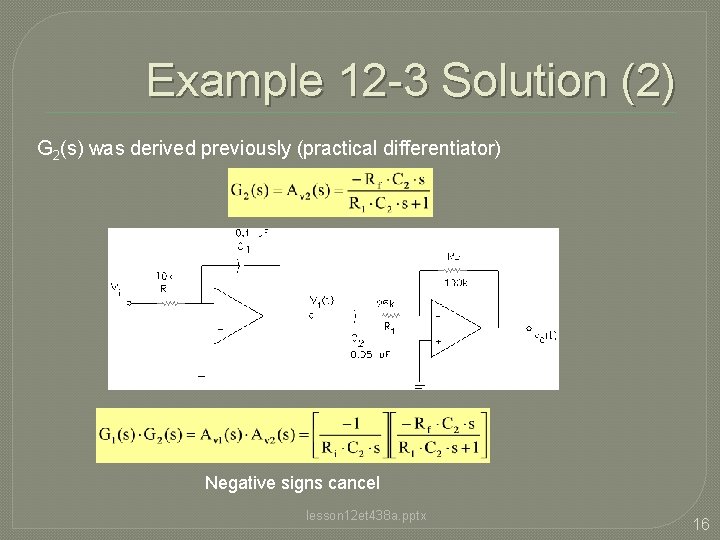
Example 12 -3 Solution (2) G 2(s) was derived previously (practical differentiator) Negative signs cancel lesson 12 et 438 a. pptx 16
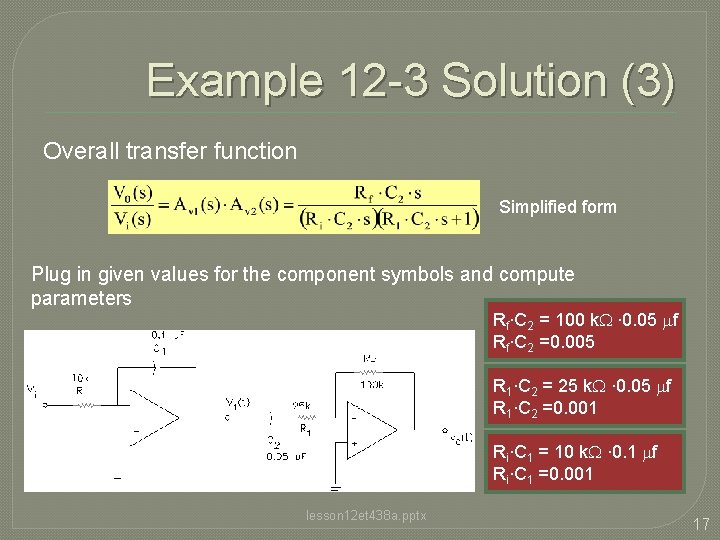
Example 12 -3 Solution (3) Overall transfer function Simplified form Plug in given values for the component symbols and compute parameters Rf∙C 2 = 100 k. W ∙ 0. 05 mf Rf∙C 2 =0. 005 R 1∙C 2 = 25 k. W ∙ 0. 05 mf R 1∙C 2 =0. 001 Ri∙C 1 = 10 k. W ∙ 0. 1 mf Ri∙C 1 =0. 001 lesson 12 et 438 a. pptx 17
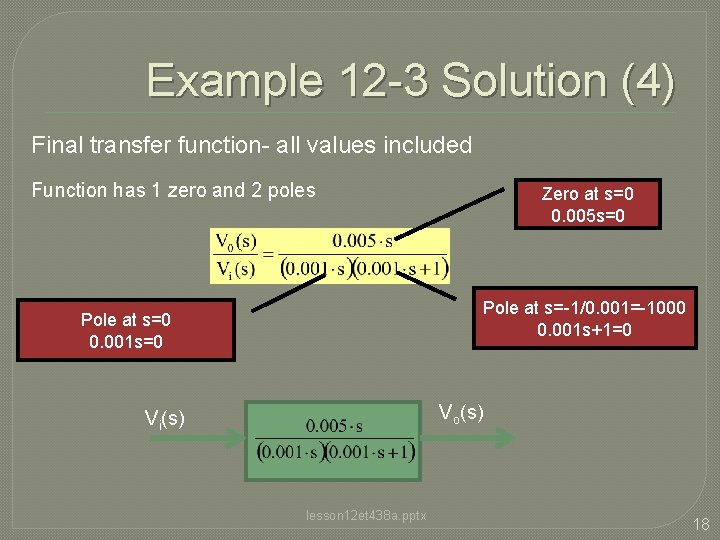
Example 12 -3 Solution (4) Final transfer function- all values included Function has 1 zero and 2 poles Zero at s=0 0. 005 s=0 Pole at s=-1/0. 001=-1000 0. 001 s+1=0 Pole at s=0 0. 001 s=0 Vo(s) Vi(s) lesson 12 et 438 a. pptx 18
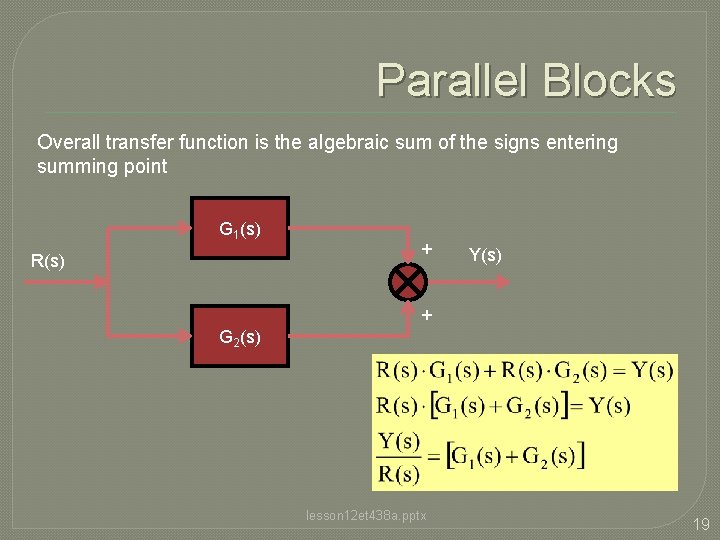
Parallel Blocks Overall transfer function is the algebraic sum of the signs entering summing point G 1(s) R(s) + Y(s) + G 2(s) lesson 12 et 438 a. pptx 19
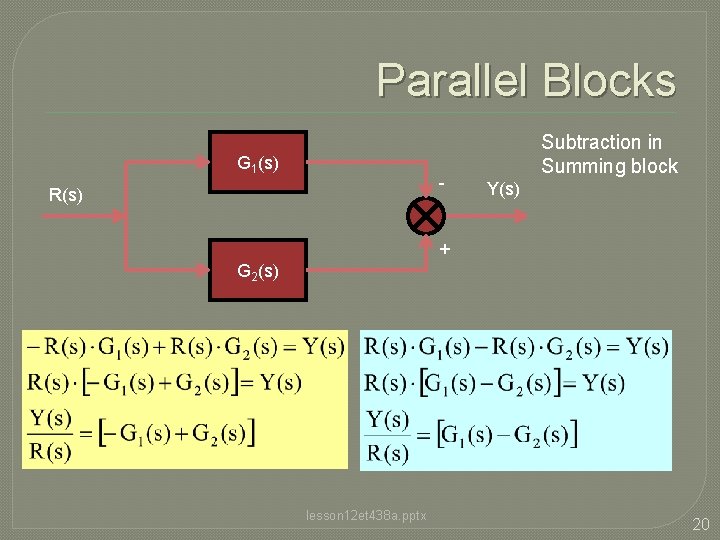
Parallel Blocks G 1(s) - R(s) Subtraction in Summing block Y(s) + G 2(s) lesson 12 et 438 a. pptx 20
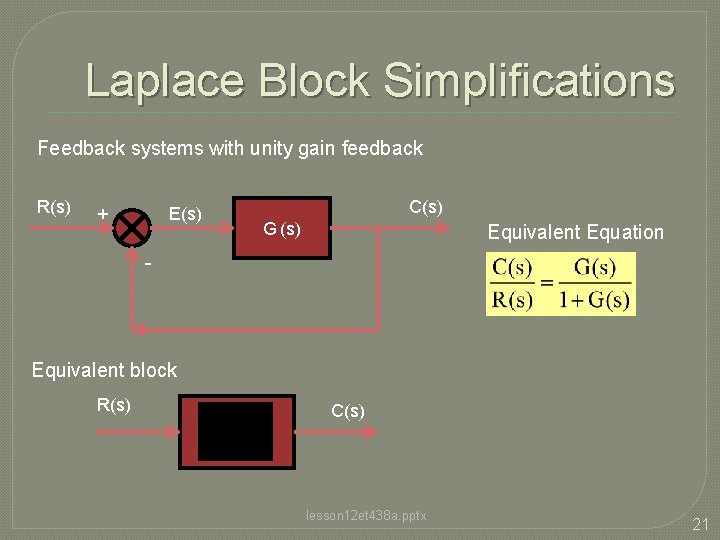
Laplace Block Simplifications Feedback systems with unity gain feedback R(s) + E(s) C(s) G (s) Equivalent Equation - Equivalent block R(s) C(s) lesson 12 et 438 a. pptx 21
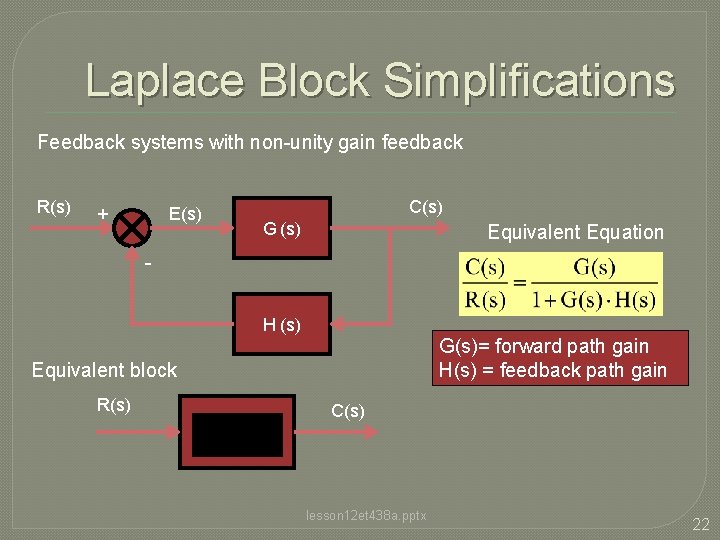
Laplace Block Simplifications Feedback systems with non-unity gain feedback R(s) + E(s) C(s) G (s) Equivalent Equation H (s) G(s)= forward path gain H(s) = feedback path gain Equivalent block R(s) C(s) lesson 12 et 438 a. pptx 22
End Lesson 12: Transfer Functions In The Laplace Domain ET 438 a Automatic Control Systems Technology lesson 12 et 438 a. pptx 23