
Lesson 10 R Chapter 10 Review Objectives Review
Lesson 10 -R Chapter 10 Review
Objectives • Review Chapter 10 material
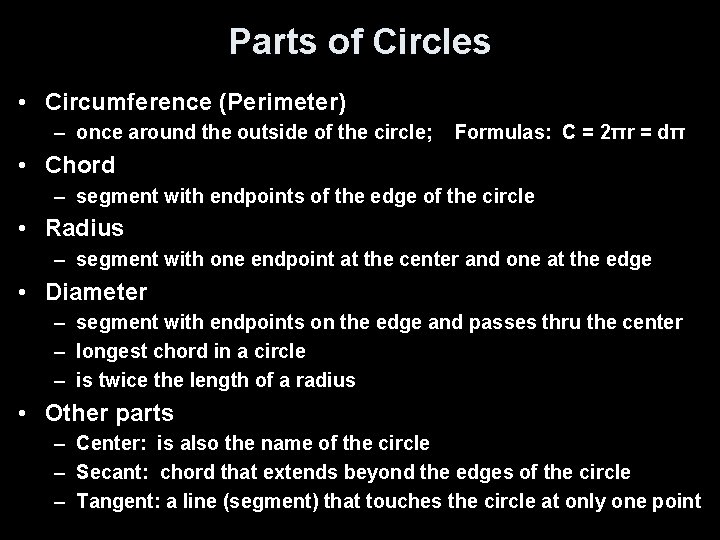
Parts of Circles • Circumference (Perimeter) – once around the outside of the circle; Formulas: C = 2πr = dπ • Chord – segment with endpoints of the edge of the circle • Radius – segment with one endpoint at the center and one at the edge • Diameter – segment with endpoints on the edge and passes thru the center – longest chord in a circle – is twice the length of a radius • Other parts – Center: is also the name of the circle – Secant: chord that extends beyond the edges of the circle – Tangent: a line (segment) that touches the circle at only one point

Arcs in Circles • • Arc is the edge of the circle between two points An arc’s measure = measure of its central angle All arcs (and central angles) have to sum to 360° If two arcs have the same measure then the chords that form those arcs have the same measure • If a radius is perpendicular to a chord then it bisects the chord and the arc formed by the chord (example arc AED below) • Major Arc (example: arc DAB) – measures more than 180° – more than ½ way around the circle BE is a diameter and AB = AD 120° • Minor Arc (example: arc AED) – measures less than 180° – less than ½ way around the circle • Semi-circle (example: arc EAB) – measures 180° – defined by a diameter B A C 120° 60° E 60° D
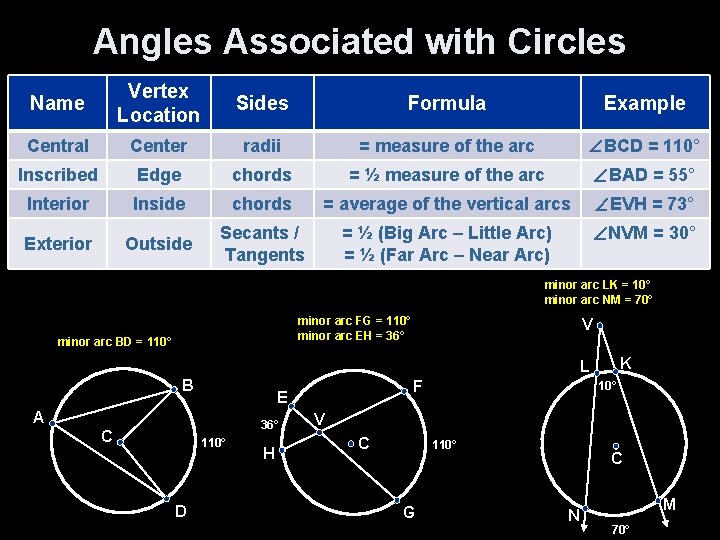
Angles Associated with Circles Name Vertex Location Sides Formula Example Central Center radii = measure of the arc BCD = 110° Inscribed Edge chords = ½ measure of the arc BAD = 55° Interior Inside chords = average of the vertical arcs EVH = 73° Exterior Outside Secants / Tangents = ½ (Big Arc – Little Arc) = ½ (Far Arc – Near Arc) NVM = 30° minor arc LK = 10° minor arc NM = 70° minor arc FG = 110° minor arc EH = 36° minor arc BD = 110° V K L B A 36° C 110° D F E H 10° V C 110° G C N M 70°

Segments Inside/Outside of Circles • Segments that intersect inside or outside the circle have the length of their parts defined by: Two Chords Inside a Circle Two Secants From Outside Point Secant & Tangent From Outside Point J K L 3 5 L 4 J 4 6 K J 6 3 K T 8 7 N M LJ · JM = NJ · JK 3 8=6 4 Inside the circle, it’s the parts of the chords multiplied together 9 11 N M JL · JN = JK · JM 5 12 = 4 15 M JT · JT = JK · JM 6 6 = 3 12 Outside the circle, it’s the outside part multiplied by the whole length O W = O W
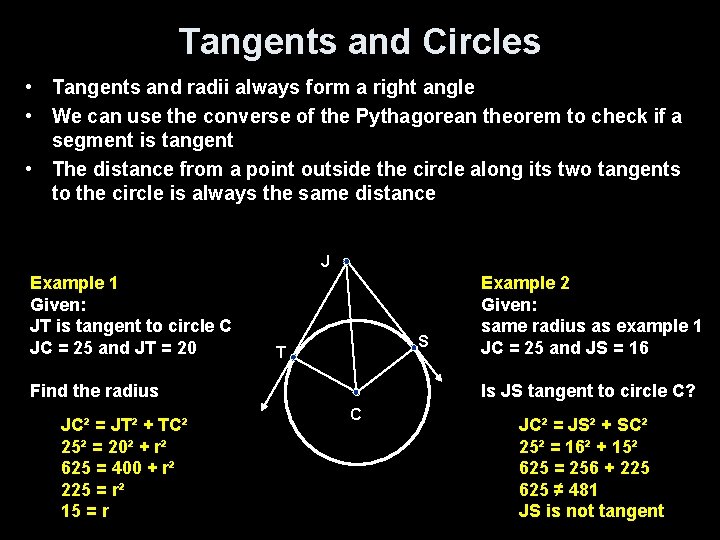
Tangents and Circles • Tangents and radii always form a right angle • We can use the converse of the Pythagorean theorem to check if a segment is tangent • The distance from a point outside the circle along its two tangents to the circle is always the same distance J Example 1 Given: JT is tangent to circle C JC = 25 and JT = 20 S T Find the radius JC² = JT² + TC² 25² = 20² + r² 625 = 400 + r² 225 = r² 15 = r Example 2 Given: same radius as example 1 JC = 25 and JS = 16 Is JS tangent to circle C? C JC² = JS² + SC² 25² = 16² + 15² 625 = 256 + 225 625 ≠ 481 JS is not tangent
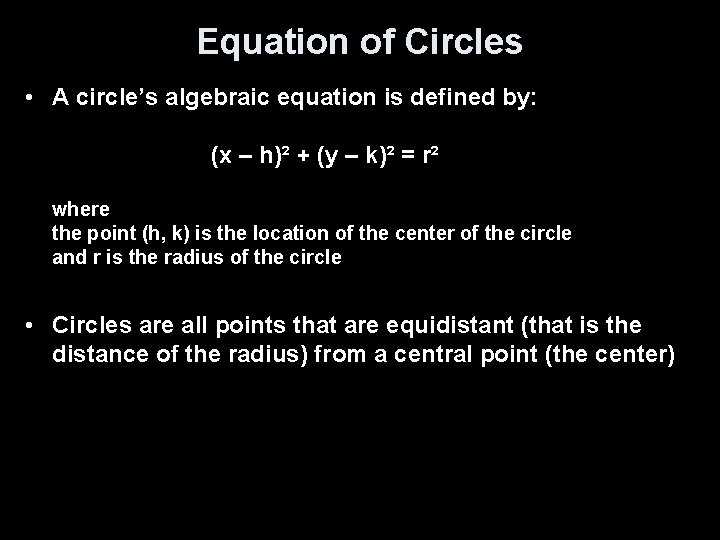
Equation of Circles • A circle’s algebraic equation is defined by: (x – h)² + (y – k)² = r² where the point (h, k) is the location of the center of the circle and r is the radius of the circle • Circles are all points that are equidistant (that is the distance of the radius) from a central point (the center)
Summary & Homework • Summary: –A • Homework: – study for the test
- Slides: 9