
Lesson 10 Conservation of Momentum Objective S 4
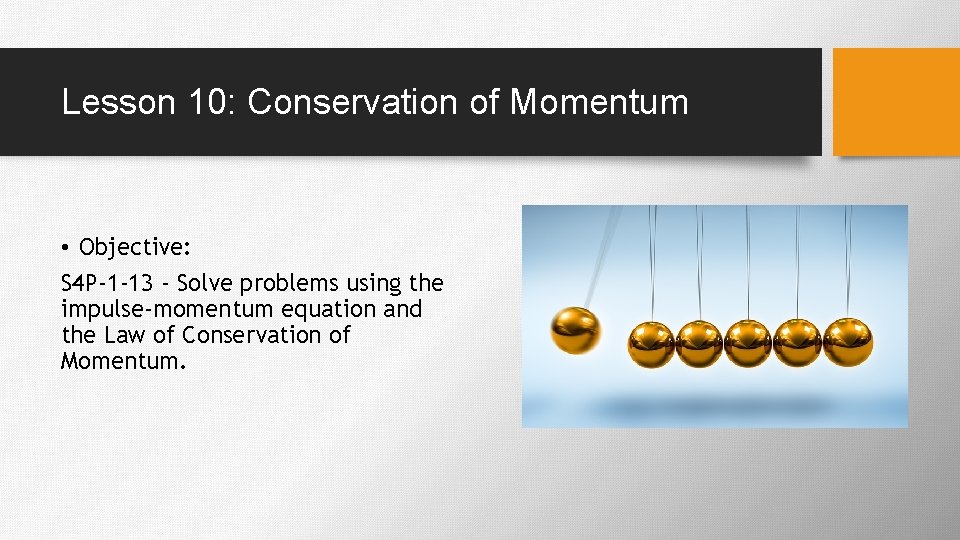
Lesson 10: Conservation of Momentum • Objective: S 4 P-1 -13 - Solve problems using the impulse-momentum equation and the Law of Conservation of Momentum.
The Law of Conservation of Momentum • In the 17 th century, Newton and others had measured the momentum of colliding objects before and after collision, and had discovered a strange phenomenon: the total momentum of the colliding objects was the same after the collision as it was before. Newton expressed this relationship as the Law of Conservation of Momentum: • The total momentum of a closed, isolated system does not change.
The Law of Conservation of Momentum • A group of objects involved in a collision is called a system. A system: • May contain any number of objects • Is considered closed provided that no object leaves or enters the system • Is considered isolated if no net external force acts on it
The Law of Conservation of Momentum • To picture the difference between an external force and an internal force, consider the difference between: • Sitting inside a car pushing on the dashboard (internal) • Standing outside the car pushing against the bumper (external). • Only the external force can produce a change in the momentum of the car.

Conservation of Momentum in One Dimension: Collisions • When analyzing the momentum in collisions, we say that: • Total initial momentum = total final momentum • There are 3 types of collisions: • Elastic Collisions • Inelastic Collisions • Explosions
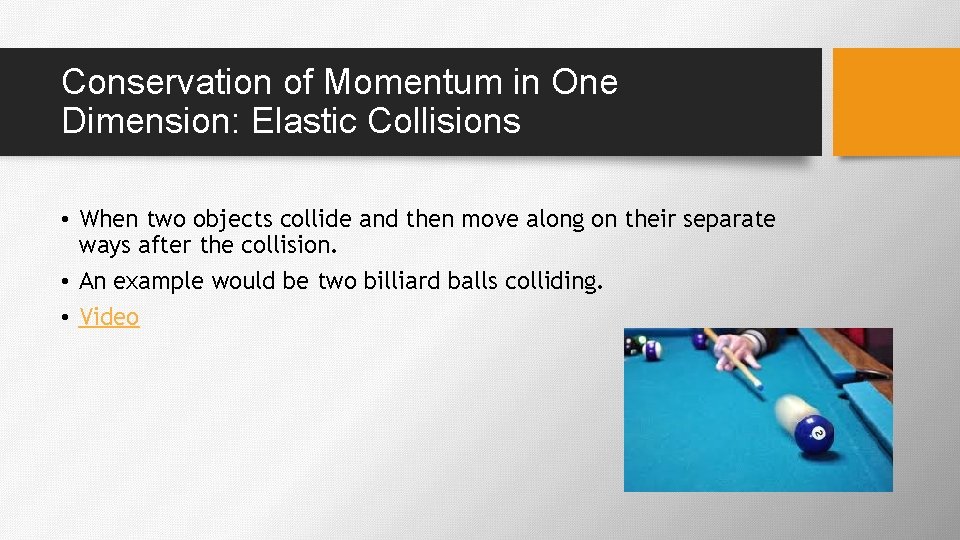
Conservation of Momentum in One Dimension: Elastic Collisions • When two objects collide and then move along on their separate ways after the collision. • An example would be two billiard balls colliding. • Video
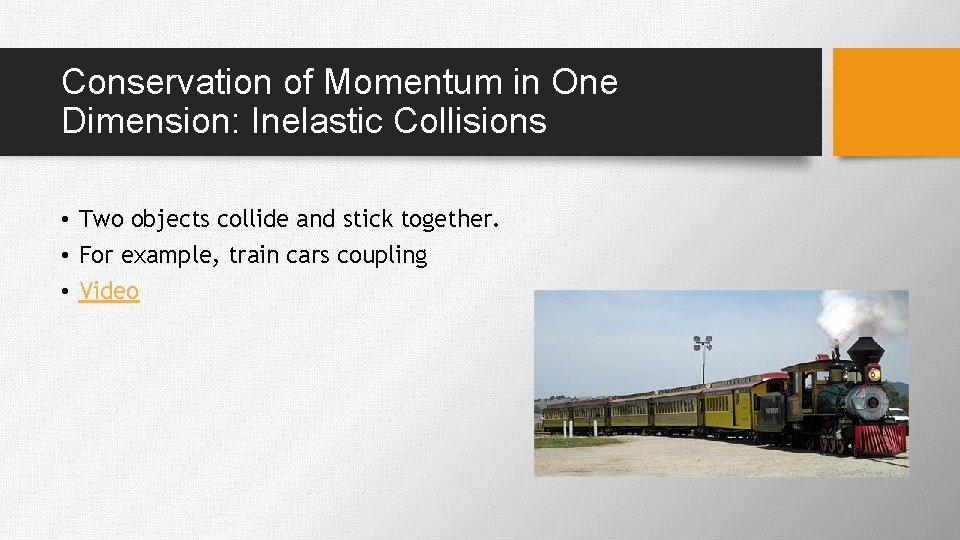
Conservation of Momentum in One Dimension: Inelastic Collisions • Two objects collide and stick together. • For example, train cars coupling • Video
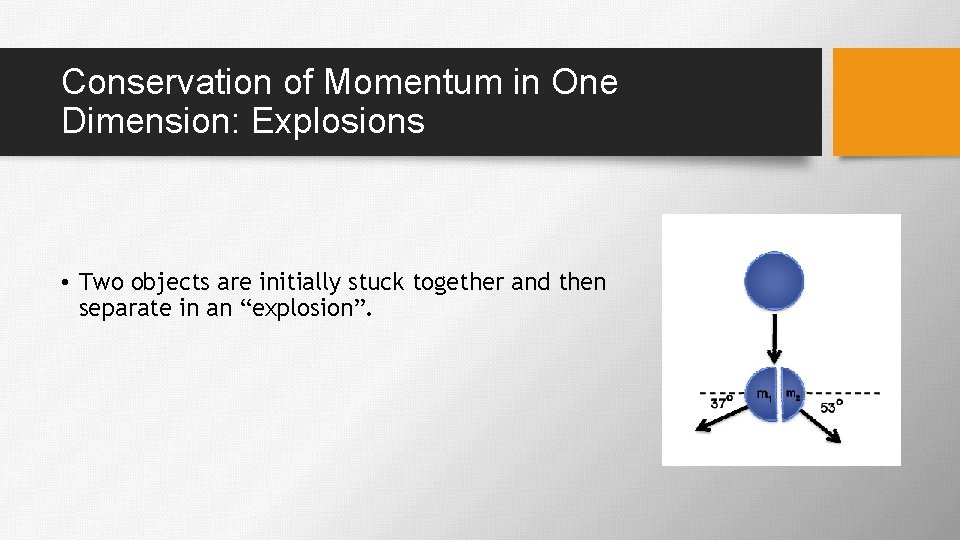
Conservation of Momentum in One Dimension: Explosions • Two objects are initially stuck together and then separate in an “explosion”.
Example 1: • A mass of 40. 0 kg is initially at rest. This mass now explodes into two pieces so that one piece of mass 10. 9 kg moves to the right at 10. 0 m/s. What is the final velocity of the second piece?
Conservation of Momentum in Two Dimensions: Glancing Collisions • Conservation of momentum in two dimensions occurs in situations called glancing collisions. • This is when the objects are deflected in more than one dimension. • An example would be a curling shot. The stones that collide are moved at various angles because the collision is not head on.
Example 2: • During a curling math, a curler throws a rock with a mass of 20. 0 kg, with a speed of 2. 00 m/s. This rock collides head-on with the stationary target stone, which also has a mass of 20 kg. After the collision, which lasted 0. 0250 s, the first rock is stationary. • a) What is the final velocity of the target stone • b) What is the change in momentum of the target stone? • c) What impulse was applied to the target stone? • d) What was the force of interaction between these two rocks?
Example 3: • A train car of mass 1250 kg is travelling at 14. 0 m/s [W]. It collides head-on with a train car of mass 5680 kg travelling at 10. 0 m/s [E]. After the collision, the two vehicles proceed, stuck together, sliding along the icy tracks. • a) What is the final velocity of these two cars locked together? • b) What is the change in momentum of the second car? • c) What is the change in momentum of the first car? • d) What impulse is applied to the second car during the collision? • e) What impulse is applied to the first car during the collision? • Let east be the positive direction. Let the first car be mass 1 and let the second car be mass 2.
- Slides: 12