
Lesson 10 Breaking the Code The Periodic Table
Lesson 10: Breaking the Code The Periodic Table
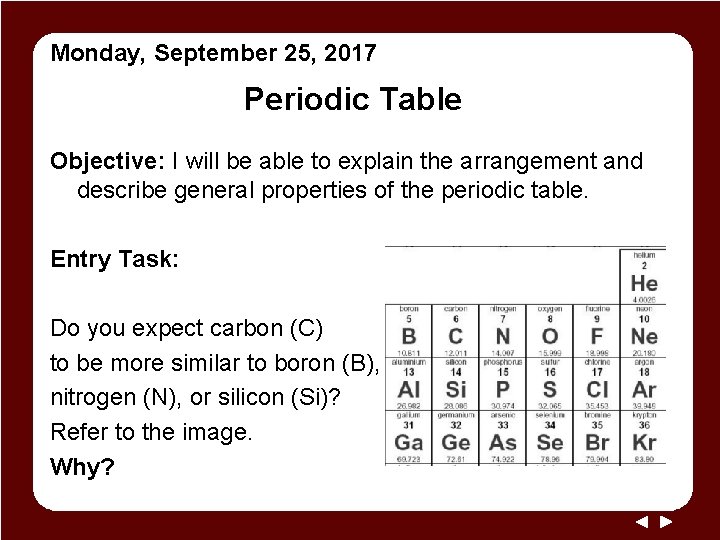
Monday, September 25, 2017 Periodic Table Objective: I will be able to explain the arrangement and describe general properties of the periodic table. Entry Task: Do you expect carbon (C) to be more similar to boron (B), nitrogen (N), or silicon (Si)? Refer to the image. Why?
Key Question What information does the periodic table reveal about the elements?
You will be able to: • use the periodic table to identify elements that are metals, nonmetals, metalloids, alkali metals, alkaline earth metals, transition elements, halogens, noble gasses, lanthanides, and actinides • describe the general properties of elements, that are periodic in nature • predict the general properties of an element based on its location on the periodic table and identify elements that will exhibit similar chemical behavior
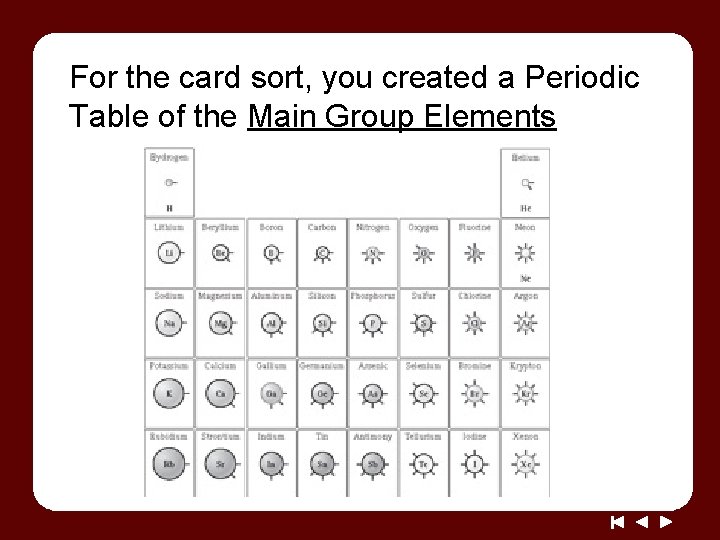
For the card sort, you created a Periodic Table of the Main Group Elements
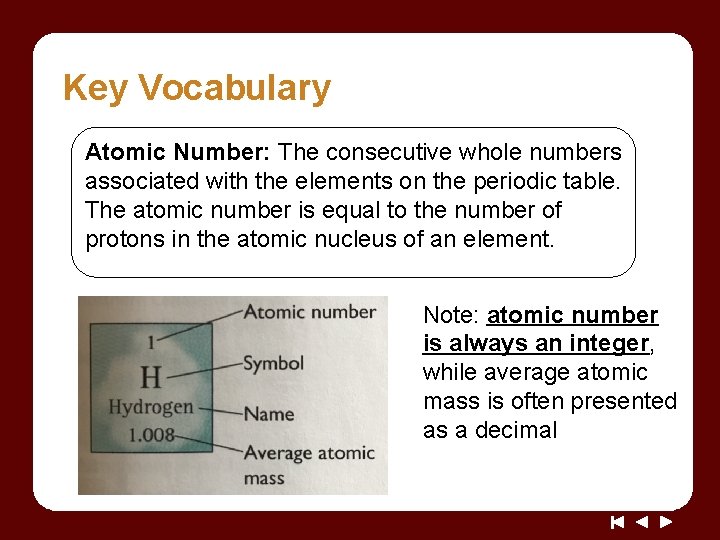
Key Vocabulary Atomic Number: The consecutive whole numbers associated with the elements on the periodic table. The atomic number is equal to the number of protons in the atomic nucleus of an element. Note: atomic number is always an integer, while average atomic mass is often presented as a decimal
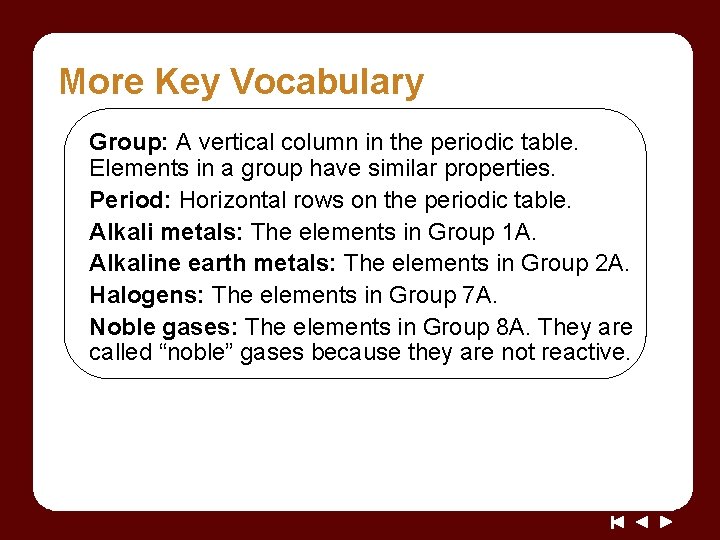
More Key Vocabulary Group: A vertical column in the periodic table. Elements in a group have similar properties. Period: Horizontal rows on the periodic table. Alkali metals: The elements in Group 1 A. Alkaline earth metals: The elements in Group 2 A. Halogens: The elements in Group 7 A. Noble gases: The elements in Group 8 A. They are called “noble” gases because they are not reactive.
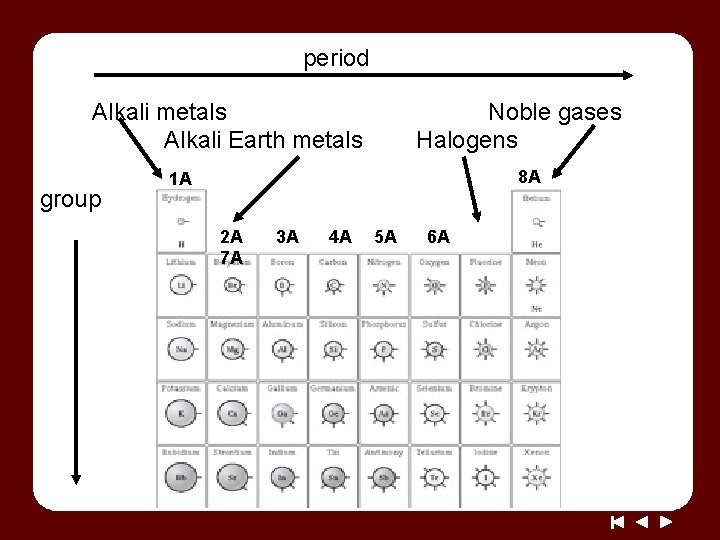
period Alkali metals Alkali Earth metals group Noble gases Halogens 8 A 1 A 2 A 7 A 3 A 4 A 5 A 6 A
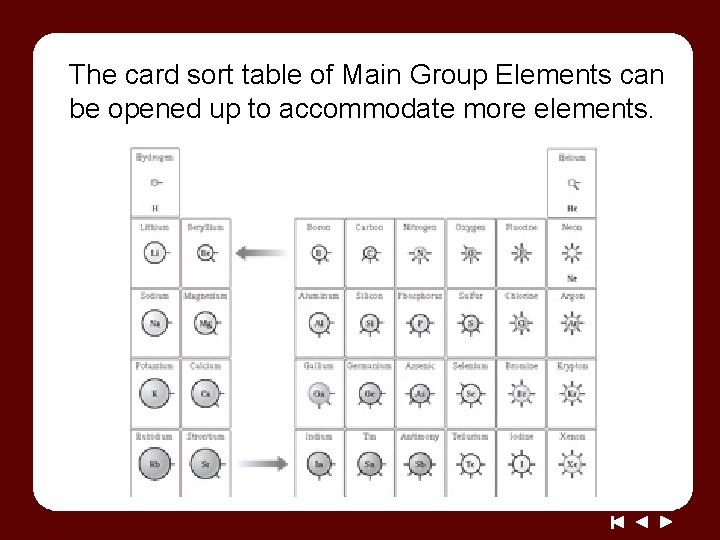
The card sort table of Main Group Elements can be opened up to accommodate more elements.
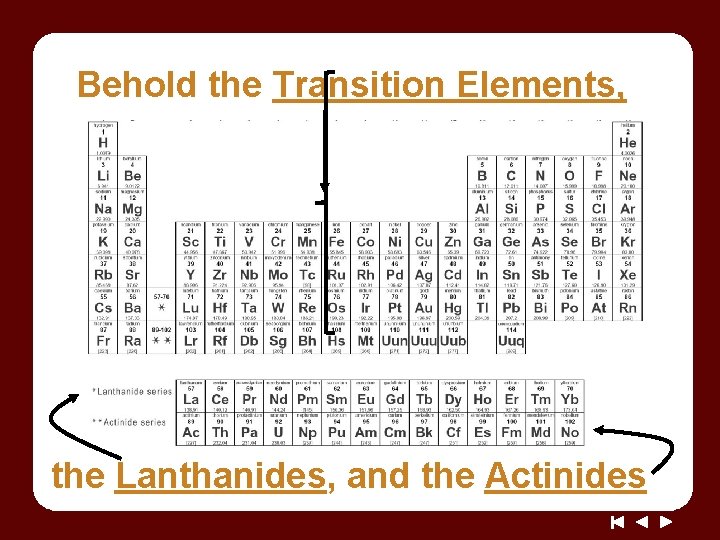
Behold the Transition Elements, the Lanthanides, and the Actinides
Even More Key Vocabulary Main group elements: The elements in Groups 1 A to 8 A. Transition elements: The elements in Groups 1 B to 8 B. Lanthanides and actinides: The two rows of 14 elements each that are often placed separately at the bottom of the periodic table so the table will fit comfortably on a sheet of paper.
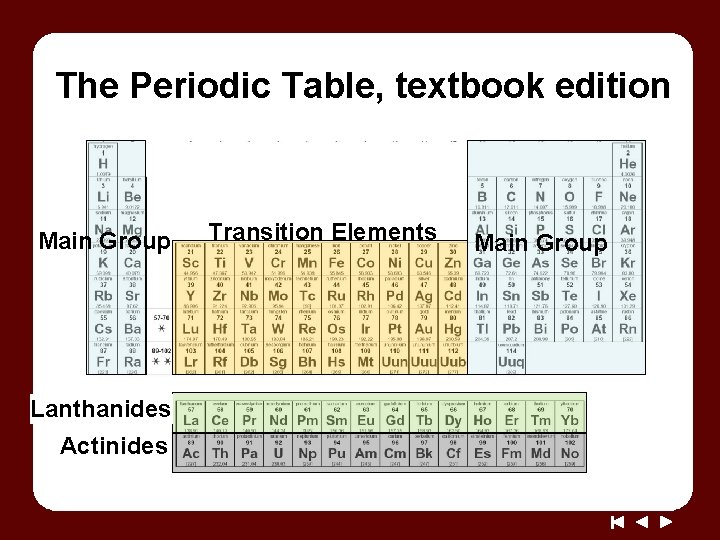
The Periodic Table, textbook edition Main Group Lanthanides Actinides Transition Elements Main Group
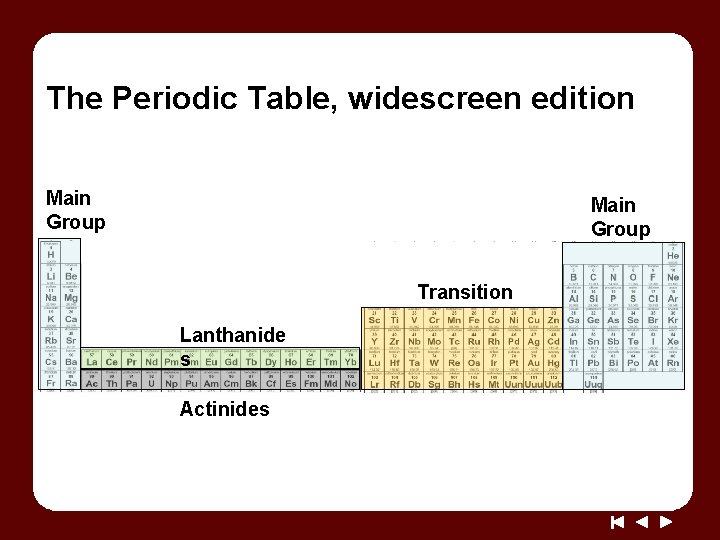
The Periodic Table, widescreen edition Main Group Transition Lanthanide s Actinides
Discussion Notes (cont. ) Metals: Elements that are excellent conductors of heat and electricity. They generally are shiny and malleable (flexible). They are found to the left of the stair-step line on the periodic table. Nonmetals: Elements that are poor conductors of heat and electricity. They generally are dull and brittle. They are found to the right of the stair-step line. Metalloids: The elements between the metals and nonmetals. They are found along the stair-step line.
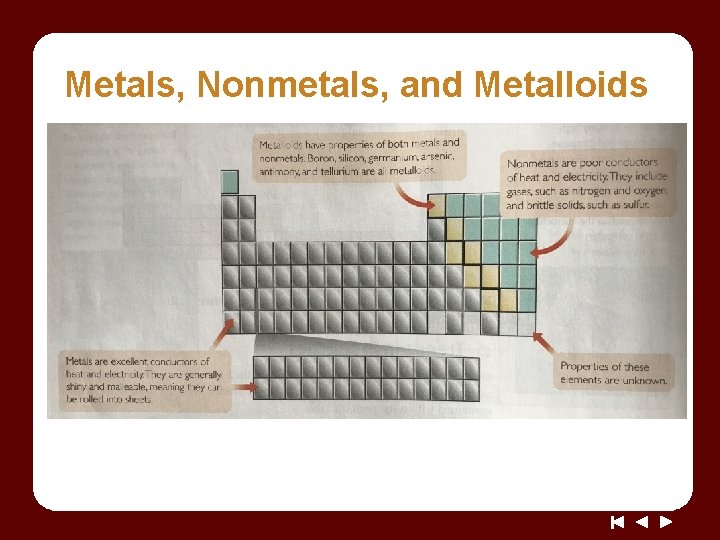
Metals, Nonmetals, and Metalloids
Periodic Table Patterns Horizontal patterns: Atomic Mass - increases L-R (exceptions - iodine, argon) Radius - decreases L-R across rows “Sticks” - increase in # L-R across rows Compound chemical formula - changes L-R as follows: Cl → Cl 2 → Cl 3 → H 4 → H 3 → H 2 → H → nothing
Periodic Table Patterns Vertical patterns: Atomic Mass - decreases Top to Bottom Reactivity - Some columns increase T-B, some decrease T-B “Sticks” - Same # of “sticks” within a column Radius - increases T-B Softness - increases in METALS T-B
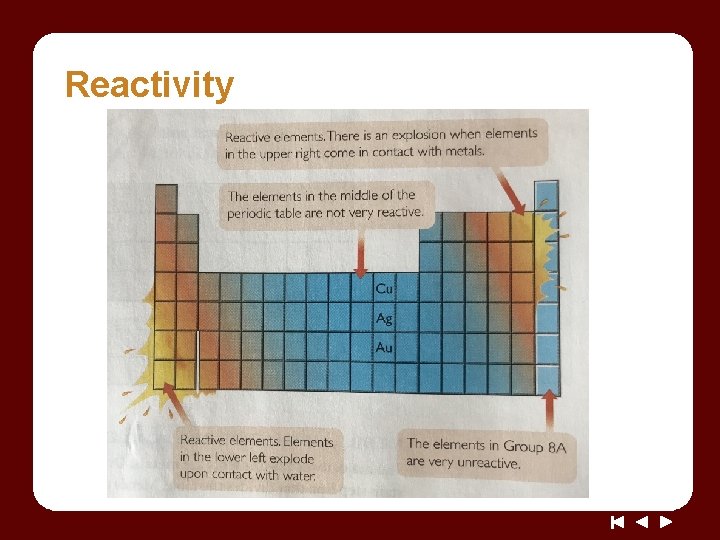
Reactivity
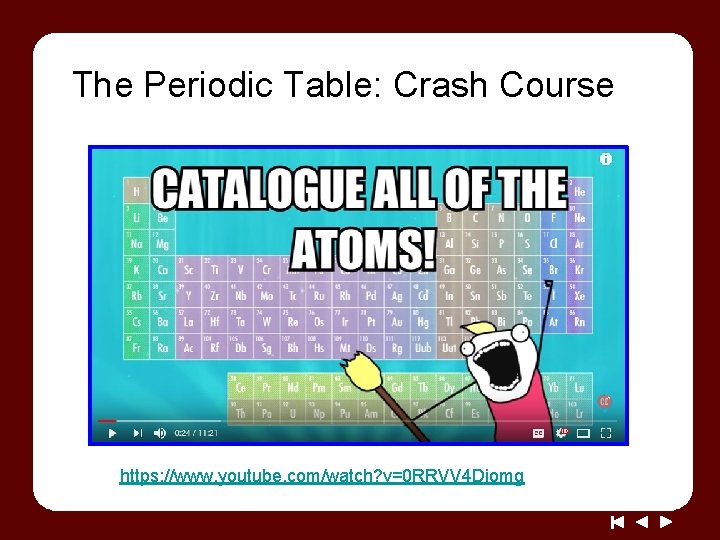
The Periodic Table: Crash Course https: //www. youtube. com/watch? v=0 RRVV 4 Diomg
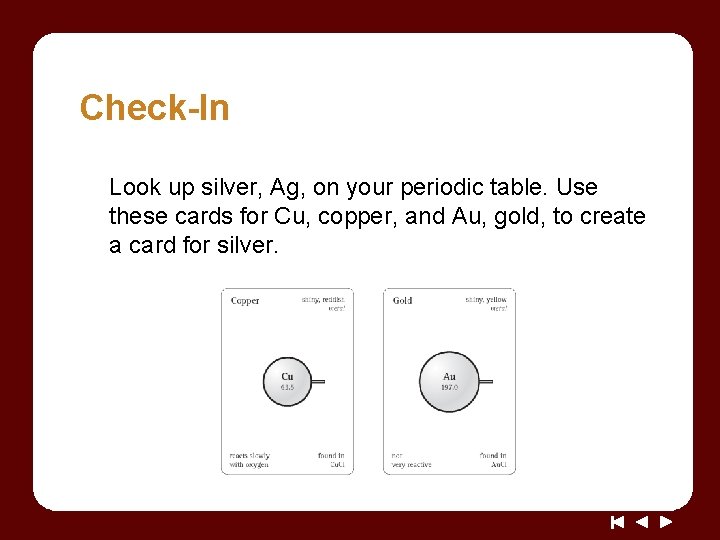
Check-In Look up silver, Ag, on your periodic table. Use these cards for Cu, copper, and Au, gold, to create a card for silver.
- Slides: 20