
Lesson 10 2 The Cell Vocabulary cell membrane

Lesson 10. 2 The Cell

Vocabulary cell membrane organelle cell wall nucleus cytoplasm chloroplast cytoskeleton
Essential Questions 1 How are prokaryotic cells and eukaryotic cells similar and how are they different? 2 What do the structures in a cell do?
Explore Activity The Right Tools for the Job • Imagine that you are teaching someone to use some everyday objects. • They have never seen or heard of the objects that have been provided, so it is up to you to explain their use. • Illustrate or describe the function of these objects using only structure as your clues.

Cell Shape and Movement Recall that all living things are made up of one or more cells. As illustrated in the images provided, cells come in many shapes and sizes. The size and shape of a cell relates to its job or function.

Cell Types Recall that the use of microscopes enabled scientists to discover cells. With more advanced microscopes, scientists discovered that all cells can be grouped into two types—prokaryotic (proh kayr ee AH tihk) cells and eukaryotic (yew kayr ee AH tihk) cells.

Cell Organelles are eukaryotic cell structures with specific functions. Organelles enable cells to carry out different functions at the same time.

Cell Structures Brain. POP 1. How big is an animal cell? A anywhere from 1/10 the size of a period to a meter long CORRECT B so small that you will never see it C about the size of an adult human being Roll over image to show video controls. Next Question
Cell Structures Brain. POP 2. Who is “the boss” inside of a cell? A the alveoli B the mitochondria C the nucleus CORRECT Next Question
Cell Structures Brain. POP 3. What actions does a cell perform every day? A energy consumption, protein production and waste management CORRECT B going out to get the paper, running to catch the school bus C sleeping, eating, reading Next Question
Cell Structures Brain. POP 4. Where is your DNA housed? A inside a cell's ribosomes B inside a cell's nucleus C inside a cell's golgi bodies CORRECT Next Question
Cell Structures Brain. POP 5. What does DNA contain? A lots of little hairs B all of your body's instructions for life C your memories CORRECT Next Question
Cell Structures Brain. POP 6. What do you call that gelatin-like mixture inside the cell membrane? A blood B ectomorph C cytoplasm CORRECT Next Question

Cell Structures Brain. POP 7. What part of the cell makes protein? A the mitochondria B the ribosomes C the golgi bodies CORRECT Next Question
Cell Structures Brain. POP 8. What do mitochondria do? A they break down food and release energy B they eat up other cells C they change colors at night CORRECT Next Question
Cell Structures Brain. POP 9. What do golgi bodies ready for secretion? A carbohydrates B lipids C proteins CORRECT Next Question
Cell Structures Brain. POP 10. What cell part does “ER” stand for? A energy race B endoplasmic reticulum C end result CORRECT Next Question
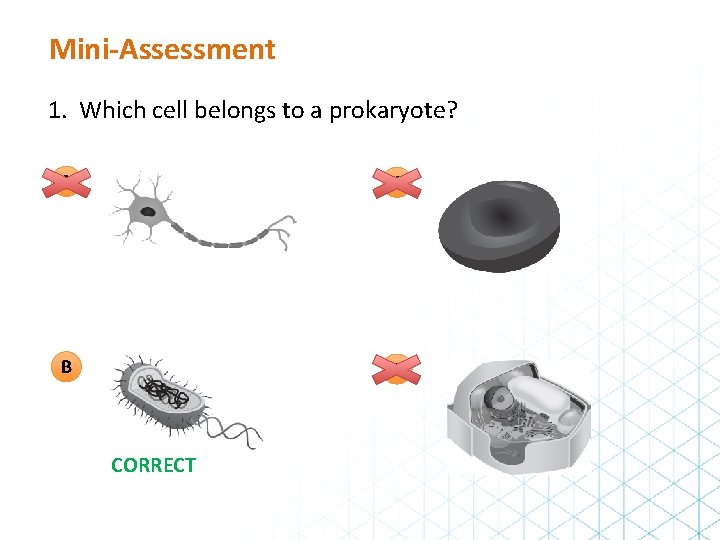
Mini-Assessment 1. Which cell belongs to a prokaryote? A C B D CORRECT
Mini-Assessment 2. Which cell structure could be called the packaging center of the cell? A lysosome B mitochondrion C endoplasmic reticulum D Golgi apparatus CORRECT
Mini-Assessment 3. Your body is protected by multiple layers of skin cells. What shape would you expect a cell on the outer layer of skin to have? A a flat shape C a long, branching shape D a short, hollow shape CORRECT B a round shape
Mini-Assessment 4. Rosa uses a microscope to look at a group of cells, as shown above. She sees that the cells are joined together, so she knows that they are from one organism. She also sees that all of them have cell walls. Rosa could be looking at A bacterial cells C mouse cells B human cells D mushroom cells CORRECT
Mini-Assessment 5. Which structure creates energy for the cell in the form of ATP? A lysosome C endoplasmic reticulum B mitochondrion D Golgi apparatus CORRECT
- Slides: 22